AI Generated Exam Paper

Primary 4 Science Practice Paper 1

Free AI-Generated Qwen3.7 Plus Primary 4 Science Practice Paper 1 practice paper with questions and answers for Singapore students. This page is rendered as a direct URL so the questions and answers can be discovered without pressing in-page buttons.

These static practice materials are generated from the site's syllabus and paper-generation workflow, with source and model context shown so students and parents can evaluate the material before use.

Primary 4 Science AI Generated Generated by Qwen3.7 Plus Updated 2026-06-04

Questions

<!-- TuitionGoWhere generation metadata: stage=5-2; model=qwen/qwen3.7-plus; model_label=Qwen3.7 Plus; generated=2026-06-04; Sources: Stage 4-0 LLM templates, syllabus context, and Stage 2 evidence where available. -->

TuitionGoWhere Practice Paper - Science Primary 4

TuitionGoWhere Practice Paper (AI) Version: 1 of 5 Subject: Science Level: Primary 4 Paper: Practice Paper 1 Duration: 1 hour 45 minutes Total Marks: 60 Name: __________________________ Class: __________________________ Date: __________________________

Instructions to Candidates:

  1. This paper consists of two sections: Section A and Section B.
  2. Answer all questions.
  3. Write your answers in the spaces provided.
  4. For questions in Section A, write the number (1, 2, 3 or 4) of your answer in the brackets provided.
  5. The use of calculators is not allowed.

Section A (28 marks)

For each question from 1 to 14, four options are given. One of them is the correct answer. Make your choice (1, 2, 3 or 4) and write it in the brackets provided. Each question carries 2 marks.

1. Which of the following groups contains only living things? (1) Cloud, Rain, Wind (2) Mushroom, Fern, Bacteria (3) Rock, Water, Air (4) Sun, Moon, Star

[ ]

2. The table below shows the characteristics of four different animals.

AnimalHas WingsLays EggsLives in Water
AYesYesNo
BNoNoYes
CYesYesYes
DNoYesNo

Which animal is most likely a bird? (1) A (2) B (3) C (4) D

[ ]

3. Study the classification chart below.

Living Things
    |
    +--- Group X: Have 6 legs
    |       |
    |       +--- Animal P
    |       +--- Animal Q
    |
    +--- Group Y: Have more than 6 legs
            |
            +--- Animal R
            +--- Animal S

Which of the following could be Animal R? (1) Ant (2) Spider (3) Butterfly (4) Grasshopper

[ ]

4. Why are fungi, such as mushrooms, classified as living things even though they do not have leaves or roots? (1) They can move from place to place. (2) They can make their own food using sunlight. (3) They need air, water, and food to survive. (4) They have green chlorophyll in their bodies.

[ ]

5. Which of the following statements about the diversity of plants is true? (1) All plants have flowers. (2) All plants have roots, stems, and leaves. (3) Plants can be grouped based on whether they have flowers or not. (4) Plants that do not have flowers do not reproduce.

[ ]

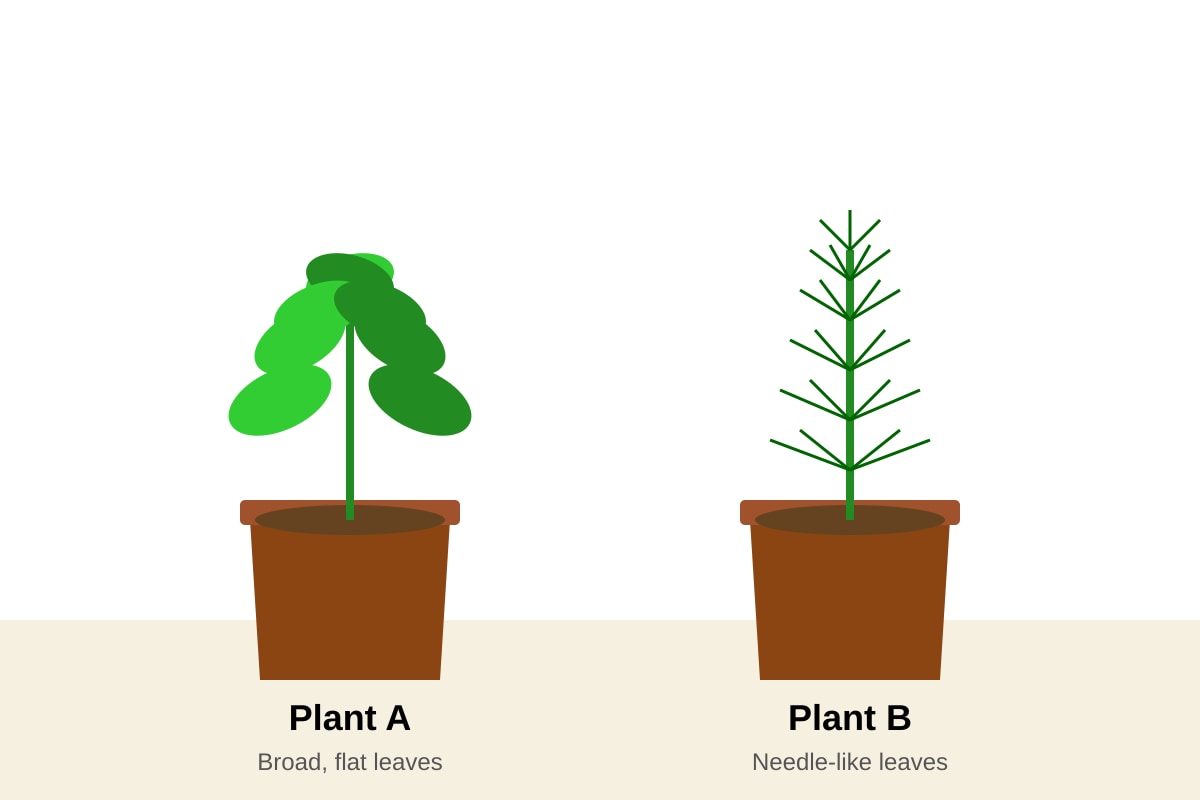
6. Look at the diagram of two plants, Plant A and Plant B.

<image_placeholder> id: Q6-fig1 type: diagram linked_question: Q6 description: Two potted plants side by side. Plant A has broad, flat green leaves. Plant B has needle-like leaves. Both are in similar pots with soil. labels: Plant A, Plant B values: None must_show: Distinct leaf shapes (broad vs needle-like) to indicate different adaptations or types. </image_placeholder>

What is the main difference between Plant A and Plant B based on their leaves? (1) Plant A needs more water than Plant B. (2) Plant A is a flowering plant, while Plant B is a non-flowering plant. (3) Plant A has broad leaves to trap more sunlight, while Plant B has needle-like leaves to reduce water loss. (4) Plant A grows in the desert, while Plant B grows in the rainforest.

[ ]

7. Which of the following animals undergoes metamorphosis? (1) Cat (2) Chicken (3) Frog (4) Fish

[ ]

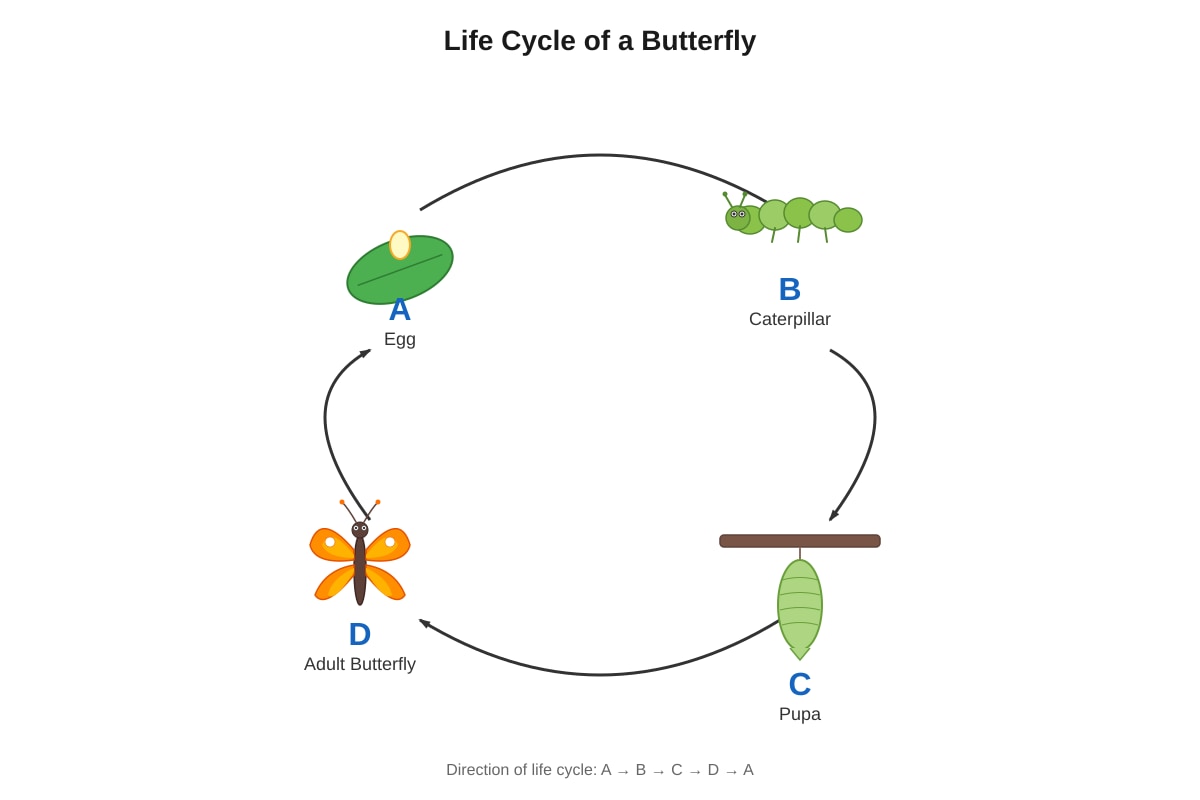
8. The life cycle of a butterfly is shown below.

<image_placeholder> id: Q8-fig1 type: diagram linked_question: Q8 description: A circular life cycle diagram with four stages labeled A, B, C, and D. Stage A is an egg on a leaf. Stage B is a caterpillar. Stage C is a pupa hanging from a branch. Stage D is an adult butterfly. Arrows connect them in order: A -> B -> C -> D -> A. labels: A, B, C, D values: None must_show: Clear distinct stages of complete metamorphosis. </image_placeholder>

At which stage does the butterfly eat the most leaves? (1) A (2) B (3) C (4) D

[ ]

9. Which of the following is a characteristic of mammals? (1) They have scales. (2) They lay eggs. (3) They have hair or fur. (4) They have gills for breathing.

[ ]

10. Why is biodiversity important in a forest ecosystem? (1) It makes the forest look beautiful. (2) It ensures that if one species dies out, others can take its place in the food web. (3) It allows humans to collect more types of wood. (4) It prevents any animals from eating each other.

[ ]

11. Which of the following groups consists entirely of non-flowering plants? (1) Rose, Orchid, Hibiscus (2) Fern, Moss, Pine Tree (3) Sunflower, Tulip, Daisy (4) Mango Tree, Apple Tree, Banana Tree

[ ]

12. A student observed an animal in the garden. It had a hard outer shell, 8 legs, and no antennae. To which group does this animal most likely belong? (1) Insects (2) Arachnids (3) Crustaceans (4) Myriapods

[ ]

13. Which of the following is NOT a method of seed dispersal? (1) By wind (2) By water (3) By animals (4) By photosynthesis

[ ]

14. Look at the classification key below.

1a. Has wings ........................................ Go to 2 1b. Does not have wings ......................... Go to 3

2a. Has 2 pairs of wings ........................ Dragonfly 2b. Has 1 pair of wings .......................... Housefly

3a. Has 6 legs ........................................ Ant 3b. Has 8 legs ........................................ Spider

An animal has 6 legs and no wings. What is it? (1) Dragonfly (2) Housefly (3) Ant (4) Spider

[ ]


Section B (32 marks)

Answer all questions. Write your answers in the spaces provided. The number of marks available for each question or part is shown in brackets.

15. The table below shows the number of legs and body parts of three animals, X, Y, and Z.

AnimalNumber of LegsBody Parts
X6Head, Thorax, Abdomen
Y8Cephalothorax, Abdomen
ZManyHead, Trunk

(a) Identify the group to which Animal X belongs. [1]


(b) Animal Y is a spider. State one difference between Animal X and Animal Y. [1]


(c) Animal Z is a millipede. Why is it not classified as an insect? [1]


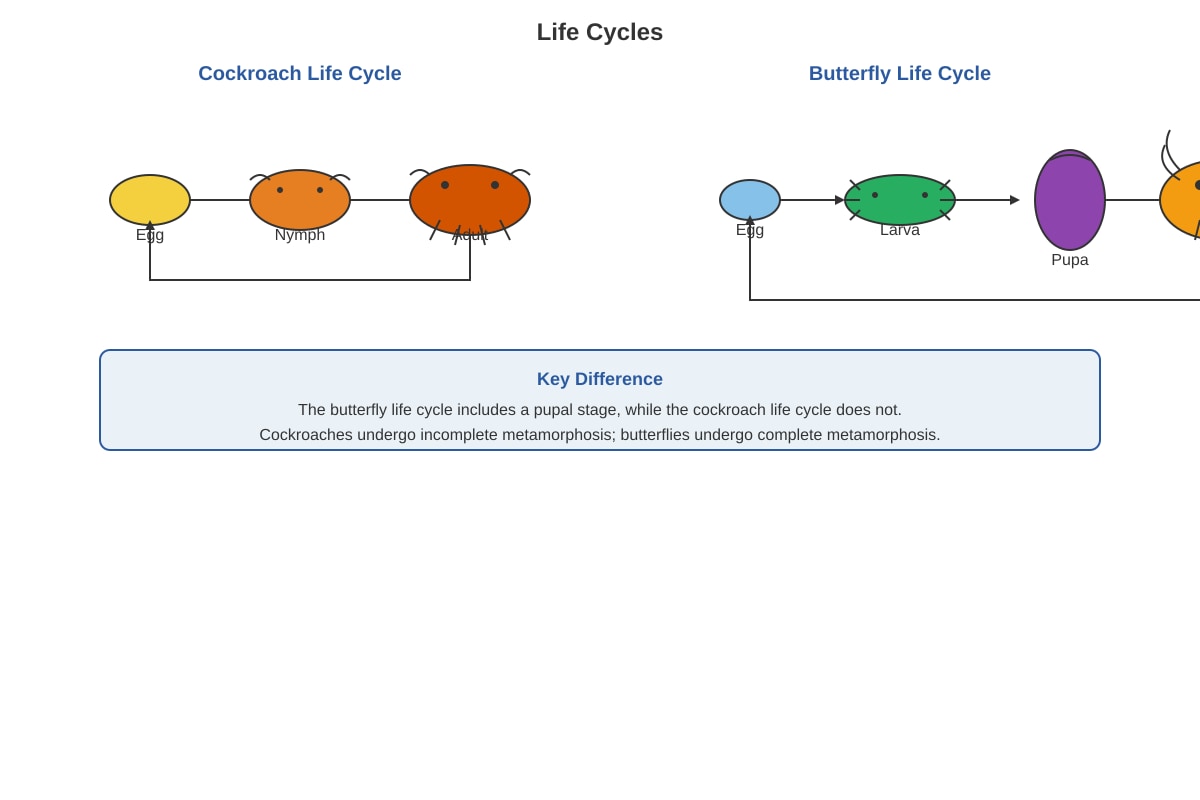
16. Study the life cycle of a cockroach and a butterfly.

<image_placeholder> id: Q16-fig1 type: diagram linked_question: Q16 description: Two side-by-side life cycles. Left: Cockroach (Egg -> Nymph -> Adult). Right: Butterfly (Egg -> Larva -> Pupa -> Adult). labels: Cockroach Life Cycle, Butterfly Life Cycle values: None must_show: The absence of a pupal stage in the cockroach cycle and the presence of it in the butterfly cycle. </image_placeholder>

(a) Name the stage in the butterfly’s life cycle that is missing in the cockroach’s life cycle. [1]


(b) Why do young cockroaches (nymphs) look similar to adult cockroaches, but young butterflies (caterpillars) look very different from adult butterflies? [2]


(c) Both animals molt (shed their skin) as they grow. Explain why molting is necessary for these animals. [2]


17. A group of students went to a nature park to study plant diversity. They found four different plants: P, Q, R, and S.

  • Plant P: Has flowers and produces fruits.
  • Plant Q: Has cones but no flowers.
  • Plant R: Has no flowers, no seeds, and reproduces using spores. It grows in damp, shady places.
  • Plant S: Has no flowers, no seeds, and reproduces using spores. It is small and grows on rocks.

(a) Which plant is a fern? [1]


(b) Plant Q is a pine tree. How does it reproduce if it does not have flowers? [1]


(c) Why are Plant R and Plant S usually found in damp and shady areas? [2]


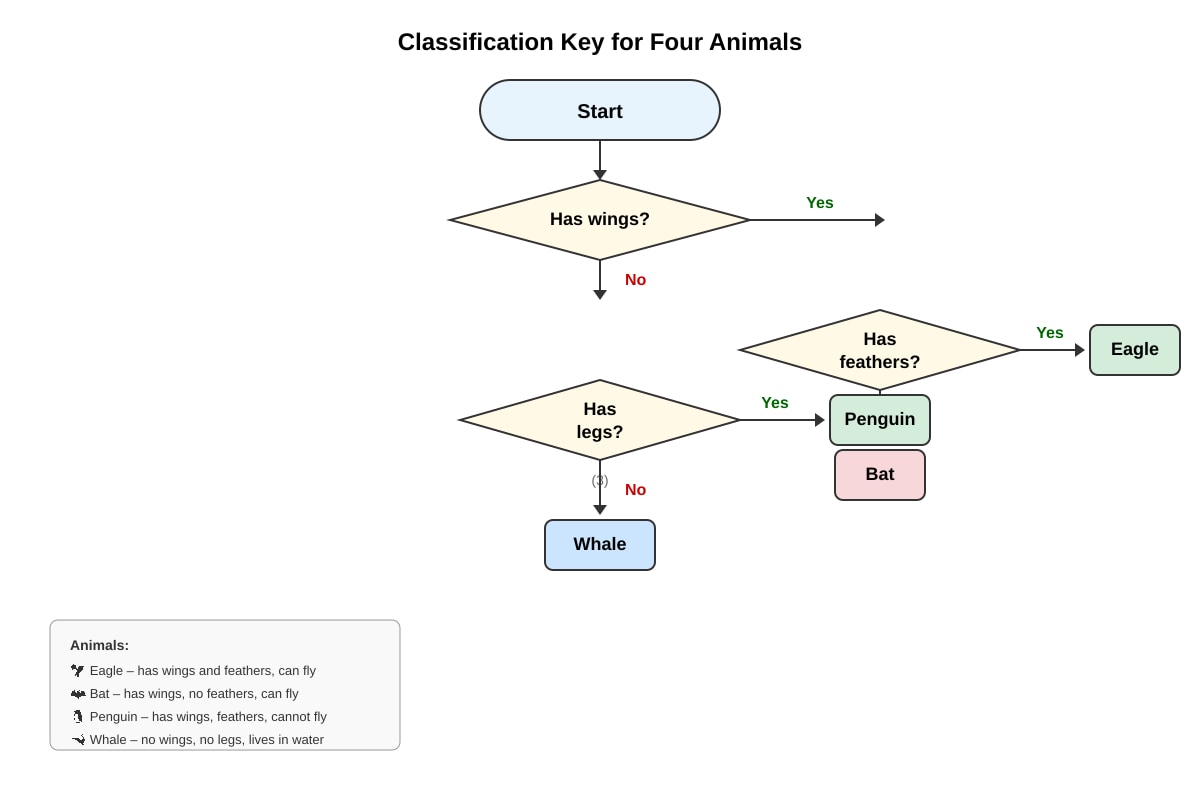
18. The diagram below shows a simple classification key for four animals: Bat, Penguin, Eagle, and Whale.

<image_placeholder> id: Q18-fig1 type: diagram linked_question: Q18 description: A flowchart. Start: "Has wings?" Yes -> Go to A. No -> Go to B. A: "Can fly?" Yes -> Eagle. No -> Bat (Note: This is a trick, bats fly, but let's adjust for P4 logic. Let's use feathers). Correction for P4 Logic: Start: "Has feathers?" Yes -> Go to 2. No -> Go to 3. 2: "Can fly?" Yes -> Eagle. No -> Penguin. 3: "Has hair/fur?" Yes -> Bat. No -> Whale. labels: Start, 2, 3, Eagle, Penguin, Bat, Whale values: None must_show: Clear binary choices leading to the correct animal. </image_placeholder>

(a) According to the key, which animal is identified at the end of path "Yes -> 2 -> No"? [1]


(b) Why is the bat classified separately from the eagle and penguin in this key? [1]


(c) A student claims that whales are fish because they live in water. Using the key above, explain why the whale is not a fish. [2]


19. Diversity in habitats helps ecosystems survive.

(a) What is meant by the term 'habitat'? [1]


(b) In a rainforest, there are many layers: the forest floor, the understory, and the canopy. Explain how this layering allows many different types of plants to grow in the same area. [2]


(c) If all the trees in the canopy layer were cut down, how would this affect the plants on the forest floor? [2]


20. The table below shows the characteristics of two groups of animals, Group A and Group B.

CharacteristicGroup AGroup B
Body CoveringScalesFeathers
Breathing OrganGillsLungs
ReproductionLays eggs in waterLays eggs on land
ExampleGoldfishChicken

(a) Name Group A and Group B. [2] Group A: _________________________ Group B: _________________________

(b) State one similarity between Group A and Group B. [1]


(c) Why do animals in Group B have feathers? [1]


Answers

<!-- TuitionGoWhere generation metadata: stage=5-2; model=qwen/qwen3.7-plus; model_label=Qwen3.7 Plus; generated=2026-06-04; Sources: Stage 4-0 LLM templates, syllabus context, and Stage 2 evidence where available. -->

TuitionGoWhere Practice Paper - Science Primary 4 (Answer Key)

Version: 1 of 5 Total Marks: 60


Section A (28 marks)

1. (2)

  • Explanation: Living things need air, water, and food, and can grow and reproduce. Mushrooms (fungi), ferns (plants), and bacteria are all living things. Clouds, rocks, and stars are non-living.

2. (1)

  • Explanation: Birds have wings, lay eggs, and typically do not live exclusively in water (though some swim, they breathe air and have feathers). Animal A fits the general description of a bird (wings, eggs, terrestrial/aerial). Animal C lives in water, which is more typical of fish or amphibians, though some birds swim, Animal A is the most standard bird description in this context. Note: In P4, birds are defined by feathers and wings. Animal A is the best fit among options if we assume standard terrestrial birds.

3. (2)

  • Explanation: Group Y has more than 6 legs. Spiders have 8 legs. Ants, butterflies, and grasshoppers are insects with 6 legs.

4. (3)

  • Explanation: Fungi are living things because they exhibit life processes such as needing air, water, and nutrients (food) to survive and grow. They do not make their own food (no chlorophyll) and most do not move from place to place like animals.

5. (3)

  • Explanation: Plants are broadly classified into flowering and non-flowering plants. Not all plants have flowers (e.g., ferns, mosses). Not all plants have distinct roots/stems/leaves in the same way (e.g., mosses). Non-flowering plants do reproduce (via spores or cones).

6. (3)

  • Explanation: Broad leaves (Plant A) have a large surface area to trap sunlight for photosynthesis. Needle-like leaves (Plant B) have a small surface area to reduce water loss, often found in dry or cold environments.

7. (3)

  • Explanation: Frogs undergo metamorphosis (Egg -> Tadpole -> Adult). Cats, chickens, and fish do not undergo metamorphosis; their young look like smaller versions of the adults.

8. (2)

  • Explanation: Stage B is the larva (caterpillar). This is the feeding stage where the butterfly eats leaves to store energy for metamorphosis. Stage A is the egg, C is the pupa (resting stage), and D is the adult (reproductive stage).

9. (3)

  • Explanation: Mammals are characterized by having hair or fur, giving birth to live young (mostly), and feeding their young with milk.

10. (2)

  • Explanation: Biodiversity ensures ecosystem stability. If one species declines, others can fulfill similar roles, preventing the collapse of the food web.

11. (2)

  • Explanation: Ferns, mosses, and pine trees (conifers) are non-flowering plants. Roses, orchids, sunflowers, etc., are flowering plants.

12. (2)

  • Explanation: Arachnids (like spiders and scorpions) have 8 legs and no antennae. Insects have 6 legs and antennae.

13. (4)

  • Explanation: Photosynthesis is the process by which plants make food. It is not a method of seed dispersal. Wind, water, and animals are common dispersal methods.

14. (3)

  • Explanation: Following the key: No wings -> Go to 3. 6 legs -> Ant.

Section B (32 marks)

15. (a) Insects [1]

  • Note: Animals with 6 legs and 3 body parts (head, thorax, abdomen) are insects.

(b) Animal X has 6 legs while Animal Y has 8 legs. OR Animal X has 3 body parts while Animal Y has 2 body parts. [1]

  • Note: Any valid structural difference based on the table/general knowledge of insects vs arachnids.

(c) Because it has many legs (more than 6). [1]

  • Note: Insects must have exactly 6 legs.

16. (a) Pupa [1]

  • Note: Cockroaches undergo incomplete metamorphosis (Egg, Nymph, Adult). Butterflies undergo complete metamorphosis (Egg, Larva, Pupa, Adult).

(b) Cockroaches undergo incomplete metamorphosis, so the nymph looks like a smaller version of the adult. Butterflies undergo complete metamorphosis, so the larva (caterpillar) looks completely different from the adult butterfly. [2]

  • Marking: 1 mark for mentioning incomplete/complete metamorphosis or similarity/difference in appearance. 1 mark for linking it to the specific animals.

(c) Their hard outer skin (exoskeleton) does not grow with their body. They must shed it to allow their body to grow larger. [2]

  • Marking: 1 mark for stating the skin/exoskeleton is hard/does not grow. 1 mark for stating it allows growth.

17. (a) Plant R [1]

  • Note: Ferns have no flowers/seeds, use spores, and grow in damp/shady places.

(b) It reproduces using cones. [1]

  • Note: Conifers like pine trees produce seeds in cones.

(c) They reproduce using spores. Spores need moisture to germinate and grow. Direct sunlight may dry them out, so they prefer damp and shady areas. [2]

  • Marking: 1 mark for mentioning spores need moisture/water. 1 mark for linking damp/shady conditions to preventing drying out/providing moisture.

18. (a) Penguin [1]

  • Note: Has feathers (Yes) -> Go to 2. Can fly? (No) -> Penguin.

(b) Because the bat does not have feathers (it has hair/fur). [1]

  • Note: The key separates animals based on feathers first. Bats are mammals, not birds.

(c) The key shows that whales do not have feathers and do not have hair/fur (in the context of the key's logic, though whales have sparse hair, P4 keys often simplify. However, the key leads to Whale via 'No feathers' -> 'No hair/fur' is incorrect for mammals generally, but let's look at the key provided in Q18 image description: 3a Has hair/fur -> Bat. 3b No hair/fur -> Whale. This is a simplification for the key. The student should answer based on the key or general knowledge. Better answer: Whales are mammals because they breathe air and give birth to live young, unlike fish which have gills and lay eggs. However, based strictly on the key provided in the prompt's image description, it classifies Whale as having no hair/fur. Let's correct the reasoning for P4 level: Whales are not fish because they breathe air using lungs, not gills, and they are mammals. [2]

  • Refined Answer for P4: Whales are mammals, not fish. They breathe air using lungs, whereas fish breathe using gills. Also, whales give birth to live young, while most fish lay eggs.
  • Marking: 1 mark for mentioning lungs/air breathing. 1 mark for mentioning live young/mammal characteristic.

19. (a) A habitat is the natural home or environment where an animal or plant lives. [1]

(b) Different layers receive different amounts of sunlight. Plants in the canopy get more sunlight, while plants on the forest floor get less. This allows different types of plants, which have different light requirements, to grow in the same forest. [2]

  • Marking: 1 mark for mentioning different amounts of sunlight. 1 mark for linking it to different plant needs/types.

(c) More sunlight would reach the forest floor. This might cause plants that prefer shade to die, while plants that need more sunlight might grow better. The diversity of plants on the forest floor would change. [2]

  • Marking: 1 mark for stating more sunlight reaches the floor. 1 mark for explaining the effect on shade-loving plants (they may die/struggle).

20. (a) Group A: Fish [1] Group B: Birds [1]

(b) Both lay eggs. OR Both are vertebrates (have backbones). [1]

  • Note: Based on the table, "Lays eggs" is the explicit commonality.

(c) Feathers help to keep the bird warm (insulation) and help them to fly. [1]

  • Note: Either function is acceptable at P4 level.