AI Generated Exam Paper
Primary 4 Science Practice Paper 1
Free P4 Science Practice Paper 1, Nemo3 AI version, with questions, answers, and syllabus-aligned practice for Singapore students.
These static practice materials are generated from the site's syllabus and paper-generation workflow, with source and model context shown so students and parents can evaluate the material before use.
Questions


Free quiz and exam paper access
Enter your details to view this paper
Your access is remembered on this device.
Answers
TuitionGoWhere Practice Paper - Science Primary 4 (Answer Key)
Subject: Science
Level: Primary 4
Paper: Practice Paper 1 (Version 1)
Total Marks: 100
SECTION A: Multiple-Choice Questions (28 marks)
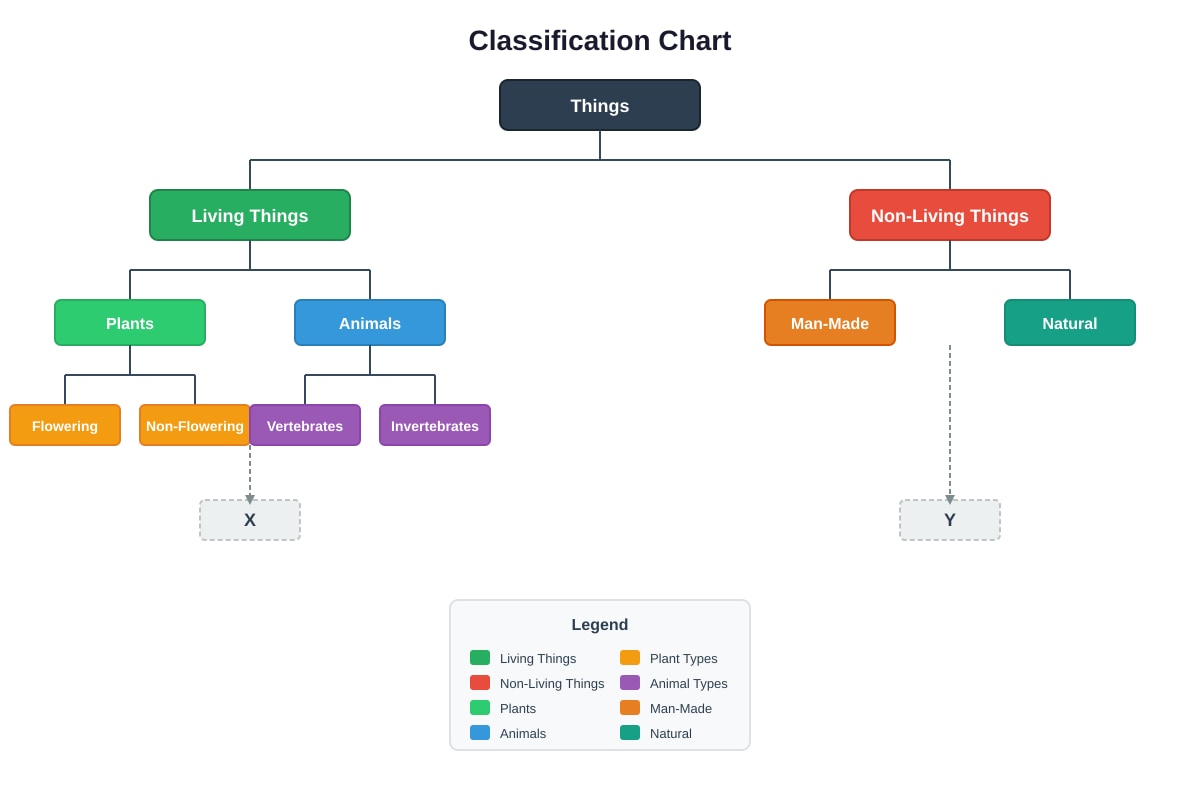
1. Answer: (3) Pebble
Marks: 2
Explanation: A pebble is a non-living thing. Mushroom, moss, and fern are all living things (fungi and plants).
2. Answer: (2) Mould | Sand
Marks: 2
Explanation: Mould is a fungus (living thing), and sand is a natural non-living thing. Bacteria and yeast are microorganisms (living), plastic bottle and metal spoon are man-made non-living things, virus is considered non-living by some definitions but water is natural non-living.
3. Answer: (1) Rose, hibiscus, grass
Marks: 2
Explanation: Rose, hibiscus, and grass are all flowering plants (angiosperms). Fern and moss are non-flowering plants; mushroom is a fungus. Pine tree and cycad are gymnosperms (non-flowering). Algae, seaweed, and kelp are non-flowering plants (algae).
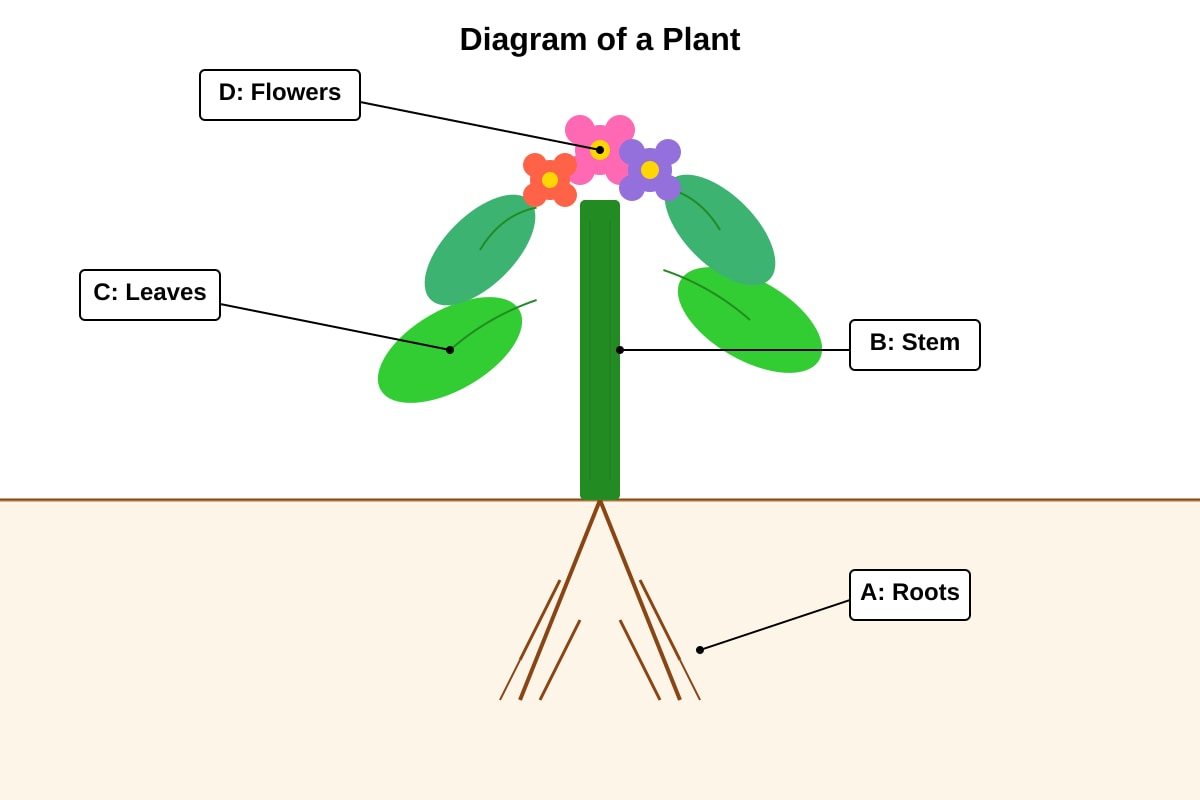
4. Answer: (3) C
Marks: 2
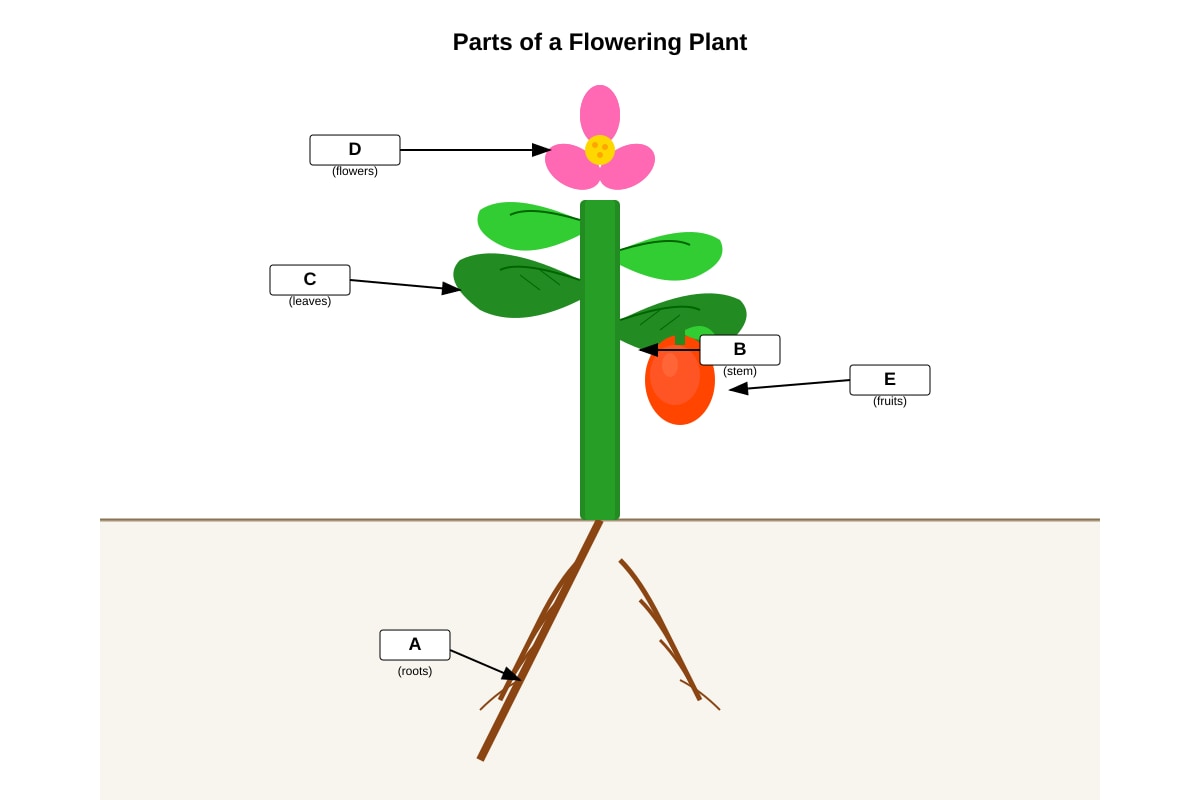
Explanation: Part C is the leaves. Leaves contain chlorophyll and make food for the plant through photosynthesis.
5. Answer: (4) Fungi reproduce by spores.
Marks: 2
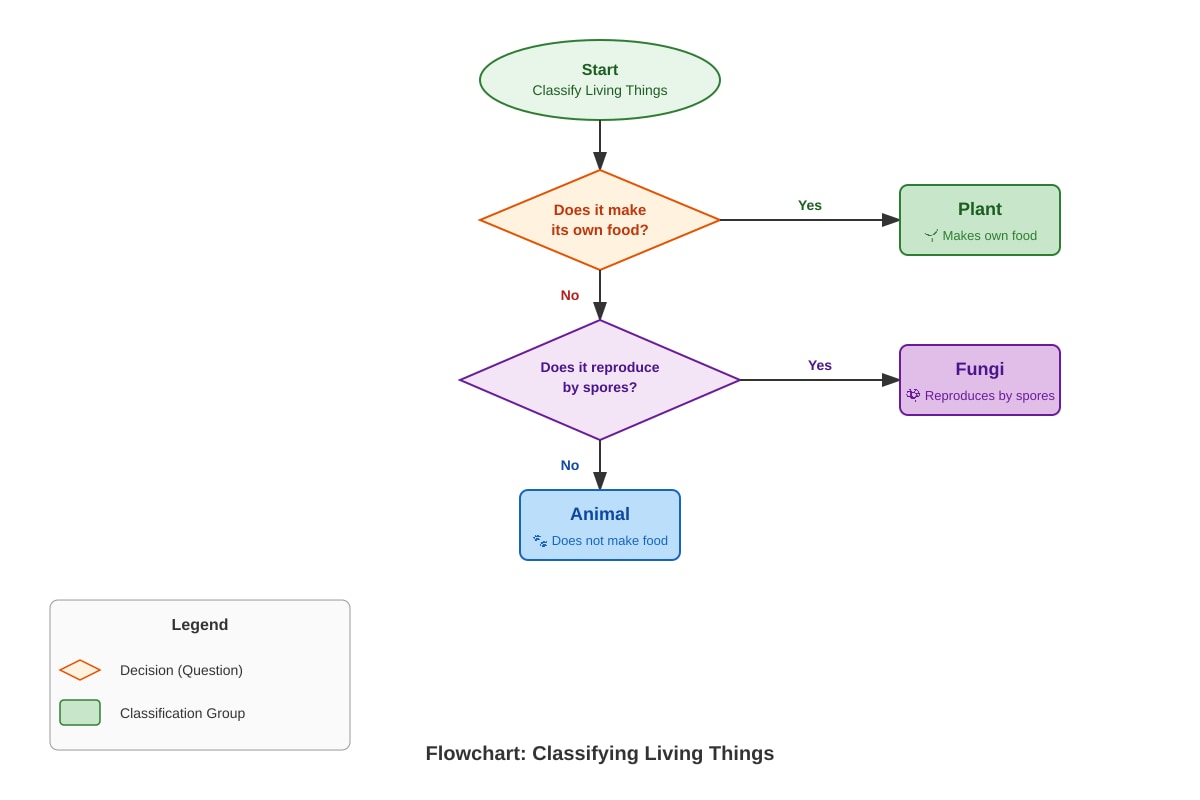
Explanation: Fungi do not make their own food (they are decomposers), they reproduce by spores (not seeds), and they are living things.
6. Answer: (3) Fungi
Marks: 2
Explanation: Following the flowchart: Does not make its own food → No → Does it reproduce by spores? → Yes → Fungi.
7. Answer: (3) Earthworm
Marks: 2
Explanation: Earthworm is an invertebrate (no backbone). Frog, snake, and bird are vertebrates (have backbones).
8. Answer: (4) Z
Marks: 2
Explanation: Mammals have backbones. Only organism Z has a backbone (✓ in "Has backbone" row). W and X make their own food (plants), Y reproduces by spores (fungi).
9. Answer: (2) They need air, food and water.
Marks: 2
Explanation: All living things need air, food, and water to survive. Not all living things move from place to place (plants), reproduce by laying eggs (mammals give live birth), or have a backbone (invertebrates).
10. Answer: (3) Bacteria | Fungi
Marks: 2
Explanation: Group A contains Bacteria and Yeast (both are microorganisms, but yeast is a fungus). Group B contains Mushroom and Mould (both are fungi). The best fit is Group A = Bacteria (though yeast is fungi, bacteria is the only option that fits Group A exclusively), Group B = Fungi.
11. Answer: (2) Fish
Marks: 2
Explanation: Fish live in water, have gills for breathing, have fins for swimming, and lay eggs in water. Amphibians have moist skin and undergo metamorphosis; reptiles have scales and breathe with lungs; mammals have hair/fur and feed young with milk.
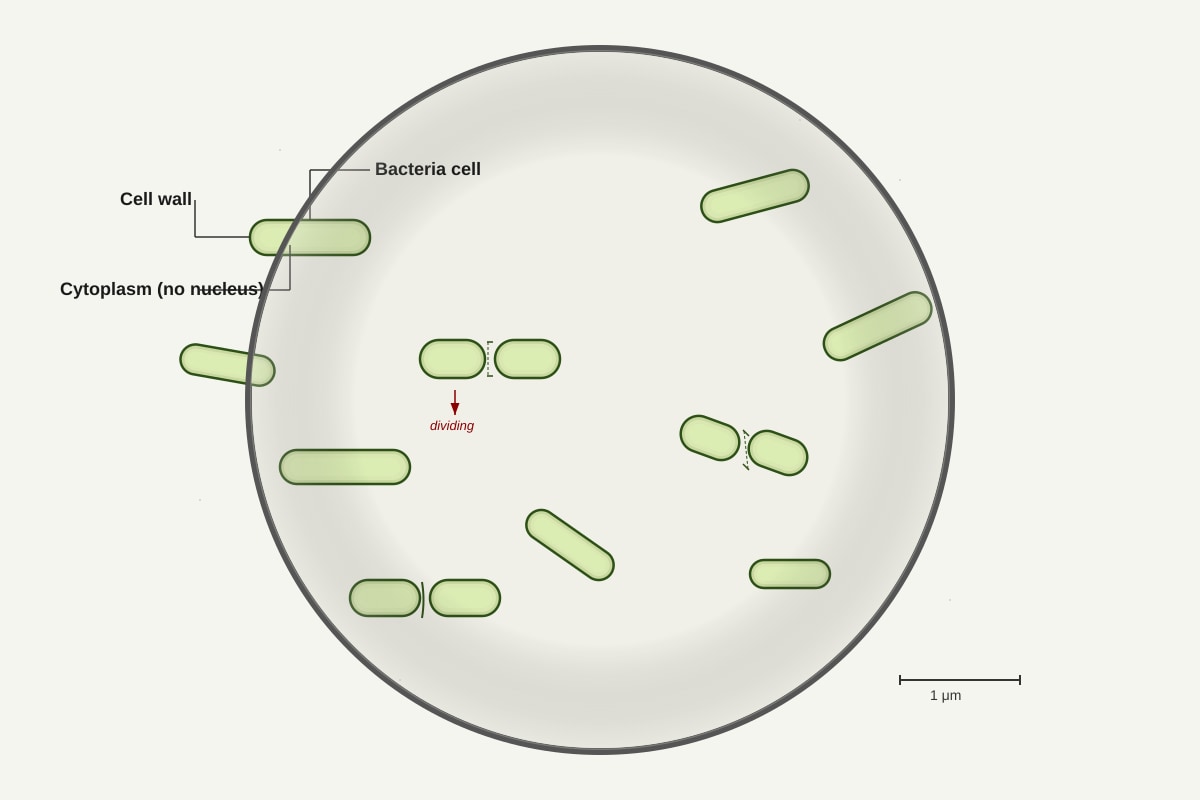
12. Answer: (3) Bacteria reproduce by binary fission.
Marks: 2
Explanation: Not all bacteria are harmful (some are useful). Bacteria are microscopic (cannot be seen with naked eye). Bacteria reproduce asexually by binary fission. Bacteria do not make their own food (they are decomposers or parasites).
13. Answer: (2) Pupa
Marks: 2
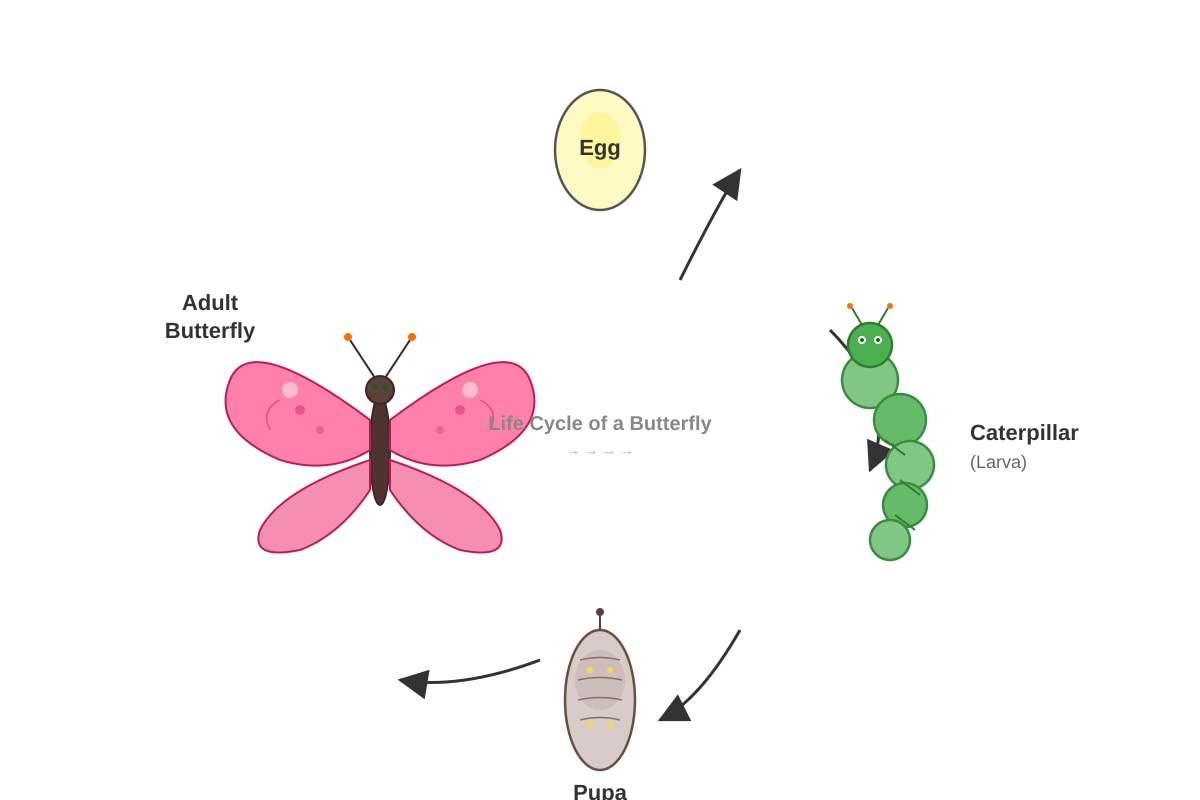
Explanation: Butterfly life cycle: Egg → Caterpillar (Larva) → Pupa (Chrysalis) → Adult Butterfly. The stage after caterpillar is pupa.
14. Answer: (2) Fern, moss, algae
Marks: 2
Explanation: Fern, moss, and algae are all non-flowering plants. Mushroom is a fungus (not a plant). Pine tree is a gymnosperm (non-flowering) but the group includes fern and moss which are correct, however option (2) has three correct non-flowering plants. Yeast and mould are fungi.
SECTION B: Structured Questions (44 marks)
15. (a)
| Organism | Group |
|---|---|
| A | Fungi |
| B | Plant (Flowering plant) |
| C | Animal (Insect) |
| Marks: 3 (1 mark each) |
(b) Organism A (mushroom) is a fungus and does not make its own food / reproduces by spores, while organism B (rose plant) is a plant and makes its own food / reproduces by seeds.
Marks: 1
Acceptable answers: Any one valid difference: nutrition mode, reproduction method, cell structure (cell wall composition), etc.
(c) (i) Insects have six legs.
(ii) Insects have three body parts (head, thorax, abdomen).
Marks: 2 (1 mark each)
Other acceptable answers: Insects have a pair of antennae; insects have an exoskeleton; most insects have wings.
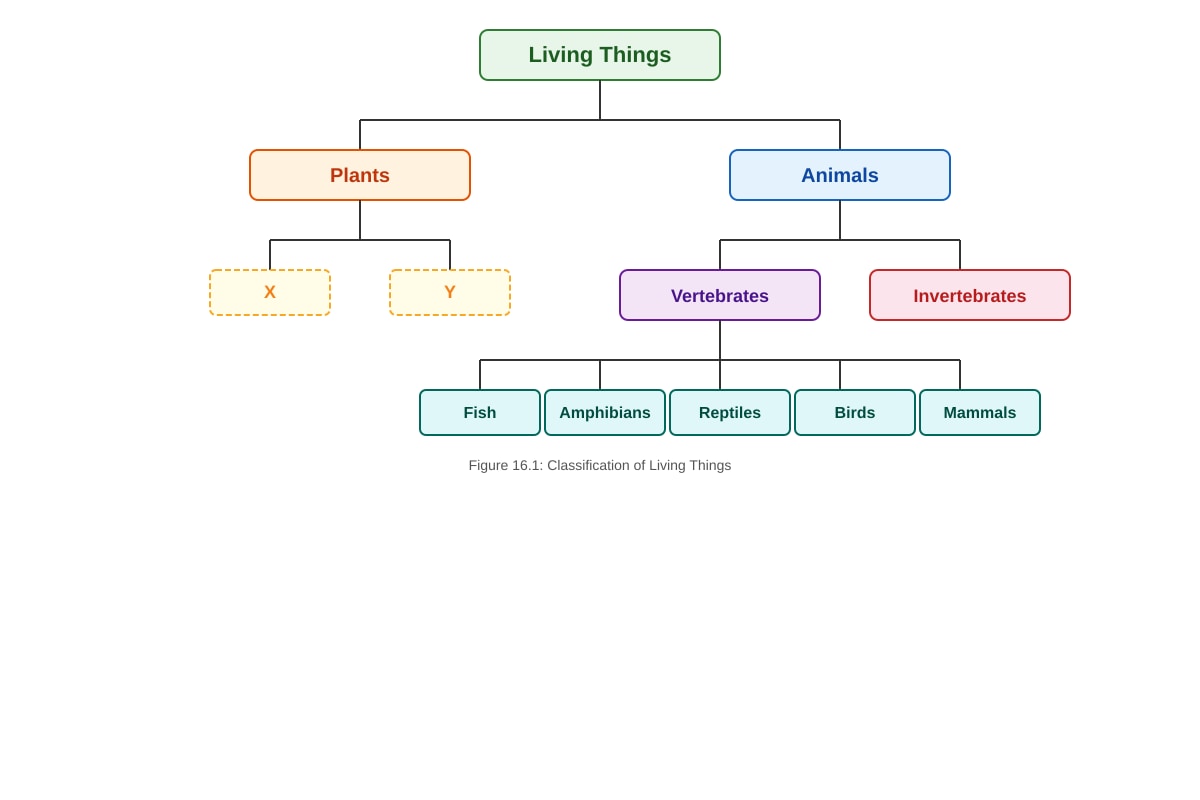
16. (a) X: Flowering plants
Y: Non-flowering plants
Marks: 2 (1 mark each)
(b) Vertebrates have a backbone, while invertebrates do not have a backbone.
Marks: 1
(c) Whales have hair/fur (at some stage of life) / feed their young with milk / breathe with lungs / give birth to live young.
Marks: 1
Accept any one mammalian characteristic.
17. (a) Plants P and S
Marks: 1
Explanation: Only P and S have ticks for "Bears flowers" and "Bears fruits".
(b) Plants Q and R
Marks: 1
Explanation: Q and R have ticks for "Reproduces by spores" and do not bear flowers or fruits.
(c) Ferns reproduce by spores.
Marks: 1
(d) Mosses are non-vascular plants (no true roots, stems, leaves), while ferns are vascular plants (have true roots, stems, leaves). OR Mosses are smaller and simpler; ferns have fronds and vascular tissue.
Marks: 1
Accept any valid structural difference.
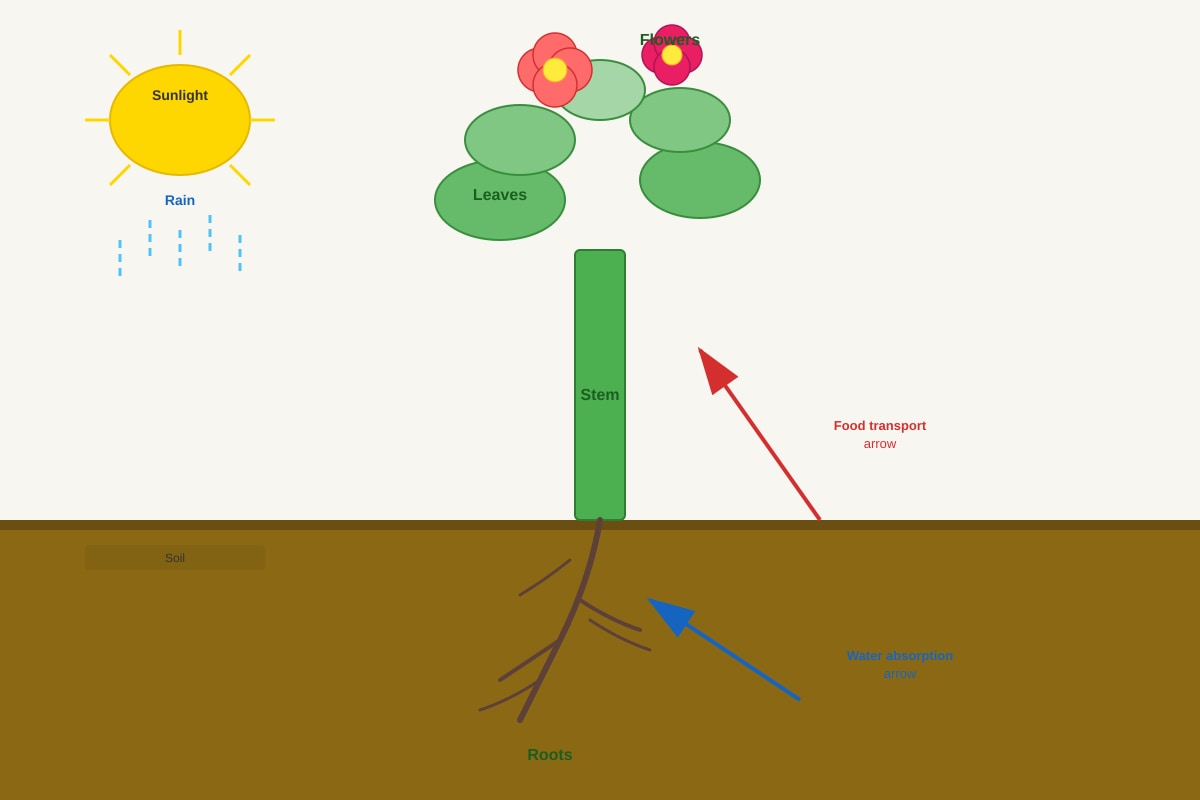
18. (a) A: Roots
B: Stem
C: Leaves
D: Flowers
Marks: 2 (0.5 marks each)
(b) The stem transports water and minerals from the roots to the leaves, and transports food from the leaves to other parts of the plant. It also supports the plant upright.
Marks: 1
Accept any one main function.
(c) The green colour is due to chlorophyll, which traps light energy from the sun for photosynthesis to make food.
Marks: 2
Breakdown: 1 mark for chlorophyll, 1 mark for trapping light for photosynthesis.
19. Animal X: Bird
Marks: 1
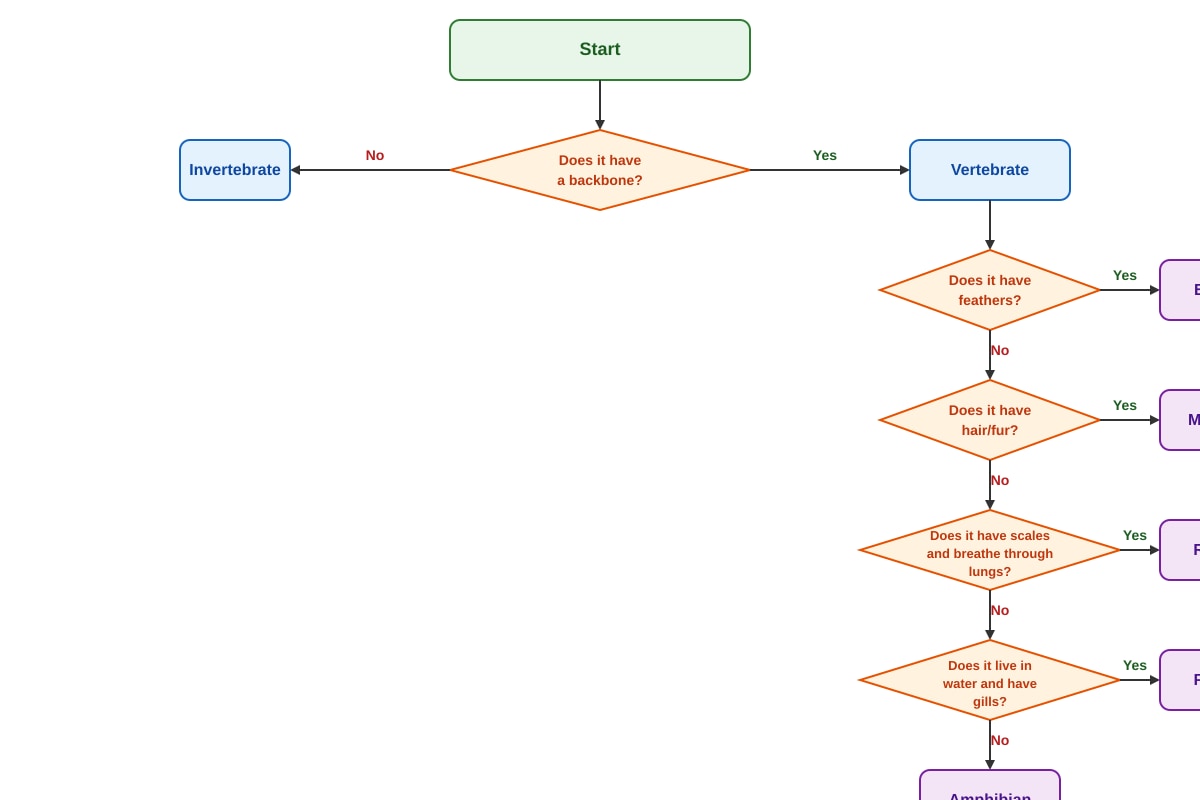
Explanation: Has backbone → Vertebrate → Has feathers → Bird.
Animal Y: Mammal
Marks: 1
Explanation: Has backbone → Vertebrate → No feathers → Has hair/fur → Mammal.
Animal Z: Invertebrate
Marks: 1
Explanation: No backbone → Invertebrate.
20. (a) Pupa
Marks: 1
(b) Larva lives in water, has no wings, and looks like a worm; adult mosquito flies, has wings, and has legs.
Marks: 1
Accept any one valid difference: habitat, body structure, presence of wings, feeding method.
(c) Remove stagnant water / cover water containers / add oil to water surface / introduce fish that eat larvae.
Marks: 1
Accept any valid mosquito breeding prevention method.
21. (a) Animal A
Marks: 1
Explanation: Reptiles have scales, breathe through lungs, and lay eggs.
(b) Animal C
Marks: 1
Explanation: Mammals have hair/fur, breathe through lungs, and give birth to live young (feed young with milk).
(c) Frogs are amphibians because they have moist skin, lay eggs in water, their young (tadpoles) live in water and breathe through gills, and adults live on land and breathe through lungs. They undergo metamorphosis.
Marks: 2
Breakdown: 1 mark for moist skin/dual life cycle, 1 mark for metamorphosis/gills to lungs transition.
22. (a)
| Living Things | Non-Living Things |
|---|---|
| Bacteria | Rock |
| Mushroom | Plastic bottle |
| Grass | Water |
| Snail | Cloud |
| Marks: 4 (0.5 marks each correct placement) |
(b) (i) Rocks do not need air, food, and water.
(ii) Rocks do not grow / do not reproduce / do not respond to changes.
Marks: 2 (1 mark each)
Accept any two characteristics of living things that rocks lack.
23. (a) Bacteria
Marks: 1
(b) Binary fission
Marks: 1
(c) Used in making yoghurt / cheese / antibiotics / decomposing waste / nitrogen fixation in soil.
Marks: 1
Accept any one useful role.
(d) Cause diseases / food poisoning / infections / tooth decay.
Marks: 1
Accept any one harmful effect.
SECTION C: Open-Ended Questions (28 marks)
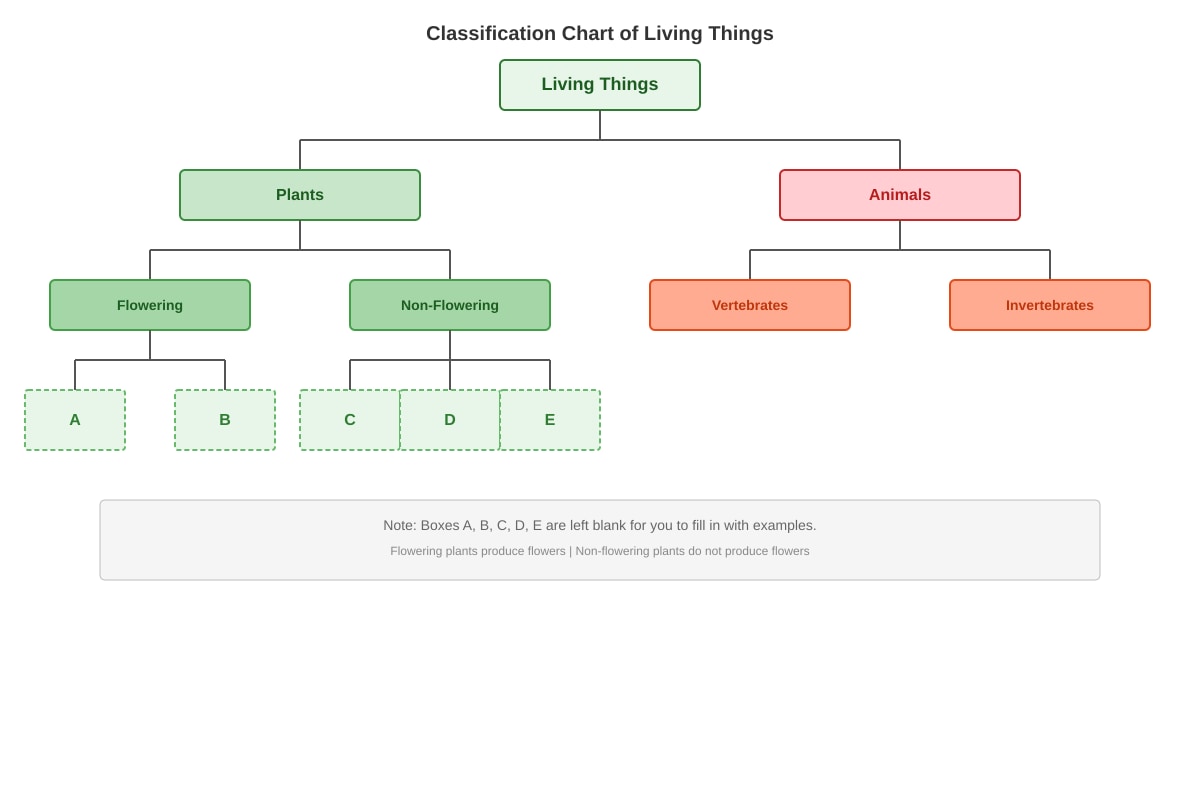
24. (a) A: Rose / Hibiscus / Grass / Any flowering plant
B: Mango tree / Apple tree / Bougainvillea / Any other flowering plant
Marks: 2 (1 mark each)
Must be two different examples of flowering plants.
(b) C: Fern
D: Moss
E: Algae / Conifer (pine) / Cycad
Marks: 3 (1 mark each)
Must be three different examples of non-flowering plants. Mushroom is not a plant.
(c) Flowering plants reproduce by seeds (bear flowers and fruits), while non-flowering plants reproduce by spores (or cones for gymnosperms) and do not bear flowers or fruits.
Marks: 1
25. (a) Water and minerals are transported from the roots to the leaves through the stem (specifically, the xylem / water-carrying tubes).
Marks: 1
(b) (i) Sunlight (light energy)
(ii) Carbon dioxide
Marks: 2 (1 mark each)
Also accept: Water (absorbed by roots) and chlorophyll (in leaves). The question asks what leaves need - sunlight and carbon dioxide are taken in at the leaves.
(c) The stem (specifically, the phloem / food-carrying tubes).
Marks: 1
(d) The plant will die / cannot survive. Without leaves, the plant cannot make food through photosynthesis, so it will not get the energy and nutrients it needs to grow and survive.
Marks: 2
Breakdown: 1 mark for "plant will die", 1 mark for explanation linking no leaves → no photosynthesis → no food.
26. (a) Insect
Marks: 1
(b) Arachnid (Spider)
Marks: 1
(c) (i) Organism X has six legs; Organism Y has eight legs.
(ii) Organism X has three body parts; Organism Y has two body parts.
Marks: 2 (1 mark each)
Other acceptable differences: X has antennae, Y has no antennae; X has wings (usually), Y has no wings.
(d) Invertebrates are animals without a backbone.
Marks: 1
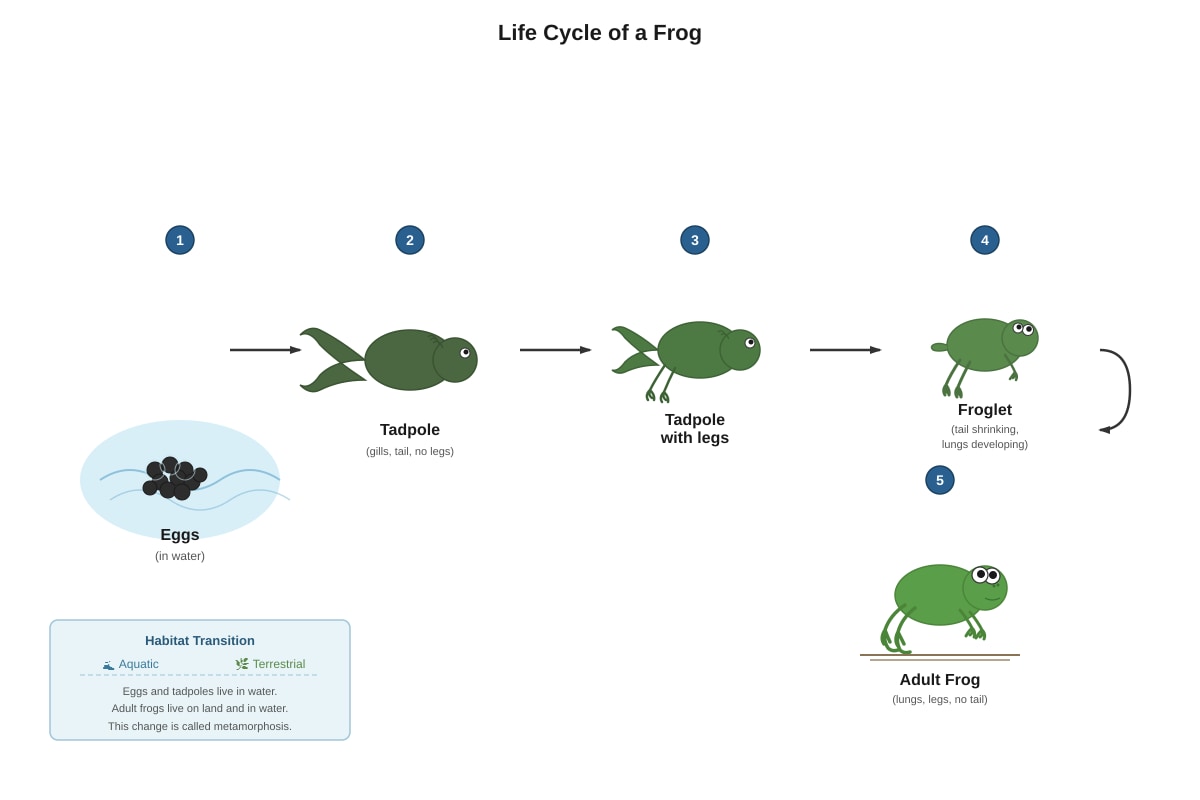
27. (a) Tadpole with legs / Froglet
Marks: 1
Accept either "Tadpole with legs" or "Froglet" as the next stage after tadpole.
(b) (i) Tadpole lives in water and breathes through gills; adult frog lives on land and breathes through lungs.
(ii) Tadpole has a tail and no legs; adult frog has legs and no tail.
Marks: 2 (1 mark each)
Other acceptable differences: Tadpole eats plants/algae, adult frog eats insects; tadpole has no lungs, adult has lungs.
(c) Laying many eggs increases the chances of survival because many eggs/tadpoles will be eaten by predators or die from environmental changes, so producing large numbers ensures some survive to adulthood.
Marks: 2
Breakdown: 1 mark for "many eggs increase survival chances", 1 mark for explaining why (predators, environmental factors).
28. (a)
| Organism | Group |
|---|---|
| A | Plant (Fern / Non-flowering plant) |
| B | Mammal |
| C | Bird |
| D | Reptile |
| E | Invertebrate (Worm) |
| Marks: 5 (1 mark each) |
(b) Ferns reproduce by spores.
Marks: 1
(c) Earthworms burrow through soil, which aerates the soil and allows air and water to reach plant roots. They also break down dead organic matter, enriching the soil with nutrients.
Marks: 1
Accept any one valid reason: aeration, decomposition, nutrient cycling.
29. (a) Bird
Marks: 1
Path: 1a (has backbone) → 2a (has feathers) → Bird.
(b) Mammal
Marks: 1
Path: 1a (has backbone) → 2b (no feathers) → 3a (has hair/fur) → Mammal.
(c) Invertebrate
Marks: 1
Path: 1b
<stage5_exam_answers_md>
TuitionGoWhere Practice Paper - Science Primary 4 (Answer Key)
Subject: Science
Level: Primary 4
Paper: Practice Paper 1 (Version 1)
Total Marks: 100
SECTION A: Multiple-Choice Questions (28 marks)
| Question | Answer | Explanation |
|---|---|---|
| 1 | (3) Pebble | Mushroom, moss, and fern are living things. Pebble is a non-living thing. |
| 2 | (2) Mould | Sand | Mould is a fungus (living thing). Sand is a natural non-living thing. Bacteria and yeast are microorganisms; virus is a microorganism; plastic bottle and metal spoon are man-made; water is natural non-living. |
| 3 | (1) Rose, hibiscus, grass | All three are flowering plants (angiosperms). Fern, moss, mushroom are non-flowering. Pine tree, cycad, conifer are gymnosperms (non-flowering). Algae, seaweed, kelp are non-flowering. |
| 4 | (3) C | Part C is the leaves. Leaves contain chlorophyll and make food through photosynthesis. |
| 5 | (4) Fungi reproduce by spores. | Fungi cannot make their own food (they are decomposers), do not reproduce by seeds, and are living things. |
| 6 | (3) Fungi | Organism X does not make its own food (not a plant) and reproduces by spores → Fungi. |
| 7 | (3) Earthworm | Frog, snake, and bird are vertebrates (have backbone). Earthworm is an invertebrate. |
| 8 | (4) Z | Mammals have backbones. Only Z has a backbone. W and X make their own food (plants). Y reproduces by spores (fungi). |
| 9 | (2) They need air, food and water. | All living things need air, food, and water. Not all living things move from place to place (plants), reproduce by laying eggs (mammals give birth), or have a backbone (invertebrates). |
| 10 | (3) Bacteria | Fungi | Group A: Bacteria, Yeast (both are microorganisms, but yeast is fungi). Actually, bacteria and yeast are both microorganisms. Mushroom and mould are fungi. Best fit: Group A = Microorganisms, Group B = Fungi. But option (3) says Bacteria and Fungi. Since yeast is a fungus, Group A has bacteria and yeast (fungus). This is tricky. In primary science, yeast is often taught as a microorganism (fungus). Mushroom and mould are fungi. So Group A = Microorganisms (bacteria, yeast), Group B = Fungi (mushroom, mould). Option (1) matches. Wait: Option (1) is Microorganisms |
| 11 | (2) Fish | Fish live in water, have gills, fins, lay eggs in water. Amphibians have moist skin, live both in water and land. Reptiles have scales, breathe with lungs. Mammals have hair, feed young with milk. |
| 12 | (3) Bacteria reproduce by binary fission. | Not all bacteria are harmful (some are useful). Bacteria are microscopic. Bacteria do not make their own food (most are decomposers). |
| 13 | (2) Pupa | Life cycle: Egg → Caterpillar (Larva) → Pupa (Chrysalis) → Adult Butterfly. |
| 14 | (2) Fern, moss, algae | All three are non-flowering plants. Mushroom is fungi. Pine tree is gymnosperm (non-flowering but seed plant). Mushroom, yeast, mould are fungi. |
SECTION B: Structured Questions (44 marks)
15.
(a)
| Organism | Group |
|---|---|
| A | Fungi |
| B | Plants (Flowering plant) |
| C | Animals (Insect) |
(b) Organism A (mushroom) is a fungus and does not make its own food / reproduces by spores, while organism B (rose plant) is a plant that makes its own food through photosynthesis / reproduces by seeds.
(c)
(i) Insects have six legs.
(ii) Insects have three body parts (head, thorax, abdomen).
(Accept: Insects have a pair of antennae / most have wings / undergo metamorphosis)
16.
(a)
X: Flowering plants
Y: Non-flowering plants
(b) Vertebrates have a backbone, while invertebrates do not have a backbone.
(c) Whales feed their young with milk / have hair (at some stage of life) / breathe with lungs / give birth to live young.
17.
(a) Plants P and S (they bear flowers and fruits).
(b) Plants Q and R (they reproduce by spores).
(c) Ferns reproduce by spores.
(d) Ferns have true roots, stems, and leaves; mosses do not have true roots, stems, or leaves (they have rhizoids, simple stems, and leaf-like structures).
(Accept: Ferns are vascular plants; mosses are non-vascular. / Ferns grow taller; mosses grow close to the ground.)
18.
(a)
A: Roots
B: Stem
C: Leaves
D: Flowers
(b) The stem transports water and nutrients from the roots to the leaves, and transports food from the leaves to other parts of the plant. It also supports the plant upright.
(c) The green colour is due to chlorophyll, which traps light energy from the sun for photosynthesis to make food for the plant.
19.
Animal X: Bird
Animal Y: Mammal
Animal Z: Invertebrate
20.
(a) Pupa
(b) The larva (wriggler) lives in water, has no wings, and looks like a worm; the adult mosquito flies, has wings, and lives on land.
(Accept: Larva has no legs; adult has six legs. / Larva breathes through a siphon; adult breathes through spiracles.)
(c) Remove stagnant water / cover water containers / add oil to water surface / introduce fish that eat larvae / change water in vases regularly.
21.
(a) Animal A (has scales, breathes through lungs, lays eggs).
(b) Animal C (has hair/fur, breathes through lungs, gives birth to live young).
(c) The frog is an amphibian because it lives both in water and on land / has moist skin / breathes through gills when young (tadpole) and lungs when adult / lays eggs in water / undergoes metamorphosis.
22.
(a)
| Living Things | Non-Living Things |
|---|---|
| Bacteria | Rock |
| Mushroom | Plastic bottle |
| Grass | Water |
| Snail | Cloud |
(b)
(i) The rock does not need air, food, and water.
(ii) The rock cannot grow / cannot reproduce / cannot respond to changes / cannot move on its own.
23.
(a) Bacteria
(b) Binary fission
(c) Used in making yogurt / cheese / antibiotics / decomposing waste / nitrogen fixation in soil / vitamin production in gut.
(d) Causes food poisoning / causes diseases (e.g., cholera, tuberculosis) / causes tooth decay / spoils food.
SECTION C: Open-Ended Questions (28 marks)
24.
(a)
A: Rose (or any flowering plant that bears fruit, e.g., mango, apple, hibiscus)
B: Grass (or any flowering plant that does not bear obvious fruit, e.g., maize, wheat, orchid)
(Note: All flowering plants bear fruits botanically, but in primary science, they may be grouped as "fruit-bearing" and "non-fruit-bearing" or "woody" and "herbaceous". Accept any two distinct flowering plants.)
(b)
C: Fern
D: Moss
E: Algae (or conifer / pine tree / cycad)
(c) Flowering plants reproduce by seeds (produced in flowers and fruits), while non-flowering plants reproduce by spores (or cones for gymnosperms).
25.
(a) The roots absorb water and mineral salts from the soil and anchor the plant firmly to the ground.
(b) The stem transports water and nutrients from the roots to the leaves, and transports food from the leaves to other parts of the plant. It also holds the leaves and flowers upright to receive sunlight.
(c) The leaves are green because they contain chlorophyll, which traps light energy from the sun for photosynthesis to make food for the plant.
(d) The flowers are the reproductive parts of the plant. They produce pollen and ovules, and after pollination and fertilisation, they develop into fruits containing seeds for reproduction.
26.
(a) The life cycle of a mealworm beetle has four stages: Egg → Larva (mealworm) → Pupa → Adult beetle.
(b) The larva (mealworm) looks like a worm, has six legs, and moults several times as it grows. The adult beetle has a hard shell (elytra), six legs, and wings.
(c) The mealworm beetle undergoes complete metamorphosis because the young (larva) looks very different from the adult and there is a pupa stage.
(d) To observe the life cycle, place mealworms in a container with oats/bran for food, add a slice of carrot/potato for moisture, keep in a warm dark place, and observe changes daily.
27.
(a) Similarity: Both the butterfly and the mosquito have four stages in their life cycle (egg, larva, pupa, adult) and undergo complete metamorphosis.
(b) Difference: The butterfly larva (caterpillar) lives on land and eats leaves, while the mosquito larva (wriggler) lives in water and feeds on microorganisms. The butterfly pupa (chrysalis) hangs from a plant, while the mosquito pupa (tumbler) lives in water.
(c) The mosquito is considered a pest because the adult female bites humans and animals to suck blood, which can transmit diseases such as dengue fever, malaria, and Zika virus.
(d) To prevent mosquito breeding, remove all stagnant water around the house (e.g., in flower pots, buckets, roof gutters), cover water storage containers, and change water in vases and pet bowls regularly.
28.
(a) Bacteria and fungi are decomposers. They break down dead organisms and waste materials into simpler substances, returning nutrients to the soil for plants to use.
(b) Yeast is used in baking bread. It respires anaerobically (fermentation) to produce carbon dioxide gas, which causes the dough to rise, making the bread soft and fluffy.
(c) Bacteria in the human gut (e.g., Lactobacillus) help in digestion, produce vitamins (like vitamin K and B vitamins), and prevent the growth of harmful bacteria.
(d) Harmful bacteria can cause food poisoning (e.g., Salmonella, E. coli) when contaminated food is eaten, leading to vomiting, diarrhoea, and fever. They can also cause diseases like tuberculosis, cholera, and tetanus.
End of Answer Key