From Real Exams Exam Paper
Primary 4 Science Semestral Assessment 2 (End of Year) Paper 5
Free Exam-Derived NVIDIA Nemotron 3 Ultra 550B A55B Free Primary 4 Science Semestral Assessment 2 (End of Year) Paper 5 practice paper with questions and answers for Singapore students. This page is rendered as a direct URL so the questions and answers can be discovered without pressing in-page buttons.
These static practice materials are generated from the site's syllabus and paper-generation workflow, with source and model context shown so students and parents can evaluate the material before use.
Questions
TuitionGoWhere Practice Paper - Science Primary 4
TuitionGoWhere Exam Practice (AI)
Subject: Science
Level: Primary 4
Paper: SA2 (Semestral Assessment 2) - Version 5
Duration: 1 hour 45 minutes
Total Marks: 100
Name: ________________________
Class: Primary 4 _______
Date: ________________________
INSTRUCTIONS TO CANDIDATES
- Do not turn over this page until you are told to do so.
- Follow all instructions carefully.
- Answer all questions.
- For Section A, shade your answers on the Optical Answer Sheet (OAS) provided.
- For Section B, write your answers in the spaces provided in this booklet.
- The number of marks is given in brackets [ ] at the end of each question or part question.
- The total marks for this paper is 100.
SECTION A: Multiple-Choice Questions (56 marks)
Questions 1 to 28 carry 2 marks each. For each question, four options are given. Choose the correct answer and shade the correct oval (1, 2, 3, or 4) on the Optical Answer Sheet.
Diversity (Living and Non-Living Things, Materials)
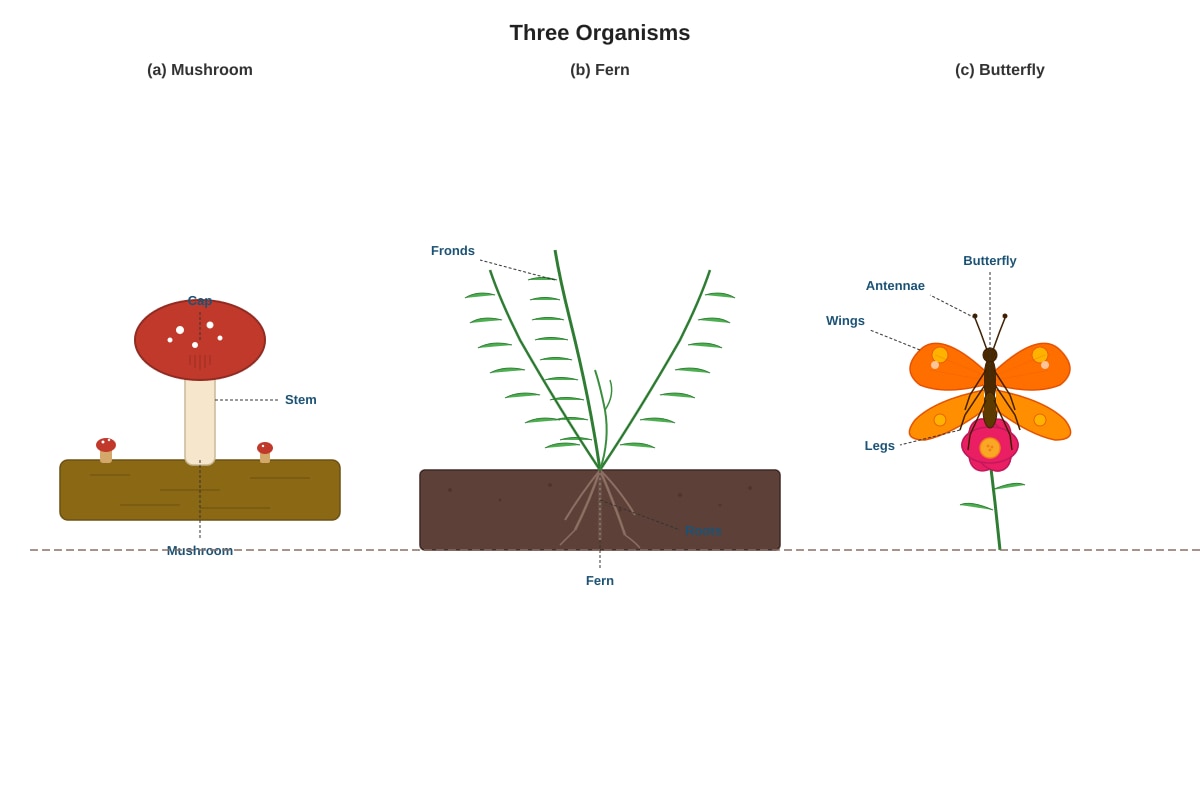
1. Which of the following groups contains only living things?
(1) Mushroom, fern, moss
(2) Cloud, river, rock
(3) Robot, car, computer
(4) Shadow, reflection, light
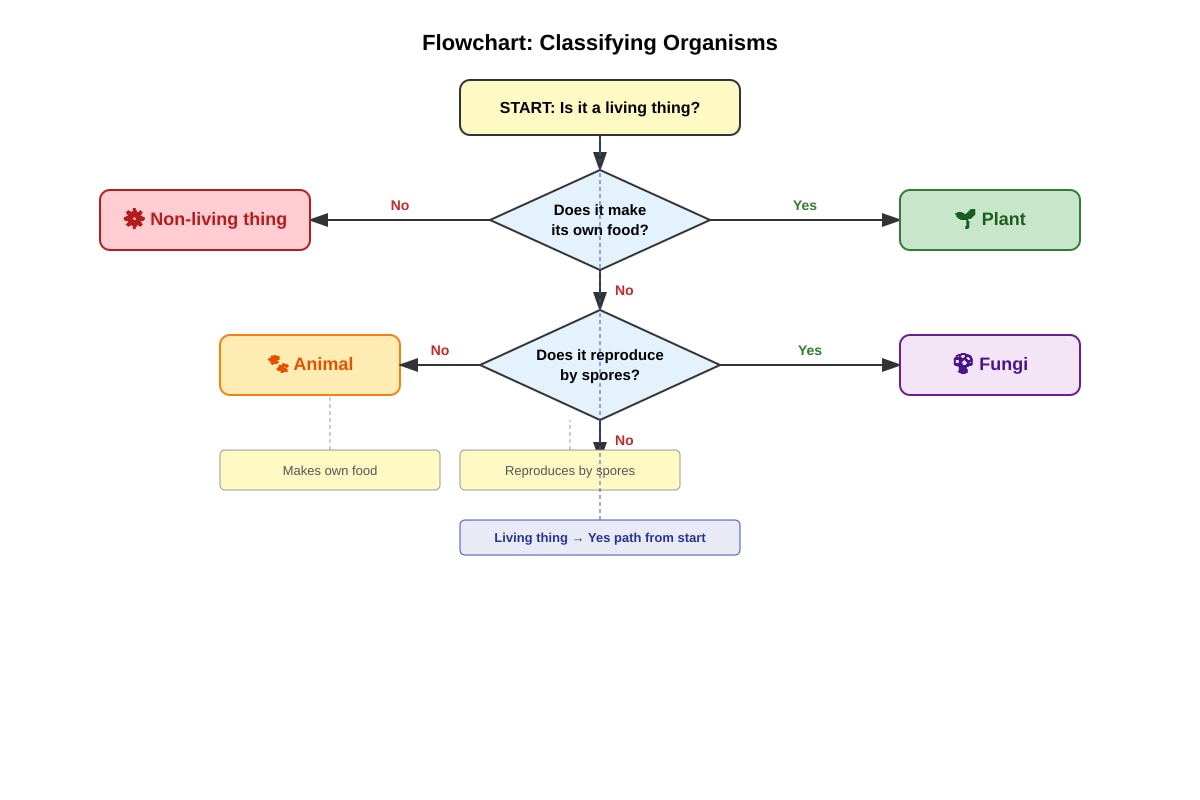
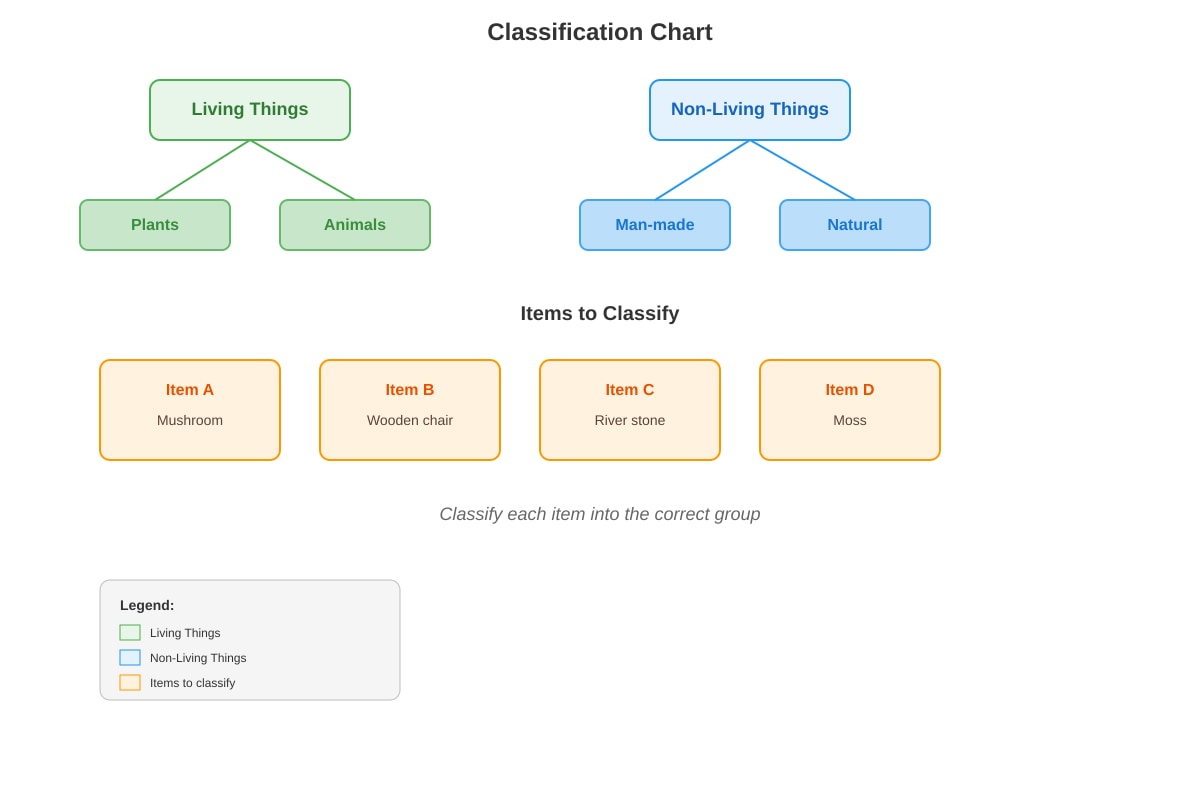
2. Study the classification chart below.
<image_placeholder> id: Q2-fig1 type: diagram linked_question: Q2 description: A classification chart with two main branches: Living Things and Non-Living Things. Living Things branch into Plants and Animals. Non-Living Things branch into Man-made and Natural. Four items (A, B, C, D) are placed at the bottom waiting to be classified. labels: Living Things, Non-Living Things, Plants, Animals, Man-made, Natural, Item A, Item B, Item C, Item D values: Item A: Mushroom; Item B: Wooden chair; Item C: River water; Item D: Butterfly must_show: Clear branching structure with all labels visible; items positioned at bottom with arrows pointing to correct categories </image_placeholder>
Which item is classified correctly?
(1) Item A → Plants
(2) Item B → Natural
(3) Item C → Man-made
(4) Item D → Animals
3. Four pupils made the following statements about living things.
Ahmad: All living things can move from place to place.
Bala: All living things need air, food, and water.
Cindy: All living things reproduce by laying eggs.
Devi: All living things grow and respond to changes.
Which two pupils made correct statements?
(1) Ahmad and Bala
(2) Bala and Cindy
(3) Bala and Devi
(4) Cindy and Devi
4. Study the flowchart below.
<image_placeholder> id: Q4-fig1 type: diagram linked_question: Q4 description: A flowchart for classifying materials. Start box: "Material X". Decision diamond 1: "Is it flexible?" Yes → "Fabric"; No → Decision diamond 2: "Does it allow light to pass through?" Yes → "Glass"; No → Decision diamond 3: "Is it magnetic?" Yes → "Iron"; No → "Plastic". labels: Material X, Is it flexible?, Fabric, Does it allow light to pass through?, Glass, Is it magnetic?, Iron, Plastic values: must_show: Clear flowchart with decision diamonds and outcome boxes; all text labels readable </image_placeholder>
Material X is flexible. What is Material X most likely made of?
(1) Glass
(2) Iron
(3) Fabric
(4) Plastic
5. Which of the following properties is not a characteristic of metals?
(1) Good conductor of heat
(2) Malleable (can be hammered into shape)
(3) Transparent
(4) Lustrous (shiny)
6. Study the table below.
| Material | Flexible | Waterproof | Transparent | Magnetic |
|---|---|---|---|---|
| A | Yes | Yes | No | No |
| B | No | Yes | Yes | No |
| C | Yes | No | No | Yes |
| D | No | Yes | No | Yes |
Which material is most suitable for making a raincoat?
(1) A
(2) B
(3) C
(4) D
7. The diagram below shows a sponge being pressed.
<image_placeholder> id: Q7-fig1 type: diagram linked_question: Q7 description: Two diagrams side by side. Left: A sponge in its original shape with air pockets visible inside. Right: The same sponge compressed into a smaller shape with air pockets reduced. Arrows show pressing force from top and bottom. labels: Original sponge, Compressed sponge, Air pockets, Pressing force values: Original volume: 50 cm³; Compressed volume: 20 cm³ must_show: Clear before/after comparison; air pockets visible in both; pressing force arrows; volume labels </image_placeholder>
What does this experiment show about the sponge?
(1) It has a definite volume.
(2) It has a definite shape.
(3) It can be compressed because it contains air.
(4) It is a liquid.
8. Which of the following statements about matter is correct?
(1) All matter can be seen.
(2) Only solids have mass.
(3) Matter occupies space and has mass.
(4) Gases have mass but do not occupy space.
9. Study the classification table below.
| Group X | Group Y |
|---|---|
| Oxygen | Sand |
| Carbon dioxide | Stone |
| Water vapour | Iron nail |
What are the suitable headings for Group X and Group Y?
(1) Group X: Solids; Group Y: Gases
(2) Group X: Gases; Group Y: Solids
(3) Group X: Liquids; Group Y: Solids
(4) Group X: Gases; Group Y: Liquids
10. A syringe contains 20 cm³ of air. The nozzle is sealed and the plunger is pushed in until the air occupies 10 cm³. What does this show about air?
(1) Air has no mass.
(2) Air cannot be compressed.
(3) Air can be compressed.
(4) Air has a fixed volume.
Plants (Plant Parts and Functions)
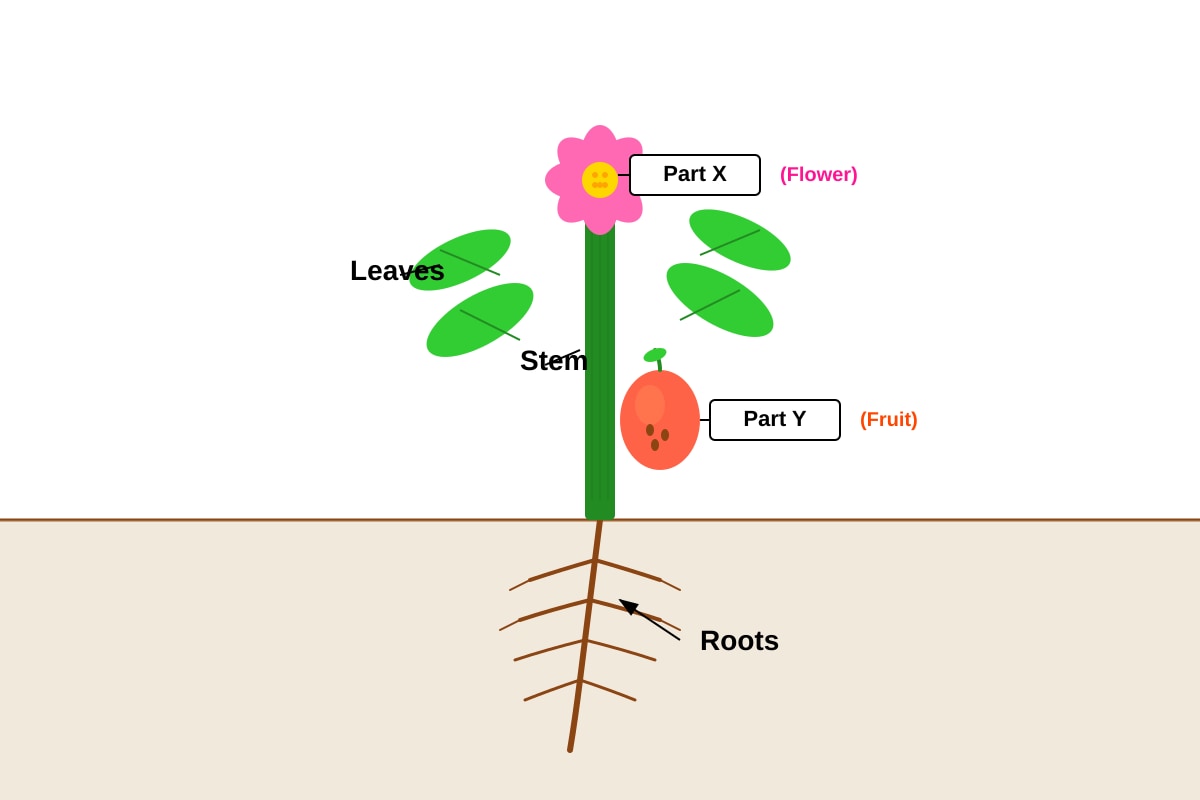
11. The diagram below shows a plant.
<image_placeholder> id: Q11-fig1 type: diagram linked_question: Q11 description: A complete flowering plant with roots, stem, leaves, flowers, and fruits. Parts labelled P, Q, R, S, T. labels: P: Roots; Q: Stem; R: Leaves; S: Flowers; T: Fruits values: must_show: Clear plant diagram with all five parts distinctly drawn and labelled P-T; roots underground, stem upright, leaves on stem, flowers and fruits visible </image_placeholder>
Which part absorbs water and mineral salts from the soil?
(1) P
(2) Q
(3) R
(4) S
12. The table below shows the functions of different plant parts.
| Plant Part | Function |
|---|---|
| Leaf | Makes food for the plant |
| Stem | ? |
| Root | Absorbs water and mineral salts; anchors the plant |
Which of the following is the correct function of the stem?
(1) Makes food for the plant
(2) Absorbs water and mineral salts
(3) Transports water and food; supports the plant
(4) Anchors the plant
13. A plant is placed in a dark cupboard for a week. Its leaves turn yellow. What is the most likely reason?
(1) The plant did not receive enough water.
(2) The plant did not receive enough light to make food.
(3) The roots stopped absorbing water.
(4) The stem could not transport food.
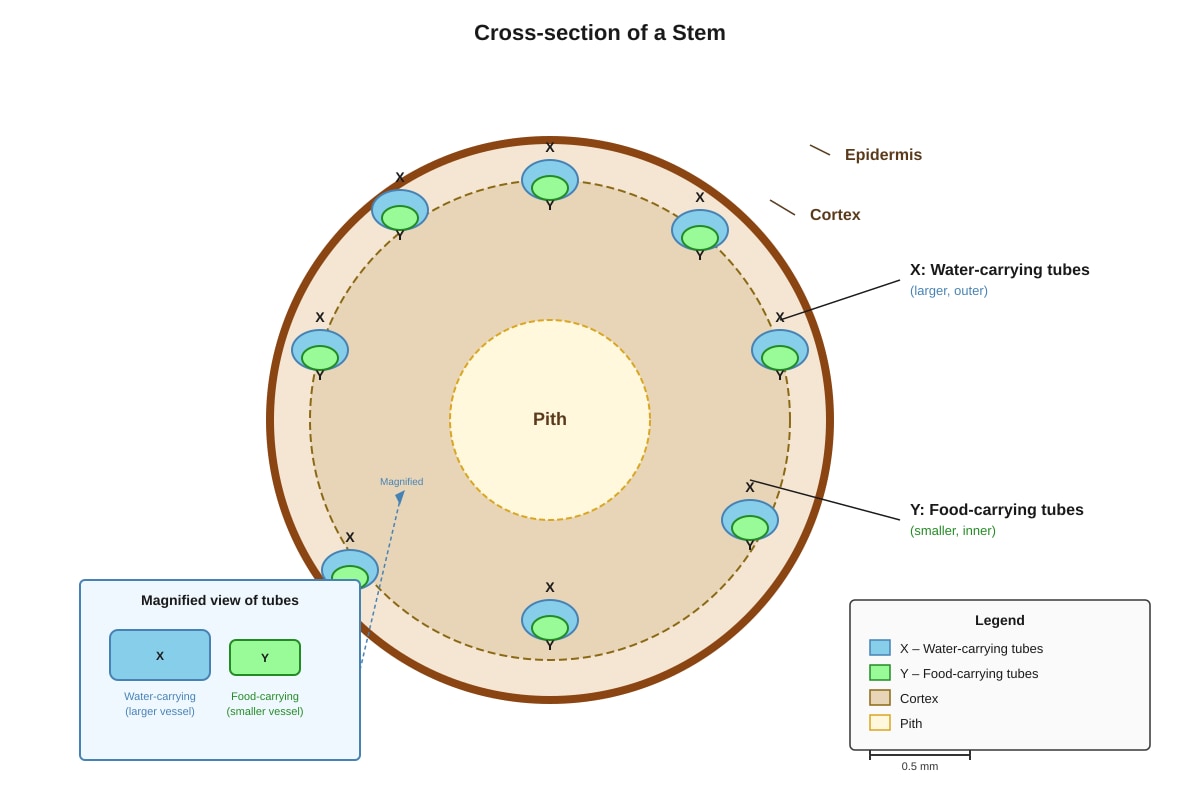
14. The diagram below shows a cross-section of a stem.
<image_placeholder> id: Q14-fig1 type: diagram linked_question: Q14 description: Cross-section of a stem showing vascular bundles. Two types of tubes shown: larger tubes (X) and smaller tubes (Y) arranged in a ring. labels: X: Water-carrying tubes (xylem); Y: Food-carrying tubes (phloem); Epidermis; Cortex; Pith values: must_show: Clear cross-section with distinct tube types labelled X and Y; other stem layers labelled </image_placeholder>
Tubes X carry water from the roots to the leaves. What do tubes Y carry?
(1) Water from roots to leaves
(2) Food from leaves to other parts
(3) Air from leaves to roots
(4) Mineral salts from soil to leaves
15. Which of the following statements about leaves is correct?
(1) Leaves absorb water from the soil.
(2) Leaves anchor the plant to the ground.
(3) Leaves make food for the plant using sunlight.
(4) Leaves transport water to the flowers.
Human System (Digestive System)
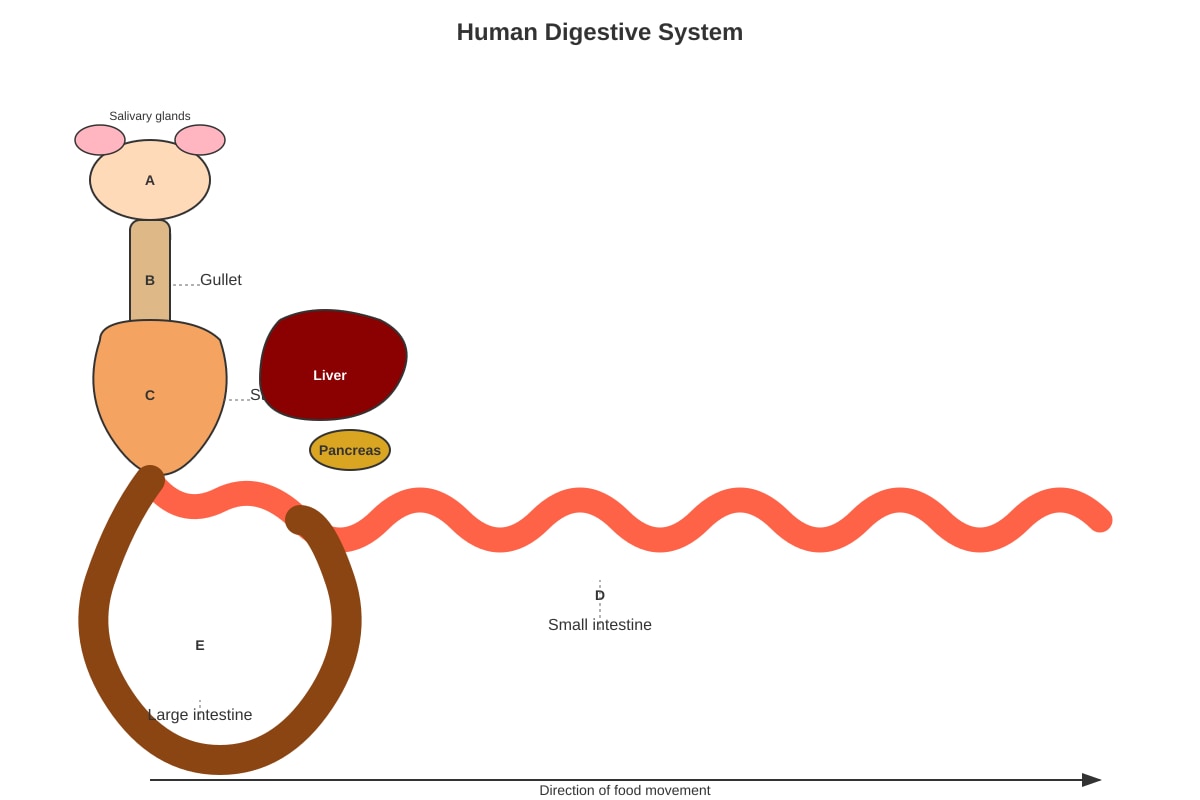
16. The diagram below shows the human digestive system.
<image_placeholder> id: Q16-fig1 type: diagram linked_question: Q16 description: Human digestive system diagram with organs labelled A, B, C, D, E, F. labels: A: Mouth; B: Gullet (Oesophagus); C: Stomach; D: Small intestine; E: Large intestine; F: Anus values: must_show: Clear digestive system outline with all six organs distinctly drawn and labelled A-F in correct anatomical positions </image_placeholder>
In which organ does digestion first begin?
(1) A
(2) B
(3) C
(4) D
17. Where does most absorption of digested food into the blood take place?
(1) Stomach
(2) Small intestine
(3) Large intestine
(4) Gullet
18. The table below shows the functions of some digestive organs.
| Organ | Function |
|---|---|
| Mouth | Chews food; mixes with saliva |
| Gullet | ? |
| Stomach | Churns food; mixes with gastric juice |
| Small intestine | Completes digestion; absorbs nutrients |
| Large intestine | Absorbs water; forms faeces |
What is the function of the gullet?
(1) Digests food using enzymes
(2) Absorbs water from undigested food
(3) Transports food from mouth to stomach
(4) Stores undigested food temporarily
19. Which of the following statements about the digestive system is incorrect?
(1) The stomach produces gastric juice to digest food.
(2) The small intestine absorbs digested food into the blood.
(3) The large intestine digests proteins.
(4) Saliva in the mouth starts the digestion of starch.
20. Food moves through the gullet to the stomach by muscular contractions. What is this process called?
(1) Digestion
(2) Absorption
(3) Peristalsis
(4) Excretion
Matter (States and Properties)
21. The diagram below shows the arrangement of particles in three states of matter.
<image_placeholder> id: Q21-fig1 type: diagram linked_question: Q21 description: Three boxes showing particle arrangement. Box 1: Particles tightly packed in ordered rows, vibrating in fixed positions. Box 2: Particles close but not ordered, sliding past each other. Box 3: Particles far apart, moving freely in all directions. labels: Box 1: Solid; Box 2: Liquid; Box 3: Gas values: must_show: Clear particle diagrams for all three states; arrows showing movement/vibration; labels for each state </image_placeholder>
Which state of matter has particles that are closest together?
(1) Solid
(2) Liquid
(3) Gas
(4) All are equally close
22. Ice is heated until it becomes water, then heated further until it becomes steam. Which of the following shows the correct change in the arrangement of particles?
(1) Ordered and close → Disordered and close → Far apart and random
(2) Far apart and random → Disordered and close → Ordered and close
(3) Disordered and close → Ordered and close → Far apart and random
(4) Ordered and close → Far apart and random → Disordered and close
23. Which of the following has a definite volume but no definite shape?
(1) Solid
(2) Liquid
(3) Gas
(4) Plasma
24. Water is boiled in a kettle. Steam rises and hits the cooler lid, forming water droplets. What process is taking place on the lid?
(1) Evaporation
(2) Condensation
(3) Freezing
(4) Melting
25. The diagram below shows a beaker of water being heated.
<image_placeholder> id: Q25-fig1 type: diagram linked_question: Q25 description: A beaker of water on a tripod stand with a Bunsen burner underneath. Thermometer in water. Bubbles forming at bottom and rising. Steam rising from surface. labels: Beaker, Water, Bunsen burner, Thermometer, Bubbles (water vapour), Steam, Tripod stand values: Water volume: 200 ml; Initial temperature: 30°C must_show: Complete experimental setup; bubbles clearly shown forming at bottom; steam at surface; thermometer readable </image_placeholder>
Bubbles are seen forming at the bottom of the beaker before the water boils. What are these bubbles made of?
(1) Air
(2) Oxygen
(3) Water vapour
(4) Hydrogen
Light (Shadows and Reflection)
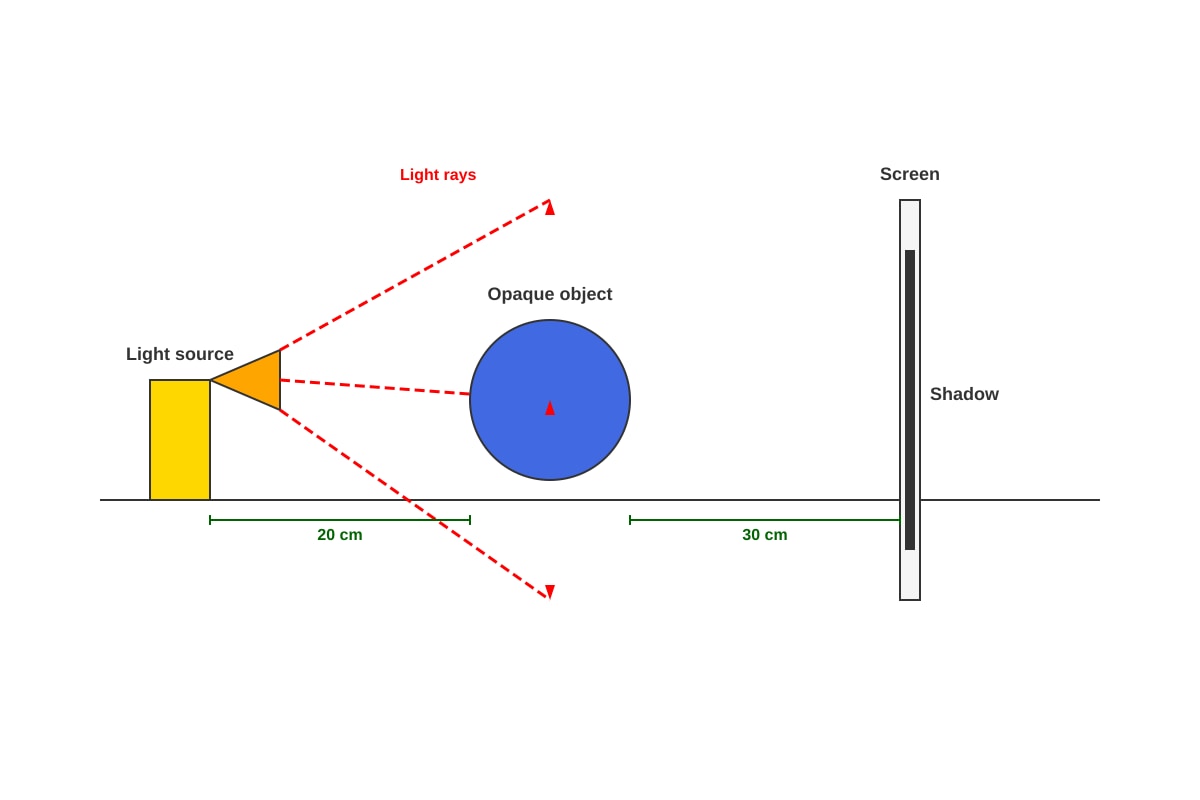
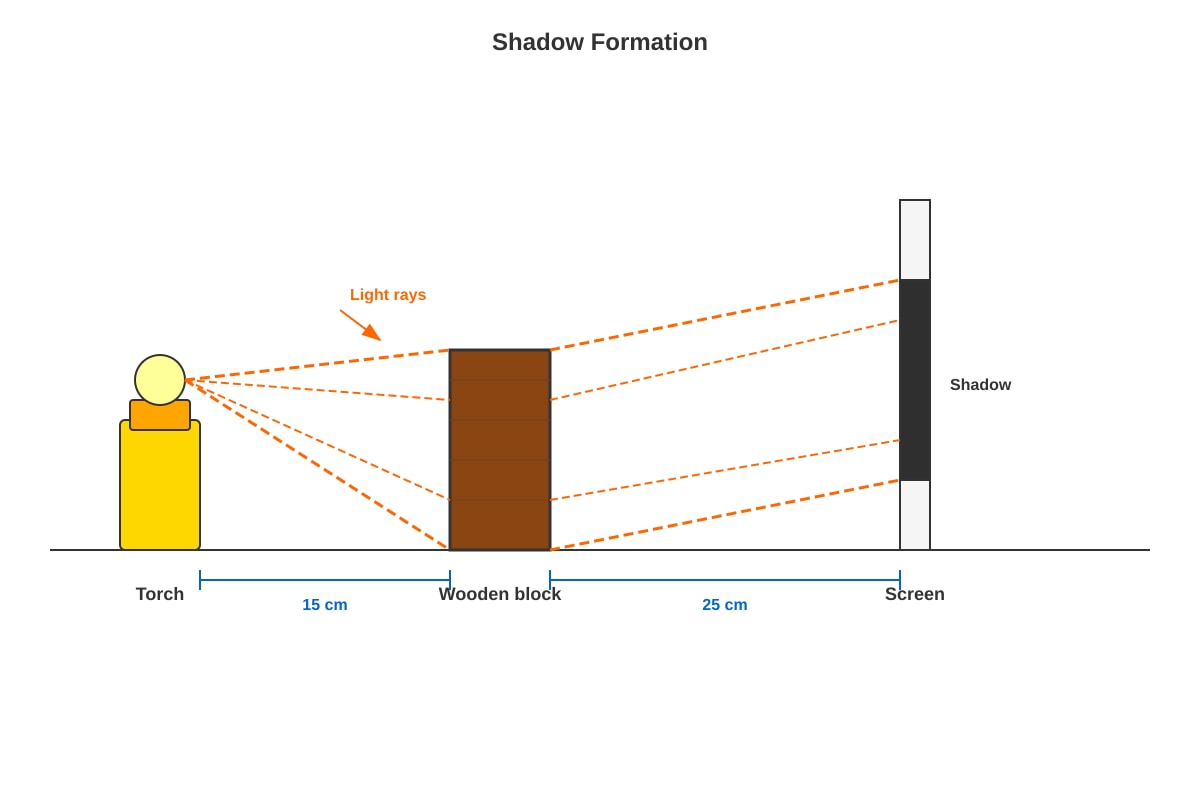
26. A wooden block is placed between a torch and a screen. A shadow is formed on the screen.
<image_placeholder> id: Q26-fig1 type: diagram linked_question: Q26 description: Torch on left, wooden block in middle, screen on right. Light rays travel from torch, hit block, and cast shadow on screen. Shadow labelled. labels: Torch (light source), Wooden block (opaque object), Screen, Shadow, Light rays (straight lines) values: Distance torch to block: 20 cm; Distance block to screen: 30 cm must_show: Straight light rays; clear shadow on screen; all components labelled; distances marked </image_placeholder>
Which of the following statements explains why a shadow is formed?
(1) Light bends around the wooden block.
(2) Light passes through the wooden block.
(3) Light travels in straight lines and is blocked by the wooden block.
(4) The wooden block reflects light onto the screen.
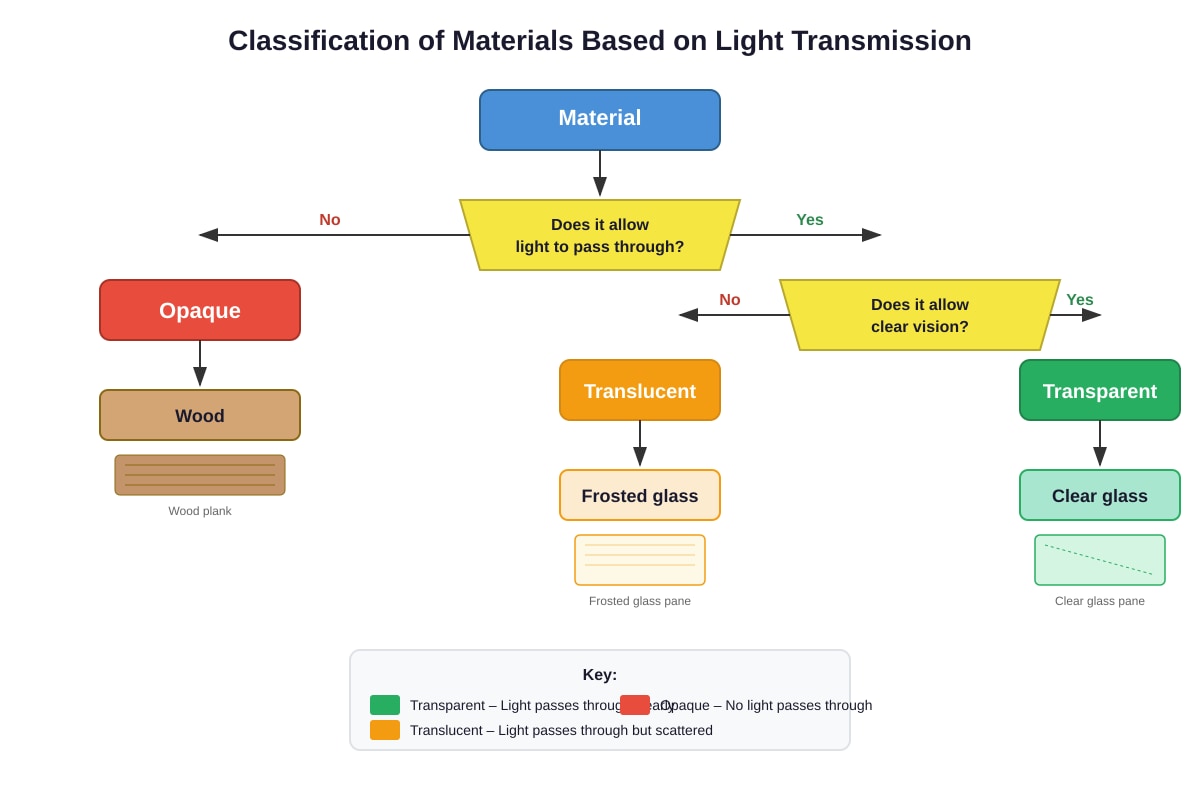
27. Which of the following objects will not form a shadow when light shines on it?
(1) A wooden ruler
(2) A clear glass cup
(3) A metal spoon
(4) A ceramic mug
28. The diagram below shows light hitting a plane mirror.
<image_placeholder> id: Q28-fig1 type: diagram linked_question: Q28 description: A light ray hitting a plane mirror at an angle. Incident ray, reflected ray, normal line, angle of incidence (i), angle of reflection (r) shown. labels: Incident ray, Reflected ray, Normal, Angle of incidence (i), Angle of reflection (r), Plane mirror values: Angle of incidence: 30° must_show: Clear ray diagram with normal line; angles i and r marked; mirror surface shown; incident and reflected rays on opposite sides of normal </image_placeholder>
If the angle of incidence is 30°, what is the angle of reflection?
(1) 15°
(2) 30°
(3) 60°
(4) 90°
SECTION B: Open-Ended Questions (44 marks)
Questions 29 to 40 carry the marks shown. Write your answers in the spaces provided.
Diversity (Living and Non-Living Things, Materials)
29. The diagram below shows four things: a cat, a mushroom, a robot, and a cloud.
<image_placeholder> id: Q29-fig1 type: diagram linked_question: Q29 description: Four separate pictures: (a) Cat, (b) Mushroom, (c) Robot, (d) Cloud. Each in its own box with label. labels: (a) Cat; (b) Mushroom; (c) Robot; (d) Cloud values: must_show: Clear illustrations of all four items; each in separate labelled box </image_placeholder>
(a) Classify the four things into the table below. [2]
| Living Things | Non-Living Things |
|---|---|
(b) State one characteristic of living things that the mushroom shows but the robot does not. [1]
30. Study the flowchart below.
<image_placeholder> id: Q30-fig1 type: diagram linked_question: Q30 description: Flowchart for classifying materials. Start: "Object X". Q1: "Is it waterproof?" Yes → Q2: "Is it flexible?" Yes → "Raincoat material"; No → "Umbrella canopy". No (from Q1) → Q3: "Is it transparent?" Yes → "Window pane"; No → "Brick". labels: Object X, Is it waterproof?, Is it flexible?, Raincoat material, Umbrella canopy, Is it transparent?, Window pane, Brick values: must_show: Complete flowchart with all decision points and outcomes; all text readable </image_placeholder>
(a) Object X is a bath towel. Write "bath towel" in the correct box in the flowchart. [1]
(b) State one property of a bath towel that allows it to be classified as "Raincoat material" in the flowchart. [1]
(c) Suggest a material for "Umbrella canopy" that is waterproof but not flexible. [1]
31. The table below shows the properties of four materials, A, B, C, and D.
| Material | Strong | Waterproof | Flexible | Transparent |
|---|---|---|---|---|
| A | Yes | Yes | No | No |
| B | Yes | Yes | Yes | No |
| C | No | Yes | Yes | Yes |
| D | Yes | No | Yes | No |
(a) Which material (A, B, C, or D) is most suitable for making a tent? Give two reasons based on the table. [2]
(b) Which material (A, B, C, or D) is least suitable for making a window pane? Explain your answer. [2]
Plants (Plant Parts and Functions)
32. The diagram below shows a young plant growing in a pot. The plant is placed near a window.
<image_placeholder> id: Q32-fig1 type: diagram linked_question: Q32 description: A potted plant near a window. Sunlight coming from window direction. Plant bending towards window. Roots visible in soil. Labels: Roots, Stem, Leaves, Window, Sunlight direction. labels: Roots, Stem, Leaves, Window, Sunlight direction values: must_show: Plant bending towards light source; roots in soil; window with sunlight arrows; all parts labelled </image_placeholder>
(a) Name the plant part that anchors the plant to the soil. [1]
(b) The plant bends towards the window. Explain why this happens. [2]
(c) If the roots are damaged, how will the plant be affected? [1]
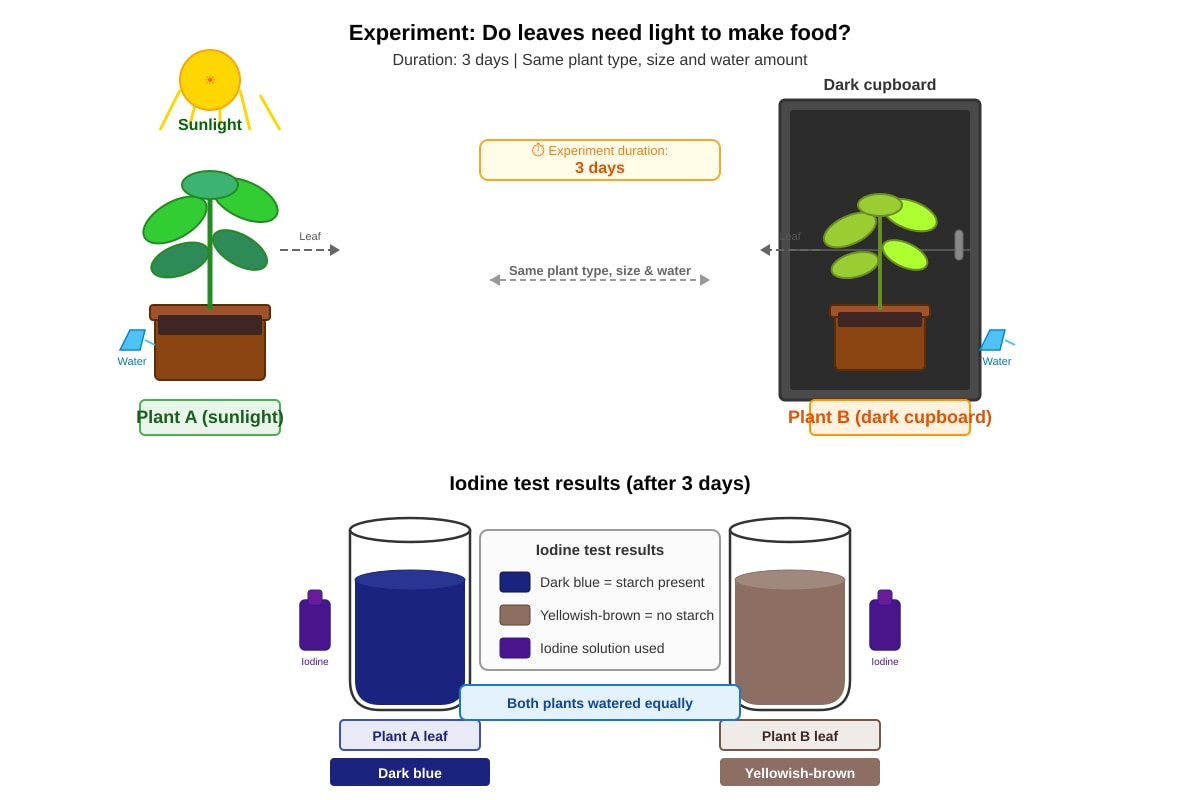
33. A student conducts an experiment to find out if leaves need light to make food. She covers part of a leaf with black paper as shown.
<image_placeholder> id: Q33-fig1 type: diagram linked_question: Q33 description: A leaf on a plant. Left half covered with black paper (labelled "Covered"), right half exposed to light (labelled "Exposed"). Sunlight shining on leaf. labels: Covered part (black paper), Exposed part, Sunlight values: Duration: 3 days must_show: Clear leaf with half covered by black paper; sunlight arrows; labels for covered and exposed parts </image_placeholder>
After 3 days, she tests both parts of the leaf for starch using iodine solution.
(a) What colour will the exposed part of the leaf turn? [1]
(b) What colour will the covered part of the leaf turn? [1]
(c) Explain the difference in results. [2]
34. The diagram below shows a cross-section of a stem. Tubes X and Y transport substances in the plant.
<image_placeholder> id: Q34-fig1 type: diagram linked_question: Q34 description: Cross-section of stem showing two types of tubes. Tube X: larger, thick-walled. Tube Y: smaller, thin-walled. Arrows showing direction of transport in each. labels: Tube X (water-carrying), Tube Y (food-carrying), Direction arrows values: must_show: Clear cross-section with two distinct tube types; arrows showing upward flow in X, bidirectional/up-down in Y; labels for X and Y </image_placeholder>
(a) Name the substances transported by Tube X and Tube Y. [2]
Tube X: ________________________________________
Tube Y: ________________________________________
(b) If Tube X is removed in a ring around the stem (ringing), the plant will die. Explain why. [2]
Human System (Digestive System)
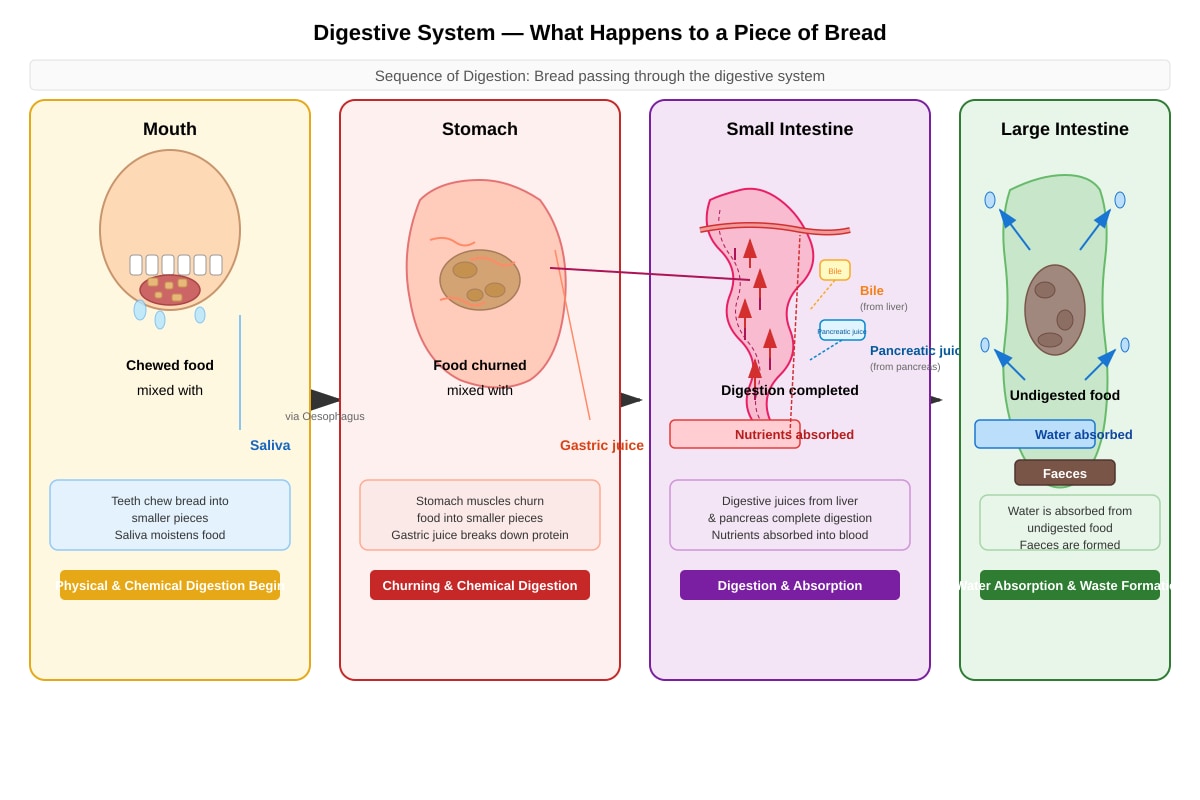
35. The diagram below shows the human digestive system.
<image_placeholder> id: Q35-fig1 type: diagram linked_question: Q35 description: Human digestive system with organs labelled 1-6. 1: Mouth, 2: Gullet, 3: Stomach, 4: Small intestine, 5: Large intestine, 6: Anus. labels: 1: Mouth, 2: Gullet, 3: Stomach, 4: Small intestine, 5: Large intestine, 6: Anus values: must_show: Complete digestive system with all six organs clearly labelled 1-6 in correct positions </image_placeholder>
(a) In which organ (1-6) is water mainly absorbed from undigested food? [1]
(b) In which organ (1-6) does digestion of proteins begin? [1]
(c) State one function of the large intestine. [1]
(d) Food stays in the stomach for a few hours. Explain why this is necessary. [2]
36. The table below shows the digestive juices and the food substances they act on.
| Digestive Juice | Produced In | Acts On |
|---|---|---|
| Saliva | Mouth | Starch |
| Gastric juice | Stomach | Protein |
| Intestinal juice | Small intestine | ? |
(a) Complete the table by stating the food substance that intestinal juice acts on. [1]
(b) Where does the digestion of fats mainly take place? [1]
(c) Explain why food must be digested before it can be absorbed into the blood. [2]
Matter (States and Properties)
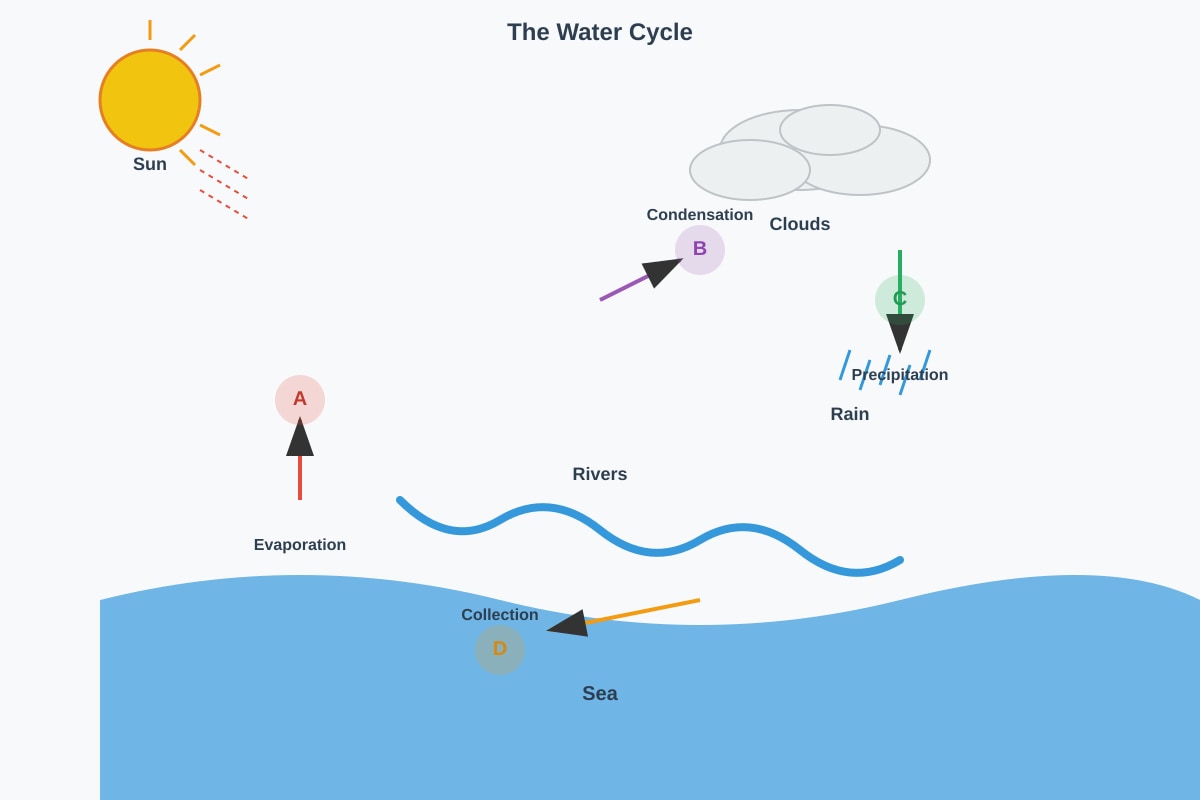
37. The diagram below shows the water cycle.
<image_placeholder> id: Q37-fig1 type: diagram linked_question: Q37 description: Water cycle diagram. Sun, evaporation from sea, condensation forming clouds, precipitation (rain), collection in rivers/sea. Processes labelled A, B, C, D. labels: A: Evaporation; B: Condensation; C: Precipitation; D: Collection; Sun, Sea, Clouds, Rain, Rivers values: must_show: Complete water cycle with all four processes labelled A-D; sun, sea, clouds, rain, rivers visible; arrows showing cycle direction </image_placeholder>
(a) Name the processes A, B, C, and D. [2]
A: ________________________________________
B: ________________________________________
C: ________________________________________
D: ________________________________________
(b) State one difference between evaporation and boiling. [1]
(c) Puddles dry up after rain even without boiling. Explain why. [2]
38. A beaker contains 150 cm³ of water at 25°C. Ice cubes are added and the mixture is stirred until all ice melts. The final volume is 200 cm³ and temperature is 5°C.
(a) What is the volume of ice added? [1]
(b) State the change of state that occurred. [1]
(c) During the melting, the temperature of the mixture remains at 0°C until all ice melts. Explain why. [2]
39. The diagram below shows a syringe with its nozzle sealed. The plunger is pulled back.
<image_placeholder> id: Q39-fig1 type: diagram linked_question: Q39 description: Syringe with sealed nozzle. Plunger pulled back. Air inside expands to fill larger volume. Arrows showing plunger movement. labels: Sealed nozzle, Plunger (pulled back), Air inside, Increased volume values: Initial volume: 20 cm³; Final volume: 40 cm³ must_show: Syringe with sealed nozzle; plunger pulled back clearly; air inside; volume markings; arrows showing movement </image_placeholder>
(a) What happens to the volume of air in the syringe? [1]
(b) What happens to the mass of air in the syringe? [1]
(c) Explain your answers in (a) and (b). [2]
Light (Shadows and Reflection)
40. The diagram below shows an experiment with a torch, an object, and a screen.
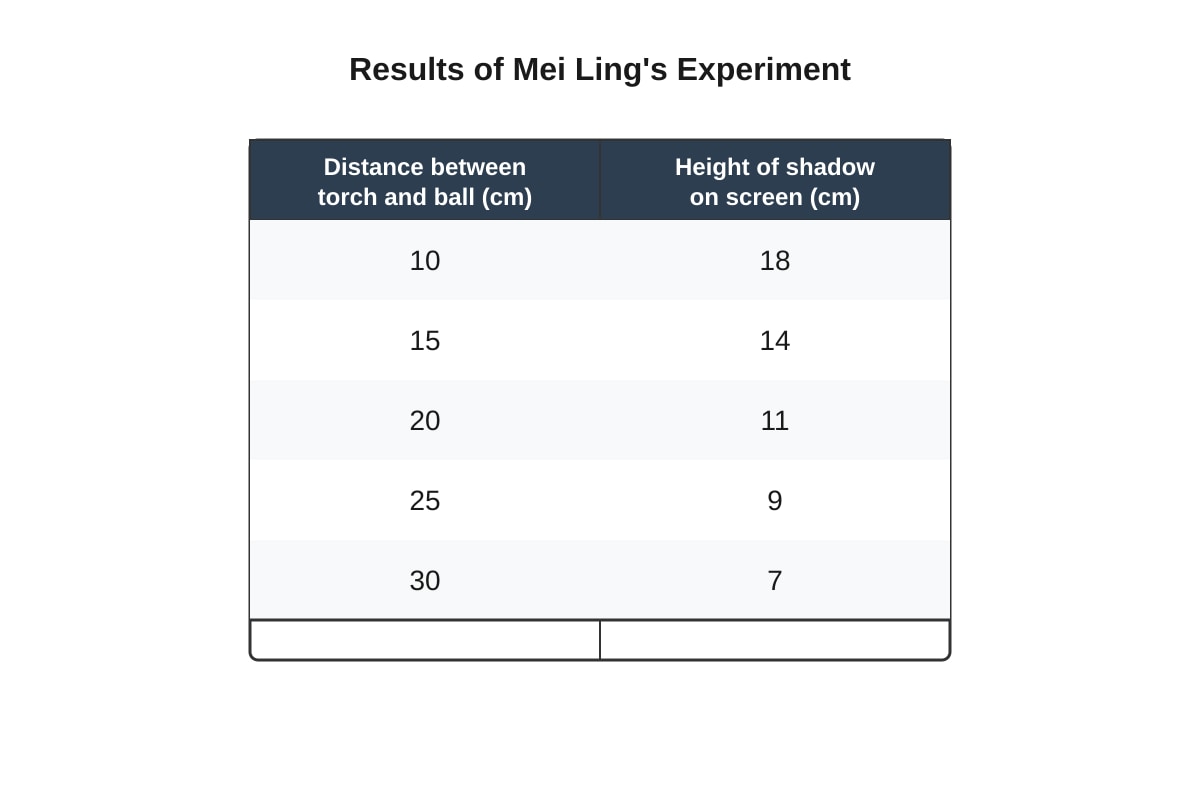
<image_placeholder> id: Q40-fig1 type: diagram linked_question: Q40 description: Torch, object, screen in a line. Three positions for object: Position A (close to torch), Position B (middle), Position C (close to screen). Shadows shown on screen for each position. labels: Torch, Object, Screen, Position A, Position B, Position C, Shadow A, Shadow B, Shadow C values: Torch to screen distance: 100 cm; Position A: 20 cm from torch; Position B: 50 cm from torch; Position C: 80 cm from torch must_show: Three object positions with corresponding shadows on screen; distances marked; torch and screen fixed; shadow sizes clearly different </image_placeholder>
(a) At which position (A, B, or C) is the shadow largest? [1]
(b) Explain why the shadow size changes when the object is moved. [2]
(c) The object is replaced with a clear glass block of the same size and shape. Will a shadow be formed? Explain. [2]
END OF PAPER
Answers
TuitionGoWhere Practice Paper - Science Primary 4 (SA2 Version 5) - Answer Key
Subject: Science
Level: Primary 4
Paper: SA2 (Semestral Assessment 2) - Version 5
Total Marks: 100
SECTION A: Multiple-Choice Questions (56 marks)
Question 1 [2 marks]
Answer: (1) Mushroom, fern, moss
Explanation: Mushrooms (fungi), ferns, and mosses are all living things. They grow, reproduce, and respond to changes. Clouds, rivers, rocks, robots, cars, computers, shadows, reflections, and light are non-living things.
Question 2 [2 marks]
Answer: (4) Item D → Animals
Explanation:
- Item A (Mushroom) is a fungus, not a plant (fungi are a separate kingdom, but at P4 level often grouped separately from plants).
- Item B (Wooden chair) is man-made, not natural.
- Item C (River water) is natural, not man-made.
- Item D (Butterfly) is an animal. This is correctly classified.
Question 3 [2 marks]
Answer: (3) Bala and Devi
Explanation:
- Bala is correct: All living things need air, food, and water to survive.
- Devi is correct: All living things grow and respond to changes in their environment.
- Ahmad is incorrect: Plants are living things but cannot move from place to place (they only move parts like leaves/flowers).
- Cindy is incorrect: Not all living things lay eggs (e.g., mammals give birth to live young; plants produce seeds/spores).
Question 4 [2 marks]
Answer: (3) Fabric
Explanation: The flowchart asks "Is it flexible?" first. If yes, the material is classified as "Fabric". Since Material X is flexible, it is fabric.
Question 5 [2 marks]
Answer: (3) Transparent
Explanation: Metals are typically opaque (not transparent). They are good conductors of heat, malleable, and lustrous (shiny).
Question 6 [2 marks]
Answer: (1) A
Explanation: A raincoat needs to be flexible (to wear comfortably) and waterproof (to keep rain out). Material A has both properties. Material B is not flexible. Material C is not waterproof. Material D is not flexible.
Question 7 [2 marks]
Answer: (3) It can be compressed because it contains air.
Explanation: The sponge changes volume when pressed (from 50 cm³ to 20 cm³) because the air pockets inside are compressed. This shows that the sponge contains air, which can be compressed. Solids have definite volume and shape; liquids have definite volume but no definite shape.
Question 8 [2 marks]
Answer: (3) Matter occupies space and has mass.
Explanation: This is the definition of matter. Not all matter can be seen (e.g., gases like air). All states of matter (solids, liquids, gases) have mass. Gases occupy space (they fill their container).
Question 9 [2 marks]
Answer: (2) Group X: Gases; Group Y: Solids
Explanation: Group X contains oxygen, carbon dioxide, and water vapour — all gases at room temperature. Group Y contains sand, stone, and iron nail — all solids.
Question 10 [2 marks]
Answer: (3) Air can be compressed.
Explanation: The volume of air decreased from 20 cm³ to 10 cm³ when the plunger was pushed in. This shows air can be compressed (its volume can be reduced). Air has mass and does not have a fixed volume.
Question 11 [2 marks]
Answer: (1) P
Explanation: P represents the roots. Roots absorb water and mineral salts from the soil and anchor the plant.
Question 12 [2 marks]
Answer: (3) Transports water and food; supports the plant
Explanation: The stem transports water (via xylem) from roots to leaves and food (via phloem) from leaves to other parts. It also supports the plant upright.
Question 13 [2 marks]
Answer: (2) The plant did not receive enough light to make food.
Explanation: Leaves need light for photosynthesis (making food). Without light, the plant cannot produce chlorophyll (green pigment) and food, so leaves turn yellow.
Question 14 [2 marks]
Answer: (2) Food from leaves to other parts
Explanation: Tube X (xylem) carries water and mineral salts from roots to leaves. Tube Y (phloem) carries food (sugar) made in the leaves to other parts of the plant.
Question 15 [2 marks]
Answer: (3) Leaves make food for the plant using sunlight.
Explanation: Leaves contain chlorophyll and carry out photosynthesis, using sunlight, carbon dioxide, and water to make food (sugar). Roots absorb water; roots anchor the plant; stem transports water.
Question 16 [2 marks]
Answer: (1) A
Explanation: A is the mouth. Digestion begins in the mouth where teeth chew food (mechanical digestion) and saliva starts chemical digestion of starch.
Question 17 [2 marks]
Answer: (2) Small intestine
Explanation: The small intestine has villi (finger-like projections) that increase surface area for absorption. Most digested nutrients (glucose, amino acids, fatty acids) are absorbed here into the bloodstream.
Question 18 [2 marks]
Answer: (3) Transports food from mouth to stomach
Explanation: The gullet (oesophagus) is a muscular tube that moves food from the mouth to the stomach by peristalsis. It does not digest food or absorb nutrients.
Question 19 [2 marks]
Answer: (3) The large intestine digests proteins.
Explanation: This statement is incorrect. The large intestine absorbs water and minerals from undigested food and forms faeces. Protein digestion occurs in the stomach (by gastric juice) and small intestine (by intestinal juice and pancreatic juice).
Question 20 [2 marks]
Answer: (3) Peristalsis
Explanation: Peristalsis is the wave-like muscular contractions that push food through the digestive tract (gullet, stomach, intestines).
Question 21 [2 marks]
Answer: (1) Solid
Explanation: In solids, particles are tightly packed in fixed positions (ordered arrangement), making them closest together. In liquids, particles are close but can slide past each other. In gases, particles are far apart.
Question 22 [2 marks]
Answer: (1) Ordered and close → Disordered and close → Far apart and random
Explanation: Ice (solid): particles ordered and close. Water (liquid): particles disordered but close. Steam (gas): particles far apart and moving randomly.
Question 23 [2 marks]
Answer: (2) Liquid
Explanation: Liquids have a definite volume (cannot be compressed easily) but no definite shape (take the shape of their container). Solids have both definite volume and shape. Gases have neither.
Question 24 [2 marks]
Answer: (2) Condensation
Explanation: Steam (water vapour/gas) hits the cooler lid and changes to water droplets (liquid). This change from gas to liquid is condensation.
Question 25 [2 marks]
Answer: (3) Water vapour
Explanation: As water is heated, water molecules gain energy and form water vapour bubbles at the bottom (where it's hottest). These are not air bubbles — air would have escaped earlier. The bubbles are water in gaseous state.
Question 26 [2 marks]
Answer: (3) Light travels in straight lines and is blocked by the wooden block.
Explanation: Shadows form because light travels in straight lines. The opaque wooden block blocks light, creating a dark area (shadow) on the screen behind it.
Question 27 [2 marks]
Answer: (2) A clear glass cup
Explanation: A clear glass cup is transparent — it allows most light to pass through, so it does not form a distinct shadow (only a very faint one). Wooden ruler, metal spoon, and ceramic mug are opaque and block light, forming clear shadows.
Question 28 [2 marks]
Answer: (2) 30°
Explanation: Law of reflection: Angle of incidence = Angle of reflection. If angle of incidence is 30°, angle of reflection is also 30°.
SECTION B: Open-Ended Questions (44 marks)
Question 29 [3 marks]
(a) [2 marks]
| Living Things | Non-Living Things |
|---|---|
| Cat, Mushroom | Robot, Cloud |
Marking: 1 mark for correct living things (both cat and mushroom), 1 mark for correct non-living things (both robot and cloud). No half marks.
(b) [1 mark]
The mushroom grows / reproduces / responds to changes / needs air, food, and water (any one characteristic of living things).
Explanation: Mushrooms are fungi (living things) — they grow, reproduce by spores, respond to environment, and need nutrients. Robots are machines (non-living) — they do not grow, reproduce, or need food/water/air.
Common mistake: Saying "mushroom can move" — mushrooms cannot move from place to place.
Question 30 [3 marks]
(a) [1 mark] "bath towel" written in the "Raincoat material" box (after "Is it flexible?" → Yes).
(b) [1 mark]
A bath towel is waterproof (or "absorbs water" — but in context of flowchart, it passes "Is it waterproof?" → Yes).
Better answer: It is waterproof (allows it to pass first question) and flexible (allows it to pass second question).
(c) [1 mark]
Plastic sheet / Polycarbonate / Acrylic sheet / Metal sheet (any rigid waterproof material).
Explanation: The flowchart path to "Umbrella canopy" is: Waterproof → Not flexible. So the material must be waterproof but not flexible (rigid).
Question 31 [4 marks]
(a) [2 marks]
Material B
Reasons (any two):
- It is strong (can withstand wind/rain).
- It is waterproof (keeps rain out).
- It is flexible (easy to set up and pack).
Marking: 1 mark for correct material (B), 1 mark for two valid reasons from table.
(b) [2 marks]
Material D (or Material A — both are not transparent).
Explanation: A window pane must be transparent to allow light to pass through so we can see through it. Material D is not transparent (and also not waterproof, but transparency is the key property for a window). Material A is also not transparent but is strong and waterproof — still unsuitable because it's opaque. Material C is transparent but not strong — also unsuitable, but D is least suitable as it lacks both transparency and waterproofing.
Better answer: Material D — it is not transparent (so light cannot pass through) and not waterproof (would let rain in).
<stage3_exam_answers_md>
TuitionGoWhere Practice Paper - Science Primary 4 (Answer Key)
TuitionGoWhere Exam Practice (AI)
Subject: Science
Level: Primary 4
Paper: SA2 (Semestral Assessment 2) - Version 5
SECTION A: Multiple-Choice Questions (56 marks)
| Question | Answer | Explanation |
|---|---|---|
| 1 | (1) | Mushroom, fern, and moss are all living things (fungi and plants). Cloud, river, rock are non-living natural things. Robot, car, computer are man-made non-living things. Shadow, reflection, light are non-living phenomena. |
| 2 | (4) | Item D (Butterfly) → Animals. Item A (Mushroom) is a fungus, not a plant. Item B (Wooden chair) is man-made, not natural. Item C (River water) is natural, not man-made. |
| 3 | (3) | Bala: All living things need air, food, and water ✓. Devi: All living things grow and respond to changes ✓. Ahmad: Plants don't move from place to place ✗. Cindy: Not all living things lay eggs (mammals give birth, plants produce seeds/spores) ✗. |
| 4 | (3) | The flowchart shows: "Is it flexible?" → Yes → "Fabric". Material X is flexible, so it is fabric. |
| 5 | (3) | Metals are opaque, not transparent. They are good conductors of heat, malleable, and lustrous. |
| 6 | (1) | Raincoat needs to be flexible, waterproof, and not transparent. Material A: Flexible (Yes), Waterproof (Yes), Transparent (No) ✓. Material B: Not flexible ✗. Material C: Not waterproof ✗. Material D: Not flexible ✗. |
| 7 | (3) | The sponge compresses because it contains air pockets that can be squeezed out. This shows it can be compressed because it contains air. |
| 8 | (3) | Matter is defined as anything that occupies space and has mass. Air (gas) has mass and occupies space but cannot be seen. |
| 9 | (2) | Group X: Oxygen, Carbon dioxide, Water vapour → all gases. Group Y: Sand, Stone, Iron nail → all solids. |
| 10 | (3) | The volume of air decreased from 20 cm³ to 10 cm³ when the plunger was pushed, showing air can be compressed. |
| 11 | (1) | P represents roots, which absorb water and mineral salts from the soil. |
| 12 | (3) | The stem transports water and food, and supports the plant. |
| 13 | (2) | Without light, plants cannot photosynthesise to make food. Leaves turn yellow due to lack of chlorophyll production. |
| 14 | (2) | Tubes Y (phloem) carry food from leaves to other parts of the plant. |
| 15 | (3) | Leaves make food for the plant using sunlight (photosynthesis). Roots absorb water, roots anchor, stem transports. |
| 16 | (1) | Digestion first begins in the mouth (A) where food is chewed and mixed with saliva containing amylase. |
| 17 | (2) | Most absorption of digested food into the blood takes place in the small intestine. |
| 18 | (3) | The gullet (oesophagus) transports food from the mouth to the stomach via peristalsis. |
| 19 | (3) | The large intestine absorbs water and forms faeces; it does not digest proteins. Protein digestion occurs in stomach and small intestine. |
| 20 | (3) | Peristalsis is the wave-like muscular contractions that move food through the digestive tract. |
| 21 | (1) | In solids, particles are tightly packed in ordered rows, closest together. |
| 22 | (1) | Ice (solid): ordered and close → Water (liquid): disordered and close → Steam (gas): far apart and random. |
| 23 | (2) | Liquids have definite volume but no definite shape (take shape of container). |
| 24 | (2) | Steam (gas) hitting cooler lid changes to water droplets (liquid) → condensation. |
| 25 | (3) | Bubbles forming at bottom before boiling are water vapour (dissolved air comes out earlier, but these are vapour bubbles nucleating at hot surface). |
| 26 | (3) | Light travels in straight lines and is blocked by opaque objects, forming shadows. |
| 27 | (2) | A clear glass cup is transparent - light passes through, so no shadow forms (or very faint). Wooden ruler, metal spoon, ceramic mug are opaque. |
| 28 | (2) | Law of reflection: angle of incidence = angle of reflection. If i = 30°, then r = 30°. |
SECTION B: Open-Ended Questions (44 marks)
Question 29 [3 marks]
(a) [2 marks - 0.5 each correct classification]
| Living Things | Non-Living Things |
|---|---|
| Cat, Mushroom | Robot, Cloud |
(b) [1 mark]
The mushroom reproduces (by producing spores) / grows / responds to changes / needs air, food, and water.
(Any one characteristic of living things that the robot does not show)
Question 30 [3 marks]
(a) [1 mark]
Write "bath towel" in the "Raincoat material" box (after: Is it waterproof? → Yes → Is it flexible? → Yes).
(b) [1 mark]
A bath towel is waterproof (absorbs water but does not let it pass through easily) and flexible.
(Must mention both properties as per flowchart path)
(c) [1 mark]
Plastic / Nylon / Polyester / Canvas (treated to be waterproof)
(Any waterproof but not flexible material suitable for umbrella canopy)
Question 31 [4 marks]
Complete Table:
| Material | Strong | Waterproof | Flexible | Transparent |
|---|---|---|---|---|
| A | Yes | Yes | No | No |
| B | Yes | Yes | No | Yes |
| C | No | Yes | Yes | No |
| D | Yes | No | Yes | No |
(a) [1 mark]
Material B — It is strong, waterproof, and transparent (allows light to pass through so the plants can get sunlight for photosynthesis).
(b) [1 mark]
Material A — It is strong and waterproof but not transparent (provides privacy) and not flexible (rigid structure for a wall).
(c) [1 mark]
Material C — It is waterproof and flexible (can be folded/sewn into a bag) but not strong (suitable for light items).
(d) [1 mark]
Material D — It is strong and flexible (can be woven into fabric) but not waterproof (allows sweat to evaporate, keeping the wearer cool).
Question 32 [3 marks]
(a) [1 mark]
Solid — The particles are tightly packed in a fixed, ordered arrangement, vibrating in fixed positions.
(b) [1 mark]
Gas — The particles are far apart and move freely in all directions at high speed.
(c) [1 mark]
In a solid, particles are closely packed in an ordered arrangement and vibrate in fixed positions.
In a liquid, particles are close but not in fixed positions, sliding past one another.
(Must contrast arrangement and movement)
Question 33 [3 marks]
(a) [1 mark]
Melting — The ice (solid) gains heat and changes to water (liquid).
(b) [1 mark]
The temperature of the ice/water mixture remains constant at 0°C until all the ice has melted.
(Heat energy is used to overcome forces between particles, not raise temperature)
(c) [1 mark]
Condensation — Water vapour (gas) in the air loses heat to the cold outer surface of the beaker and changes into water droplets (liquid).
Question 34 [4 marks]
(a) [1 mark]
Shadow A — The opaque card blocks all light, forming a dark shadow.
(b) [1 mark]
Shadow B — The clear plastic sheet is transparent and allows most light to pass through, so no distinct shadow is formed (or a very faint one).
(c) [1 mark]
Shadow C — The tracing paper is translucent, allowing some light to pass through but blocking the rest, forming a lighter/fainter shadow.
(d) [1 mark]
Move the torch closer to the object / Move the screen further from the object.
(Either increases the size of the shadow)
Question 35 [3 marks]
(a) [1 mark]
Light travels in straight lines.
The light from the torch travels in straight lines, hits the opaque book, and is blocked, forming a sharp shadow on the wall.
(b) [1 mark]
The shadow becomes larger.
(Moving the torch closer to the object increases the angle of light rays blocked, enlarging the shadow on the wall)
(c) [1 mark]
Use a smaller light source (e.g., a point source like a laser pointer or a torch with a smaller bulb) / Move the torch further away from the object.
(A smaller or more distant light source produces sharper shadows with less penumbra)
Question 36 [4 marks]
(a) [1 mark]
Angle of reflection = 40°
(Law of reflection: angle of incidence = angle of reflection)
(b) [1 mark]
Draw the reflected ray on the opposite side of the normal, making a 40° angle with the normal.
(Arrow pointing away from mirror)
(c) [1 mark]
The image is laterally inverted (left-right reversed) / upright / same size as object / virtual (cannot be caught on a screen) / same distance behind mirror as object in front.
(Any one correct property)
(d) [1 mark]
Periscope / Rear-view mirror in vehicles / Mirror at blind corners / Dentist's mirror.
(Any one practical application of plane mirror reflection)
Question 37 [4 marks]
(a) [1 mark]
Mouth — Teeth chew food into smaller pieces (mechanical digestion); saliva contains amylase that starts digestion of starch (chemical digestion).
(b) [1 mark]
Stomach — Churns food (mechanical digestion); gastric juice contains protease that digests proteins (chemical digestion); hydrochloric acid kills bacteria.
(c) [1 mark]
Small intestine — Receives bile (emulsifies fats) and pancreatic juice (digests carbohydrates, proteins, fats); completes digestion; villi absorb nutrients into blood.
(d) [1 mark]
Large intestine — Absorbs water and mineral salts from undigested food; forms faeces; stores faeces temporarily before egestion.
Question 38 [4 marks]
(a) [1 mark]
Roots — Absorb water and mineral salts from the soil.
(b) [1 mark]
Stem — Transports water and mineral salts from roots to leaves (via xylem); transports food from leaves to other parts (via phloem); supports the plant upright.
(c) [1 mark]
Leaves — Trap sunlight with chlorophyll; make food (glucose) through photosynthesis using carbon dioxide and water; release oxygen.
(d) [1 mark]
Flowers — Reproductive organs; produce male (pollen) and female (ovules) gametes; after pollination and fertilisation, develop into fruits and seeds.
Question 39 [4 marks]
(a) [1 mark]
Set-up B — The plant has no roots, so it cannot absorb water. The water level remains the same (no decrease).
(b) [1 mark]
Set-up A — The plant has roots to absorb water, and the oil layer prevents evaporation, so any decrease in water level is due to absorption by roots only.
(c) [1 mark]
The oil layer prevents evaporation of water from the beaker, ensuring that any change in water level is due only to absorption by the plant roots.
(d) [1 mark]
The water level in Set-up C will decrease more than in Set-up A.
(Set-up C has no oil layer, so water is lost through both root absorption AND evaporation)
Question 40 [4 marks]
(a) [1 mark]
Solid — The metal block has a fixed shape and fixed volume; its particles are tightly packed in fixed positions.
(b) [1 mark]
Liquid — The water takes the shape of the container (no fixed shape) but has a fixed volume; its particles are close but can slide past one another.
(c) [1 mark]
Gas — The air fills the entire balloon (no fixed shape or volume); its particles are far apart and move freely in all directions.
(d) [1 mark]
When the metal block is heated, it expands slightly (particles vibrate more vigorously and move slightly further apart).
When the water is heated, it expands (particles move faster and further apart, increasing volume).
When the air in the balloon is heated, it expands significantly (particles move much faster and further apart, increasing pressure and volume, causing balloon to inflate more).
(Must describe expansion for all three states due to increased particle movement)
MARKING SCHEME SUMMARY
| Section | Questions | Marks per Question | Total Marks |
|---|---|---|---|
| A (MCQ) | 1–28 | 2 | 56 |
| B (OE) | 29 | 3 | 3 |
| B (OE) | 30 | 3 | 3 |
| B (OE) | 31 | 4 | 4 |
| B (OE) | 32 | 3 | 3 |
| B (OE) | 33 | 3 | 3 |
| B (OE) | 34 | 4 | 4 |
| B (OE) | 35 | 3 | 3 |
| B (OE) | 36 | 4 | 4 |
| B (OE) | 37 | 4 | 4 |
| B (OE) | 38 | 4 | 4 |
| B (OE) | 39 | 4 | 4 |
| B (OE) | 40 | 4 | 4 |
| Total | 100 |
End of Answer Key