From Real Exams Exam Paper

Primary 4 Science Semestral Assessment 2 (End of Year) Paper 4

Free Exam-Derived NVIDIA Nemotron 3 Ultra 550B A55B Free Primary 4 Science Semestral Assessment 2 (End of Year) Paper 4 practice paper with questions and answers for Singapore students. This page is rendered as a direct URL so the questions and answers can be discovered without pressing in-page buttons.

These static practice materials are generated from the site's syllabus and paper-generation workflow, with source and model context shown so students and parents can evaluate the material before use.

Primary 4 Science From Real Exams Generated by NVIDIA Nemotron 3 Ultra 550B A55B Free Updated 2026-06-06

Questions

<!-- TuitionGoWhere generation metadata: stage=3-1; model=nvidia/nemotron-3-ultra-550b-a55b:free; model_label=NVIDIA Nemotron 3 Ultra 550B A55B Free; generated=2026-06-05; Sources: Stage 2-1 real exam-derived templates and Stage 2-2 exam-enriched syllabus. -->

TuitionGoWhere Practice Paper - Science Primary 4

TuitionGoWhere Exam Practice (AI)

Subject: Science
Level: Primary 4
Paper: SA2 (Version 4)
Duration: 1 hour 30 minutes
Total Marks: 60

Name: ________________________
Class: Primary 4 ________
Date: ________________________


INSTRUCTIONS TO CANDIDATES

  1. Do not turn over this page until you are told to do so.
  2. Follow all instructions carefully.
  3. Answer all questions.
  4. For Section A, shade your answers on the Optical Answer Sheet (OAS) provided.
  5. For Section B, write your answers in the spaces provided in this booklet.
  6. The number of marks is given in brackets [ ] at the end of each question or part question.
  7. The total marks for this paper is 60.

SECTION A (30 marks)

For each question from 1 to 15, four options are given. One of them is the correct answer. Make your choice (1, 2, 3 or 4) and shade the correct oval on the OAS.

Question 1 [2 marks]

Which of the following groups of living things are all classified as plants?

(1) Mushroom, fern, moss
(2) Algae, yeast, toadstool
(3) Balsam plant, water lily, bamboo
(4) Bacteria, mould, moss

Question 2 [2 marks]

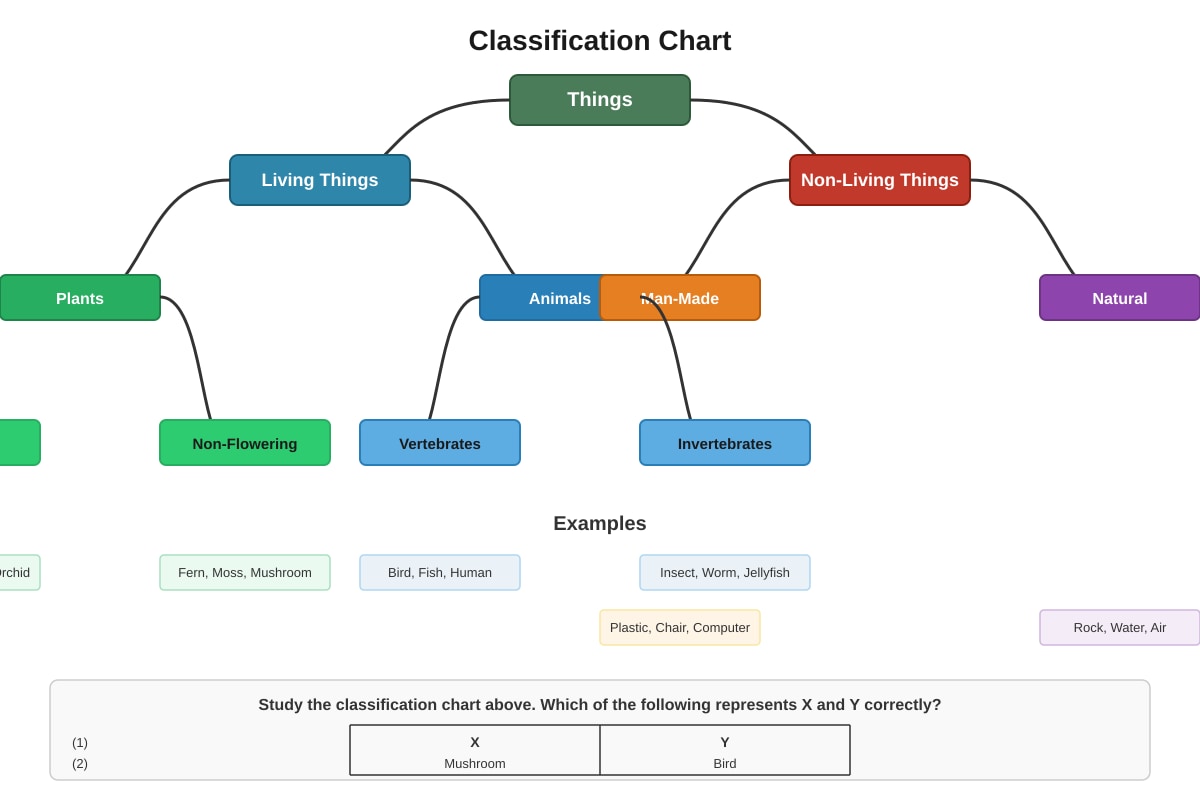
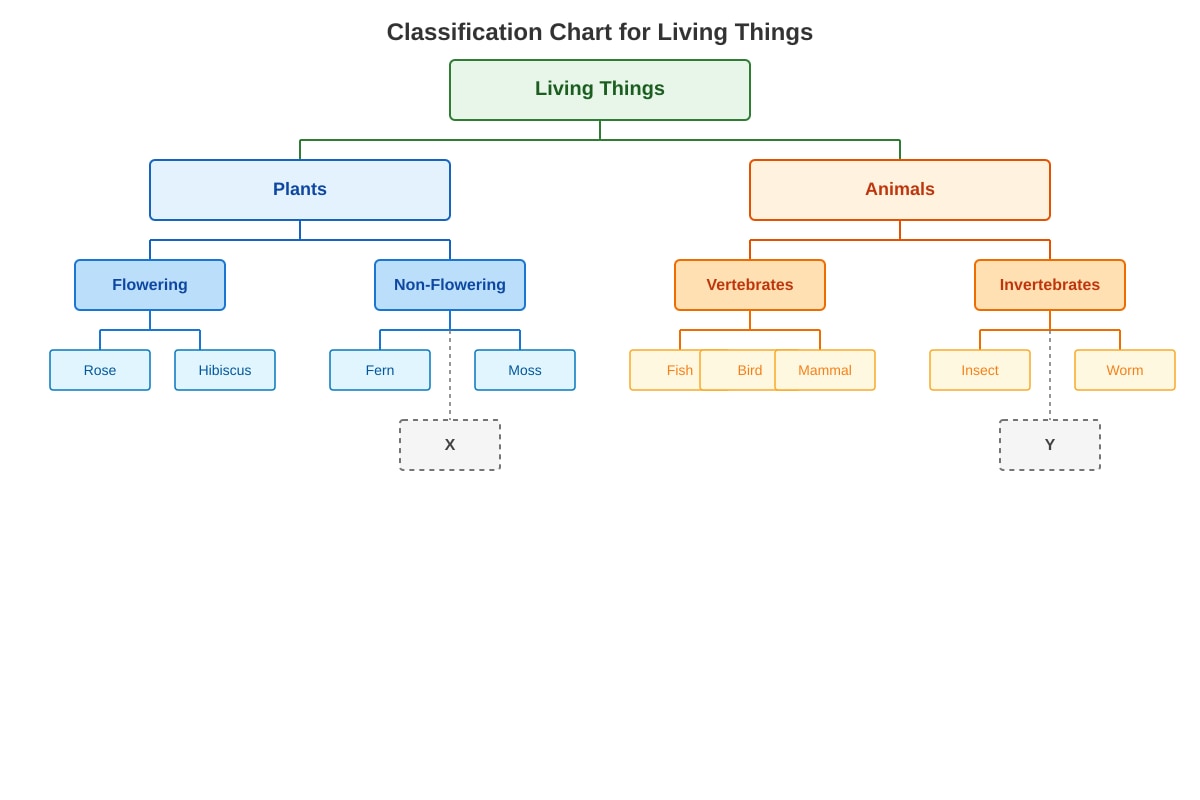
Study the classification chart below.

<image_placeholder> id: Q1-fig1 type: diagram linked_question: Q1 description: A classification chart with two main branches: Living Things and Non-living Things. Living Things branch into Plants and Animals. Plants branch into Flowering and Non-flowering. Animals branch into Vertebrates and Invertebrates. Vertebrates branch into Mammals, Birds, Fish, Reptiles, Amphibians. Invertebrates branch into Insects, Arachnids, Molluscs, Worms. labels: Living Things, Non-living Things, Plants, Animals, Flowering, Non-flowering, Vertebrates, Invertebrates, Mammals, Birds, Fish, Reptiles, Amphibians, Insects, Arachnids, Molluscs, Worms values: None must_show: Clear hierarchical branching with all group names visible </image_placeholder>

Which of the following living things is classified incorrectly in the chart above?

(1) Whale → Mammals
(2) Penguin → Birds
(3) Bat → Mammals
(4) Shark → Mammals

Question 3 [2 marks]

Four pupils made the following statements about fungi and bacteria.

  • Ali: Fungi and bacteria are both microorganisms.
  • Bala: Fungi make their own food but bacteria do not.
  • Cindy: Both fungi and bacteria reproduce by spores.
  • Devi: Fungi and bacteria are both decomposers.

Which two pupils made correct statements?

(1) Ali and Bala
(2) Ali and Devi
(3) Bala and Cindy
(4) Cindy and Devi

Question 4 [2 marks]

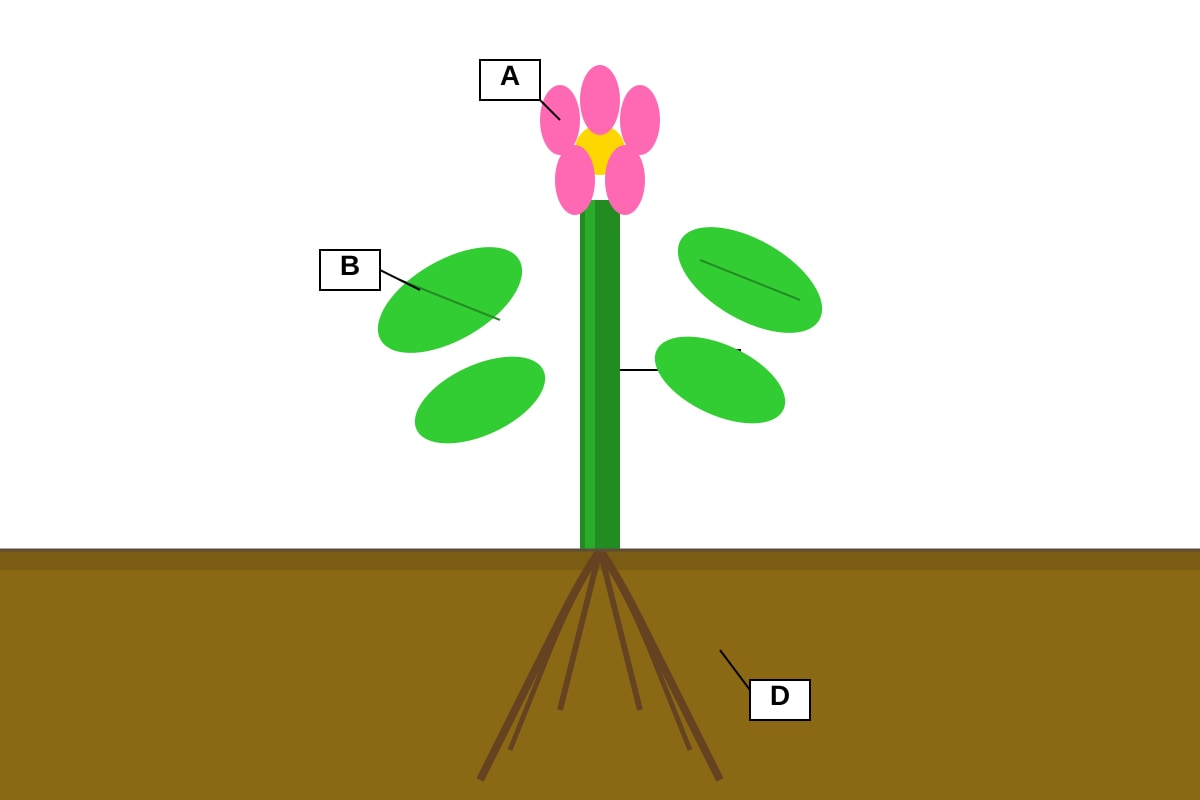
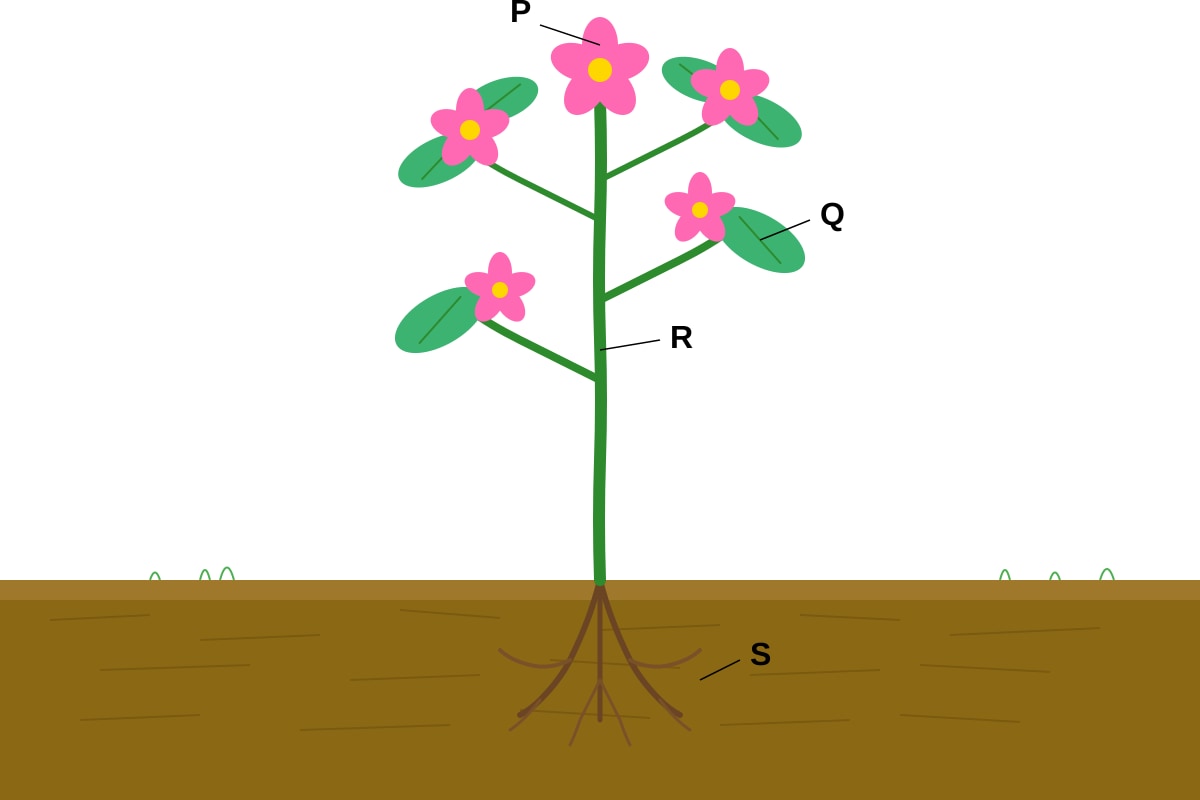
The diagram below shows a plant.

<image_placeholder> id: Q4-fig1 type: diagram linked_question: Q4 description: A diagram of a flowering plant showing roots, stem, leaves, flowers, and fruits. The roots are underground. The stem is upright. Leaves are attached to the stem. Flowers and fruits are at the top of the plant. labels: Roots, Stem, Leaves, Flowers, Fruits values: None must_show: Clear labels for all five plant parts; roots underground, stem upright, leaves on stem, flowers and fruits at top </image_placeholder>

Which part of the plant absorbs water and mineral salts from the soil?

(1) Roots
(2) Stem
(3) Leaves
(4) Flowers

Question 5 [2 marks]

Which of the following statements about non-flowering plants is correct?

(1) They reproduce by seeds.
(2) They reproduce by spores.
(3) They have flowers to attract pollinators.
(4) They cannot make their own food.

Question 6 [2 marks]

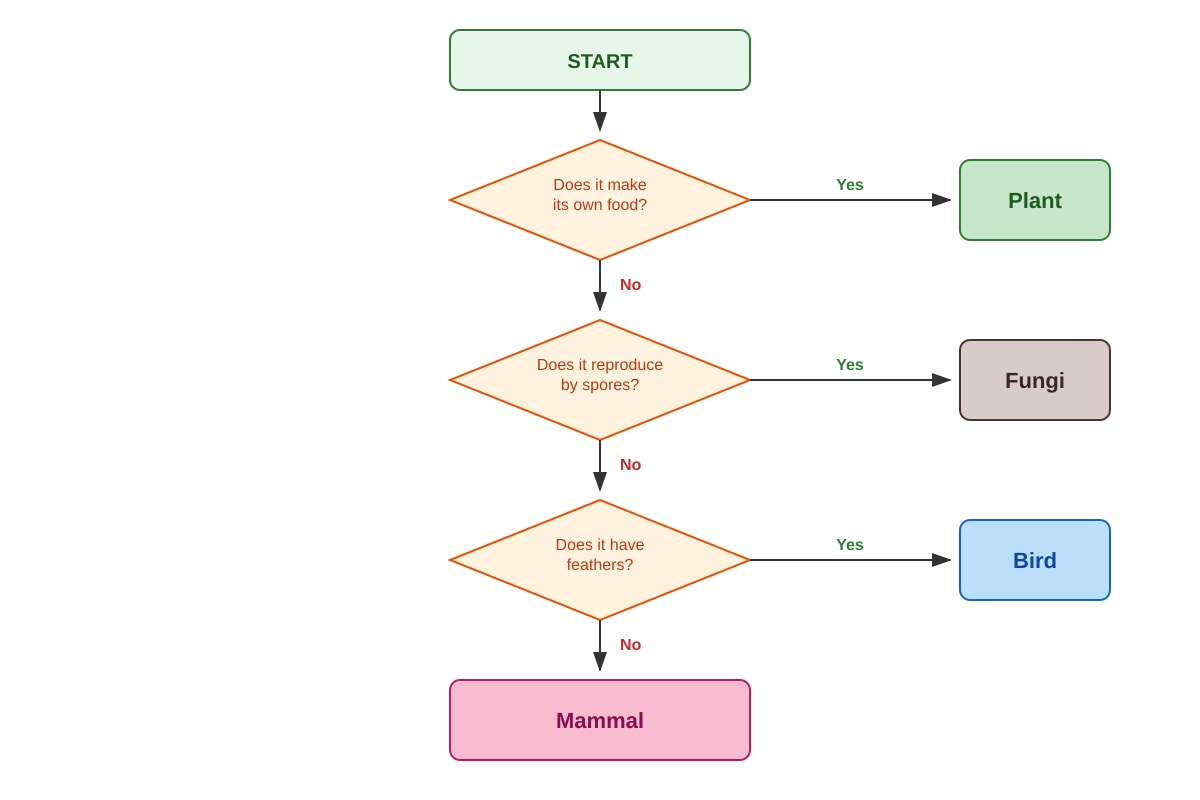
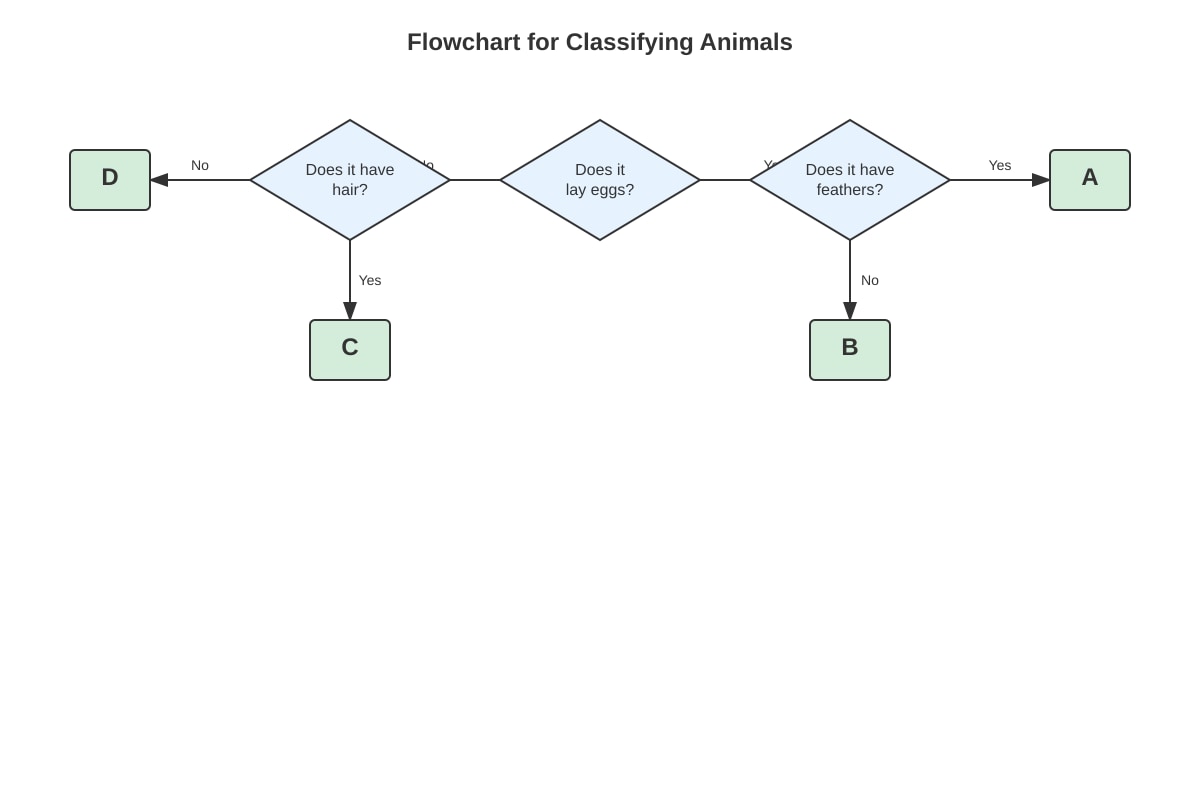
Study the flowchart below.

<image_placeholder> id: Q6-fig1 type: diagram linked_question: Q6 description: A flowchart for classifying animals. Start: Does it have a backbone? Yes → Vertebrates. No → Invertebrates. Vertebrates branch: Does it have feathers? Yes → Birds. No → Does it have hair/fur? Yes → Mammals. No → Does it live in water and have gills? Yes → Fish. No → Does it have dry scaly skin? Yes → Reptiles. No → Amphibians. Invertebrates branch: Does it have 6 legs and 3 body parts? Yes → Insects. No → Does it have 8 legs and 2 body parts? Yes → Arachnids. No → Others. labels: Backbone, Vertebrates, Invertebrates, Feathers, Birds, Hair/Fur, Mammals, Water/Gills, Fish, Dry Scaly Skin, Reptiles, Amphibians, 6 Legs/3 Body Parts, Insects, 8 Legs/2 Body Parts, Arachnids, Others values: None must_show: Clear decision diamonds and branching with all questions and group names visible </image_placeholder>

Animal X has a backbone, lays eggs in water, and has moist skin. Animal Y has a backbone, has feathers, and lays eggs on land.

Which groups do Animal X and Animal Y belong to?

Animal XAnimal Y
(1)AmphibiansBirds
(2)FishBirds
(3)AmphibiansMammals
(4)ReptilesBirds

Question 7 [2 marks]

The table below shows the characteristics of four organisms, P, Q, R, and S. A tick (✓) means the organism has the characteristic.

CharacteristicPQRS
Makes its own food
Reproduces by spores
Has cell wall

Which organism is most likely a fungus?

(1) P
(2) Q
(3) R
(4) S

Question 8 [2 marks]

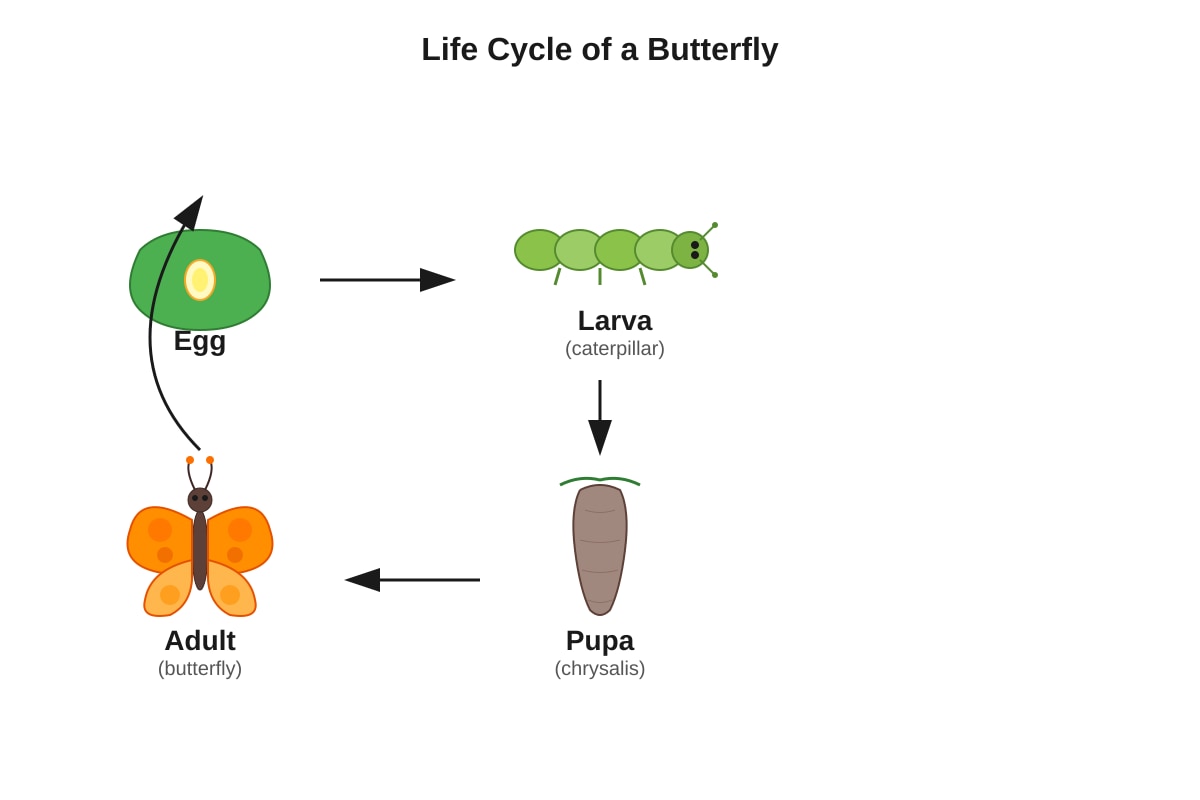
Which of the following shows the correct order of the life cycle of a butterfly?

(1) Egg → Pupa → Larva → Adult
(2) Egg → Larva → Pupa → Adult
(3) Egg → Nymph → Adult
(4) Egg → Adult → Larva → Pupa

Question 9 [2 marks]

The diagram below shows the life cycle of a mosquito.

<image_placeholder> id: Q9-fig1 type: diagram linked_question: Q9 description: A circular life cycle diagram of a mosquito with four stages: Egg, Larva, Pupa, Adult. Arrows show Egg → Larva → Pupa → Adult → Egg. Labels indicate Larva and Pupa live in water. Adult flies. labels: Egg, Larva, Pupa, Adult, Water (for larva and pupa), Air (for adult) values: None must_show: Four distinct stages in correct cyclic order; labels for aquatic stages (larva, pupa) and terrestrial adult </image_placeholder>

At which stage(s) does the mosquito live in water?

(1) Egg only
(2) Larva and Pupa only
(3) Egg, Larva and Pupa
(4) Adult only

Question 10 [2 marks]

Mei Ling observed an animal. It has a three-stage life cycle: Egg → Nymph → Adult. The nymph looks like a smaller version of the adult but has no wings.

Which animal did Mei Ling most likely observe?

(1) Butterfly
(2) Grasshopper
(3) Mosquito
(4) Frog

Question 11 [2 marks]

Which of the following statements about bacteria is incorrect?

(1) Bacteria are microorganisms.
(2) Bacteria can be found in air, water, and soil.
(3) All bacteria are harmful to humans.
(4) Bacteria reproduce by binary fission.

Question 12 [2 marks]

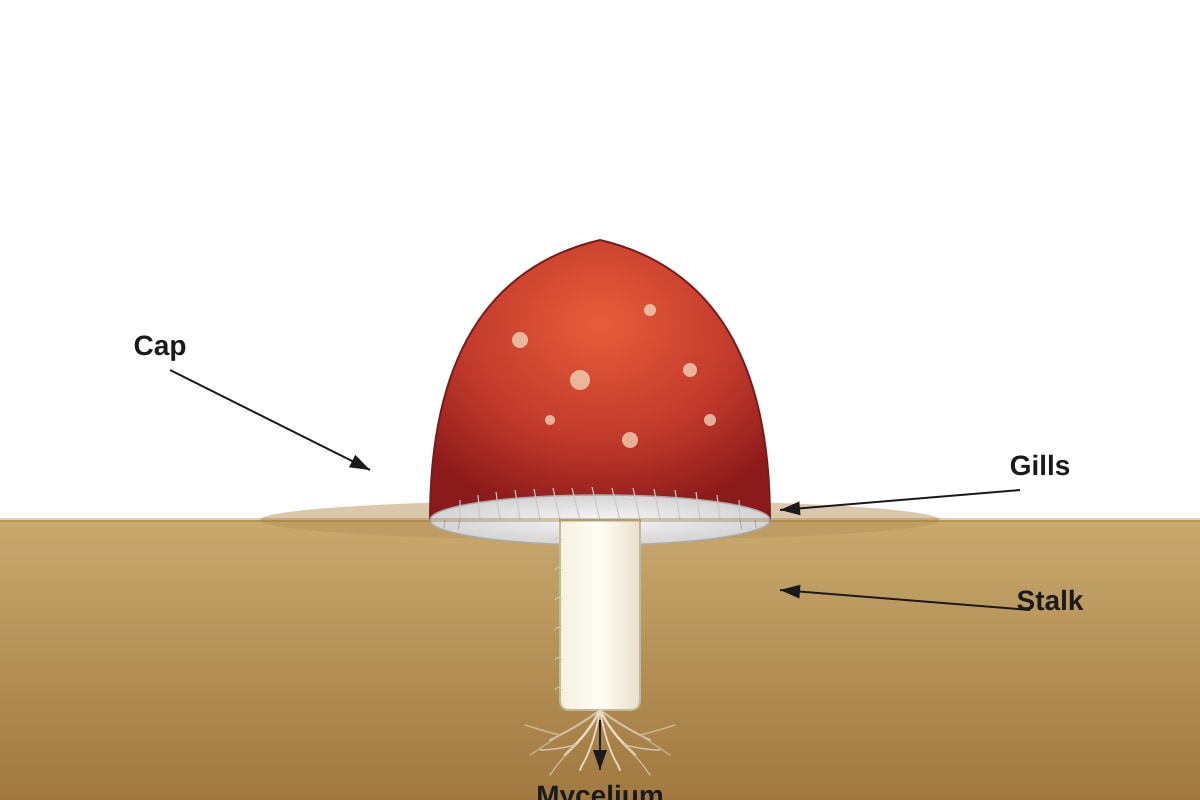
The diagram below shows a mushroom growing on a rotting log.

<image_placeholder> id: Q12-fig1 type: diagram linked_question: Q12 description: A mushroom growing on a decaying log. The mushroom has a cap, gills (under the cap), and a stalk. The log appears decayed with visible decomposition. labels: Cap, Gills, Stalk, Rotting Log values: None must_show: Mushroom with visible cap, gills, stalk on a clearly decaying log </image_placeholder>

What is the function of the gills on the underside of the mushroom cap?

(1) To absorb water from the log
(2) To produce and release spores
(3) To make food for the mushroom
(4) To support the mushroom cap

Question 13 [2 marks]

Study the classification table below.

GroupExamples
AMould, Yeast, Mushroom
BFern, Moss, Conifer
CBacteria, Amoeba, Paramecium
DRose, Hibiscus, Orchid

Which group represents fungi?

(1) A
(2) B
(3) C
(4) D

Question 14 [2 marks]

Ahmad found an organism in the garden. It has the following characteristics:

  • It has a cell wall.
  • It does not make its own food.
  • It reproduces by spores.

Which group does this organism most likely belong to?

(1) Plants
(2) Fungi
(3) Bacteria
(4) Animals

Question 15 [2 marks]

The diagram below shows the life cycle of a frog.

<image_placeholder> id: Q15-fig1 type: diagram linked_question: Q15 description: A circular life cycle diagram of a frog with stages: Egg → Tadpole (with gills, tail, no legs) → Tadpole with legs (developing hind legs, then front legs, tail shrinking) → Froglet (four legs, very short tail) → Adult Frog (four legs, no tail, lungs). Arrows show progression. Labels indicate tadpole lives in water, adult lives on land and water. labels: Egg, Tadpole, Tadpole with legs, Froglet, Adult Frog, Water, Land values: None must_show: Clear progression from egg to adult with distinct morphological changes; labels for aquatic (tadpole) and semi-terrestrial (adult) stages </image_placeholder>

Which of the following statements about the frog's life cycle is correct?

(1) The tadpole breathes through lungs.
(2) The adult frog lays eggs on land.
(3) The tadpole and the adult frog live in different habitats.
(4) The frog undergoes incomplete metamorphosis.


SECTION B (30 marks)

Write your answers in the spaces provided. The number of marks is given in brackets [ ] at the end of each question or part question.

Question 16 [2 marks]

The diagram below shows two organisms, A and B.

<image_placeholder> id: Q16-fig1 type: diagram linked_question: Q16 description: Two separate diagrams side by side. Organism A: A green plant with roots, stem, leaves, and flowers. Organism B: A mushroom with cap, gills, and stalk growing on soil. labels: Organism A: Roots, Stem, Leaves, Flowers. Organism B: Cap, Gills, Stalk values: None must_show: Clear contrast between flowering plant (A) and mushroom (B) with all parts labeled </image_placeholder>

(a) State one similarity between Organism A and Organism B. [1]


(b) State one difference between Organism A and Organism B in terms of how they obtain food. [1]


Question 17 [3 marks]

Classify the following living things into the correct groups in the table below.

Living things: Bat, Whale, Penguin, Guppy, Frog, Lizard

MammalsBirdsFishReptilesAmphibians

Question 18 [3 marks]

The flowchart below shows how some animals are classified.

<image_placeholder> id: Q18-fig1 type: diagram linked_question: Q18 description: A flowchart with questions: Start → Does it have 6 legs? Yes → Insect. No → Does it have 8 legs? Yes → Arachnid. No → Does it have a soft body and a shell? Yes → Mollusc. No → Worm. labels: 6 legs, Insect, 8 legs, Arachnid, Soft body/Shell, Mollusc, Worm values: None must_show: Clear decision path with four end groups: Insect, Arachnid, Mollusc, Worm </image_placeholder>

(a) Based on the flowchart, which group does an animal with 8 legs and no shell belong to? [1]


(b) State two characteristics of an insect. [2]


Question 19 [4 marks]

The diagram below shows the life cycle of a mealworm beetle.

<image_placeholder> id: Q19-fig1 type: diagram linked_question: Q19 description: A life cycle diagram of a mealworm beetle (complete metamorphosis): Egg → Larva (mealworm) → Pupa → Adult Beetle. Arrows show progression. Labels: Larva eats a lot and molts several times. Pupa does not eat or move. Adult has wings and can fly. labels: Egg, Larva (Mealworm), Pupa, Adult Beetle, Molts, Wings values: None must_show: Four distinct stages; labels for molting larva, inactive pupa, winged adult </image_placeholder>

(a) Name the type of metamorphosis shown by the mealworm beetle. [1]


(b) State one difference between the larva and the adult beetle. [1]


(c) The pupa stage is often called the "resting stage". Explain why this term is not entirely accurate. [2]


Question 20 [4 marks]

Siti conducted an experiment to find out how temperature affects the growth of mould on bread. She prepared four set-ups as shown below.

<image_placeholder> id: Q20-fig1 type: experimental_setup linked_question: Q20 description: Four identical slices of bread in sealed transparent containers labeled A, B, C, D. Each has a few drops of water added. Container A placed in freezer (-10°C). Container B placed in refrigerator (4°C). Container C placed at room temperature (28°C). Container D placed in an incubator (37°C). All containers observed daily for 7 days. labels: Container A: Freezer (-10°C), Container B: Refrigerator (4°C), Container C: Room temp (28°C), Container D: Incubator (37°C), Bread slice, Water drops, Sealed container values: Temperatures: -10°C, 4°C, 28°C, 37°C; Duration: 7 days must_show: Four containers with clear temperature labels; identical bread slices; water drops visible; sealed containers </image_placeholder>

(a) What is the aim of Siti's experiment? [1]


(b) Which container (A, B, C, or D) will the mould grow fastest? Explain your answer. [2]


(c) State one variable that Siti must keep the same for all four set-ups to ensure a fair test. [1]


Question 21 [4 marks]

The diagram below shows a plant cell and an animal cell.

<image_placeholder> id: Q21-fig1 type: diagram linked_question: Q21 description: Two cell diagrams side by side. Left: Plant cell with cell wall, cell membrane, cytoplasm, nucleus, chloroplasts, large vacuole. Right: Animal cell with cell membrane, cytoplasm, nucleus, small vacuoles (no cell wall, no chloroplasts, no large vacuole). labels: Plant Cell: Cell Wall, Cell Membrane, Cytoplasm, Nucleus, Chloroplasts, Large Vacuole. Animal Cell: Cell Membrane, Cytoplasm, Nucleus, Small Vacuoles values: None must_show: Clear structural differences: cell wall, chloroplasts, large vacuole in plant cell; absence in animal cell </image_placeholder>

(a) Identify two structures present in the plant cell but absent in the animal cell. [2]


(b) State the function of chloroplasts. [1]


(c) Why do root cells of a plant not have chloroplasts? [1]


Question 22 [4 marks]

Study the classification chart below.

<image_placeholder> id: Q22-fig1 type: diagram linked_question: Q22 description: A classification chart: Living Things → Plants and Animals. Plants → Flowering (Fruit-bearing, Non-fruit-bearing) and Non-flowering (Spore-bearing, Cone-bearing). Animals → Vertebrates (Mammals, Birds, Fish, Reptiles, Amphibians) and Invertebrates (Insects, Arachnids, Molluscs, Worms). labels: Living Things, Plants, Animals, Flowering, Non-flowering, Fruit-bearing, Non-fruit-bearing, Spore-bearing, Cone-bearing, Vertebrates, Invertebrates, Mammals, Birds, Fish, Reptiles, Amphibians, Insects, Arachnids, Molluscs, Worms values: None must_show: Complete hierarchy with all sub-groups visible </image_placeholder>

(a) State one difference between flowering and non-flowering plants. [1]


(b) Give one example of a cone-bearing plant. [1]


(c) Classify the following: Moss, Pine tree, Hibiscus, Fern into the correct groups in the table below. [2]

Flowering PlantsNon-flowering Plants
Fruit-bearingNon-fruit-bearing

Question 23 [3 marks]

The diagram below shows the life cycle of a chicken.

<image_placeholder> id: Q23-fig1 type: diagram linked_question: Q23 description: A life cycle diagram of a chicken: Egg → Chick → Adult Hen/Rooster. Arrows show progression. Labels: Egg incubated for 21 days. Chick hatches with down feathers. Grows adult feathers. Adult lays eggs. labels: Egg, Chick, Adult Hen/Rooster, 21 days incubation, Down feathers, Adult feathers values: Incubation: 21 days must_show: Three-stage life cycle; labels for incubation period, feather changes </image_placeholder>

(a) The chicken has a three-stage life cycle. Name the three stages. [1]


(b) State one difference between the chick and the adult chicken. [1]


(c) Does the chicken undergo metamorphosis? Explain your answer. [1]


Question 24 [3 marks]

Ravi observed two organisms, X and Y, under a microscope. He recorded his observations in the table below.

ObservationOrganism XOrganism Y
Cell wall presentYesNo
Chloroplasts presentYesNo
Nucleus presentYesYes
Movement observedNoYes

(a) Which organism (X or Y) is most likely a plant cell? [1]


(b) Which organism (X or Y) is most likely an animal cell? [1]


(c) State the function of the nucleus in a cell. [1]


Question 25 [3 marks]

The diagram below shows a food relationship.

<image_placeholder> id: Q25-fig1 type: diagram linked_question: Q25 description: A simple food chain: Grass → Grasshopper → Frog → Snake → Eagle. Arrows point from food to consumer. Labels: Producer, Primary Consumer, Secondary Consumer, Tertiary Consumer, Quaternary Consumer. labels: Grass (Producer), Grasshopper (Primary Consumer), Frog (Secondary Consumer), Snake (Tertiary Consumer), Eagle (Quaternary Consumer) values: None must_show: Clear linear food chain with 5 organisms and trophic level labels </image_placeholder>

(a) Which organism is the producer? [1]


(b) If the population of grasshoppers decreases, what will happen to the frog population? Explain. [2]


END OF PAPER

Answers

<!-- TuitionGoWhere generation metadata: stage=3-1; model=nvidia/nemotron-3-ultra-550b-a55b:free; model_label=NVIDIA Nemotron 3 Ultra 550B A55B Free; generated=2026-06-05; Sources: Stage 2-1 real exam-derived templates and Stage 2-2 exam-enriched syllabus. -->

TuitionGoWhere Practice Paper - Science Primary 4 (SA2 Version 4) - Answer Key

Subject: Science
Level: Primary 4
Paper: SA2 (Version 4)
Total Marks: 60


SECTION A (30 marks)

Question 1 [2 marks]

Answer: (3) Balsam plant, water lily, bamboo

Explanation:

  • Option (1): Mushroom and toadstool are fungi, not plants. Fern and moss are plants.
  • Option (2): Yeast is a fungus (microorganism). Algae are plant-like but some are classified as protists. Not all are plants.
  • Option (3): Correct. Balsam plant, water lily, and bamboo are all flowering plants (angiosperms).
  • Option (4): Bacteria and mould are microorganisms (bacteria and fungi respectively), not plants. Moss is a plant.

Key Concept: Plants make their own food through photosynthesis, have cell walls made of cellulose, and include flowering and non-flowering plants. Fungi (mushroom, yeast, mould) and bacteria are separate kingdoms.


Question 2 [2 marks]

Answer: (4) Shark → Mammals

Explanation:

  • Whale → Mammals: Correct. Whales are marine mammals (breathe air, have hair, give birth to live young, produce milk).
  • Penguin → Birds: Correct. Penguins are flightless birds (have feathers, lay eggs, beaks).
  • Bat → Mammals: Correct. Bats are the only flying mammals (have fur, give birth to live young, produce milk).
  • Shark → Mammals: Incorrect. Sharks are fish (cartilaginous fish). They have gills, lay eggs or give birth to live young but do not produce milk or have hair.

Common Mistake: Students often think whales and sharks are both "big sea animals" so they must be in the same group. Whales are mammals; sharks are fish.


Question 3 [2 marks]

Answer: (2) Ali and Devi

Explanation:

  • Ali: Correct. Fungi (e.g., mould, yeast) and bacteria are both microorganisms (too small to be seen with naked eye).
  • Bala: Incorrect. Fungi cannot make their own food. They are decomposers (saprotrophs) that absorb nutrients from dead/decaying matter. Bacteria can be autotrophic (photosynthetic/chemosynthetic) or heterotrophic.
  • Cindy: Incorrect. Bacteria reproduce mainly by binary fission (asexual splitting), not spores. Some bacteria form endospores for survival, but this is not their main reproductive method. Fungi reproduce by spores.
  • Devi: Correct. Both fungi and bacteria act as decomposers, breaking down dead organic matter and recycling nutrients.

Key Concept: Fungi = decomposers, reproduce by spores, no photosynthesis. Bacteria = mostly decomposers, reproduce by binary fission, some photosynthetic.


Question 4 [2 marks]

Answer: (1) Roots

Explanation:

  • Roots anchor the plant and absorb water and mineral salts from the soil through root hairs.
  • Stem transports water and food, supports the plant.
  • Leaves make food (photosynthesis).
  • Flowers are reproductive structures (produce seeds/fruits).

Key Concept: Root hairs increase surface area for absorption of water and dissolved minerals.


Question 5 [2 marks]

Answer: (2) They reproduce by spores.

Explanation:

  • Non-flowering plants (e.g., ferns, mosses) reproduce by spores, not seeds.
  • Option (1): Incorrect. Only flowering plants (and cone-bearing plants like conifers) reproduce by seeds.
  • Option (3): Incorrect. Non-flowering plants do not have flowers.
  • Option (4): Incorrect. Non-flowering plants are green and can make their own food (photosynthesis).

Key Concept: Non-flowering plants → spores. Flowering plants → seeds. Cone-bearing plants (conifers) → seeds in cones.


Question 6 [2 marks]

Answer: (1) Amphibians | Birds

Explanation: Using the flowchart:

  • Animal X: Has backbone → Vertebrate. No feathers. No hair/fur. Does not live in water with gills (adult amphibians have lungs). Has moist skin → Amphibians.
  • Animal Y: Has backbone → Vertebrate. Has feathers → Birds.

Key Concept: Amphibians have moist, permeable skin; lay eggs in water; undergo metamorphosis. Birds have feathers; lay eggs on land; have beaks.


Question 7 [2 marks]

Answer: (3) R

Explanation: Analyze each organism:

  • P: Makes food (✓), No spores (✗), Cell wall (✓) → Plant (photosynthetic, cell wall, reproduces by seeds/spores but table says no spores - could be seed plant).
  • Q: Makes food (✓), Spores (✓), Cell wall (✓) → Could be fern/moss (non-flowering plant).
  • R: No food (✗), Spores (✓), Cell wall (✓) → Fungus (decomposer, spore reproduction, cell wall made of chitin).
  • S: No food (✗), No spores (✗), No cell wall (✗) → Animal.

Key Concept: Fungi: heterotrophic, cell wall (chitin), reproduce by spores. Plants: autotrophic, cell wall (cellulose). Animals: heterotrophic, no cell wall.


Question 8 [2 marks]

Answer: (2) Egg → Larva → Pupa → Adult

Explanation:

  • Butterflies undergo complete metamorphosis with four distinct stages: Egg → Larva (caterpillar) → Pupa (chrysalis) → Adult (butterfly).
  • Option (1) has wrong order (pupa before larva).
  • Option (3) is incomplete metamorphosis (egg → nymph → adult) e.g., grasshopper.
  • Option (4) has jumbled order.

Key Concept: Complete metamorphosis = 4 stages (egg, larva, pupa, adult). Incomplete = 3 stages (egg, nymph, adult).


Question 9 [2 marks]

Answer: (3) Egg, Larva and Pupa

Explanation:

  • Egg: Laid in water (raft on water surface).
  • Larva (wriggler): Lives in water, breathes through siphon.
  • Pupa (tumbler): Lives in water, breathes through trumpets.
  • Adult: Terrestrial, flies, breathes air.

All three immature stages are aquatic. Only the adult is terrestrial.

Key Concept: Mosquitoes have aquatic immature stages. This is why removing stagnant water prevents breeding.


Question 10 [2 marks]

Answer: (2) Grasshopper

Explanation:

  • Three-stage life cycle (Egg → Nymph → Adult) = Incomplete metamorphosis.
  • Grasshopper: Egg → Nymph (wingless, resembles small adult) → Adult (winged). Correct.
  • Butterfly: Complete metamorphosis (4 stages: egg, larva, pupa, adult).
  • Mosquito: Complete metamorphosis (4 stages: egg, larva, pupa, adult).
  • Frog: Egg → Tadpole (larva) → Froglet → Adult (metamorphosis but not insect-style; distinct aquatic larva).

Key Concept: Insects with incomplete metamorphosis: grasshopper, cockroach, dragonfly, bug. Nymphs resemble adults but lack wings.


Question 11 [2 marks]

Answer: (3) All bacteria are harmful to humans.

Explanation:

  • Option (1): Correct. Bacteria are microorganisms (microscopic).
  • Option (2): Correct. Bacteria are ubiquitous (air, water, soil, on/in bodies).
  • Option (3): Incorrect. Many bacteria are beneficial: gut bacteria aid digestion, decomposers recycle nutrients, used in food production (yogurt, cheese), nitrogen-fixing bacteria in soil. Only some are pathogenic.
  • Option (4): Correct. Bacteria reproduce asexually by binary fission (one cell splits into two).

Key Concept: Most bacteria are harmless or beneficial. Pathogenic bacteria cause disease.


Question 12 [2 marks]

Answer: (2) To produce and release spores

Explanation:

  • The gills (lamellae) on the underside of a mushroom cap are the spore-producing surface.
  • Basidia on the gills produce basidiospores which are released into the air for dispersal.
  • Option (1): Absorption is done by mycelium (hyphae) in the substrate (log).
  • Option (3): Fungi cannot photosynthesize (no chloroplasts).
  • Option (4): Support is provided by the stalk (stipe).

Key Concept: Mushroom = fruiting body of fungus. Cap protects gills. Gills = spore production. Stalk = support. Mycelium = absorption.


Question 13 [2 marks]

Answer: (1) A

Explanation:

  • Group A: Mould, Yeast, Mushroom → All are fungi.
  • Group B: Fern, Moss, Conifer → Non-flowering plants (fern/moss = spore-bearing; conifer = cone-bearing).
  • Group C: Bacteria, Amoeba, Paramecium → Microorganisms (bacteria = prokaryotes; amoeba/paramecium = protists).
  • Group D: Rose, Hibiscus, Orchid → Flowering plants.

Key Concept: Fungi kingdom: moulds (filamentous), yeasts (unicellular), mushrooms (fruiting bodies).


Question 14 [2 marks]

Answer: (2) Fungi

Explanation:

  • Cell wall present: Plants (cellulose), Fungi (chitin), Bacteria (peptidoglycan). Animals: No.
  • Does not make own food: Fungi (heterotrophic), Animals (heterotrophic), Some bacteria. Plants: Autotrophic.
  • Reproduces by spores: Fungi (characteristic), Some plants (ferns/mosses), Some bacteria (endospores - survival not reproduction).

Combination: Cell wall + Heterotrophic + Spore reproduction = Fungi.

Key Concept: This combination of traits is diagnostic for fungi.


Question 15 [2 marks]

Answer: (3) The tadpole and the adult frog live in different habitats.

Explanation:

  • Option (1): Incorrect. Tadpoles breathe through gills (external then internal). Adult frogs breathe through lungs and skin.
  • Option (2): Incorrect. Frogs lay eggs in water (jelly-coated masses).
  • Option (3): Correct. Tadpoles are aquatic (live in water). Adult frogs are amphibious (live on land and in water).
  • Option (4): Incorrect. Frogs undergo complete metamorphosis (drastic change: gills → lungs, tail → legs, aquatic → terrestrial). Incomplete metamorphosis is for some insects (gradual change).

Key Concept: Frog life cycle shows habitat shift from aquatic larva to semi-terrestrial adult.


SECTION B (30 marks)

Question 16 [2 marks]

(a) Similarity: Both are living things / Both grow / Both reproduce / Both respond to changes / Both are made of cells. (Any one) [1]

(b) Difference in obtaining food: Organism A (plant) makes its own food through photosynthesis (autotroph), while Organism B (mushroom/fungus) obtains food by decomposing dead/decaying matter (saprotroph/decomposer). [1]

Marking Note: Must contrast "makes own food" vs "decomposes/absorbs from dead matter". "Eats food" is vague for fungus.


Question 17 [3 marks]

MammalsBirdsFishReptilesAmphibians
Bat, WhalePenguinGuppyLizardFrog

Marking: ½ mark per correct placement (6 organisms × ½ = 3 marks). All 6 correct = 3 marks. 4-5 correct = 2 marks. 2-3 correct = 1 mark. 0-1 correct = 0 marks.

Key Concepts:

  • Bat, Whale: Mammals (hair/fur, live birth, milk).
  • Penguin: Bird (feathers, lays eggs, beak) - flightless but still bird.
  • Guppy: Fish (gills, fins, scales, lives in water).
  • Lizard: Reptile (dry scaly skin, lays eggs on land).
  • Frog: Amphibian (moist skin, lays eggs in water, metamorphosis).

Question 18 [3 marks]

(a) Arachnid [1]

Explanation: Flowchart: 8 legs? Yes → Arachnid. (No shell condition is irrelevant once 8 legs is "Yes").

(b) Two characteristics of an insect: [2]

  1. Three body parts (head, thorax, abdomen).
  2. Six legs (attached to thorax).
  3. One pair of antennae (on head).
  4. Usually one or two pairs of wings (adults).
  5. Exoskeleton made of chitin.

(Any two correct characteristics, 1 mark each)

Common Mistake: Saying "8 legs" or "2 body parts" (those are arachnids).


Question 19 [4 marks]

(a) Complete metamorphosis [1]

(b) Difference between larva and adult: [1]

  • Larva (mealworm): Worm-like, no wings, no legs (or 6 small legs), eats a lot, molts several times.
  • Adult (beetle): Hard wing cases (elytra), 6 legs, wings (can fly), does not molt, reproduces. (Any one clear difference, e.g., "Larva has no wings but adult has wings" or "Larva molts but adult does not")

(c) Why "resting stage" is not entirely accurate: [2]

  • Although the pupa does not eat or move much externally, internally it undergoes intense reorganisation and transformation of tissues and organs (histolysis and histogenesis) to form the adult structures (wings, legs, eyes, reproductive organs).
  • It is a stage of active internal development, not rest.

Marking: 1 mark for "internal changes/reorganisation", 1 mark for "forming adult structures/organs".


Question 20 [4 marks]

(a) Aim: To find out how temperature affects the growth of mould on bread / the effect of temperature on mould growth. [1]

(b) Container D (37°C). [1] Explanation: Mould grows best in warm, moist conditions. 37°C is the optimal temperature for many mould species (close to human body temperature), allowing fastest metabolic and reproductive rates. [1]

Marking: Correct container (D) = 1 mark. Correct explanation (warmth speeds up growth/metabolism) = 1 mark.

(c) Variable to keep same (any one): [1]

  • Type/size of bread slice
  • Amount of water added
  • Type of container / sealing method
  • Initial mould spore exposure (e.g., all inoculated same way or all from same environment)
  • Duration of experiment
  • Light exposure (if controlled)

Key Concept: Fair test = only independent variable (temperature) changes; all other variables controlled.


Question 21 [4 marks]

(a) Two structures in plant cell but absent in animal cell: [2]

  1. Cell wall
  2. Chloroplasts
  3. Large central vacuole (Any two, 1 mark each)

(b) Function of chloroplasts: Contain chlorophyll to trap light energy for photosynthesis (making food/glucose). [1]

(c) Why root cells lack chloroplasts: Roots are underground and do not receive light, so they cannot photosynthesize. Chloroplasts are only in parts exposed to light (leaves, stems). [1]

Key Concept: Chloroplasts need light → only in aerial parts. Roots absorb water/minerals → no chloroplasts.


Question 22 [4 marks]

(a) Difference between flowering and non-flowering plants: [1]

  • Flowering plants reproduce by seeds (produced in flowers/fruits).
  • Non-flowering plants reproduce by spores (or cones for conifers).

<stage3_exam_answers_md>

TuitionGoWhere Practice Paper - Science Primary 4 (Answer Key)

Subject: Science
Level: Primary 4
Paper: SA2 (Version 4)
Total Marks: 60


SECTION A (30 marks)

QuestionAnswerExplanation
1(3)Balsam plant, water lily, and bamboo are all flowering plants. Mushroom, yeast, toadstool, mould are fungi. Algae are plant-like protists. Bacteria are microorganisms.
2(4)Sharks are fish (cartilaginous fish), not mammals. Whales are mammals, penguins are birds, bats are mammals.
3(2)Ali: Correct - both are microorganisms. Devi: Correct - both are decomposers. Bala: Incorrect - fungi do not make their own food (they are saprotrophs). Cindy: Incorrect - bacteria reproduce by binary fission, not spores.
4(1)Roots absorb water and mineral salts from the soil.
5(2)Non-flowering plants (e.g., ferns, mosses) reproduce by spores, not seeds. They make their own food via photosynthesis.
6(1)Animal X: backbone + lays eggs in water + moist skin = Amphibian. Animal Y: backbone + feathers + lays eggs on land = Bird.
7(3)Fungi: do not make own food (✗), reproduce by spores (✓), have cell wall (✓). Organism R matches. P = plant, Q = fungus? (but Q makes food - incorrect for fungus), S = animal.
8(2)Butterfly undergoes complete metamorphosis: Egg → Larva (caterpillar) → Pupa (chrysalis) → Adult.
9(2)Mosquito eggs are laid in water, but the egg stage itself is not aquatic in the same way. Larva and pupa live entirely in water. Adult is terrestrial/flying.
10(2)Grasshopper has incomplete metamorphosis: Egg → Nymph (resembles adult, no wings) → Adult. Butterfly/mosquito have complete metamorphosis. Frog has tadpole stage.
11(3)Not all bacteria are harmful; many are beneficial (e.g., gut flora, decomposers, nitrogen-fixing bacteria).
12(2)Gills produce and release spores for reproduction.
13(1)Group A: Mould, Yeast, Mushroom are all fungi. B = non-flowering plants, C = microorganisms (bacteria/protists), D = flowering plants.
14(2)Fungi have cell walls (chitin), do not photosynthesize, reproduce by spores. Plants make own food. Bacteria lack true nucleus, some photosynthesize. Animals no cell wall.
15(3)Tadpole lives in water (gills), adult frog lives on land and water (lungs). Tadpole breathes through gills, not lungs. Frog lays eggs in water. Frog undergoes complete metamorphosis.

SECTION B (30 marks)

Question 16 [2 marks]

(a) Both are living things / Both grow / Both reproduce / Both respond to changes. (Any one valid similarity)
(b) Organism A (plant) makes its own food through photosynthesis, while Organism B (mushroom/fungus) obtains food by decomposing dead organic matter / is a decomposer / absorbs nutrients from decaying matter.

Question 17 [3 marks]

MammalsBirdsFishReptilesAmphibians
Bat, WhalePenguinGuppyLizardFrog

1 mark for each correct column (all 5 groups correct = 3 marks; 3-4 groups correct = 2 marks; 1-2 groups correct = 1 mark)

Question 18 [3 marks]

(a) Arachnid
(b) Has 6 legs, 3 body parts (head, thorax, abdomen), and usually 1 or 2 pairs of wings. (Any two correct characteristics)

Question 19 [4 marks]

(a) Complete metamorphosis
(b) Larva (mealworm) is worm-like, has no wings, and cannot fly; Adult beetle has a hard exoskeleton, wing cases (elytra), wings, and can fly. (Any one valid difference)
(c) Although the pupa does not eat or move, internal reorganization (histolysis and histogenesis) is actively taking place where larval tissues are broken down and adult structures are formed. It is a stage of intense internal development, not rest.

Question 20 [4 marks]

(a) To find out how temperature affects the growth of mould on bread.
(b) Container D (37°C). Mould grows fastest at warm temperatures (optimal around 25-30°C, but 37°C is closer to optimum than 28°C, and much warmer than 4°C or -10°C). Higher temperature increases metabolic rate and spore germination.
(c) Type/size of bread slice / Amount of water added / Size of container / Exposure to light / Initial mould spores (sterility) / Duration of experiment. (Any one controlled variable)

Question 21 [4 marks]

(a) Cell wall, chloroplasts, large central vacuole (Any two)
(b) Chloroplasts contain chlorophyll to trap light energy for photosynthesis (to make food).
(c) Root cells are underground and do not receive light, so they cannot perform photosynthesis; thus, they do not need chloroplasts.

Question 22 [4 marks]

(a) Flowering plants reproduce by seeds (produced in flowers/fruits), while non-flowering plants reproduce by spores (or cones for conifers).
(b) Cone-bearing plants (e.g., conifers) produce seeds in cones, while spore-bearing plants (e.g., ferns, mosses) reproduce by spores.
(c) Guppy → Fish
(d) Bat → Mammals
(e) Penguin → Birds
(f) Lizard → Reptiles
(g) Frog → Amphibians


End of Answer Key