From Real Exams Exam Paper
Primary 4 Science Semestral Assessment 2 (End of Year) Paper 4
Free P4 Science SA2 Paper 4, Kimi2.6 Exam version, with questions, answers, and syllabus-aligned practice for Singapore students.
These static practice materials are generated from the site's syllabus and paper-generation workflow, with source and model context shown so students and parents can evaluate the material before use.
Questions
Free quiz and exam paper access
Enter your details to view this paper
Your access is remembered on this device.
Answers
TuitionGoWhere Exam Practice (AI) - Answer Key
Subject: Science
Level: Primary 4
Paper: SA2 Practice Paper
Version: 4 of 5
Total Marks: 60
SECTION A: Multiple Choice Questions (20 marks)
1. [Answer: B]
Explanation: A robot (B) is a man-made machine with moving parts but does not carry out life processes such as growth, reproduction, or respiration. Mushrooms (A) are fungi that grow and reproduce. A seedling (C) is a young plant that grows. Bacteria (D) are microscopic living organisms that reproduce and respond to stimuli.
Common mistake: Some students think anything that moves is living. Movement alone does not make something alive—it must show all life processes.
Marks: 2
2. [Answer: B]
Explanation: A carnivore is an animal that eats other animals. Frogs catch and eat insects, which are animals. Herbivores (A) eat only plants. Omnivores (C) eat both plants and animals. Decomposers (D) break down dead matter and absorb nutrients, like fungi and bacteria.
Marks: 2
3. [Answer: A]
Explanation: A bird must have feathers, wings, and lay eggs. Organism P has all three features (✓ for wings, feathers, and lays eggs). Organism Q lacks wings and feathers, so it could be a reptile or amphibian. Organism R has fur and does not lay eggs, so it is a mammal. Organism S has wings and lays eggs but no feathers, so it is likely an insect (insects have wings but not feathers).
Marks: 2
4. [Answer: B]
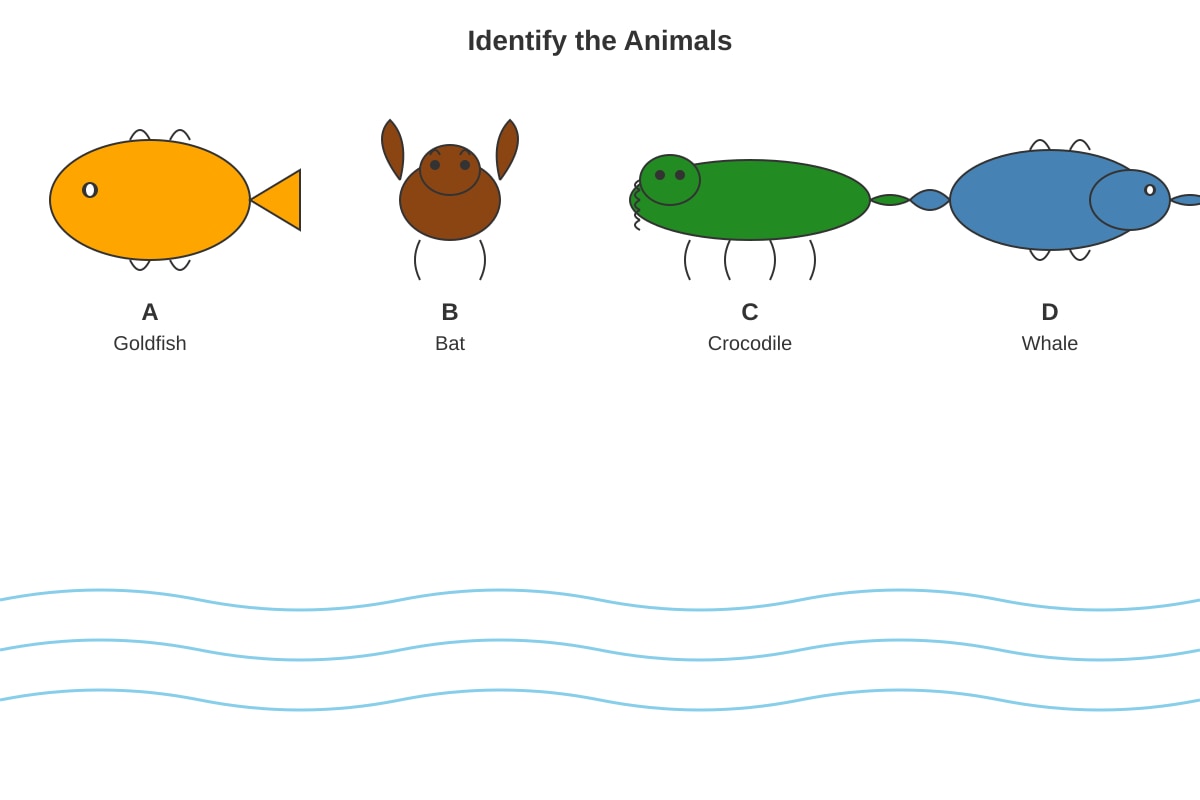
Explanation: Bats (B) and whales (D) are both mammals. They have fur/hair, give birth to live young, and feed their young with milk. A goldfish (A) is a fish with scales and gills. A crocodile (C) is a reptile with scales that lays eggs.
Visual verification: The images should show bat with fur-covered body and whale with smooth skin (both mammals); goldfish with fins and scales; crocodile with scaly skin and elongated snout.
Marks: 2
5. [Answer: B]
Explanation: An herb has a soft, green, flexible stem that does not become woody. A sunflower (B) has a green, herbaceous stem. An oak tree (A) is a woody plant with a thick trunk. A cactus (C) has a thick, fleshy, water-storing stem. A strawberry plant (D) is also an herb, but its most distinctive feature is the runner (a horizontal stem for reproduction), not the main stem structure; however, the sunflower more clearly exemplifies a typical herb with its upright green stalk.
Note: Strawberry is technically also an herb, but the question asks "most likely" and sunflower displays the classic herb form more clearly.
Marks: 2
6. [Answer: C]
Explanation: Complete metamorphosis has four distinct stages: egg → larva → pupa → adult. The mosquito's life cycle matches this exactly. Incomplete metamorphosis (B) has only three stages with no pupal stage (egg → nymph → adult), like a grasshopper. Germination (A) is when a seed begins to grow. Photosynthesis (D) is how plants make food.
Marks: 2
7. [Answer: C]
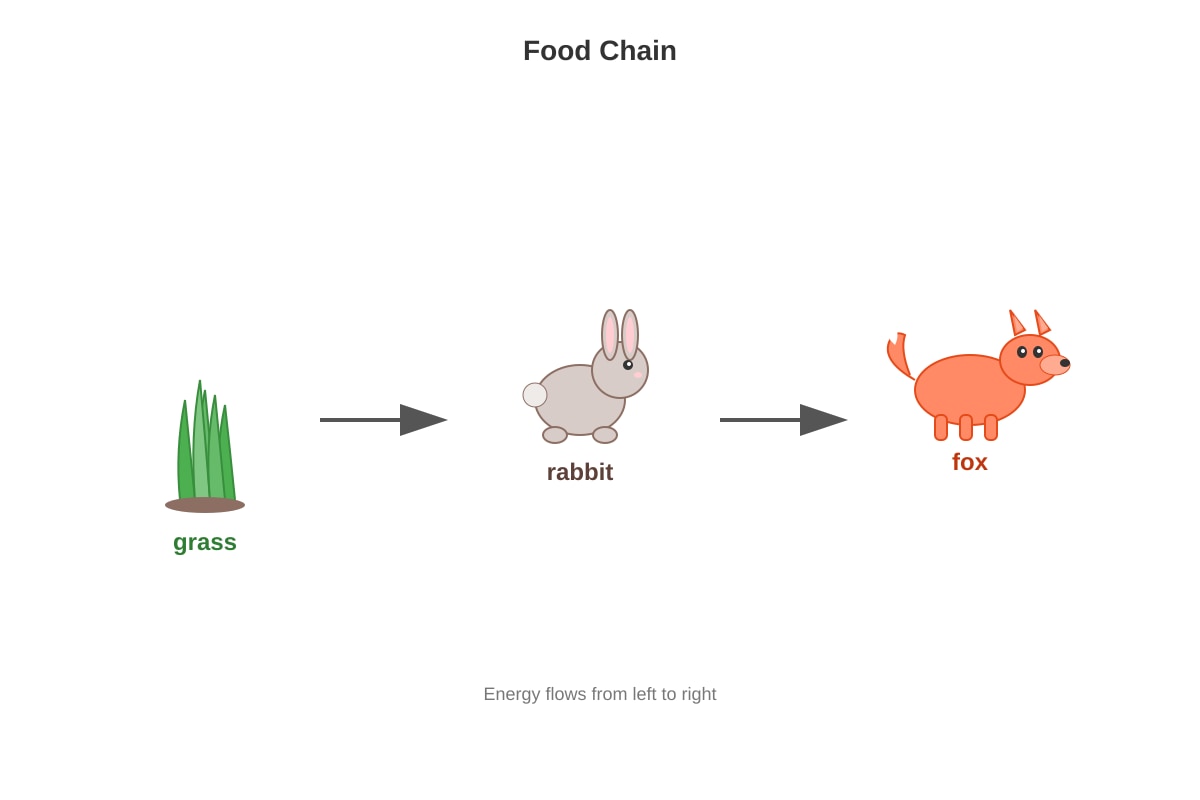
Explanation: If rabbits (the food source for foxes) are removed, foxes lose their food supply. Foxes are carnivores that eat meat, so they cannot eat grass (A is wrong). Without rabbits eating grass, grass would increase, not decrease (B is wrong). Rabbits do not grow from grass seeds (D is wrong). The foxes would either starve or must move to find food elsewhere (C is correct).
Marks: 2
8. [Answer: B]
Explanation: Ben and Deb are correct. Fungi (like mushrooms) cannot make their own food—they absorb nutrients from dead matter (Ben is correct). Like all living things, fungi need water and air to grow (Deb is correct). Ali is wrong because fungi do not photosynthesize—they lack chlorophyll. Cali is wrong because fungi do not have leaves or chlorophyll for trapping sunlight.
Marks: 2
9. [Answer: B]
Explanation: Cold-blooded animals (ectotherms) have body temperatures that change with the environment. Fish, lizards, and crocodiles are all reptiles or fish, which are cold-blooded. Eagles (A), penguins, whales, dolphins (C), bats, and sparrows (D) are warm-blooded (maintain constant body temperature). Butterflies are insects and cold-blooded, but bats and sparrows in that group are warm-blooded.
Marks: 2
10. [Answer: B]
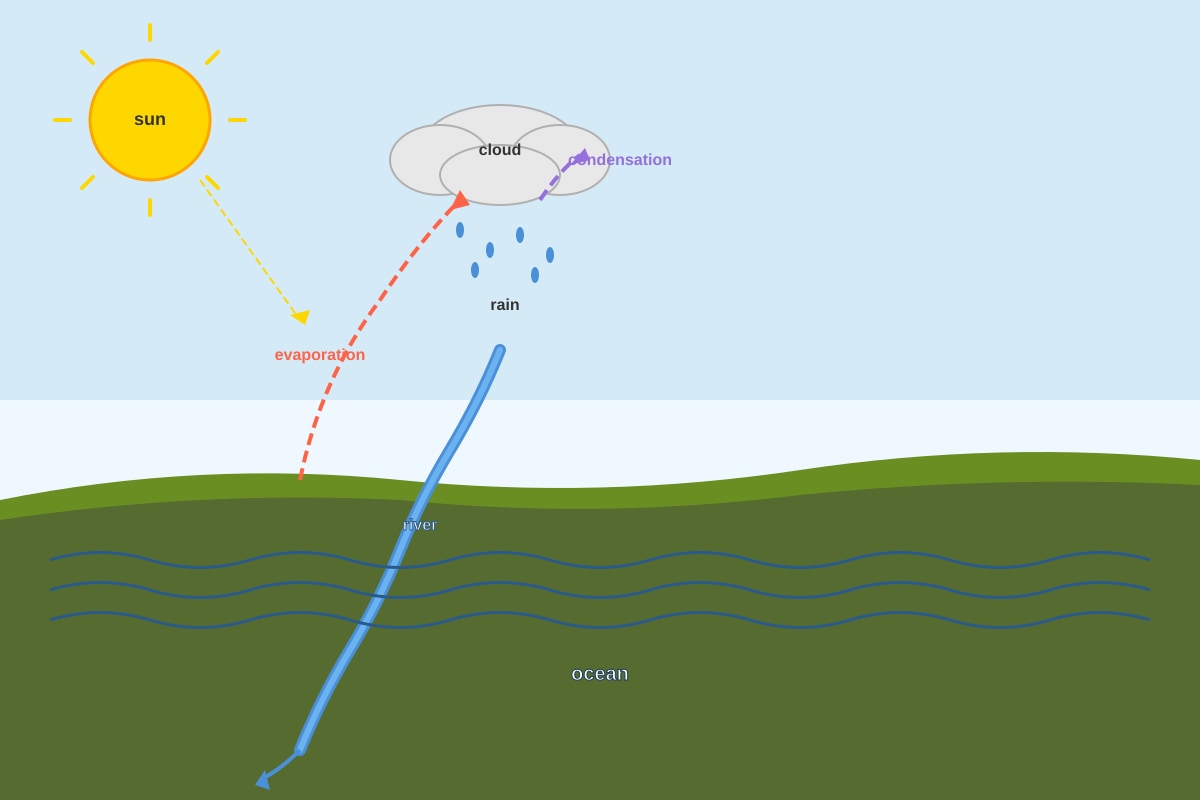
Explanation: Condensation is the process where water vapour cools and changes back into tiny liquid water droplets, forming clouds. Evaporation (A) is when liquid water becomes water vapour (happens at the ocean surface). Precipitation (C) is water falling from clouds as rain, snow, or hail. Collection (D) is when water gathers in oceans, lakes, rivers, or underground.
Visual verification: The diagram should show water vapour rising and forming visible cloud masses; this is the condensation stage.
Marks: 2
SECTION B: Structured Questions (40 marks)
11. (Total: 5 marks) [Answer: (a) Group 1: A, D; Group 2: C; (b) any dicot example; (c) explanation of shape-function relationship]
(a) [2 marks]
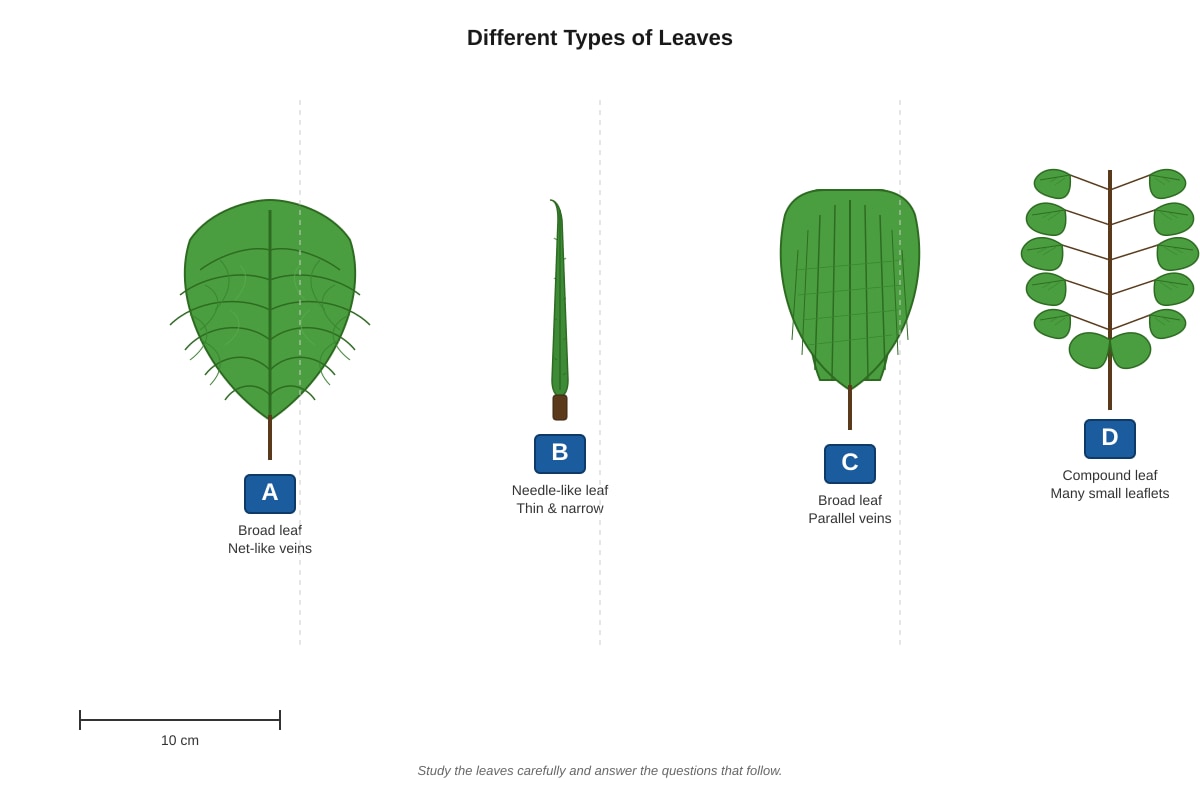
Group 1 (Net-veined): A, D [1 mark for all correct; 0.5 if one correct with no wrong entries]
Group 2 (Parallel-veined): C [1 mark]
Note: B (needle-like) is a modified leaf; pine needles show parallel venation but this may be classified differently. Accept A,D for net-veined based on clear visual distinction.
(b) [1 mark]
Any correct dicot plant example: Rose, hibiscus, bean plant, papaya, grasshopper tree (any common dicot) [1]
(c) [2 marks]
Sample answer: Broad, flat leaves (like A) have a large surface area to trap sunlight for photosynthesis [1]. Needle-like leaves (like B) reduce water loss and are found in dry or cold places [1]. Thick waxy leaves may store water in dry climates.
Marking notes: Must link shape to survival function. 1 mark for identifying a leaf shape feature, 1 mark for explaining the survival advantage.
12. (Total: 5 marks) [Answer: (a) P; (b) Q, explanation; (c) any valid defence with example]
(a) [1 mark]
P (Camouflage) [1]
The stick insect looks like a twig, which is camouflage—blending with the surroundings.
(b) [2 marks]
Q (Armour) [1]
The porcupine's sharp spines act as a protective covering/armour. When a predator tries to attack, the spines can hurt the predator and prevent the porcupine from being eaten [1].
Alternative answer: Could argue for a unique category (special defence), but Q is the closest match. Accept reasoned alternative if well-explained.
(c) [2 marks]
Any valid example: [1 mark for method, 1 mark for example with specific animal]
Examples:
- Speed/running away: Deer, cheetah, rabbit flee from predators [2]
- Living in groups: Zebras, meerkats, deer in herds—more eyes to spot danger [2]
- Warning colours: Poison dart frog has bright colours to warn predators it is poisonous [2]
- Venom/poison: Snakes inject venom; bees sting [2]
- Great sense of smell/hearing: Rabbits have large ears to detect predators early [2]
13. (Total: 7 marks) [Answer: (a) germination; (b) water, air/oxygen, suitable temperature (any two); (c) D, explanation; (d) explanation of seed dispersal/protection]
(a) [1 mark]
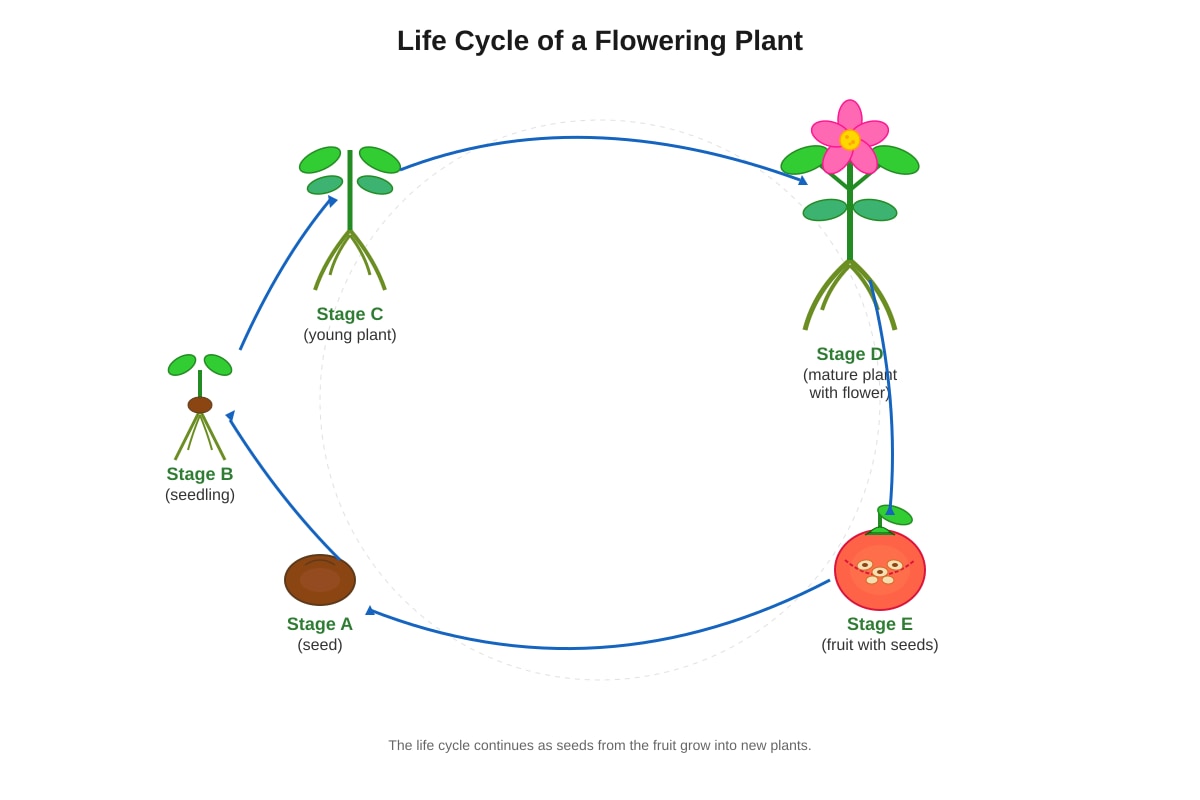
Germination [1]
(b) [2 marks]
Any two: water/moisture, air/oxygen, suitable/warm temperature [1 each]
(c) [2 marks]
Stage D [1]
During pollination, pollen grains from the male part (anther) of one flower are transferred to the female part (stigma) of another flower of the same kind [1]. This can happen by wind, water, or animals like bees and butterflies.
(d) [2 marks]
The fruit protects the seeds from being eaten by animals or damaged by the weather [1]. The fruit may also be colourful, sweet, or have hooks to help disperse the seeds to new places where they can grow with less competition for space, light, and nutrients [1].
14. (Total: 6 marks) [Answer: (a) two valid groupings; (b) body segments, antennae, wings, etc.]
(a) [4 marks] — 2 marks per valid grouping
Grouping 1: Number of legs [1]
Group 1 (6 legs): Ant [0.5]
Group 2 (more/fewer than 6 legs): Spider (8 legs), Earthworm (0), Frog (4) [0.5]
Or other valid groupings: 0 legs (earthworm) vs. has legs; 8 legs vs. not 8 legs; etc.
Grouping 2: Body covering [1]
Group 1 (Hard outer shell/exoskeleton): Ant, Spider [0.5]
Group 2 (Moist, smooth skin): Earthworm, Frog [0.5]
Alternative grouping: By habitat (land vs. water/water+land); by vertebrate/invertebrate; etc. Accept any two clear, justifiable groupings using table data.
(b) [2 marks]
Scientists look at: body segments, presence of antennae, number of body parts, wings, mouthparts, or how they breathe [any two = 2 marks, or 1 mark for one feature with explanation]
Example answer: Ants have three body parts (head, thorax, abdomen) and six legs attached to the thorax. Spiders have two body parts (cephalothorax and abdomen) and eight legs. Ants have antennae; spiders do not [2].
15. (Total: 8 marks) [Answer: (a) producer and consumer; (b) food chain; (c) explanation with decay/nutrients; (d) explanation of food web disruption]
(a) [2 marks]
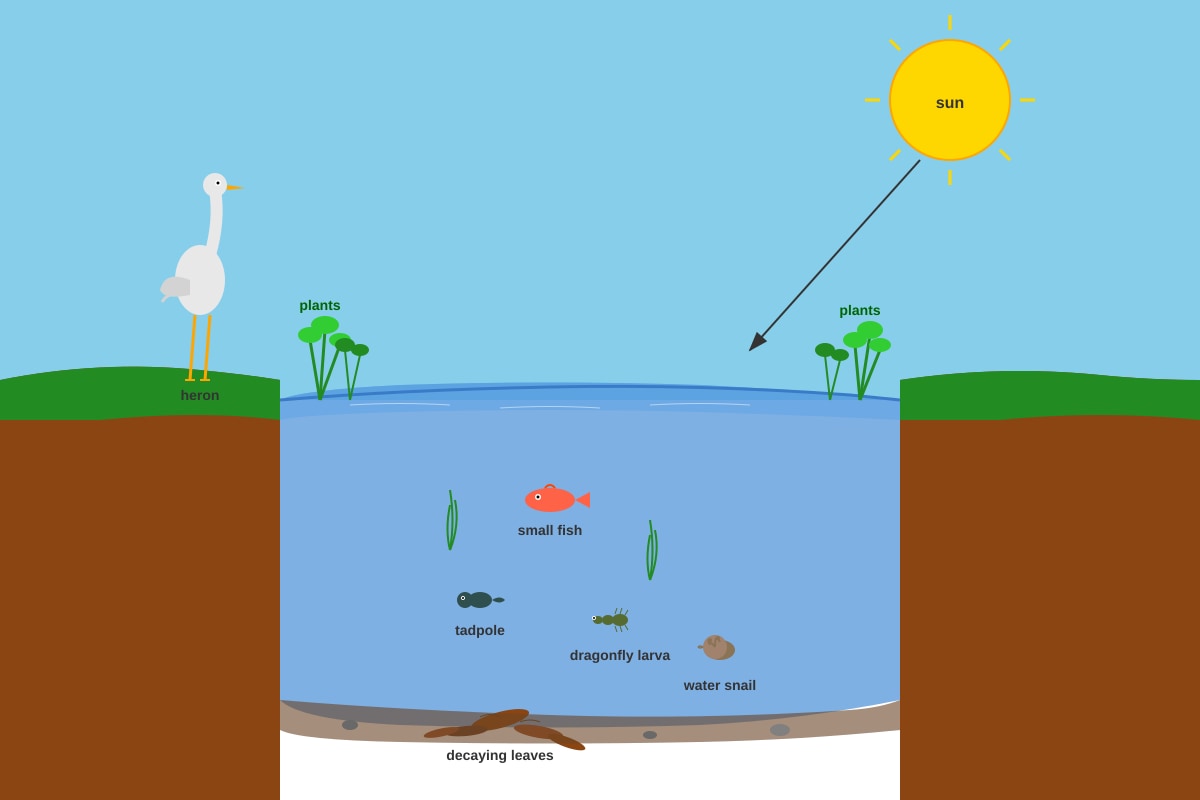
Producer: Plants/water plants (any plant in diagram) [1]
Consumer: Small fish/tadpole/dragonfly larva/water snail/heron (any animal that eats other organisms) [1]
(b) [2 marks]
Three-organism food chain: [1 for correct organisms in order, 1 for correct arrow pattern]
Water plants → Small fish → Heron [2]
Or: Plants → Tadpole → Heron; or Plants → Water snail → Small fish (but check: do herons eat snails? Some do, but check validity)
Accept any valid 3-organism chain from the diagram.
(c) [2 marks]
The water snails feed on decaying matter and help break it down into simpler substances [1]. Without snails, dead matter would pile up, and nutrients would not be returned to the soil/water for plants to absorb. This would make the water dirty and reduce nutrients available for plant growth [1].
Alternative: If snails are removed, there would be more decaying matter, which might actually provide more nutrients short-term, but the ecosystem's recycling is disrupted. The key point is about nutrient cycling and water quality.
(d) [2 marks]
If many small fish die, the herons lose a main food source [1]. Herons would have less food to eat, so some herons might starve, and the heron population would decrease. Herons would need to find other food or move to another pond [1].
16. (Total: 7 marks) [Answer: (a) Cup 3, explanation; (b) evaluate conclusion; (c) improvement; (d) conduction/convection/radiation]
(a) [2 marks]
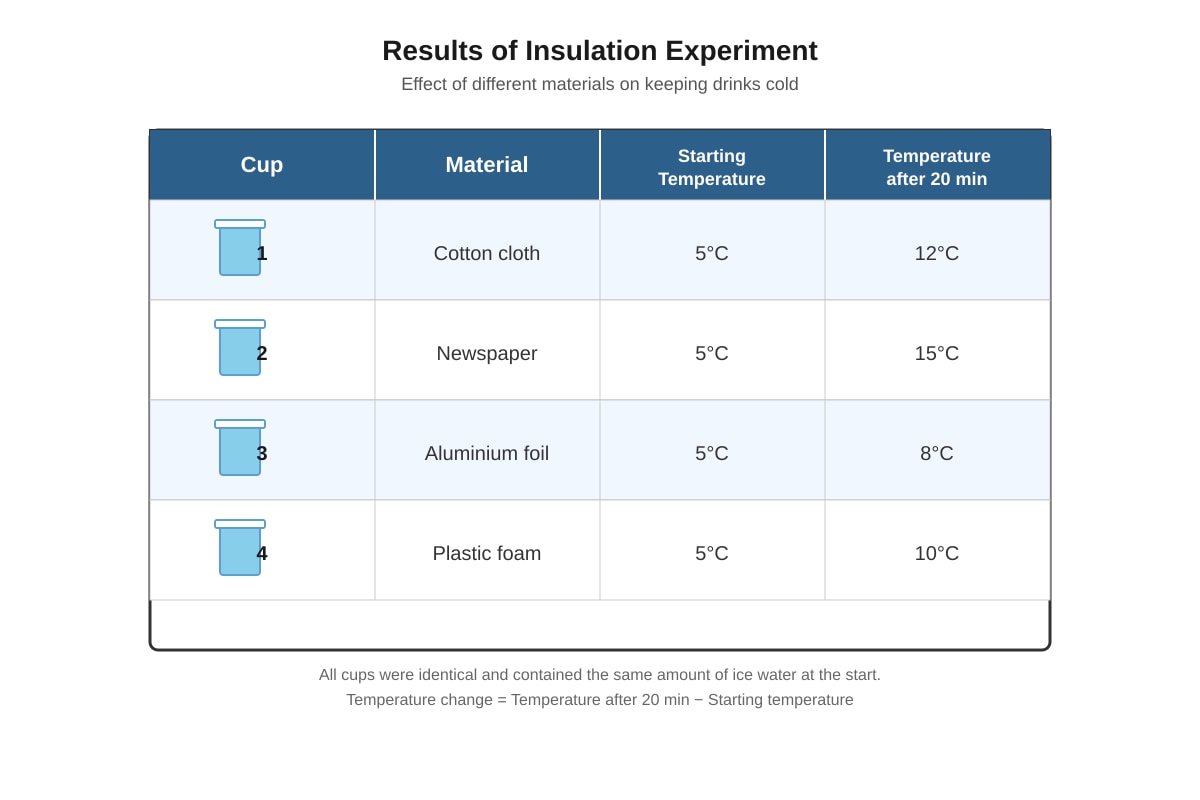
Cup 3 (aluminium foil) had the smallest temperature change: from 5°C to 8°C, a change of only 3°C [1].
This tells us that aluminium foil was the best insulator/poorest conductor among the materials tested—it let in the least heat from the surroundings [1].
Working: Temperature change = 8 − 5 = 3°C. Compare: Cup 1: 7°C change; Cup 2: 10°C change; Cup 4: 5°C change.
(b) [2 marks]
Disagree [1]
The data shows that aluminium foil kept the water coolest (smallest temperature rise), which means it was the best at keeping heat out [1]. However, "best" depends on what we mean. For keeping drinks cold, we want slowest warming—aluminium foil did this. BUT aluminium is actually a good conductor of heat; in this experiment, the shiny surface reflected heat radiation, which is why it performed well. The conclusion should specify this is about keeping cold in (preventing heat gain), not about keeping heat in.
Alternative mark scheme: Agree with caveat—student can agree if they note aluminium foil worked best in this specific test, but the reasoning about conduction vs. radiation should be addressed.
Teaching note: Aluminium foil is surprising here because it reflects radiant heat. This is a good learning point about radiation vs. conduction.
(c) [1 mark]
Any valid improvement: Repeat the experiment; use a thermometer for more precise readings; test for longer than 20 minutes; use a control cup with no wrapping; stir water before measuring; ensure same starting temperature more precisely [1]
(d) [1 mark]
Conduction (through the cup walls) and/or radiation (from warmer surroundings) [1]
Accept: Heat transfer/heat gain. The main processes are conduction through solid materials and radiation from the environment.
17. (Total: 6 marks) [Answer: (a) two predators; (b) count and example chain; (c) bird population effect; (d) natural method reason]
(a) [1 mark]
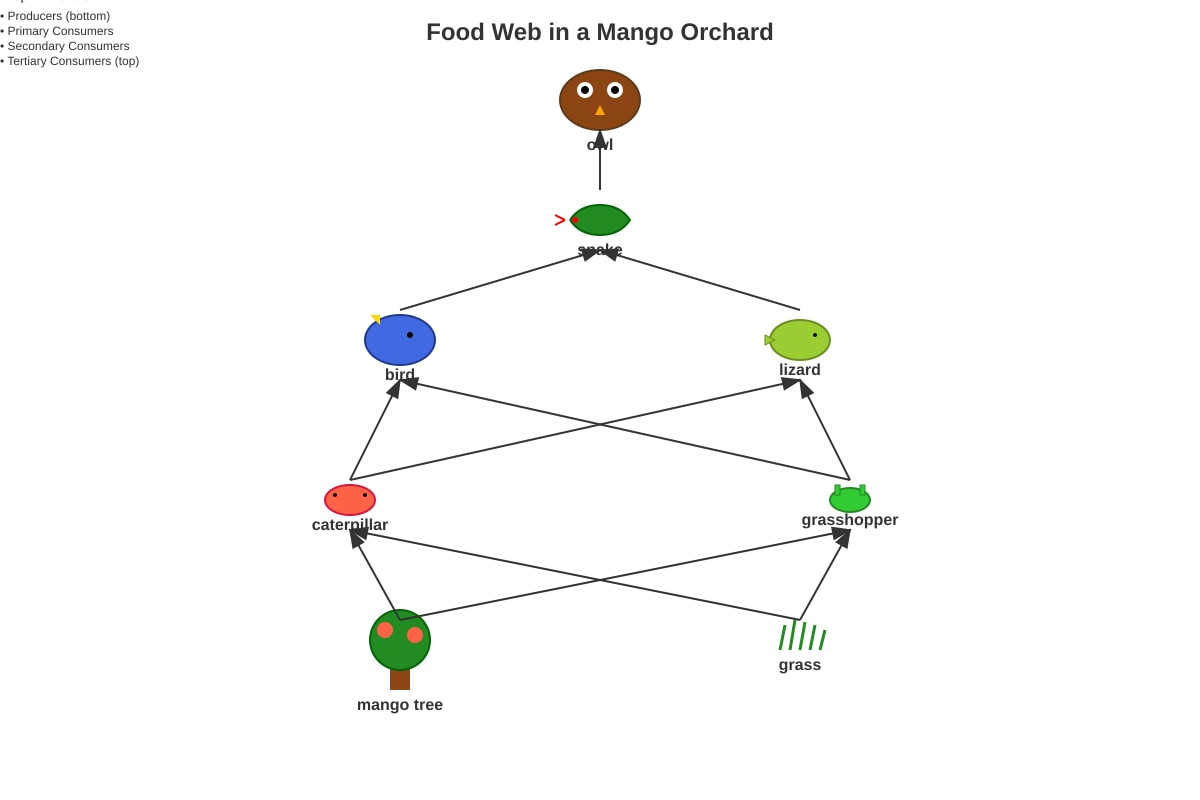
Any two: Bird, Lizard, Snake, Owl [1] (0.5 mark each, max 1)
Note: Predators are animals that hunt and eat other animals. All these eat other animals in the web.
(b) [2 marks]
Number of food chains ending with owl: 3 [1]
Food chains:
- Mango tree → Caterpillar → Bird → Snake → Owl
- Mango tree → Grasshopper → Bird → Snake → Owl
- Grass → Grasshopper → Lizard → Snake → Owl
- Grass → Grasshopper → Bird → Snake → Owl
Actually 4 chains; recount carefully based on diagram. Accept correct count from student's valid reasoning.
One food chain: Mango tree → Caterpillar → Bird → Snake → Owl [1]
(c) [2 marks]
The bird population would decrease [1] because birds lose a food source (caterpillars). With fewer caterpillars to eat, some birds might starve or have to compete more for grasshoppers. Some birds might leave the orchard to find food elsewhere [1].
(d) [1 mark]
Any valid reason: Pesticide might kill other helpful insects; pesticide could stay on mangoes and harm people; pesticide might run into rivers and pollute water; natural methods (like attracting birds) are cheaper long-term; natural methods don't harm the ecosystem [1]
18. (Total: 7 marks) [Answer: (a) light; (b) two controlled variables; (c) chlorophyll/etiolation; (d) evaluate with evidence]
(a) [1 mark]
Light/Presence or absence of light [1]
(b) [2 marks]
Any two: Type/number of seeds (5 bean seeds in each); type/amount of soil; amount of water given; size of pots; temperature of location; type of seed [1 each]
(c) [2 marks]
The seedlings in the dark were yellow because they could not make chlorophyll (the green pigment) without light [1]. Plants need light to produce chlorophyll. Without chlorophyll, the seedlings could not photosynthesize and stayed yellow (this is called etiolation) [1].
(d) [2 marks]
Agree [1]
The experiment shows that seeds in both the dark and light germinated (sprouted), so light is not needed for the seed to start growing. However, the seedlings in the dark were unhealthy (yellow), showing that light IS needed for healthy growth after germination [1].
Alternative: Disagree with nuance—if student notes that while germination happened, the experiment doesn't prove ALL seeds don't need light (some seeds do need light to germinate, like lettuce). But for bean seeds, the teacher's conclusion is valid.
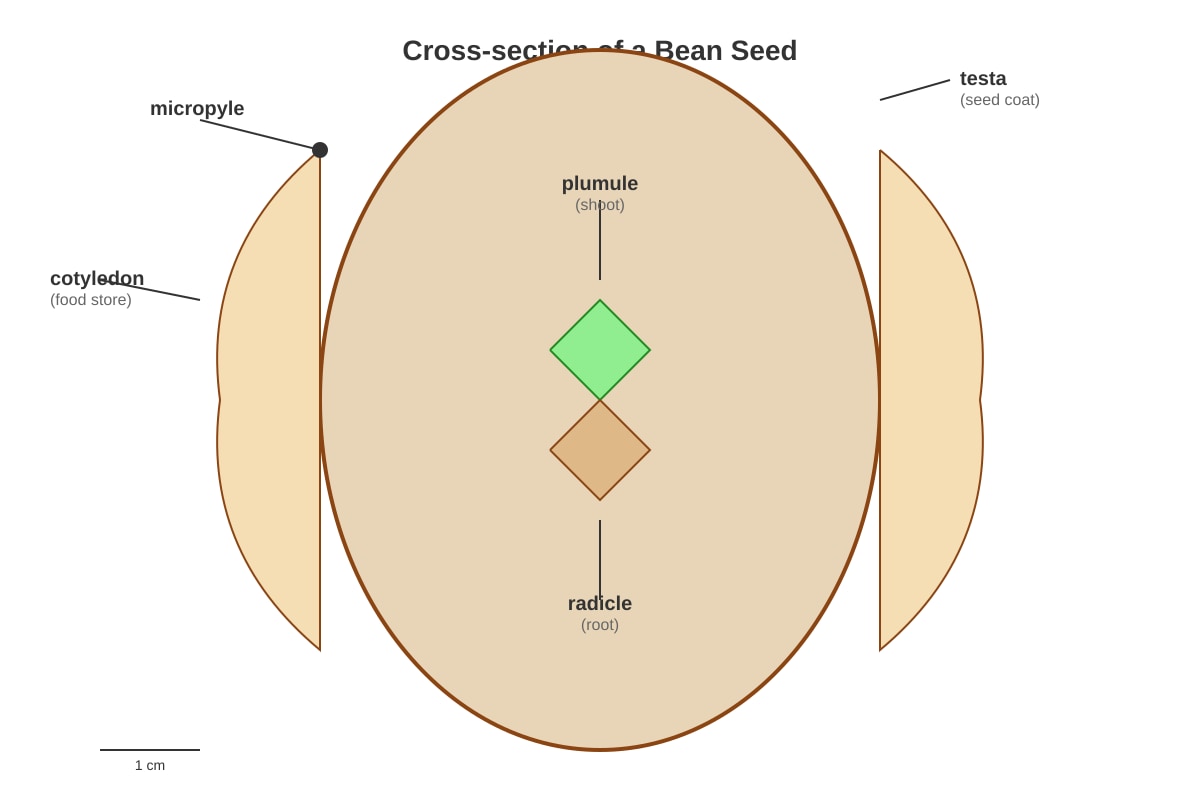
19. (Total: 5 marks) [Answer: (a) testa, radicle, cotyledon; (b) food store explanation; (c) gravity/geotropism/phototropism]
(a) [3 marks]
- protects the seed: Testa/seed coat [1]
- grows into the root: Radicle [1]
- stores food for the young plant: Cotyledon [1]
(b) [2 marks]
A seed needs a food store because the young plant cannot make its own food yet [1]. It has no leaves for photosynthesis and is underground, so it uses stored food in the cotyledon until it grows leaves and can make its own food [1].
A fully grown plant has leaves to trap sunlight and make food through photosynthesis, so it does not need a stored food supply.
(c) [1 mark]
Gravity pulls the radicle downward (positive geotropism/roots grow toward gravity) [1]. Light causes the plumule to grow upward (negative geotropism/shoots grow away from gravity; or phototropism—growth toward light).
Accept: Gravity alone for full mark if well-explained; or mention of geotropism.
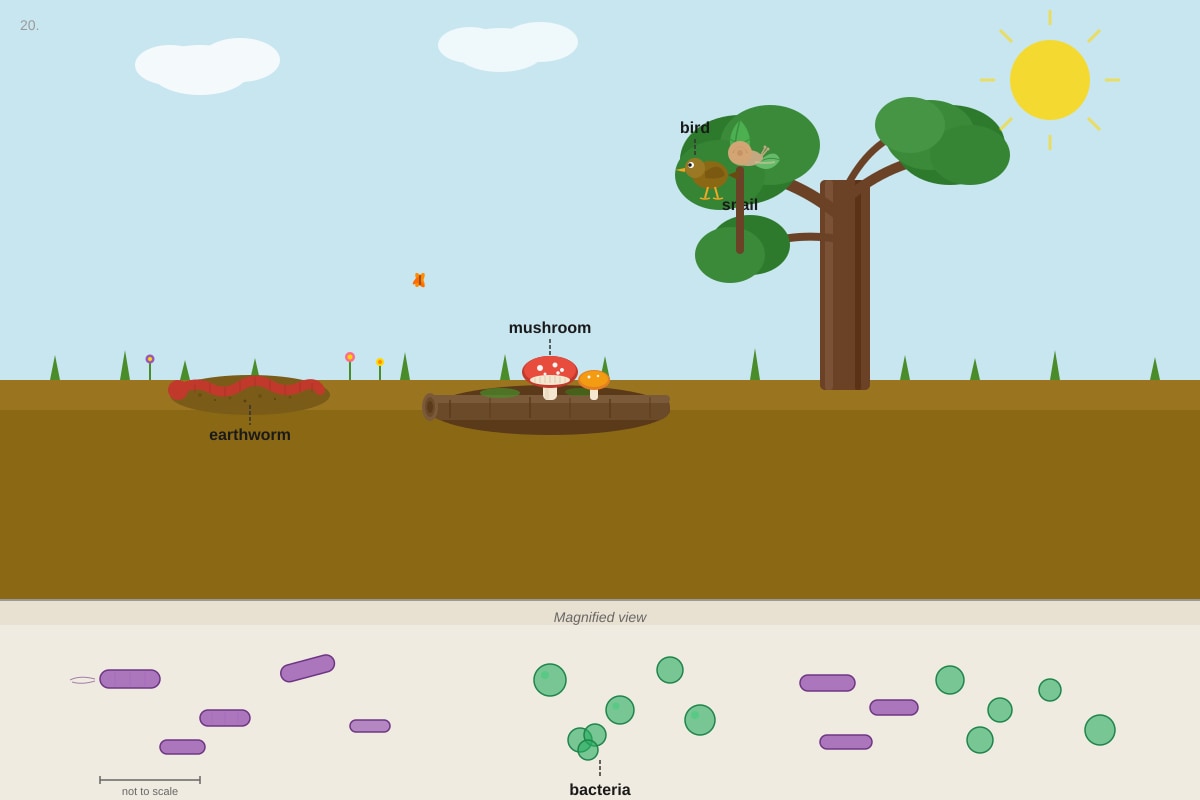
20. (Total: 7 marks) [Answer: (a) decomposers; (b) nutrient cycling; (c) seed dispersal methods; (d) nitrogen fixation/decay]
(a) [1 mark]
Decomposers [1]
(b) [2 marks]
Earthworms eat decaying matter and excrete nutrient-rich waste that improves soil fertility [1]. Mushrooms (fungi) break down dead plants and animals, releasing nutrients like nitrogen back into the soil for plants to absorb [1].
(c) [2 marks]
Any two valid methods with brief description:
- By wind: Seeds with wings (saga seeds) or parachutes (dandelion) float through the air [1]
- By water: Seeds with air spaces or waterproof coatings (coconut, lotus) float to new locations [1]
- By animals eating fruit: Seeds pass through digestive system and are deposited in droppings far away (berries, figs) [1]
- By hooks/burrs sticking to fur: Seeds attach to animal coats and fall off elsewhere (rambutan, some grasses) [1]
(d) [2 marks]
Bacteria break down dead matter and waste, returning nutrients to the soil for plants to use [1]. Some bacteria also fix nitrogen from the air into forms that plants can use, helping plants grow better and making soil more fertile [1].
TOTAL MARKS: 60
Mark distribution check:
- Section A: 10 questions × 2 marks = 20 marks ✓
- Section B: Q11 (5) + Q12 (5) + Q13 (7) + Q14 (6) + Q15 (8) + Q16 (7) + Q17 (6) + Q18 (7) + Q19 (5) + Q20 (7) = 60 marks ✓
Duration check: 75 minutes for 60 marks ≈ 1.25 minutes per mark. MCQs: 20 minutes. Structured: 50 minutes with review buffer = 70 minutes. Reasonable with buffer.
Level check: Language and concepts appropriate for P4 (second half of P4, near SA2). Mix of recall, application, and simple experimental analysis.
Syllabus check: Covers plant systems, life cycles, matter, ecosystems, energy (heat/light), experimental skills, and diversity themes aligned with P4 Science syllabus.