From Real Exams Exam Paper
Primary 4 Science Semestral Assessment 2 (End of Year) Paper 4
Free P4 Science SA2 Paper 4, HY3 Exam version, with questions, answers, and syllabus-aligned practice for Singapore students.
These static practice materials are generated from the site's syllabus and paper-generation workflow, with source and model context shown so students and parents can evaluate the material before use.
Questions
Free quiz and exam paper access
Enter your details to view this paper
Your access is remembered on this device.
Answers
Answer Key — SA2 Practice Paper Version 4 (Primary 4 Science: Diversity)
Total Marks: 60
Section A (10 marks)
- C — Fern. Teaching note: A fern is a plant and is alive. Rock, cloud, water are non-living.
- C — Fungus. Teaching note: Mushrooms are fungi, not plants or animals.
- B — Can move by itself. Teaching note: Some living things (e.g. plants) do not move from place to place, but all need food, reproduce, and grow.
- B — Fish. Teaching note: Fish use gills to breathe underwater; others use lungs.
- B — Soil. Teaching note: Soil is non-living though it holds living organisms.
- A — Sunlight. Teaching note: Plants use sunlight to make food (photosynthesis, not required term but concept).
- B — Dolphin. Teaching note: Dolphin is a mammal; shark is fish, penguin is bird, crocodile is reptile.
- B — It does not grow or die. Teaching note: Non-living things do not show life processes.
- B — Water. Teaching note: Water is in living and non-living things but is not alive itself.
- A — Insect. Teaching note: Butterfly has 3 body parts and 6 legs = insect.
Section B (12 marks)
- [2] Living thing grows / needs food / reproduces (any one correct difference). e.g. “A living thing can grow.”
- [2] Any two: plants, animals, fungi, bacteria (e.g. plants and animals). 1 mark each.
- [2] Car does not eat, grow, reproduce, or breathe; it is made by humans and is non-living. (2 pts for clear reason)
- [2] Any two: moves, eats, breathes, reproduces, has senses. 1 mark each.
- [2] Example: mushroom; found on damp wood / soil. 1 mark example, 1 mark location.
- [2] Tree is living because it grows, needs water/sunlight, and can make food / reproduce (any 2 linked ideas).
Section C (28 marks)
- (a) [2] Living: rose, dog; Non-living: stone, wind. (1 mark living pair, 1 mark non-living pair) (b) [2] Stone is non-living because it does not grow, breathe, or reproduce. (c) [2] Shared characteristic: both need food / grow / reproduce (e.g. both are alive).
- (a) [3] Plants, animals, fungi (1 mark each). (b) [3] e.g. rose, cat, mushroom (1 mark each). (c) [3] Plant: makes food; Animal: moves/eats; Fungus: absorbs food / grows on decay (1 mark each).
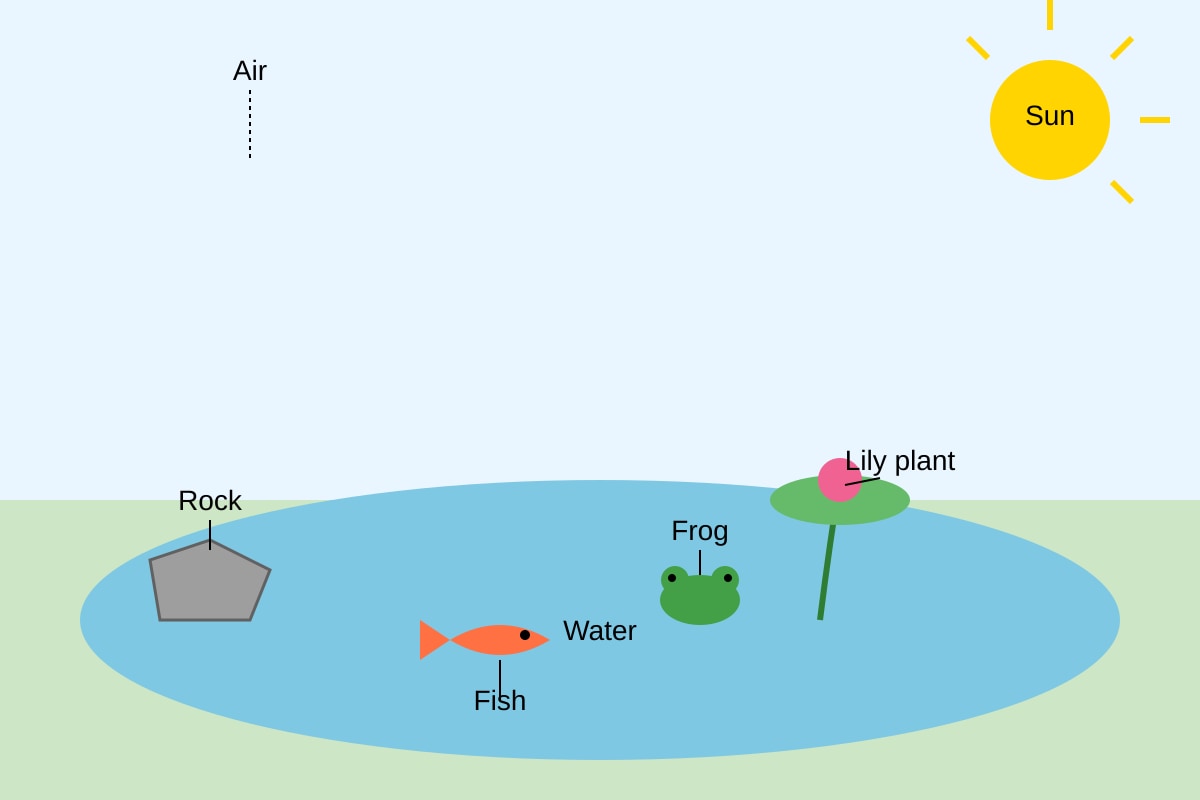
- (a) [2] Lily, fish (or frog). 1 mark each from image labels. (b) [2] Sun, water, rock, air (any two). 1 mark each. (c) [2] Fish is living because it breathes, moves, and eats.
- (a) [2] Diversity means the variety of living things in nature. (b) [2] Keeps balance, provides food/oxygen, protects ecosystem (any two). (c) [2] Protect habitats, do not litter, plant trees (any one clear action).
Marking notes: Deduct for wrong group names; accept local synonyms (e.g. “bug” for insect only if clarified). MCQ wrong = 0.