From Real Exams Exam Paper

Primary 4 Science Semestral Assessment 2 (End of Year) Paper 3

Free Kimi AI-generated P4 Science SA2 Paper 3 with questions, answers, and syllabus-aligned practice for Singapore students preparing for exams.

These static practice materials are generated from the site's syllabus and paper-generation workflow, with source and model context shown so students and parents can evaluate the material before use.

Primary 4 Science From Real Exams Generated by Kimi K2.6 Free Updated 2026-06-09

Questions

<!-- TuitionGoWhere generation metadata: stage=3-1; model=moonshotai/kimi-k2.6:free; model_label=Kimi K2.6 Free; generated=2026-06-09; Sources: Stage 2-1 real exam-derived templates and Stage 2-2 exam-enriched syllabus. -->

TuitionGoWhere Practice Paper - Science Primary 4

SA2 End-of-Year Examination - Version 3 of 5

TuitionGoWhere Exam Practice (AI)

| Subject: | Science | | Level: | Primary 4 | | Paper: | SA2 Practice Paper | | Duration: | 1 hour 15 minutes | | Total Marks: | 60 | | Name: | ______________________ | | Class: | ______________________ | | Date: | ______________________ |


INSTRUCTIONS TO CANDIDATES

  1. Write your name, class, and date in the spaces provided above.
  2. This paper consists of THREE sections: Section A, Section B, and Section C.
  3. Answer ALL questions.
  4. Write your answers in the spaces provided. For questions requiring explanation, use complete sentences.
  5. Section A (Questions 1–15): Multiple Choice — choose the correct answer and write A, B, C, or D in the box.
  6. Section B (Questions 16–22): Short Answer — answer in the spaces provided.
  7. Section C (Questions 23–25): Structured Response — answer with explanations using scientific concepts.

SECTION A: MULTIPLE CHOICE [15 marks]

Answer all questions. Each question carries 1 mark.


1. Which of the following is a characteristic of all living things?

ABCD
They can move from place to placeThey can make their own foodThey can grow and developThey do not need water

Answer: [ ]


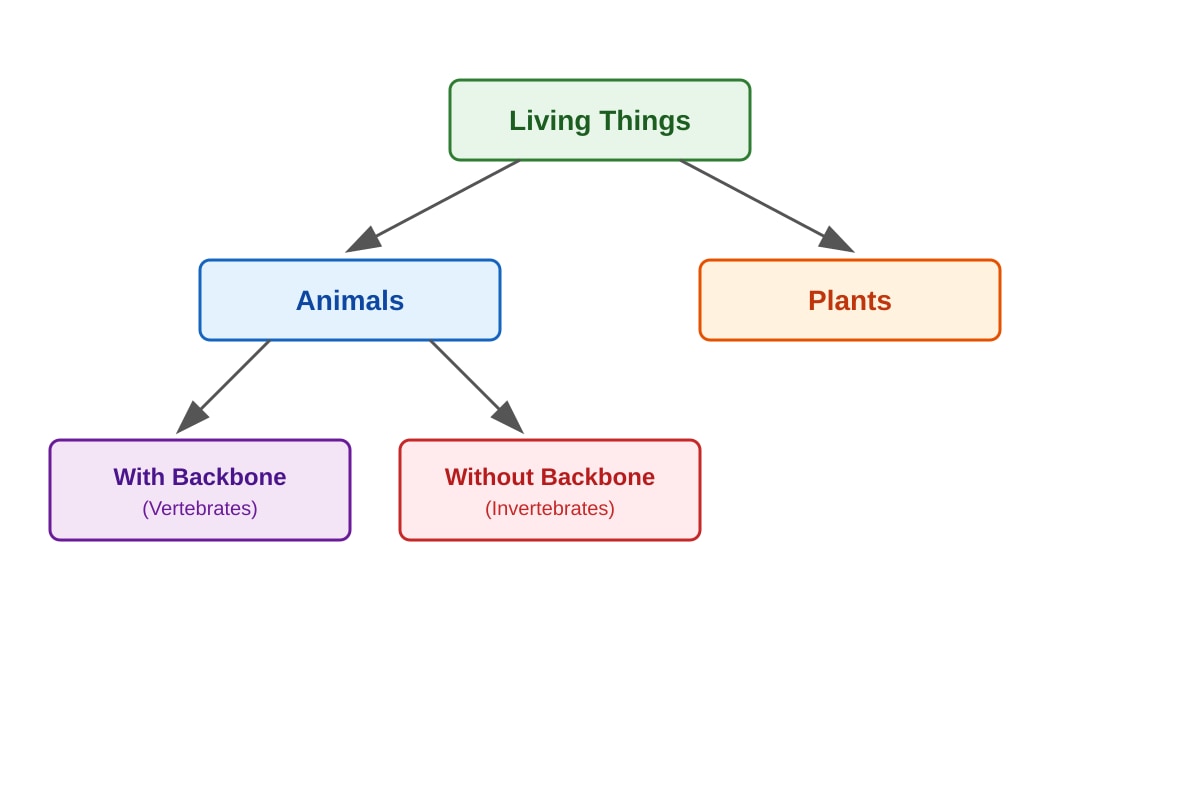
2. The diagram below shows how living things are classified.

<image_placeholder> id: Q2-fig1 type: diagram linked_question: Q2 description: A simple classification flowchart showing branching from "Living Things" to "Animals" and "Plants", then "Animals" branches to "With Backbone" and "Without Backbone" labels: Living Things, Animals, Plants, With Backbone (Vertebrates), Without Backbone (Invertebrates) values: None must_show: Clear hierarchical branching tree structure with 5 boxes total; arrows showing classification direction </image_placeholder>

Based on the diagram, which group of animals has a backbone?

ABCD
JellyfishEarthwormFrogSpider

Answer: [ ]


3. Which of the following is an example of a non-living thing?

ABCD
A mushroom growing on a treeA river flowing through a valleyA seed germinating in soilA bird building a nest

Answer: [ ]


4. The table below shows some characteristics of four different things.

ThingCan moveCan growCan reproduceNeeds water
P
Q
R
S

Which of the following is most likely a living thing?

ABCD
PQRS

Answer: [ ]


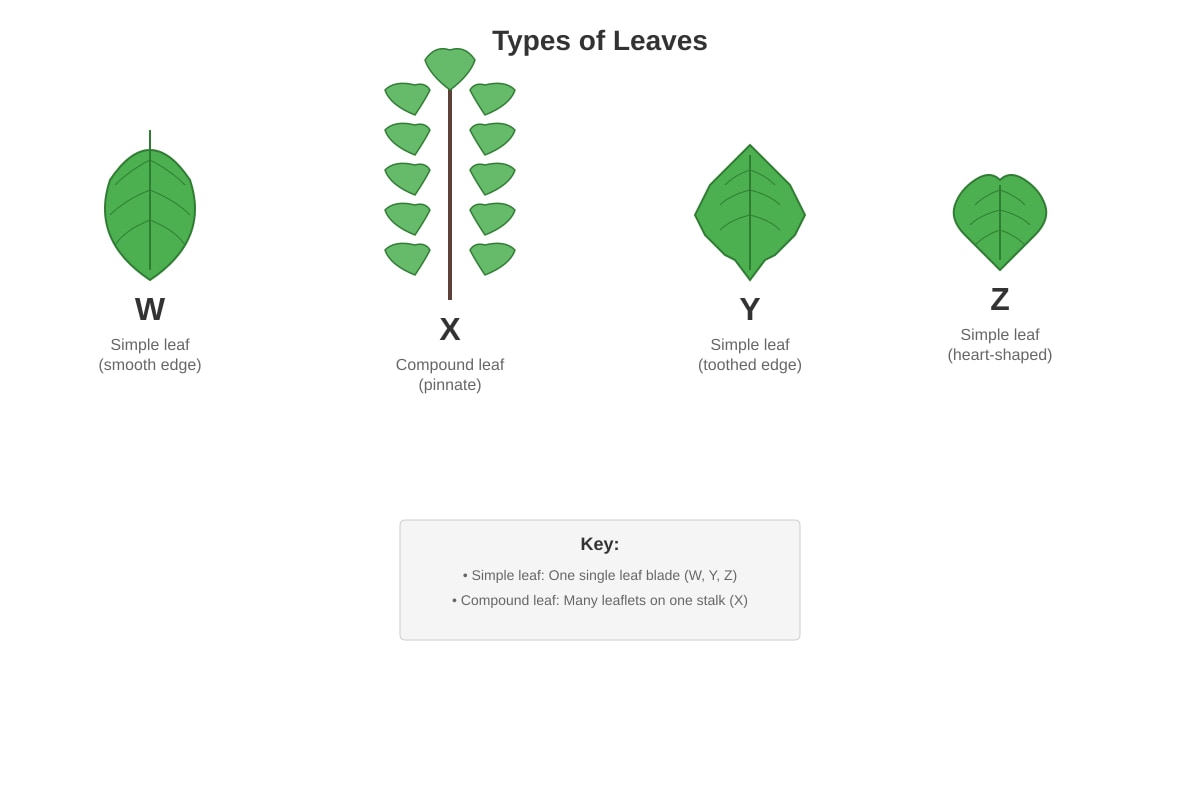
5. Plants can be classified by their leaf shapes. Which plant below has compound leaves?

<image_placeholder> id: Q5-fig1 type: diagram linked_question: Q5 description: Four leaf drawings labeled W, X, Y, and Z. W shows a single simple oval leaf with smooth edge. X shows a long leaf divided into many small leaflets arranged along a central stalk (pinnate compound). Y shows a simple leaf with toothed edges. Z shows a simple heart-shaped leaf. labels: W, X, Y, Z values: None must_show: Clear distinction between simple leaves (W, Y, Z) and compound leaf (X); labels W, X, Y, Z on each drawing; X must show multiple leaflets attached to one central rachis/stalk </image_placeholder>

ABCD
WXYZ

Answer: [ ]


6. Which characteristic helps to distinguish between a mammal and a bird?

ABCD
Only birds have eyesOnly mammals have bloodOnly birds have feathersOnly mammals can move

Answer: [ ]


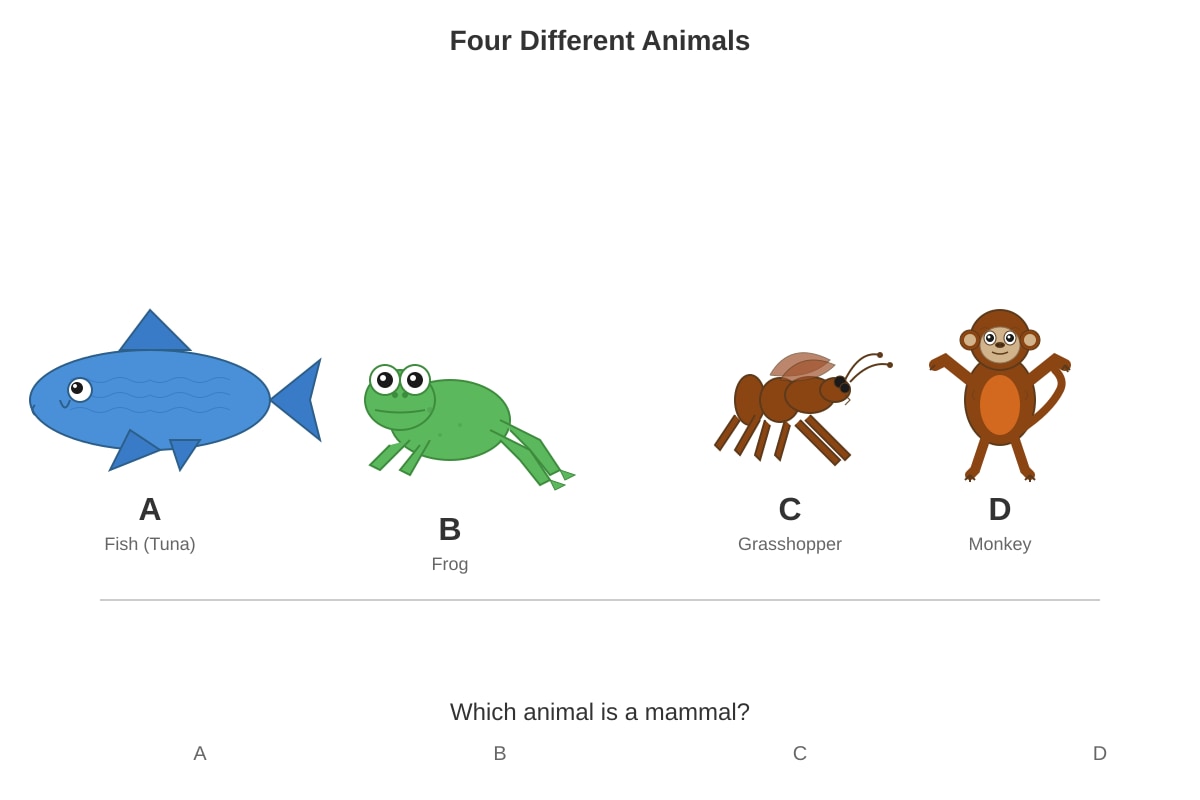
7. The picture below shows four different animals.

<image_placeholder> id: Q7-fig1 type: diagram linked_question: Q7 description: Four animals arranged in a row: Animal A is a fish (tuna), Animal B is a frog, Animal C is a grasshopper, Animal D is a monkey. Simple cartoon or realistic style side profiles. labels: A, B, C, D values: None must_show: Clear visual identification of each animal type; labels A-D; fish with fins and scales visible; frog with moist skin and no tail; grasshopper with six legs and antennae; monkey with fur and limbs with nails visible </image_placeholder>

Which animal is a mammal?

ABCD
ABCD

Answer: [ ]


8. Which of the following groups of animals are all invertebrates?

ABCD
Fish, frog, snakeCrab, butterfly, snailBird, bat, whaleCrocodile, lizard, turtle

Answer: [ ]


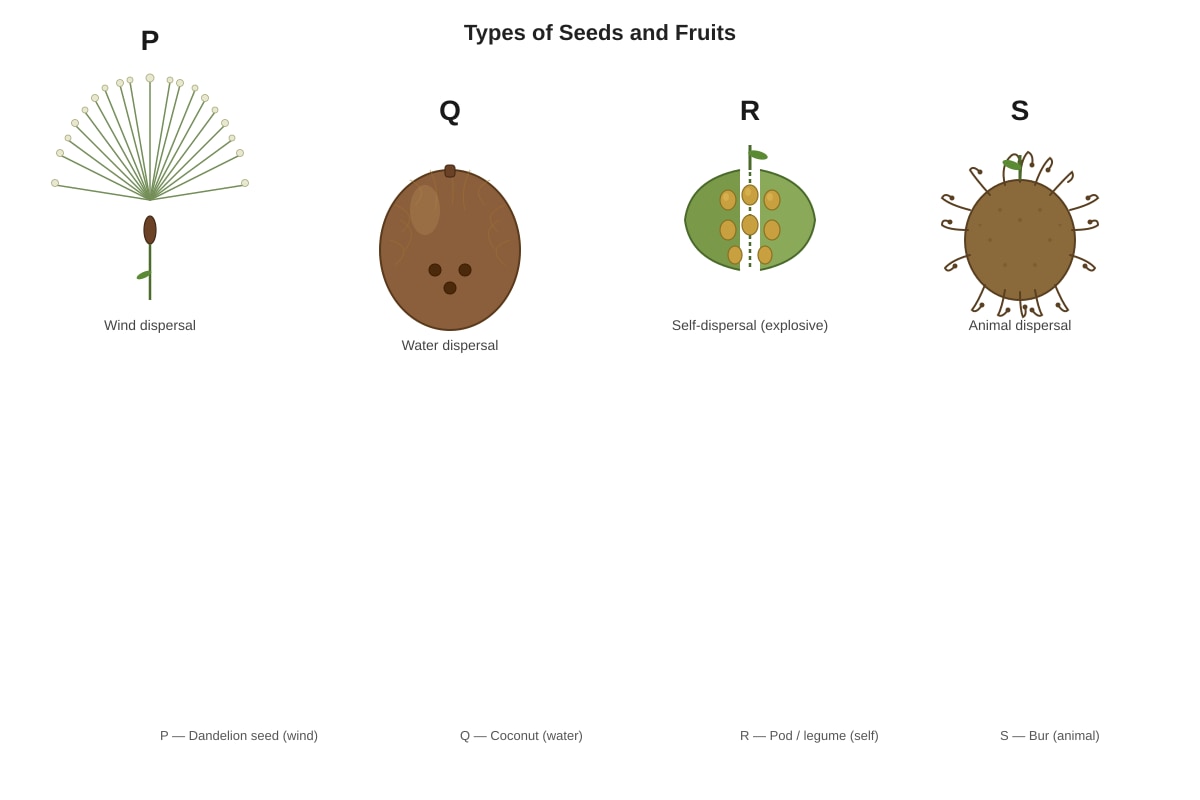
9. Seeds are dispersed in different ways. The picture below shows four types of seeds or fruits.

<image_placeholder> id: Q9-fig1 type: diagram linked_question: Q9 description: Four seed/fruit types labeled P, Q, R, S. P shows a dandelion-like seed with fluffy parachute. Q shows a coconut. R shows a pod that splits open. S shows a seed with a hooked spiny coat. labels: P, Q, R, S values: None must_show: P with feathery pappus/parachute structure for wind dispersal; Q with thick fibrous husk and round shape for water dispersal; R showing dry dehiscent pod splitting open for self-dispersal; S with burr-like hooks for animal dispersal; clear labels P, Q, R, S </image_placeholder>

Which seed is most likely dispersed by water?

ABCD
PQRS

Answer: [ ]


10. Fungi are classified separately from plants because fungi:

ABCD
Can move around freelyCannot make their own foodHave green leavesNeed sunlight to survive

Answer: [ ]


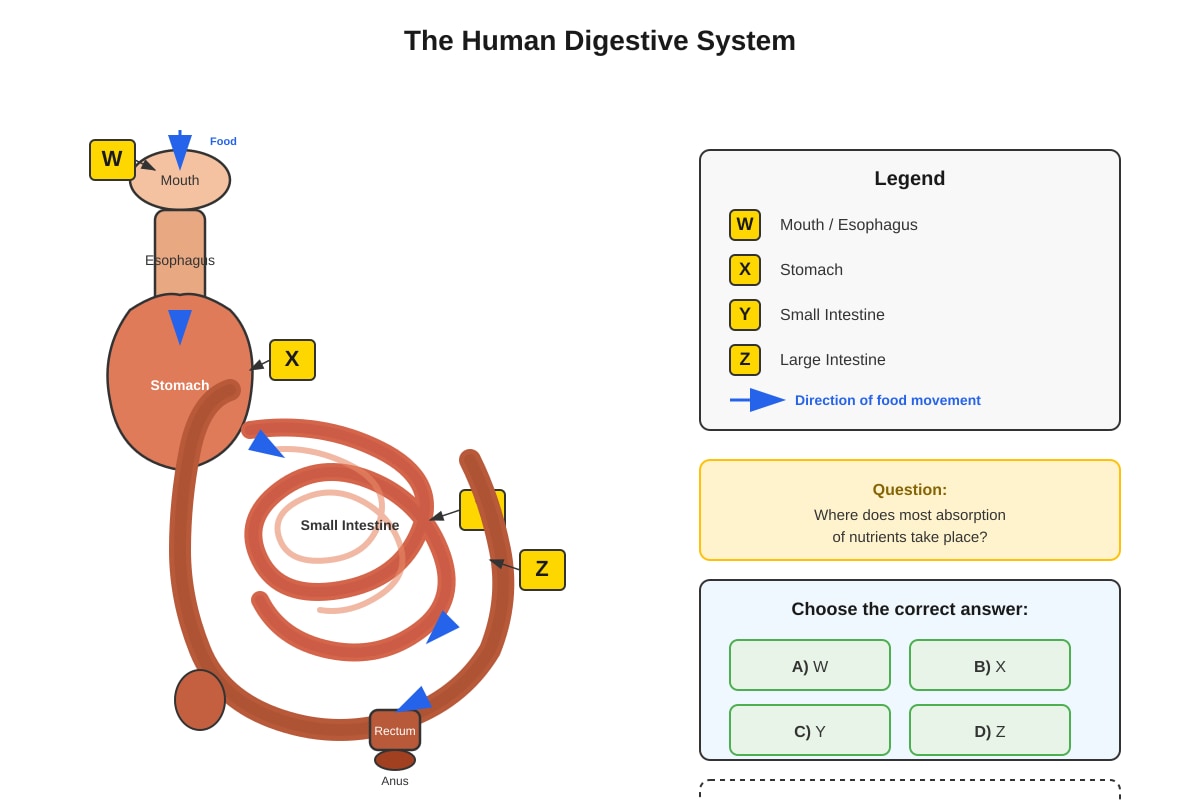
11. The diagram below shows the human digestive system.

<image_placeholder> id: Q11-fig1 type: diagram linked_question: Q11 description: Simple diagram of human digestive system from mouth to anus, with parts labeled W, X, Y, Z. W is at the mouth/esophagus area. X is the stomach. Y is the small intestine. Z is the large intestine. labels: W (mouth/esophagus), X (stomach), Y (small intestine), Z (large intestine) values: None must_show: Simplified digestive tract outline; clearly labeled W, X, Y, Z; approximate relative sizes and positions; arrows showing direction of food movement </image_placeholder>

Where does most absorption of nutrients take place?

ABCD
WXYZ

Answer: [ ]


12. Which of the following is NOT a correct pairing of an animal and its characteristic?

ABCD
Fish — lives in waterBird — has wingsInsect — has six legsReptile — has fur

Answer: [ ]


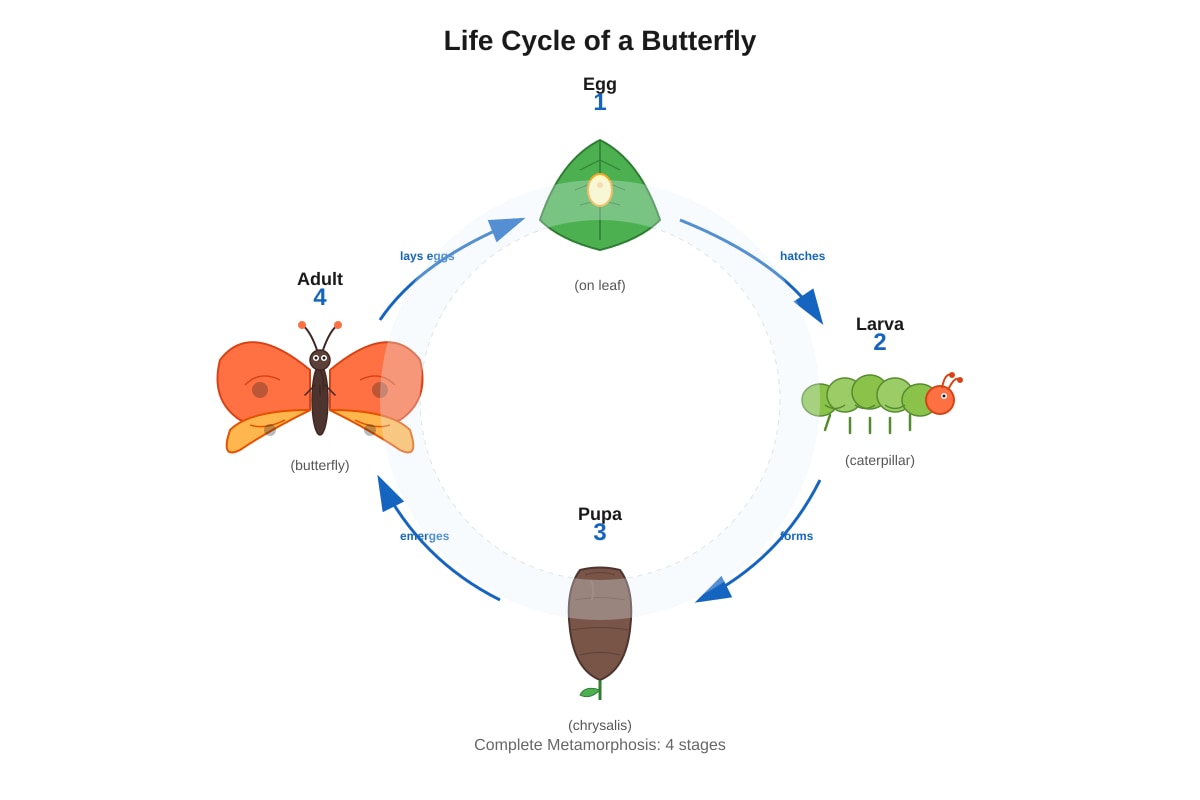
13. The picture shows the life cycle of a butterfly.

<image_placeholder> id: Q13-fig1 type: diagram linked_question: Q13 description: Butterfly life cycle shown in circular sequence with four stages labeled 1, 2, 3, 4. Stage 1 is an egg on a leaf. Stage 2 is a caterpillar. Stage 3 is a pupa/chrysalis. Stage 4 is an adult butterfly. Arrows show progression 1→2→3→4→1. labels: 1 (egg), 2 (larva/caterpillar), 3 (pupa/chrysalis), 4 (adult butterfly) values: None must_show: Complete metamorphosis stages in correct order; labels 1-4; circular arrangement with directional arrows; each stage visually distinct and recognizable </image_placeholder>

What type of metamorphosis does the butterfly undergo?

ABCD
Incomplete metamorphosisComplete metamorphosisNo metamorphosisPartial metamorphosis

Answer: [ ]


14. Which of these can be used to classify plants?

ABCD
Colour of the stem onlyNumber of friends it hasWhether it has flowers or notHow old the plant is

Answer: [ ]


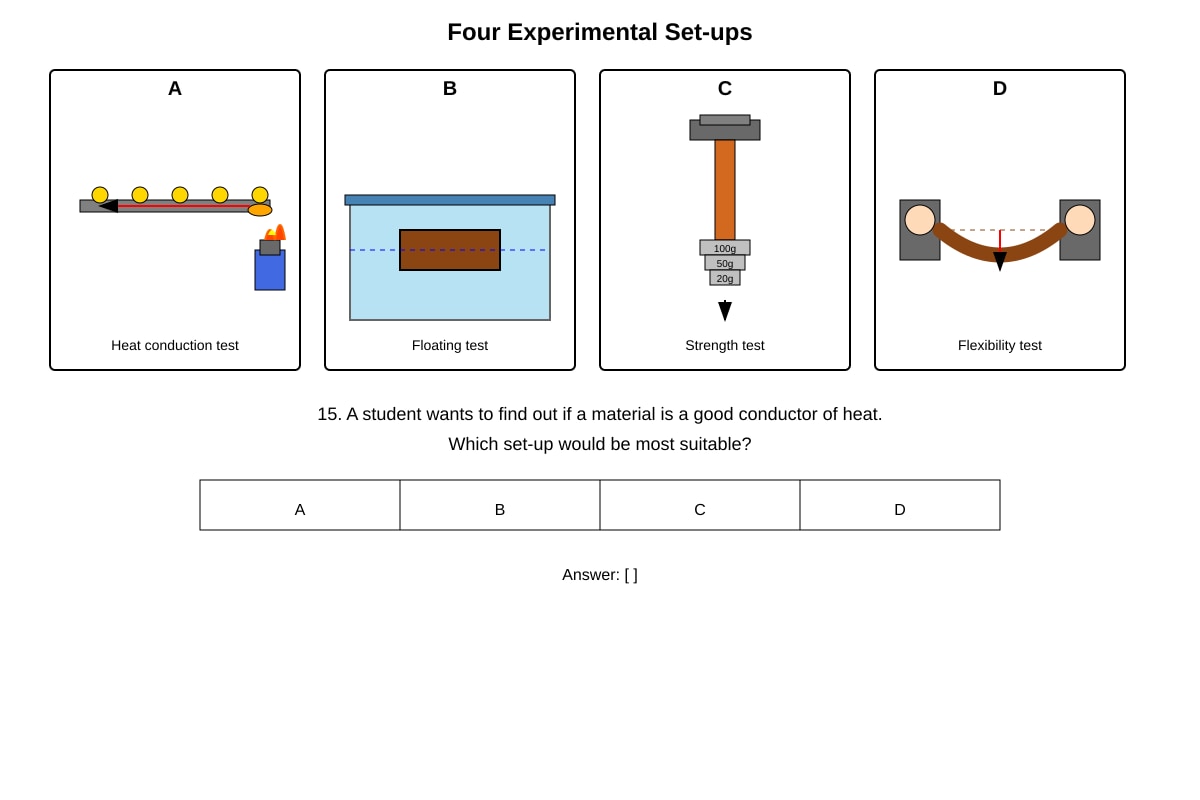
15. A student wants to find out if a material is a good conductor of heat. Which set-up would be most suitable?

<image_placeholder> id: Q15-fig1 type: diagram linked_question: Q15 description: Four experimental setups labeled A, B, C, D. A shows a rod with wax dots being heated at one end over a flame. B shows a material floating on water. C shows a material being stretched by weights. D shows a material being bent repeatedly. labels: A, B, C, D values: None must_show: Setup A with metal rod, candle/dots of wax, Bunsen burner flame at one end, wax dots melting sequentially; B showing floating test; C showing strength test with weights; D showing flexibility/bending test; clear labels A-D </image_placeholder>

ABCD
ABCD

Answer: [ ]


Section A Total: ______ / 15


SECTION B: SHORT ANSWER [25 marks]

Answer all questions in the spaces provided.


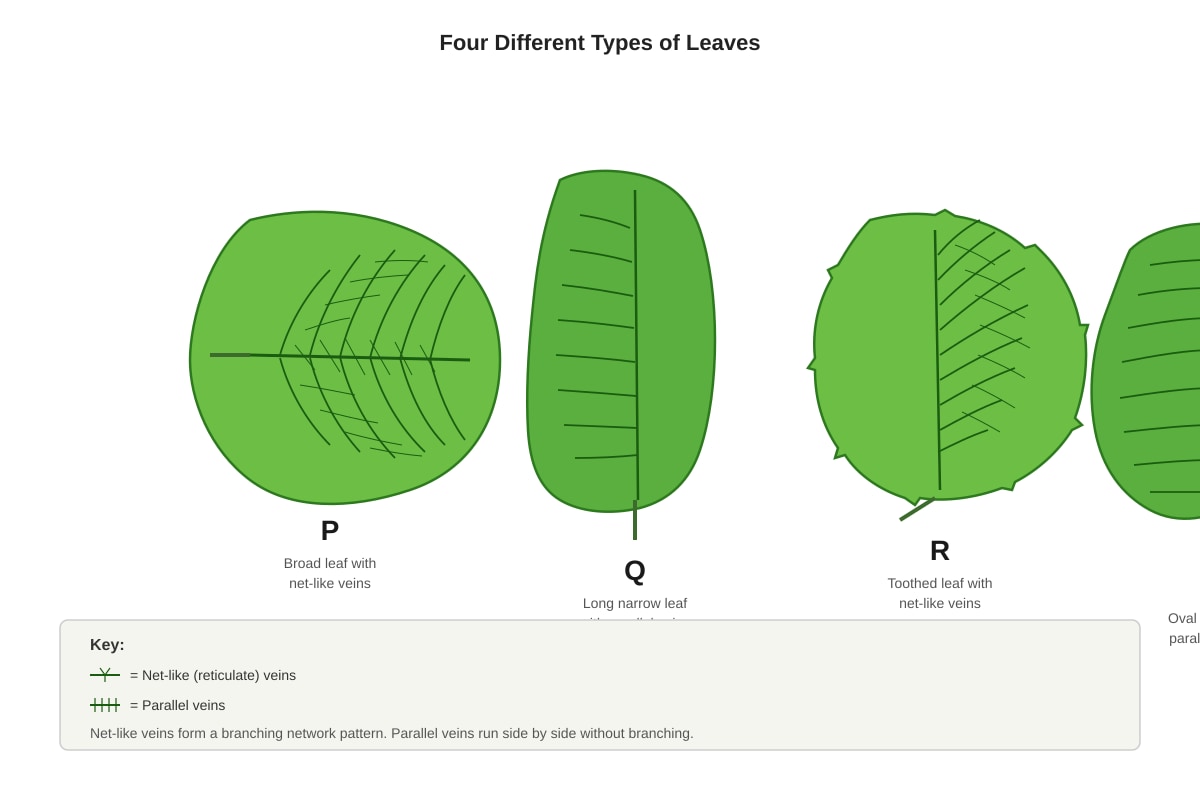
16. The diagram below shows four different types of leaves.

<image_placeholder> id: Q16-fig1 type: diagram linked_question: Q16 description: Four leaves arranged showing different shapes and vein patterns. Leaf P has net-like (reticulate) veins and broad blade. Leaf Q has parallel veins and long narrow shape. Leaf R has net-like veins and toothed edges. Leaf S has parallel veins and oval shape. labels: P, Q, R, S values: None must_show: Clear visual distinction between reticulate/net veins (P, R) and parallel veins (Q, S); different leaf shapes; labels P, Q, R, S </image_placeholder>

(a) Which leaves have net-like veins? Write the letter(s). [1]


(b) Plants with parallel veins are usually monocots. Name one example of a plant with parallel veins. [1]


(c) Based on the vein patterns, which group of plants (P, Q, R, or S) are most likely flowering plants? Explain your answer. [2]


17. The table below shows some characteristics of four animals.

AnimalBody coveringHow it breathesNumber of legs
TScalesGills0
UFeathersLungs2
VFurLungs4
WMoist skinLungs and skin4

(a) Which animal is most likely a fish? [1]


(b) Name the animal group that animal U belongs to. [1]


(c) Animal W is an amphibian. Give one reason why it is not a reptile. [1]


(d) Animal V gives birth to live young. Name one other characteristic of mammals that animal V has. [1]


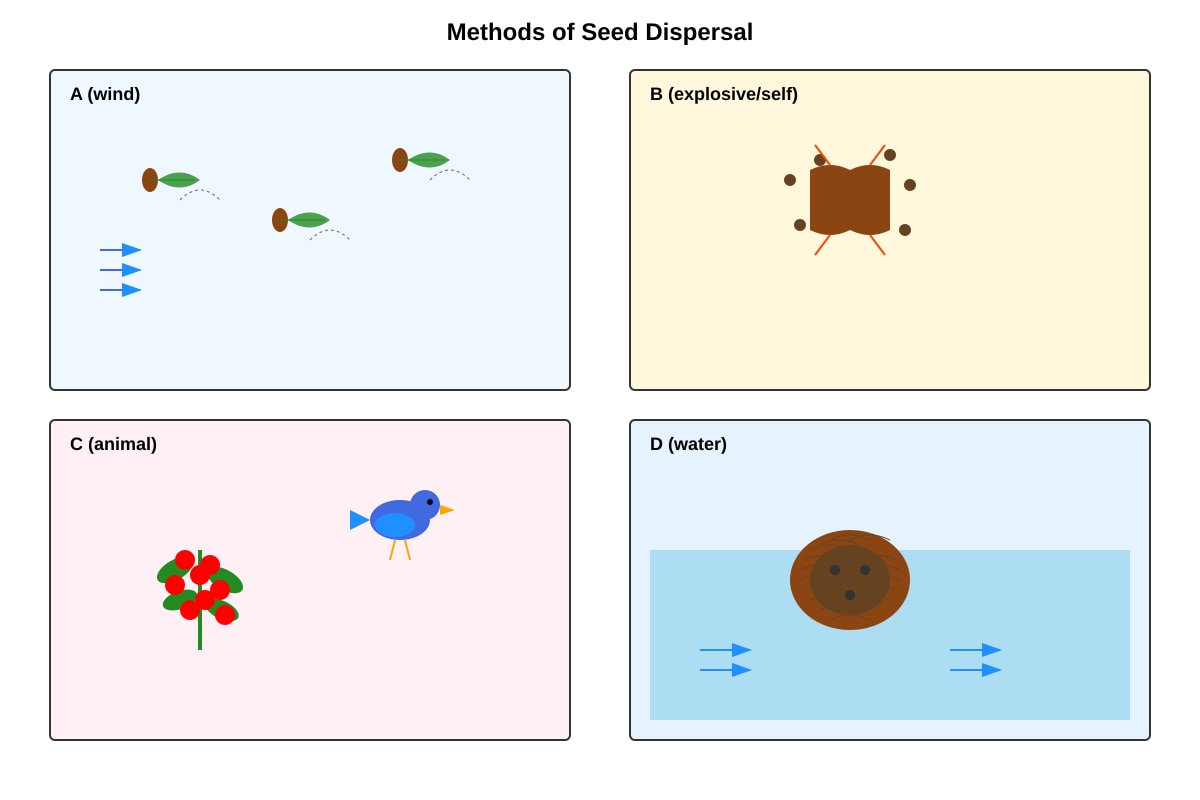
18. The diagram below shows how seeds can be dispersed.

<image_placeholder> id: Q18-fig1 type: diagram linked_question: Q18 description: Four methods of seed dispersal shown in separate panels A-D. A shows winged seeds like maple samaras spinning down. B shows explosive/pod splitting with seeds scattering. C shows fleshy bright red berries on a plant. D shows coconut with fibrous husk in water. labels: A (wind), B (explosive/self), C (animal), D (water) values: None must_show: A with spinning winged seeds; B with pod bursting open; C with colorful fleshy fruits; D with coconut husk and water context; labels A, B, C, D </image_placeholder>

(a) Name the method of seed dispersal shown in A. [1]


(b) Explain how the structure of the seed in D helps it to be dispersed by water. [2]


(c) Why do plants need to disperse their seeds? Give two reasons. [2]


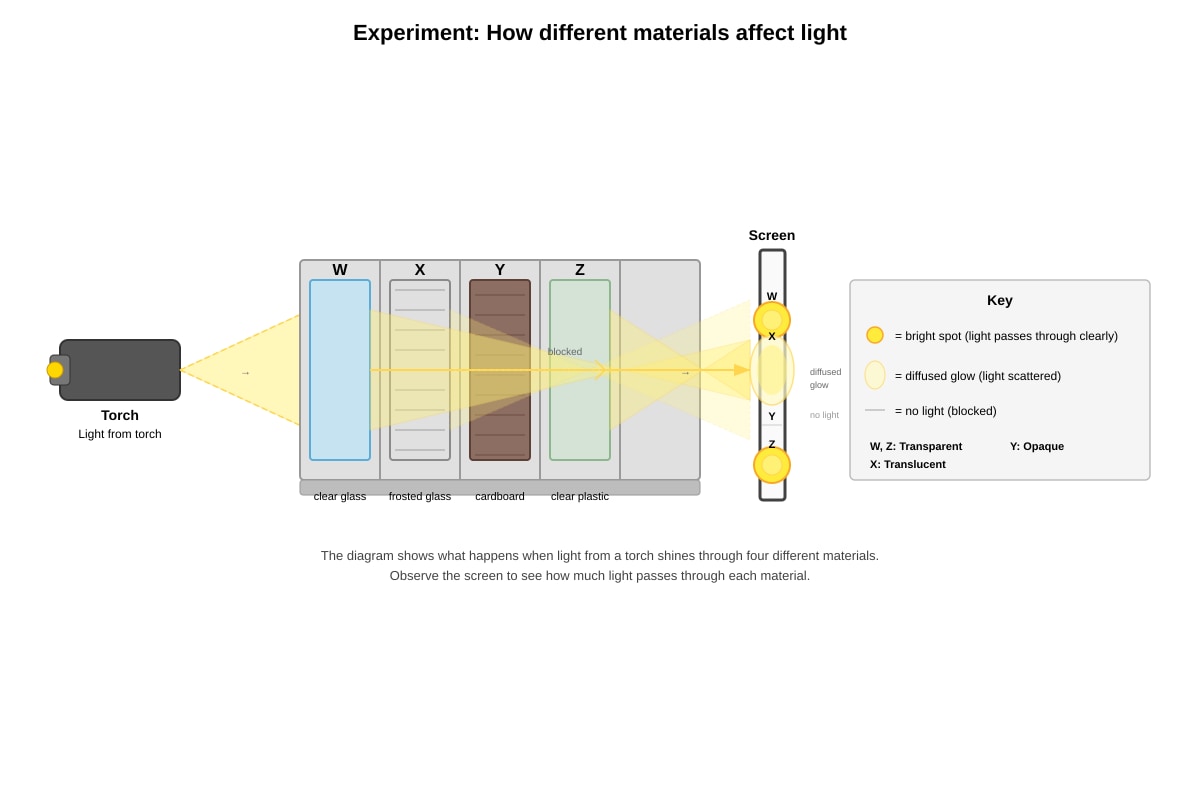
19. James set up an experiment to find out if different materials allow light to pass through.

<image_placeholder> id: Q19-fig1 type: diagram linked_question: Q19 description: Experimental setup showing a torch shining at four materials placed in slots (W, X, Y, Z) with a screen behind. W is a clear glass. X is frosted glass. Y is cardboard. Z is clear plastic. Light beam shown with different results on screen. labels: W (clear glass), X (frosted glass), Y (cardboard), Z (clear plastic), Light from torch, Screen values: None must_show: Torch as light source; four material samples in holders; screen showing bright spot for W and Z, diffused glow for X, no light for Y; arrows showing light path; labels W, X, Y, Z </image_placeholder>

(a) Name the material that is opaque. [1]


(b) Through which materials does light pass directly? Write the letter(s). [1]


(c) Name the type of material that X represents. [1]


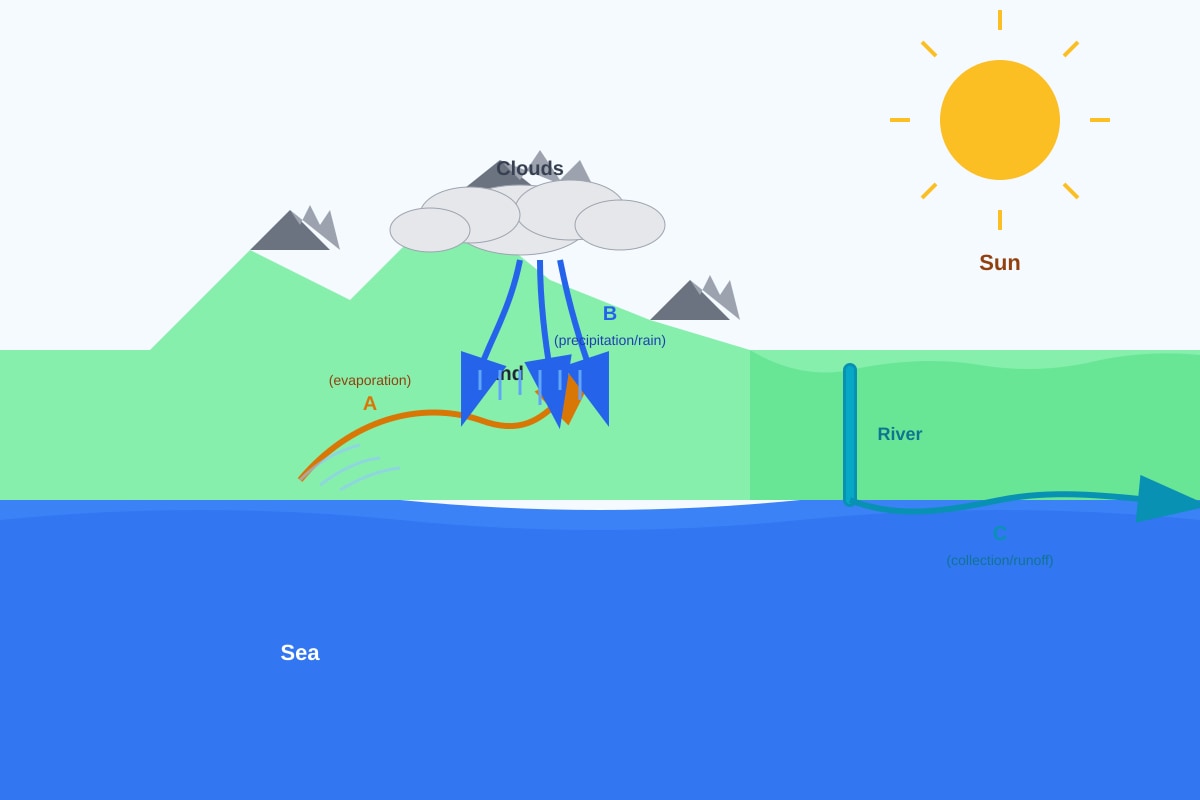
20. The diagram below shows the water cycle.

<image_placeholder> id: Q20-fig1 type: diagram linked_question: Q20 description: Water cycle diagram showing sea/river with sun above. Arrow A shows water rising from sea. Clouds form. Arrow B shows rain falling. Arrow C shows water flowing in river back to sea. Mountains/land in between. labels: A (evaporation), B (precipitation/rain), C (collection/runoff), Sun, Sea, Clouds, Land values: None must_show: Sun heating water surface; upward arrow A from water body; cloud formation; downward arrow B from clouds; river/arrow C flowing back to water body; labels A, B, C; water body, land features </image_placeholder>

(a) What process is happening at A? [1]


(b) What must happen in the clouds before process B can occur? [1]


(c) Explain why the water cycle is important for living things. [2]


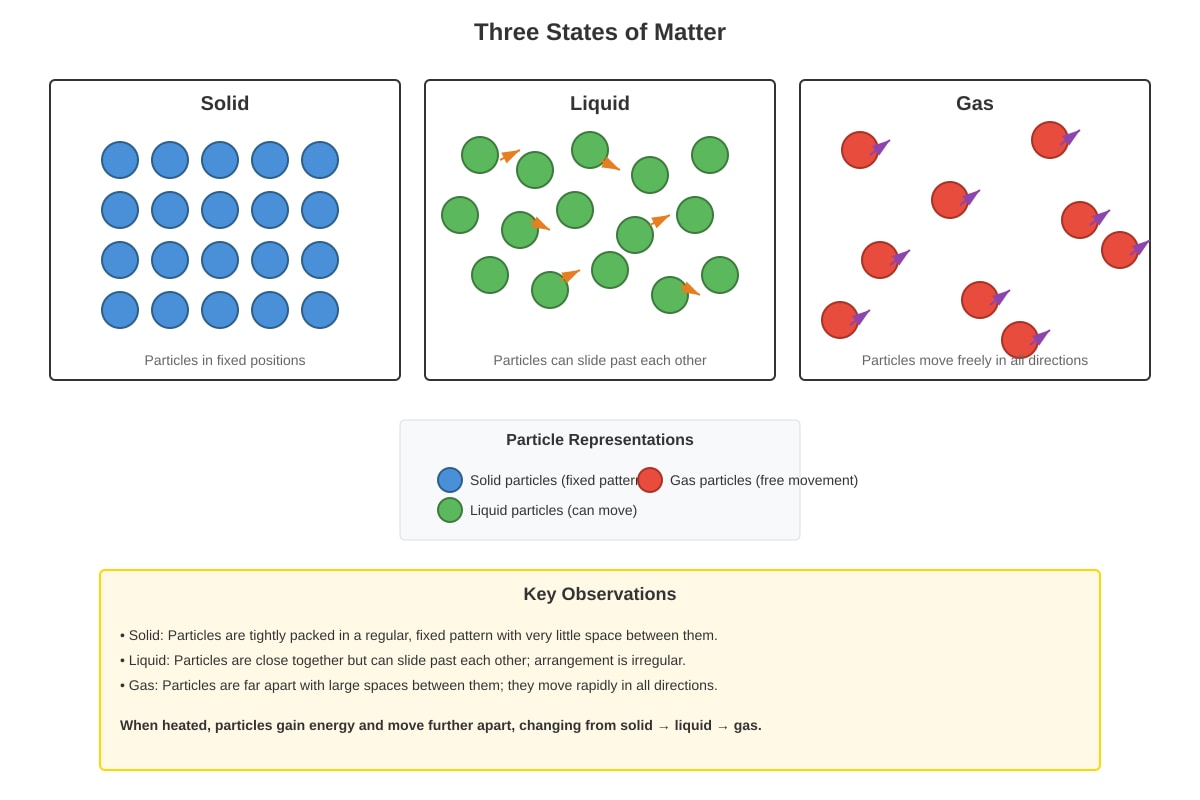
21. The diagram below shows three states of matter.

<image_placeholder> id: Q21-fig1 type: diagram linked_question: Q21 description: Three particle diagrams showing solid, liquid, gas. Solid shows particles in regular arrangement close together. Liquid shows particles close but random arrangement with some space to move. Gas shows particles far apart with large spaces, moving randomly. labels: Solid, Liquid, Gas, particle representations values: None must_show: Solid with tightly packed particles in fixed pattern; liquid with particles touching but able to slide past; gas with particles far apart and random motion arrows; labels identifying each state; consistent particle size across all three </image_placeholder>

(a) In which state do the particles have the most energy? [1]


(b) What happens to the particles when a solid is heated and becomes a liquid? [2]


22. The table below shows the life cycles of two animals.

GrasshopperFrog
StagesEgg → Nymph → AdultEgg → Tadpole → Adult
Young looks like adult?Similar, but smaller and no wingsVery different, has tail and lives in water
BreathingAir throughoutGills when young, lungs when adult

(a) Complete this sentence: The grasshopper has _____________ metamorphosis. [1]


(b) How many stages are there in the frog's life cycle? [1]


(c) Explain one way the frog's life cycle is different from the grasshopper's life cycle. [2]


Section B Total: ______ / 25


SECTION C: STRUCTURED RESPONSE [20 marks]

Answer all questions. Write your answers in the spaces provided.


23. A class of students went on a field trip to a pond. They observed different living things and recorded their observations in a table.

Living thingWhere foundObservations
Water lilyFloating on waterGreen leaves; white flowers
TadpoleIn water black; has tail
DragonflyFlying above waterSix legs; two pairs of wings
Water snailOn rocks in waterShell on body; moves slowly

(a) Classify the living things in the table into plants and animals. Copy the names into the correct columns below. [2]

PlantsAnimals

(b) The tadpole develops into a frog. Explain two changes that happen during this development. [4]


(c) The water lily has flowers. Using this information, name one other group of plants it belongs to. Explain your answer. [2]


24. Sarah wanted to find out which material would keep her drink cold for the longest time. She wrapped four identical cups with different materials and measured the temperature of the drink inside after 30 minutes.

CupMaterial wrappingTemperature after 30 minutes (°C)
ANothing (control)25
BCotton cloth22
CAluminium foil24
DPlastic foam18

(a) What is the purpose of Cup A in this experiment? [1]


(b) Based on the results, which material is the best insulator? Explain your answer. [2]


(c) Sarah said, "Materials that are good conductors of heat are also good insulators." Do you agree with Sarah? Use evidence from the table to support your answer. [2]


(d) Suggest one improvement Sarah could make to her experiment to make her results more reliable. [1]


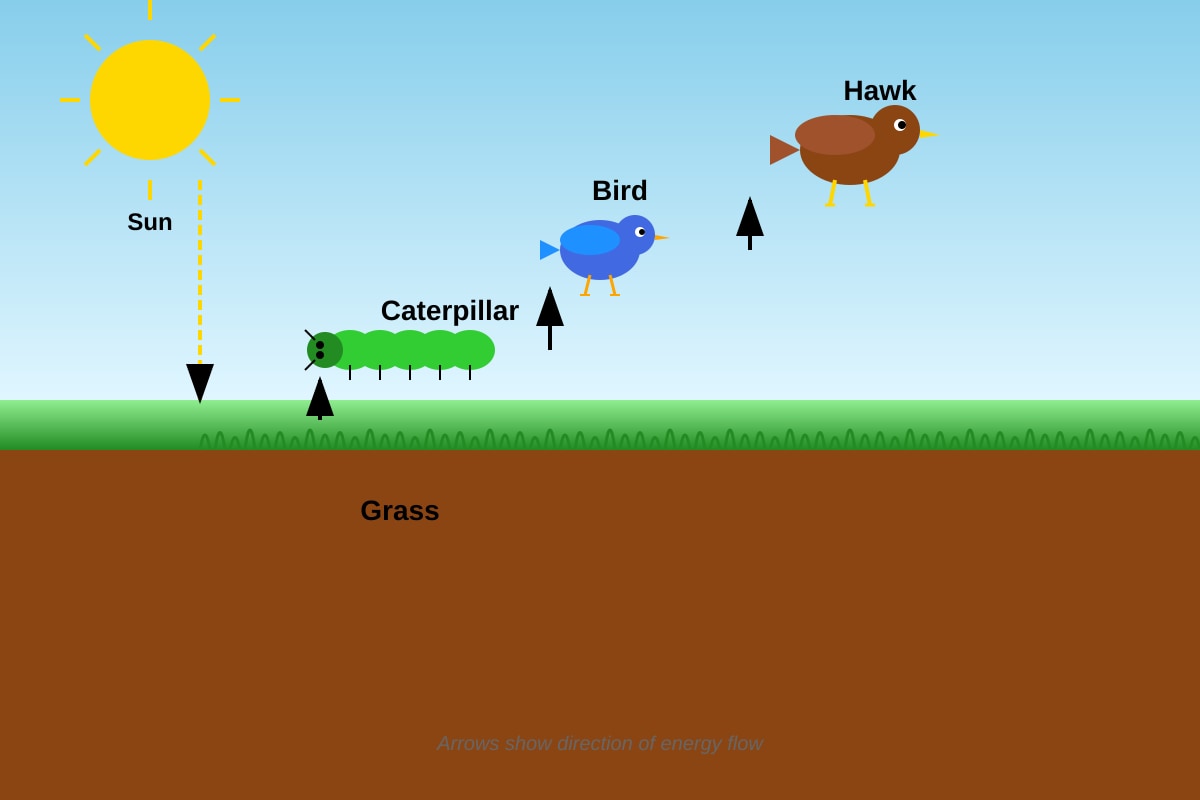
25. The diagram below shows a food chain in a garden.

<image_placeholder> id: Q25-fig1 type: diagram linked_question: Q25 description: Simple food chain diagram showing: grass → caterpillar → bird → hawk. Arrows point from food to eater. Sun shown shining on grass. Each organism drawn simply with label. labels: Grass, Caterpillar, Bird, Hawk, Sun; arrows showing energy flow direction values: None must_show: Producer (grass) with sun; primary consumer (caterpillar) eating grass; secondary consumer (bird) eating caterpillar; tertiary consumer (hawk) eating bird; directional arrows; simple recognizable drawings; labels on each organism </image_placeholder>

(a) Name the producer in this food chain. [1]


(b) What does the arrow between the grass and the caterpillar represent? [1]


(c) Explain what would happen to the bird population if all the hawks were removed from the garden. [3]


(d) A farmer uses pesticide to kill caterpillars. Explain two effects this might have on the food chain. [4]


Section C Total: ______ / 20


END OF PAPER

GRAND TOTAL: ______ / 60


Please check your work before handing in your paper.

Answers

<!-- TuitionGoWhere generation metadata: stage=3-1; model=moonshotai/kimi-k2.6:free; model_label=Kimi K2.6 Free; generated=2026-06-09; Sources: Stage 2-1 real exam-derived templates and Stage 2-2 exam-enriched syllabus. -->

TuitionGoWhere Practice Paper - Science Primary 4

SA2 End-of-Year Examination - Version 3 of 5

ANSWER KEY


SECTION A: MULTIPLE CHOICE [15 marks]

QuestionAnswerExplanation
1CLiving things can grow and develop. Not all living things can move freely (plants cannot), not all make their own food (animals eat other organisms), and ALL living things need water.
2CFrog is an amphibian, which is a vertebrate (has backbone). Jellyfish and spider are invertebrates. Earthworm is also an invertebrate. Based on the classification diagram, "With Backbone" includes frogs, toads, snakes, birds, mammals, and fish.
3BA river is non-living — it does not grow, reproduce, or need food. A mushroom, seed, and bird are all living things that show life processes.
4ALiving things must show ALL characteristics of life: growth, reproduction, need for water, and typically movement. Only P shows all these features. Q shows none; R cannot grow or reproduce; S cannot reproduce.
5BX shows a compound leaf — it has many small leaflets arranged along a central stalk (rachis). W, Y, and Z are all simple leaves with a single blade.
6CBirds have feathers; mammals have fur or hair. Both have eyes, blood, and can move. Feathers are unique to birds and are used for flight and insulation.
7DAnimal D (monkey) is a mammal — it has fur, gives birth to live young, and feeds its young with milk. A is a fish, B is an amphibian, C is an insect.
8BCrab, butterfly, and snail are all invertebrates — they do not have backbones. All other options contain vertebrates (fish, frog, snake, bird, bat, whale, crocodile, lizard, turtle all have backbones).
9BQ (coconut) is dispersed by water. It has a thick, fibrous husk that acts as a float, and a waterproof shell. P is wind-dispersed (fluffy parachute), R is self-dispersed (explosive pod), S is animal-dispersed (hooks catch on fur).
10BFungi cannot make their own food — they are decomposers that absorb nutrients from dead organic matter. Plants can photosynthesize; fungi cannot.
11CY (small intestine) is where most absorption of nutrients occurs. The inner wall has tiny finger-like projections called villi that increase surface area for absorption. Water is absorbed in Z (large intestine), but most nutrients pass through Y first.
12DReptiles have scales, NOT fur. Fish do live in water; birds have wings; insects have six legs. Reptiles are cold-blooded, have scales, and most lay eggs.
13BButterflies undergo complete metamorphosis: egg → larva (caterpillar) → pupa (chrysalis) → adult. The young (caterpillar) looks completely different from the adult and there is a resting pupal stage. Incomplete metamorphosis lacks the pupa stage.
14CPlants can be classified by whether they have flowers (flowering plants / angiosperms) or not (non-flowering plants like ferns and mosses). Stem colour, number of friends, and age are not valid scientific classification criteria.
15ASet-up A tests heat conductivity — the wax dots melt in order from the heat source, showing how quickly heat travels along the rod. B tests floating/density; C tests strength; D tests flexibility.

SECTION B: SHORT ANSWER [25 marks]


16(a) P and R [1]

Leaves P and R both show net-like (reticulate) vein patterns where veins branch and interconnect across the leaf blade.


16(b) Grasses / Maize / Corn / Rice / Wheat / Bamboo / Any monocot plant [1]

These are monocot plants characterized by parallel-veined leaves. Dicots generally have net-like veins.


16(c) P and R (or: the plants with net-like veins) [1]

Explanation: Flowering plants (dicotyledons) usually have net-like veins in their leaves. Net-like veins help to support the leaf and transport water and food throughout the broad leaf surface. Plants with parallel veins are typically monocots, which are also flowering plants, but the more common P4 syllabus association is that dicots = net-like veins = flowering plants. The presence of net veins is a key identifying feature of dicot flowering plants. [1]

Marking note: Accept either P/R or acknowledge that both P/R and Q/S could be flowering plants, but net-like veins specifically indicate dicots. Full marks for identifying P/R with correct reasoning.


17(a) Animal T [1]

Fish have scales, breathe through gills, and have no legs (they have fins for swimming).


17(b) Bird [1]

Feathers are unique to birds. Birds breathe with lungs, have two legs (wings are modified forelimbs), and are warm-blooded vertebrates.


17(c) Any one of: [1]

  • It has moist skin (reptiles have dry, scaly skin)
  • It breathes through its skin as well as lungs (reptiles only use lungs)
  • It does not have scales (reptiles have scales)

Marking note: Any valid distinction between amphibian and reptile characteristics is accepted.


17(d) Any one of: [1]

  • It has fur/hair
  • It feeds its young with milk
  • It is warm-blooded
  • It has external ear flaps (pinnae)

18(a) Wind dispersal [1]

The spinning winged structure (samaras) helps the seed float through the air.


18(b) Any two of: [2]

  • The seed/fruit has a fibrous husk [1] that contains air spaces, making it light and able to float [1]
  • The husk is waterproof/protects the seed from getting wet [1]
  • It is round and can roll/flow easily with water currents [1]

18(c) Any two of: [2]

  • To prevent overcrowding so seedlings have space, light, and nutrients to grow [1]
  • To reduce competition with the parent plant for water, sunlight, and minerals [1]
  • To allow the species to colonize new habitats/survive in different conditions [1]

19(a) Y (cardboard) [1]

Cardboard does not allow any light to pass through — it is opaque.


19(b) W and Z [1] (or: clear glass and clear plastic)

Both clear glass and clear plastic are transparent — light passes through them directly without being scattered.


19(c) Translucent (material) [1]

Translucent materials allow some light to pass through but scatter it, so objects cannot be seen clearly through them. Frosted glass diffuses light.


20(a) Evaporation [1]

Heat from the sun causes water from the sea/river to change into water vapour (gas) and rise into the air.


20(b) Condensation [1]

Water vapour in the air cools down and changes back into tiny water droplets (liquid) around dust particles. These droplets join together to form clouds. When they become too heavy, they fall as rain.


20(c) Any two of: [2]

  • It provides freshwater for drinking and daily use [1]
  • It provides water for plants to grow, which produce food and oxygen [1]
  • It maintains the balance of water in the environment [1]
  • It helps in weathering and shaping the land [1]

21(a) Gas [1]

Gas particles have the most energy — they move freely and rapidly in all directions, filling the space available.


21(b) Any two of: [2]

  • The particles gain energy from the heat [1]
  • The particles move faster and vibrate more vigorously [1]
  • The arrangement becomes less ordered/more random [1]
  • The particles are able to slide past each other rather than being fixed in position [1]
  • Spaces between particles increase slightly [1]

Key concept: In melting, the particles gain enough energy to overcome the forces holding them in fixed positions, but not enough to break free completely (which would be boiling/evaporation).


22(a) Incomplete [1]

Grasshoppers develop through egg → nymph → adult without a pupal stage. The nymph resembles a small adult.


22(b) Three [1]

Egg → Tadpole → Adult (or: Egg → Tadpole → Froglet → Adult — accept three main stages or four if froglet is included)


22(c) Any one valid comparison with explanation: [2]

  • The frog has complete metamorphosis while the grasshopper has incomplete metamorphosis [1] — the frog has a pupa/tadpole stage where it looks very different from the adult, but the grasshopper's nymph looks similar to the adult [1]
  • The frog's young lives in water and breathes with gills, while the adult lives on land and breathes with lungs [1] — the grasshopper breathes with air throughout its life using spiracles/tracheae [1]
  • The frog develops through radical body changes (losing tail, growing legs, developing lungs), while the grasshopper mainly grows larger and develops wings [1]

SECTION C: STRUCTURED RESPONSE [20 marks]


23(a)

PlantsAnimals
Water lilyTadpole
Dragonfly
Water snail

[2 marks: 1 mark for correct plants; 1 mark for correct animals — deduct 0.5 for each error, minimum 0 per column]


23(b) Any two valid changes with explanations: [4]

  • Develops legs: The tadpole grows hind legs first, then front legs [1] to help it move on land when it becomes a frog [1]
  • Loses tail: The tail shrinks and is absorbed into the body [1] as it is no longer needed for swimming [1]
  • Develops lungs: The tadpole breathes with gills in water [1] but develops lungs to breathe air on land [1]
  • Changes diet: Tadpoles are herbivores (eat algae/plants) [1] but adult frogs are carnivores (eat insects) [1]

Marking note: Each change must include what changes AND why/how this helps survival. Award [1] for identifying change, [1] for explaining significance.


23(c) Flowering plants / Angiosperms [1]

Explanation: The water lily produces flowers, which is the defining feature of flowering plants (angiosperms). Flowers are the reproductive structures that develop into fruits containing seeds. [1]


24(a) To compare with/To act as a control/To show what happens without any wrapping [1]

The control cup allows Sarah to compare whether the wrapping materials actually make a difference to temperature change.


24(b) Plastic foam (Cup D) [1]

Explanation: It has the lowest temperature after 30 minutes (18°C), meaning least heat entered the drink [1]. The temperature rose by only 3°C from a typical cold starting point (assumed 15°C), or stayed coolest compared to others, showing it best prevented heat transfer from surroundings. [1]

Alternative: If assuming all started at same cold temperature, D is clearly coolest, meaning least heat gained.


24(c) Disagree [1]

Evidence: Aluminium foil (a metal, good conductor) gave temperature 24°C, close to unwrapped cup [1] — poor insulation. Cotton and plastic foam (poor conductors, good insulators) kept drink colder. A good conductor allows heat through easily, so it is a poor insulator. The results show conductors and insulators have opposite effects. [1]


24(d) Any one valid improvement: [1]

  • Repeat the experiment several times and calculate average temperatures
  • Use a thermometer with finer scale/more precise readings
  • Ensure all drinks start at exactly the same temperature
  • Use same thickness of each wrapping material
  • Conduct experiment in a temperature-controlled room
  • Place cups the same distance from heat sources

25(a) Grass [1]

Producers are organisms that can make their own food through photosynthesis. Plants are producers.


25(b) The direction of energy flow / "The caterpillar eats the grass" / Energy transfer from grass to caterpillar [1]

Arrows in food chains point from the food source to the organism that eats it, showing how energy moves through the ecosystem.


25(c) Any three valid points: [3]

  • The bird population would increase at first [1] because there are no hawks to hunt and eat them [1]
  • As bird numbers increase, they would eat more caterpillars [1], so the caterpillar population would decrease
  • Eventually, birds might face food shortage if caterpillars become scarce [1], leading to competition and possible decline

Alternative acceptable chain: More birds → less caterpillars → less food for birds → bird population drops → caterpillars recover, etc.


25(d) Any two valid effects with explanations: [4]

  • Caterpillar population decreases sharply [1], so birds have less food and their population may also decrease [1]
  • Grass population increases [1] because fewer caterpillars are eating it [1]
  • Pesticide may poison the birds [1] if they eat caterpillars that have absorbed the chemical (biomagnification) [1]
  • Hawk population decreases [1] due to fewer birds to eat / food chain disrupted [1]

Marking note: Each effect [1] with linked consequence/explanation [1]. Accept any reasonable ecological cascade effects.


MARK SCHEME SUMMARY

SectionMarks
A: Multiple Choice15
B: Short Answer25
C: Structured Response20
TOTAL60

End of Answer Key