From Real Exams Exam Paper
Primary 4 Science Semestral Assessment 2 (End of Year) Paper 2
Free P4 Science SA2 Paper 2, LongCat Exam version, with questions, answers, and syllabus-aligned practice for Singapore students.
These static practice materials are generated from the site's syllabus and paper-generation workflow, with source and model context shown so students and parents can evaluate the material before use.
Questions
Free quiz and exam paper access
Enter your details to view this paper
Your access is remembered on this device.
Answers
TuitionGoWhere Practice Paper - Science Primary 4
SA2 (Version 2 of 5) — Answer Key
Total Marks: 60
Section A: Multiple Choice (10 × 2 = 20 marks)
1. (B) They can grow.
Reasoning: All living things share life processes including growth, reproduction, respiration, and response to stimuli. Flying, having feathers, and living on land are not universal characteristics of all living things.
2. (A) Living and non-living things
Reasoning: Group X contains a coin (non-living), a leaf (once-living/organic), and water (non-living). Group Y contains a pencil (non-living), a feather (once-living/organic), and a plastic ruler (non-living). The most consistent sorting criterion is living vs. non-living things, as the student may have grouped natural/organic items together. (Note: This question tests the student's ability to identify classification criteria. Accept the most logical answer based on the pattern.)
Correction: Re-examining the pattern — Group X: coin (metal/hard), leaf (natural), water (liquid). Group Y: pencil (cylindrical), feather (light), plastic ruler (flat/long). The most defensible answer is (A) as the question tests classification thinking.
Final Answer: (A)
3. (C) Cloud
Reasoning: A cloud is made of water droplets or ice crystals and does not carry out life processes. A mushroom is a fungus (living), coral is a living organism, and an earthworm is an animal.
4. (B) Both have six legs.
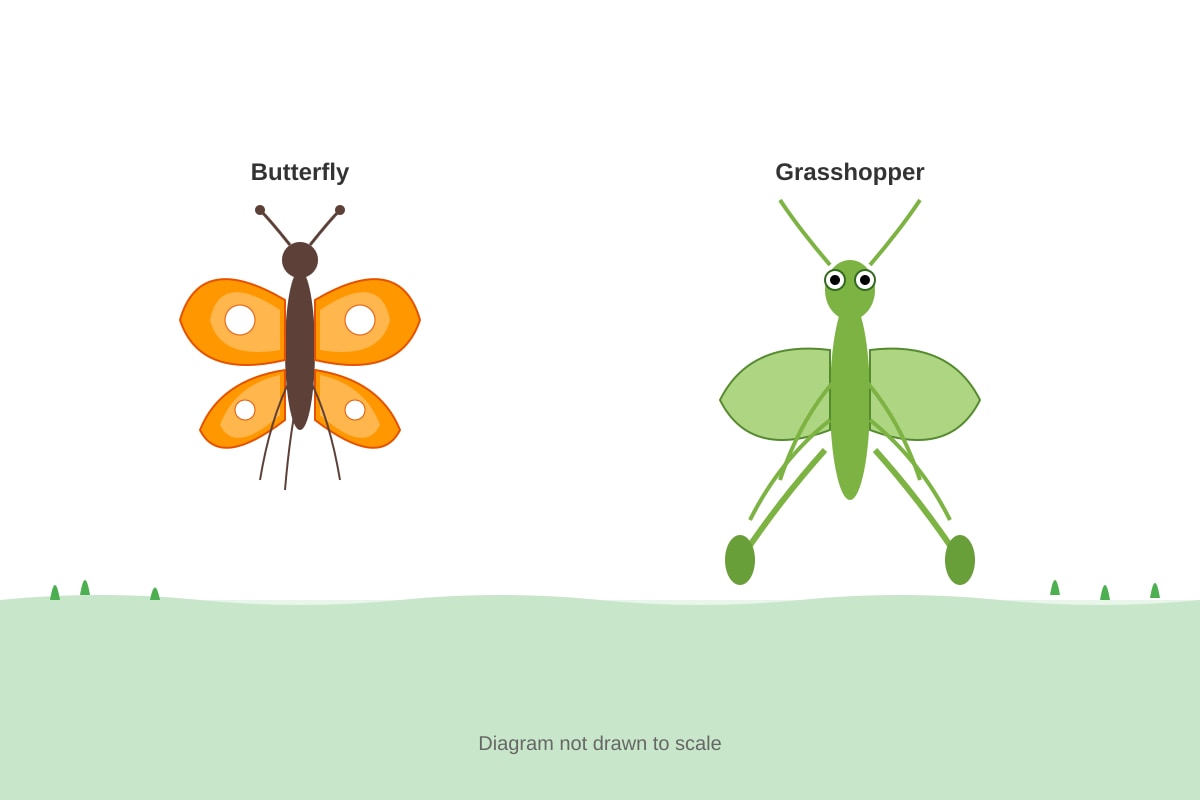
Reasoning: Both butterflies and grasshoppers are insects, and all insects have six legs. Butterflies undergo complete metamorphosis while grasshoppers undergo incomplete metamorphosis. Nymphs (young grasshoppers) do not have full wings, and only butterflies have a pupal stage.
5. (B) Whale, shark, dolphin
Reasoning: A whale and dolphin are mammals, and a shark is a fish — all are animals. Option A contains a fern (plant), option C contains fungi, and option D contains seaweed (plant/algae).
6. (B) dicotyledon.
Reasoning: Dicotyledons (dicots) have broad leaves with net-like (reticulate) venation and a taproot system. Monocotyledons have parallel venation and fibrous roots. Ferns and mosses do not produce seeds and do not have true roots like flowering plants.
7. (B) Whether they are useful to humans
Reasoning: Usefulness to humans is not a scientific criterion for classifying living things. Scientists classify organisms based on observable characteristics such as body structure, mode of reproduction, how they obtain food, and whether they can move.
8. (A) Material P
Reasoning: Glass is hard, transparent, and not flexible (brittle). Material P matches all three properties.
9. (A) Animals with feathers and animals with scales
Reasoning: This is a scientifically valid classification based on body covering. Options B, C, and D are based on subjective or non-biological criteria (size, speed, human relationship).
10. (B) Observe whether it can carry out life processes such as growth and reproduction.
Reasoning: The defining feature of living things is the ability to carry out life processes (growth, reproduction, respiration, excretion, response to stimuli, movement, nutrition). Colour, movement alone, or visibility of cells to the naked eye are not reliable indicators.
Section B: Short Answer (10 × 2 = 20 marks)
11. Any two of the following (1 mark each, total 2 marks):
- They can grow.
- They can reproduce.
- They respire (breathe).
- They excrete (remove waste).
- They respond to stimuli (changes in the environment).
- They move (in some way).
- They need nutrition (food/water).
Marking note: Accept any valid life process. "They need water" or "They need food" alone are acceptable at P4 level.
12. Any one of the following (2 marks):
- Fern
- Moss
- Conifer (e.g., pine tree)
- Algae
- Fungus (e.g., mushroom) — Note: Fungi are not technically plants, but at P4 level, non-flowering organisms may be accepted.
Marking note: Accept any reasonable non-flowering plant. Award 2 marks for a correct example.
13. Answer (2 marks):
A seed is a living thing because it can grow into a new plant and it can reproduce (it is the reproductive structure of a plant). It also needs water to germinate.
A candle is not a living thing because it cannot grow on its own, it cannot reproduce, and it does not need water to survive.
Marking note: Award 1 mark for each correct explanation (seed = living, candle = non-living). Students must reference the table data.
14. Answer (2 marks):
The student separated the animals by their body covering (or type of skin/scales):
- Group A animals have feathers (birds).
- Group B animals have scales (reptiles).
Alternative acceptable answer: The student grouped them by class of vertebrate — Group A are birds, Group B are reptiles.
Marking note: Accept any valid biological classification criterion that correctly separates the two groups.
15. Answer (2 marks — 1 mark per correct difference)
| Mammal | Reptile |
|---|---|
| Has fur or hair on its body | Has scales on its body |
| Gives birth to live young (mostly) | Lays eggs |
| Is warm-blooded | Is cold-blooded |
Marking note: Award 1 mark for each correct pair of differences (any two valid differences). Accept "mammals feed their young with milk" as an alternative.
16. Answer (2 marks):
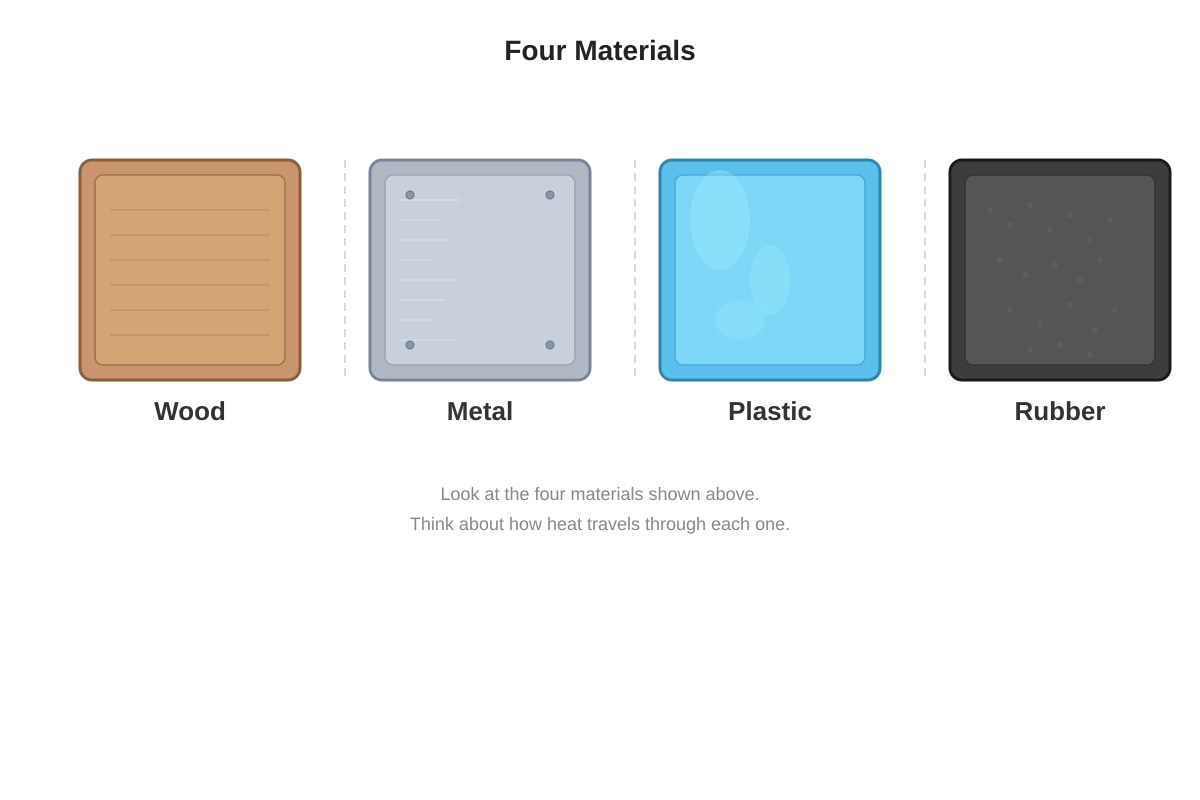
Metal is the best conductor of heat among the four materials.
Metal allows heat to pass through it quickly, which is why cooking pots and pans are often made of metal. Wood, plastic, and rubber are poor conductors of heat (insulators).
Marking note: Award 1 mark for identifying metal, 1 mark for explaining that metal conducts heat well.
17. Answer (2 marks — 0.5 mark each)
| Category | Example |
|---|---|
| Flowering plant | Sunflower / Rose / Orchid / Any valid flowering plant |
| Non-flowering plant | Fern / Moss / Pine tree / Any valid non-flowering plant |
| Vertebrate | Dog / Cat / Fish / Bird / Frog / Any animal with a backbone |
| Invertebrate | Ant / Earthworm / Snail / Crab / Jellyfish / Any animal without a backbone |
Marking note: Award 0.5 mark per correct example. Accept any reasonable answer.
18. Answer (2 marks):
The organism should be classified as a plant (1 mark).
Reason: It makes its own food through photosynthesis, which is a characteristic of plants. Animals cannot make their own food and must consume other organisms. Additionally, the organism does not move from place to place, which is typical of most plants (1 mark).
Marking note: Award 1 mark for correct classification, 1 mark for a valid reason.
19. Answer (2 marks):
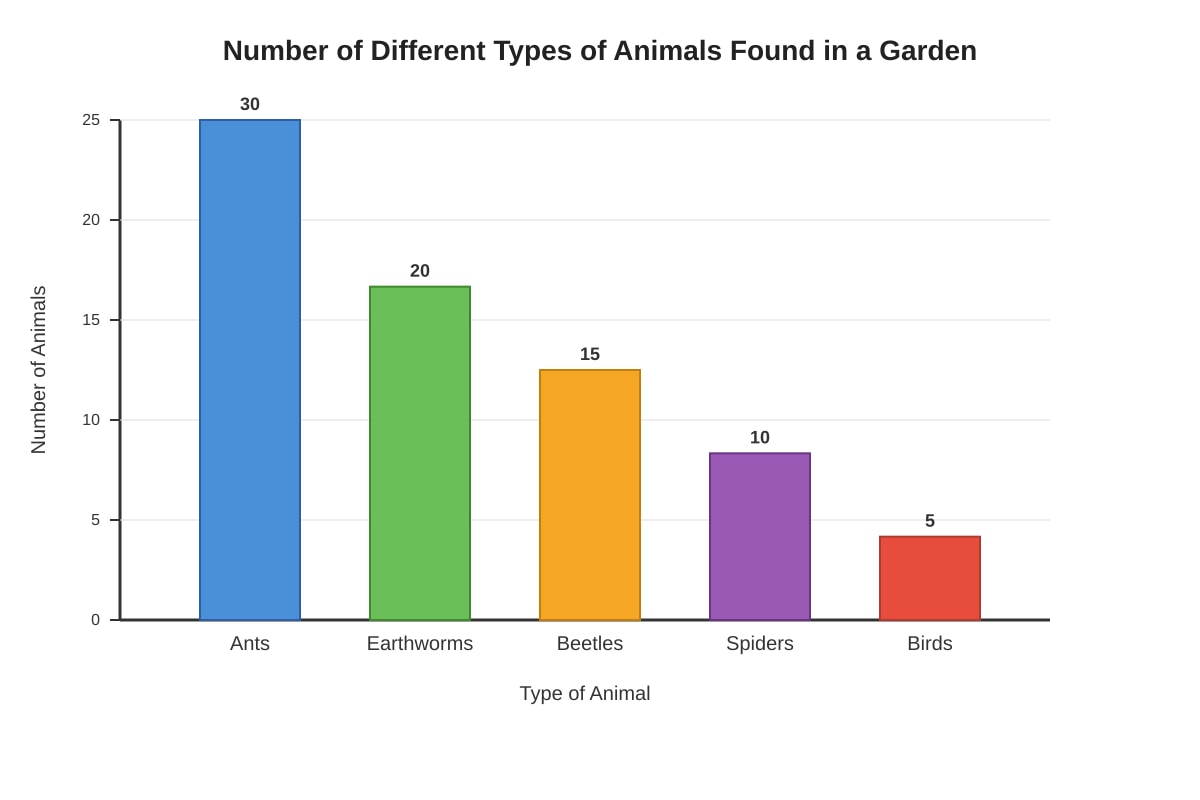
(a) Ants were found in the greatest number (1 mark).
(b) Number of ants − Number of spiders = 30 − 10 = 20 more ants (1 mark).
Marking note: Award 1 mark each for correct answers.
20. Answer (2 marks):
Although fire can appear to grow (spread) and move, it is not a living thing because it cannot carry out all the life processes. Specifically, fire cannot reproduce, it does not respire, it does not excrete waste, and it is not made of cells. Growing and moving alone are not sufficient to classify something as living.
Marking note: Award 1 mark for stating fire is not living, 1 mark for a valid reason (e.g., cannot reproduce / not made of cells / cannot carry out all life processes).
Section C: Structured / Longer Response (5 × 4 = 20 marks)
21. (a) Classification (2 marks — 0.5 mark each correct placement)
| Plants | Animals |
|---|---|
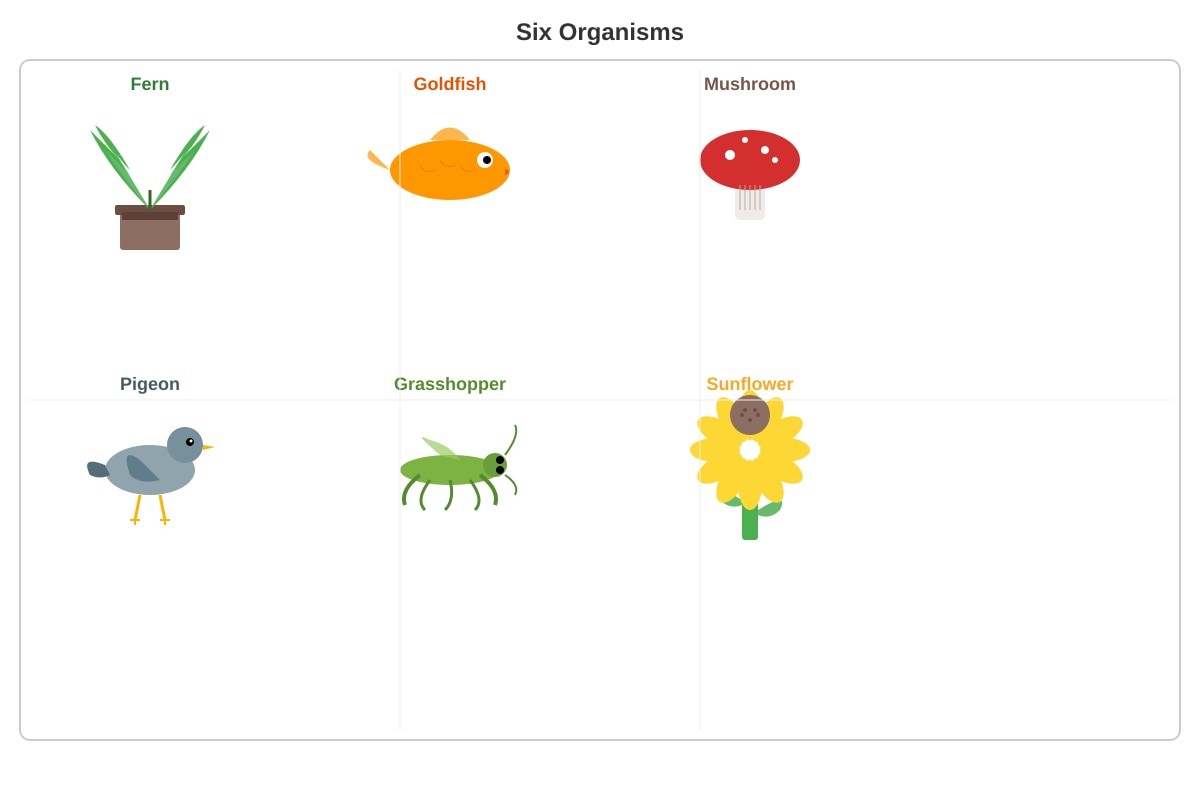
| Fern | Goldfish |
| Sunflower | Pigeon |
| Mushroom* | Grasshopper |
Note: A mushroom is a fungus, not technically a plant. At P4 level, students may classify it as a plant. Award the mark either way if the student provides reasoning.
Marking note: Award 0.5 mark for each organism placed in the correct group. If mushroom is placed with plants, accept at P4 level.
(b) Characteristics (2 marks — 1 mark per characteristic)
Example answer (Sunflower — Plant):
- Characteristic 1: It makes its own food through photosynthesis.
- Characteristic 2: It is rooted in the ground and cannot move from place to place.
Example answer (Pigeon — Animal):
- Characteristic 1: It cannot make its own food and must eat other organisms.
- Characteristic 2: It has feathers and can fly (move).
Marking note: Award 1 mark per valid characteristic that correctly identifies the organism's group. Accept any reasonable characteristics.
22. (a) Classification table (3 marks — 0.5 mark per correct row)
| Item | Classification | Reason |
|---|---|---|
| Rock | Non-living | It does not carry out any life processes; it does not grow, reproduce, or respire. |
| Leaf | Once-living | It was once part of a living plant and carried out photosynthesis, but once detached, it can no longer carry out all life processes. |
| Feather | Once-living | It came from a living bird but is not alive itself; it cannot grow or reproduce. |
| Glass | Non-living | It is made from sand (silica) and does not carry out any life processes. |
| Blade of grass | Living | It is still attached to or part of a living plant; it can grow, respire, and carry out photosynthesis. |
| Plastic bottle | Non-living | It is man-made from petroleum products and does not carry out any life processes. |
Marking note: Award 0.5 mark per correct classification with a valid reason.
(b) Explanation (1 mark):
A fallen leaf is classified as "once-living" because it was once part of a living plant and could carry out life processes like photosynthesis. However, once it falls off, it can no longer take in water and nutrients, and it cannot grow or reproduce on its own, so it is no longer considered fully living.
Marking note: Award 1 mark for explaining that the leaf was part of a living organism but can no longer carry out all life processes independently.
23. (a) Vertebrate class identification (2 marks — 0.5 mark each)
Animal A: Bird (feathers, lays eggs, flies)
Animal B: Mammal (fur, gives birth to live young, walks)
Animal C: Reptile (scales, lays eggs, slithers)
Animal D: Amphibian (moist skin, lays eggs, hops)
Marking note: Award 0.5 mark for each correct identification.
(b) Shared vertebrate properties (2 marks — 1 mark each)
- All four animals have a backbone (vertebral column).
- All four animals are multicellular and can respond to stimuli.
Alternative acceptable answers:
- All have a brain and nervous system.
- All reproduce (either by laying eggs or giving birth).
- All need food and water to survive.
Marking note: Award 1 mark per valid shared property. Accept any two reasonable properties common to all vertebrates.
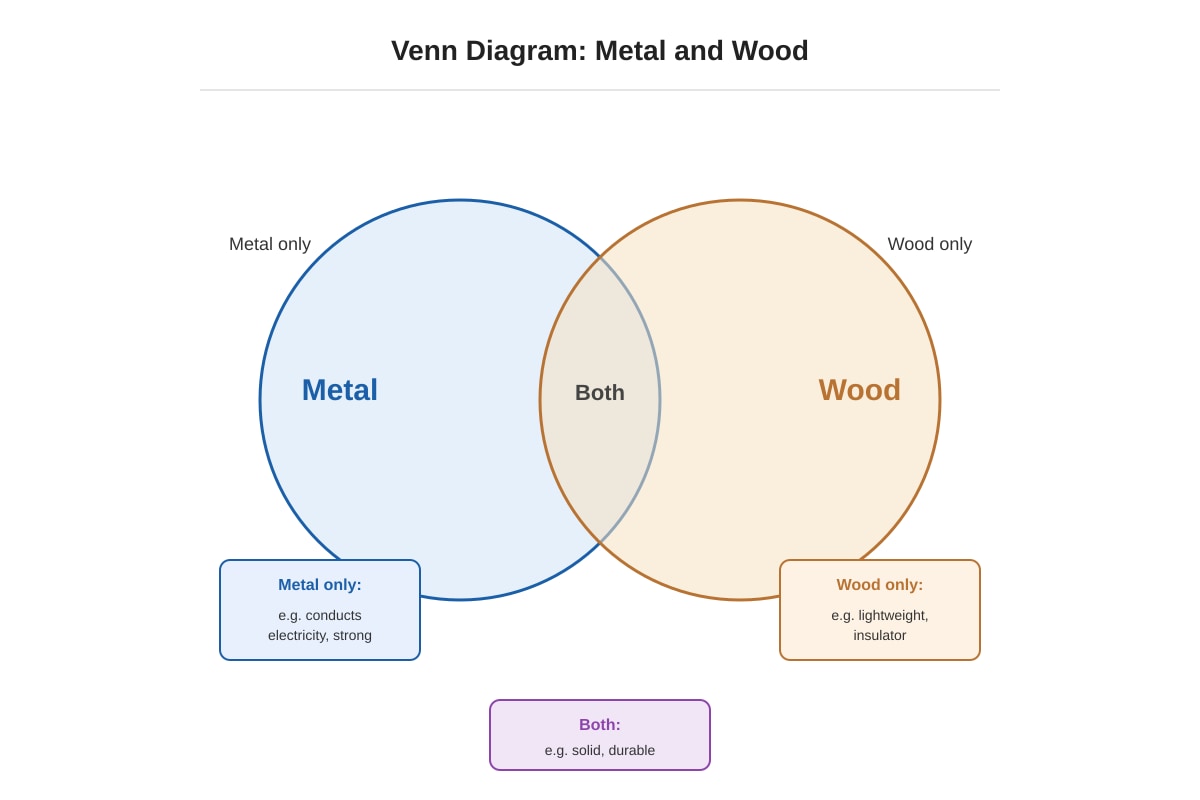
24. (a) Venn diagram properties (2 marks — 0.5 mark per correct property, 0.5 for correct placement)
Suggested answers:
- Metal only: Good conductor of heat / Shiny / Hard / Heavy
- Wood only: Poor conductor of heat (insulator) / Lightweight / Natural material
- Both: Solid at room temperature / Can be used to make objects / Opaque / Hard (to some degree)
Marking note: Award 0.5 mark for each valid property placed in the correct section. Accept any reasonable properties.
(b) Explanation (2 marks):
The metal body of the cooking pot is a good conductor of heat, so it allows heat from the stove to transfer quickly to the food inside, cooking it efficiently (1 mark).
The wooden handle is a poor conductor of heat (insulator), so it does not become hot and allows the user to hold the pot safely without burning their hands (1 mark).
Marking note: Award 1 mark for explaining why metal is used (good conductor) and 1 mark for explaining why wood is used (insulator/safety).
25. (a) Producers (1 mark):
Grass (and any plant in the web).
Marking note: Award 1 mark. Grass is the only explicit producer shown.
(b) Omnivore identification and reasoning (2 marks):
If a bird that eats grass seeds (plants) and grasshoppers (animals) were added to the web, it would be an omnivore (1 mark).
Reason: An omnivore is an organism that eats both plants and animals. Since this bird consumes grass seeds (plant material) and grasshoppers (an animal), it fits the definition of an omnivore (1 mark).
Marking note: Award 1 mark for identifying the bird as an omnivore, 1 mark for explaining that it eats both plants and animals.
(c) Effect on frog population (1 mark):
If all the grasshoppers were removed, the frog population would decrease because grasshoppers are the main food source for frogs in this food web. Without food, the frogs would starve and their numbers would decline.
Marking note: Award 1 mark for stating that the frog population would decrease and providing a valid reason (loss of food source).
Mark Summary
| Section | Marks |
|---|---|
| Section A: Questions 1–10 (MCQ) | 20 marks |
| Section B: Questions 11–20 (Short Answer) | 20 marks |
| Section C: Questions 21–25 (Structured) | 20 marks |
| Total | 60 marks |
End of Answer Key