From Real Exams Exam Paper
Primary 4 Science Semestral Assessment 2 (End of Year) Paper 2
Free P4 Science SA2 Paper 2, Nemo3 Exam version, with questions, answers, and syllabus-aligned practice for Singapore students.
These static practice materials are generated from the site's syllabus and paper-generation workflow, with source and model context shown so students and parents can evaluate the material before use.
Questions
Free quiz and exam paper access
Enter your details to view this paper
Your access is remembered on this device.
Answers
TuitionGoWhere Practice Paper - Science Primary 4 (SA2 Version 2) - Answer Key
Subject: Science
Level: Primary 4
Paper: SA2 (Version 2)
Total Marks: 100
SECTION A: Multiple-Choice Questions (56 marks)
Diversity
1. Answer: (3) Pebble [2]
Explanation: A pebble is a non-living thing. Mushrooms and moulds are fungi (living things), moss and ferns are plants (living things). Non-living things do not need air, food, or water, and cannot grow or reproduce on their own.
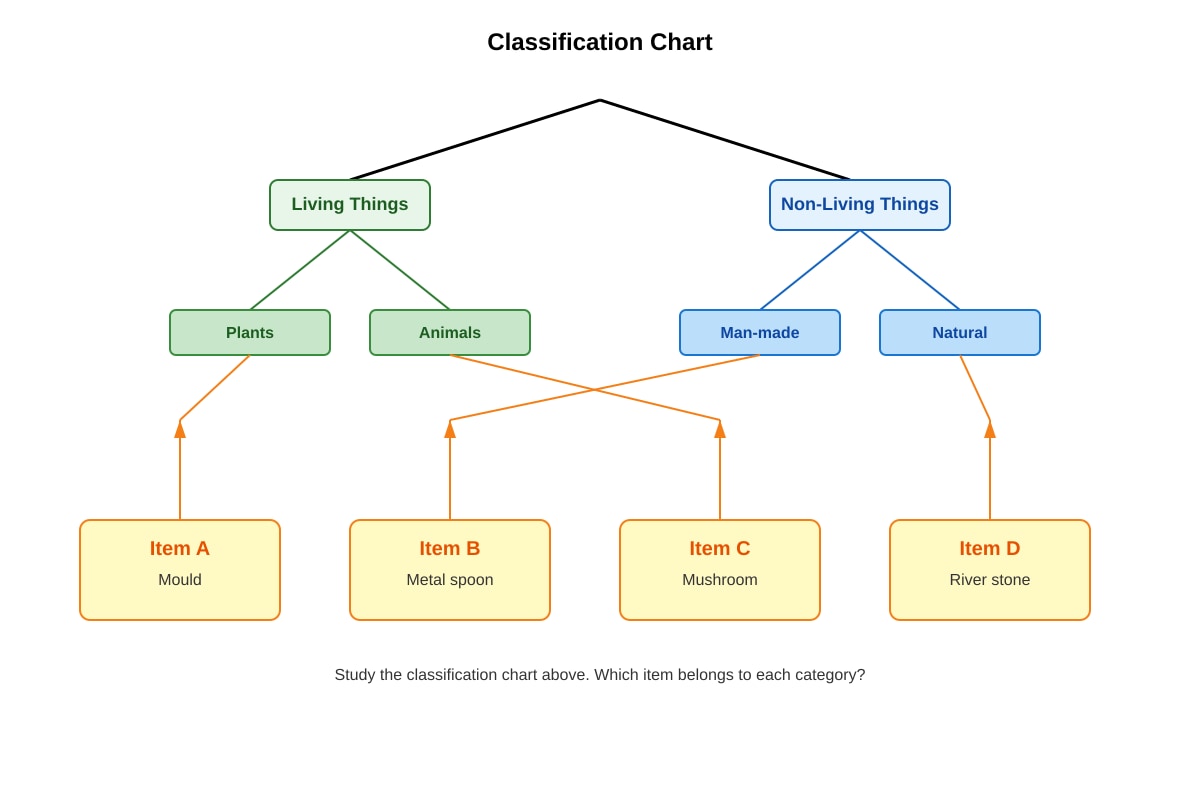
2. Answer: (1) [2]
Explanation:
- Mould (Item A) is a fungus → Living Thing (Fungi)
- Metal spoon (Item B) is made by humans → Non-Living Thing (Man-made)
- Mushroom (Item C) is a fungus → Living Thing (Fungi)
- River stone (Item D) occurs naturally → Non-Living Thing (Natural)
Common mistake: Mushrooms are often mistaken as plants. They are fungi, not plants (no photosynthesis).
3. Answer: (3) Bala and Devi only [2]
Explanation:
- Ali is incorrect: Plants are living things but cannot move from place to place.
- Bala is correct: All living things need air, food, and water to survive.
- Carol is incorrect: Not all living things lay eggs (e.g., mammals give birth, plants produce seeds).
- Devi is correct: All living things grow and respond to changes in their environment.
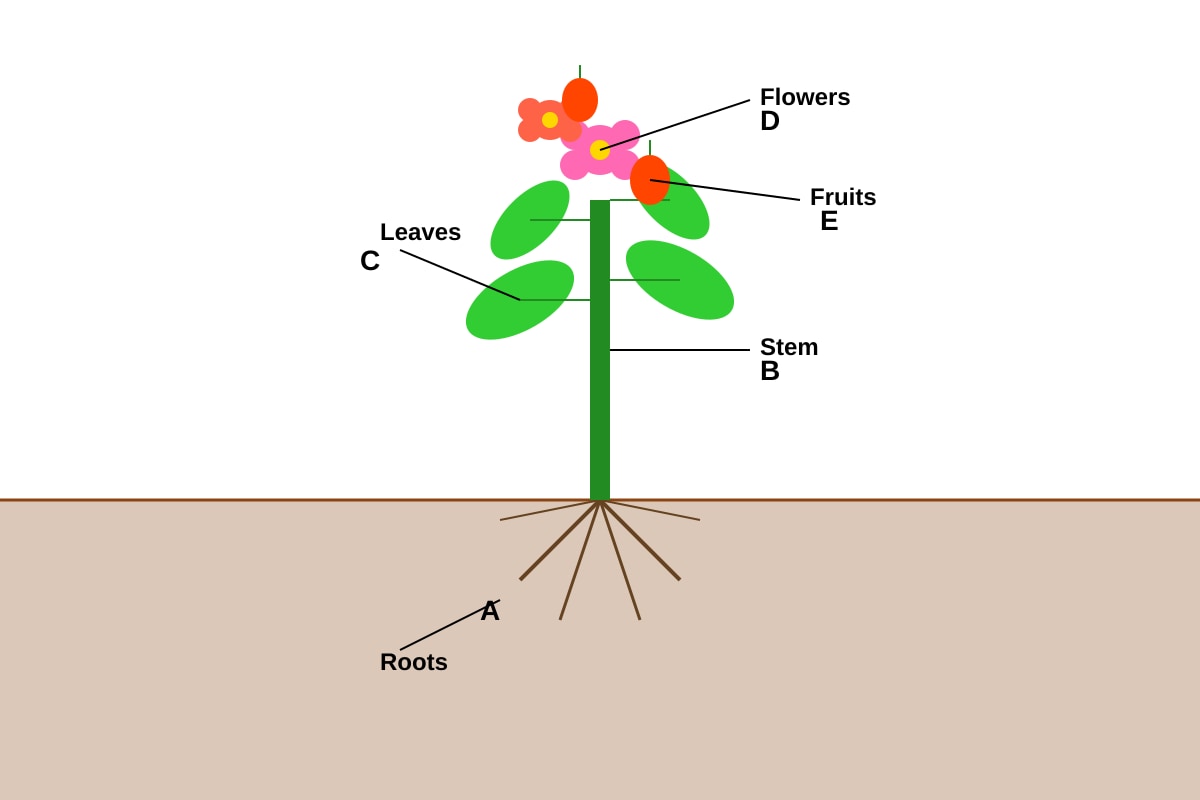
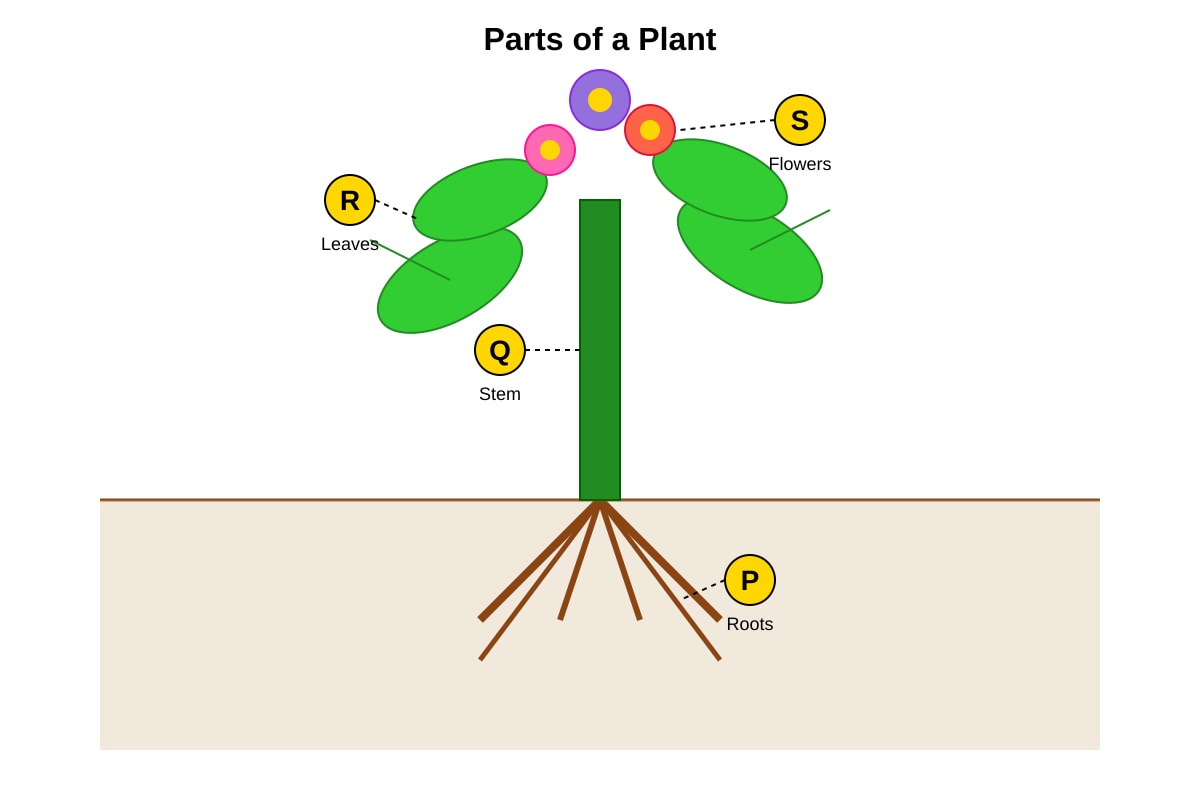
4. Answer: (1) A (Roots) [2]
Explanation: Roots absorb water and mineral salts from the soil. They also anchor the plant. The stem transports water and food, leaves make food, and flowers are for reproduction.
5. Answer: (2) Cotton cloth, rubber hose, leather belt [2]
Explanation: Flexible materials can bend without breaking. Cotton cloth, rubber hose, and leather belt are all flexible. Glass rod, wooden chopstick, ceramic tile (3) are rigid. Steel spoon, aluminium foil, copper coin (4) - aluminium foil is flexible but steel spoon and copper coin are not. Rubber band and plastic ruler (1) are flexible but metal wire may not be very flexible depending on thickness.
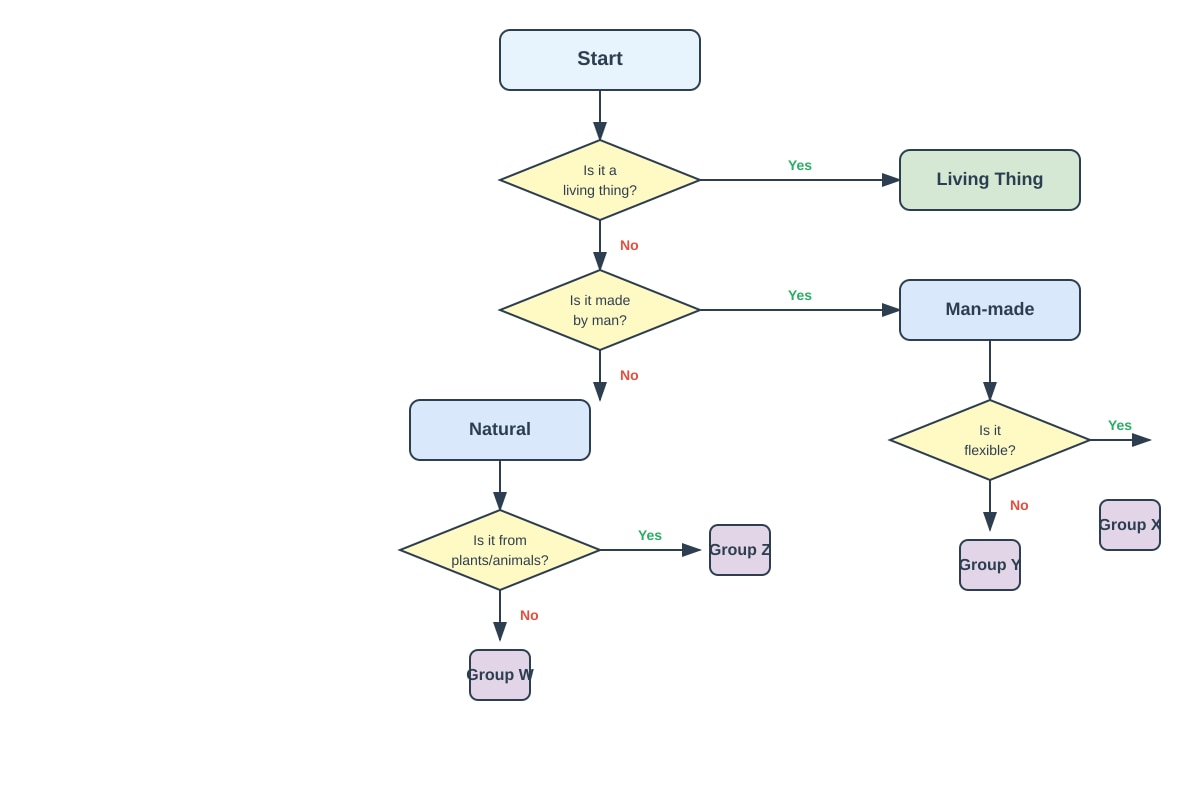
6. Answer: (3) Group Z [2]
Explanation: Following the flowchart: Cotton fabric → Not a living thing → Not man-made (it's from plants) → Natural → From plants/animals? Yes → Group Z.
Note: Cotton comes from the cotton plant, so it is a natural material from plants.
7. Answer: (2) It is a good conductor of heat [2]
Explanation: Cooking pots need to transfer heat quickly and evenly from the stove to the food. Metals are good conductors of heat. Transparency (1), floating (3), and magnetism (4) are not relevant properties for cooking pots.
8. Answer: (2) X [2]
Explanation: A raincoat needs to be waterproof (to keep rain out), flexible (to wear comfortably), and strong (to last). Material X has all three properties: Waterproof ✓, Flexible ✓, Strong ✓. Material W is not flexible. Material Y is not waterproof or strong. Material Z is not flexible.
9. Answer: (2) Microorganisms can only be seen with a microscope [2]
Explanation: Microorganisms are too small to be seen with the naked eye. Not all are harmful (some are useful, e.g., yeast, decomposers). They do need air, food, and water. Bacteria and viruses are microorganisms.
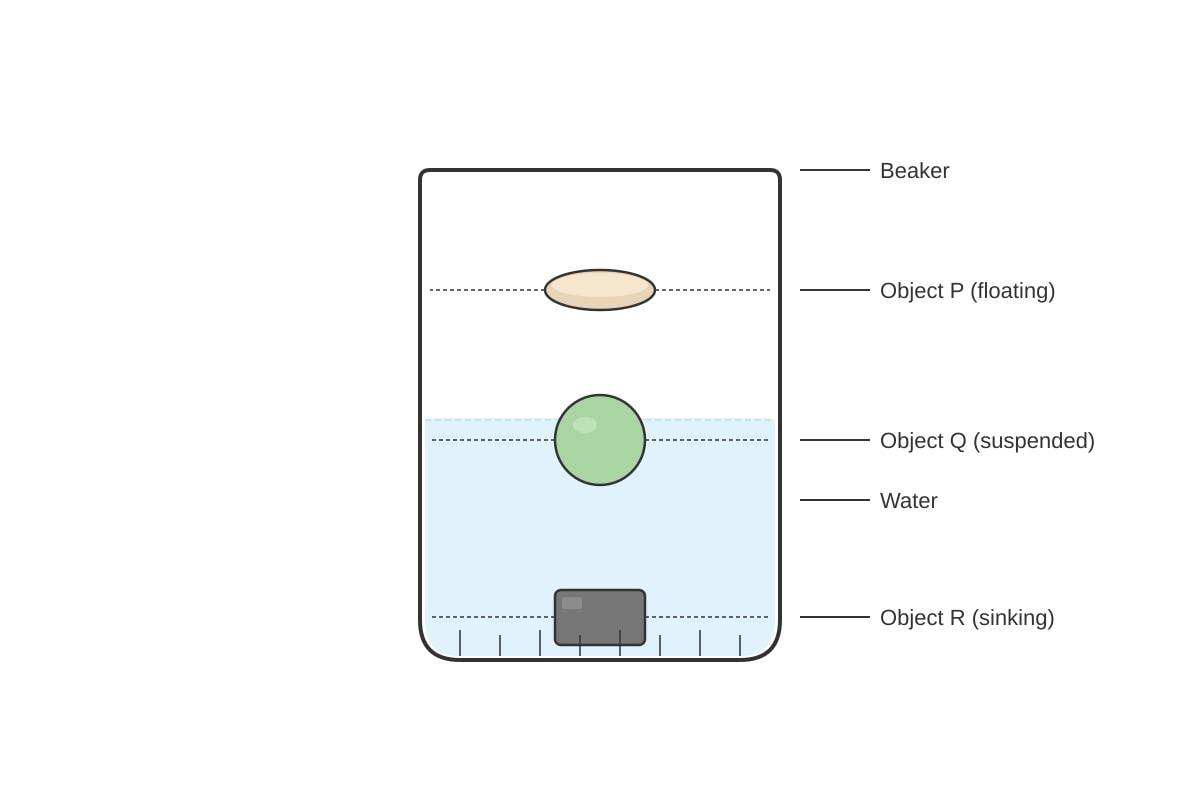
10. Answer: (3) Object P is less dense than water [2]
Explanation: Object P floats on the surface, meaning its density is less than water (1 g/cm³). Object Q is suspended (neutral buoyancy), so its density equals water. Object R sinks, so its density is greater than water. Mass and volume alone cannot determine floating/sinking without density.
Cycles
11. Answer: (4) -5°C, Solid [2]
Explanation: Water freezes at 0°C and below. At -5°C, water is in solid state (ice). At 0°C it can be solid or liquid (melting/freezing point). At 25°C it is liquid. At 100°C it boils and becomes gas (steam).
12. Answer: (2) B only [2]
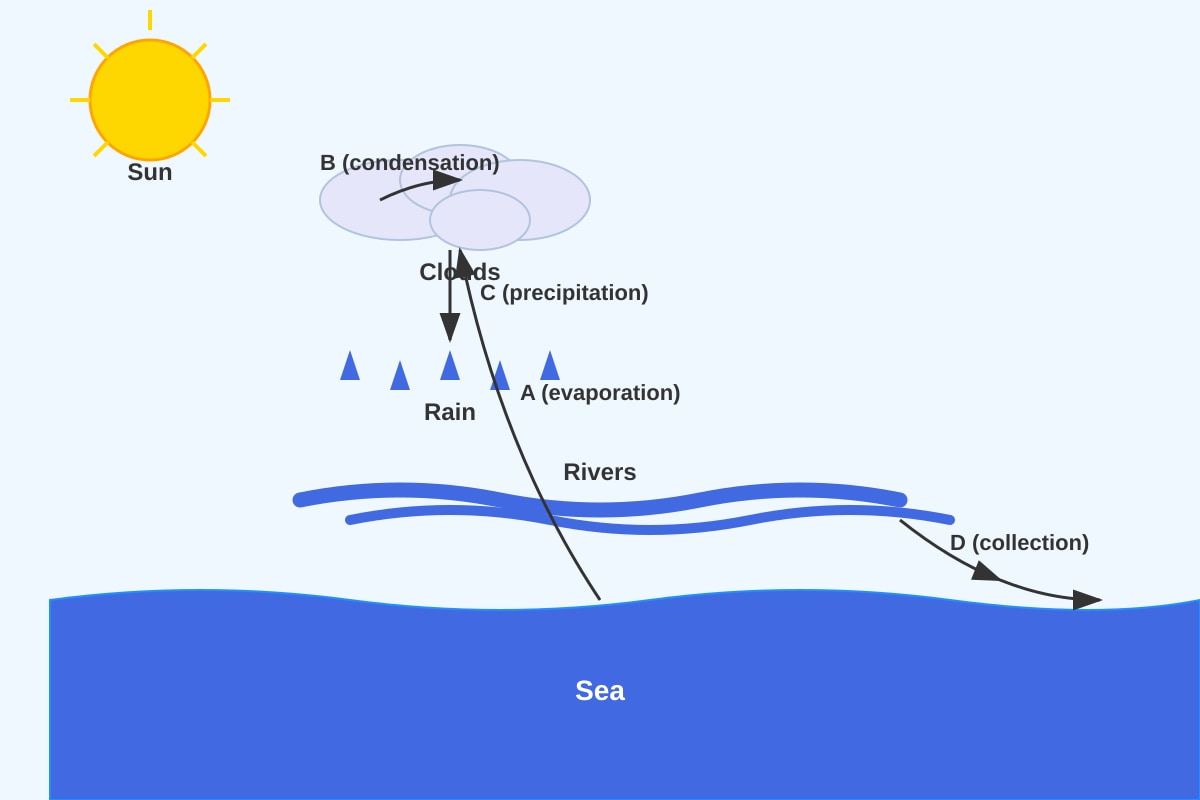
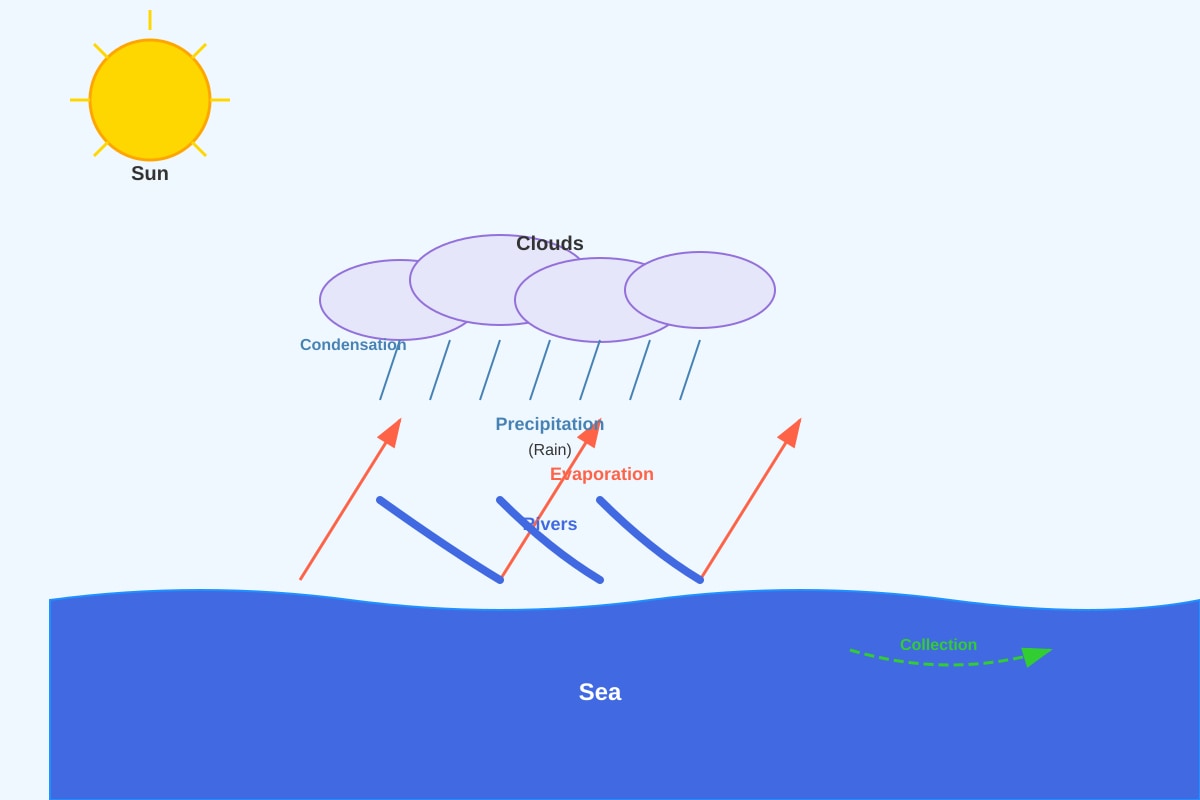
Explanation: Process B is condensation (gas → liquid). Process A is evaporation (liquid → gas). Process C is precipitation (liquid falling). Process D is collection (liquid gathering). Only condensation involves gas to liquid change.
13. Answer: (3) The ice cubes gain heat from the warm water [2]
Explanation: Heat flows from hotter to colder regions. The warm water is hotter than the ice cubes, so the ice cubes gain heat from the warm water, causing them to melt. The warm water loses heat to the ice cubes.
14. Answer: (2) condensation [2]
Explanation: Condensation is the process where water vapour (gas) changes to liquid water when it loses heat to a cooler surface (the cold glass).
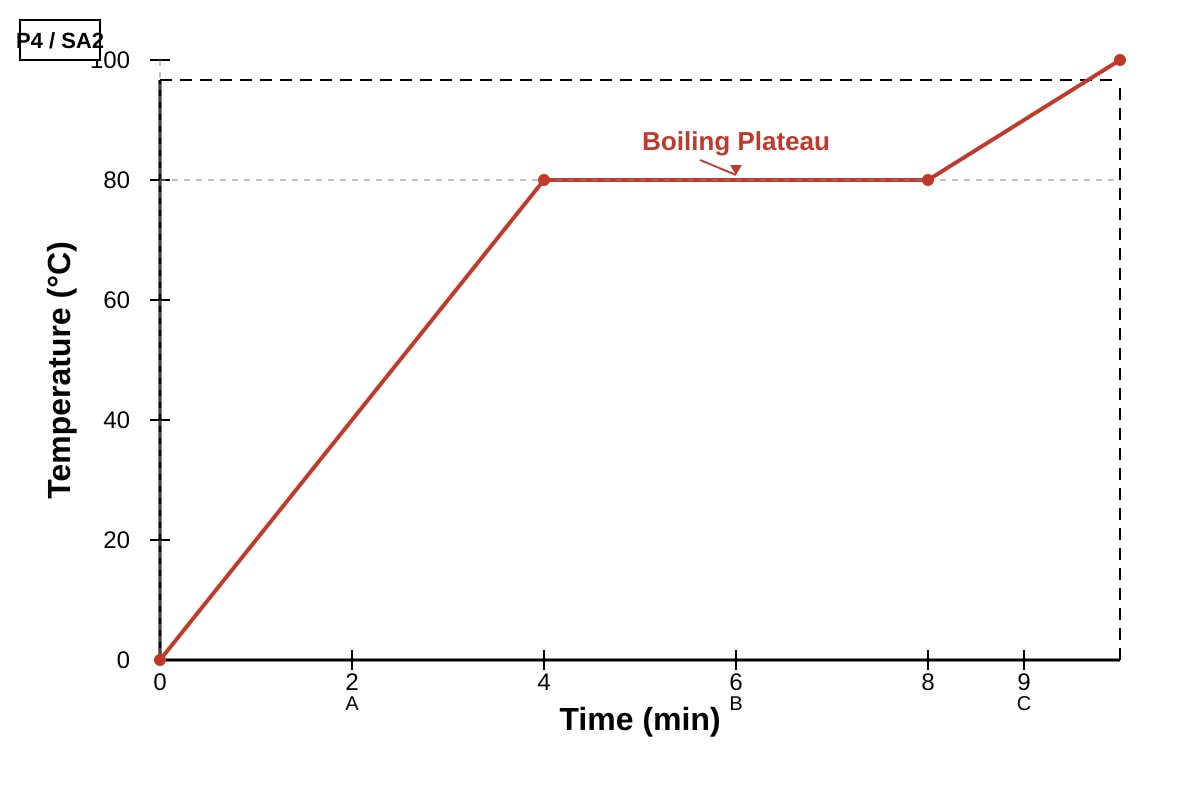
15. Answer: (2) The part where the temperature stays constant at 100°C [2]
Explanation: During boiling, temperature remains constant at 100°C (boiling point) even though heating continues. The heat energy is used to overcome forces between molecules to change state from liquid to gas, not to raise temperature.
Systems
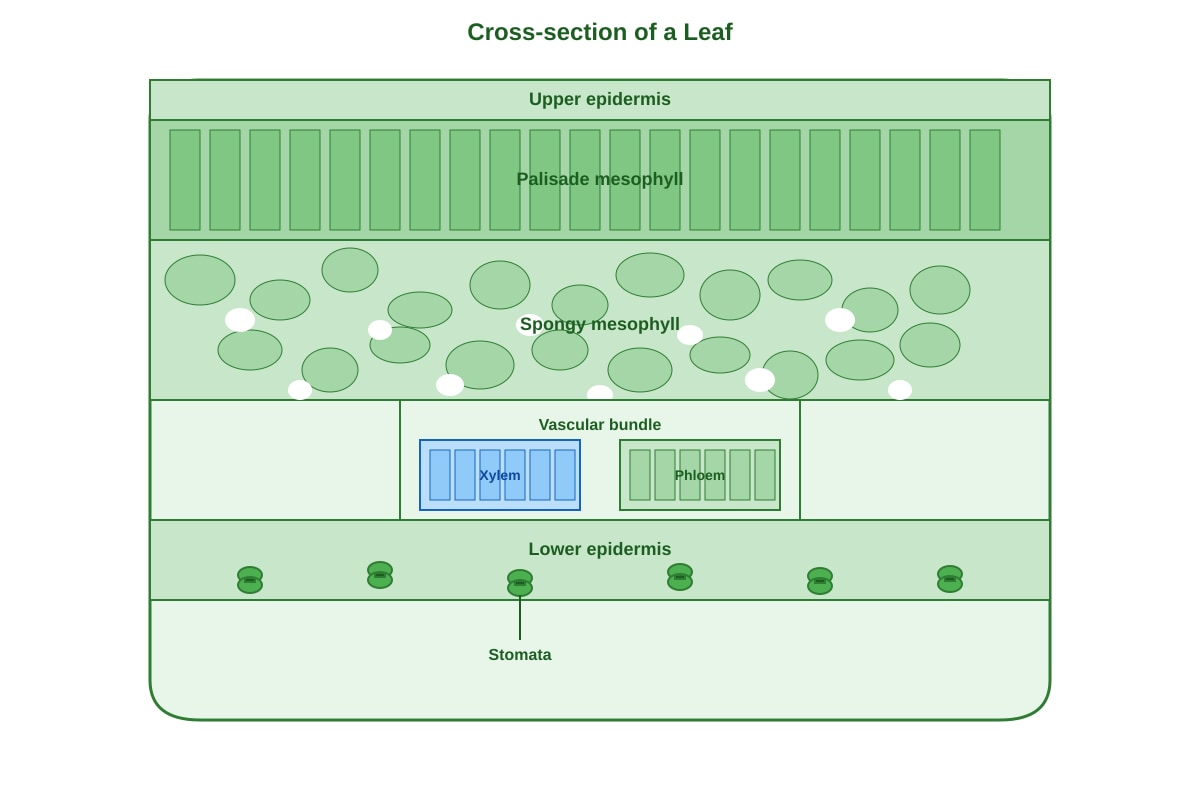
16. Answer: (3) Stomata [2]
Explanation: Stomata (pores on the leaf surface, usually lower epidermis) allow gas exchange - carbon dioxide enters for photosynthesis, oxygen and water vapour exit. Xylem transports water, phloem transports food, epidermis protects.
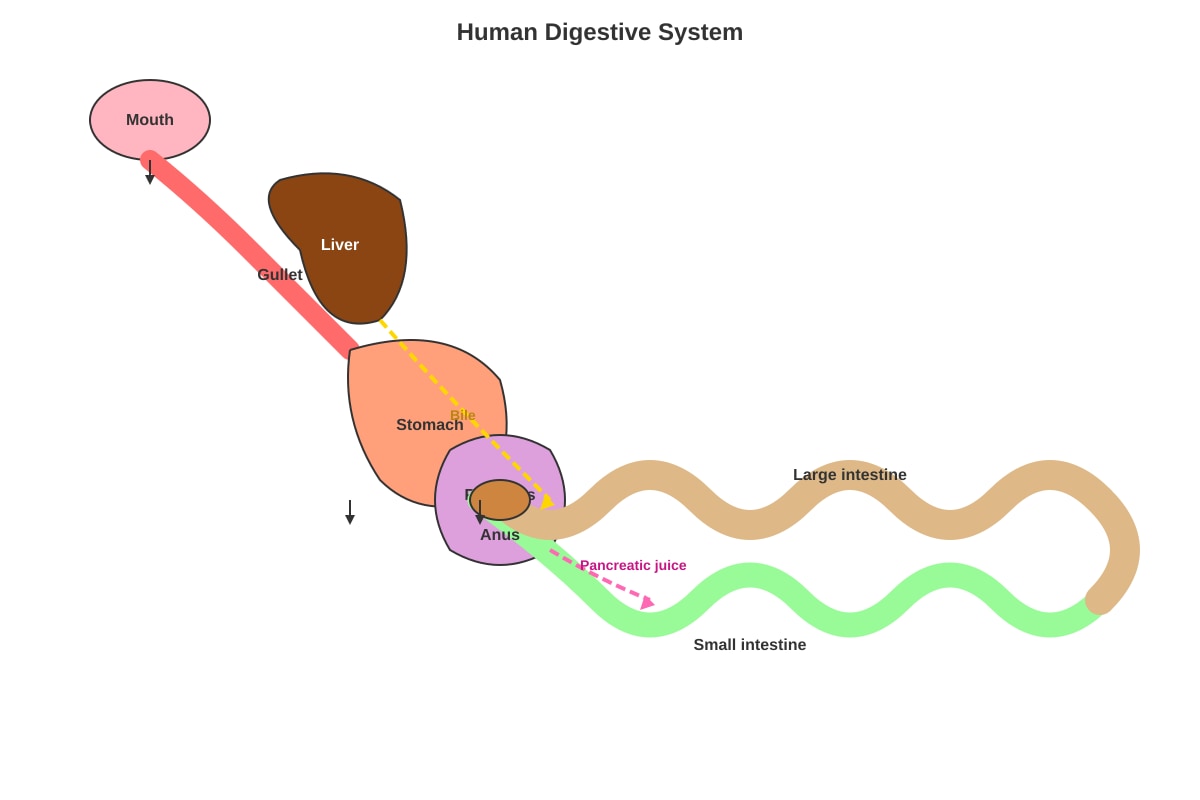
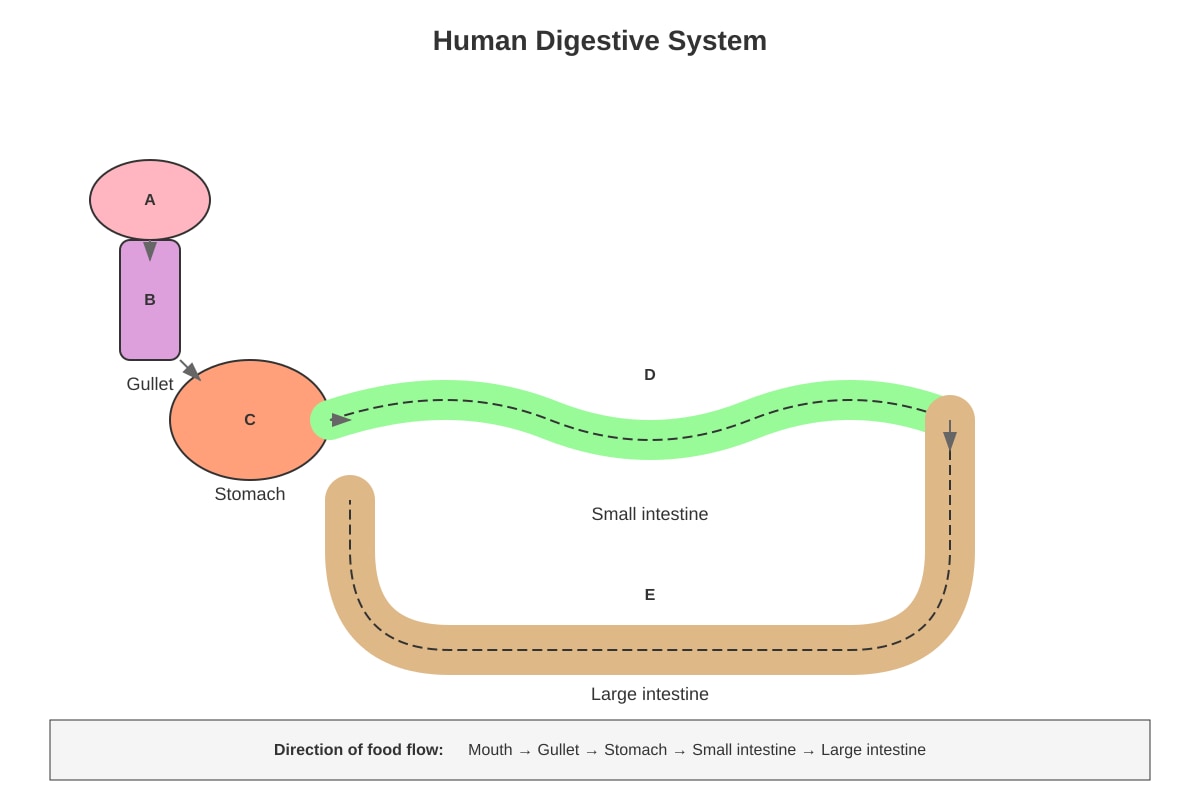
17. Answer: (1) Mouth → Gullet → Stomach → Small intestine → Large intestine → Anus [2]
Explanation: This is the correct sequence of the digestive tract. Food enters the mouth, passes through the gullet (oesophagus) to the stomach, then small intestine (main digestion/absorption), large intestine (water absorption), and out through the anus.
18. Answer: (3) Small intestine [2]
Explanation: The small intestine is where most chemical digestion occurs (with enzymes from pancreas and bile from liver) and where most nutrients are absorbed into the bloodstream through villi. The stomach does some digestion (proteins), mouth starts digestion (starch), large intestine mainly absorbs water.
19. Answer: (1) Liver [2]
Explanation: The liver produces bile, which emulsifies fats (breaks large fat globules into smaller droplets) to help in fat digestion. The pancreas produces lipase (enzyme that digests fats), but the question asks for the organ producing digestive juices that help break down fats - bile from the liver is the key answer at P4 level.
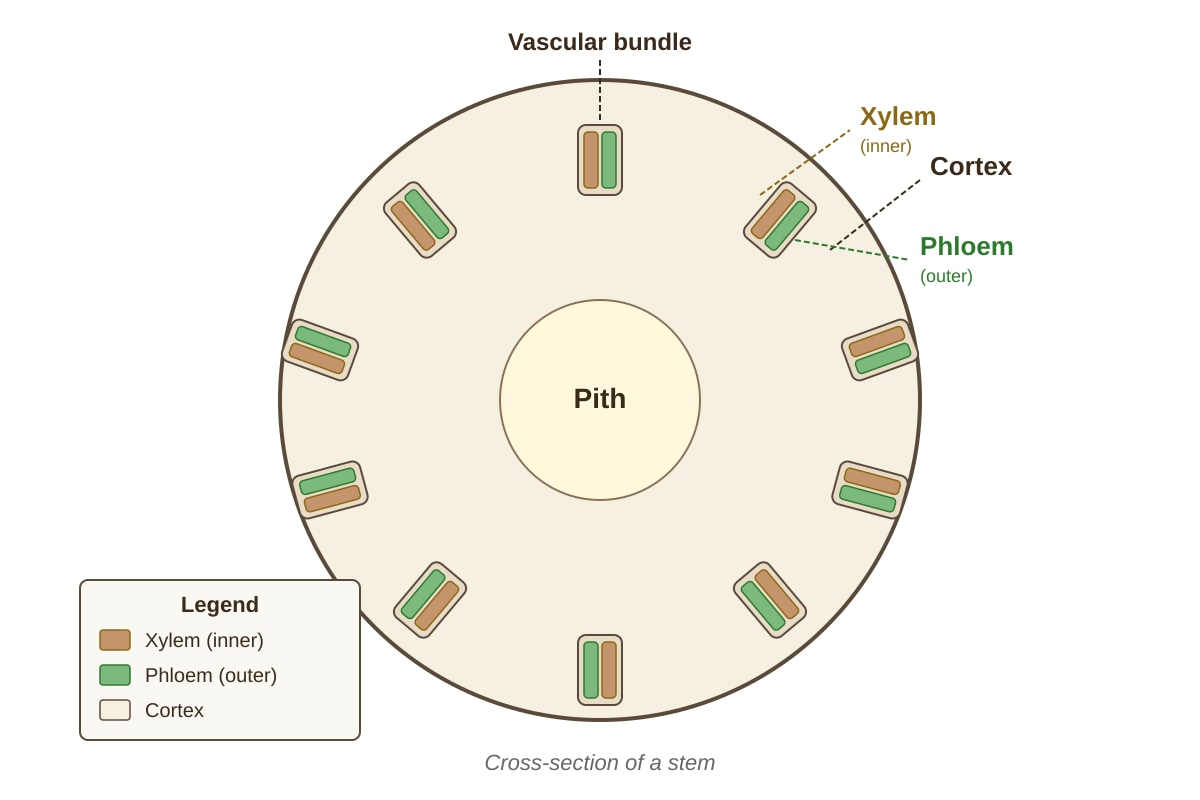
20. Answer: (3) The xylem transports water and mineral salts from the roots to the leaves [2]
Explanation: Xylem: water and mineral salts (upward, one-way). Phloem: food (sugar) from leaves to all parts (two-way). Options (1), (2), and (4) have the functions swapped or incorrect directions.
Energy
21. Answer: (3) Sun [2]
Explanation: The Sun produces its own light (luminous). The Moon reflects sunlight, mirrors reflect light, white paper reflects light - they are non-luminous.
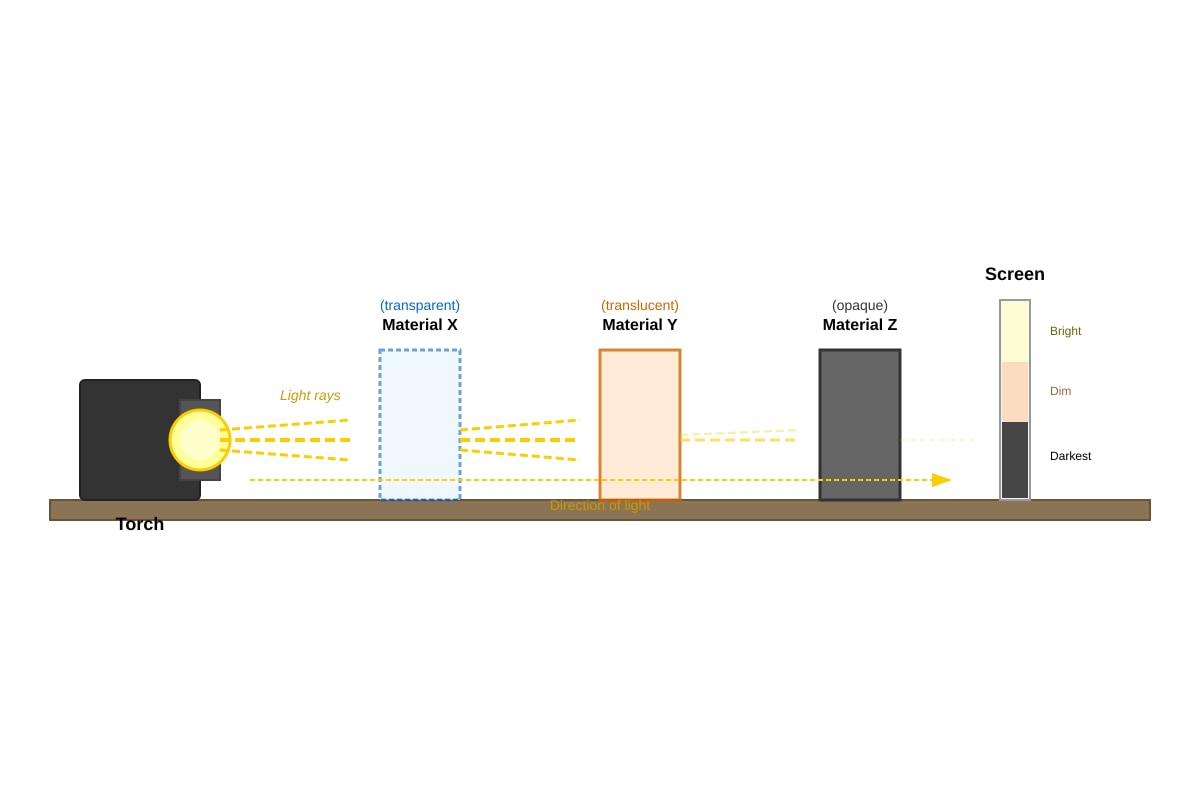
22. Answer: (4) The shadow is formed because light travels in straight lines [2]
Explanation: Light travels in straight lines. The opaque ball blocks the light, preventing it from reaching the screen behind, forming a shadow. Light does not bend around objects (1). The shadow is larger than the object when the screen is further away (2). The shadow forms on the side away from the light source (3).
23. Answer: (2) B [2]
Explanation: A bathroom window needs to allow light in (translucent - allows some light) but provide privacy (not transparent - cannot see through clearly). Material B allows some light to pass through (translucent/frosted glass). Material A and D are transparent (clear glass). Material C is opaque (blocks all light).
24. Answer: (1) hotter, colder [2]
Explanation: Heat always flows from a region of higher temperature (hotter) to a region of lower temperature (colder) until thermal equilibrium is reached.
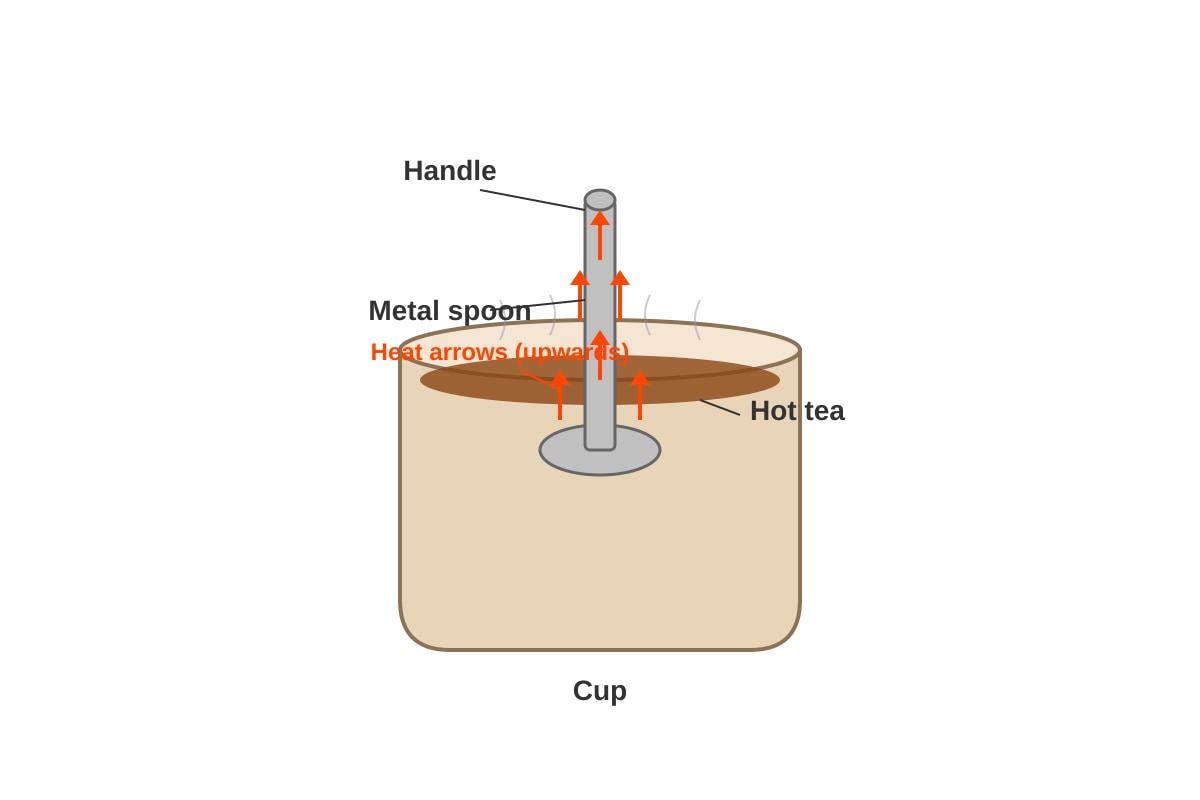
25. Answer: (1) metal is a good conductor of heat [2]
Explanation: Metals are good conductors of heat. Heat from the hot tea travels quickly through the metal spoon by conduction to the handle. Radiation (3) and air conduction (4) are minor effects. Metal is not a poor conductor (2).
26. Answer: (3) Plastic [2]
Explanation: Plastic is a poor conductor of heat (good insulator). Copper, aluminium, and iron are metals and good conductors of heat. Insulators slow down heat transfer.
27. Answer: (2) contracts [2]
Explanation: Most materials expand when heated and contract when cooled. The metal ball expands when heated; when it cools, it loses heat and contracts back to its original size (assuming no phase change).
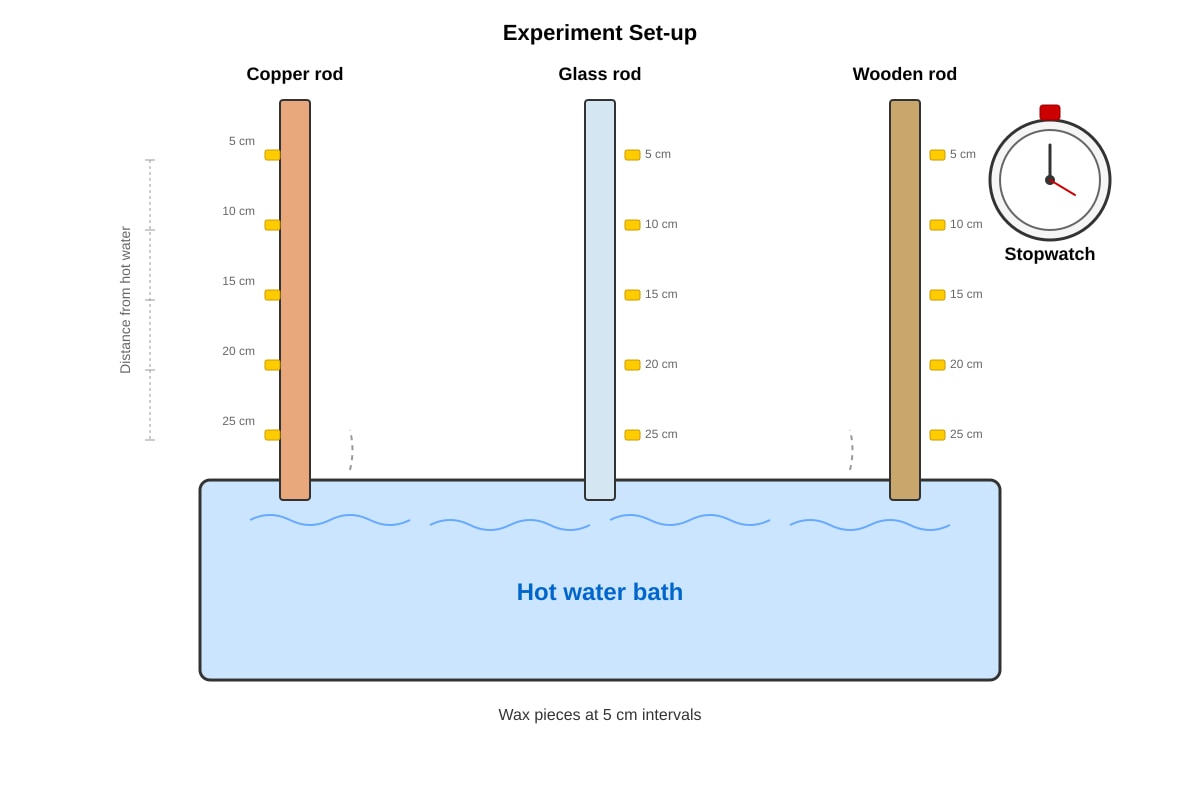
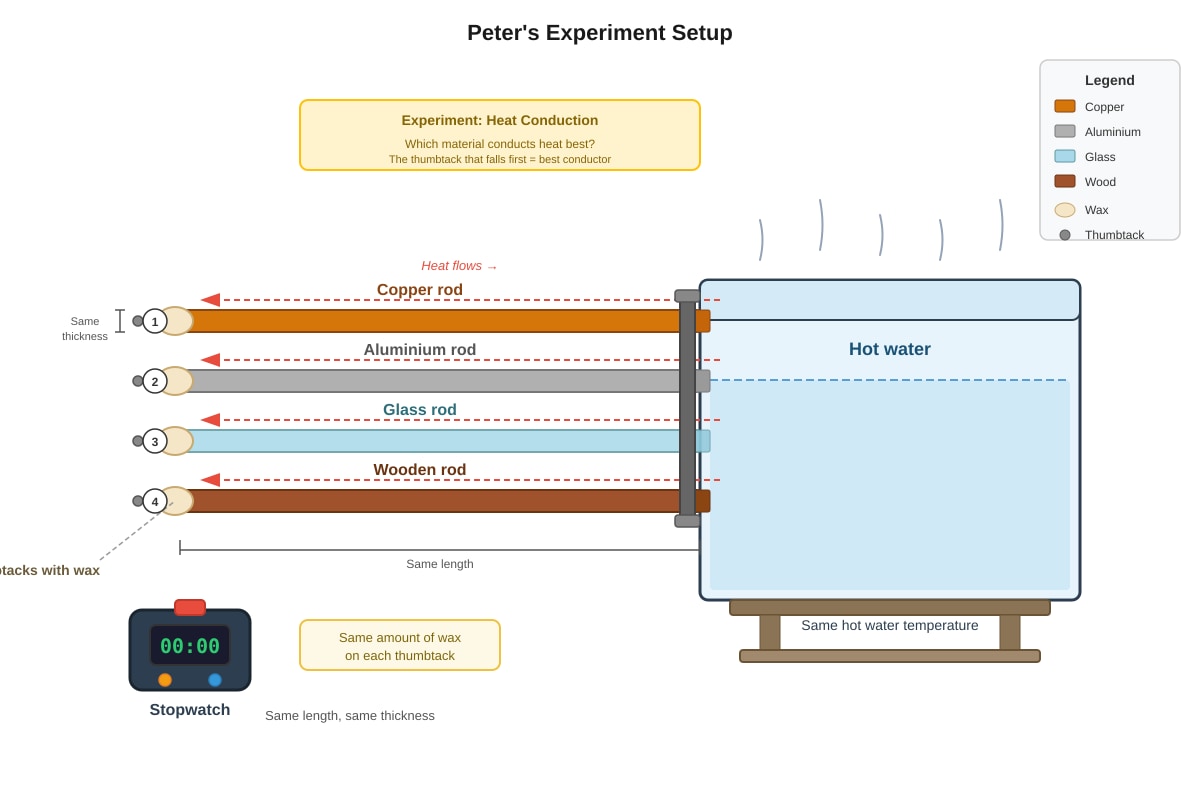
28. Answer: (1) To find out which rod conducts heat the fastest [2]
Explanation: The wax melts when heat reaches it by conduction along the rod. The faster the heat travels (better conductor
<stage3_exam_answers_md>
TuitionGoWhere Practice Paper - Science Primary 4 (Answer Key)
TuitionGoWhere Exam Practice (AI)
Subject: Science
Level: Primary 4
Paper: SA2 (Version 2)
Total Marks: 100
SECTION A: Multiple-Choice Questions (56 marks)
| Question | Answer | Explanation |
|---|---|---|
| 1 | (3) | A pebble is a non-living thing. Mushroom, moss, and fern are living things (fungi, bryophyte, plant). |
| 2 | (1) | Mould and mushroom are fungi (Living Things). Metal spoon is man-made. River stone is natural non-living. |
| 3 | (3) | Bala: All living things need air, food, water (correct). Devi: All living things grow and respond to changes (correct). Ali: Plants don't move place to place. Carol: Not all lay eggs (plants, mammals). |
| 4 | (1) | Roots absorb water and mineral salts from soil. |
| 5 | (2) | Cotton cloth, rubber hose, leather belt are all flexible. Others contain rigid materials. |
| 6 | (3) | Cotton fabric: Not living → Man-made? No (from plant) → Natural → From plants/animals? Yes → Group Z. |
| 7 | (2) | Metals are good conductors of heat, allowing even cooking. |
| 8 | (2) | Raincoat needs waterproof, flexible, strong. Material X has all three (Waterproof ✓, Flexible ✓, Strong ✓). |
| 9 | (2) | Microorganisms are microscopic. Some are beneficial. They need air, food, water. Bacteria/viruses are microorganisms. |
| 10 | (3) | Object P floats → less dense than water. Object R sinks → denser than water. Object Q suspended → density ≈ water. |
| 11 | (4) | At -5°C, water is solid (ice). At 0°C: solid/liquid. At 25°C: liquid. At 100°C: liquid/gas. |
| 12 | (2) | B (condensation) is gas → liquid. A: liquid→gas. C: liquid→solid (or liquid→liquid). D: collection (no state change). |
| 13 | (3) | Heat flows from hotter (water) to colder (ice). Ice gains heat, melts. |
| 14 | (2) | Water vapour (gas) → liquid water on cold surface = condensation. |
| 15 | (2) | Boiling occurs at constant temperature (100°C) - the horizontal plateau. |
| 16 | (3) | Stomata (pores on leaf underside) allow gas exchange (CO₂ in, O₂ out). |
| 17 | (1) | Correct order: Mouth → Gullet → Stomach → Small intestine → Large intestine → Anus. |
| 18 | (3) | Small intestine: villi increase surface area for most digestion & absorption. |
| 19 | (1) | Liver produces bile (stored in gallbladder) which emulsifies fats. Pancreas produces lipase too, but liver is primary for bile. |
| 20 | (3) | Xylem: water & minerals ↑ (roots to leaves). Phloem: food ↓↑ (leaves to all parts). |
| 21 | (3) | Sun produces own light. Moon reflects. Mirror reflects. White paper reflects. |
| 22 | (4) | Shadows form because light travels in straight lines and is blocked by opaque object. |
| 23 | (2) | Bathroom window: translucent (allows some light, privacy). Material B = translucent. A/D = transparent. C = opaque. |
| 24 | (1) | Heat flows from hotter region to colder region (2nd Law of Thermodynamics). |
| 25 | (1) | Metal conducts heat well from hot tea up handle via conduction. |
| 26 | (3) | Plastic is a poor conductor (good insulator). Copper, Aluminium, Iron are metals (good conductors). |
| 27 | (2) | Heating → expansion. Cooling → contraction (particles move closer). |
| 28 | (1) | Wax melting time indicates heat travel speed along rod → compares thermal conductivity. |
SECTION B: Open-Ended Questions (44 marks)
Diversity
29.
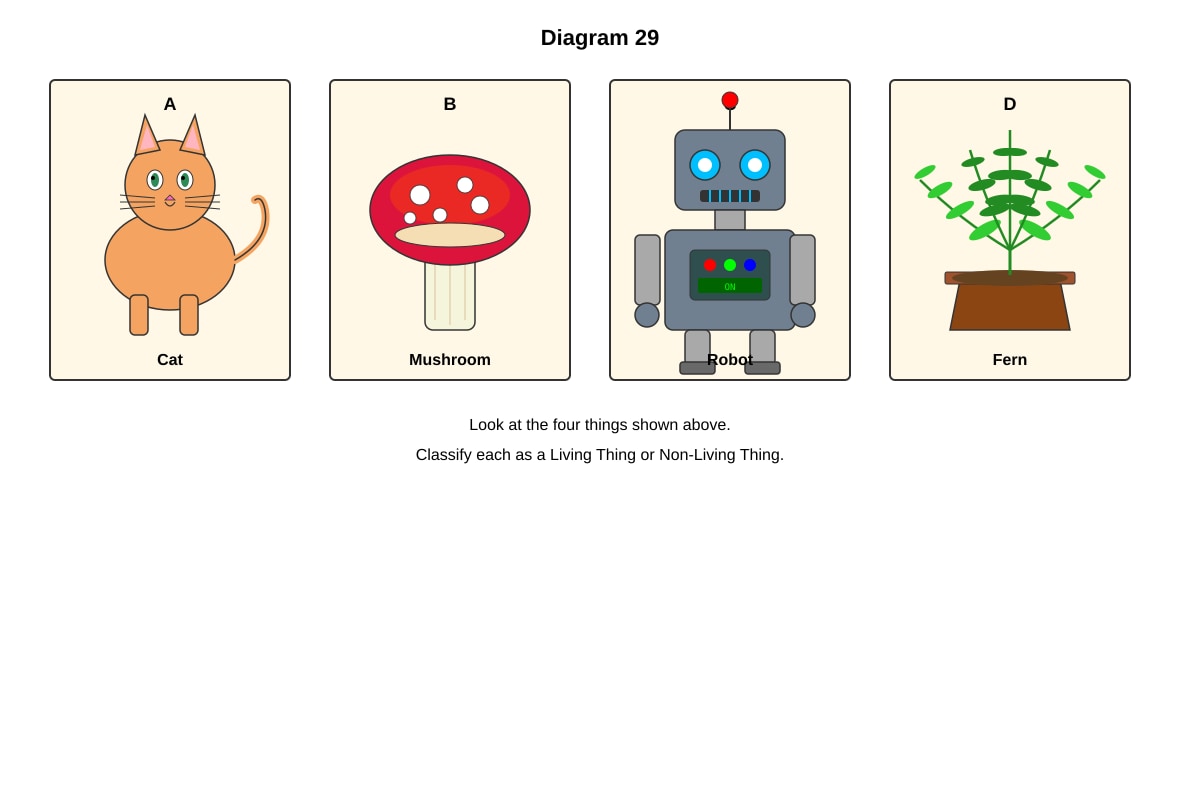
(a) Living Things: A, B, D
Non-Living Things: C
(Cat, Mushroom, Fern are living. Robot is man-made non-living.)
(b) The mushroom can reproduce / grow / respond to changes / needs air, food, water (any one characteristic of life).
(Robot does not carry out life processes.)
(c) The fern is a plant that makes its own food through photosynthesis, while the mushroom is a fungus that obtains food by decomposing dead matter / is a decomposer.
(Or: Fern has chlorophyll/roots/stems/leaves; mushroom does not. Fern reproduces by spores on fronds; mushroom by spores on gills.)
30.
(a) Group 1: Conductors of electricity / Metals / Good conductors of heat
Group 2: Insulators of electricity / Non-metals / Poor conductors of heat
(Copper wire, Iron nail, Steel paper clip are metals/conductors. Plastic ruler, Wooden chopstick, Rubber band are non-metals/insulators.)
(b) Aluminium foil
(It is a metal, so it belongs to Group 1 - conductors.)
(c) Property: Waterproof / Flexible / Transparent / Strong (choose one relevant to the group).
Example: "Group 1 materials are generally strong and good conductors of heat. Group 2 materials are generally flexible and poor conductors of heat."
(Answer must match the property used to classify in (a). If classified by electrical conductivity, state "Electrical conductivity".)
31.
(a) Solid
(Ice is solid water. Definite shape and volume.)
(b) The ice gained heat from the warmer surroundings / water, causing it to melt into liquid water.
(Heat gain → melting. State change: Solid → Liquid.)
(c) The water vapour in the surrounding air lost heat to the cold outer surface of the beaker and condensed into tiny water droplets.
(Condensation: Gas → Liquid on a cooler surface. Not from inside the beaker.)
Cycles
32.
(a) Process A: Evaporation. Process B: Condensation.
(A: Liquid → Gas (sea to clouds). B: Gas → Liquid (clouds to rain).)
(b) The Sun provides heat energy for water to evaporate from water bodies (sea, rivers, lakes) into water vapour, driving the water cycle.
(Heat source for evaporation.)
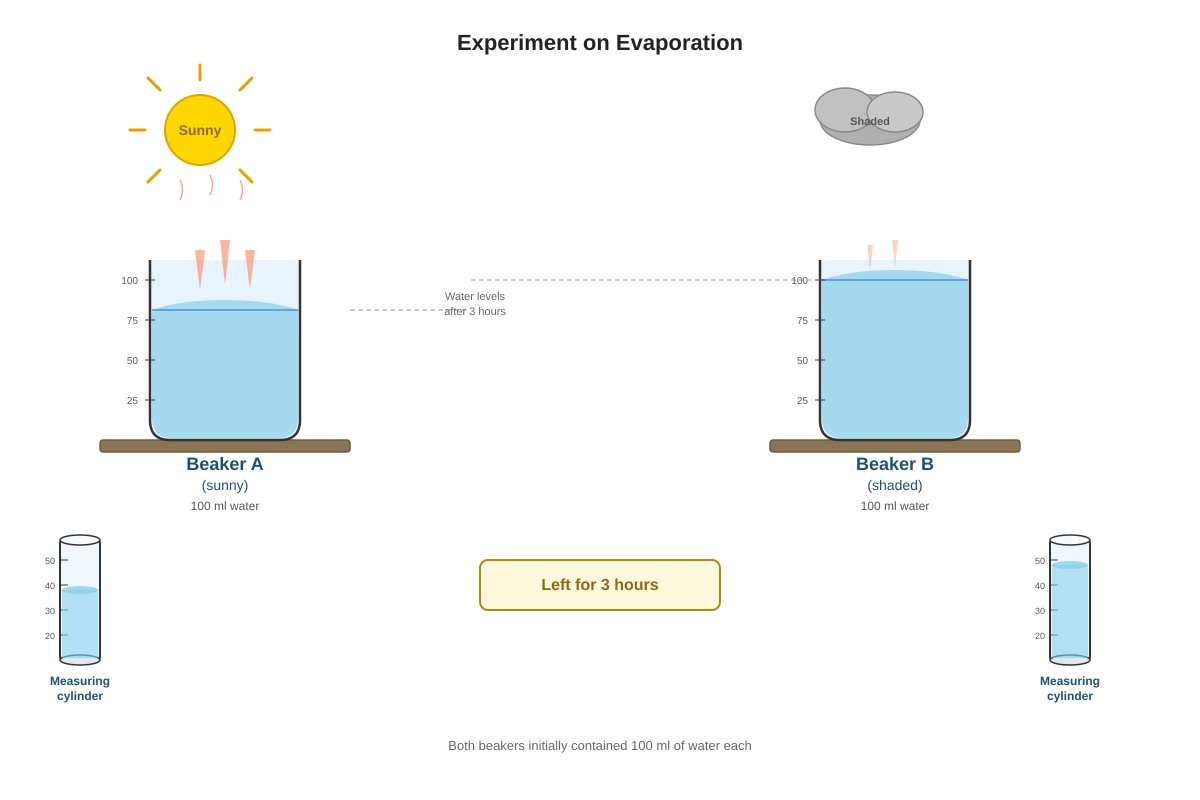
(c) The water level in the beaker will decrease / drop.
(Water evaporates over time, escaping as vapour into the air. Mass/volume of liquid water reduces.)
33.
(a) 100°C
(Boiling point of water at standard atmospheric pressure.)
(b) The temperature of the water remains constant at 100°C while it is boiling.
(Heat energy absorbed is used to overcome intermolecular forces for state change (latent heat), not raise temperature.)
(c) Use a lid on the beaker / Use a wider beaker / Increase the flame / Use less water (any one valid method).
(Lid traps heat, reduces heat loss. Wider surface area increases evaporation rate. More heat input. Less mass to heat.)
Systems
34.
(a) Part X: Stomach. Part Y: Small intestine.
(X: J-shaped bag, churns food. Y: Long coiled tube, villi shown.)
(b) Digestion: The stomach churns food and secretes gastric juices to break it down into a semi-liquid (chyme). Absorption: The small intestine has villi (finger-like projections) that increase surface area for absorption of digested nutrients into the bloodstream.
(Stomach: mainly digestion (proteins). Small intestine: completes digestion & main site of absorption.)
(c) The large intestine absorbs water and mineral salts from the undigested food / waste matter.
(Forms faeces. No digestion occurs here.)
35.
(a) Function of Part A (Roots): To absorb water and mineral salts from the soil / To anchor the plant firmly to the ground.
(Either answer accepted.)
(b) The food-carrying tubes (phloem) in the stem were removed / blocked by the ring cut, so food made by the leaves could not be transported down to the roots. The roots starved and died, causing the plant to die.
(Water-carrying tubes (xylem) are inner, usually intact in ring barking. Phloem is outer. Food accumulates above cut → swelling.)
(c) The leaves cannot make food because there are no roots to absorb water (raw material for photosynthesis). / The plant cannot take in water to replace water lost through transpiration, so it wilts and dies.
(Roots dead → no water uptake → photosynthesis stops / plant dehydrates.)
36.
(a) Cell wall
(Plant cells have cell wall (cellulose). Animal cells do not. Both have cell membrane, cytoplasm, nucleus.)
(b) Part B: Nucleus. Function: Controls all activities in the cell / Contains genetic information (DNA) / Controls cell division.
(Brain of the cell.)
(c) The red blood cell has no nucleus (in mammals) / has a biconcave disc shape / contains haemoglobin to transport oxygen.
(Any one correct difference. Plant cell: regular shape, cell wall, chloroplasts, large vacuole. Red blood cell: no nucleus, no mitochondria, disc shape, haemoglobin.)
Energy
37.
(a) Light travels in straight lines. The opaque book blocks the light from the torch, preventing it from reaching the wall behind it, forming a dark shadow.
(Key terms: straight lines, opaque, blocks light, shadow.)
(b) The shadow becomes larger / bigger.
(Moving object closer to light source → larger shadow (diverging rays).)
(c) Use a brighter torch / Move the torch closer to the book / Move the screen further away from the book (any one).
(Sharper shadow: point source, increase object-screen distance, decrease source-object distance. "Brighter" increases contrast.)
38.
(a) Set-up B
(Metal rod is a good conductor of heat. Heat travels fast from hot water → wax → melts first. Wood/Plastic are poor conductors.)
(b) The metal rod conducts heat faster than the wooden rod, so heat reaches the thumbtack on the metal rod first, melting the wax and causing the thumbtack to drop first.
(Comparative explanation: Good conductor vs Poor conductor → speed of heat transfer.)
(c) To ensure a fair test / To ensure that the only variable is the type of material (rod), so that any difference in time taken is due to the material's conductivity.
(Constants: Length, thickness, wax amount, water temp, distance from heat source.)
39.
(a) The metal lid expands / becomes larger when heated / gains heat.
(Metal expands on heating. Lid loosens.)
(b) The glass jar expands very little / is a poor conductor of heat, so the lid expands more than the jar, loosening the fit.
(Differential expansion. Glass has low thermal expansion & conductivity. Hot water heats metal lid faster/more.)
(c) Metal expands more than glass for the same rise in temperature / Metal is a better conductor of heat than glass.
(Underlying principle: Different coefficients of thermal expansion / conductivity.)
MARKING SCHEME SUMMARY
- Section A: 28 questions × 2 marks = 56 marks
- Section B: 11 questions (29-39) = 44 marks
- Q29: 2+1+1 = 4
- Q30: 2+1+1 = 4
- Q31: 1+1+1 = 3
- Q32: 1+1+1 = 3
- Q33: 1+1+1 = 3
- Q34: 1+2+1 = 4
- Q35: 1+2+1 = 4
- Q36: 1+2+1 = 4
- Q37: 2+1+1 = 4
- Q38: 1+2+1 = 4
- Q39: 1+1+1 = 3
- Total: 44 marks
Grand Total: 100 marks
End of Answer Key