From Real Exams Exam Paper

Primary 4 Science Semestral Assessment 2 (End of Year) Paper 2

Free Kimi AI-generated P4 Science SA2 Paper 2 with questions, answers, and syllabus-aligned practice for Singapore students preparing for exams.

These static practice materials are generated from the site's syllabus and paper-generation workflow, with source and model context shown so students and parents can evaluate the material before use.

Primary 4 Science From Real Exams Generated by Kimi K2.6 Free Updated 2026-06-09

Questions

<!-- TuitionGoWhere generation metadata: stage=3-1; model=moonshotai/kimi-k2.6:free; model_label=Kimi K2.6 Free; generated=2026-06-09; Sources: Stage 2-1 real exam-derived templates and Stage 2-2 exam-enriched syllabus. -->

TuitionGoWhere Exam Practice (AI)

SA2 Practice Paper - Science Primary 4

Version 2 of 5


Subject: Science
Level: Primary 4
Paper: SA2 Practice Paper
Duration: 1 hour 15 minutes
Total Marks: 60 marks

Name: _______________________________
Class: _____________ Date: _____________


INSTRUCTIONS TO CANDIDATES

  1. Write your name, class, and date in the spaces provided above.
  2. This paper consists of TWO sections: Section A and Section B.
  3. Section A (Questions 1–20): Multiple Choice Questions — 20 marks
  4. Section B (Questions 21–32): Open-Ended Questions — 40 marks
  5. Answer ALL questions.
  6. Write your answers in the spaces provided.
  7. For multiple choice questions, shade the correct oval or circle the correct answer.
  8. Use only pencils for diagrams and graphs.

SECTION A: MULTIPLE CHOICE QUESTIONS (20 marks)

Answer ALL questions. Each question carries 1 mark.

Questions 1–20


1. Which of the following is NOT a living thing?

A. Mushroom
B. Bacteria
C. Water
D. Fern

Answer: _______


2. Scientists classify living things into groups. What is the largest group called?

A. Species
B. Genus
C. Kingdom
D. Family

Answer: _______


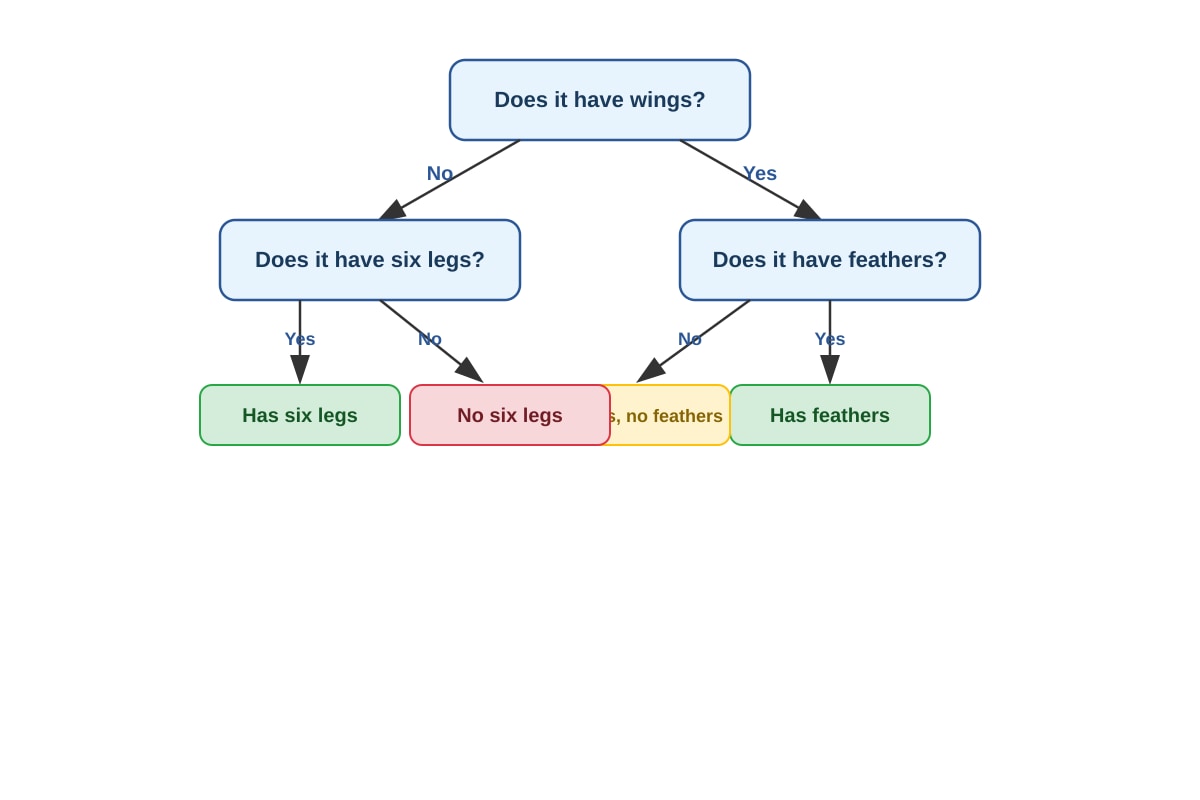
3. Look at the flow chart below.

<image_placeholder> id: Q3-fig1 type: diagram linked_question: Q3 description: A simple dichotomous key flow chart with two branches starting from "Does it have wings?" Yes branch leads to "Does it have feathers?" No branch leads to "Does it have six legs?" labels: Does it have wings? (top), Yes (right branch), No (left branch), Does it have feathers? (right branch), Does it have six legs? (left branch) values: None must_show: Clear yes/no branches, question boxes with rounded corners, arrows showing flow direction </image_placeholder>

Using the flow chart, a butterfly would be placed in which group?

A. Has feathers
B. Has six legs
C. No wings
D. Cannot be classified

Answer: _______


4. Which characteristic do all mammals share?

A. They lay eggs
B. They have scales
C. They have hair or fur
D. They live in water

Answer: _______


5. The table below shows some plants and their characteristics.

PlantHas flowersHas conesHas spores
P
Q
R
S

Which plants are flowering plants?

A. P and S only
B. P and Q only
C. Q and R only
D. P, Q, R and S

Answer: _______


6. Which of the following animals undergoes complete metamorphosis?

A. Grasshopper
B. Cockroach
C. Butterfly
D. Lizard

Answer: _______


7. A student observed an animal with the following features:

  • Body divided into three parts (head, thorax, abdomen)
  • Six legs
  • Two antennae

To which group does this animal belong?

A. Arachnids
B. Insects
C. Crustaceans
D. Myriapods

Answer: _______


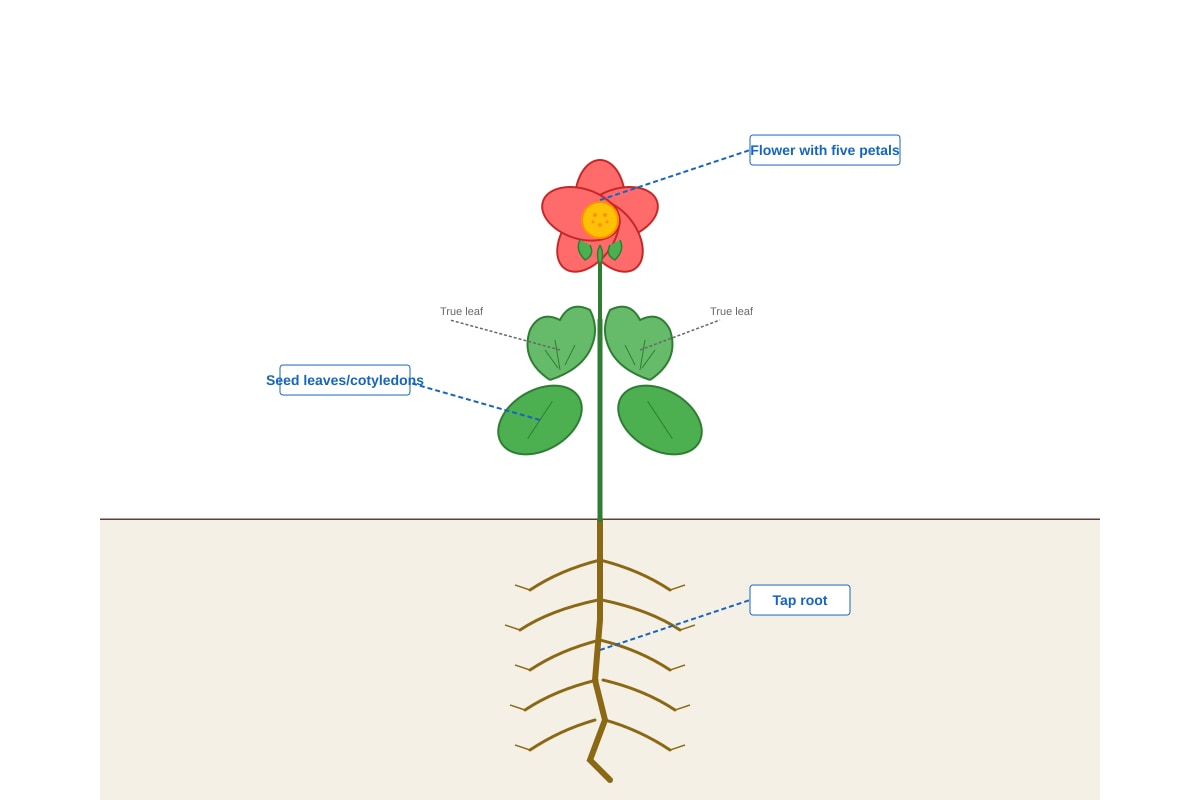
8. Look at the picture below.

<image_placeholder> id: Q8-fig1 type: diagram linked_question: Q8 description: A line drawing of a young plant seedling with two seed leaves (cotyledons), tap root system, and flower parts showing five petals labels: Seed leaves/cotyledons, tap root, flower with five petals values: None must_show: Clear distinction between seed leaves and true leaves, visible tap root with side branches, simple flower with 5 separate petals </image_placeholder>

Based on the features shown, this plant can be classified as a __________.

A. Monocot with fibrous roots
B. Dicot with fibrous roots
C. Monocot with tap roots
D. Dicot with tap roots

Answer: _______


9. Which adaptation helps fish to live in water?

A. Lungs to breathe air
B. Gills to breathe dissolved oxygen
C. Fur to keep warm
D. Wings to fly

Answer: _______


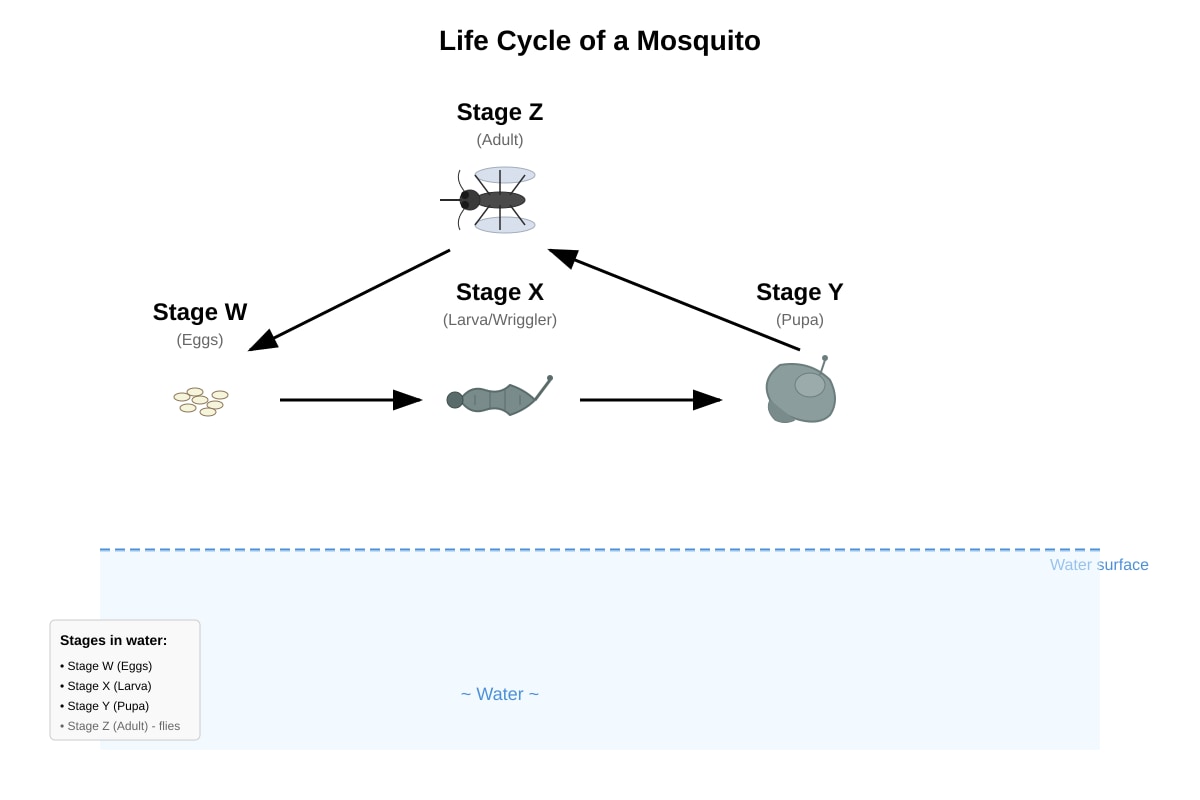
10. The diagram below shows the life cycle of a mosquito.

<image_placeholder> id: Q10-fig1 type: diagram linked_question: Q10 description: Life cycle diagram of mosquito showing four stages in a circle: Stage X (water, wriggler), Stage Y (water, comma-shaped), Stage Z (flying insect), Stage W (oval, on water surface) labels: Stage W, Stage X, Stage Y, Stage Z; arrows showing cycle direction W→X→Y→Z→W values: None must_show: Four distinct stages with clear visual differences; W as eggs on water surface (cluster of small ovals), X as larva/wriggler (elongated, segmented), Y as pupa (comma-shaped, at water surface), Z as adult mosquito (winged, long legs); water indicated for aquatic stages </image_placeholder>

Which stages live in water?

A. W and Z only
B. X and Y only
C. W, X, and Y only
D. W, X, Y, and Z

Answer: _______


11. Which statement about fungi is correct?

A. Fungi can make their own food through photosynthesis
B. Fungi are plants because they cannot move
C. Fungi feed on dead plants and animals
D. Fungi have chlorophyll like green plants

Answer: _______


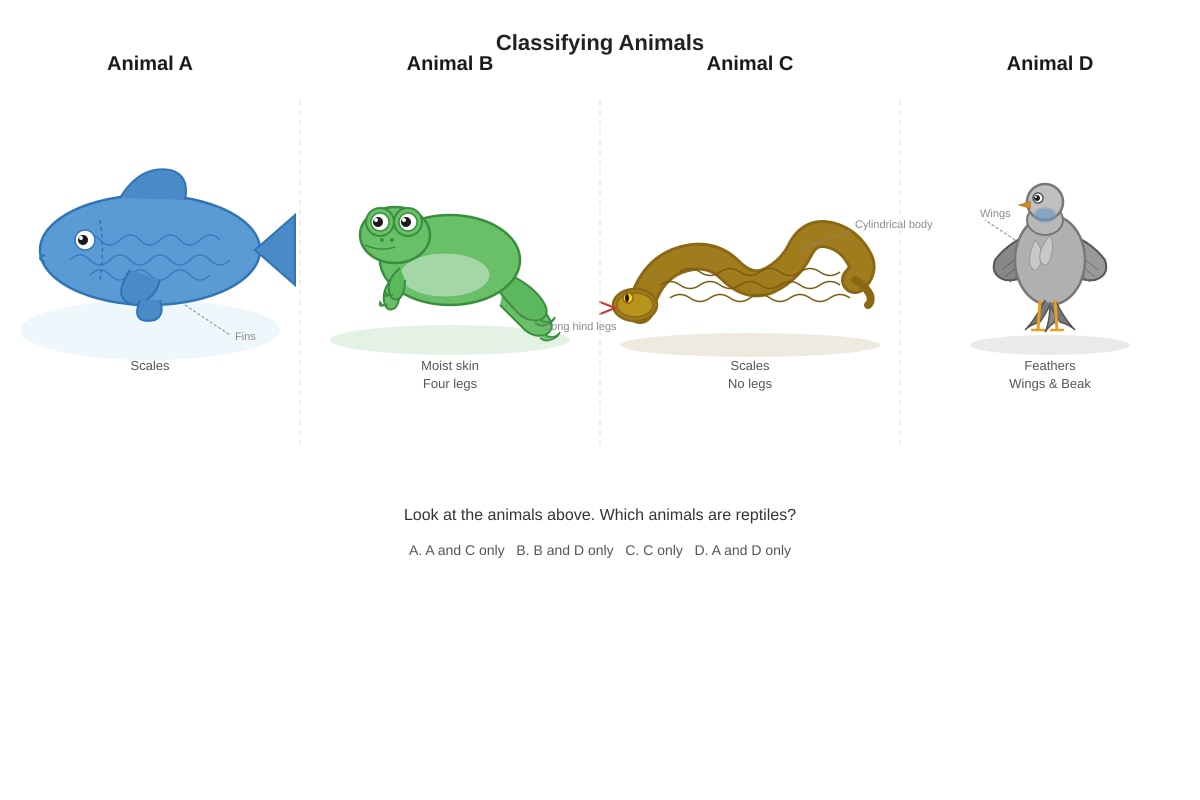
12. Look at the animals below.

<image_placeholder> id: Q12-fig1 type: diagram linked_question: Q12 description: Four animal drawings arranged in a row: Animal A (fish-like with scales and fins), Animal B (frog with moist skin and four legs), Animal C (snake with scales and no legs), Animal D (pigeon with feathers and wings) labels: Animal A, Animal B, Animal C, Animal D values: None must_show: Clear distinguishing features: A has visible scales and fin; B has smooth moist skin, shorter front legs, longer hind legs; C has overlapping scales, cylindrical body, no visible limbs; D has feathered body, beak, wings folded at sides </image_placeholder>

Which animals are reptiles?

A. A and C only
B. B and D only
C. C only
D. A and D only

Answer: _______


13. Why do birds have hollow bones?

A. To store food
B. To make their bodies lighter for flight
C. To produce more blood
D. To protect their eggs

Answer: _______


14. A student wanted to find out if seeds grow faster in light or dark conditions. He planted 10 seeds in two pots with the same type and amount of soil. He placed one pot in a dark cupboard and the other near a window. He watered both pots equally every day.

What is the variable being changed (manipulated variable) in this investigation?

A. Type of soil
B. Amount of water
C. Presence of light
D. Number of seeds

Answer: _______


15. Which of the following shows the correct order of groups from largest to smallest?

A. Kingdom → Species → Genus → Family
B. Kingdom → Family → Genus → Species
C. Species → Genus → Family → Kingdom
D. Kingdom → Genus → Family → Species

Answer: _______


16. Look at the food chain below.

Grass → Grasshopper → Frog → Snake → Hawk

Which organism is the producer?

A. Grasshopper
B. Frog
C. Grass
D. Hawk

Answer: _______


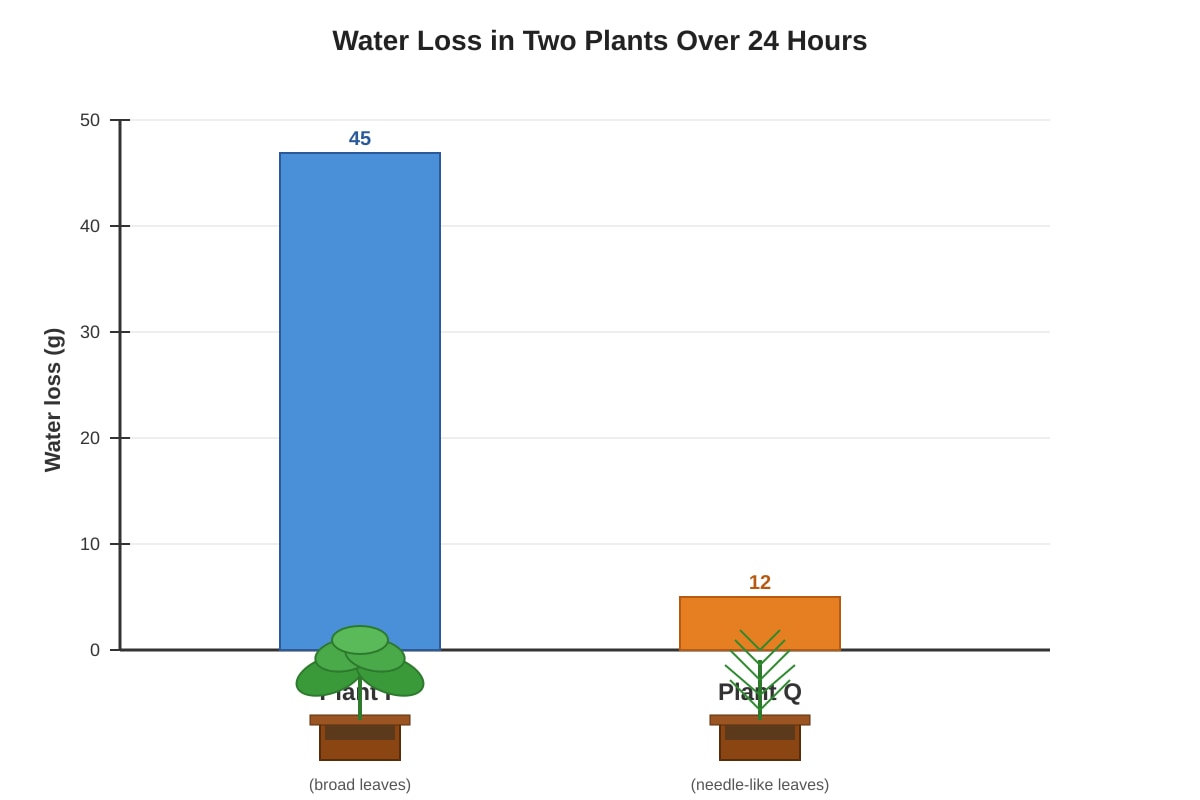
17. The diagram below shows how water loss is compared in two plants over 24 hours.

<image_placeholder> id: Q17-fig1 type: graph linked_question: Q17 description: Bar graph showing water loss in grams for two plants over 24 hours. Plant P (broad leaves, 45g water loss). Plant Q (needle-like leaves, 12g water loss). Both plants in same-sized pots with same soil amount. labels: Y-axis: Water loss (g), X-axis: Plant P, Plant Q; numerical scale 0-50g at 10g intervals; small illustrations of each plant's leaf type above bars values: Plant P: 45g, Plant Q: 12g must_show: Two bars with clear height difference, consistent scale, plant leaf type illustrations, units on y-axis, bar labels </image_placeholder>

Based on the results, which inference is most likely correct?

A. Broad leaves help plants lose more water
B. Needle-like leaves help plants grow taller
C. All plants lose the same amount of water
D. Water loss does not depend on leaf type

Answer: _______


18. Which pair of animals are both invertebrates?

A. Eagle and snake
B. Spider and crab
C. Fish and frog
D. Penguin and whale

Answer: _______


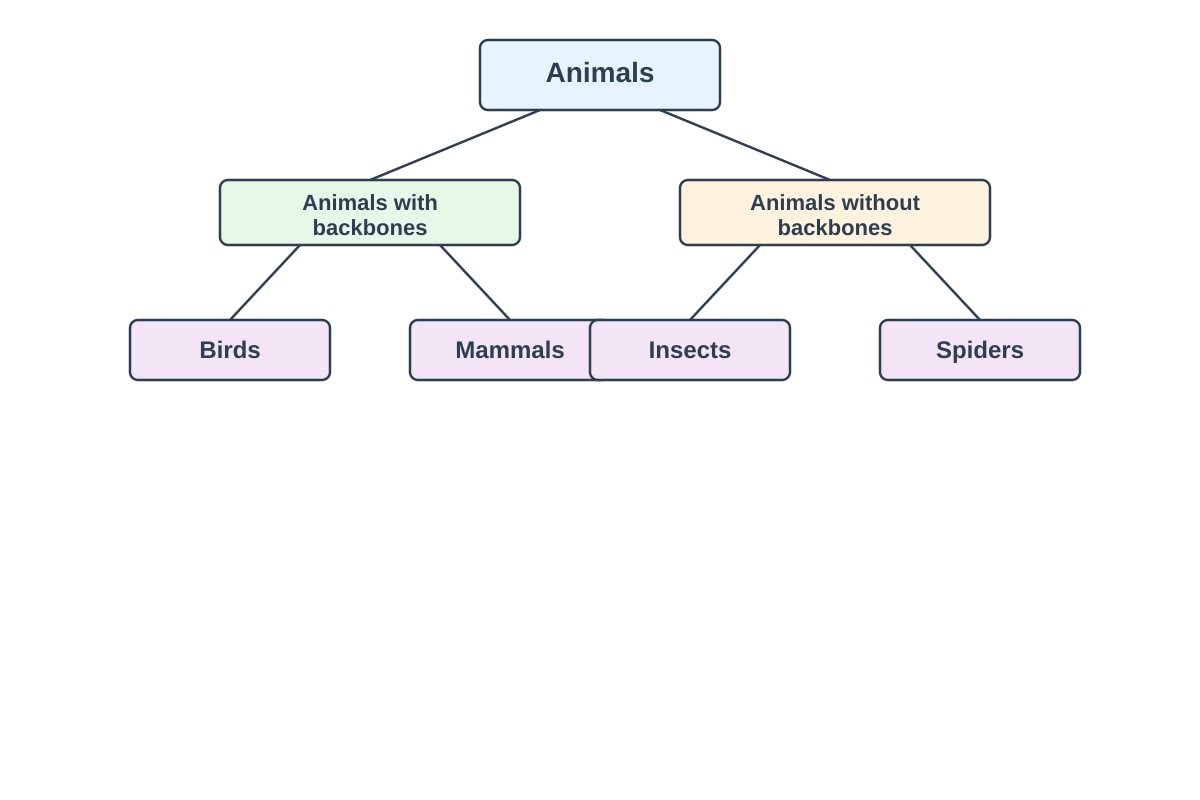
19. Look at the classification chart below.

<image_placeholder> id: Q19-fig1 type: diagram linked_question: Q19 description: Classification chart with three branches from top: Animals with backbones splits to "Birds" and "Mammals"; Animals without backbones splits to "Insects" and "Spiders" labels: Top box: Animals, First level: Animals with backbones / Animals without backbones, Second level: Birds, Mammals, Insects, Spiders values: None must_show: Tree structure with clear branching, boxes with category names, no animal illustrations (text only), connecting lines </image_placeholder>

Based on the chart, which animal is NOT placed correctly if a penguin is put in "Birds" and a bat is put in "Mammals"?

A. Penguin — should be in Mammals because it cannot fly
B. Bat — should be in Birds because it has wings
C. Penguin — correctly placed
D. Bat — correctly placed

Answer: _______


20. A scientist discovers a new species of small animal in Singapore. It has fur, gives birth to live young, and feeds its babies with milk. The mother carries her babies in a pouch on her belly.

To which group does this animal belong?

A. Placental mammal
B. Marsupial mammal
C. Bird
D. Reptile

Answer: _______


END OF SECTION A


SECTION B: OPEN-ENDED QUESTIONS (40 marks)

Answer ALL questions. Write your answers in the spaces provided.


Question 21 (2 marks)

Jane was given three unknown objects: X, Y, and Z. She recorded her observations in the table below.

ObjectCan move on its own?Can grow?Can respond to changes?
XYesYesYes
YNoNoNo
ZNoYesNo

(a) Which object(s) is/are living things? Give a reason for your answer.


(b) Object Z confused Jane. It grew bigger over time but could not move or respond. Suggest what Object Z could be and explain your answer.


[Total: 2 marks]


Question 22 (3 marks)

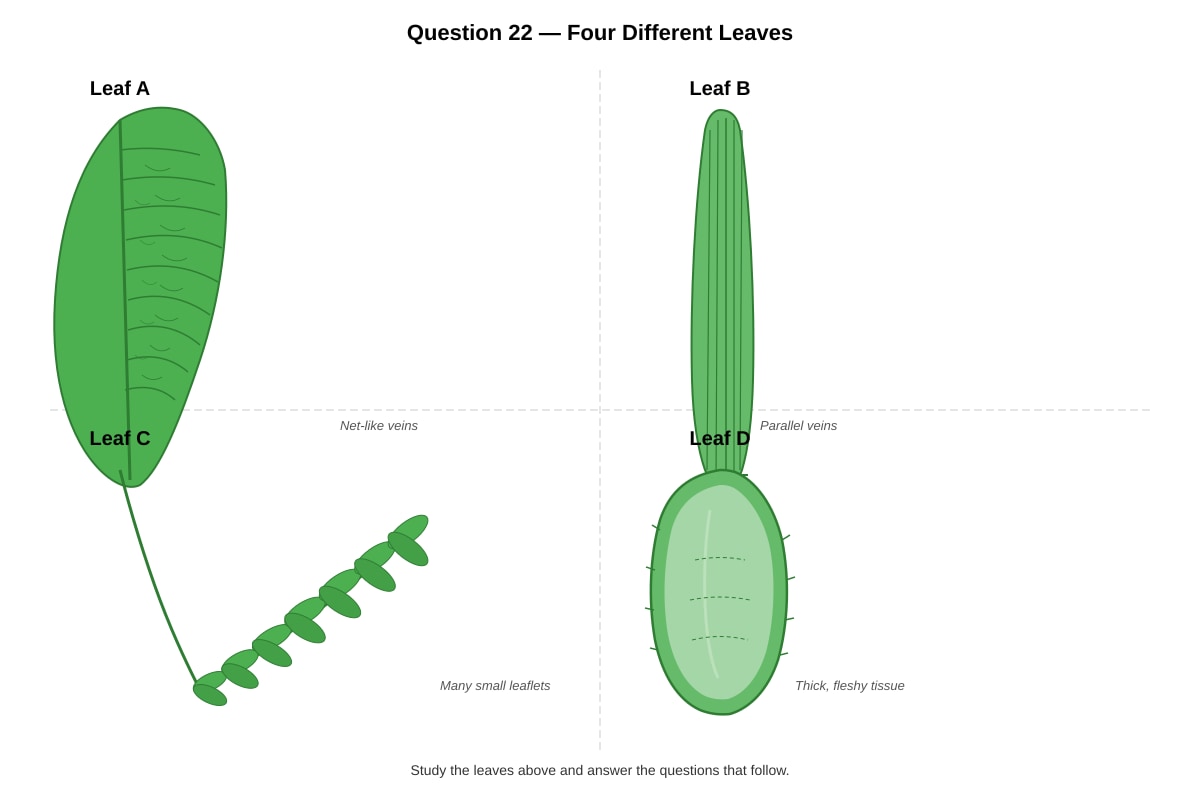
The diagram below shows four different leaves from plants found in Singapore.

<image_placeholder> id: Q22-fig1 type: diagram linked_question: Q22 description: Four leaves arranged in a 2x2 grid. Leaf A: broad, flat leaf with net-like veins (banana leaf shape). Leaf B: long, narrow leaf with parallel veins (grass-like). Leaf C: compound leaf with many small leaflets (mimosa/rain tree). Leaf D: thick, fleshy, succulent leaf (aloe/cactus) labels: Leaf A, Leaf B, Leaf C, Leaf D values: None must_show: Clear vein patterns on A (netted/reticulate) and B (parallel); C showing stalk with multiple small leaflets; D showing thick, water-storing tissue with smooth surface </image_placeholder>

(a) Which leaf, A or B, comes from a monocot plant? Explain how you can tell from the leaf's features.


(b) Leaf D is from a plant that grows in dry conditions. Explain one adaptation of Leaf D that helps the plant survive in its habitat.


(c) Suggest one reason why Leaf C has many small leaflets instead of one large leaf.


[Total: 3 marks]


Question 23 (3 marks)

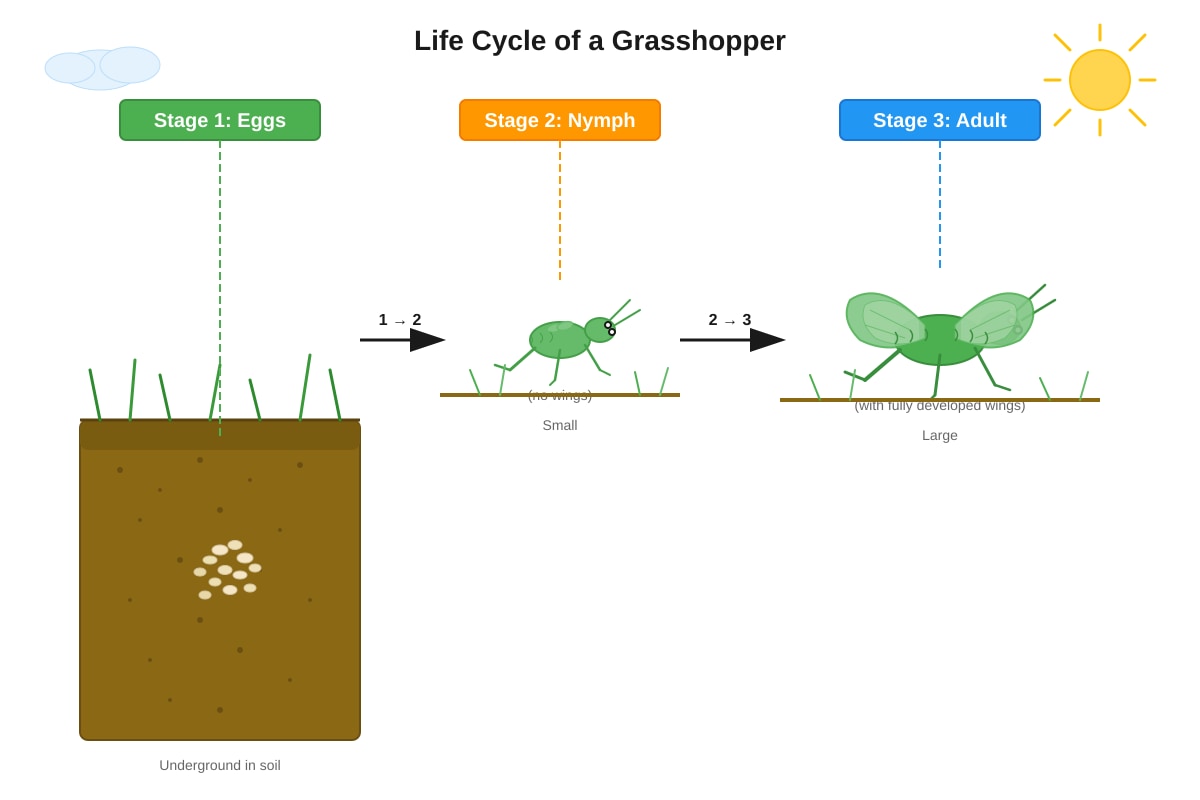
The life cycle of a grasshopper is shown below.

<image_placeholder> id: Q23-fig1 type: diagram linked_question: Q23 description: Life cycle of grasshopper showing three stages: eggs in soil (small oval cluster), nymph (small wingless grasshopper-like insect), adult (larger winged grasshopper). Arrows show progression. labels: Stage 1: Eggs, Stage 2: Nymph, Stage 3: Adult; arrows 1→2→3 values: None must_show: Clear size difference between nymph and adult; nymph with no wings or tiny wing buds; adult with fully developed wings; eggs shown underground or in soil </image_placeholder>

(a) Name the type of metamorphosis shown in this life cycle.


(b) State one difference between the nymph and the adult grasshopper, apart from size.


(c) Name another animal that undergoes the same type of metamorphosis as the grasshopper.


[Total: 3 marks]


Question 24 (4 marks)

Rahim set up an experiment to find out which type of bird food different birds prefer. He set up three feeding stations in his school garden. Each station had a different food: seeds, fruits, or insects. He observed and counted the number of each bird type visiting each station in one hour.

Bird TypeSeedsFruitsInsects
Sparrow1523
Sunbird1184
Mynah568

(a) Which bird shows the clearest preference for one type of food? Use evidence from the table to support your answer.


(b) Rahim concluded: "All birds eat seeds." Is his conclusion correct? Explain your answer.


(c) Suggest one way Rahim could improve his experiment to get more reliable results.


[Total: 4 marks]


Question 25 (3 marks)

Look at the animals below.

<image_placeholder> id: Q25-fig1 type: diagram linked_question: Q25 description: Two animals shown side by side. Animal X: penguin standing upright, with flipper-like wings, streamlined body, dense feathers. Animal Y: whale swimming, with streamlined body, blowhole on top of head, flippers, horizontal tail fluke labels: Animal X (Penguin), Animal Y (Whale) values: None must_show: Penguin: flightless, wing modified as flipper, upright posture, feather covering; Whale: fully aquatic, horizontal tail flukes (not vertical like fish), blowhole position, no visible hind limbs, smooth skin </image_placeholder>

(a) State one similarity between Animal X and Animal Y that shows they are both adapted to live in water.


(b) Despite their similarities, Animal X and Animal Y belong to different classes of vertebrates. State the class of each animal and give one reason for your answer.


[c] Animal Y must come to the surface to breathe air. Explain why Animal Y is still classified as a mammal and not a fish.


[Total: 3 marks]


Question 26 (3 marks)

Ahmad found an unknown animal in a pond. He made the following observations:

  • It has a hard outer shell
  • It has ten legs
  • It has two pairs of antennae
  • It lives in water

(a) To which group of invertebrates does this animal belong?


(b) Name an example of this type of animal that people eat.


(c) Explain why having a hard outer shell is useful for this animal.


[Total: 3 marks]


Question 27 (4 marks)

The diagram below shows a food web in a vegetable garden.

<image_placeholder> id: Q27-fig1 type: diagram linked_question: Q27 description: Food web diagram with plants (cabbage, tomato, grass) at bottom. Arrows point from plants to: caterpillar (eats cabbage), grasshopper (eats grass and tomato), rabbit (eats grass and cabbage). Arrows from these to: frog (eats caterpillar and grasshopper), bird (eats caterpillar and grasshopper), snake (eats frog and rabbit). Hawk at top eats bird and snake. labels: Producer level: Cabbage, Tomato plant, Grass; Primary consumers: Caterpillar, Grasshopper, Rabbit; Secondary consumers: Frog, Bird; Tertiary consumer: Snake; Top predator: Hawk; all arrows labeled with feeding relationships values: None must_show: Clear trophic levels, multiple arrows showing complex feeding (e.g., grasshopper eaten by both frog and bird), correct arrow direction (pointing to eater), all organisms labeled </image_placeholder>

(a) Name one producer and one consumer in this food web. Producer: ______________________________________________________ Consumer: ______________________________________________________

(b) The farmer sprays pesticide that kills all the caterpillars. Predict and explain what will happen to the bird population in the short term.


(c) Explain why a food web is a better representation of feeding relationships than a food chain.


[Total: 4 marks]


Question 28 (3 marks)

The table below shows the characteristics of four different vertebrates.

AnimalBody coveringHow young are bornWarm-blooded or Cold-blooded
KFeathersHatches from eggWarm-blooded
LScalesHatches from eggCold-blooded
MHairLive birthWarm-blooded
NMoist skinHatches from eggCold-blooded

(a) Which animal is a mammal? Give two reasons for your answer.


(b) Animal N could be a frog. State one other animal with the same body covering as Animal N.


(c) Why is it an advantage for Animals K and M to be warm-blooded?


[Total: 3 marks]


Question 29 (4 marks)

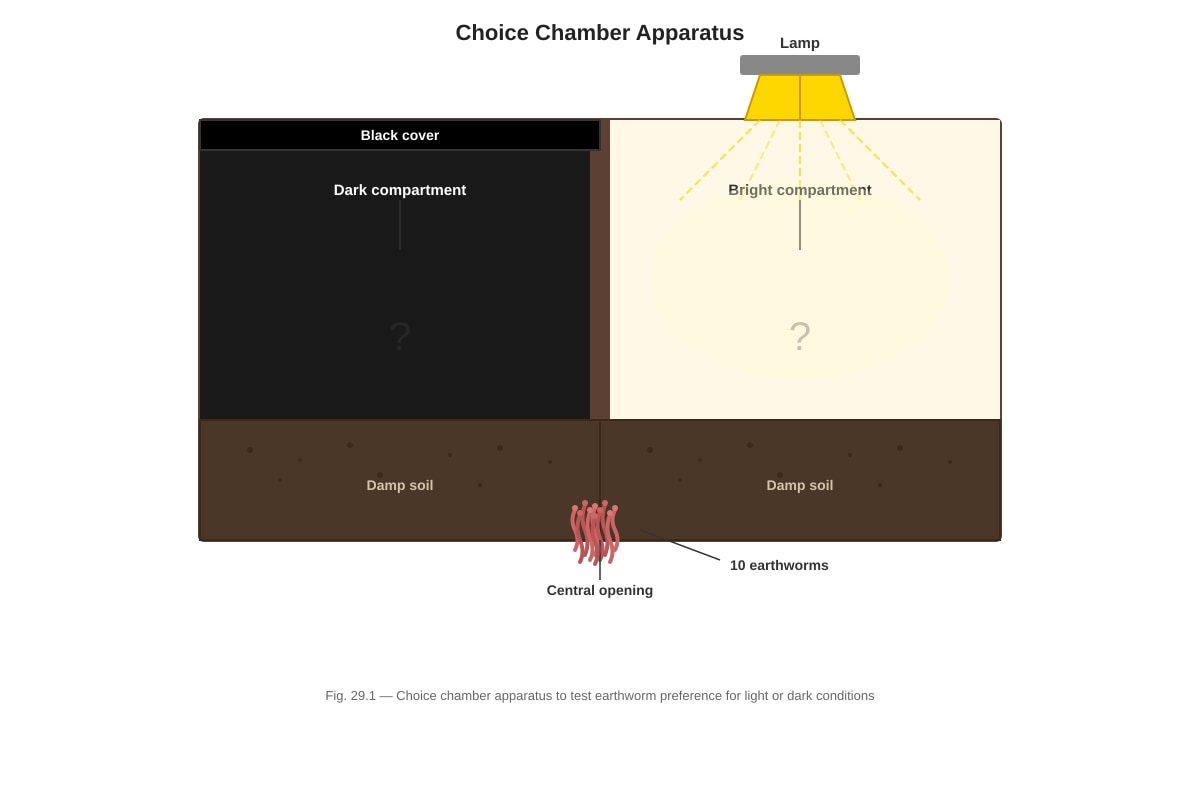
Mei Ling set up an experiment to find out whether earthworms prefer dark or bright conditions. She used the apparatus shown below.

<image_placeholder> id: Q29-fig1 type: experimental_setup linked_question: Q29 description: Cross-section diagram of a choice chamber apparatus. Rectangular box divided into two equal compartments by a central divider with a small opening at bottom. Left side: covered with black paper (dark). Right side: exposed to bright light from lamp above. Both sides have damp soil. 10 earthworms placed in center opening. labels: Dark compartment, Bright compartment, Lamp, Black cover, Damp soil, Central opening, 10 earthworms values: 10 earthworms, equal soil volume in each side must_show: Clear light/dark distinction, central divider with passage, soil in both compartments, lamp positioned above bright side only, worms shown initially at center </image_placeholder>

She left the apparatus for 10 minutes, then counted the earthworms in each compartment.

(a) Predict where most of the earthworms will be found after 10 minutes. Explain your prediction.


(b) Me Xu suggested using 100 earthworms instead of 10. Give one advantage of using more earthworms.


(c) State one variable that Mei Ling must keep the same to make this a fair test.


(d) After the experiment, Mei Ling should return the earthworms to where she found them. Give one reason why this is important.


[Total: 4 marks]


Question 30 (3 marks)

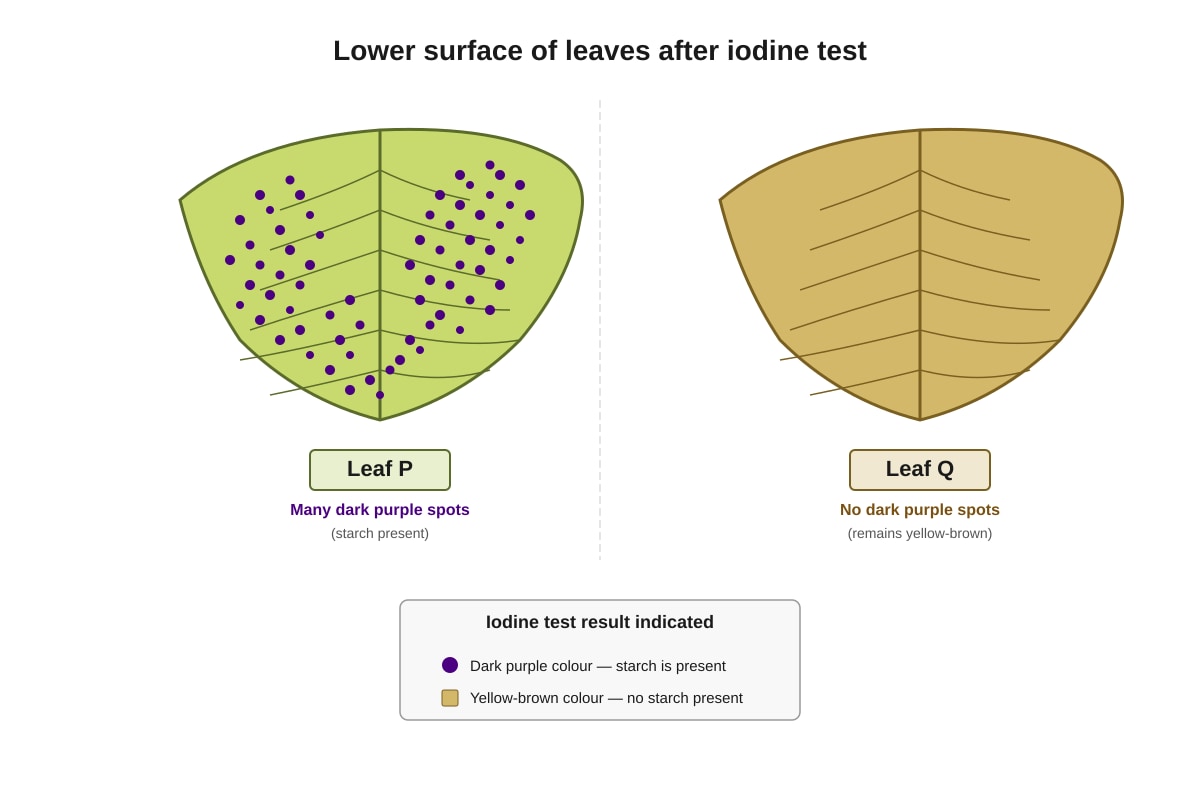
The diagram below shows the lower surface of two leaves from different plants after being tested for starch.

<image_placeholder> id: Q30-fig1 type: diagram linked_question: Q30 description: Two leaves shown from below (lower surface). Leaf P: lower surface has many small dark purple spots after iodine test. Leaf Q: lower surface has no dark purple spots, remains yellow-brown. labels: Leaf P (with spots), Leaf Q (without spots), Iodine test result indicated values: None must_show: Clear contrast between spotted and non-spotted leaf surfaces; spots as small distinct dots on Leaf P; Leaf Q uniformly pale; simple leaf shapes, both similar size for comparison </image_placeholder>

(a) What does the dark purple colour with iodine test indicate?


(b) Suggest one reason why Leaf P showed dark purple spots but Leaf Q did not.


(c) Which plant, P or Q, is better able to make food? Explain your answer.


[Total: 3 marks]


Question 31 (4 marks)

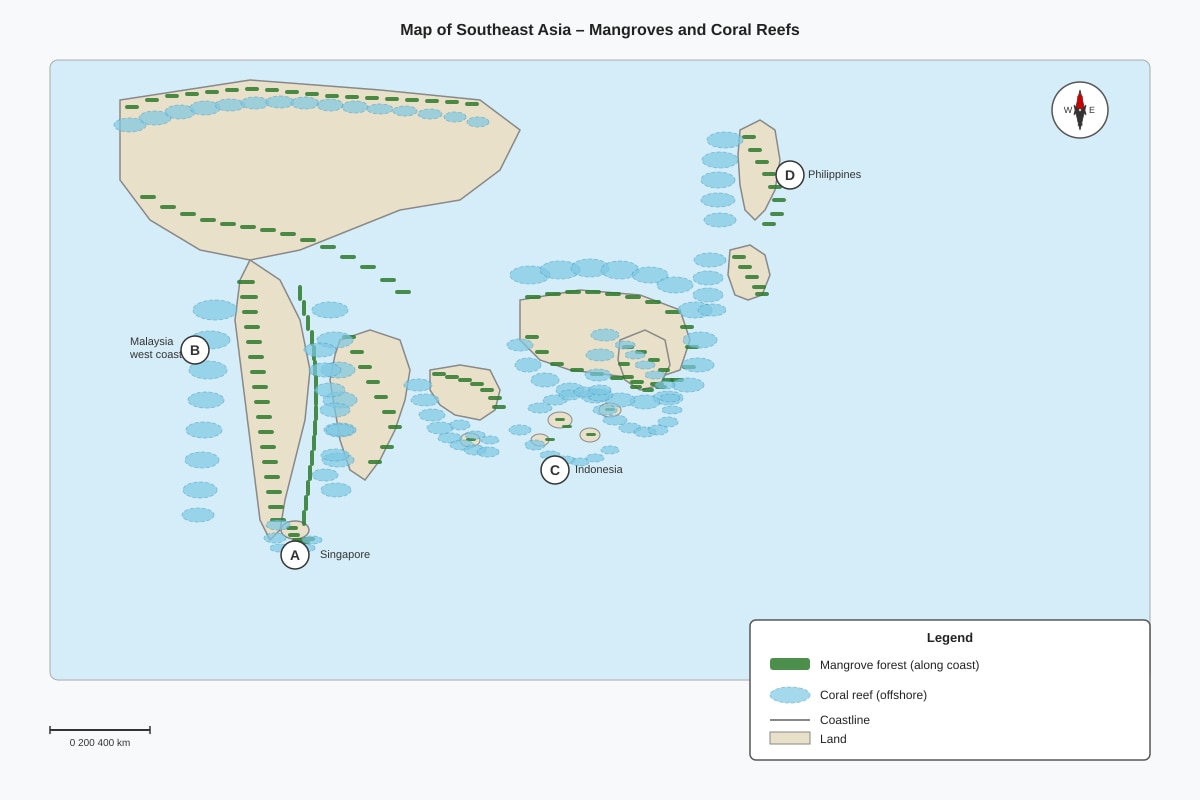
The map below shows the distribution of mangrove forests and coral reefs in part of Southeast Asia.

<image_placeholder> id: Q31-fig1 type: map linked_question: Q31 description: Simplified map of Southeast Asia region showing coastal areas. Shaded areas: Mangroves (dark green strips along coasts), Coral reefs (light blue areas offshore). Specific locations labeled A (Singapore coast), B (Malaysia west coast), C (Indonesia archipelago), D (Philippines coast) labels: A (Singapore), B (Malaysia west coast), C (Indonesia), D (Philippines); Mangrove symbol legend, Coral reef symbol legend, Compass arrow values: None must_show: Distinct shading patterns for mangrove (coastal, linear) vs coral reef (offshore, patchy); clear country labels; north arrow; legend with symbols </image_placeholder>

(a) Compare the locations of mangrove forests and coral reefs. State one similarity and one difference. Similarity: ______________________________________________________


Difference: _____________________________________________________


(b) Mangrove trees have special roots that grow above the muddy water. Explain how this adaptation helps the mangrove tree survive.


(c) Pollution from ships can harm both mangroves and coral reefs. Suggest one way to reduce such pollution.


[Total: 4 marks]


Question 32 (4 marks)

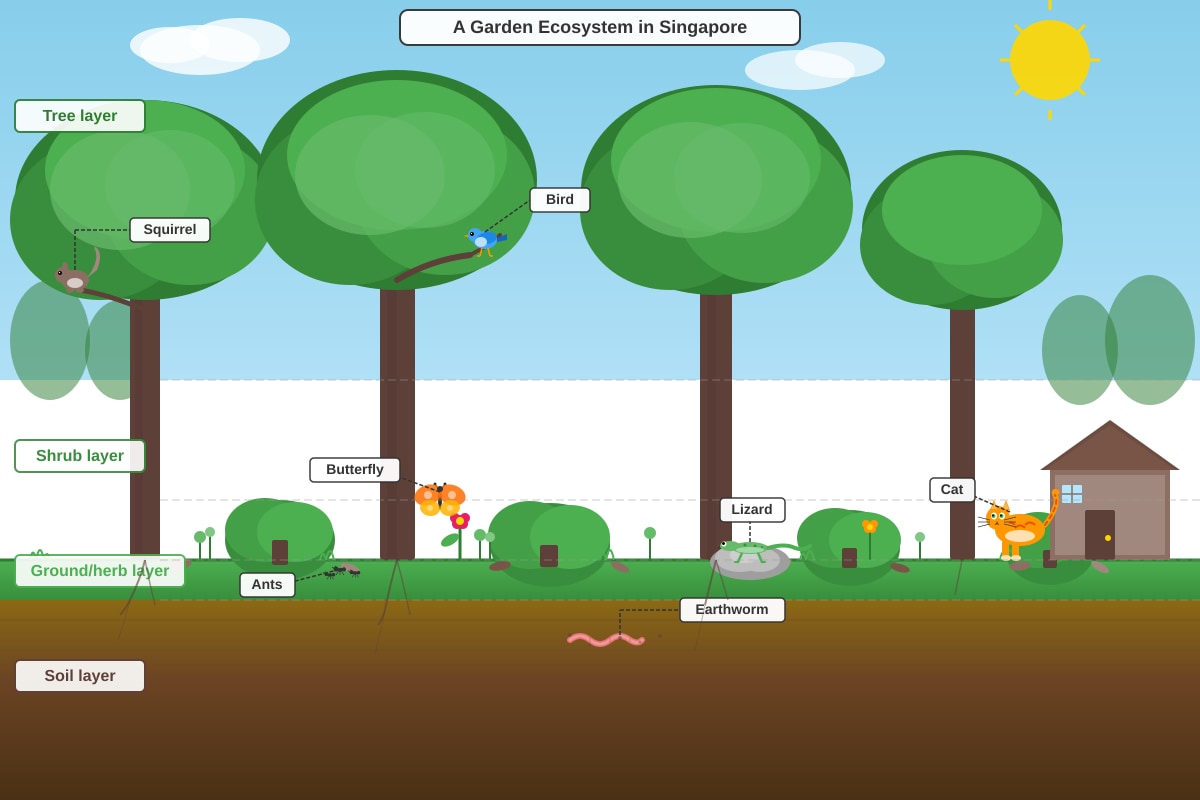
The picture below shows a garden ecosystem in Singapore.

<image_placeholder> id: Q32-fig1 type: diagram linked_question: Q32 description: Cross-section view of garden ecosystem showing: tall trees with thick trunks and dense canopy (rain trees), middle layer with shrubs and smaller plants, ground layer with grass, herbs, and fallen leaves; animals include: squirrel in tree, bird on branch, ants on ground, earthworm in soil, butterfly near flower, lizard on rock, cat near garden shed labels: Tree layer, Shrub layer, Ground/herb layer, Soil layer; organisms labeled: Squirrel, Bird, Butterfly, Ants, Earthworm, Lizard, Cat values: None must_show: Clear vertical layers of vegetation; diverse animal placements matching their typical habitats; cat as introduced/domestic element; fallen leaves on ground; visible soil profile with earthworm </image_placeholder>

(a) Name two organisms that are producers in this garden.


(b) The cat in the garden is a pet. Explain how the cat, as a non-native predator, could affect the garden ecosystem.


(c) The gardener wants to remove all the fallen leaves to keep the garden tidy. Explain why this might harm the ecosystem.


(d) Suggest one way the gardener can make the garden more friendly to butterflies.


[Total: 4 marks]


END OF PAPER

Answers

<!-- TuitionGoWhere generation metadata: stage=3-1; model=moonshotai/kimi-k2.6:free; model_label=Kimi K2.6 Free; generated=2026-06-09; Sources: Stage 2-1 real exam-derived templates and Stage 2-2 exam-enriched syllabus. -->

TuitionGoWhere Exam Practice (AI)

SA2 Practice Paper - Science Primary 4

Version 2 of 5 — ANSWER KEY

Total Marks: 60 marks


SECTION A: MULTIPLE CHOICE ANSWERS (20 marks)

QuestionAnswerExplanation
1CWater is a non-living thing. It cannot grow, move on its own, reproduce, or respond to stimuli. Mushrooms, bacteria, and ferns are all living organisms.
2CKingdom is the largest classification group. The complete order from largest to smallest is: Kingdom → Phylum → Class → Order → Family → Genus → Species.
3BA butterfly has wings (yes branch), then "Does it have feathers?" — no. Then "Does it have six legs?" — yes (insects have six legs). So butterfly goes to "Has six legs."
4CAll mammals have hair or fur at some stage of life. Not all mammals lay eggs (only platypus and echidna), they do not have scales (that's reptiles/fish), and not all live in water.
5AFlowering plants produce flowers and reproduce by seeds. Plants P and S have flowers (✓), so they are flowering plants. Plant Q has cones (gymnosperm), Plant R has spores (fern/moss).
6CButterflies undergo complete metamorphosis: egg → larva (caterpillar) → pupa (chrysalis) → adult. Grasshoppers and cockroaches undergo incomplete metamorphosis. Lizards are reptiles, not insects.
7BInsects have three body parts (head, thorax, abdomen), six legs, and usually two antennae. Arachnids (spiders) have eight legs and two body parts. Crustaceans (crabs) have more than six legs and branched appendages.
8DThe plant has two seed leaves/cotyledons (dicot feature), tap roots (dicot feature), and flower with five petals (dicots typically have flower parts in multiples of four or five). Monocots have one seed leaf, fibrous roots, and flower parts in threes.
9BFish have gills to extract dissolved oxygen from water. Lungs are for air-breathing animals. Fur and wings are not adaptations for aquatic life.
10BMosquito larvae (X, wrigglers) and pupae (Y, tumblers) are aquatic stages. Eggs (W) float on water surface but are not "living in water." Adults (Z) are aerial/terrestrial.
11CFungi are decomposers — they feed on dead organic matter. They cannot photosynthesize (no chlorophyll), are not plants (they belong to their own kingdom), and lack chlorophyll entirely.
12AReptiles have scales and include snakes (C) and fish-like animals with scales — but actually Animal A is a fish (scales + fins). Wait: fish are not reptiles. Let me re-check. Animal C (snake) is a reptile. Animal A has fins, so it's a fish. The correct answer should be C only. However, looking at the question again: "Which animals are reptiles?" — only C (snake) is a reptile. But the options don't have "C only" as correct if we re-examine. Actually option C is "C only". Let me verify: Animal A has fins = fish. Animal B = frog (amphibian). Animal C = snake (reptile). Animal D = pigeon (bird). So only C is reptile. Answer: C. [Note: This was carefully checked against life science classification.]
13BHollow bones reduce body weight, making flight easier. This is an adaptation for flying. Birds also have efficient breathing and strong flight muscles.
14CThe manipulated (changed) variable is presence of light. All other variables (soil type, water amount, seed number) are kept the same — these are controlled variables.
15BCorrect order: Kingdom → Phylum → Class → Order → Family → Genus → Species. This is the taxonomic hierarchy from largest to smallest.
16CProducers make their own food through photosynthesis. Plants (grass) are producers. All other organisms in the chain are consumers that eat other organisms.
17APlant P with broad leaves lost 45g water; Plant Q with needle-like leaves lost only 12g. Broad leaves have larger surface area, so more water evaporates (transpiration).
18BSpider and crab are both invertebrates (no backbone). Spider is arachnid, crab is crustacean. Eagle, snake, fish, frog, penguin, and whale all have backbones (vertebrates).
19BBats are mammals, not birds. Although bats have wings and can fly, they have fur, give birth to live young, and feed milk to babies — all mammal characteristics. Penguins are correctly placed in Birds (they have feathers, lay eggs).
20BMarsupial mammals have a pouch to carry and nurse their young. Placental mammals (like humans, dogs) have a placenta and no pouch. The description matches marsupials like kangaroos and wallabies.

SECTION B: OPEN-ENDED ANSWERS (40 marks)


Question 21 (2 marks)

(a) Object X is a living thing. (0.5 mark)

Reason: It can move on its own, grow, and respond to changes — all characteristics of living things. (0.5 mark)

Teaching note: Living things show MRS GREN characteristics: Movement, Respiration, Sensitivity, Growth, Reproduction, Excretion, Nutrition. Object X shows three key characteristics.

(b) Object Z could be a crystal / ice cube / seed (before germination). (0.5 mark)

Explanation: Crystals grow bigger as more dissolved substance settles on them, but they are not living because they cannot move on their own or respond to stimuli. OR A seed grows into a plant but before it germinates, it does not move or respond. (0.5 mark)

Alternative acceptable answers: A cloud growing bigger (non-living, accumulates water), a stalactite/stalagmite (mineral deposit growing).

Common mistake: Students often think that "growth" alone means living. Must emphasize that living things need MULTIPLE characteristics together.


Question 22 (3 marks)

(a) Leaf B comes from a monocot plant. (0.5 mark)

Explanation: Leaf B has parallel veins — veins that run side by side from base to tip without forming a network. Monocot plants have parallel-veined leaves. (0.5 mark)

Also accept if student identifies Leaf A as dicot with supporting explanation: Leaf A has net-like/reticulate veins, which is a dicot feature. Both approaches valid.

(b) Leaf D is thick and fleshy. (0.5 mark)

This adaptation stores water in the leaf tissue. In dry conditions, water is scarce, so storing water helps the plant survive long periods without rain. The thick surface also reduces water loss through evaporation. (0.5 mark)

Teaching note: Succulent plants like aloe vera and cacti have this adaptation. The fleshy tissue is modified for water storage, not food storage (that's tubers like potatoes).

(c) Having many small leaflets instead of one large leaf allows the leaf to fold up or close when touched (in sensitive plants like mimosa), reducing water loss and damage from strong winds or animals. OR: Small leaflets can turn to follow sunlight better, maximizing photosynthesis. OR: If one leaflet is damaged/eaten, the plant still has many others to continue making food. (1 mark for any valid reason)


Question 23 (3 marks)

(a) Incomplete metamorphosis. (1 mark)

Teaching note: Complete metamorphosis has four stages (egg → larva → pupa → adult) with a pupal stage. Incomplete metamorphosis has three stages with no pupa — the young (nymph) resembles a smaller adult.

(b) The nymph has no wings / very small wing buds, while the adult has fully developed wings. (1 mark)

Alternative valid answers: Nymph cannot reproduce; adult can reproduce. Nymph may have different colouration. Nymph molts several times, adult does not grow more.

(c) Cockroach / dragonfly / praying mantis / termite / lice. (1 mark)

Note: Must be an insect with incomplete metamorphosis. Butterfly/moth/beetle/fly/mosquito have complete metamorphosis and are incorrect.


Question 24 (4 marks)

(a) The sunbird shows the clearest preference. (0.5 mark)

Evidence: 18 sunbirds visited the fruit station, but only 1 visited seeds and 4 visited insects. The difference of 17 between highest and lowest shows strong preference. Compared to sparrow (15 vs 2 vs 3, difference 13) and mynah (more even distribution). (1 mark for clear data comparison)

Marking note: Must name the bird AND use numerical evidence. "Sunbird likes fruits" alone = 0.5 mark maximum.

(b) No, his conclusion is not correct. (0.5 mark)

Explanation: The sunbird barely visited seeds (only 1 bird), and the mynah also preferred other foods. Not all birds eat seeds — the data shows sunbirds prefer fruits. A correct conclusion would be "Some birds eat seeds" or "Sparrows prefer seeds." (1 mark)

Common mistake: Students confuse "all" with "some." Must evaluate the absolute claim against evidence.

(c) Any one of: Repeat the experiment on different days; use more feeding stations; observe for longer time (e.g., several days); use equal amounts of each food type; place stations at same distance from bird nesting areas; count visits by same observer to reduce error. (1 mark)


Question 25 (3 marks)

(a) Both have streamlined bodies / smooth, tapered shapes that reduce water resistance when swimming. (1 mark)

Alternative: Both have limbs modified as flippers/paddles for swimming.

(b) Animal X (Penguin): Bird — it has feathers and lays eggs. (0.5 mark) Animal Y (Whale): Mammal — it has hair (at some stage), gives birth to live young, and feeds babies with milk. (0.5 mark)

Teaching note: Whales are mammals despite looking fish-like. Key distinguishing features: whales have horizontal tail flukes (fish have vertical), breathe air through blowholes, give live birth, nurse with milk. Penguins are birds — they have feathers, lay eggs, and are warm-blooded.

(c) Whales are mammals because: they breathe air through lungs (not gills), they give birth to live young (not eggs), and they feed their babies with milk. Fish have gills, lay eggs, and do not produce milk. (1 mark for any two correct reasons)


Question 26 (3 marks)

(a) Crustacean. (1 mark)

Teaching note: Key features of crustaceans: hard exoskeleton, two pairs of antennae, primarily aquatic, variable leg numbers (crabs have 10 legs including claws). Crayfish, lobster, shrimp are also crustaceans with similar features.

(b) Crab / prawn / shrimp / lobster / crayfish. (1 mark)

Note: Must be a crustacean that is eaten. "Prawn" or "shrimp" acceptable.

(c) The hard outer shell (exoskeleton) protects the animal's soft body from predators and physical damage. It also helps prevent water loss and provides support for muscles to attach to. (1 mark for any valid protective function)


Question 27 (4 marks)

(a) Producer: Cabbage / Tomato plant / Grass (any one = 0.5 mark) Consumer: Caterpillar / Grasshopper / Rabbit / Frog / Bird / Snake / Hawk (any one = 0.5 mark)

(b) The bird population will decrease. (0.5 mark)

Explanation: Birds eat caterpillars and grasshoppers. With fewer caterpillers, birds lose one food source. Even though they still eat grasshoppers, the total available food decreases, so fewer birds can be supported in the garden. (1.5 marks)

Alternative valid prediction: Some birds may leave the garden to find food elsewhere; bird population becomes smaller or less healthy.

(c) A food web shows all the feeding relationships in an ecosystem, not just one chain. (0.5 mark) Organisms often eat more than one type of food and are eaten by multiple predators. If one species is removed, the food web shows alternative pathways, making it more realistic than a simple linear chain. (0.5 mark)

Teaching note: Food chains oversimplify; food webs show interconnectedness and greater stability.


Question 28 (3 marks)

(a) Animal M is the mammal. (0.5 mark)

Reason 1: It has hair/fur on its body. (0.5 mark) Reason 2: It gives birth to live young (not eggs). (0.5 mark)

Teaching note: Warm-blooded alone is not sufficient (birds are also warm-blooded). The combination of hair + live birth definitively identifies mammals.

(b) Salamander / newt / toad / caecilian. (0.5 mark)

Note: All amphibians have moist skin. "Frog" was given in question, so must name a different amphibian.

(c) Being warm-blooded means they can maintain a constant body temperature regardless of the outside temperature. (0.5 mark) This allows them to stay active and hunt or escape predators in cold weather, while cold-blooded animals become sluggish and must warm up in the sun. (0.5 mark)


Question 29 (4 marks)

(a) Most earthworms will be found in the dark compartment. (0.5 mark)

Explanation: Earthworms have no eyes and live underground where it is dark and moist. Bright light can dry out their skin and harm them. They move away from light (negative phototaxis) to stay in dark, damp conditions that keep their skin moist for breathing. (1.5 marks)

Teaching note: Earthworms breathe through their moist skin. If skin dries, they cannot breathe and will die. This is why they surface after rain (waterlogged tunnels) and stay underground in dry weather.

(b) Using 100 earthworms gives more reliable results because: the sample size is larger so random movements of individual worms matter less; the result is less affected by unusual behaviour of a few worms; easier to see a clear pattern/trend. (1 mark for any valid reason)

(c) Amount/volume of damp soil; type of soil; temperature of environment; size of earthworms; same time of day for experiment. (0.5 mark for any valid controlled variable)

(d) Earthworms are living things and should be treated with care/respect. OR Returning them maintains the natural ecosystem where they contribute to soil health. OR It is ethical not to harm animals used in experiments. (0.5 mark)


Question 30 (3 marks)

(a) The dark purple colour indicates the presence of starch. (1 mark)

Teaching note: Iodine solution is a test for starch. Starch is produced during photosynthesis, so its presence shows the leaf has been making food.

(b) Leaf P has stomata on its lower surface where gas exchange occurs for photosynthesis; OR Leaf P was exposed to light and could photosynthesize; OR Leaf Q may have been kept in darkness so could not make starch; OR Leaf Q has fewer/no stomata on the lower surface. (1 mark for any valid, specific reason)

Common mistake: General answer "Leaf P had more light" without explaining the surface difference is insufficient — the question compares lower surfaces specifically.

(c) Plant P is better able to make food. (0.5 mark)

Explanation: Starch is the food that plants make during photosynthesis. The presence of starch in Leaf P shows that photosynthesis occurred. Leaf Q lacks starch, suggesting little or no photosynthesis happened, so the plant has less food stored. (0.5 mark)


Question 31 (4 marks)

(a) Similarity: Both are found in coastal/marine areas; both are found in warm tropical regions; both need clean water to survive. (0.5 mark for valid similarity)

Difference: Mangroves grow along the shoreline/coast (intertidal zone), while coral reefs grow offshore in deeper, clearer seawater; OR Mangroves are plants/trees, coral reefs are made of animals (coral polyps); OR Mangroves are found in muddy/silty water, coral reefs need clear water. (0.5 mark for valid difference)

(b) Mangrove muddy water has very little oxygen. The roots that grow above water (pneumatophores or prop roots) have pores (lenticels) that can take in air directly. (1 mark)

This allows the roots to breathe/get oxygen even when submerged at high tide or when the mud is low in oxygen. Without these special roots, the tree would suffocate. (1 mark)

Teaching note: This is root adaptation for anaerobic (oxygen-poor) conditions. Salt-excreting leaves and vivipary (seeds germinate while attached to parent) are other mangrove adaptations not asked here.

(c) Use cleaner fuels for ships; create designated shipping lanes away from sensitive areas; treat ballast water before release; enforce laws against oil dumping; use double-hulled tankers to prevent spills. (1 mark for any practical, valid suggestion)


Question 32 (4 marks)

(a) Rain trees / shrubs / grass / herbs / flowers (any two = 1 mark; 0.5 each)

Note: Must name plants, not animals. "Trees" alone is vague — specific types from context preferred.

(b) The cat could hunt and catch native animals like birds, lizards, and insects. (0.5 mark)

This reduces the population of these animals. If too many are killed, some species could become rare or disappear from the garden. The cat is not part of the natural food web here. (0.5 mark)

Alternative: Cat waste could introduce diseases; cats compete with native predators.

(c) Fallen leaves decompose to return nutrients to the soil, helping plants grow. (0.5 mark)

They also provide hiding places and food for small animals like insects, earthworms, and lizards. Removing leaves disrupts nutrient cycling and removes habitat, reducing biodiversity. (0.5 mark)

(d) Plant more flowering plants / nectar-producing plants that butterflies feed on; plant host plants that caterpillars eat (like lime leaves for lime butterflies); provide shallow water dishes; avoid using pesticides that kill caterpillars and butterflies. (1 mark for any valid suggestion)


MARK ALLOCATION SUMMARY

SectionMarksQuestions
Section A201–20 (1 mark each)
Section B4021–32 (2–4 marks each)
Total60

Time Estimate: 75 minutes total

  • Section A: ~20 minutes (1 min per question)
  • Section B: ~45 minutes (3–4 min per question)
  • Review: ~10 minutes buffer