From Real Exams Exam Paper
Primary 4 Science Semestral Assessment 2 (End of Year) Paper 2
Free P4 Science SA2 Paper 2, HY3 Exam version, with questions, answers, and syllabus-aligned practice for Singapore students.
These static practice materials are generated from the site's syllabus and paper-generation workflow, with source and model context shown so students and parents can evaluate the material before use.
Questions
TuitionGoWhere Exam Practice (AI) — SA2 Practice Paper
Subject: Science
Level: Primary 4
Paper: SA2 Practice Paper (Version 2 of 5)
Duration: 60 minutes
Total Marks: 60
Name: ______________________
Class: ______
Date: ______________
Instructions:
- This paper has 20 questions across Sections A, B, C and D.
- Section A: 10 multiple-choice questions (1 mark each).
- Section B: 4 short-answer questions (2 marks each).
- Section C: 3 structured questions with subparts (total 12 marks).
- Section D: 3 application questions (total 16 marks).
- Write your answers clearly in the spaces provided.
- Use the correct scientific terms taught in Primary 4.
Section A (10 marks)
Answer all questions. Each question carries 1 mark.
1. Which of the following is a living thing?
A. A wooden chair
B. A flowering plant
C. A plastic cup
D. A stone
2. Which of these is NOT a characteristic of a living thing?
A. Needs food
B. Can move from place to place
C. Made of metal
D. Reproduces
3. A mushroom is classified as a —
A. Plant
B. Animal
C. Fungus
D. Non-living thing
4. Which group do ferns belong to?
A. Flowering plants
B. Non-flowering plants
C. Animals
D. Fungi
5. Which of the following is a vertebrate?
A. Earthworm
B. Spider
C. Fish
D. Snail
6. Birds are grouped together because they all —
A. Live in water
B. Have feathers and lay eggs
C. Have scales
D. Are cold-blooded
7. Which of these is a non-living thing that was once part of a living thing?
A. Cotton shirt
B. Rock
C. Cloud
D. Sunlight
8. Which sense is used mainly to group things by smell?
A. Sight
B. Touch
C. Smell
D. Hearing
9. A lizard and a snake are both grouped as —
A. Mammals
B. Reptiles
C. Amphibians
D. Birds
10. Which of the following is the best reason to group living things?
A. To make them look the same
B. To study their similarities and differences
C. To count them easily
D. To feed them
Section B (8 marks)
Answer all questions. Each question carries 2 marks.
11. State two characteristics that all living things share.
12. Give one difference between flowering and non-flowering plants.
13. Name one group of animals that are invertebrates and give an example.
14. Why is a bicycle not considered a living thing?
Section C (12 marks)
Answer all questions. Marks shown for each part.
15. Study the groups of things below.
Group X: Cat, Dog, Bird
Group Y: Table, Book, Cup
(a) Which group contains only living things? [1]
(b) Give one reason for your answer in (a). [1]
16.
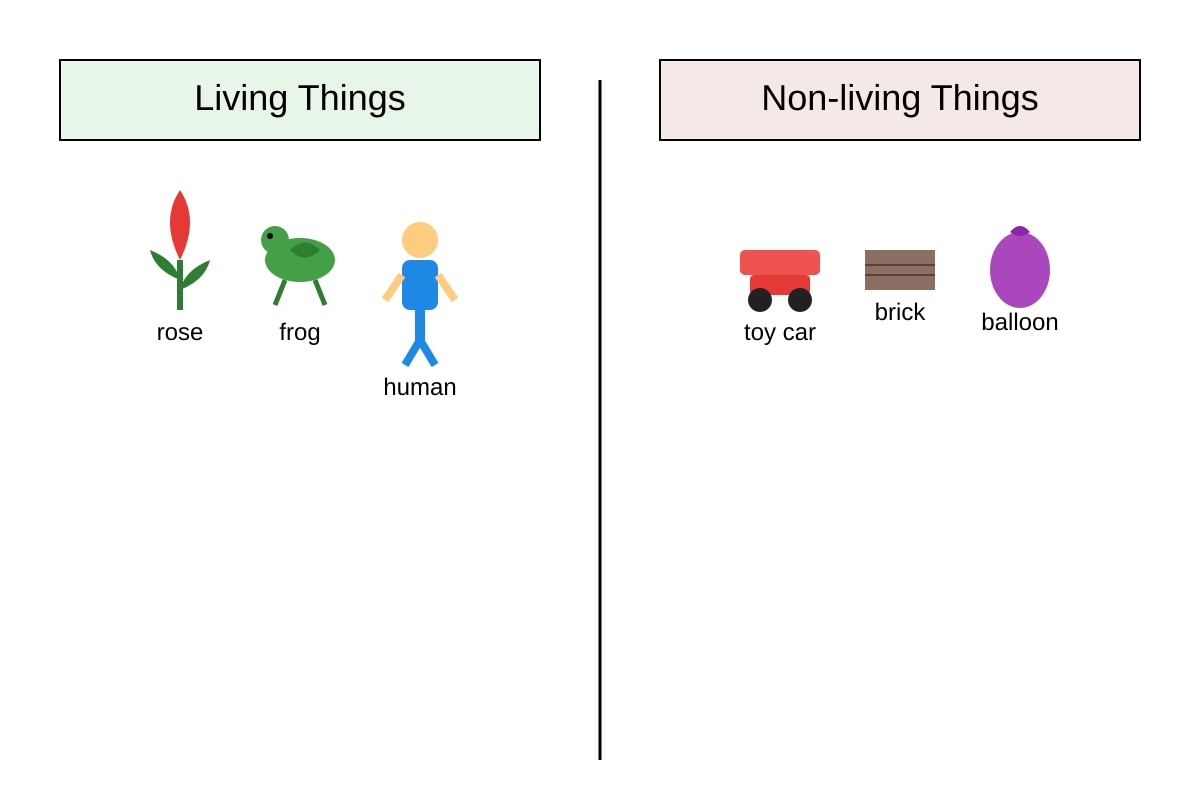
Image pending generation: diagram for 16.
(a) Name one living thing from the diagram. [1]
(b) Name one non-living thing from the diagram. [1]
(c) State one characteristic that the living things in the diagram share. [1]
17. A pupil grouped animals as follows:
Group A: Animals with backbone
Group B: Animals without backbone
(a) What name is given to animals with a backbone? [1]
(b) Name one animal in Group B. [1]
(c) Give one reason why grouping animals this way is useful. [1]
Section D (16 marks)
Answer all questions. Marks shown for each part.
18. A student collected the following items from a park:
- A leaf
- A dead log
- A butterfly
- A glass bottle
(a) Which item is non-living but was once part of a living thing? [1]
(b) Which item is a living thing? [1]
(c) Explain why the glass bottle is non-living. [2]
19.
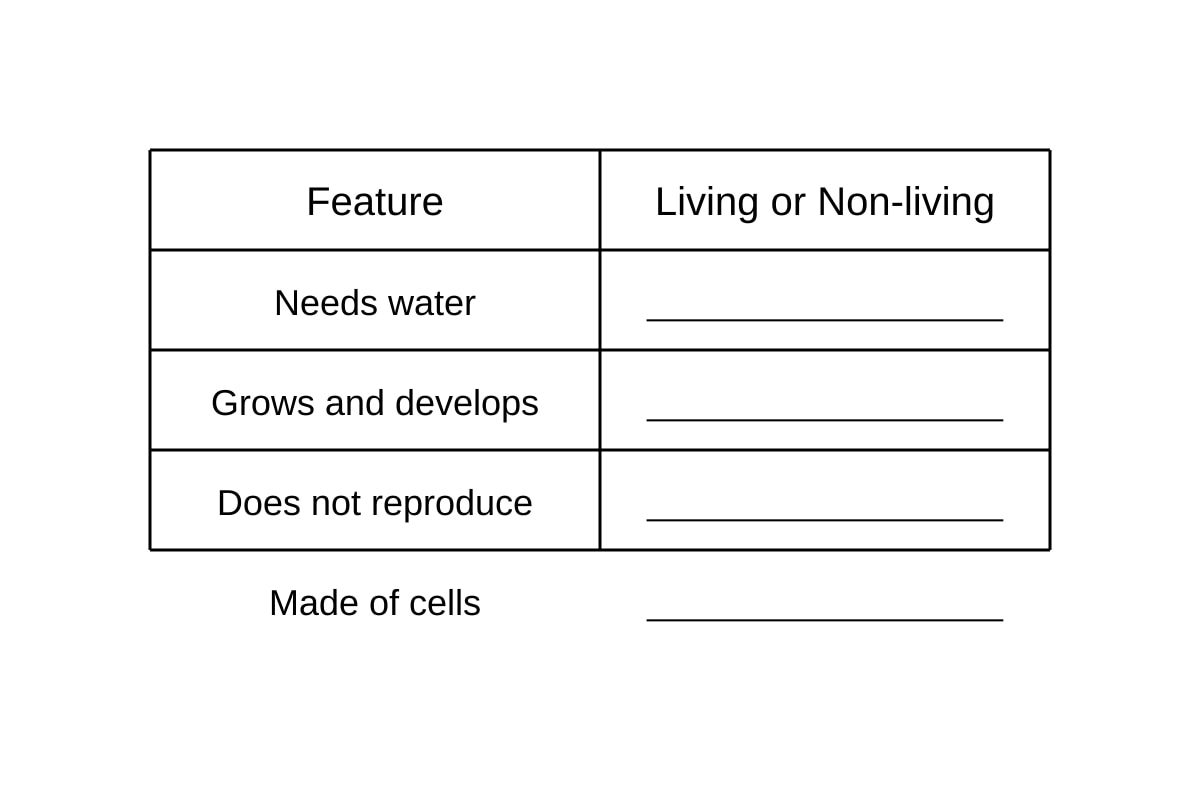
Image pending generation: table for 19.
(a) From the table, state one feature of living things. [1]
(b) State one feature that shows something is non-living. [1]
(c) Explain how grouping by features helps us learn about diversity. [2]
20. A class made a diversity chart of classroom objects.
- Living: Potted plant, Goldfish
- Non-living: Scissors, Eraser, Water bottle
(a) Name one more living thing they could add. [1]
(b) Name one more non-living thing they could add. [1]
(c) Describe two ways to group the non-living things further. [2]
(d) Why is it important to know the diversity of things around us? [2]
Answers
TuitionGoWhere Exam Practice (AI) — SA2 Practice Paper Answer Key (Version 2)
Subject: Science
Level: Primary 4
Paper: SA2 Practice Paper
Total Marks: 60
Section A (10 marks)
1. B — A flowering plant is a living thing. (Teaching note: Living things are plants, animals, fungi etc. Wood, plastic, stone are non-living.)
2. C — Made of metal is not a characteristic of living things. (Teaching note: Living things need food, can move, reproduce; metal is a material, not a life property.)
3. C — Fungus. (Teaching note: Mushrooms are fungi, a separate group from plants and animals.)
4. B — Non-flowering plants. (Teaching note: Ferns do not produce flowers or seeds; they reproduce by spores.)
5. C — Fish. (Teaching note: Vertebrates have backbones; fish, birds, mammals, reptiles, amphibians are vertebrates.)
6. B — Have feathers and lay eggs. (Teaching note: Birds share feathers and egg-laying; not all live in water or have scales.)
7. A — Cotton shirt. (Teaching note: Cotton comes from cotton plant, once living, now processed into non-living object.)
8. C — Smell. (Teaching note: Grouping by odour uses the smell sense.)
9. B — Reptiles. (Teaching note: Lizard and snake are cold-blooded, scaly, backbone animals = reptiles.)
10. B — To study their similarities and differences. (Teaching note: Classification helps science organise diversity.)
Section B (8 marks)
11. [2 marks] Any two: needs food, reproduces, grows, responds to surroundings, made of cells.
(Marking: 1 mark each correct characteristic.)
12. [2 marks] Example: Flowering plants produce flowers and seeds; non-flowering plants do not.
(Marking: 1 mark for stating flower/seeds difference, 1 mark for correct comparison.)
13. [2 marks] Invertebrate group: insect / worm / mollusc etc. Example: butterfly / earthworm / snail.
(Marking: 1 mark group, 1 mark example.)
14. [2 marks] A bicycle does not need food, does not grow, does not reproduce, is not made of cells.
(Marking: 1 mark stating it is non-living, 1 mark giving valid reason.)
Section C (12 marks)
15.
(a) [1] Group X.
(b) [1] They are living things (cat, dog, bird are animals).
16. (Based on placeholder Q16-fig1)
(a) [1] Rose / frog / human (any one).
(b) [1] Toy car / brick / balloon (any one).
(c) [1] They are living (need food, grow, reproduce).
17.
(a) [1] Vertebrates.
(b) [1] Earthworm / insect / snail (any invertebrate).
(c) [1] Helps us study animals with/without backbone separately.
Section D (16 marks)
18.
(a) [1] Dead log.
(b) [1] Butterfly.
(c) [2] Glass bottle is non-living because it does not need food, does not grow, does not reproduce, not made of cells. (1 mark non-living, 1 mark reason.)
19. (Based on placeholder Q19-fig1)
(a) [1] Needs water / grows and develops / made of cells.
(b) [1] Does not reproduce.
(c) [2] Grouping by features shows how living and non-living things are different and helps us see diversity. (1 mark link to features, 1 mark link to diversity.)
20.
(a) [1] Any living: e.g., student, spider plant.
(b) [1] Any non-living: e.g., book, pencil.
(c) [2] Group by material (plastic vs metal); by use (writing vs drinking). (1 mark each grouping.)
(d) [2] To understand our environment and care for living things. (1 mark understanding, 1 mark responsibility.)
Total marks awarded across sections = 10 + 8 + 12 + 16 = 60. Matches paper total.
Free quiz and exam paper access
Enter your details to view this paper
Your access is remembered on this device.