From Real Exams Exam Paper

Primary 4 Science Semestral Assessment 2 (End of Year) Paper 1

Free Exam-Derived NVIDIA Nemotron 3 Ultra 550B A55B Free Primary 4 Science Semestral Assessment 2 (End of Year) Paper 1 practice paper with questions and answers for Singapore students. This page is rendered as a direct URL so the questions and answers can be discovered without pressing in-page buttons.

These static practice materials are generated from the site's syllabus and paper-generation workflow, with source and model context shown so students and parents can evaluate the material before use.

Primary 4 Science From Real Exams Generated by NVIDIA Nemotron 3 Ultra 550B A55B Free Updated 2026-06-06

Questions

<!-- TuitionGoWhere generation metadata: stage=3-1; model=nvidia/nemotron-3-ultra-550b-a55b:free; model_label=NVIDIA Nemotron 3 Ultra 550B A55B Free; generated=2026-06-05; Sources: Stage 2-1 real exam-derived templates and Stage 2-2 exam-enriched syllabus. -->

TuitionGoWhere Practice Paper - Science Primary 4

TuitionGoWhere Exam Practice (AI)

Subject: Science
Level: Primary 4
Paper: SA2 (Semestral Assessment 2) - Version 1
Duration: 1 hour 45 minutes
Total Marks: 100

Name: ________________________
Class: Primary 4 _______
Date: ________________________


INSTRUCTIONS TO CANDIDATES

  1. Do not turn over this page until you are told to do so.
  2. Follow all instructions carefully.
  3. Answer all questions.
  4. Write your answers in this booklet.
  5. The number of marks is given in brackets [ ] at the end of each question or part question.
  6. The total marks for this paper is 100.

BOOKLET A: Multiple-Choice Questions (56 marks)

Questions 1 to 28 carry 2 marks each. For each question, four options are given. Choose the correct answer and write its number (1, 2, 3 or 4) in the brackets provided.

Section 1: Diversity (Living and Non-Living Things)

1. Which of the following groups contains only living things?
(1) moss, mushroom, mould
(2) cloud, river, rock
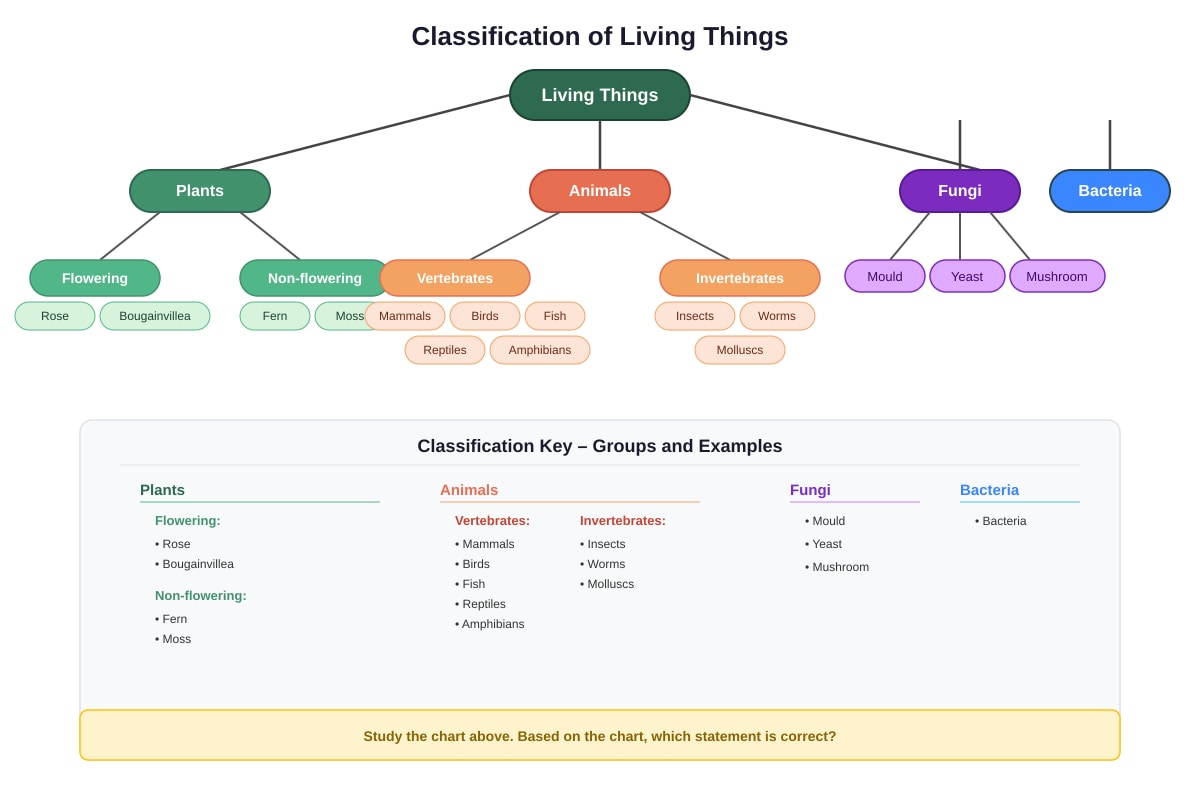
(3) robot, car, computer
(4) shadow, reflection, echo
[ ]

2. Study the classification chart below.

<image_placeholder> id: Q1-fig1 type: diagram linked_question: Q2 description: Classification chart with two main branches: Living Things and Non-Living Things. Living Things branch into Plants and Animals. Non-Living Things branch into Man-made and Natural. Four items (A, B, C, D) are placed at the bottom to be classified. labels: Living Things, Non-Living Things, Plants, Animals, Man-made, Natural, A, B, C, D values: Item A: Mushroom; Item B: Metal spoon; Item C: Fern; Item D: River stone must_show: Clear branching structure with all category labels and four items to classify </image_placeholder>

Which item is classified correctly?
(1) A
(2) B
(3) C
(4) D
[ ]

3. A student observed four things: a growing seedling, a crystal growing in a solution, a cloud forming in the sky, and a robot moving. Which of these shows characteristics of living things?
(1) Crystal growing in a solution
(2) Cloud forming in the sky
(3) Robot moving
(4) Growing seedling
[ ]

4. Which of the following statements about non-living things is correct?
(1) All non-living things are man-made.
(2) Non-living things cannot move on their own.
(3) Non-living things need air, food and water.
(4) Non-living things can reproduce.
[ ]

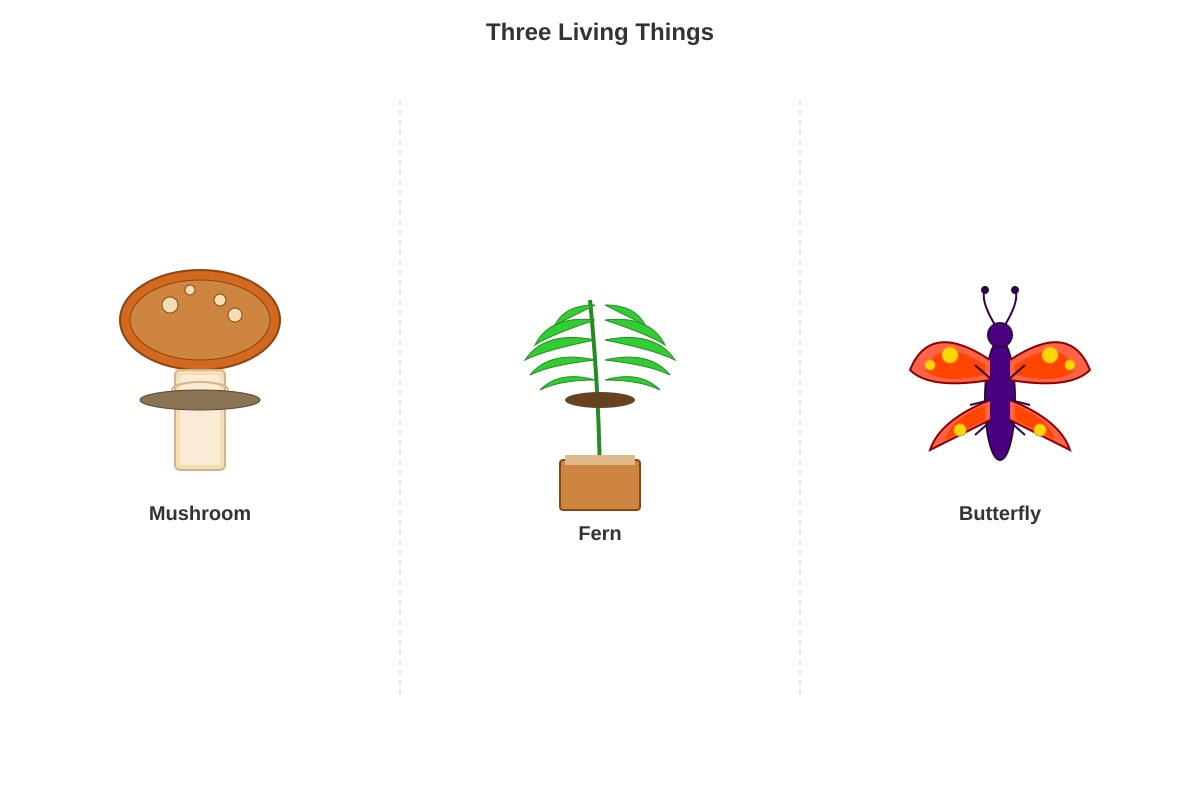
5. The diagram below shows a mushroom and a fern.

<image_placeholder> id: Q5-fig1 type: diagram linked_question: Q5 description: Two separate diagrams side by side. Left: Mushroom with cap, gills, and stem labelled. Right: Fern with fronds, stem, and roots labelled. labels: Mushroom: cap, gills, stem; Fern: fronds, stem, roots values: None must_show: Clear structural differences between mushroom (fungus) and fern (plant) </image_placeholder>

Based on the diagrams, which statement is correct?
(1) Both make their own food.
(2) Both reproduce by spores.
(3) The mushroom is a plant but the fern is not.
(4) The fern is a plant but the mushroom is not.
[ ]

6. Which of the following groups of animals are classified correctly according to their outer covering?

GroupAnimals
(1)Scales: Snake, Fish, Crocodile
(2)Feathers: Bat, Penguin, Eagle
(3)Hair/Fur: Whale, Dolphin, Shark
(4)Shell: Snail, Turtle, Crab
[ ]

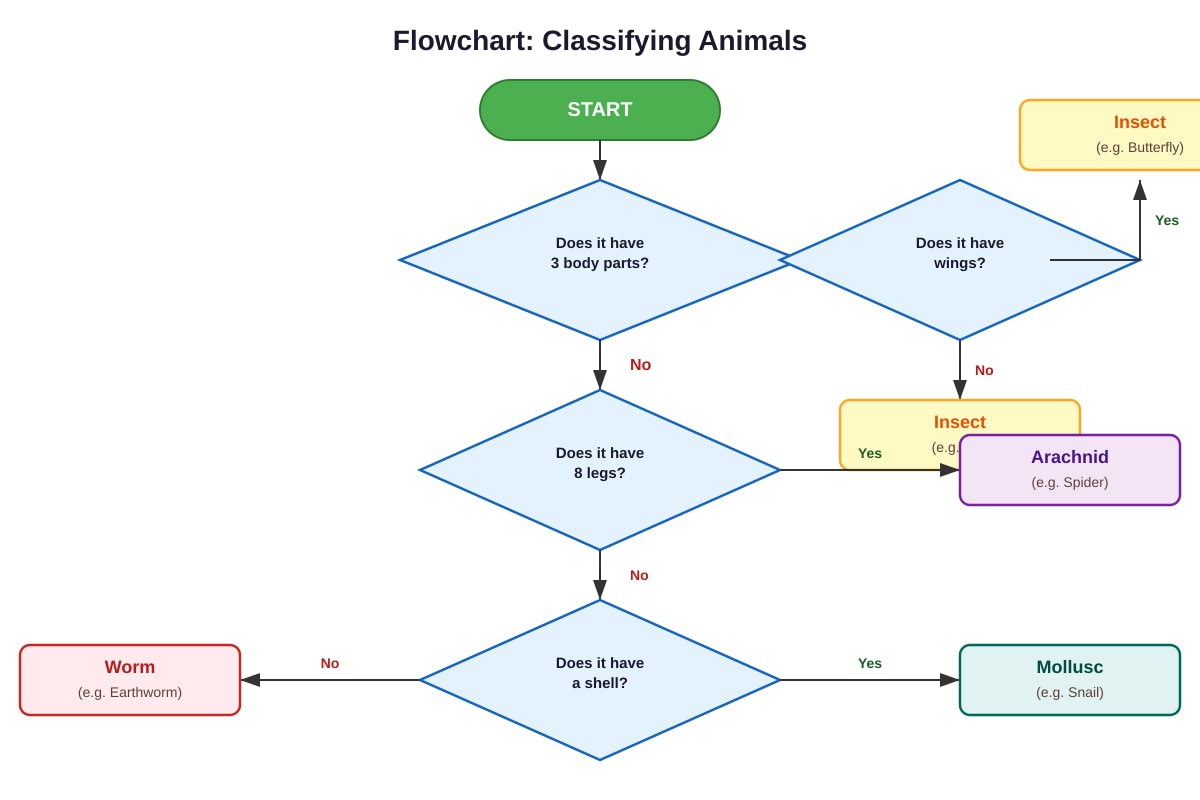
7. Study the flowchart below.

<image_placeholder> id: Q7-fig1 type: diagram linked_question: Q7 description: Flowchart for animal classification. Start: Does it have 6 legs? Yes → Insect. No → Does it have feathers? Yes → Bird. No → Does it have hair/fur? Yes → Mammal. No → Does it have scales and live in water? Yes → Fish. No → Reptile/Amphibian. labels: Decision diamonds with questions, rectangular boxes with animal groups values: None must_show: Complete flowchart with all decision points and animal group outcomes </image_placeholder>

Animal X has 4 legs, breathes through lungs, and has hair on its body. Which group does Animal X belong to?
(1) Insect
(2) Bird
(3) Mammal
(4) Reptile
[ ]

8. Which of the following is NOT a characteristic of insects?
(1) Three body parts
(2) Six legs
(3) Two pairs of wings
(4) Lay eggs
[ ]

Section 2: Diversity (Materials)

9. Four objects are made of different materials as shown below.

ObjectMaterial
AMetal
BGlass
CWood
DRubber

Which object is most suitable for making a cooking pot handle?
(1) A
(2) B
(3) C
(4) D
[ ]

10. A student wants to choose a material to make a window pane. Which property is most important?
(1) Flexibility
(2) Transparency
(3) Strength
(4) Waterproof
[ ]

11. The table below shows the properties of four materials W, X, Y and Z.

MaterialFlexibleWaterproofTransparentStrong
WYesYesNoYes
XNoYesYesYes
YYesNoNoNo
ZNoYesNoYes

Which material is most suitable for making a raincoat?
(1) W
(2) X
(3) Y
(4) Z
[ ]

12. Which of the following statements about materials is correct?
(1) All metals are magnetic.
(2) All plastics are flexible.
(3) Ceramics are good conductors of heat.
(4) Glass is transparent but brittle.
[ ]

Section 3: Cycles (Matter)

13. The diagram below shows the arrangement of particles in three states of matter.

<image_placeholder> id: Q13-fig1 type: diagram linked_question: Q13 description: Three boxes showing particle arrangement. Box A: Particles tightly packed in ordered rows, vibrating. Box B: Particles close but not ordered, sliding past each other. Box C: Particles far apart, moving randomly in all directions. labels: Box A, Box B, Box C values: None must_show: Clear distinction between solid, liquid, and gas particle arrangements </image_placeholder>

Which of the following correctly identifies the states of matter?
(1) A: Gas, B: Liquid, C: Solid
(2) A: Solid, B: Liquid, C: Gas
(3) A: Liquid, B: Solid, C: Gas
(4) A: Solid, B: Gas, C: Liquid
[ ]

14. Water is heated until it boils. Which of the following statements is correct?
(1) The mass of water increases.
(2) The volume of water decreases.
(3) Water changes from liquid to gas.
(4) Water changes from gas to liquid.
[ ]

15. Ice cubes are placed in a beaker and left on a table. After some time, the ice melts. Which of the following explains this?
(1) The ice gains heat from the surroundings.
(2) The ice loses heat to the surroundings.
(3) The surroundings gain heat from the ice.
(4) The surroundings lose heat to the ice.
[ ]

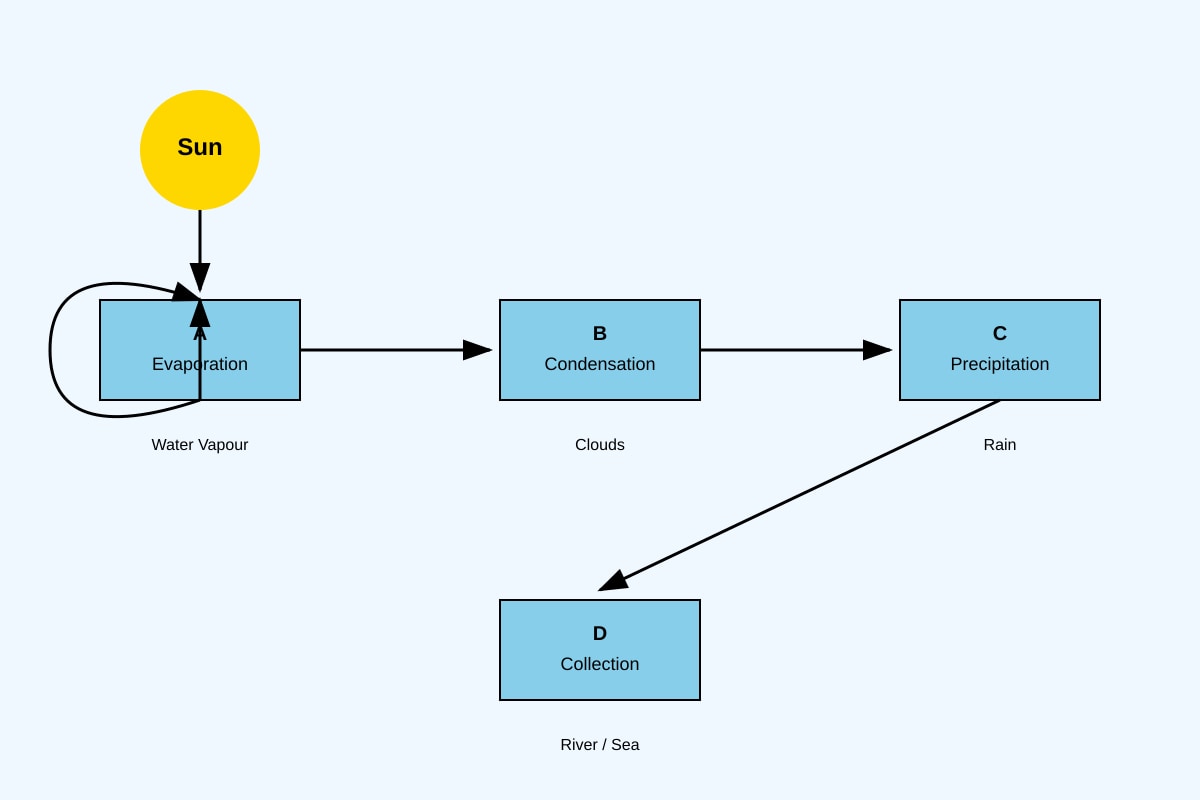
16. The diagram below shows the water cycle.

<image_placeholder> id: Q16-fig1 type: diagram linked_question: Q16 description: Water cycle diagram showing evaporation from water bodies, condensation forming clouds, precipitation as rain, and collection in water bodies. Arrows show direction. Sun labelled as heat source. labels: Evaporation, Condensation, Precipitation, Collection, Sun, Water vapour, Clouds, Rain, River/Sea values: None must_show: Complete water cycle with all four processes labelled and directional arrows </image_placeholder>

At which stage does water vapour change into tiny water droplets?
(1) Evaporation
(2) Condensation
(3) Precipitation
(4) Collection
[ ]

Section 4: Systems (Plant System)

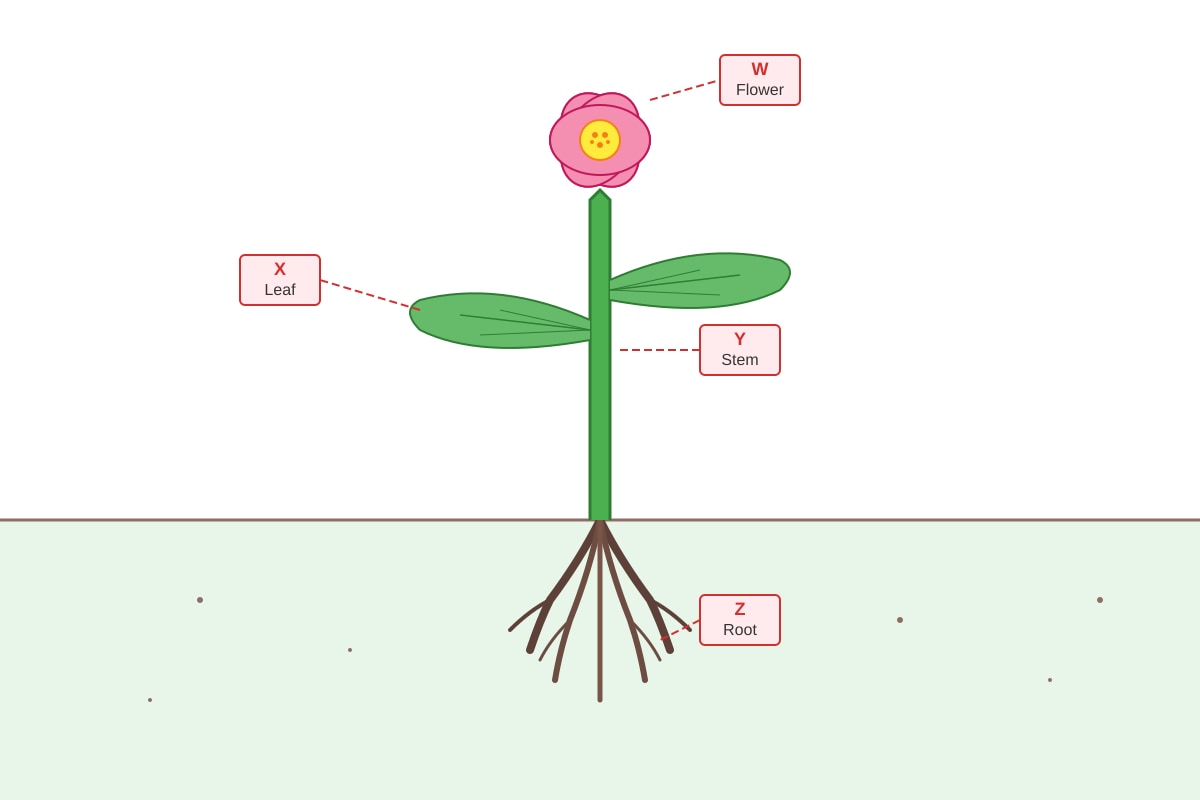
17. The diagram below shows a plant.

<image_placeholder> id: Q17-fig1 type: diagram linked_question: Q17 description: Complete plant diagram with roots, stem, leaves, flowers, and fruits labelled. labels: Roots, Stem, Leaves, Flowers, Fruits values: None must_show: All main plant parts clearly labelled </image_placeholder>

Which part of the plant absorbs water and mineral salts from the soil?
(1) Leaves
(2) Stem
(3) Roots
(4) Flowers
[ ]

18. The function of the stem is to:
(1) make food for the plant
(2) absorb water and minerals
(3) transport water and food
(4) hold the plant firmly to the ground
[ ]

19. A plant is placed in a dark cupboard for a week. What will happen to the plant?
(1) It will grow taller.
(2) It will make more food.
(3) It will wither and die.
(4) It will reproduce faster.
[ ]

20. Which part of the plant is responsible for reproduction?
(1) Roots
(2) Stem
(3) Leaves
(4) Flowers
[ ]

Section 5: Systems (Human System - Digestive System)

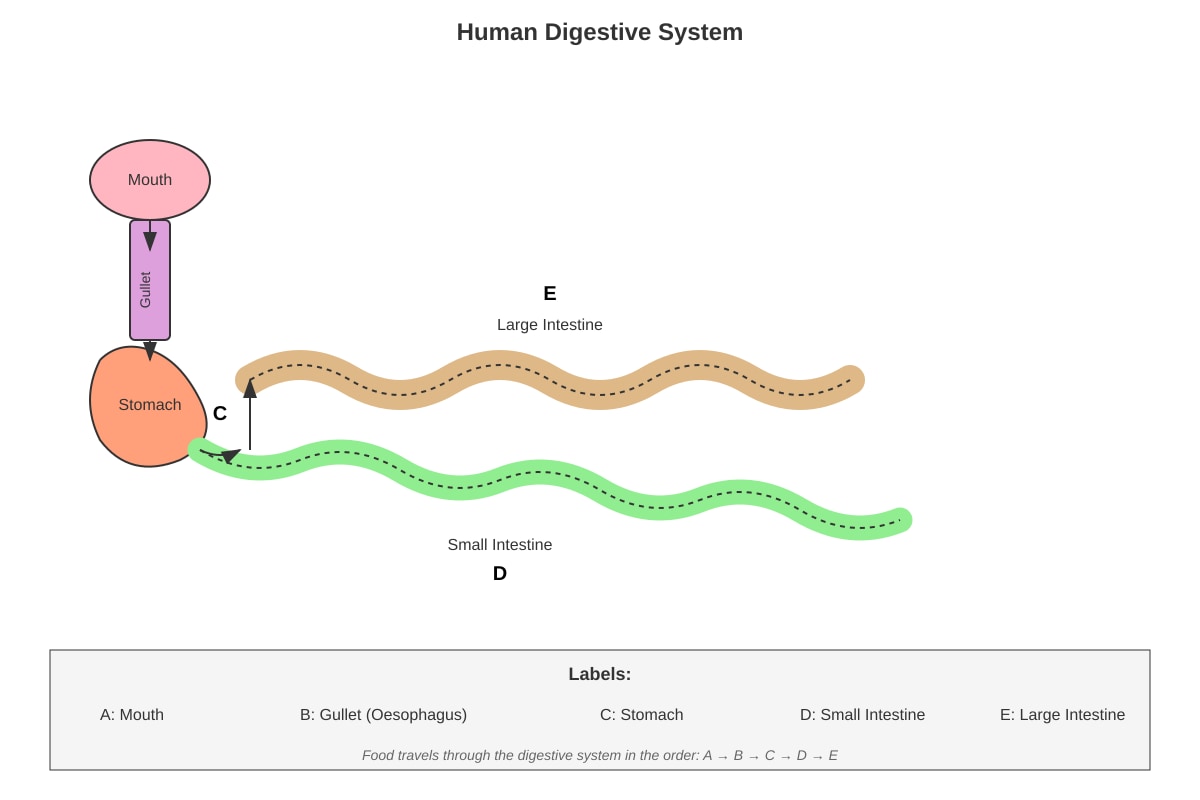
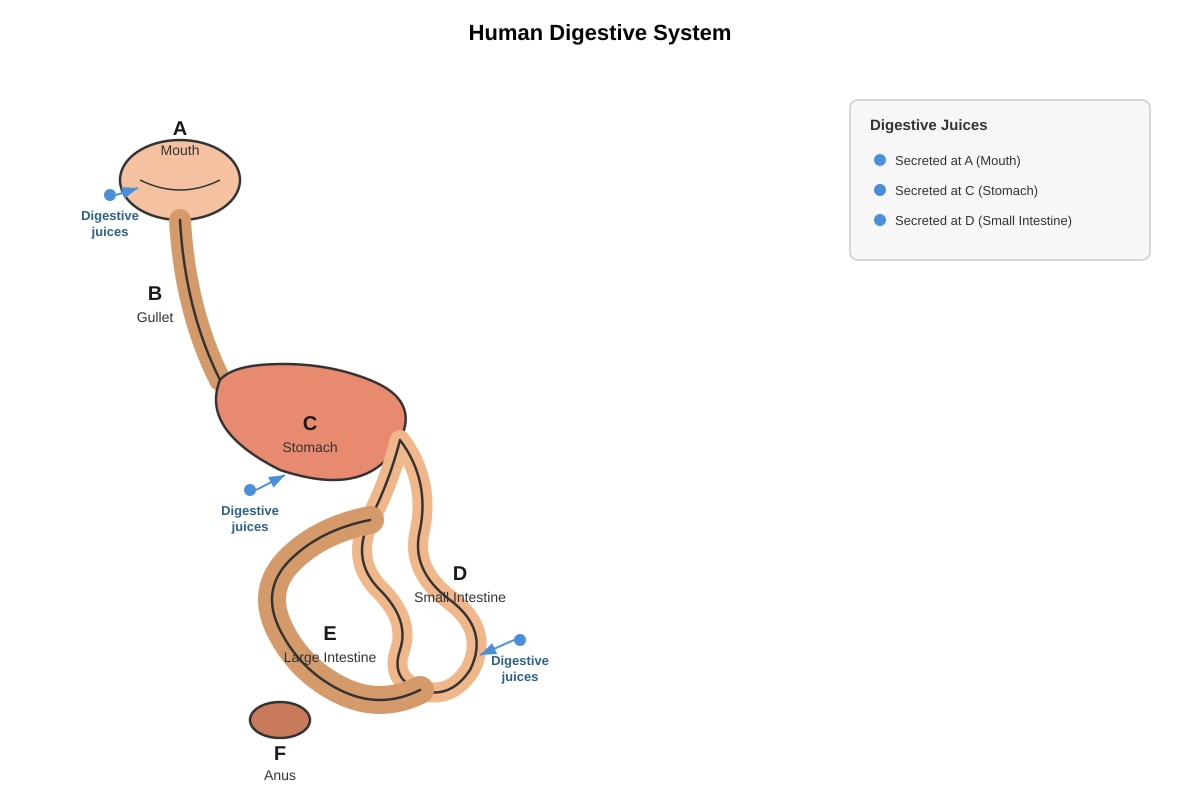
21. The diagram below shows the human digestive system.

<image_placeholder> id: Q21-fig1 type: diagram linked_question: Q21 description: Human digestive system diagram showing mouth, oesophagus, stomach, small intestine, large intestine, anus. Accessory organs: salivary glands, liver, pancreas. labels: Mouth, Oesophagus, Stomach, Small Intestine, Large Intestine, Anus, Salivary Glands, Liver, Pancreas values: None must_show: Complete digestive tract with all major organs labelled </image_placeholder>

In which organ is food completely digested and absorbed into the blood?
(1) Stomach
(2) Small intestine
(3) Large intestine
(4) Oesophagus
[ ]

22. What is the function of saliva in the mouth?
(1) To kill bacteria in food
(2) To soften food and start digestion of starch
(3) To absorb nutrients
(4) To push food down the oesophagus
[ ]

23. Which of the following shows the correct order of food passing through the digestive system?
(1) Mouth → Stomach → Oesophagus → Small intestine → Large intestine
(2) Mouth → Oesophagus → Stomach → Small intestine → Large intestine
(3) Mouth → Oesophagus → Small intestine → Stomach → Large intestine
(4) Mouth → Stomach → Large intestine → Small intestine → Oesophagus
[ ]

24. Undigested food moves from the small intestine to the large intestine. What is the main function of the large intestine?
(1) Digest proteins
(2) Absorb water
(3) Produce digestive juices
(4) Store digested food
[ ]

Section 6: Energy (Light and Heat)

25. Which of the following is a source of light?
(1) Moon
(2) Mirror
(3) Sun
(4) White paper
[ ]

26. The diagram below shows a torch shining on a wooden block. A shadow is formed on the screen.

<image_placeholder> id: Q26-fig1 type: diagram linked_question: Q26 description: Torch on left shining light rays toward a wooden block in centre. Screen on right shows shadow of block. Light rays travel in straight lines. labels: Torch (light source), Wooden block (opaque object), Screen, Shadow, Light rays (straight lines with arrows) values: None must_show: Light travelling in straight lines, opaque object blocking light, shadow formation on screen </image_placeholder>

Which of the following statements explains why a shadow is formed?
(1) Light passes through the wooden block.
(2) Light bends around the wooden block.
(3) Light travels in straight lines and is blocked by the wooden block.
(4) The wooden block reflects light to the screen.
[ ]

27. A metal spoon feels colder than a wooden spoon at room temperature because:
(1) Metal is a better conductor of heat than wood.
(2) Metal is at a lower temperature than wood.
(3) Wood is a better conductor of heat than metal.
(4) Metal absorbs less heat than wood.
[ ]

28. Which of the following materials is the best conductor of heat?
(1) Plastic
(2) Wood
(3) Metal
(4) Rubber
[ ]


BOOKLET B: Open-Ended Questions (44 marks)

Questions 29 to 40 carry the marks shown. Write your answers in the spaces provided.

Section 7: Diversity (Living and Non-Living Things)

29. The table below shows the characteristics of four things A, B, C and D.

CharacteristicABCD
Needs air, food and waterYesYesNoNo
Can growYesYesNoNo
Can reproduceYesYesNoNo
Can move on its ownYesNoNoNo
Can respond to changesYesYesNoNo

(a) Which two things are living things? [1]
(b) Which thing is most likely a plant? [1]
(c) Which thing is most likely an animal? [1]

30. Study the classification chart below.

<image_placeholder> id: Q30-fig1 type: diagram linked_question: Q30 description: Classification chart. Top: Living Things. Branches: Plants and Animals. Plants branch: Flowering and Non-flowering. Animals branch: Vertebrates and Invertebrates. Vertebrates branch: Mammals, Birds, Fish, Reptiles, Amphibians. Invertebrates branch: Insects, Others. Four animals (P, Q, R, S) need to be placed. labels: All category labels as described values: Animal P: Bat; Animal Q: Frog; Animal R: Butterfly; Animal S: Shark must_show: Complete classification chart with empty boxes for P, Q, R, S </image_placeholder>

Classify the following animals by writing P, Q, R, S in the correct boxes in the chart above. [2]

31. Ali found an unknown organism in the garden. He observed that it:

  • Is green in colour
  • Grows in damp, shady places
  • Reproduces by spores
  • Does not have flowers

(a) State the group this organism belongs to. [1]
(b) Give one reason for your answer in (a). [1]

Section 8: Diversity (Materials)

32. Jane wants to make a food container to keep soup hot for a long time. She tests four materials by wrapping each around a beaker of hot water and measuring the temperature after 30 minutes.

MaterialTemperature after 30 minutes (°C)
A45
B60
C52
D38

(a) Which material is the best insulator of heat? [1]
(b) Explain your answer in (a). [1]
(c) State one other property the material should have to be suitable for a food container. [1]

33. The diagram below shows a tent.

<image_placeholder> id: Q33-fig1 type: diagram linked_question: Q33 description: Tent with labelled parts: outer fabric, inner mesh, poles, pegs, groundsheet. labels: Outer fabric, Inner mesh, Poles, Pegs, Groundsheet values: None must_show: Tent structure with all parts clearly labelled for material property discussion </image_placeholder>

The table below shows the materials used for different parts of the tent.

PartMaterialProperty
Outer fabricNylonWaterproof
Inner meshPolyesterAllows air to pass through
PolesAluminiumStrong and light
PegsSteelStrong
GroundsheetPVCWaterproof and flexible

(a) Why is nylon suitable for the outer fabric? [1]
(b) Why is polyester mesh used for the inner layer? [1]
(c) The poles need to be strong and light. Explain why both properties are important. [1]

Section 9: Cycles (Matter)

34. The diagram below shows a beaker of ice being heated over time. The temperature is recorded every 2 minutes.

<image_placeholder> id: Q34-fig1 type: graph linked_question: Q34 description: Temperature vs Time graph. X-axis: Time (min) from 0 to 20. Y-axis: Temperature (°C) from -10 to 100. Graph shows: rising line from -10°C to 0°C (0-6 min), flat line at 0°C (6-10 min), rising line from 0°C to 100°C (10-18 min), flat line at 100°C (18-20 min). labels: Time (min), Temperature (°C), Melting, Boiling values: Melting point 0°C, Boiling point 100°C must_show: Clear plateau at 0°C (melting) and 100°C (boiling) with labelled phases </image_placeholder>

(a) What is the state of water at the 8th minute? [1]
(b) Explain why the temperature remains constant between the 6th and 10th minute. [1]
(c) At which temperature does water boil? [1]

35. Peter set up an experiment as shown below.

<image_placeholder> id: Q35-fig1 type: experimental_setup linked_question: Q35 description: Two identical beakers. Beaker A: 100 ml water at 80°C. Beaker B: 100 ml water at 20°C. Both placed in a larger container of water at 30°C. Thermometers in each beaker. labels: Beaker A (80°C), Beaker B (20°C), Surrounding water (30°C), Thermometers values: Initial temperatures as labelled must_show: Two beakers in water bath with thermometers showing heat transfer direction </image_placeholder>

(a) Draw arrows on the diagram to show the direction of heat flow for Beaker A and Beaker B. [1]
(b) After some time, what will be the final temperature of the water in both beakers? [1]
(c) Explain your answer in (b). [1]

36. The diagram below shows the water cycle.

<image_placeholder> id: Q36-fig1 type: diagram linked_question: Q36 description: Water cycle diagram with labels A, B, C, D at four stages. A: Water vapour rising from sea. B: Clouds forming. C: Rain falling. D: Water flowing in river back to sea. labels: A, B, C, D at four stages values: None must_show: Water cycle with four distinct stages marked A, B, C, D for identification </image_placeholder>

(a) Name the process at stage A. [1]
(b) Name the process at stage B. [1]
(c) State one difference between the processes at stage A and stage B. [1]

Section 10: Systems (Plant System)

37. The diagram below shows a cross-section of a stem.

<image_placeholder> id: Q37-fig1 type: diagram linked_question: Q37 description: Cross-section of stem showing vascular bundles. Xylem (inner) and phloem (outer) labelled. Arrows showing water upward in xylem, food downward in phloem. labels: Xylem, Phloem, Water transport (upward arrow), Food transport (downward arrow) values: None must_show: Clear xylem and phloem positions with transport direction arrows </image_placeholder>

(a) Name the tubes labelled X and Y.
X: _______________ [1]
Y: _______________ [1]

(b) State the function of tube X. [1]

(c) A student removes a ring of the outer part of the stem (including tube Y). After a few days, the stem swells above the cut. Explain why. [2]

38. An experiment is set up as shown below.

<image_placeholder> id: Q38-fig1 type: experimental_setup linked_question: Q38 description: Two identical plants in pots. Plant A: Normal. Plant B: All leaves removed. Both watered equally and placed in sunlight for one week. labels: Plant A (with leaves), Plant B (no leaves), Sunlight, Water values: None must_show: Clear comparison between plant with leaves and plant without leaves </image_placeholder>

(a) After one week, which plant will grow better? [1]
(b) Explain your answer in (a). [1]
(c) What does this experiment show about the function of leaves? [1]

Section 11: Systems (Human System - Digestive System)

39. The diagram below shows part of the digestive system.

<image_placeholder> id: Q39-fig1 type: diagram linked_question: Q39 description: Magnified view of small intestine wall showing villi. Blood capillaries and lacteals inside villi. Arrows showing absorption into blood. labels: Villi, Blood capillaries, Lacteals, Absorbed nutrients values: None must_show: Villi structure with capillaries and lacteals, showing absorption mechanism </image_placeholder>

(a) Name the finger-like structures shown in the diagram. [1]
(b) How do these structures help in absorption? [1]
(c) Name the two types of substances absorbed into the blood capillaries and lacteals respectively.
Blood capillaries: _______________ [1]
Lacteals: _______________ [1]

40. Ravi ate a meal of rice, chicken, and vegetables. The table below shows the digestion of different food types.

Food TypeWhere Digestion StartsDigestive JuiceEnzyme
CarbohydrateMouthSalivaAmylase
ProteinStomachGastric juicePepsin
FatSmall intestineBile, Pancreatic juiceLipase

(a) Which food type is digested first in Ravi's meal? [1]
(b) Where does the digestion of fat start? [1]
(c) Bile is produced by the _______________ and stored in the _______________. [1]
(d) State one function of bile in fat digestion. [1]


End of Paper

Answers

<!-- TuitionGoWhere generation metadata: stage=3-1; model=nvidia/nemotron-3-ultra-550b-a55b:free; model_label=NVIDIA Nemotron 3 Ultra 550B A55B Free; generated=2026-06-05; Sources: Stage 2-1 real exam-derived templates and Stage 2-2 exam-enriched syllabus. -->

TuitionGoWhere Practice Paper - Science Primary 4 (SA2 Version 1) - Answer Key

Subject: Science
Level: Primary 4
Paper: SA2 (Semestral Assessment 2) - Version 1
Total Marks: 100


BOOKLET A: Multiple-Choice Questions (56 marks)

Section 1: Diversity (Living and Non-Living Things)

1. Answer: (1) moss, mushroom, mould
Explanation: Living things need air, food, and water; can grow; can reproduce; and can respond to changes. Moss (plant), mushroom (fungus), and mould (fungus) are all living things. Clouds, rivers, rocks are natural non-living things. Robots, cars, computers are man-made non-living things. Shadows, reflections, echoes are non-living phenomena.

2. Answer: (3) C
Explanation: From the classification chart: Mushroom (A) is a fungus, not a plant → should be under Living Things but not Plants. Metal spoon (B) is man-made non-living → correct if placed under Man-made. Fern (C) is a non-flowering plant → correctly placed under Plants. River stone (D) is natural non-living → correct if placed under Natural. Since the question asks which is classified correctly and only one option is correct, C (Fern as plant) is the clearest correct classification.

3. Answer: (4) Growing seedling
Explanation: A growing seedling shows all characteristics of living things: it needs air, food (makes own), water; grows; reproduces (eventually); responds to light/gravity. Crystals grow by adding particles (not cellular growth). Clouds form by condensation. Robots move by programming, not on their own.

4. Answer: (2) Non-living things cannot move on their own.
Explanation: Non-living things do not move on their own (they need external force). Statement (1) is false - natural non-living things exist (rocks, water). Statement (3) is false - only living things need air, food, water. Statement (4) is false - only living things reproduce.

5. Answer: (4) The fern is a plant but the mushroom is not.
Explanation: Ferns are plants (non-flowering, reproduce by spores, make own food). Mushrooms are fungi (not plants), do not make own food (decomposers), reproduce by spores. Both reproduce by spores, so (2) is true but (4) is the better distinguishing statement.

6. Answer: (1) Scales: Snake, Fish, Crocodile
Explanation: Snakes, fish, and crocodiles all have scales. (2) Bats have hair/fur, not feathers. (3) Whales and dolphins are mammals with hair (minimal), sharks are fish with scales. (4) Crabs have exoskeletons, not shells like snails/turtles.

7. Answer: (3) Mammal
Explanation: Following the flowchart: 6 legs? No (4 legs). Feathers? No. Hair/fur? Yes → Mammal. Mammals have hair/fur, breathe through lungs, most have 4 legs (except marine mammals).

8. Answer: (3) Two pairs of wings
Explanation: Insects have three body parts (head, thorax, abdomen), six legs, and typically one or two pairs of wings (some have none). "Two pairs of wings" is not a defining characteristic as many insects have one pair (flies) or none (fleas, worker ants). The defining characteristics are 3 body parts and 6 legs.

Section 2: Diversity (Materials)

9. Answer: (3) C (Wood)
Explanation: Cooking pot handles need to be heat insulators (poor conductors) so they don't get hot. Wood is a poor conductor of heat. Metal (A) conducts heat well - would burn hand. Glass (B) conducts heat and breaks. Rubber (D) melts at high temperatures.

10. Answer: (2) Transparency
Explanation: Window panes must allow light to pass through so we can see outside and light enters. Transparency is the most critical property. Strength, waterproof, flexibility are secondary.

11. Answer: (1) W
Explanation: Raincoats need to be waterproof (to keep rain out) and flexible (to wear comfortably). Material W: Flexible (Yes), Waterproof (Yes). Material X: Not flexible. Material Y: Not waterproof. Material Z: Not flexible.

12. Answer: (4) Glass is transparent but brittle.
Explanation: (1) False - only iron, nickel, cobalt, steel are magnetic. (2) False - some plastics are rigid. (3) False - ceramics are poor conductors (insulators). (4) True - glass allows light through (transparent) but breaks easily (brittle).

Section 3: Cycles (Matter)

13. Answer: (2) A: Solid, B: Liquid, C: Gas
Explanation: Solid: particles tightly packed, ordered, vibrate. Liquid: particles close but not ordered, slide past each other. Gas: particles far apart, move randomly. This matches A=Solid, B=Liquid, C=Gas.

14. Answer: (3) Water changes from liquid to gas.
Explanation: Boiling is the change of state from liquid to gas at boiling point. Mass is conserved (1 false). Volume increases as gas expands (2 false). (4) describes condensation.

15. Answer: (1) The ice gains heat from the surroundings.
Explanation: Heat flows from hotter to colder. Surroundings (room temp) are warmer than ice (0°C). Ice gains heat, melts. (2) and (4) describe heat loss by ice/surroundings incorrectly. (3) is true but doesn't explain melting.

16. Answer: (2) Condensation
Explanation: Condensation is the process where water vapour (gas) changes into tiny water droplets (liquid) when it cools. This forms clouds. Evaporation: liquid→gas. Precipitation: droplets→rain. Collection: water gathering.

Section 4: Systems (Plant System)

17. Answer: (3) Roots
Explanation: Roots absorb water and mineral salts from soil. Root hairs increase surface area for absorption. Leaves make food. Stem transports. Flowers reproduce.

18. Answer: (3) transport water and food
Explanation: Stem contains xylem (water/minerals up) and phloem (food down). It also supports the plant, but transport is the primary function tested.

19. Answer: (3) It will wither and die.
Explanation: Plants need light for photosynthesis to make food. Without light, no food production, plant uses stored energy, then withers and dies.

20. Answer: (4) Flowers
Explanation: Flowers are the reproductive organs of flowering plants. They produce seeds and fruits after pollination and fertilisation.

Section 5: Systems (Human System - Digestive System)

21. Answer: (2) Small intestine
Explanation: Most digestion completes and almost all absorption occurs in the small intestine. Villi increase surface area. Stomach digests proteins partially. Large intestine absorbs water. Oesophagus only transports.

22. Answer: (2) To soften food and start digestion of starch
Explanation: Saliva contains amylase which breaks down starch into simpler sugars. It also moistens food for swallowing. It doesn't kill bacteria (stomach acid does), absorb nutrients (small intestine), or push food (oesophagus muscles).

23. Answer: (2) Mouth → Oesophagus → Stomach → Small intestine → Large intestine
Explanation: Correct order of digestive tract. Food enters mouth, swallowed down oesophagus, to stomach, then small intestine (duodenum, jejunum, ileum), then large intestine (colon, rectum), out anus.

24. Answer: (2) Absorb water
Explanation: Large intestine's main functions: absorb water and minerals from undigested food, form and store faeces. No digestion occurs here. Digestive juices from pancreas/liver enter small intestine.

Section 6: Energy (Light and Heat)

25. Answer: (3) Sun
Explanation: Sun produces its own light (luminous). Moon reflects sunlight. Mirror reflects light. White paper reflects light. Only the Sun is a light source.

26. Answer: (3) Light travels in straight lines and is blocked by the wooden block.
Explanation: Shadows form because light travels in straight lines and opaque objects block light. Wood is opaque. Light doesn't pass through (1), bend around (2 - negligible diffraction), or reflect to screen (4 - would light up shadow).

27. Answer: (1) Metal is a better conductor of heat than wood.
Explanation: Metal conducts heat away from hand faster than wood, so it feels colder (actually same room temperature). Both are at room temperature (2 false). Wood is poorer conductor (3 false). Metal absorbs more heat from hand (4 false).

28. Answer: (3) Metal
Explanation: Metals are the best conductors of heat among common materials. Plastic, wood, rubber are insulators (poor conductors).


BOOKLET B: Open-Ended Questions (44 marks)

Section 7: Diversity (Living and Non-Living Things)

29. (a) A and B [1]
Explanation: Living things show all 5 characteristics: need air/food/water, grow, reproduce, respond to changes. A and B have "Yes" for all. C and D have "No" for all → non-living.

29. (b) B [1]
Explanation: Plants cannot move on their own (fixed in place). B cannot move on its own (No) but is living. A can move on its own (Yes) → animal.

29. (c) A [1]
Explanation: Animals can move on their own. A is the only living thing that can move on its own (Yes).

30. P → Mammals; Q → Amphibians; R → Insects; S → Fish [2]
Marking: 0.5 marks each correct placement.
Explanation: Bat (P) has hair/fur, feeds young milk → Mammal. Frog (Q) lives in water and land, moist skin, lays eggs in water → Amphibian. Butterfly (R) has 6 legs, 3 body parts, wings → Insect. Shark (S) lives in water, gills, scales → Fish.

31. (a) Fungi / Mould / Yeast [1]
31. (b) It reproduces by spores and does not make its own food (not green plants) / It is a decomposer. [1]
Explanation: Green colour might mislead, but fungi can appear greenish. Key: reproduces by spores, no flowers, damp shady places, doesn't make own food → fungi (mould/yeast). Not plants (plants make food, flowering/non-flowering). Not bacteria (microscopic).

Section 8: Diversity (Materials)

32. (a) Material B [1]
32. (b) It kept the water hottest (60°C) after 30 minutes, meaning it loses heat the slowest / best insulator. [1]
32. (c) Waterproof / Safe for food contact (non-toxic) / Durable / Easy to clean (any one) [1]
Explanation: Insulators slow heat loss. Highest final temperature = least heat lost = best insulator. Food containers also need to be waterproof (hold liquid), food-safe, durable.

33. (a) Nylon is waterproof, so it keeps rain out. [1]
33. (b) Polyester mesh allows air to pass through for ventilation / prevents condensation inside. [1]
33. (c) Strong: to support the tent structure against wind. Light: easy to carry/transport. [1]
Explanation: Outer fabric needs waterproofing. Inner mesh needs breathability. Poles need strength for structure, lightness for portability.

Section 9: Cycles (Matter)

34. (a) Liquid and solid (mixture) / Melting [1]
34. (b) Heat gained is used to overcome forces between particles / change state from solid to liquid, not increase temperature. [1]
34. (c) 100°C [1]
Explanation: At 8 min, on plateau at 0°C → melting (solid→liquid). Temperature constant during state change as heat is latent heat (breaks bonds). Boiling point at second plateau = 100°C.

35. (a) Beaker A: Arrow from beaker → surroundings (heat out). Beaker B: Arrow from surroundings → beaker (heat in). [1]
35. (b) 30°C [1]
35. (c) Heat flows from hotter to colder until thermal equilibrium. Both beakers reach surrounding water temperature (30°C). [1]
Explanation: Beaker A (80°C) hotter than surroundings (30°C) → heat flows out. Beaker B (20°C) colder → heat flows in. Final equilibrium at surroundings temperature.

36. (a) Evaporation [1]
36. (b) Condensation [1]
36. (c) Evaporation: liquid to gas (needs heat). Condensation: gas to liquid (releases heat). / Evaporation occurs at water surface. Condensation occurs in air/on cool surfaces. (any one) [1]
Explanation: Stage A: water vapour rising from sea = evaporation. Stage B: clouds forming = condensation. They are opposite processes.

Section 10: Systems (Plant System)

37. (a) X: Xylem; Y: Phloem [1 each]
37. (b) Transports water and mineral salts from roots to other parts of the plant. [1]
37. (c) Food made by leaves cannot be transported down past the cut (phloem removed). Food accumulates above the cut, causing swelling. [2]
Marking: 1 mark for "food cannot go down", 1 mark for "accumulates/swells".
Explanation: Phloem (outer) transports

<stage3_exam_answers_md>

TuitionGoWhere Practice Paper - Science Primary 4

Answer Key and Explanations

Subject: Science
Level: Primary 4
Paper: SA2 (Semestral Assessment 2) - Version 1


BOOKLET A: Multiple-Choice Questions (56 marks)

Section 1: Diversity (Living and Non-Living Things)

1. Answer: (1) moss, mushroom, mould
Explanation: Moss (plant), mushroom (fungus), and mould (fungus) are all living things. Clouds, rivers, rocks are non-living natural things. Robots, cars, computers are man-made non-living things. Shadows, reflections, echoes are non-living phenomena.

2. Answer: (3) C
Explanation: Item C is a fern, which is a plant (Living Things → Plants). Item A (mushroom) is a fungus, not a plant. Item B (metal spoon) is man-made. Item D (river stone) is natural non-living.

3. Answer: (4) Growing seedling
Explanation: A growing seedling shows all characteristics of living things: it grows, needs air/food/water, reproduces, and responds to changes. Crystals grow by accumulation, not cell division. Clouds form by condensation. Robots move but don't grow or reproduce.

4. Answer: (2) Non-living things cannot move on their own
Explanation: Non-living things need external forces to move. Statement (1) is false - natural non-living things exist (rocks, water). Statement (3) is false - only living things need air, food, water. Statement (4) is false - reproduction is a characteristic of living things.

5. Answer: (4) The fern is a plant but the mushroom is not
Explanation: Ferns are plants (make food by photosynthesis, have roots/stems/leaves). Mushrooms are fungi (decomposers, reproduce by spores, no chlorophyll).

6. Answer: (1) Scales: Snake, Fish, Crocodile
Explanation: All three have scales. (2) Bats have hair/fur, not feathers. (3) Whales and dolphins have hair (mammals), sharks have scales (fish). (4) Crabs have exoskeletons, not shells like snails/turtles.

7. Answer: (3) Mammal
Explanation: Following the flowchart: 4 legs (not 6) → No feathers → Has hair/fur → Mammal.

8. Answer: (3) Two pairs of wings
Explanation: Insects have three body parts, six legs, and lay eggs. However, not all insects have two pairs of wings (some have one pair, some have none).

Section 2: Diversity (Materials)

9. Answer: (3) C (Wood)
Explanation: Wood is a poor conductor of heat (good insulator), so the handle stays cool. Metal conducts heat, glass is brittle, rubber may melt.

10. Answer: (2) Transparency
Explanation: Window panes need to allow light to pass through (transparency). Flexibility, strength, and waterproof are secondary.

11. Answer: (1) W
Explanation: Raincoats need to be waterproof and flexible. Material W is both waterproof and flexible. X is not flexible. Y is not waterproof. Z is not flexible.

12. Answer: (4) Glass is transparent but brittle
Explanation: (1) Only iron, nickel, cobalt are magnetic. (2) Some plastics are rigid. (3) Ceramics are poor conductors (insulators). (4) Correct - glass allows light through but breaks easily.

Section 3: Cycles (Matter)

13. Answer: (2) A: Solid, B: Liquid, C: Gas
Explanation: A shows tightly packed ordered particles (solid). B shows close but sliding particles (liquid). C shows far apart random particles (gas).

14. Answer: (3) Water changes from liquid to gas
Explanation: Boiling is the change of state from liquid to gas. Mass is conserved. Volume increases during boiling.

15. Answer: (1) The ice gains heat from the surroundings
Explanation: Heat flows from warmer surroundings to colder ice, causing melting.

16. Answer: (2) Condensation
Explanation: Condensation is the process where water vapour changes into tiny water droplets (clouds).

Section 4: Systems (Plant System)

17. Answer: (3) Roots
Explanation: Roots absorb water and mineral salts from the soil.

18. Answer: (3) transport water and food
Explanation: Stem transports water (xylem) and food (phloem). Leaves make food. Roots absorb water. Roots anchor the plant.

19. Answer: (3) It will wither and die
Explanation: Without light, plants cannot photosynthesise to make food. They will use stored food and eventually die.

20. Answer: (4) Flowers
Explanation: Flowers are the reproductive organs of flowering plants.

Section 5: Systems (Human System - Digestive System)

21. Answer: (2) Small intestine
Explanation: Complete digestion and absorption of nutrients into blood occurs in the small intestine.

22. Answer: (2) To soften food and start digestion of starch
Explanation: Saliva contains amylase which breaks down starch. It also moistens food for swallowing.

23. Answer: (2) Mouth → Oesophagus → Stomach → Small intestine → Large intestine
Explanation: This is the correct sequence of the digestive tract.

24. Answer: (2) Absorb water
Explanation: Large intestine absorbs water from undigested food, forming faeces.

Section 6: Energy (Light and Heat)

25. Answer: (3) Sun
Explanation: The Sun produces its own light. Moon reflects sunlight. Mirror reflects light. White paper reflects light.

26. Answer: (3) Light travels in straight lines and is blocked by the wooden block
Explanation: Shadows form when opaque objects block light travelling in straight lines.

27. Answer: (1) Metal is a better conductor of heat than wood
Explanation: Metal conducts heat away from your hand faster, making it feel colder. Both are at room temperature.

28. Answer: (3) Metal
Explanation: Metals are the best conductors of heat among the options. Plastic, wood, rubber are insulators.


BOOKLET B: Open-Ended Questions (44 marks)

Section 7: Diversity (Living and Non-Living Things)

29.
(a) A and B [1]
Explanation: Both A and B show all characteristics of living things (need air/food/water, grow, reproduce, respond to changes).

(b) B [1]
Explanation: B cannot move on its own (characteristic of plants), while A can move (characteristic of animals).

(c) A [1]
Explanation: A can move on its own, which is a characteristic of animals.

30. [2]
Classification:

  • P (Bat) → Living Things → Animals → Vertebrates → Mammals
  • Q (Frog) → Living Things → Animals → Vertebrates → Amphibians
  • R (Butterfly) → Living Things → Animals → Invertebrates → Insects
  • S (Shark) → Living Things → Animals → Vertebrates → Fish

31.
(a) Moss / Non-flowering plant / Bryophyte [1]
(b) It reproduces by spores and does not have flowers. [1]
Explanation: Mosses are non-flowering plants that reproduce by spores and grow in damp, shady places.

Section 8: Diversity (Materials)

32.
(a) Material B [1]
(b) Material B kept the water hottest (60°C) after 30 minutes, meaning it lost the least heat / is the poorest conductor of heat / best insulator. [1]
(c) Waterproof / Safe for food contact / Durable / Easy to clean (any one) [1]

33.
(a) Nylon is waterproof, so it keeps rain out / protects from rain. [1]
(b) Polyester mesh allows air to pass through / provides ventilation / prevents condensation inside. [1]
(c) Strong: to support the tent structure / withstand wind. Light: easy to carry / transport. [1]

Section 9: Cycles (Matter)

34.
(a) Liquid / Water [1]
Explanation: At 8 minutes, the temperature is at 0°C plateau (melting). Ice has melted to water.

(b) The heat gained is used to overcome forces of attraction between particles / change state from solid to liquid, not to increase temperature. [1]

(c) 100°C [1]

35.
(a) Beaker A: Temperature decreases. Beaker B: Temperature increases. [1]
Explanation: Heat flows from hotter to colder. Beaker A (80°C) loses heat to surroundings (30°C). Beaker B (20°C) gains heat from surroundings (30°C).

(b) Both will reach the same temperature as the surrounding water (30°C). [1]
Explanation: Thermal equilibrium is reached when all are at the same temperature.

(c) Conduction [1]
Explanation: Heat transfers through direct contact between the beaker and surrounding water.

36.
(a) Evaporation [1]
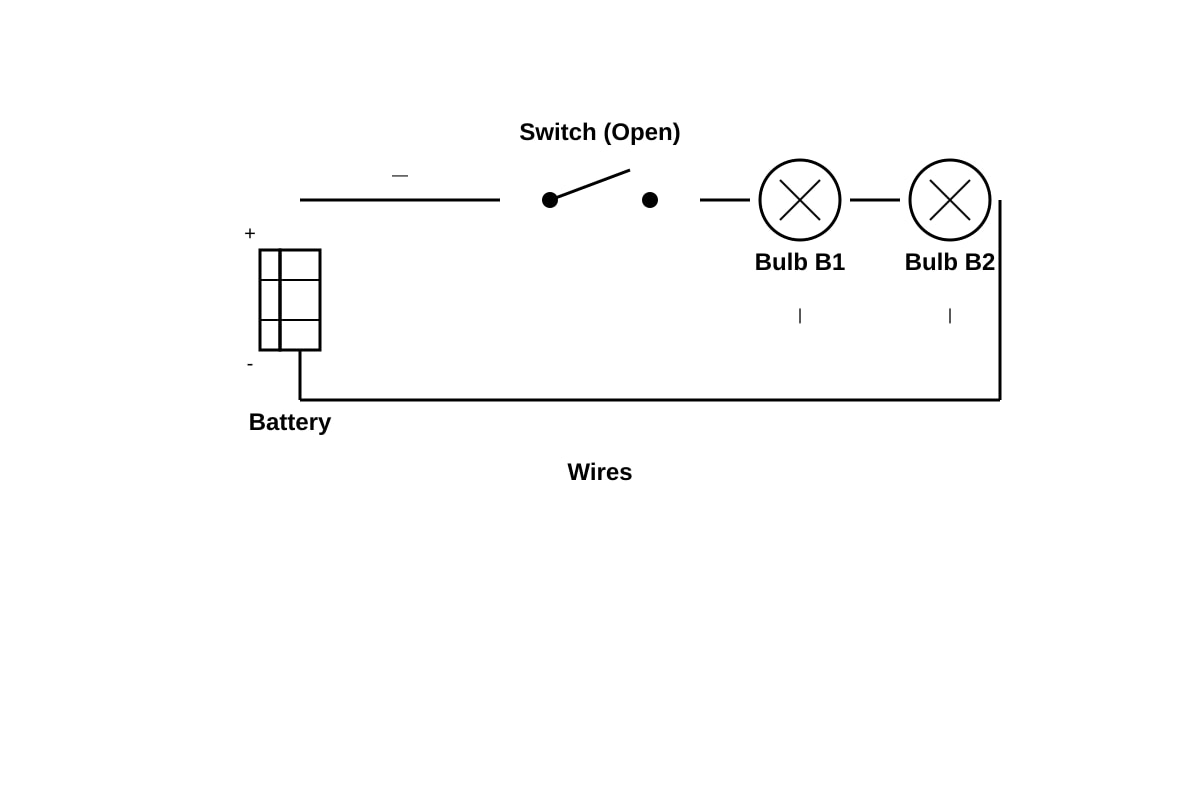
(b) Water vapour rises, comes into contact with the cooler underside of the lid, loses heat, and condenses into water droplets. [1]
(c) The water droplets on the lid represent clouds / condensation. When they become heavy, they fall as rain / precipitation. [1]

Section 10: Systems (Plant System)

37.
(a) To make food for the plant / photosynthesis [1]
(b) The plant cannot make food / photosynthesise without light. It will use up stored food and eventually die. [1]
(c) The leaves in the light will make food. The food is transported by the stem to all parts of the plant, including the covered leaf. [1]

38.
(a) X: Stem, Y: Roots [1]
(b) Stem (X): Transports water from roots to leaves. Roots (Y): Absorb water and mineral salts from soil. [1]
(c) The plant will not be able to absorb water / will wilt and die. [1]

Section 11: Systems (Human System - Digestive System)

39.
(a) A: Mouth, B: Oesophagus, C: Stomach, D: Small intestine, E: Large intestine [2]
(b) Digestion is completed and nutrients are absorbed into the blood in the small intestine (D). [1]
(c) Water is absorbed from undigested food / Formation of faeces [1]

40.
(a) Chewing breaks food into smaller pieces / increases surface area for digestive enzymes to act on. [1]
(b) Saliva contains amylase which digests starch into simpler sugars. [1]
(c) The stomach churns food and mixes it with gastric juices / Produces gastric juice containing pepsin to digest proteins / Kills bacteria with hydrochloric acid (any one) [1]


MARKING SCHEME SUMMARY

BookletQuestionsMarks per QuestionTotal Marks
A (MCQ)1-282 marks each56
B (OE)29-401-3 marks each44
Total100

Suggested Grade Boundaries (Primary 4 Science)

  • A / AL1:* 90-100 marks
  • A / AL2: 85-89 marks
  • B / AL3: 75-84 marks
  • C / AL4: 65-74 marks
  • D / AL5: 50-64 marks
  • E / AL6: Below 50 marks

End of Answer Key