From Real Exams Exam Paper
Primary 4 Science Semestral Assessment 2 (End of Year) Paper 1
Free P4 Science SA2 Paper 1, Kimi2.6 Exam version, with questions, answers, and syllabus-aligned practice for Singapore students.
These static practice materials are generated from the site's syllabus and paper-generation workflow, with source and model context shown so students and parents can evaluate the material before use.
Questions
Free quiz and exam paper access
Enter your details to view this paper
Your access is remembered on this device.
Answers
TuitionGoWhere Exam Practice (AI) - SA2 Science Primary 4
Primary 4 Science Practice Paper - Diversity
ANSWER KEY - Version 1 of 5
Section A: Multiple Choice (Questions 1-12)
Total: 12 marks
Question 1 (1 mark)
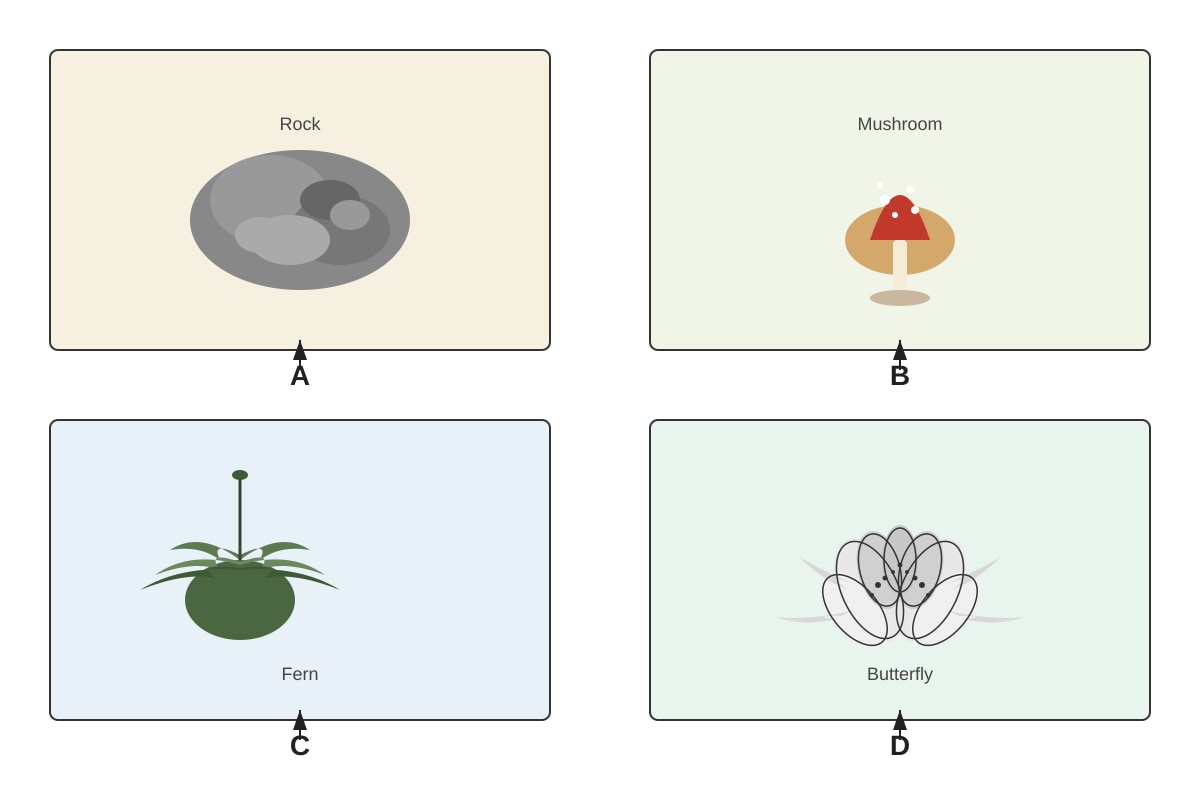
Answer: A) A
Explanation: A rock (A) is non-living. It does not grow, move on its own, need food, or reproduce. The mushroom (B), butterfly (C) and fern (D) are all living things because they grow, need food, and can reproduce. Living things show life processes like nutrition, respiration, growth, and reproduction. Rocks do not show any life processes.
Question 2 (1 mark)
Answer: B) leaves
Explanation: Leaves contain chlorophyll (the green pigment) and are the main site of photosynthesis, where plants make their own food using sunlight, water and carbon dioxide. Roots absorb water and minerals, stems transport substances, and flowers are for reproduction. The leaf is the food-making factory of the plant.
Question 3 (1 mark)
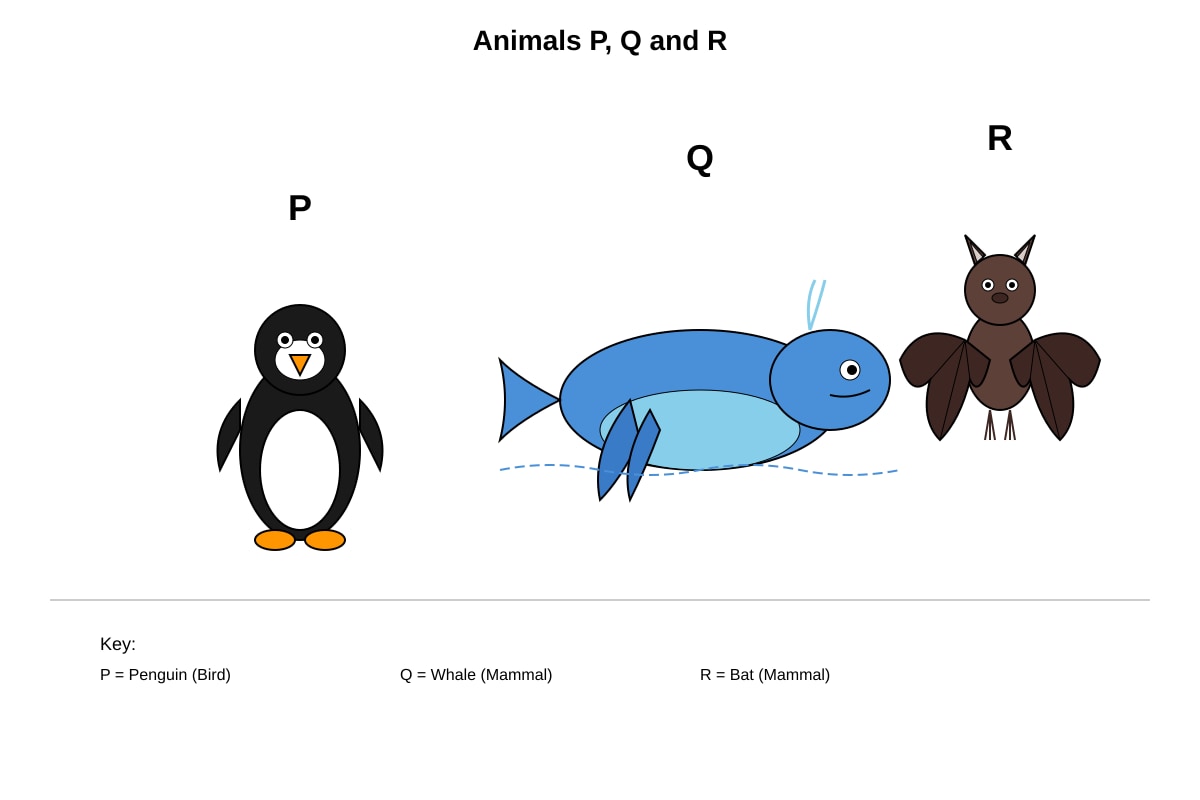
Answer: B) Q and R only
Explanation: Whales (Q) and bats (R) are both mammals. They have hair/fur, breathe with lungs, and give birth to live young (whales in water, bats on land). Penguins (P) are birds—they have feathers and lay eggs. Key distinguishing feature: mammals feed their young with milk from mammary glands. Do not confuse bats (mammals, fly with skin flaps) with birds (feathers, beaks, lay eggs).
Question 4 (1 mark)
Answer: A) X: eagle, Y: snake, Z: rabbit
Explanation: X has feathers = bird = eagle. Y has scales = reptile = snake (snakes are reptiles with dry scales). Z has fur = mammal = rabbit. Check other options: B has bat (fur, not feathers) and penguin (feathers, not fur); C has frog (moist skin, not scales) and dolphin (no fur); D has crocodile (correct for Y) but whale (no fur).
Question 5 (1 mark)
Answer: B) Bacteria, viruses and some fungi
Explanation: Microorganisms (or microbes) are living things too small to be seen with the unaided eye. They include bacteria, viruses, and some fungi like yeast. You need a microscope to see them. Ferns, mosses, mushrooms, insects, spiders, worms, fish, frogs and lizards are all large enough to see with your eyes.
Question 6 (1 mark)
Answer: A) Insects
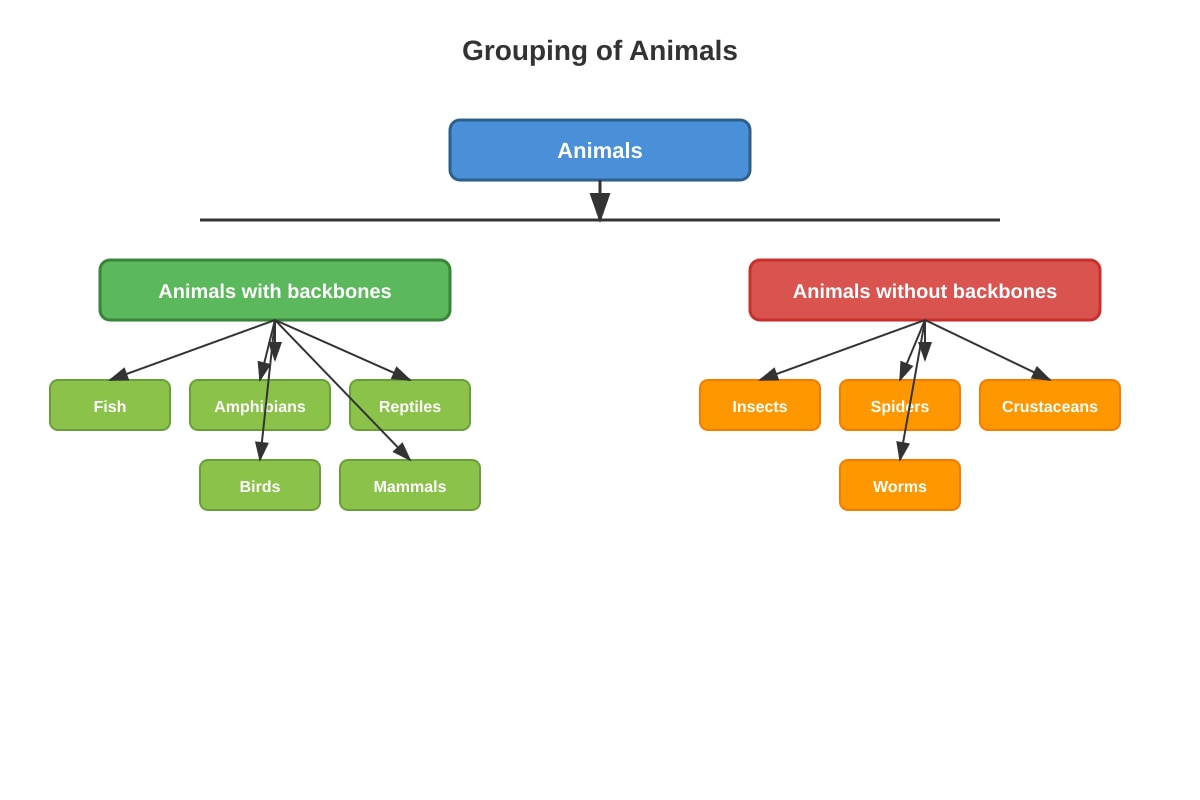
Explanation: Insects have six legs, a hard outer covering called an exoskeleton, and no backbone—they are invertebrates. Spiders have eight legs. Crustaceans (like crabs) have more than six legs, often ten. Worms have soft bodies without the hard covering. Remember: "Insecta = six legs" is a key classification rule.
Question 7 (1 mark)
Answer: B) egg → larva → pupa → adult
Explanation: This is complete metamorphosis, shown by butterflies and moths. The larva (caterpillar) looks completely different from the adult. The pupa (chrysalis) is the resting stage where transformation happens. Option A has wrong order; C is incomplete metamorphosis (grasshopper, cockroach); D has wrong starting stage. Common mistake: confusing larva with nymph. Larva = complete metamorphosis with pupal stage; nymph = incomplete metamorphosis, no pupa, gradual changes.
Question 8 (1 mark)
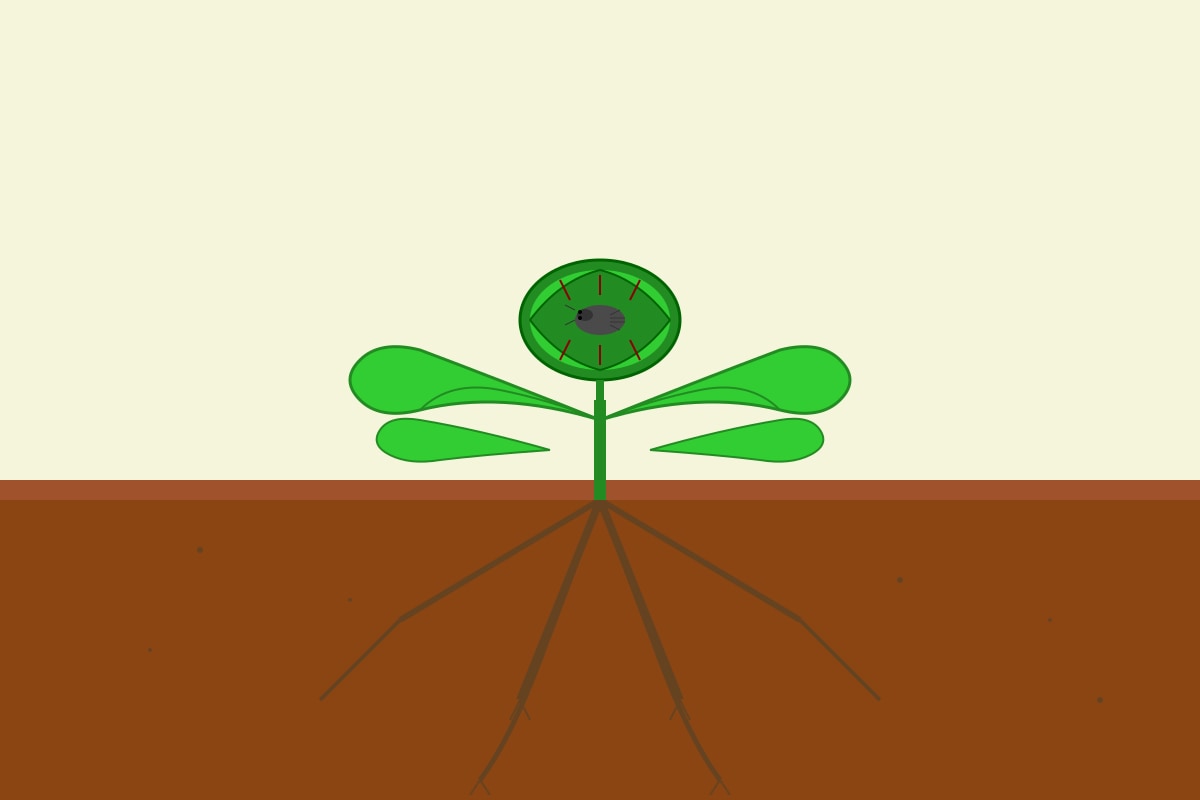
Answer: C) the soil has little nutrients
Explanation: Venus flytraps grow in nutrient-poor, acidic soil (typically bogs). They catch insects to get nitrogen and other nutrients that are missing from the soil. This is an adaptation—a special feature that helps an organism survive in its environment. They still photosynthesize like other plants, but supplement their diet with insects. Not A (too much water—though they like wet conditions, this isn't why they catch insects), not B (sunlight helps photosynthesis), not D (temperature is moderate in their habitat).
Question 9 (1 mark)
Answer: C) bean pod — by splitting open
Explanation: Bean pods use explosive splitting (self-dispersal). When dry, the pod splits open forcefully and shoots seeds out. Dandelion is wind-dispersed (has feathery parachute). Coconut is water-dispersed (has fibrous husk that floats). Water lily is water-dispersed (seeds float). Common mistake: thinking all fruits with "water" in name are water-dispersed—check the actual structure.
Question 10 (1 mark)
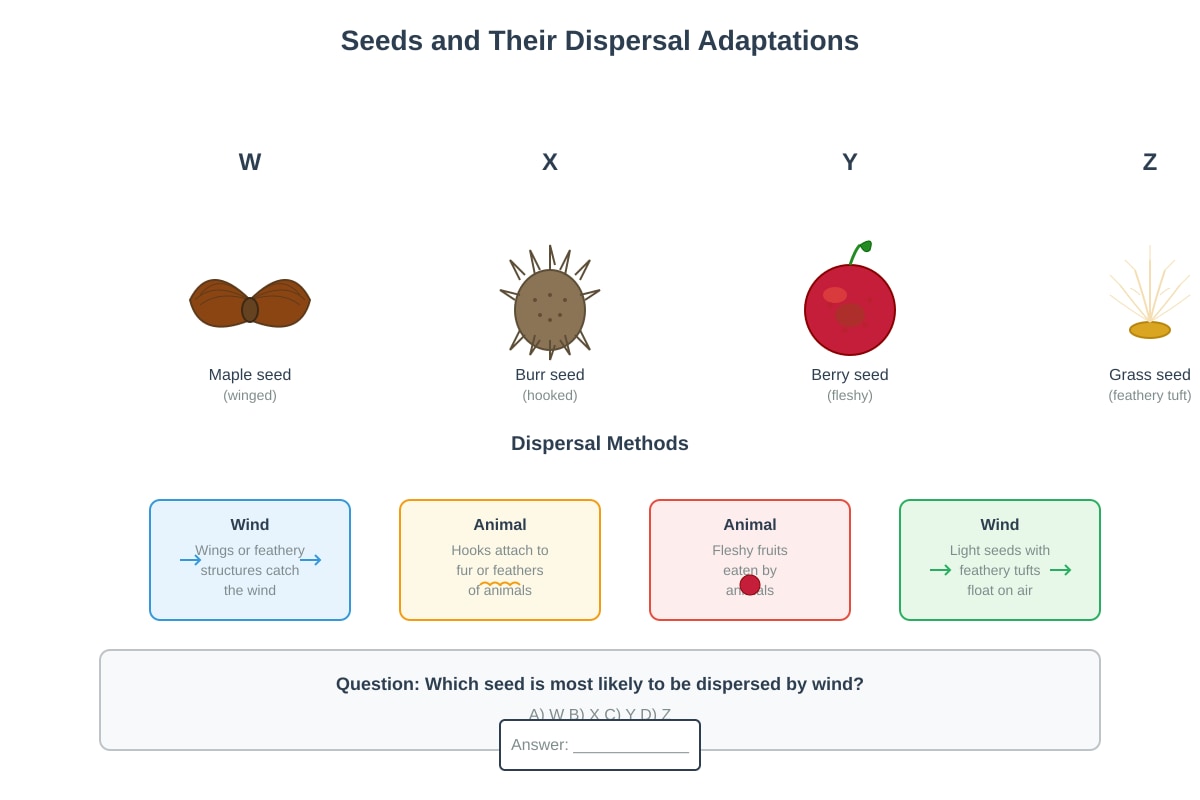
Answer: D) Z
Explanation: Seed Z is small, light, and has a feathery tuft—these are adaptations for wind dispersal. The feathery structure acts like a parachute to catch the wind. W (wings) is also wind-dispersed but the question shows Z with the feathery tuft typical of wind dispersal. X (hooks) is animal-dispersed. Y (fleshy) is animal-dispersed (eaten). Note: Both W and Z could be wind-dispersed, but the feathery tuft (Z) is the classic wind adaptation shown in many textbook questions. Read carefully—if Z is clearly the most feathery/wispy, that's the answer.
Question 11 (1 mark)
Answer: C) all four fruits
Explanation: To test fairly if all fruits contain seeds, the student needs to examine a range of different fruits. A good investigation tests multiple examples to see if a pattern holds. Testing only one or two fruits is not enough evidence. Apple, banana, grape and orange are all fruits—botanically they develop from flowers and contain seeds (banana seeds are tiny and undeveloped in cultivated varieties, but wild bananas have seeds; however, at P4 level, all are considered fruits with seeds). The key word is "fairly" meaning needs good evidence from multiple examples.
Question 12 (1 mark)
Answer: B) do not make their own food
Explanation: Fungi cannot photosynthesize—they lack chlorophyll. They feed by absorbing nutrients from dead or decaying matter (saprophytes) or from living organisms (parasites). Plants make their own food. Both fungi and plants: cannot move (A is true for both), fungi do have root-like structures called hyphae (so C is tricky but technically incorrect), both are living things (D is wrong). The fundamental difference is nutrition: plants are producers (make food), fungi are decomposers (absorb food).
Section B: Short Answer (Questions 13-18)
Total: 24 marks
Question 13 (7 marks total)
(a) (2 marks)
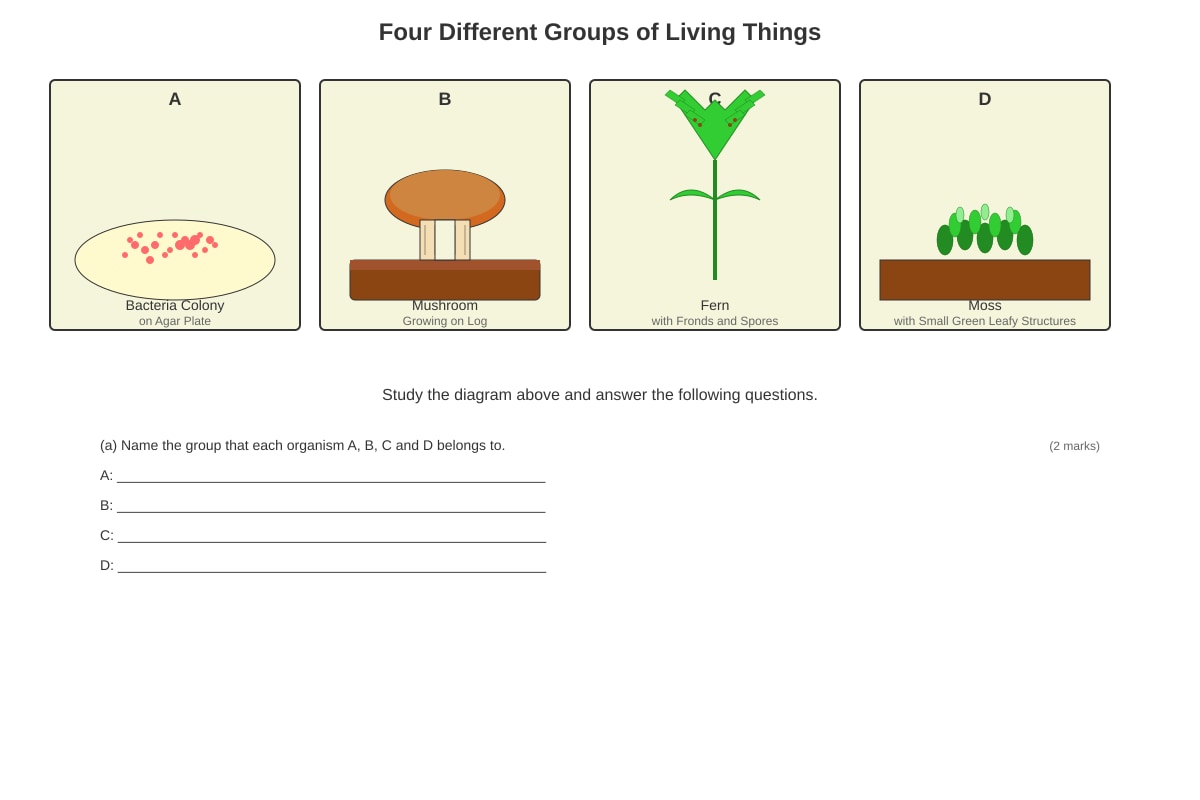
| Organism | Group |
|---|---|
| A | Bacteria (½ mark) |
| B | Fungi (½ mark) |
| C | Ferns / Pteridophytes (½ mark) |
| D | Mosses / Bryophytes (½ mark) |
Marking: All four correct = 2 marks. Three correct = 1½ marks. Two correct = 1 mark. One correct = ½ mark.
Explanation:
- Bacteria are single-celled microorganisms (prokaryotes), often seen as colonies.
- Fungi include mushrooms, toadstools, moulds—they have hyphae and reproduce by spores.
- Ferns are vascular plants with true leaves, stems, roots; reproduce by spores in sporangia on fronds.
- Mosses are non-vascular plants; small, simple, no true roots (have rhizoids instead).
Common mistake: Calling B a "mushroom"—mushroom is the fruiting body, the organism is a fungus. Calling C or D "plants" alone is too vague; need the specific group name at P4 level.
(b) (1 mark)
Answer: Yeast / Mould / Bread mould / Mildew / Toadstool / Puffball (any one correct)
Explanation: These are all fungi. Yeast is used in bread-making. Mould grows on old bread. Toadstools are like mushrooms but often poisonous. Puffballs release clouds of spores.
(c) (2 marks)
Answer:
- Ferns have chlorophyll / can make their own food through photosynthesis (1 mark)
- Ferns have true roots, stems and leaves / are vascular plants (1 mark)
OR other valid points:
- Ferns reproduce using spores but are still classified as plants due to photosynthesis
- They have leaf-like fronds that are green (contain chlorophyll)
Explanation: Plants are defined as organisms that can make their own food using chlorophyll and sunlight (autotrophs). Fungi cannot do this—they absorb nutrients. Ferns also have specialized tissues for transporting water (vascular system), unlike mosses. The presence of chlorophyll for photosynthesis is the key distinguishing feature from fungi.
Question 14 (5 marks total)
(a) (1 mark)
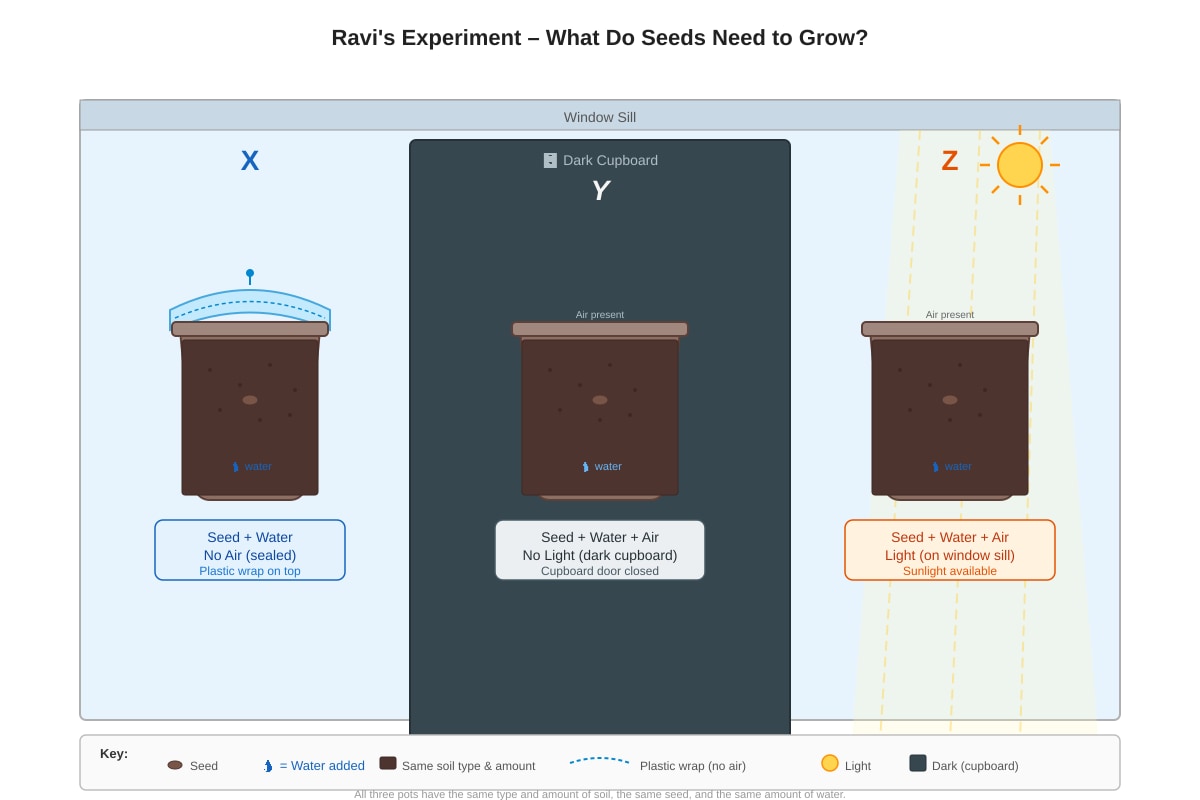
Answer: Pots Y and Z (both must be named)
Explanation: To test if seeds need light, keep all other conditions the same and change only light. Y and Z both have water and air, but Y is in darkness while Z is in light. This is a fair test—only one variable (light) is changed. Cannot compare X and Z because air is also different (two variables changed).
(b) (2 marks)
Answer:
- Seeds need air / oxygen to grow (1 mark)
- Pot X had no air (sealed), so the seed could not grow; pot Z had air and the seed grew (1 mark)
Explanation: The only difference between X and Z is air availability (X sealed, Z open). Both had water. Z grew, X didn't, showing air is needed. Note: Z also had light, but since Y (no light, with air) also grows, light is not the critical factor here—air is. Answer should focus on air/oxygen for respiration. Seeds need energy to germinate, which comes from aerobic respiration using oxygen.
(c) (2 marks)
Answer:
- To make it a fair test / to control variables (1 mark)
- So that only the changed factor affects the results / to ensure any difference in growth is due to the factor being tested, not due to different seeds or water amounts (1 mark)
Explanation: In scientific experiments, we keep all conditions the same except the one being tested. This is called controlling variables. If seed types differed, a small seed might not grow because of its type, not because of light/air. If water amounts differed, lack of growth might be due to drought, not the test factor. Fair testing is a key scientific practice.
Question 15 (7 marks total)
(a) (1 mark)
Answer: Animal P has feathers / can fly / has wings; Animal R has dry scales / cannot fly / is cold-blooded (any valid difference)
OR: P breathes with lungs but also has air sacs; R breathes with lungs only
Explanation: P is a bird (feathers, wings, lays eggs with hard shells, warm-blooded). R is a reptile (scales, lays eggs with leathery shells, cold-blooded). Both lay eggs, but the egg structure and body covering differ. Birds have feathers for insulation and flight; reptiles have scales to prevent water loss.
(b) (2 marks)
Answer:
- Animal Q (amphibian) lays eggs in water / its eggs have no hard shell (1 mark)
- The eggs would dry out / die if not in water; OR the young (tadpoles) live in water and breathe with gills (1 mark)
Explanation: Amphibians like frogs have double life—aquatic larvae and terrestrial adults. Eggs are jelly-like, without hard shells, so they must be laid in water to stay moist. Tadpoles have gills for underwater breathing and undergo metamorphosis to develop lungs. Water is essential for reproduction and early development.
(c) (2 marks)
Answer: Animal S (1 mark)
Explanation:
- Humans are mammals (½ mark)
- Humans have hair, breathe with lungs, and develop inside mother's body (internal development / live birth) (½ mark)
Development detail: Humans do not lay eggs; babies develop in the womb (uterus) and are born alive. They are fed milk from mother's breasts. S matches all these mammal characteristics.
Question 16 (7 marks total)
(a) (1 mark)
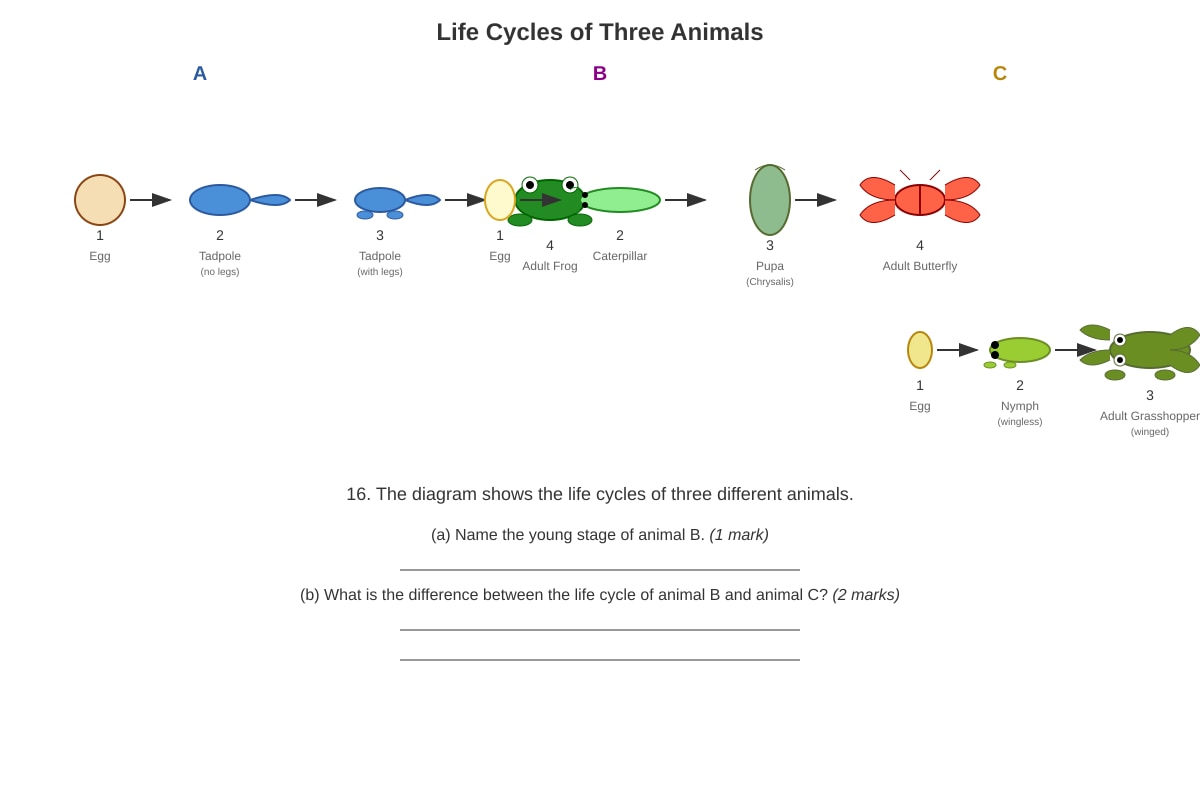
Answer: Caterpillar / larva
(b) (2 marks)
Answer:
- Animal B (butterfly) has a pupa stage / chrysalis; Animal C (grasshopper) has no pupa stage (1 mark)
- Animal B undergoes complete metamorphosis; Animal C undergoes incomplete metamorphosis / gradual metamorphosis (1 mark)
OR: The young of B looks very different from the adult; the young of C looks similar to the adult but smaller and wingless (1 mark for clear description)
Explanation: Complete metamorphosis = egg → larva → pupa → adult (big change, different forms). Incomplete metamorphosis = egg → nymph → adult (gradual change, nymph resembles small adult without wings). The pupa is the critical difference—it's a resting stage where complete rebuilding occurs.
(c) (2 marks)
Answer:
- The tadpole has gills / can breathe underwater (1 mark)
- The tadpole has a tail / can swim in water (1 mark)
OR: Streamlined body shape for swimming in water
Explanation: These are adaptations for aquatic life. Gills extract oxygen from water (like fish). The tail provides propulsion. As the tadpole develops into a frog, it grows legs for hopping on land, loses the tail, and develops lungs for air breathing. This metamorphosis allows the animal to exploit two environments—water for safety of eggs/young, land for food/territory as adults.
Question 17 (6 marks total)
(a) (2 marks)
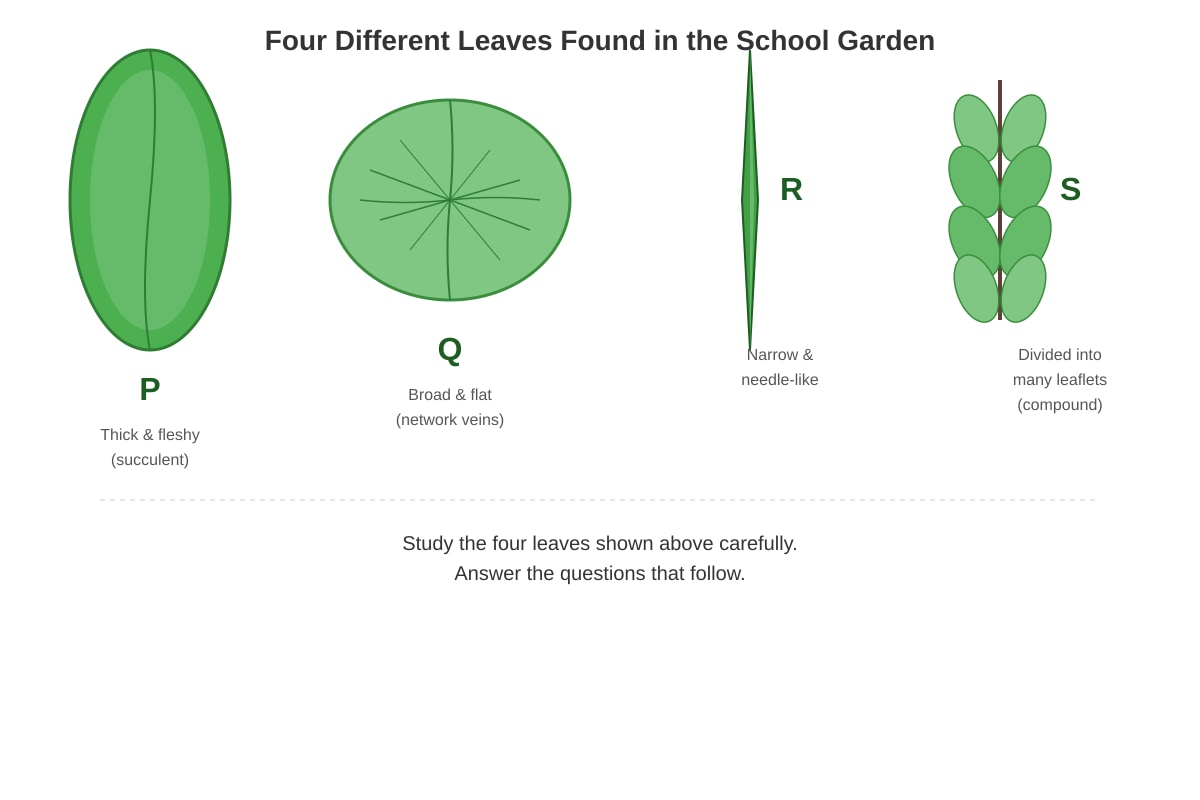
Answer: Leaf P (1 mark)
Explanation: It is thick and fleshy / has a waxy surface / stores water (1 mark)
This is a succulent adaptation. Thick, fleshy leaves store water during dry periods. The waxy cuticle reduces water loss through evaporation (transpiration). Examples: cactus, aloe vera, desert plants. Broad thin leaves (Q) lose water quickly; needle leaves (R) reduce surface area but are more typical of cold/dry places; compound leaves (S) are for other functions.
(b) (2 marks)
Answer:
- Large surface area captures more sunlight (1 mark)
- More sunlight means more photosynthesis / more food can be made for the plant (1 mark)
Explanation: Leaf Q (broad, flat with network veins) is typical of plants in good light and water conditions. Large surface area maximizes light absorption. Network veins spread water and food throughout the large blade. This is why forest floor plants often have broad leaves—they compete for light. However, broad leaves also lose more water, so they need adequate water supply.
Question 18 (6 marks total)
(a) (1 mark)
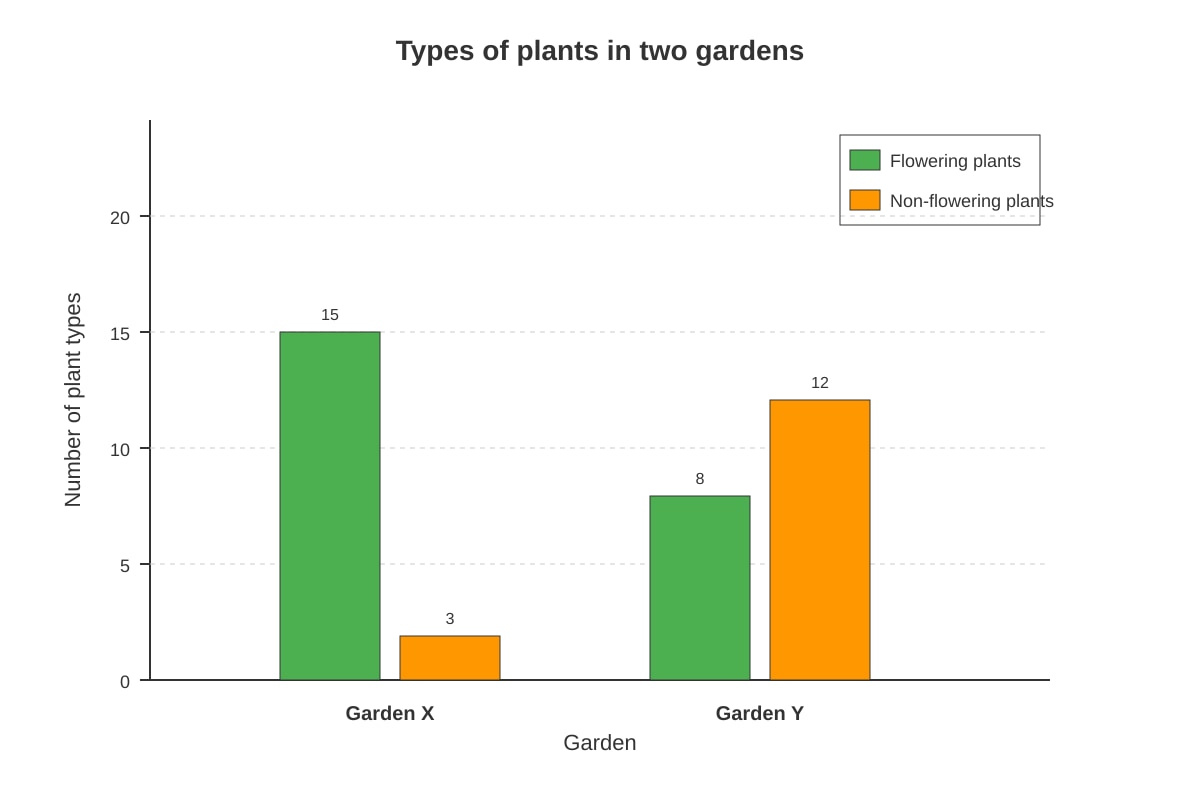
Answer: 3
(b) (1 mark)
Answer: 8 + 12 = 20 types (working shown, correct answer)
(c) (2 marks)
Answer: Garden Y (1 mark)
Explanation: Garden Y has more types of non-flowering plants / has more balanced numbers / 20 total types compared to 18 in Garden X / greater variety across both categories (1 mark for using data)
More detailed acceptable answer: Garden Y has 20 types in total (8 flowering + 12 non-flowering) compared to Garden X's 18 types (15 + 3). Garden Y has greater variety in non-flowering plants (12 vs 3). "Diversity" means variety—more different kinds of organisms. While Garden X has more flowering plants, Garden Y has more balanced representation and more total types, suggesting greater overall diversity.
Section C: Application and Open Response (Questions 19-20)
Total: 24 marks
Question 19 (10 marks total)
(a) (3 marks)
Answer:
- The animal is a frog (1 mark)
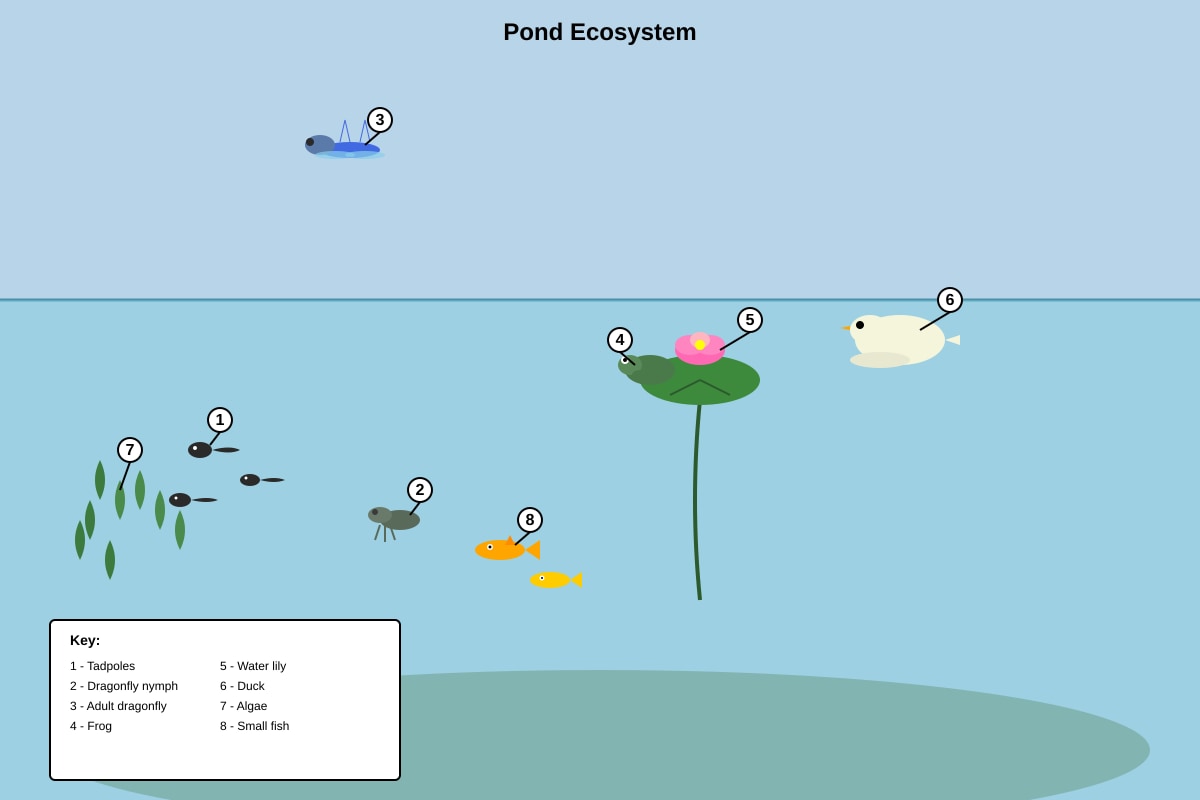
- Organism 1 (tadpole) lives in water / has gills / has a tail / has no legs (1 mark)
- Organism 4 (adult frog) lives on land and water / has lungs / has four legs / has no tail (1 mark)
Explanation: Tadpoles are the larval stage of frogs, adapted for aquatic life with gills and tail for swimming. Adult frogs are amphibious—they have lungs for breathing air, four legs for hopping, and lose the tail. This is complete metamorphosis with dramatic body reorganization.
(b) (3 marks)
Answer:
- Incomplete metamorphosis (1 mark)
- Dragonfly nymph (organism 2) lives in water; adult (organism 3) lives on land and flies (1 mark for life cycle type or stage description)
- There is no pupa stage / the nymph gradually grows and develops wings; OR the young looks similar to the adult (unlike tadpole to frog) (1 mark for key difference)
Explanation: Dragonflies have incomplete metamorphosis: egg → nymph (aquatic, called naiad) → adult. The nymph resembles a wingless adult, molts several times, and emerges directly as adult from its final molt. No resting pupal stage. Frogs have complete metamorphosis with a very different larval form and a pupa-like transformation period (though less enclosed than butterfly chrysalis).
(c) (4 marks)
Answer:
- Yes, I agree (1 mark for position—must match explanation)
With evidence:
- Producers are organisms that make their own food (½ mark)
- Examples of producers in the pond: water lily (organism 5), algae (organism 7) (1 mark for at least two correct examples)
Comparing to consumers:
- Consumers are organisms that eat other organisms (½ mark)
- Examples of consumers: tadpoles (1), dragonfly nymph (2), adult dragonfly (3), frog (4), duck (6), small fish (8) (½ mark for identifying consumers)
Conclusion:
- There are only 2 producers but at least 6 consumers, so more consumers (½ mark for comparison using numbers)
OR Disagree answer (must be well-justified):
- No, I do not agree (1 mark)
- Algae may cover large areas / there is a lot of algae; one plant can be counted as one type but there are many individual algae organisms (1 mark)
- The question asks about diversity (types), not numbers of organisms (1 mark)
- There are only 2 producer types shown, but this doesn't mean "more" in number of organisms (1 mark)
Marking note: "Agree" is the expected answer based on the diagram's numbered organisms. But "disagree" with thoughtful reasoning about abundance vs. types can score full marks. Key is clear use of the diagram and correct definitions of producer/consumer.
Question 20 (14 marks total)
(a) (4 marks)
Sample answers (any two valid ways with correct grouping):
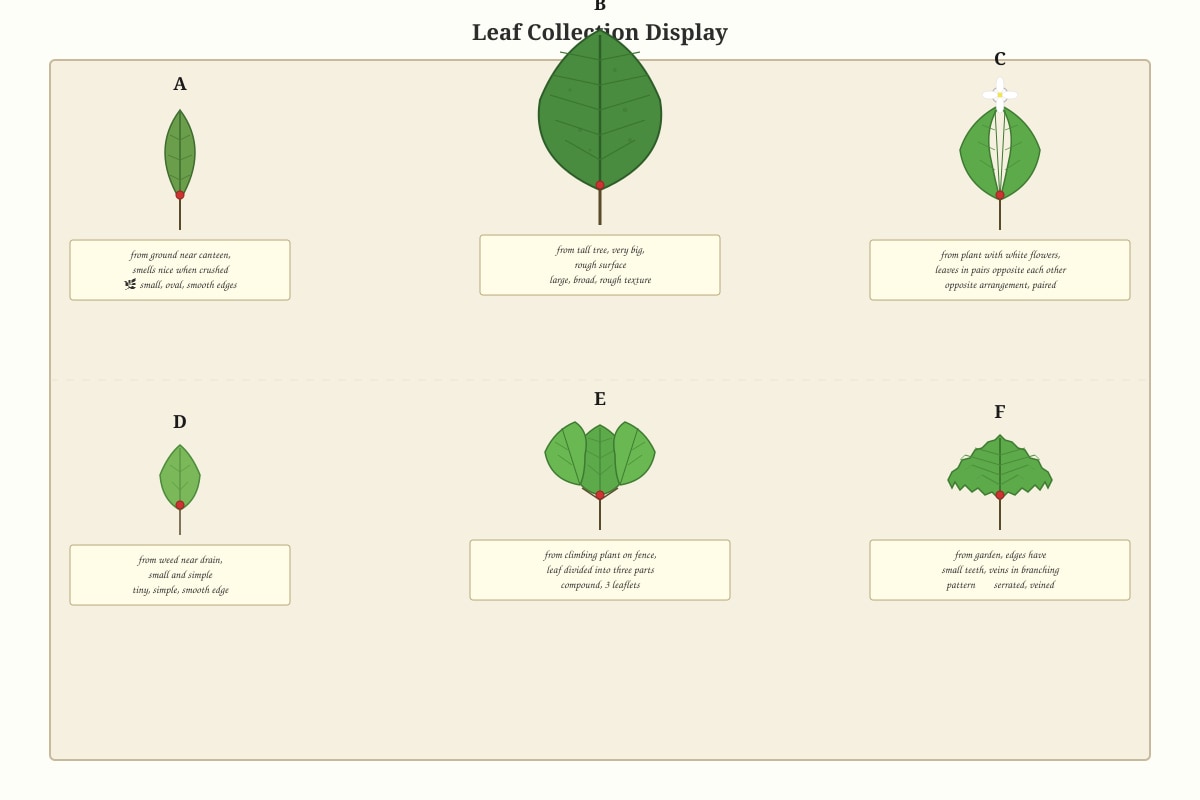
Way 1: By leaf edge / margin
- Smooth edge: Leaf A, Leaf D (½ mark)
- Toothed / rough edge: Leaf B, Leaf F (½ mark)
- Divided / compound: Leaf E (½ mark)
- In pairs / opposite: Leaf C (can be in smooth group) (½ mark)
Way 2: By leaf arrangement on stem
- Opposite (in pairs): Leaf C (1 mark)
- Alternate / single: Leaf A, B, D, E, F (1 mark)
Way 3: By size
- Small: Leaf A, D (½ mark)
- Medium: Leaf C, F, E (½ mark)
- Large: Leaf B (½ mark)
Way 4: By smell
- Smells when crushed: Leaf A (1 mark)
- No noticeable smell: B, C, D, E, F (1 mark)
Way 5: By vein pattern
- Branching / network veins: Leaf B, F (1 mark)
- Other / not clearly branching: A, C, D, E (1 mark)
Marking: Each way = 1 mark for criterion + 1 mark for correct grouping. Must have at least two leaves in at least one group to be valid.
(b) (2 marks)
Answer:
- Both have branching veins / network venation (1 mark)
- This is a characteristic of dicotyledonous plants / flowering plants with two seed leaves (1 mark)
OR:
- Leaf C has flowers (mentioned in description: "white flowers")—flowers are a feature of flowering plants (1 mark)
- Leaf F has toothed edges and branching veins typical of flowering plants like rose / hibiscus (1 mark)
Explanation: Dicot flowering plants typically have broad leaves with net-like (reticulate) venation. The branching pattern described for Leaf F and the paired leaf arrangement of Leaf C (opposite phyllotaxy) are common in dicots. Having flowers is definitive proof of a flowering plant (angiosperm). Monocots have parallel veins.
(c)(i) (1 mark)
Answer: Grass / monocot / monocotyledonous plant
(c)(ii) (1 mark)
Answer: Monocots / grasses have parallel veins / long thin leaves with veins running side by side from base to tip
Explanation: Parallel venation is the hallmark of monocotyledonous plants (one seed leaf when germinating). Grasses, lilies, orchids, corn, and palms are examples. The veins run parallel without forming a network. This contrasts with dicots (two seed leaves) which have branching, net-like veins.
(d) (4 marks)
Any two features with explanations:
Feature 1: Flowers / reproductive structures (1 mark)
- The number of petals, shape, colour, and arrangement help identify plant families (1 mark)
Feature 2: Fruits and seeds (1 mark)
- Seed number, shape, and seed leaf number (cotyledons) distinguish monocots and dicots (1 mark)
Feature 3: Stem structure (1 mark)
- Woody vs. herbaceous; presence of bark; stem shape (round, square, hollow) (1 mark)
Feature 4: Roots (1 mark)
- Tap root (single main root with branches) vs. fibrous roots (many thin roots) (1 mark)
Feature 5: Growth form / habit (1 mark)
- Tree, shrub, herb, climber, aquatic plant (1 mark)
Marking: Two features × 2 marks each = 4 marks. Need feature name + how it helps classification.
(e) (2 marks)
Answer:
- Some plants have no leaves for part of the year / leaves fall off in autumn (deciduous plants) (1 mark)
- Different plants can have very similar-looking leaves / same plant can have different leaf shapes (1 mark)
OR:
- Leaves change as the plant grows (seedling leaves vs. adult leaves) (1 mark)
- Two different species can have almost identical leaves (1 mark)
OR:
- Need to see flowers/fruits for accurate identification as leaf-only is unreliable (1 mark)
Explanation: Taxonomists (scientists who classify organisms) use multiple characteristics because single features can be misleading. For example, some Acacia species have compound leaves as seedlings but flattened stems (phyllodes) as adults. DNA analysis is now used alongside physical features for the most accurate classification.
Mark Summary
| Section | Question Range | Marks | Your Marks |
|---|---|---|---|
| A | 1-12 | 12 | |
| B | 13-18 | 24 | |
| C | 19-20 | 24 | |
| Total | 60 |
End of Answer Key