From Real Exams Exam Paper
Primary 4 Science Semestral Assessment 2 (End of Year) Paper 1
Free P4 Science SA2 Paper 1, HY3 Exam version, with questions, answers, and syllabus-aligned practice for Singapore students.
These static practice materials are generated from the site's syllabus and paper-generation workflow, with source and model context shown so students and parents can evaluate the material before use.
Questions
Free quiz and exam paper access
Enter your details to view this paper
Your access is remembered on this device.
Answers
Answer Key — SA2 Practice Paper (Version 1) Science Primary 4
Total Marks: 60
Section A (10 marks)
- B — cactus plant. Teaching note: Living things are made of cells, need food, grow, reproduce. A cactus is a plant (living). Others are non-living objects. [1m]
- C — Fungus. Teaching note: Mushroom is not a plant (no chlorophyll) nor animal; it is a fungus. [1m]
- C — Made of glass. Teaching note: Glass is a material, not a life characteristic. Living things need food, move, reproduce. [1m]
- B — Backbone. Teaching note: Bird (vertebrate) and lizard (reptile, vertebrate) both have backbone. Birds have feathers, lizards have scales, not gills. [1m]
- A — cotton shirt. Teaching note: Cotton comes from cotton plant (living), shirt is non-living made from it. Gold, rubber, glass not from living thing directly in this context. [1m]
- B — Mammals. Teaching note: Mammals breathe with lungs and feed young with milk. [1m]
- C — Rose. Teaching note: Rose is flowering plant producing fruits/seeds. Fern/moss reproduce by spores; mushroom is fungus. [1m]
- C — break down dead matter. Teaching note: Fungi absorb nutrients from dead matter; not green, not non-living. [1m]
- B — Body covering. Teaching note: Scientists group animals by body covering (feathers, scales, fur). [1m]
- B — scaly skin, lays eggs on land. Teaching note: Reptiles have dry scaly skin, land eggs. [1m]
Section B (12 marks)
- [2m] Any two: needs food / grows / reproduces / responds / breathes / excretes. Marking: 1m each.
- [2m] e.g. Plants make food by photosynthesis; animals cannot. Or plants do not move from place to place; animals can. 1m difference + 1m example.
- [2m] Example: mushroom (1m), found on damp wood or soil (1m).
- [2m] Car not living because: does not need food (1m), cannot reproduce (1m). Other valid: no growth, no breathing.
- [2m] Living: cat, maize plant (1m). Non-living: rock, spoon (1m).
- [2m] Birds have feathers and lungs; fish have scales and gills (1m group feature, 1m contrast).
Section C (20 marks)
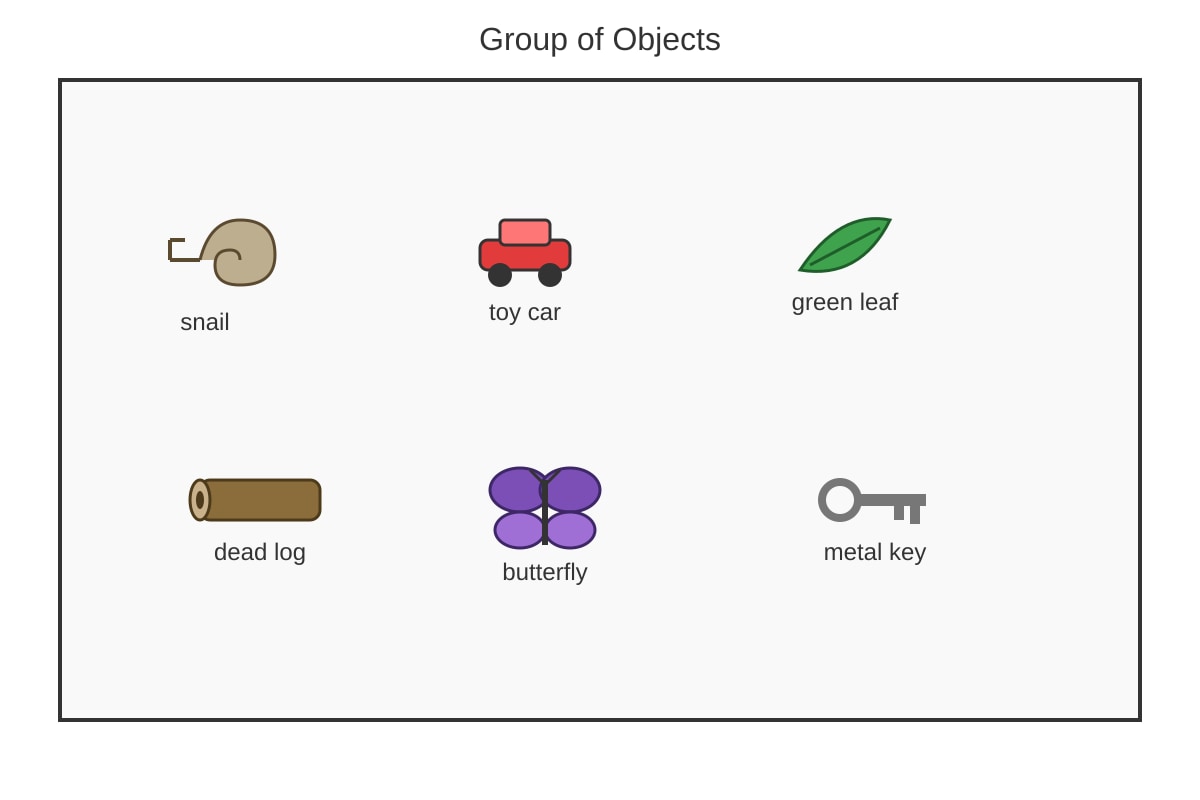
- (a) [3m] Living: snail, green leaf, butterfly (1m each, max 3m). Non-living in diagram: toy car, dead log, metal key.
(b) [2m] Dead log was once living tree but now no longer shows life processes (no growth, no reproduction) so it is non-living (2m explanation). - (a) [3m] Plants, Animals, Fungi (1m each).
(b) [2m] e.g. Plant–rose; Animal–cat; Fungus–mushroom (1m per correct pair, max 2m). - (a) [1m] Amphibians.
(b) [2m] Frog, toad (1m each).
(c) [2m] Amphibians have wet skin and live partly in water; birds have feathers and lay hard-shelled land eggs (2m clear difference). - (a) [2m] Diversity means the variety of different living things in nature (2m).
(b) [3m] Studying diversity helps us: know how to group and care for them (1m), understand their roles in environment (1m), protect ecosystems (1m).