AI Generated Quiz
Primary 4 Mathematics Whole Numbers Quiz
Free P4 Maths Whole Numbers quiz, Kimi2.6 AI version, with questions, answers, and syllabus-aligned practice for Singapore students.
These static practice materials are generated from the site's syllabus and paper-generation workflow, with source and model context shown so students and parents can evaluate the material before use.
Questions
Free quiz and exam paper access
Enter your details to view this paper
Your access is remembered on this device.
Answers
Primary 4 Mathematics Quiz - Whole Numbers (Answer Key)
Total Marks: 40 marks
Section A: Multiple Choice (Questions 1-5)
1 mark each
1. Answer: D) 7,000
Explanation: In the number 47,293, the digit 7 is in the thousands place. The thousands place is the fourth digit from the right. To find what the digit stands for, multiply the digit by its place value: 7 × 1,000 = 7,000.
Common mistake: Choosing C) 700 means confusing thousands with hundreds place.
2. Answer: A) 72,008
Explanation: "Seventy-two thousand" gives us 72,000. "And eight" means we add 8 to the ones place. We need to put 0 in the hundreds and tens places as placeholders: 72,008.
Teaching note: The word "and" separates the thousands from the ones. Zero placeholders are needed for empty places.
3. Answer: C) 87,000
Explanation: To round 86,514 to the nearest thousand, look at the hundreds digit (5). Since 5 is equal to or greater than 5, we round up: 86,514 → 87,000.
Rounding rule: Look at the digit to the right of the place you're rounding to. If it's 5 or more, round up. If it's 4 or less, round down.
4. Answer: B) 59,048
Explanation: Compare digit by digit from left (ten thousands place):
- All have 5 in ten thousands place
- Compare thousands: 58,xxx vs 59,xxx → 59,xxx is larger (B and D)
- Compare hundreds: 59,048 vs 59,004 → 0 = 0, continue
- Compare tens: 4 vs 0 → 4 > 0, so 59,048 is greatest
5. Answer: B) 37,750
Explanation: Find the pattern by subtracting consecutive terms: 37,500 − 37,250 = 250. The rule is "add 250 each time." So: 37,250, 37,500, 37,750, 38,000, 38,250. Check: 37,750 + 250 = 38,000 ✓
Section B: Short Answer (Questions 6-14)
6. Answer: Sixty-three thousand and forty-nine Marks: 2 marks
Explanation: Break down the number:
- 63,000 = sixty-three thousand
- 049 = forty-nine (note: we say "and" before the tens/ones part when there's no hundreds)
Common mistake: Writing "sixty-three thousand, forty-nine" without "and", or saying "sixty-three thousand, four hundred and nine" by misreading 049.
7. Answer: The digit 8 is in the ten thousands place. It stands for 80,000 (eighty thousand). Marks: 2 marks (1 mark for identifying digit; 1 mark for value)
Explanation: In 84,726, reading from left to right:
- 8 is in the first position → ten thousands place
- 8 × 10,000 = 80,000
8. Answer: 45,238, 45,283, 45,382, 45,832 Marks: 2 marks
Explanation: All numbers have 45 in thousands place. Compare the hundreds digit:
- 45,238: 2
- 45,283: 2
- 45,382: 3
- 45,832: 8
Then compare tens for 45,238 and 45,283: 3 < 8, so 45,238 < 45,283.
Method: Compare digits from left to right, stopping when you find a difference.
9. Answers:
- (a) 49,610 [1 mark]
- (b) 49,600 [1 mark]
- (c) 50,000 [1 mark]
Total: 3 marks
Explanation:
- (a) Nearest ten: Look at ones digit (7). 7 ≥ 5, so round up: 49,607 → 49,610
- (b) Nearest hundred: Look at tens digit (0). 0 < 5, so round down: 49,607 → 49,600
- (c) Nearest thousand: Look at hundreds digit (6). 6 ≥ 5, so round up: 49,607 → 50,000
10. Answer: 14,450; 16,450. The rule is "add 1,000 each time." Marks: 2 marks (1 mark for numbers; 1 mark for rule)
Explanation: 13,450 − 12,450 = 1,000. Check: 14,450 + 1,000 = 15,450 ✓, and 15,450 + 1,000 = 16,450 ✓
11. Answer: 43,315 Marks: 2 marks
Working:
  24,368
+ 18,947
--------
  43,315
Step-by-step:
- Ones: 8 + 7 = 15, write 5, carry 1
- Tens: 6 + 4 + 1 = 11, write 1, carry 1
- Hundreds: 3 + 9 + 1 = 13, write 3, carry 1
- Thousands: 4 + 8 + 1 = 13, write 3, carry 1
- Ten thousands: 2 + 1 + 1 = 4
12. Answer: 30,144 Marks: 2 marks
Working:
  50,000
- 19,856
--------
  30,144
Step-by-step (using regrouping/borrowing):
- Ones: 0 − 6, need to borrow. 10 − 6 = 4
- Tens: 9 − 5 = 4 (after borrowing)
- Hundreds: 9 − 8 = 1 (after borrowing)
- Thousands: 9 − 9 = 0 (after borrowing)
- Ten thousands: 4 − 1 = 3
13. Answer: 7,625 books were donated. Marks: 2 marks
Working:
  41,875  (new total)
- 34,250  (original)
--------
   7,625
Explanation: The difference between the new and original number of books gives the donation amount.
14. Answer: 42,250 packets Marks: 2 marks
Working: 8,450 × 5 = ?
Method: 8,000 × 5 = 40,000; 450 × 5 = 2,250; Total = 42,250
Or:
  8,450
×     5
-------
 42,250
Section C: Problem Solving (Questions 15-20)
3 marks each
15. Answers:
- (a) 56,000 [1 mark]
- (b) 12,242 [1 mark]
- (c) Disagree. 68,725 ≈ 69,000 (nearest thousand) or 68,725 ≈ 70,000 (nearest ten thousand). Using nearest thousand, the statement is not accurate.
Working and explanation:
(a) 56,483: hundreds digit is 4, so round down → 56,000
(b) 68,725 − 56,483 = 12,242
  68,725
- 56,483
--------
  12,242
(c) Using nearest thousand: 68,725 ≈ 69,000, not 70,000. However, to nearest ten thousand: 68,725 ≈ 70,000. The newspaper is approximately correct if rounding to ten thousands, but should specify. Accept reasoned answers with ≈ used correctly.
Marking note: Award 1 mark for correct use of ≈ symbol with any valid rounding explanation.
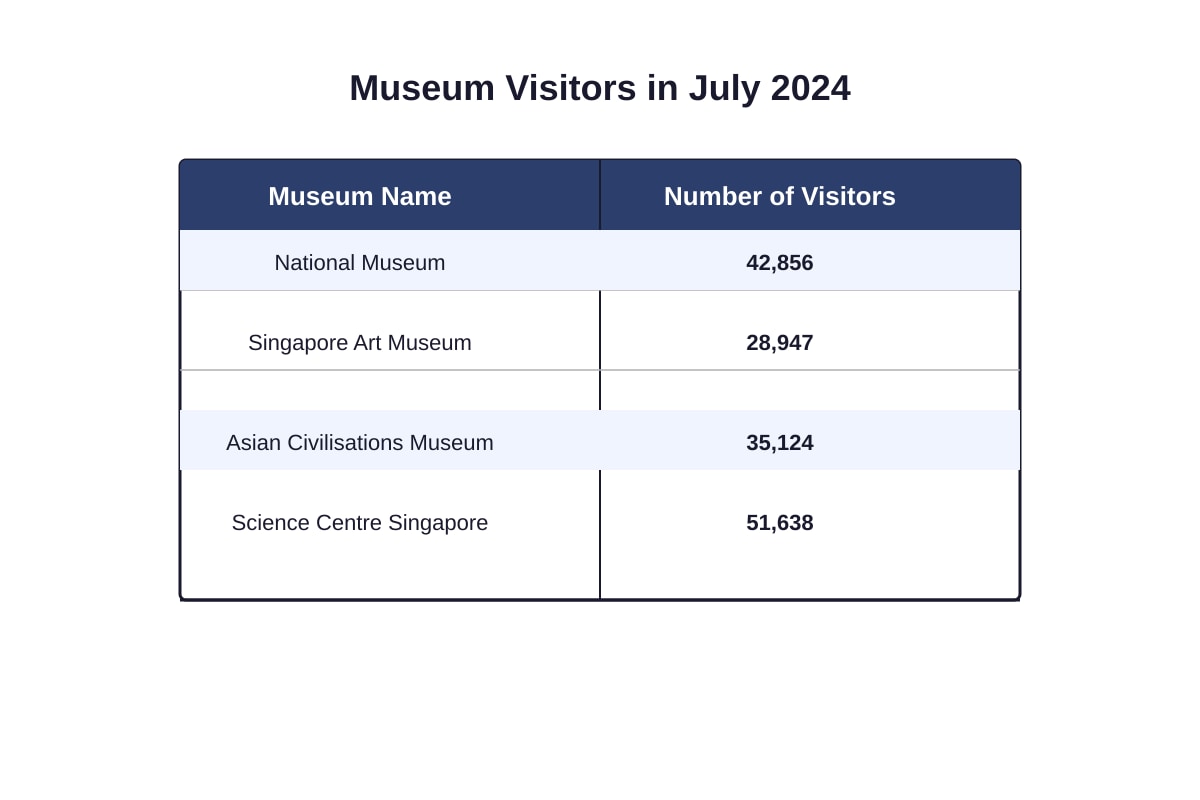
16. Answers based on expected table:
- (a) Science Centre Singapore [1 mark]
- (b) 51,600 [1 mark]
- (c) 77,980 [1 mark]
Working: (a) Compare: 51,638 > 42,856 > 35,124 > 28,947
(b) 51,638: hundreds digit is 6 ≥ 5, round up → 51,600... wait: 51,638 → look at tens digit (3) for nearest hundred. 3 < 5, so 51,600.
Correction: For nearest hundred, look at tens digit: 3 < 5, so 51,638 → 51,600.
(c) 42,856 + 35,124 = 77,980
  42,856
+ 35,124
--------
  77,980
Expected visual: Table must show four museums with specified numbers for answer to be valid.
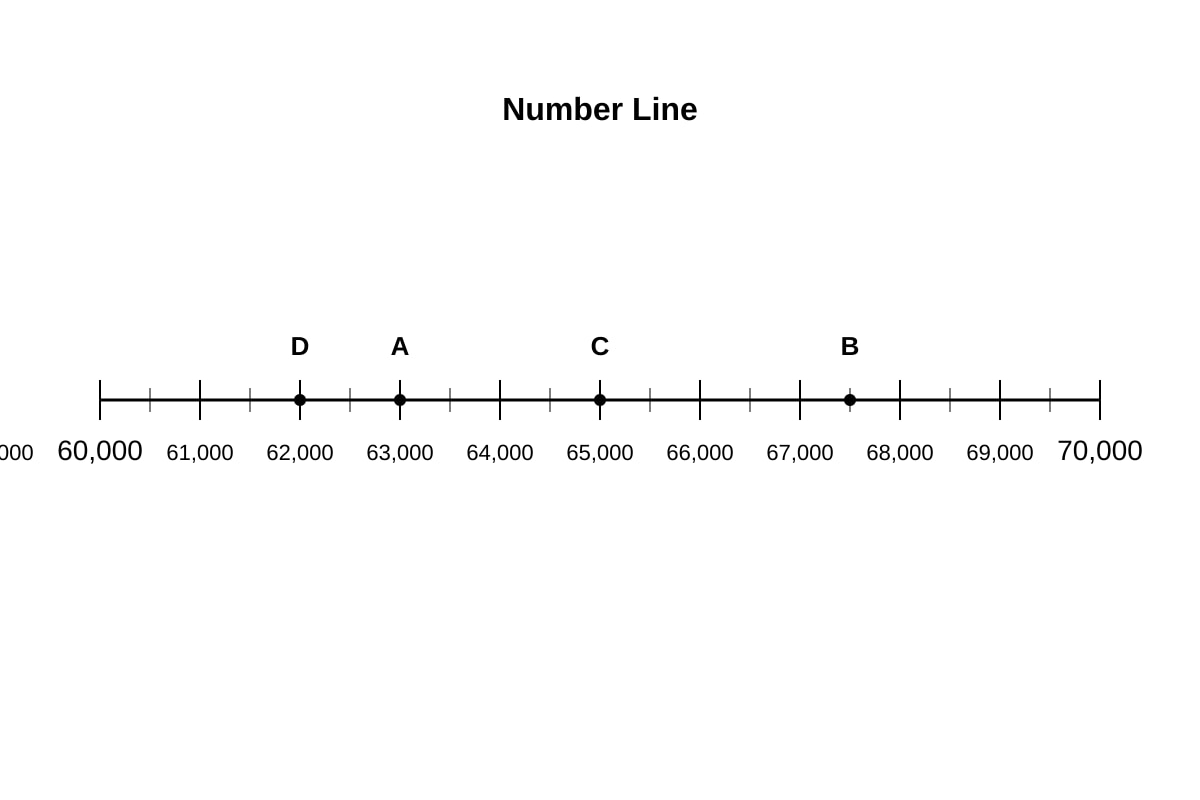
17. Answers based on expected number line:
- (a) 67,500 [1 mark]
- (b) 1,000 [1 mark]
- (c) 68,750 [1 mark]
Working: (a) Point B is marked at 67,500 (halfway between 67,000 and 68,000, or 7.5 units from 60,000 where each unit = 1,000)
(b) Point A = 63,000; Point D = 62,000; Difference = 63,000 − 62,000 = 1,000
(c) Halfway between 67,500 and 70,000: (67,500 + 70,000) ÷ 2 = 137,500 ÷ 2 = 68,750
Or: Difference is 2,500; half is 1,250; 67,500 + 1,250 = 68,750
Expected visual: Number line must show positions at 62,000 (D), 63,000 (A), 65,000 (C), 67,500 (B) between 60,000 and 70,000.
18. Answers:
- (a) 24,754 [1 mark]
- (b) 24,849 [1 mark] (Correction: 24,750 + 99 = 24,849 for 100th receipt, or 24,750 + 100 − 1 = 24,849)
- (c) 24,800 [1 mark]
Working: (a) 5th receipt: 24,750 + 4 = 24,754 (since first is 24,750, second is 24,751, etc.)
Alternative interpretation: If "first receipt numbered 24,750" means that's the starting number, then 5th receipt = 24,750 + 4 = 24,754.
(b) 100 receipts: 24,750 + 99 = 24,849 (or 24,750 + 100 − 1 = 24,849)
(c) 24,754 rounded to nearest hundred: tens digit is 5, so round up → 24,800
19. Answers:
- (a) 86,524 [1 mark]
- (b) 26,504 [1 mark]
- (c) 27,000 [1 mark]
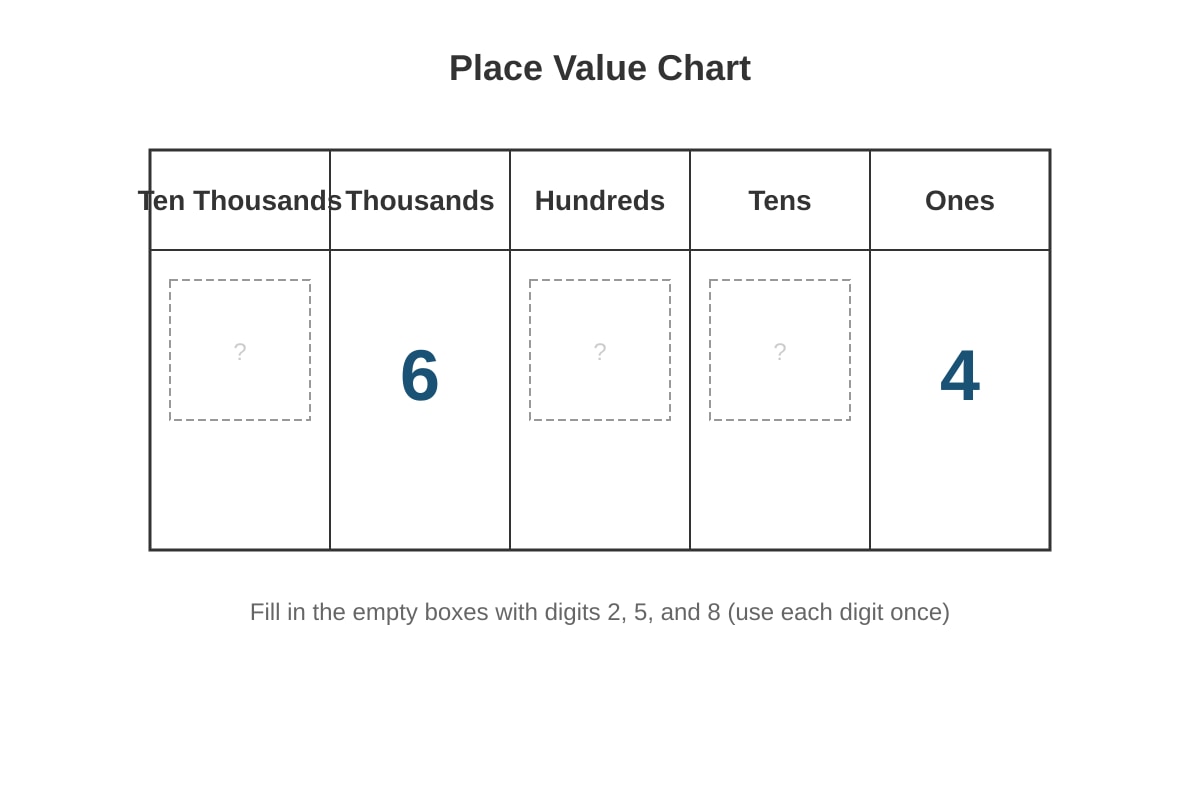
Working from expected visual: Place value chart shows: _ 6 _ _ 4 with digits 2, 5, 8 to fill three empty places.
(a) Largest number: Put largest remaining digit in highest empty place (ten thousands):
- Ten thousands: 8
- Hundreds: 5
- Tens: 2
- Result: 86,524
(b) Smallest number: Put smallest remaining digit in highest empty place, but ten thousands cannot be 0. Digits available: 2, 5, 8. Smallest for ten thousands is 2:
- Ten thousands: 2
- Hundreds: 0? No, we must use 5 and 8. Hundreds: 5, Tens: 8, or vice versa.
- For smallest: 26,584 or 26,854? Compare: 26,504 would require 0, but we must use 2, 5, 8.
Wait — re-reading: The empty boxes are Ten Thousands, Hundreds, Tens. We place 2, 5, 8 in these three places.
(b) Smallest: 2 in Ten Thousands, then 0 not available... Actually we need minimum: 2, then 5, then 8 in remaining: 26,584? Or 26,854?
26,504 is wrong (no 0). With digits 2,5,8: options are 26,584, 26,854, 28,654, etc.
Smallest: 26,854? No wait — put smallest digit in highest value place: 2 (ten thousands), then 5 (hundreds), then 8 (tens): 26,584
Or 2 (ten thousands), 5 (tens), 8 (hundreds): 25,684? No, hundreds is higher place than tens.
Places: Ten Thousands, Thousands, Hundreds, Tens, Ones Filled: [blank], 6, [blank], [blank], 4
To fill: Ten Thousands, Hundreds, Tens with 2, 5, 8.
For smallest: 2 (ten thousands), then 5 (hundreds), then 8 (tens): 26,584
Wait — 5 hundreds vs 8 hundreds: Actually we want smallest overall number, so after fixing ten thousands as 2, we arrange 5 and 8 in remaining places to minimize: 5 in hundreds, 8 in tens gives 26,584. If we swap: 28,564... no that's larger.
Actually comparing 26,584 vs 26,854: 26,584 < 26,854. So smallest is 26,584.
(c) 26,584 rounded to nearest thousand: hundreds digit is 5 ≥ 5, round up → 27,000
Marking correction for (b): Accept 26,584 as correct answer.
20. Answers:
- (a) $43,330 [1 mark]
- (b) $30,685 [1 mark]
- (c) $108,595 [1 mark]
Working: (a) Campaign B = 34,580 + 8,750 = 43,330
  34,580
+  8,750
--------
  43,330
(b) Campaign C = 43,330 − 12,645 = 30,685
  43,330
- 12,645
--------
  30,685
(c) Total = 34,580 + 43,330 + 30,685 = 108,595
   34,580
   43,330
+  30,685
---------
  108,595
END OF ANSWER KEY