AI Generated Quiz
Primary 4 Mathematics Multiplication Division Quiz
Free P4 Maths Multiplication Division quiz, GLM5.3 AI version, with questions, answers, and syllabus-aligned practice for Singapore students.
These static practice materials are generated from the site's syllabus and paper-generation workflow, with source and model context shown so students and parents can evaluate the material before use.
Questions
Free quiz and exam paper access
Enter your details to view this paper
Your access is remembered on this device.
Answers
Primary 4 Mathematics Quiz - Multiplication Division: Answer Key
Total Marks: 50 | Version: Practice Quiz 1 of 5
Teaching notes are written for students new to the topic. Key idea: multiplication is repeated equal grouping; division splits a total into equal groups.
Answer 1.
468 [1] Method: means two groups of 234. Multiply the ones, tens, hundreds: , , , giving 468. Common mistake: forgetting to carry when a digit product exceeds 9 (not needed here).
Answer 2.
90 [1] Method: asks "7 groups of what makes 630?" Since , then (the zero carries over because 630 is 63 tens). Common mistake: writing 9 instead of 90 — always check place value.
Answer 3.
54,000 [1] Method: , then attach the three zeros from 6,000: . Marking note: accept 54 000 with any spacing; the three zeros are required.
Answer 4.
7 bags [1] Method: sharing 56 into equal groups of 8 is division: . Check by multiplying back: . ✓
Answer 5.
70 [1] Method: This is a missing-factor question. Think : since , then . Check: . ✓ Key idea: multiplication and division are inverse operations.
Answer 6.
16,070 [2] Method (short multiplication, 4-digit × 1-digit):
- Ones: → write 0, carry 2
- Tens: , plus carry 2 = 7
- Hundreds: → write 0, carry 1
- Thousands: , plus carry 1 = 16
Marks: [1] correct method/setup, [1] correct final answer. Common mistake: misplacing the carried digit or missing a zero in the answer.
Answer 7.
182 [2] Method (long division):
- remainder 3
- Bring down 2: remainder 0
- Bring down 8: remainder 0
Check: . ✓ Marks: [1] correct division steps, [1] correct answer.
Answer 8.
5,635 [2] Method (3-digit × 2-digit, split 23 into 20 and 3):
- Add:
Marks: [1] both partial products correct, [1] correct addition/final answer. Common mistake: multiplying by 2 instead of 20 in the first row (misaligned place value).
Answer 9.
Quotient = 763, Remainder = 5 [2] Method (long division of 4,583 by 6):
- remainder 3
- Bring down 8: remainder 2
- Bring down 3: remainder 5
So . Check: ; . ✓ Marks: [1] correct working, [1] both quotient and remainder correct. Common mistake: giving a remainder larger than the divisor (never valid — here remainder must be less than 6).
Answer 10.
and , so [2] Method: Round each factor to the nearest ten ( since 2 < 5 rounds down; since 9 ≥ 5 rounds up), then multiply: . Marks: [1] both roundings correct, [1] correct estimate with . Note: the exact answer is 1,508, which is close to 1,500 — estimates help us check whether exact answers are reasonable.
Answer 11.
5,760 pages [3] Method: 128 pages each minute, 45 minutes → total .
- Split 45 into 40 and 5:
Answer: 5,760 pages Marks: [1] choosing , [1] correct partial products, [1] correct total with unit. Common mistake: multiplying 128 by 4 instead of 40.
Answer 12.
700 beads [3] Method (two-step problem):
- Step 1: beads left after the bracelet:
- Step 2: share equally among 5 friends:
Answer: 700 beads each Marks: [1] subtraction step, [1] division step, [1] correct answer with unit. Common mistake: dividing 3,750 by 5 before subtracting — read carefully for what happens first.
Answer 13.
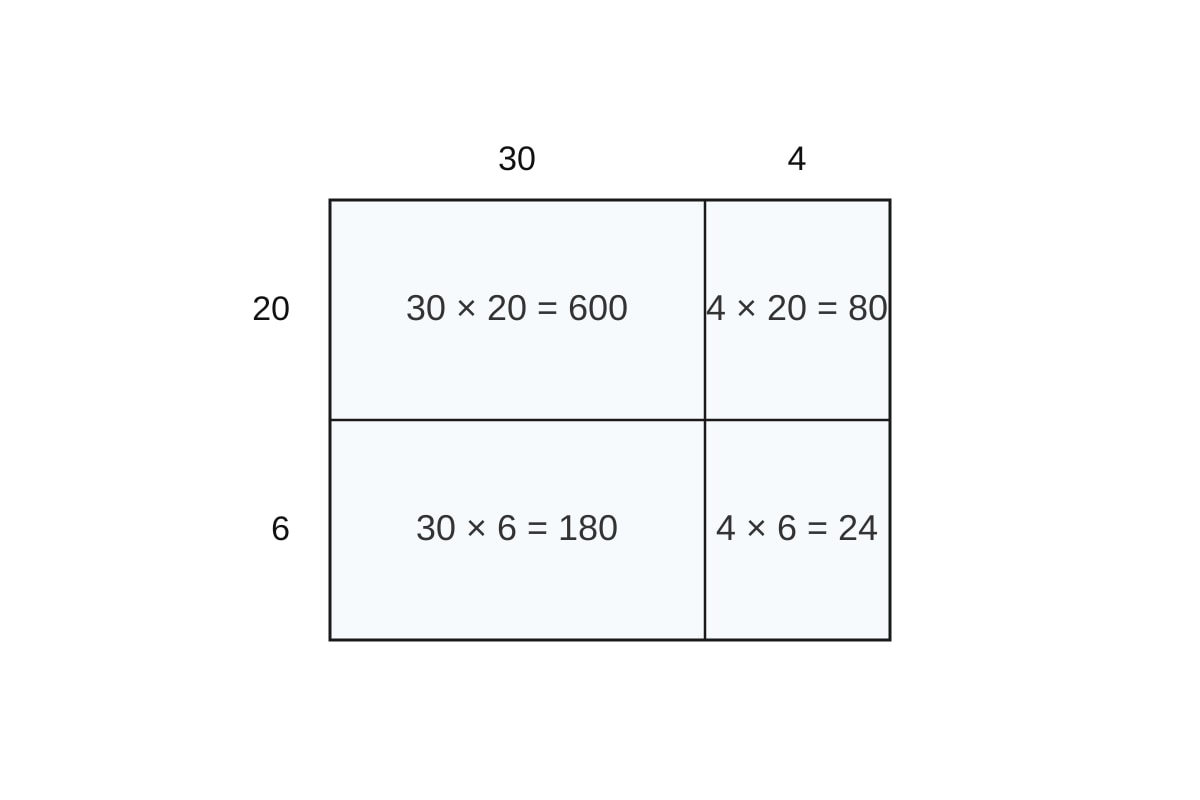
(a) The four rectangles contain: 600, 180, 80, 24 [1] (b) [2] Method: The area model splits 34 into and 26 into . Each small rectangle is one pair multiplied:
Add all four parts: . Key idea: this works because of the distributive property — a big multiplication becomes four easier ones. Marks: (a) [1] all four values correct; (b) [1] correct addition of the four parts, [1] final answer 884. Expected visual: the rendered model must show edge labels 30, 4 (top) and 20, 6 (side) with partial products 600, 180, 80, 24 inside the four rectangles.
Answer 14.
(a) 30 full boxes [1] (b) 5 tins left over [1] (c) 3 more tins [1] Method: remainder , because and . (c) A full box needs 8 tins, so tins still needed . Marks: [1] each correct part with working shown. Common mistake in (c): answering 5 (the remainder) instead of comparing the remainder to the box size of 8.
Answer 15.
(i) 16.2 [1] (ii) 2.4 [1] (iii) 0.7 [1] Method:
- (i) Ignore the point first: . There is 1 decimal place in 2.7, so put the point one place from the right: .
- (ii) ; with 1 decimal place in 7.2, the answer is .
- (iii) ; with 1 decimal place in 5.6, the answer is .
Key idea: multiply or divide the digits as whole numbers first, then place the decimal point according to the decimal places in the question. Common mistake: writing 162 instead of 16.2 — count decimal places every time.
Answer 16.
276 cans [4] Method (two-step problem):
- Step 1: total cans bought:
- (; ; )
- Step 2: cans not sold:
Answer: 276 cans Marks: [1] correct multiplication setup, [1] correct product 432, [1] correct subtraction, [1] correct final answer with unit. Common mistake: subtracting before multiplying, or misreading "not sold" as the amount sold.
Answer 17.
(a) 540 cm [2] (b) 5.4 m [2] Method:
- (a) Cut into 8 equal pieces means divide: cm.
- ( remainder 3; bring down 2 → ; bring down 0 → )
- (b) cm m, so m.
Marks: (a) [1] division setup, [1] correct answer 540 cm; (b) [1] dividing by 100 correctly, [1] answer 5.4 m with unit. Common mistake: writing 5.40 m is acceptable, but 54 m or 0.54 m shows a place-value slip when dividing by 100.
Answer 18.
(a) (or ) [2] (b) 840 [2] Method: Both terms share the factor 42. Factorising out 42 gives .
- Bracket first:
- Then
Check the long way: and ; . ✓ Key idea: this is the distributive property in reverse — . Marks: (a) [1] recognising the common factor 42, [1] correct bracketed form; (b) [1] evaluating the bracket first, [1] correct answer 840.
Answer 19.
7 buses [4] Method:
- Divide: remainder , since and .
- Interpretation: 6 buses carry 240 pupils, but 16 pupils still have no seat.
- Therefore one extra bus is needed: buses.
Explanation (expected): The remainder cannot be ignored here because every pupil must have a seat, so we always round up to the next whole bus. Marks: [1] correct division with remainder, [1] correct interpretation of the remainder, [1] answer 7 buses, [1] valid explanation about rounding up. Common mistake: answering 6 buses — check whether the remainder people can be left behind!
Answer 20.
29 [4] Method (work backwards, reversing each operation):
- The last operation was "divided by 2", so reverse it by multiplying: .
- Before that, the number was "multiplied by 14", so reverse it by dividing: .
Check forwards: , then . ✓ Marks: [1] reversing division with multiplication, [1] correct value 406, [1] reversing multiplication with division, [1] correct answer 29. Key idea: to undo a chain of operations, reverse them in the opposite order, swapping each operation with its inverse.
End of Answer Key