AI Generated Quiz
Primary 4 Mathematics Geometry Quiz
Free P4 Maths Geometry quiz, Nemo3 AI version, with questions, answers, and syllabus-aligned practice for Singapore students.
These static practice materials are generated from the site's syllabus and paper-generation workflow, with source and model context shown so students and parents can evaluate the material before use.
Questions
Free quiz and exam paper access
Enter your details to view this paper
Your access is remembered on this device.
Answers
Primary 4 Mathematics Quiz - Geometry (Answer Key)
Total Marks: 40
Section A: Multiple Choice Questions (10 × 1 mark = 10 marks)
1. C (1 mark)
Explanation: An acute angle is an angle less than 90°. Among the options, only 45° is less than 90°.
- 90° is a right angle
- 120° is an obtuse angle (between 90° and 180°)
- 180° is a straight angle
2. B (1 mark)
Explanation: A straight angle measures 180°. A right angle measures 90°.
180° ÷ 90° = 2 right angles.
3. C (1 mark)
Explanation: An obtuse angle is an angle between 90° and 180°. 135° lies between 90° and 180°, so it is an obtuse angle.
4. C (1 mark)
Explanation: A rectangle has exactly 2 lines of symmetry (vertical and horizontal through the centre).
- Equilateral triangle: 3 lines of symmetry
- Square: 4 lines of symmetry
- Circle: Infinite lines of symmetry
5. C (1 mark)
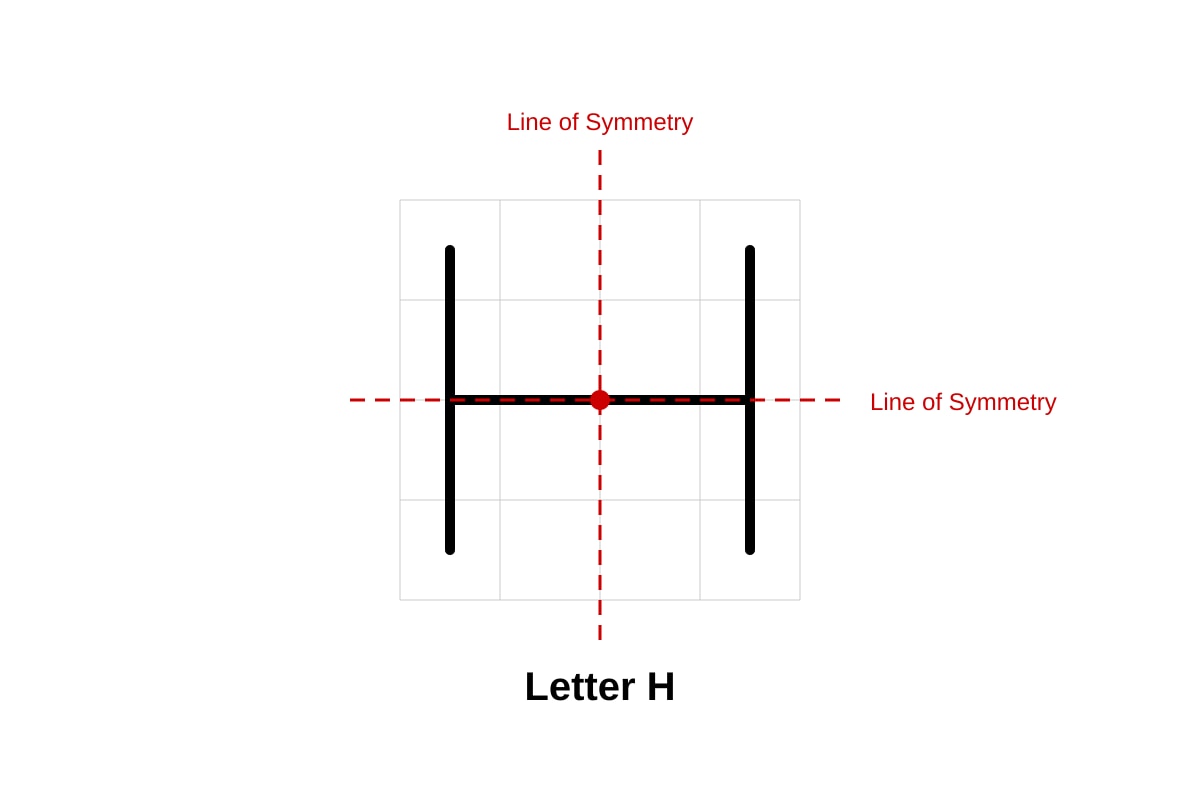
Explanation: The capital letter H has 2 lines of symmetry: one vertical (through the middle of the crossbar) and one horizontal (through the middle of the crossbar).
6. A (1 mark)
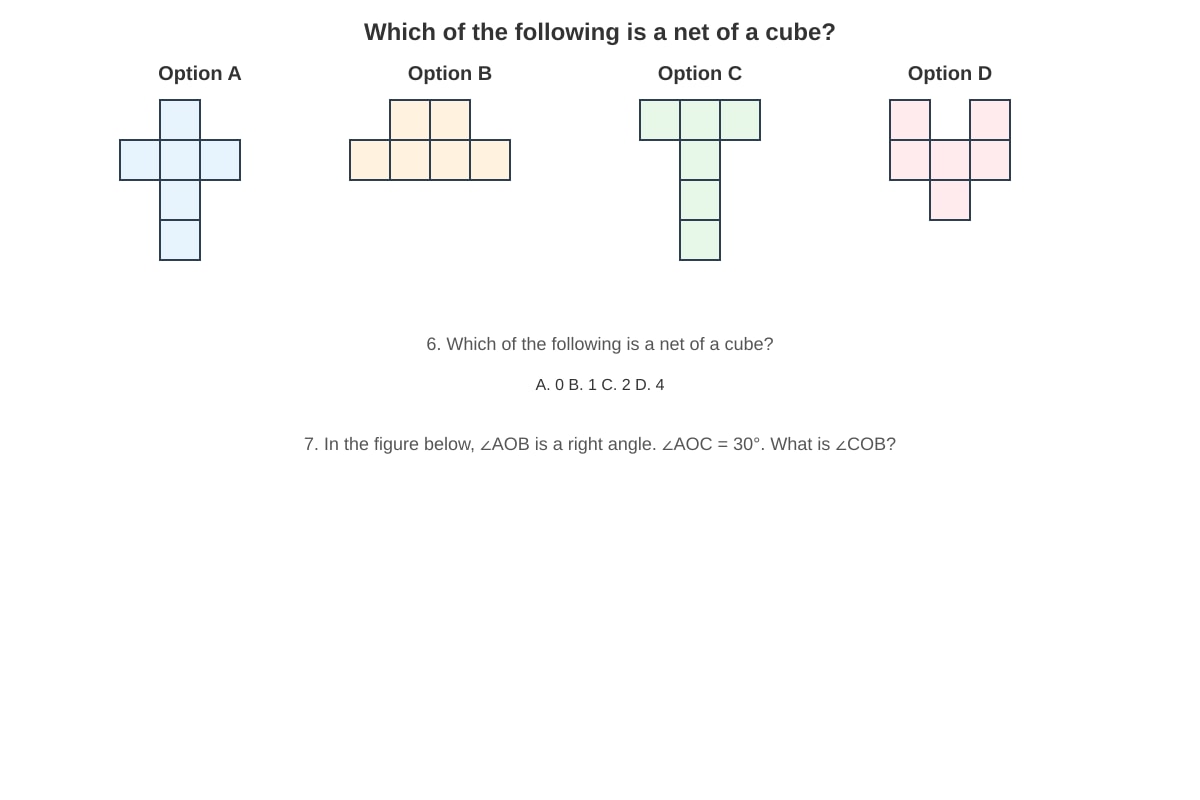
Explanation: A valid cube net must have 6 squares that can fold to form a closed cube. Option A (cross shape) and Option C (T-shape) are both valid cube nets. However, only Option A is listed as a choice. Option B has 4 squares in a row with 2 attached on the same side — this creates overlapping faces when folded. Option D has an arrangement that cannot form a closed cube.
7. B (1 mark)
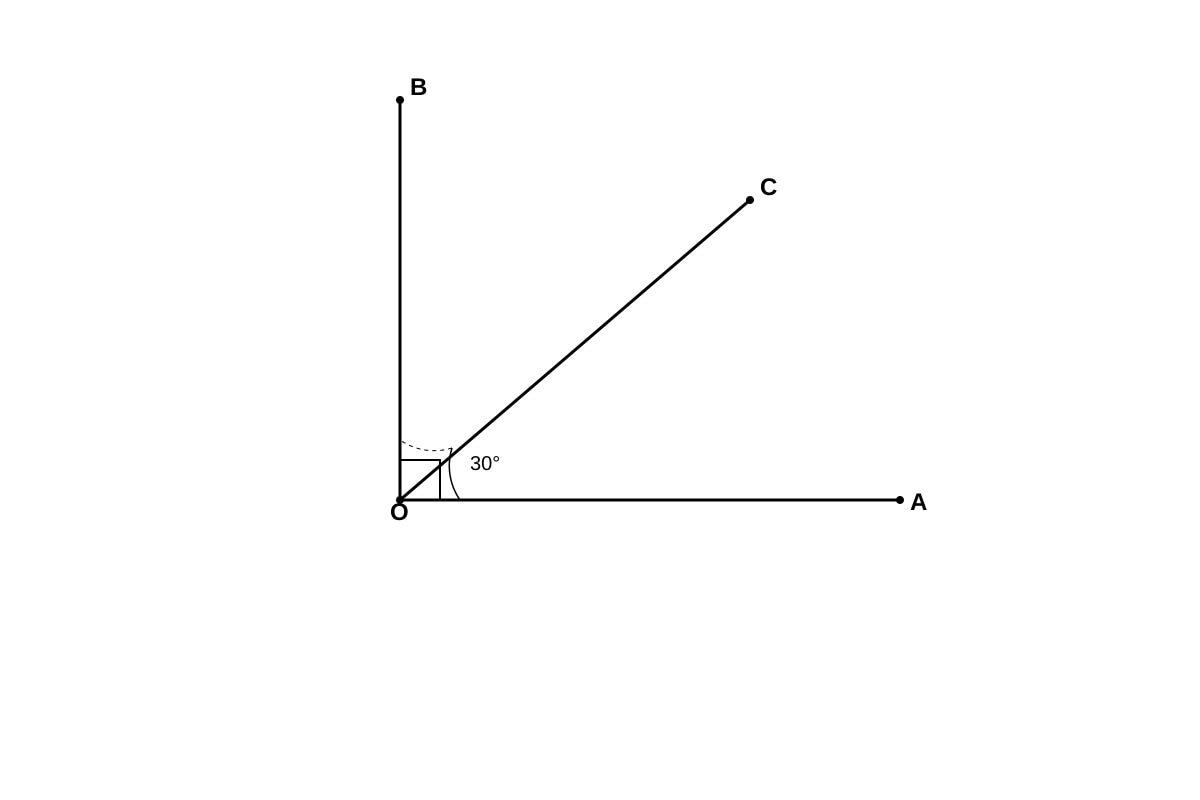
Explanation: ∠AOB = 90° (right angle). ∠AOC = 30°.
∠COB = ∠AOB − ∠AOC = 90° − 30° = 60°.
8. C (1 mark)
Explanation: A rectangle (that is not a square) has exactly 2 lines of symmetry: one vertical and one horizontal through the centre. The dimensions (12 cm × 8 cm) confirm it is not a square.
9. B (1 mark)
Explanation: A regular hexagon can tessellate because its interior angle is 120°, and 360° ÷ 120° = 3, so three hexagons meet perfectly at a point.
- Regular pentagon: interior angle 108°, 360° ÷ 108° = 3.33... (not whole number)
- Regular heptagon: interior angle ≈ 128.6°, does not divide 360° evenly
- Circle: cannot tessellate (gaps remain)
10. A (1 mark)
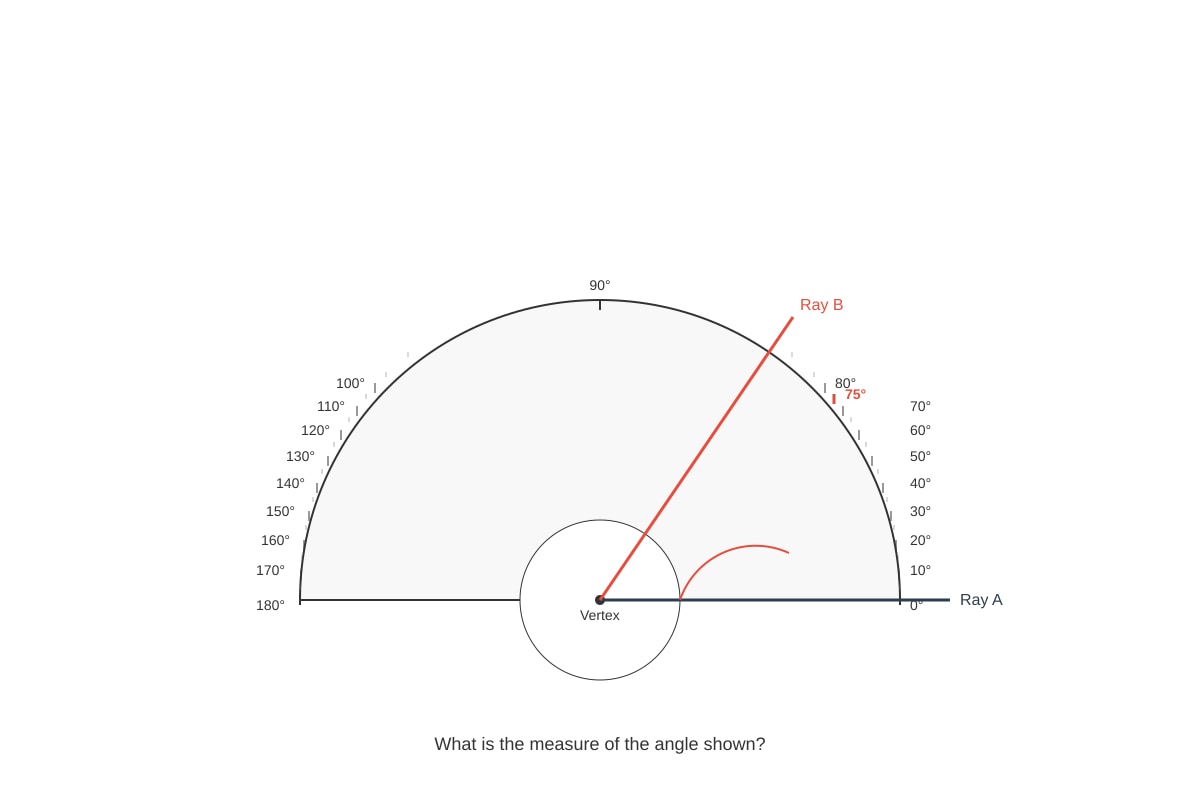
Explanation: The protractor shows one ray at 0° and the other at 75°. The angle measured is 75°.
Section B: Short Answer Questions (10 × 2 marks = 20 marks)
11. 120° (2 marks)
Working:
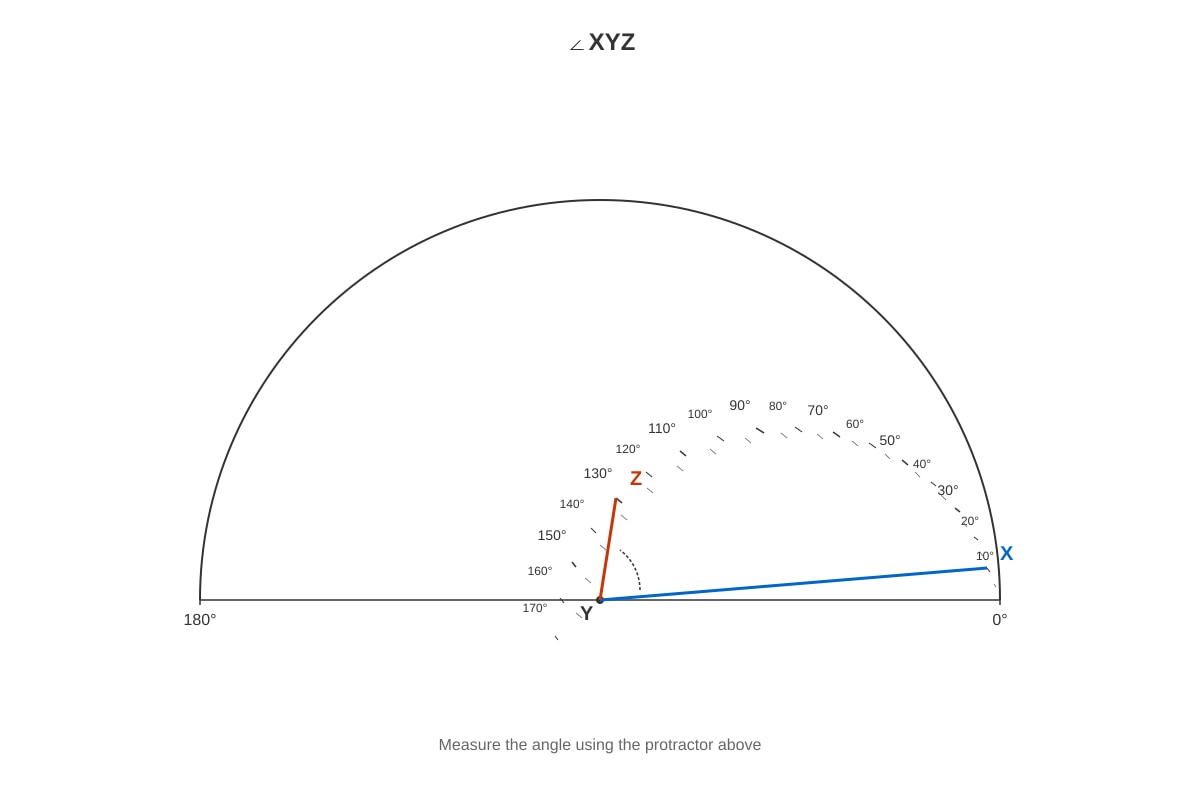
- Ray YX is at 10° on the protractor.
- Ray YZ is at 130° on the protractor.
- ∠XYZ = 130° − 10° = 120°.
Marking: 1 mark for correct reading of both rays, 1 mark for correct subtraction and answer with degree symbol.
Common mistake: Reading the wrong scale on the protractor (using 180° − 130° = 50° and 180° − 10° = 170°). Always read from the same scale (usually the inner scale starting from 0° on the baseline ray).
12. (2 marks)
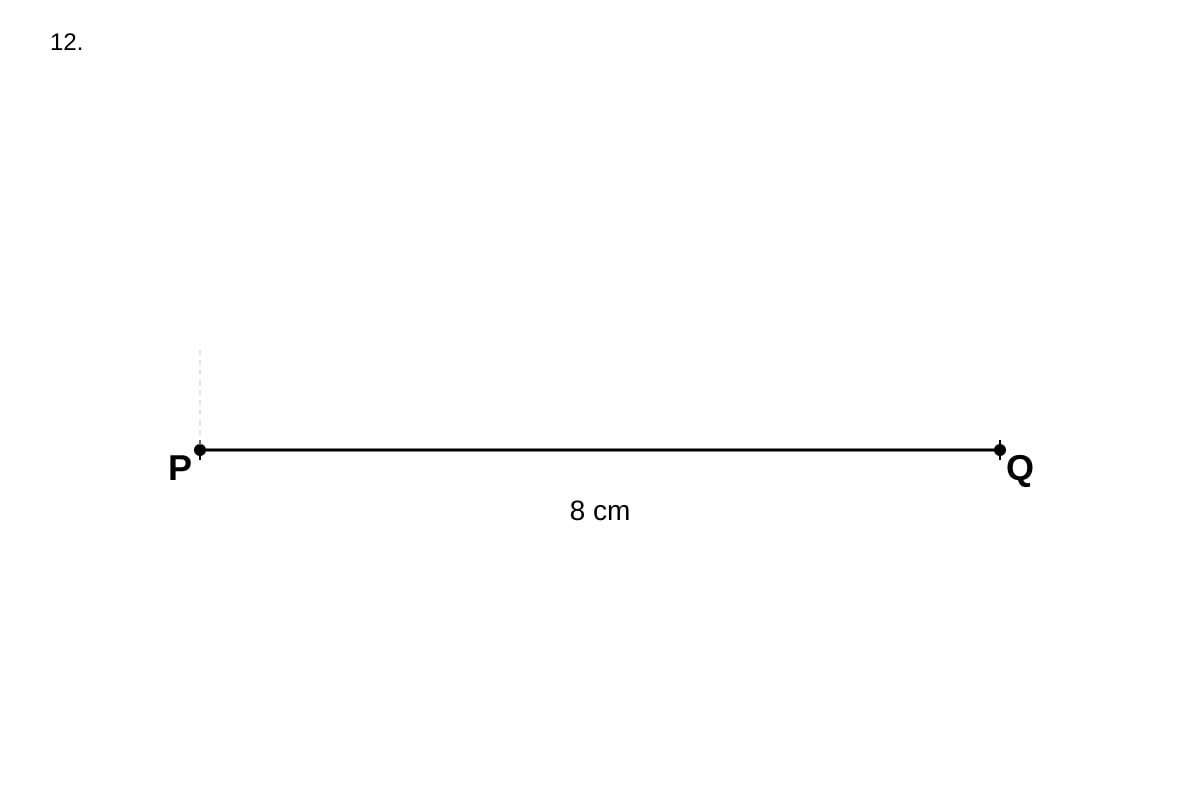
Expected drawing:
- Place protractor centre at point P, baseline along PQ.
- Mark a point at 110° on the protractor (using inner scale).
- Remove protractor and draw ray PR through the marked point.
- Label the angle ∠RPQ.
Marking: 1 mark for accurate angle (110° ± 2°), 1 mark for correct labelling (∠RPQ or ∠QPR with vertex at P).
Teaching note: An angle of 110° is an obtuse angle (between 90° and 180°). The ray should open upward from the horizontal line PQ.
13. 115° (2 marks)
Working:
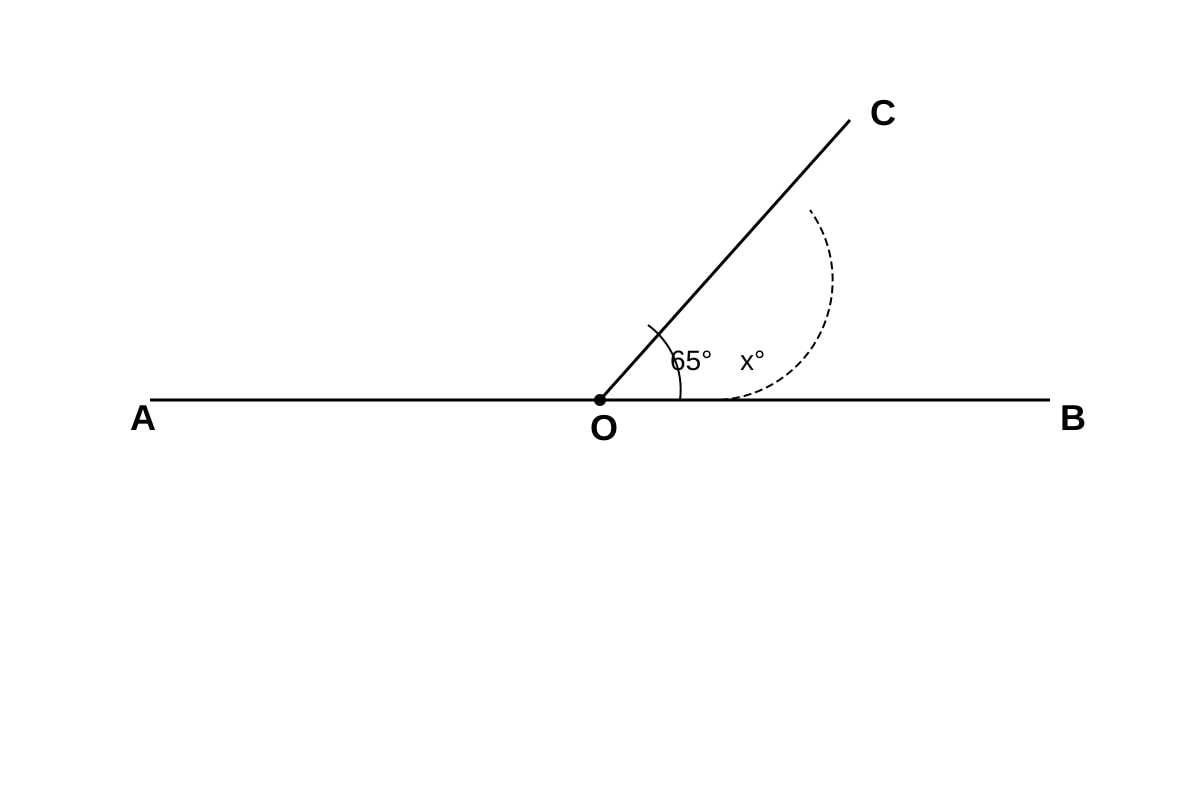
- AB is a straight line, so ∠AOB = 180° (angles on a straight line).
- ∠AOC = 65° (given).
- ∠COB = ∠AOB − ∠AOC = 180° − 65° = 115°.
- ∠x = 115°.
Marking: 1 mark for stating "angles on a straight line = 180°" or equivalent reasoning, 1 mark for correct answer.
Key concept: Angles on a straight line add up to 180°.
14. (2 marks)
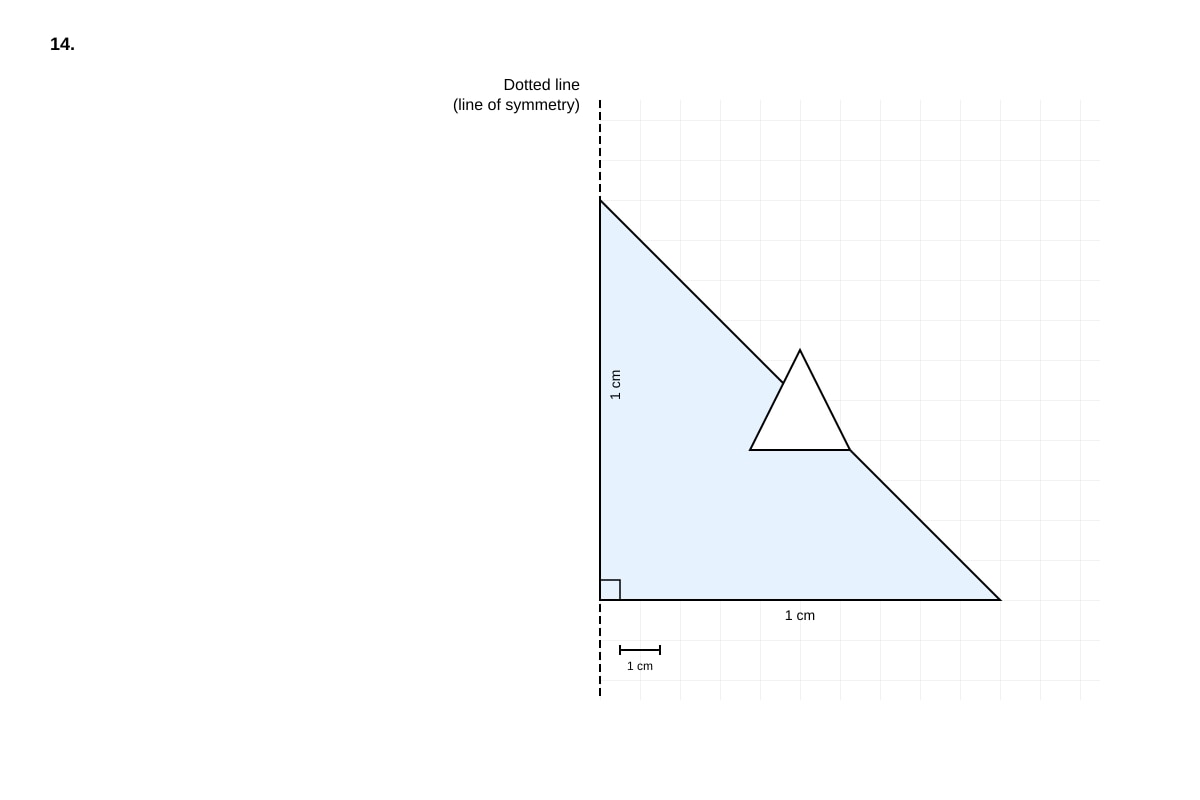
Expected completion: Reflect the given half-shape across the vertical dotted line of symmetry. Each grid square on the right must have a matching square on the left at the same distance from the line.
Marking: 1 mark for correct reflection of main shape, 1 mark for correct reflection of the notch/detail. Deduct ½ mark per grid square error (max 2 marks).
Teaching note: For line symmetry, every point on one side has a matching point on the other side at the same perpendicular distance from the line of symmetry.
15. (2 marks)
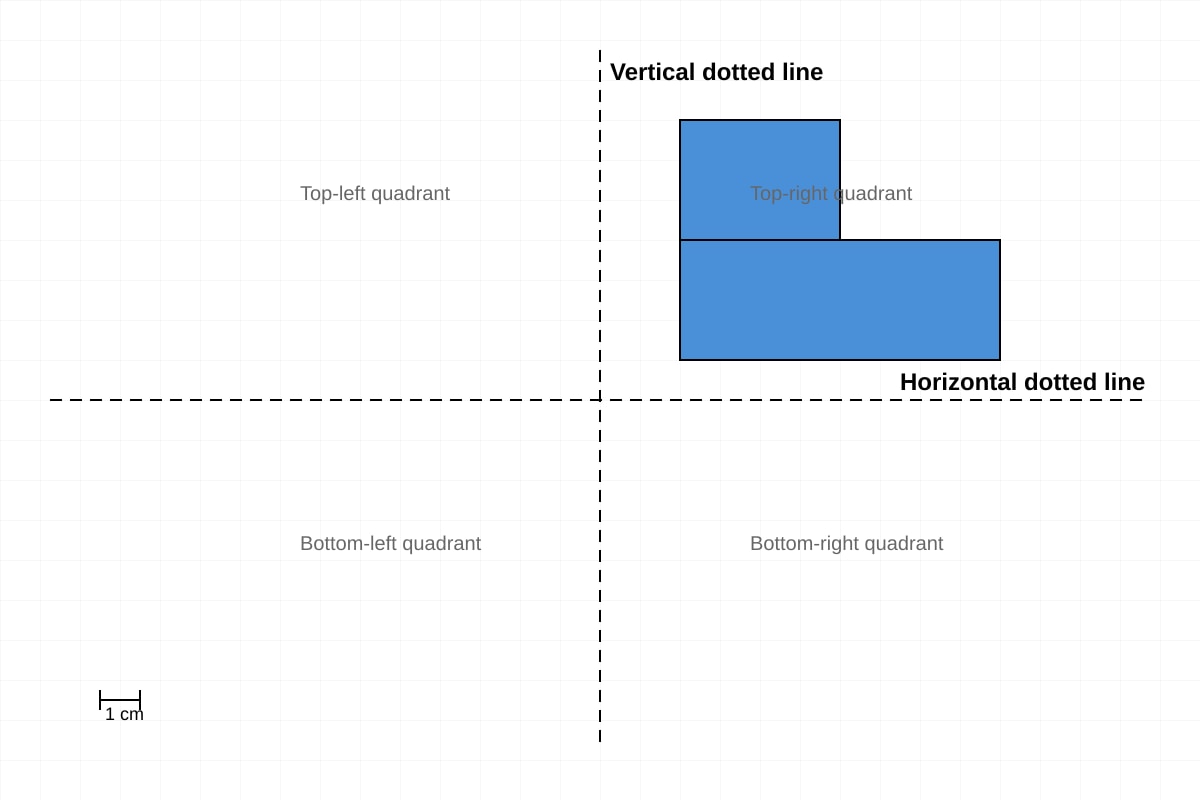
Expected completion: Reflect the quarter-shape across the vertical dotted line to the top-left quadrant, then reflect both top quadrants across the horizontal dotted line to the bottom two quadrants. The final shape has 4-fold rotational symmetry (or 2 lines of symmetry).
Marking: 1 mark for correct vertical reflection, 1 mark for correct horizontal reflection (or 2 marks for fully correct completed shape).
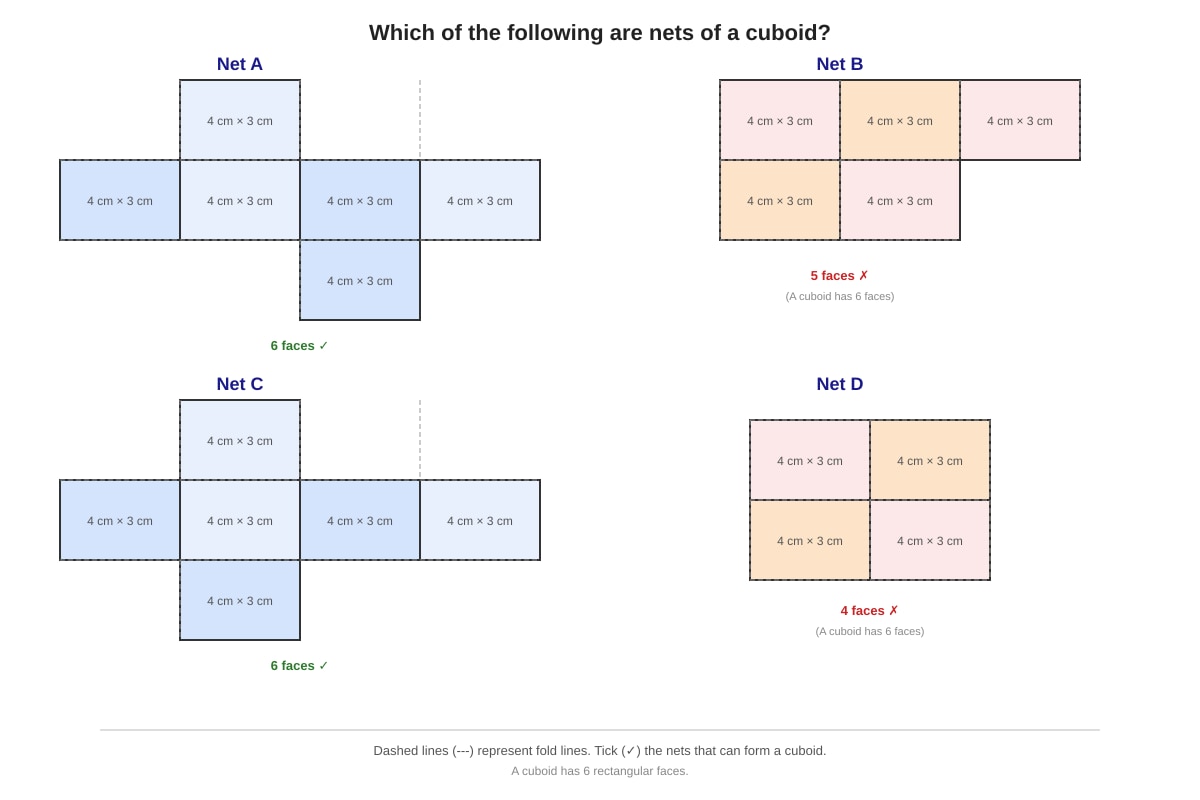
16. Net A and Net C (2 marks)
Explanation: A cuboid net must have 6 rectangular faces (3 pairs of identical rectangles).
- Net A: 6 rectangles arranged in a valid cross pattern — can fold into a cuboid. ✓
- Net B: Only 5 rectangles — missing one face. ✗
- Net C: 6 rectangles in a T-shape arrangement — valid cuboid net. ✓
- Net D: Only 4 rectangles — missing two faces. ✗
Marking: 1 mark for each correct net identified (A and C). No marks if incorrect nets are also ticked.
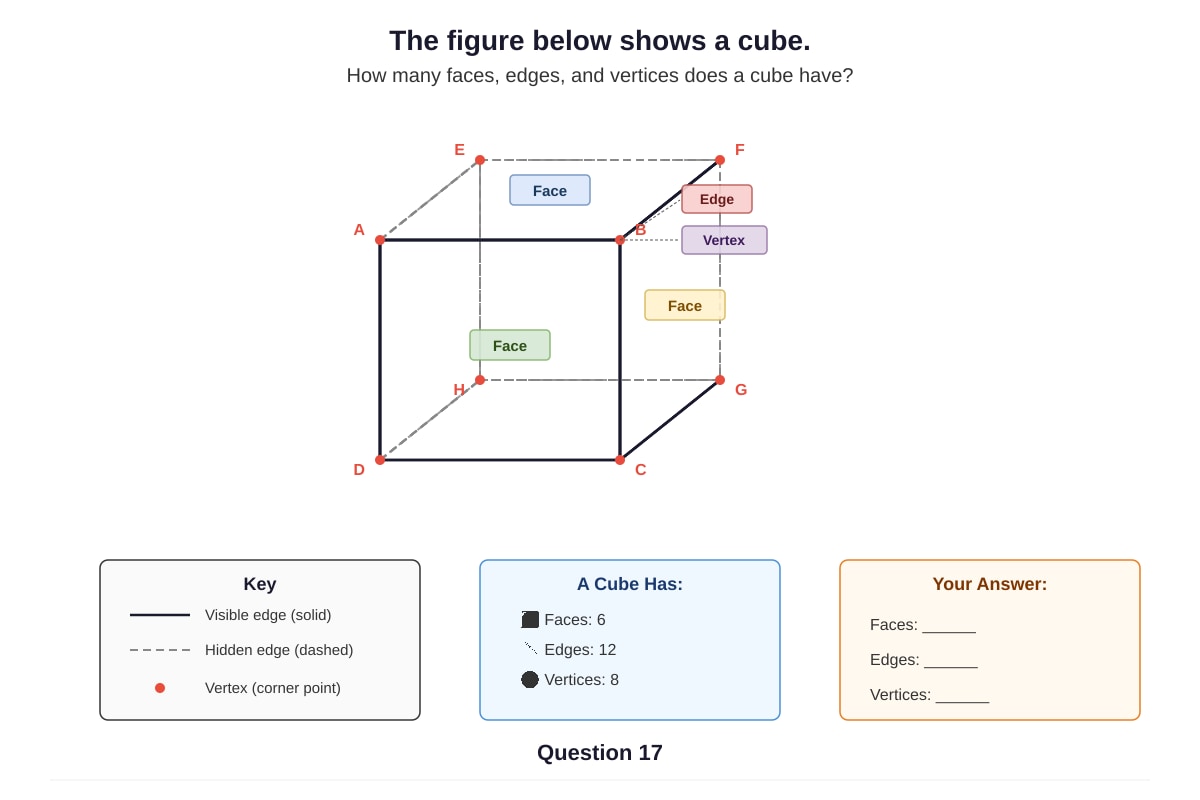
17. Faces: 6, Edges: 12, Vertices: 8 (2 marks)
Explanation: A cube is a 3D solid with:
- 6 square faces (top, bottom, front, back, left, right)
- 12 edges (4 on top, 4 on bottom, 4 vertical)
- 8 vertices (4 on top, 4 on bottom)
Marking: 1 mark for all three correct, ½ mark each if 1–2 correct (round down to nearest ½ mark).
Teaching note: Euler's formula for polyhedra: Faces + Vertices = Edges + 2 → 6 + 8 = 12 + 2 ✓
18. 120° (2 marks)
Working:
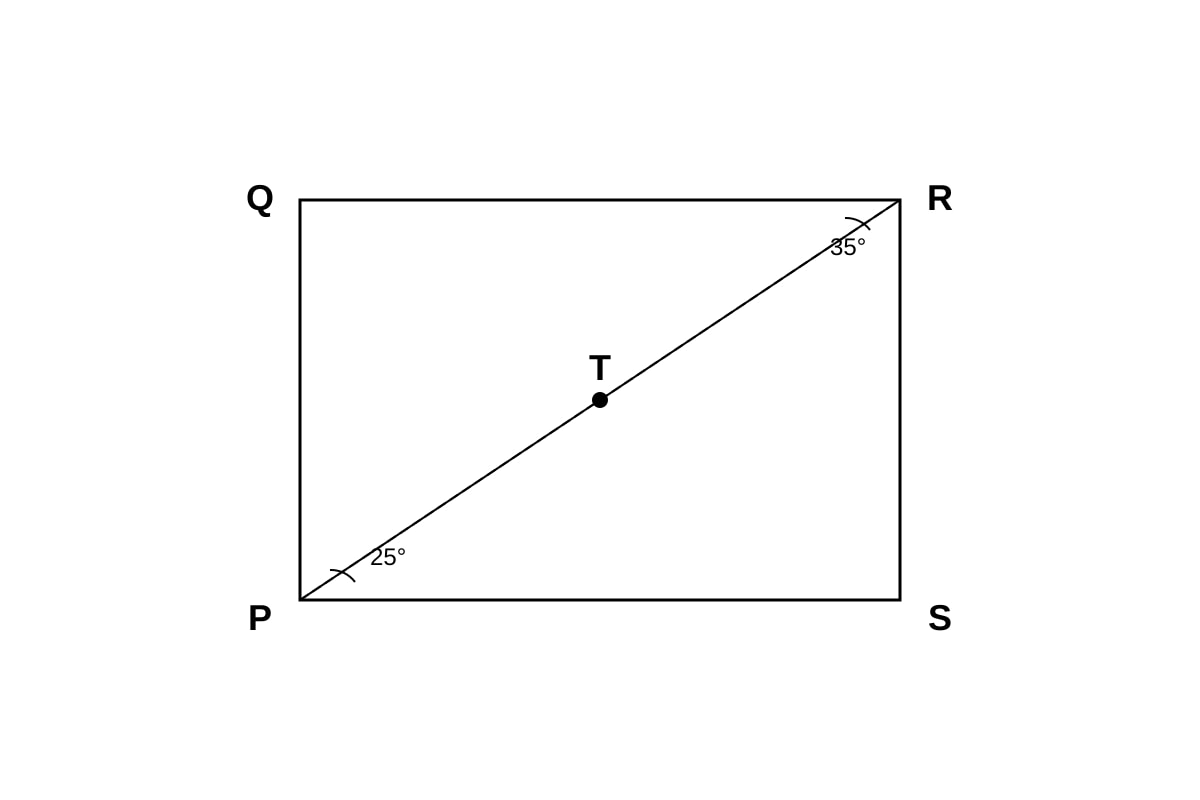
- PQRS is a rectangle, so all interior angles are 90°.
- ∠SPT = 25° (given), so ∠TPR = 90° − 25° = 65°.
- ∠QRT = 35° (given), so ∠TRS = 90° − 35° = 55°.
- In triangle PTR: ∠TPR + ∠TRS + ∠PTR = 180° (angle sum of triangle).
- 65° + 55° + ∠PTR = 180°
- 120° + ∠PTR = 180°
- ∠PTR = 60°
Wait — correction: The angles at P and R in triangle PTR are ∠TPR and ∠PRT, not ∠TRS. Let's re-read the diagram carefully.
Point T is inside rectangle PQRS.
∠SPT = 25° → ∠TPR = 90° − 25° = 65° (since ∠SPR = 90°).
∠QRT = 35° → ∠PRT = 90° − 35° = 55° (since ∠QRP = 90°).
In ΔPTR: ∠TPR + ∠PRT + ∠PTR = 180°
65° + 55° + ∠PTR = 180°
120° + ∠PTR = 180°
∠PTR = 60°
Correct Answer: 60° (2 marks)
Marking: 1 mark for finding ∠TPR = 65° and ∠PRT = 55°, 1 mark for correct triangle angle sum and final answer.
Common mistake: Using ∠TRS (55°) instead of ∠PRT, or forgetting that rectangle corners are 90°.
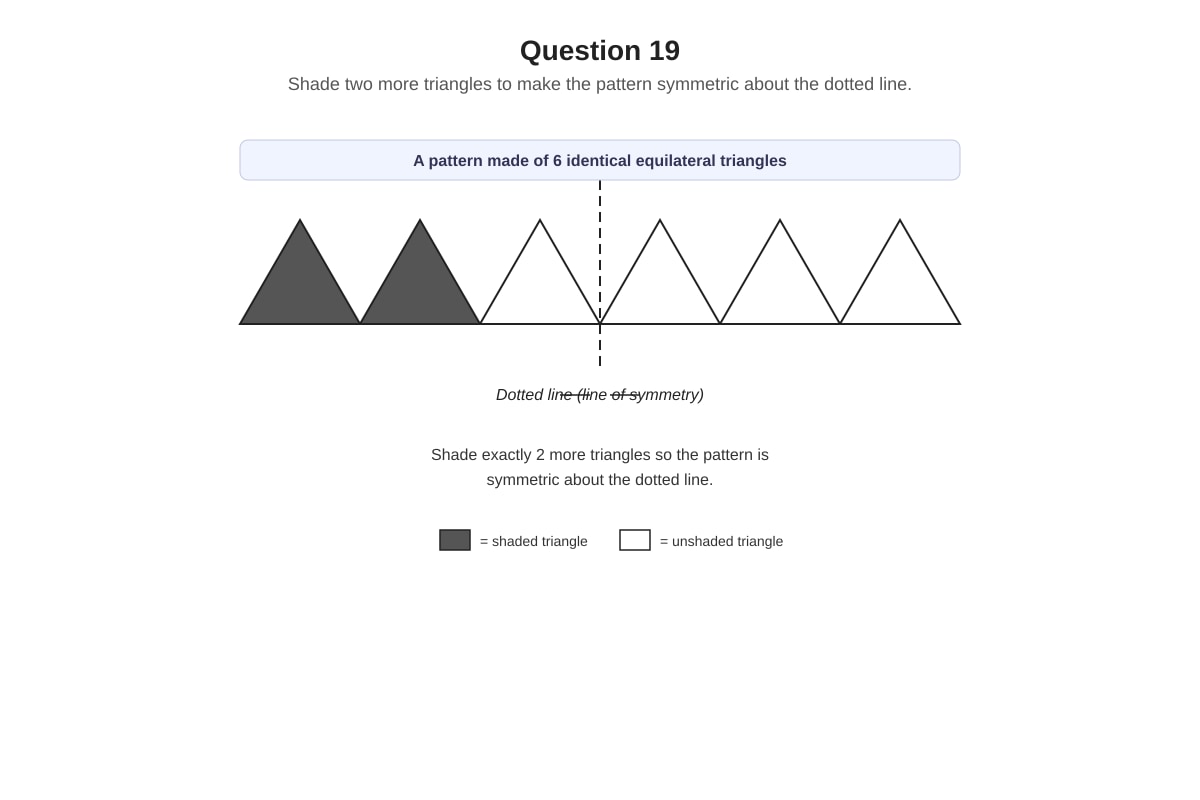
19. (2 marks)
Expected shading: Shade the 4th and 5th triangles (counting from left) — the mirror images of the 3rd and 2nd triangles respectively, across the vertical dotted line between the 3rd and 4th triangles.
Marking: 1 mark for each correctly shaded triangle in the symmetric position.
Teaching note: The line of symmetry acts like a mirror. The pattern on the right must be the mirror image of the pattern on the left.
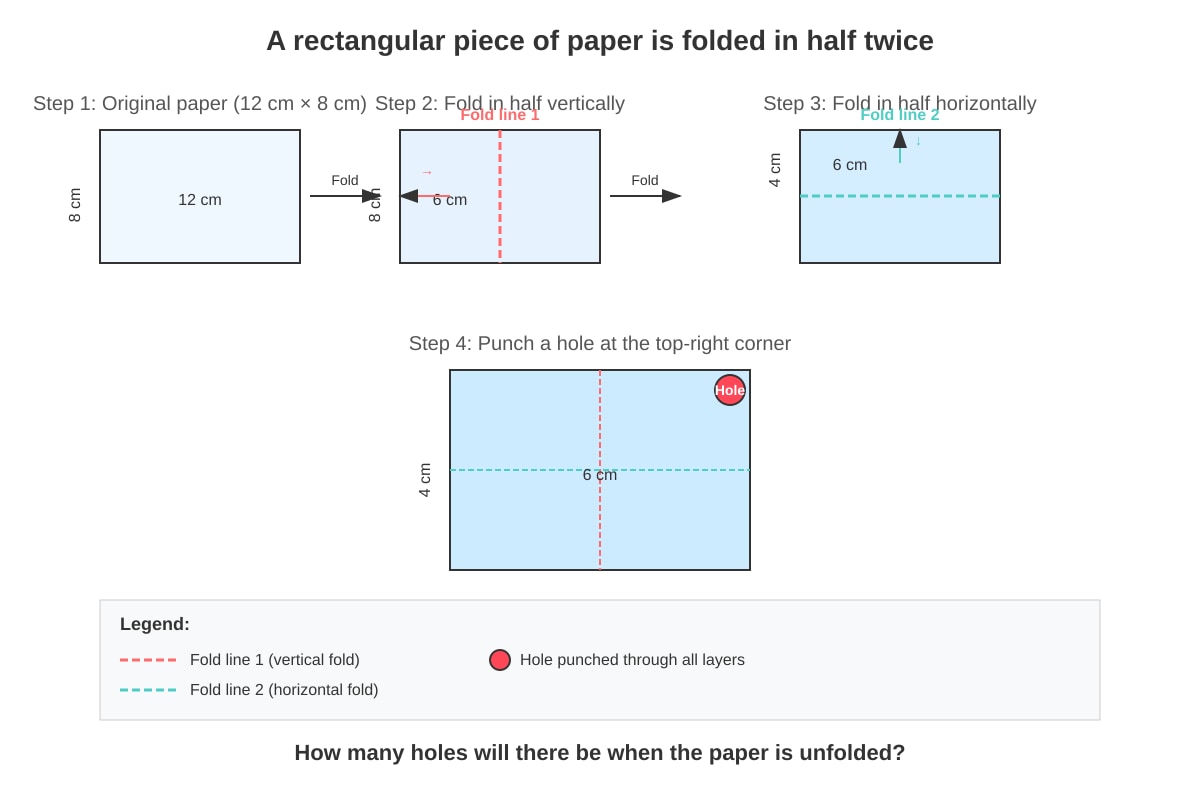
20. 4 holes (2 marks)
Explanation:
- First fold (vertical): 2 layers
- Second fold (horizontal): 4 layers total
- One hole punched through all 4 layers
- When unfolded: 4 holes (one in each quadrant)
Marking: 1 mark for understanding 2 folds = 4 layers, 1 mark for correct answer "4 holes".
Teaching note: Each fold doubles the number of layers. Number of holes = 2^(number of folds) = 2² = 4.
End of Answer Key