AI Generated Quiz

Primary 4 Mathematics Data Analysis Quiz

Free P4 Maths Data Analysis quiz with questions, answers, and syllabus-aligned practice for Singapore students preparing for school assessments.

These static practice materials are generated from the site's syllabus and paper-generation workflow, with source and model context shown so students and parents can evaluate the material before use.

Primary 4 Mathematics AI Generated Generated by Kimi K2.6 Free Updated 2026-06-09

Questions

<!-- TuitionGoWhere generation metadata: stage=5-1; model=moonshotai/kimi-k2.6:free; model_label=Kimi K2.6 Free; generated=2026-06-09; Sources: Stage 4-0 LLM templates, syllabus context, and Stage 2 evidence where available. -->

Primary 4 Mathematics Quiz - Data Analysis

Name: _________________________ Class: ___________ Date: ___________

Duration: 40 minutes
Total Marks: 40 marks
Instructions: Answer all questions. Show your working clearly.


Section A: Tables and Lists (Questions 1-7, 14 marks)

Answer all questions. Each question carries 2 marks unless stated otherwise.


1. The table below shows the number of books borrowed from a school library in a week.

DayMondayTuesdayWednesdayThursdayFriday
Books borrowed145203178256198

(a) On which day were the most books borrowed? (1 mark)


(b) How many more books were borrowed on Thursday than on Monday? (1 mark)


2. The table shows the favourite sports of 80 Primary 4 students.

SportSwimmingBadmintonBasketballSoccerRunning
Number of students18241615?

(a) How many students chose Running? (1 mark)


(b) Which two sports were chosen by exactly 40 students altogether? (1 mark)


3. A shop sells four types of fruits. The table shows their prices per kilogram.

FruitAppleOrangePearGrapes
Price per kg$4.50$3.80$5.20$7.90

Ming has $20. He wants to buy 2 kg of oranges and 1 kg of apples.

(a) How much does Ming need to pay? (1 mark)


(b) Does Ming have enough money? If not, how much more does he need? (1 mark)


4. The table shows the temperature in four cities on a certain day.

CityTokyoSeoulBangkokSingapore
Temperature (°C)1253431

(a) What is the difference in temperature between the hottest and coldest city? (1 mark)


(b) The temperature in London was 8°C lower than in Tokyo. What was the temperature in London? (1 mark)


5. The table shows the number of stamps in three collections.

CollectorLocal stampsForeign stampsTotal
Ali4538?
Ben6229?
Charlie51?97

(a) Complete the table by filling in the three missing numbers. (1 mark)


(b) Who has the most stamps altogether? (1 mark)


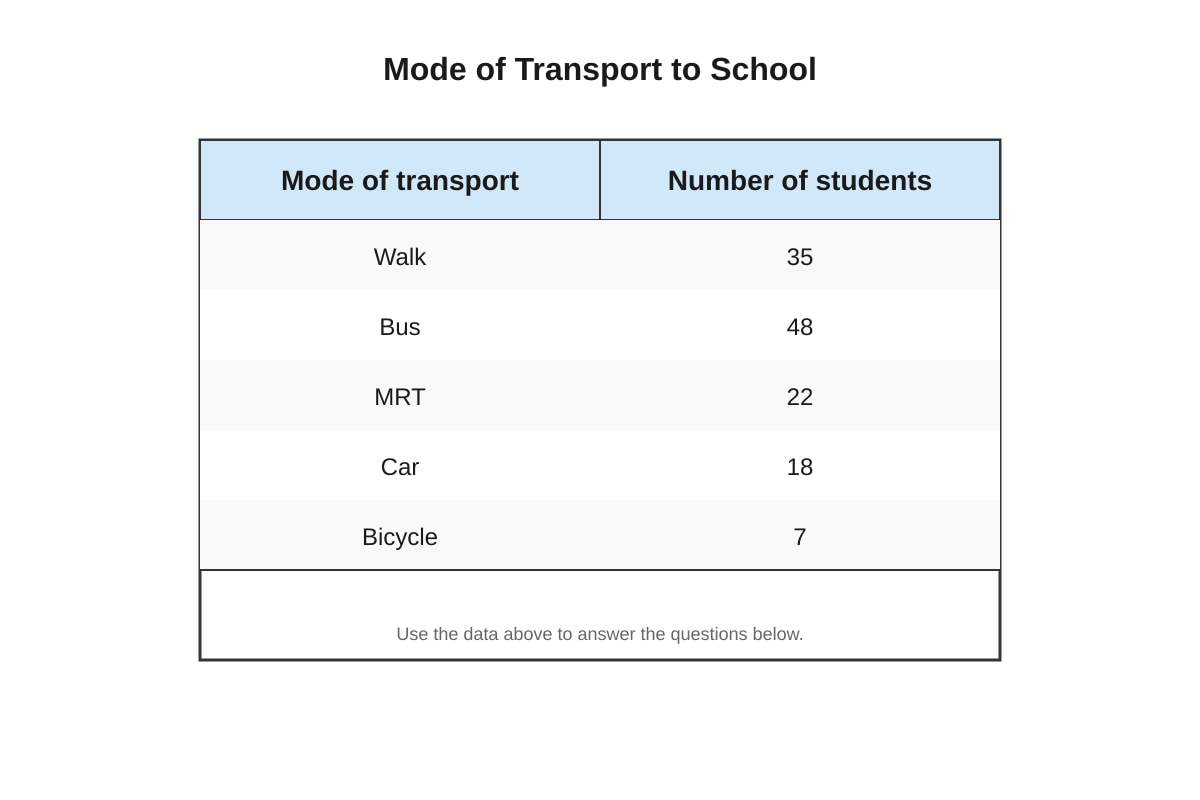
6. A survey was done to find how students travel to school. The results are shown below.

Mode of transportWalkBusMRTCarBicycle
Number of students354822187

<image_placeholder> id: Q6-fig1 type: table linked_question: Q6 description: Adapt this table into a simple table for creating a bar graph later; not needed for direct answer but kept for syllabus alignment labels: Mode of transport, Number of students values: Walk 35, Bus 48, MRT 22, Car 18, Bicycle 7 must_show: All five categories with correct corresponding values </image_placeholder>

(a) How many students were surveyed altogether? (1 mark)


(b) How many more students travel by bus than by MRT and bicycle combined? (1 mark)


7. The table shows the scores of four players in a game.

PlayerRound 1Round 2Round 3Total
Devi8592?260
Esther78?88250
Farhan908587?
Gina?7684245

(a) What was Devi's score in Round 3? (1 mark)


(b) Which player had the highest total score? (1 mark)


Section B: Line Graphs (Questions 8-14, 14 marks)


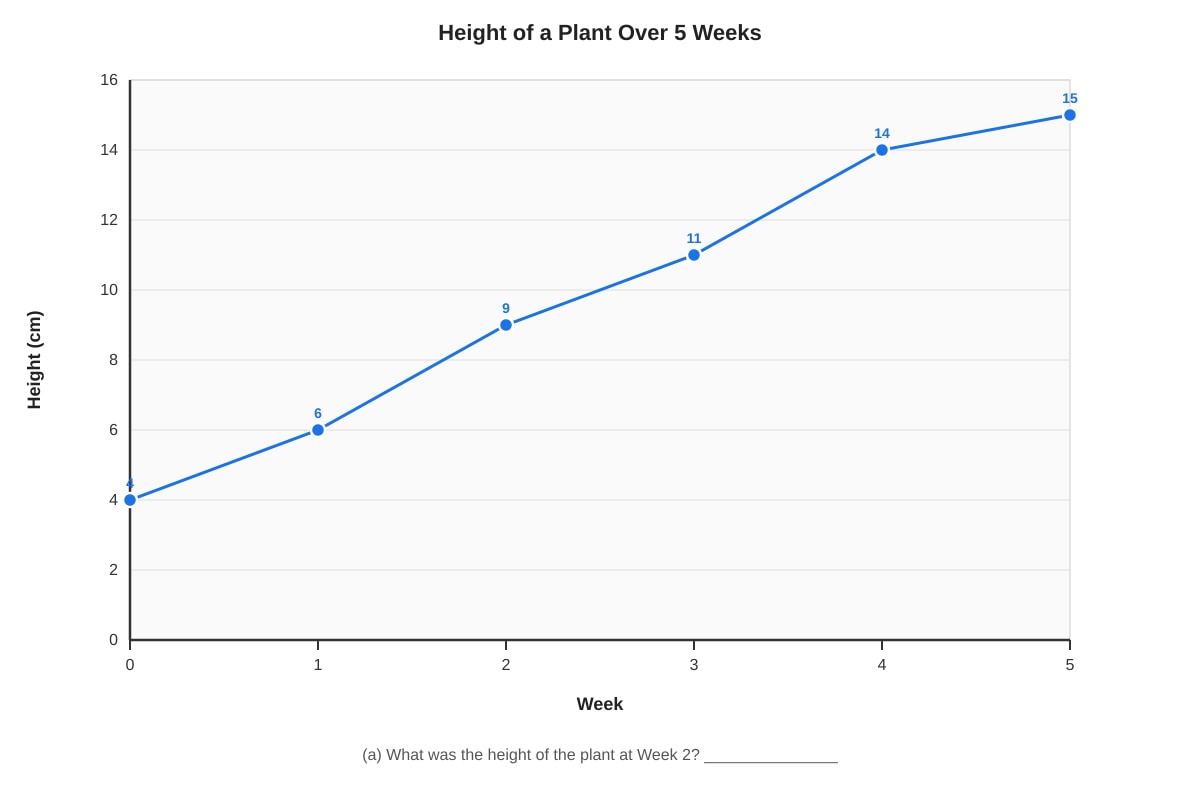
8. The line graph below shows the height of a plant over 5 weeks.

<image_placeholder> id: Q8-fig1 type: graph linked_question: Q8 description: Line graph showing plant height over 5 weeks labels: x-axis labeled "Week" with values 0, 1, 2, 3, 4, 5; y-axis labeled "Height (cm)" with scale 0, 2, 4, 6, 8, 10, 12, 14, 16 values: Week 0: 4 cm, Week 1: 6 cm, Week 2: 9 cm, Week 3: 11 cm, Week 4: 14 cm, Week 5: 15 cm must_show: Data points at each week connected by straight line segments; clear grid lines; labeled axes with units </image_placeholder>

(a) What was the height of the plant at Week 2? (1 mark)


(b) Between which two weeks did the plant grow the most? (1 mark)


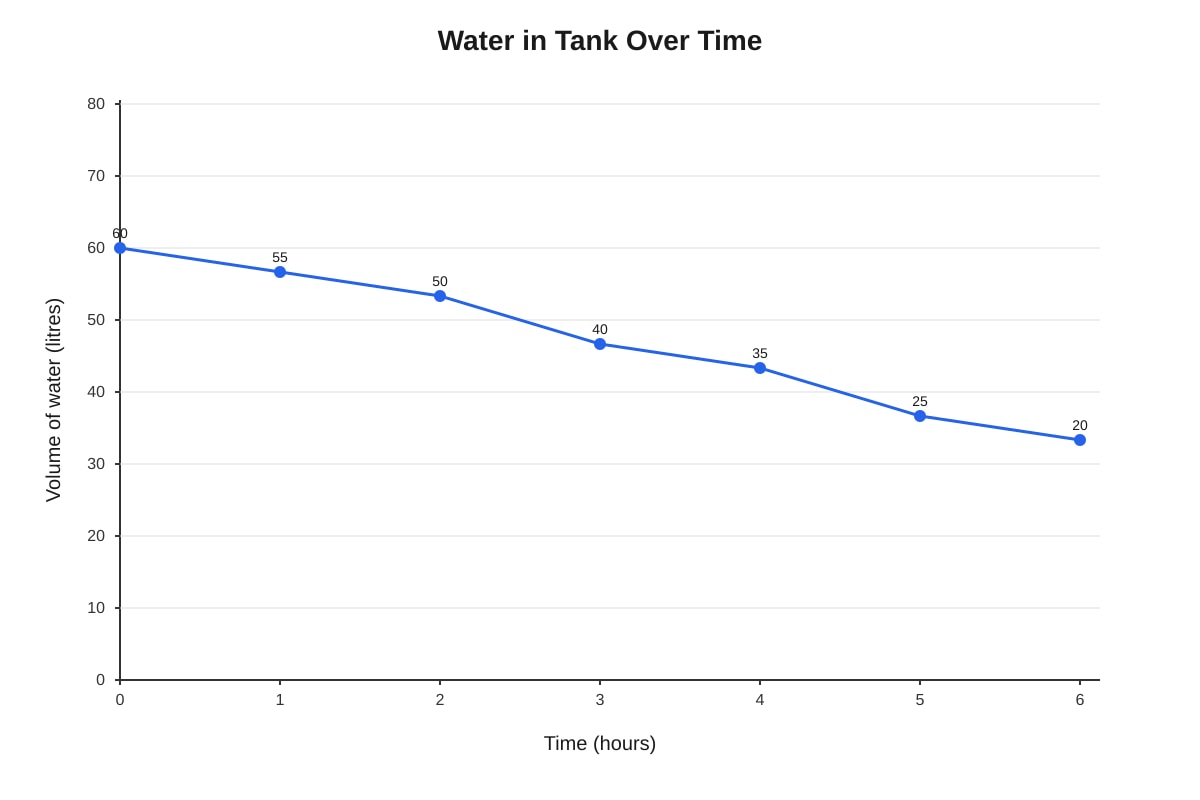
9. The line graph shows the amount of water in a tank over 6 hours.

<image_placeholder> id: Q9-fig1 type: graph linked_question: Q9 description: Line graph showing water volume in a tank over time labels: x-axis labeled "Time (hours)" with values 0, 1, 2, 3, 4, 5, 6; y-axis labeled "Volume of water (litres)" with scale 0, 10, 20, 30, 40, 50, 60, 70, 80 values: Hour 0: 60 L, Hour 1: 55 L, Hour 2: 50 L, Hour 3: 40 L, Hour 4: 35 L, Hour 5: 25 L, Hour 6: 20 L must_show: Downward sloping line with data points; clearly labeled axes with units; title "Water in Tank Over Time" </image_placeholder>

(a) How much water was in the tank at the start? (1 mark)


(b) How much water was lost between Hour 2 and Hour 5? (1 mark)


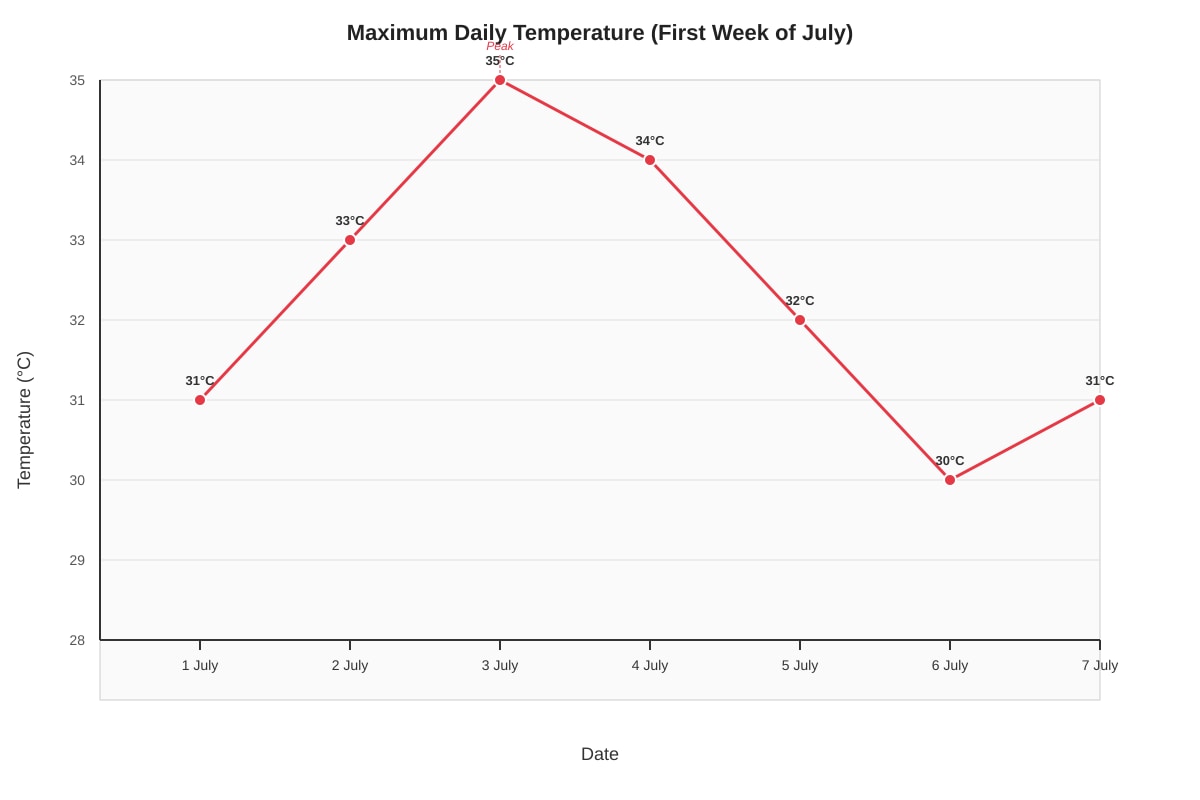
10. The line graph shows the maximum daily temperature for the first week of July.

<image_placeholder> id: Q10-fig1 type: graph linked_question: Q10 description: Line graph showing daily maximum temperature over 7 days labels: x-axis labeled "Date" with values 1, 2, 3, 4, 5, 6, 7 July; y-axis labeled "Temperature (°C)" with scale 28, 29, 30, 31, 32, 33, 34, 35 values: 1 July: 31°C, 2 July: 33°C, 3 July: 35°C, 4 July: 34°C, 5 July: 32°C, 6 July: 30°C, 7 July: 31°C must_show: Data points connected by line; peak at 3 July; labeled axes; grid lines for reading values </image_placeholder>

(a) On which date was the temperature the highest? (1 mark)


(b) What was the increase in temperature from 1 July to 3 July? (1 mark)


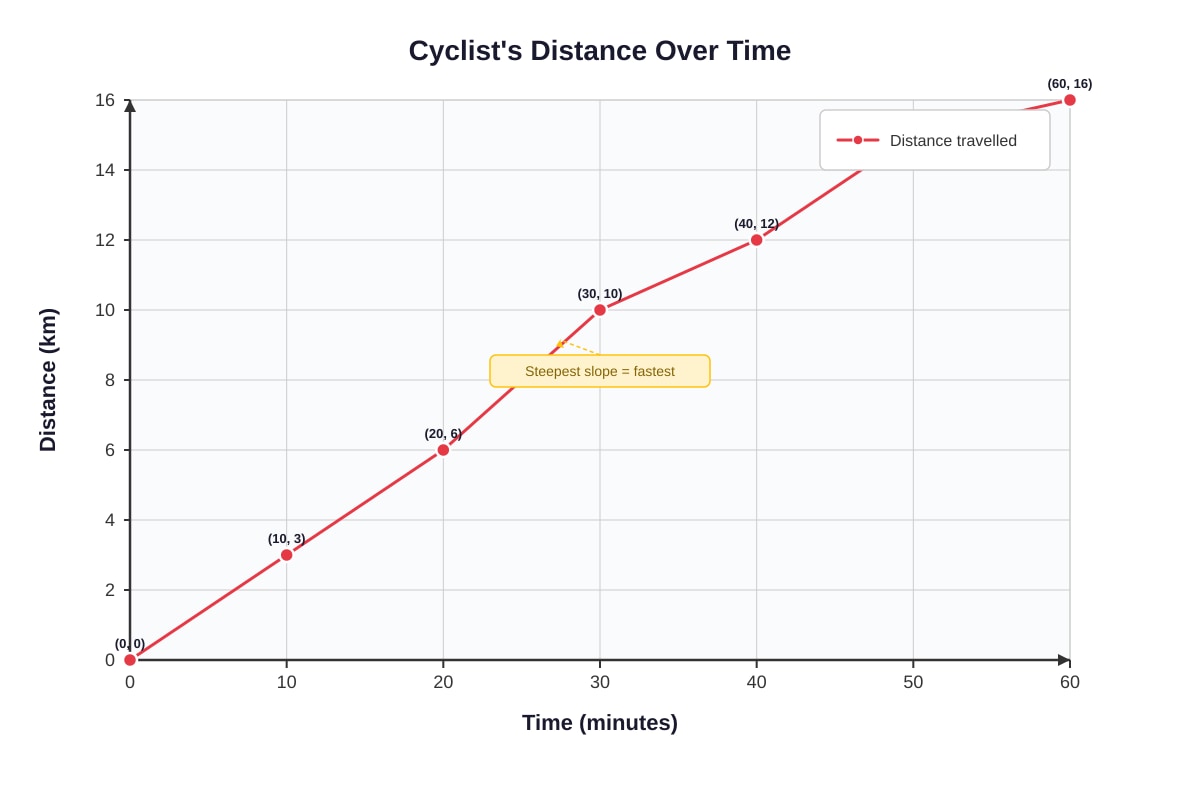
11. The line graph shows the distance travelled by a cyclist during a race.

<image_placeholder> id: Q11-fig1 type: graph linked_question: Q11 description: Line graph showing cumulative distance of cyclist over time labels: x-axis labeled "Time (minutes)" with values 0, 10, 20, 30, 40, 50, 60; y-axis labeled "Distance (km)" with scale 0, 2, 4, 6, 8, 10, 12, 14, 16 values: 0 min: 0 km, 10 min: 3 km, 20 min: 6 km, 30 min: 10 km, 40 min: 12 km, 50 min: 15 km, 60 min: 16 km must_show: Non-uniform slope showing varying speed; clearly marked data points; axes with units; title "Cyclist's Distance Over Time" </image_placeholder>

(a) How far did the cyclist travel in the first 30 minutes? (1 mark)


(b) During which 10-minute interval was the cyclist fastest? Explain how you can tell from the graph. (2 marks)


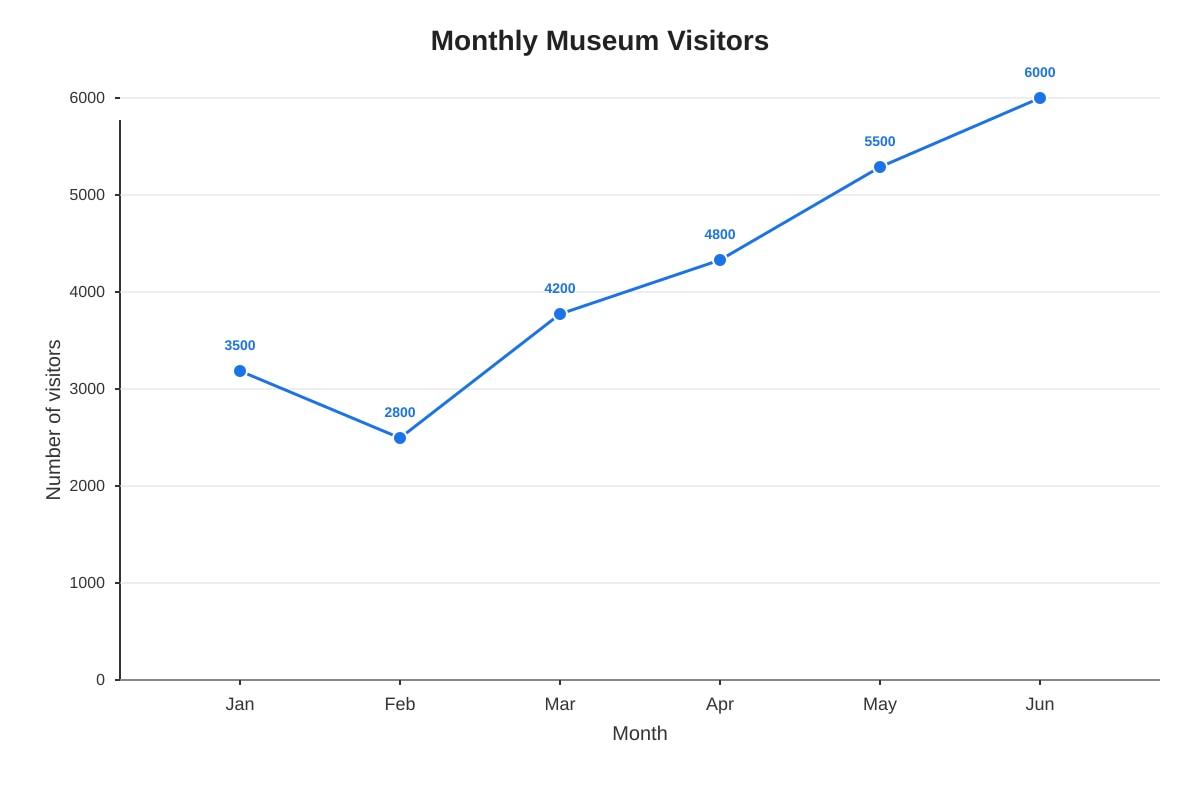
12. The line graph shows the number of visitors to a museum over a 6-month period.

<image_placeholder> id: Q12-fig1 type: graph linked_question: Q12 description: Line graph showing monthly museum visitors labels: x-axis labeled "Month" with Jan, Feb, Mar, Apr, May, Jun; y-axis labeled "Number of visitors" with scale 0, 1000, 2000, 3000, 4000, 5000, 6000 values: Jan: 3500, Feb: 2800, Mar: 4200, Apr: 4800, May: 5500, Jun: 6000 must_show: Upward trend overall with dip in Feb; labeled data points; axes with clear scales; grid lines </image_placeholder>

(a) In which month were there 4200 visitors? (1 mark)


(b) What was the total number of visitors from March to June? (2 marks)

Working: _______________________________________________


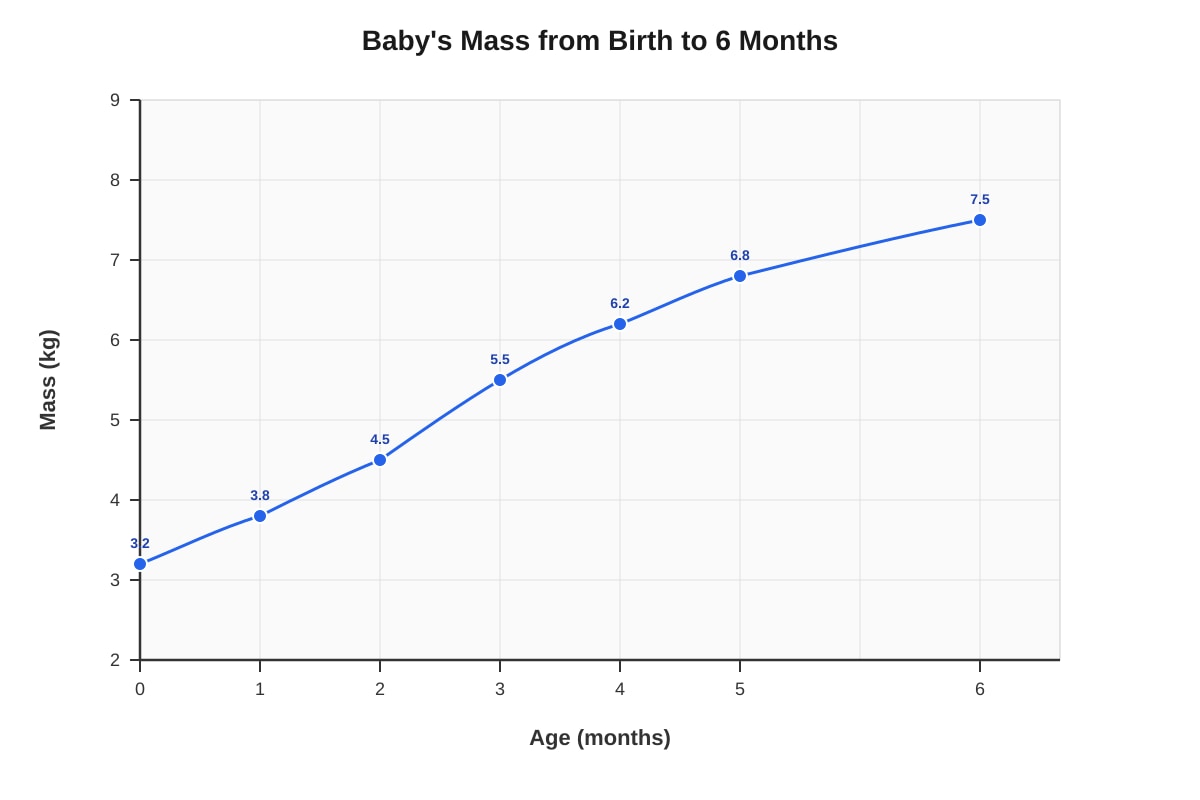
13. The line graph shows the mass of a baby from birth to 6 months old.

<image_placeholder> id: Q13-fig1 type: graph linked_question: Q13 description: Line graph showing baby mass over 6 months labels: x-axis labeled "Age (months)" with values 0, 1, 2, 3, 4, 5, 6; y-axis labeled "Mass (kg)" with scale 2, 3, 4, 5, 6, 7, 8, 9 values: 0 months: 3.2 kg, 1 month: 3.8 kg, 2 months: 4.5 kg, 3 months: 5.5 kg, 4 months: 6.2 kg, 5 months: 6.8 kg, 6 months: 7.5 kg must_show: Steady growth curve; labeled data points; axes with units; gentle upward curve </image_placeholder>

(a) What was the baby's mass at 2 months old? (1 mark)


(b) How much mass did the baby gain from birth to 6 months? (1 mark)


(c) During which month did the baby gain the most mass? (1 mark)


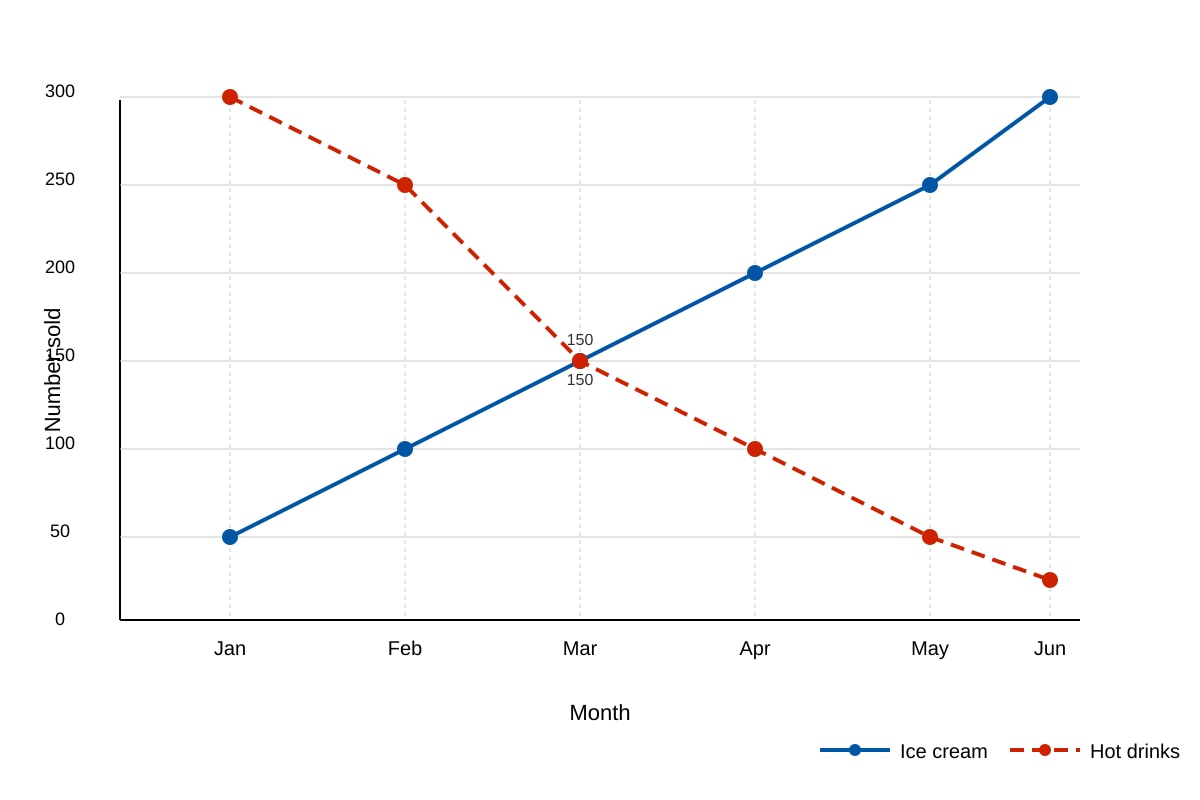
14. Two lines are drawn on the same graph to show the sales of ice cream and hot drinks at a café.

<image_placeholder> id: Q14-fig1 type: graph linked_question: Q14 description: Dual line graph showing sales of two products over 6 months labels: x-axis labeled "Month" with Jan, Feb, Mar, Apr, May, Jun; y-axis labeled "Number sold" with scale 0, 50, 100, 150, 200, 250, 300; legend showing solid line for Ice cream and dashed line for Hot drinks values: Ice cream: Jan 50, Feb 80, Mar 150, Apr 220, May 280, Jun 300; Hot drinks: Jan 250, Feb 200, Mar 150, Apr 100, May 60, Jun 40 must_show: Two clearly distinguished lines (solid vs dashed) with data points; crossing point around March; labeled legend; axes with scales </image_placeholder>

(a) In which month were the sales of ice cream and hot drinks the same? (1 mark)


(b) Describe the trend for ice cream sales from January to June. (1 mark)


(c) Why do you think the two lines show opposite patterns? Give a reason. (1 mark)


Section C: Pie Charts (Questions 15-20, 12 marks)


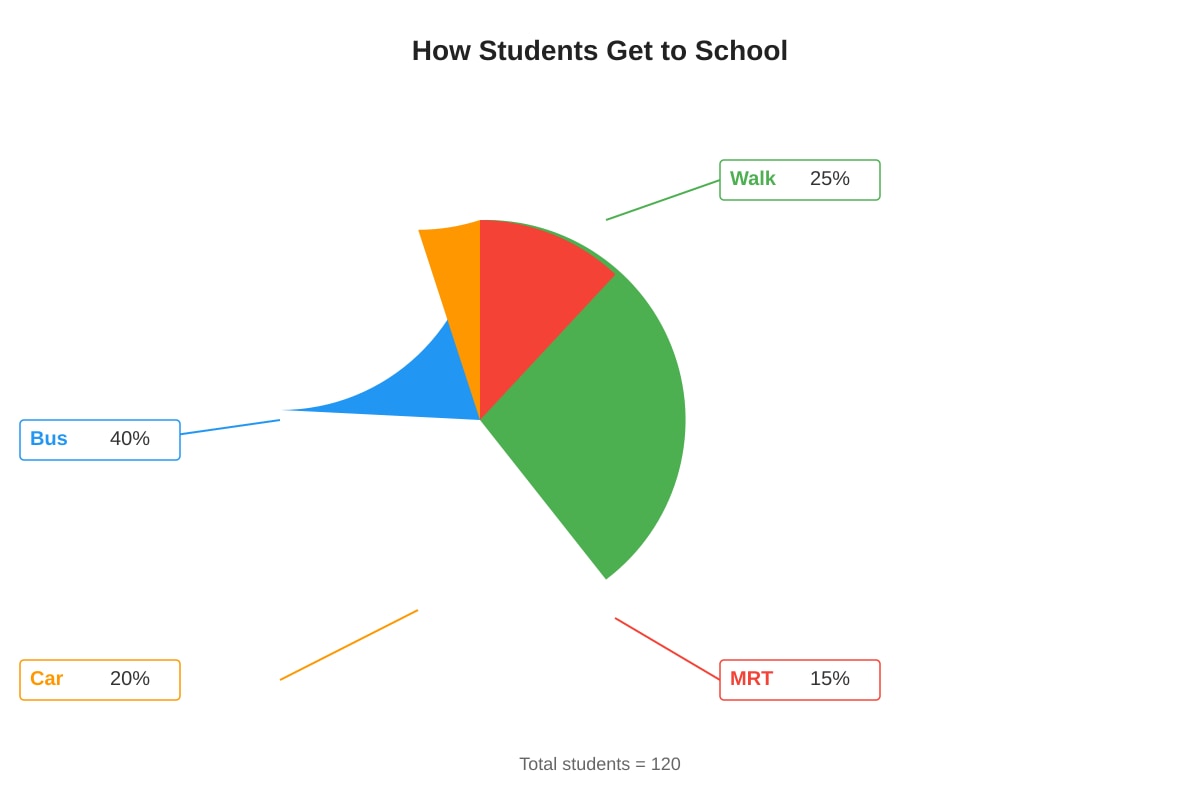
15. The pie chart below shows how 120 students get to school.

<image_placeholder> id: Q15-fig1 type: chart linked_question: Q15 description: Pie chart divided into four sectors for transport modes labels: Four sectors labelled Walk, Bus, Car, MRT; percentages shown as 25% for Walk, 40% for Bus, 20% for Car, 15% for MRT values: Total students = 120; percentages as labeled must_show: Four colored/shaded sectors with clear labels and percentages; title "How Students Get to School" </image_placeholder>

(a) How many students walk to school? (2 marks)

Working: _______________________________________________


16. The pie chart shows how Mrs. Tan spent $800 on a family dinner.

<image_placeholder> id: Q16-fig1 type: chart linked_question: Q16 description: Pie chart showing dinner expenses by category labels: Four sectors labelled Food, Drinks, Dessert, Tips; angle measures shown as Food 180°, Drinks 90°, Dessert 45°, Tips 45° values: Total cost = $800; angles as labeled must_show: Four sectors with angle measures labeled; title "Dinner Expenses"; clear proportional sectors </image_placeholder>

(a) What fraction of the total cost was spent on food? Give your answer in simplest form. (2 marks)

Working: _______________________________________________


(b) How much was spent on drinks? (2 marks)

Working: _______________________________________________


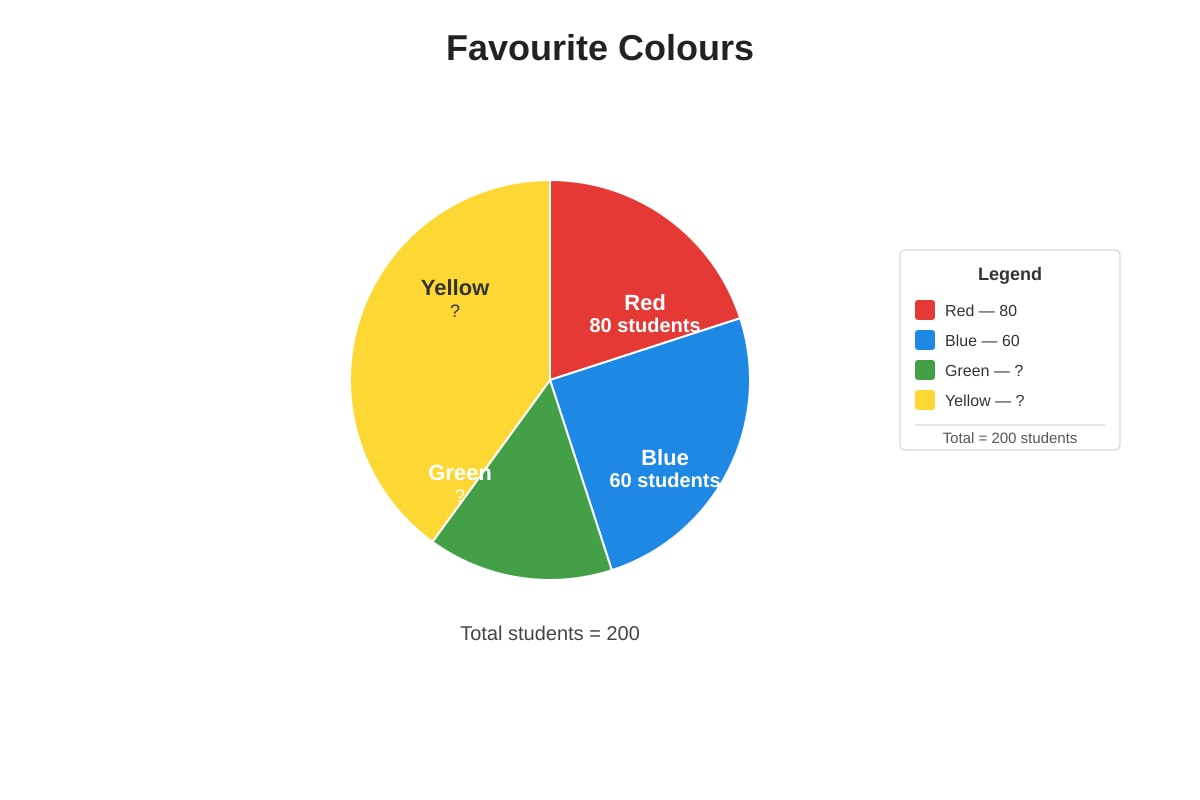
17. The pie chart shows the favourite colours of 200 students.

<image_placeholder> id: Q17-fig1 type: chart linked_question: Q17 description: Pie chart showing favourite colours with some data missing labels: Four sectors labelled Red, Blue, Green, Yellow; values shown for Red 80 students, Blue 60 students, Green and Yellow unlabeled values: Total students = 200; Red = 80, Blue = 60, Green and Yellow unknown but equal angles visually must_show: Four sectors with Red and Blue labeled with numbers, Green and Yellow blank/missing for student to calculate; title "Favourite Colours" </image_placeholder>

(a) How many students chose Green or Yellow altogether? (1 mark)


(b) If Green and Yellow were chosen by equal numbers of students, how many chose Yellow? (2 marks)

Working: _______________________________________________


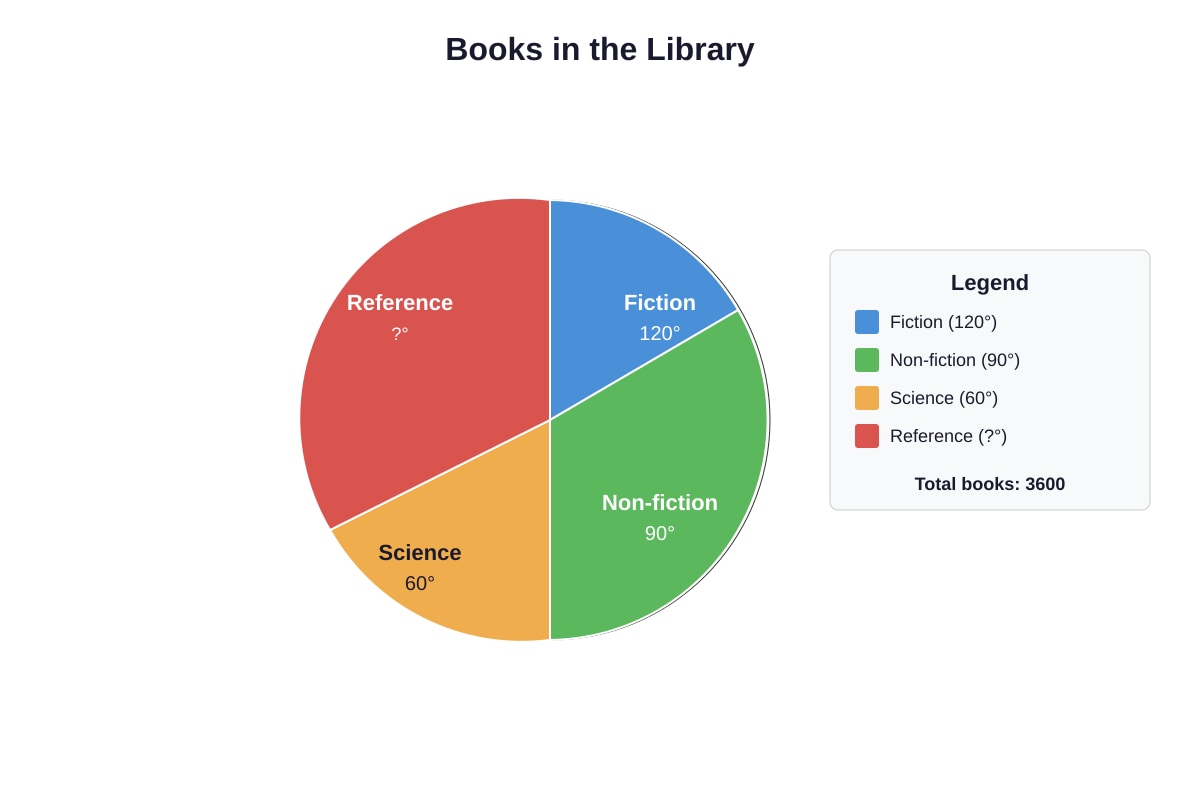
18. The pie chart shows the types of books in a library of 3600 books.

<image_placeholder> id: Q18-fig1 type: chart linked_question: Q18 description: Pie chart showing book categories with angle measures labels: Four sectors labelled Fiction, Non-fiction, Science, Reference; angle measures Fiction 120°, Non-fiction 90°, Science 60°, Reference remainder values: Total books = 3600; angles as labeled must_show: Four sectors three with angles labeled, Reference to be calculated; title "Books in the Library" </image_placeholder>

(a) What is the angle for the Reference sector? (1 mark)


(b) How many Science books are there? (2 marks)

Working: _______________________________________________


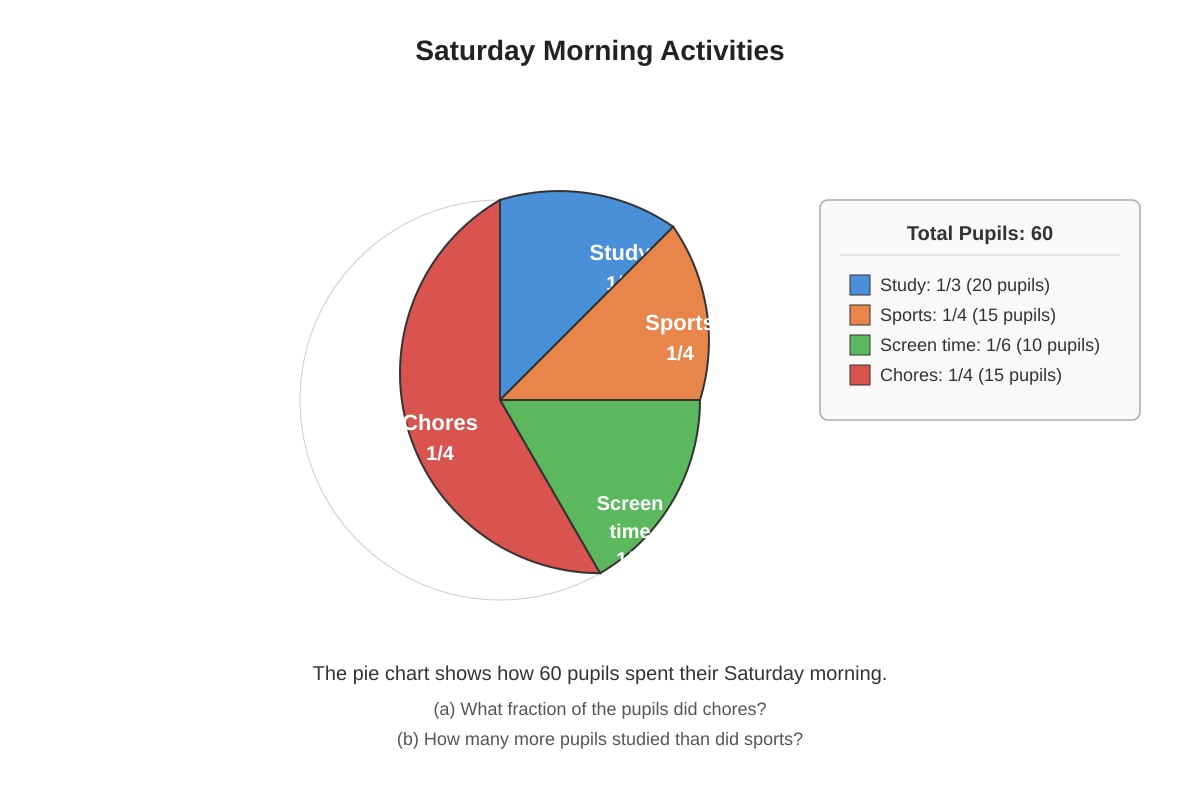
19. The pie chart shows how 60 pupils spent their Saturday morning.

<image_placeholder> id: Q19-fig1 type: chart linked_question: Q19 description: Pie chart showing activities with fraction labels labels: Four sectors labelled Study, Sports, Screen time, Chores; fraction of total shown as Study 1/3, Sports 1/4, Screen time 1/6, Chores remainder values: Total pupils = 60; fractions as labeled must_show: Four sectors with fraction labels; title "Saturday Morning Activities"; sectors proportional to fractions </image_placeholder>

(a) What fraction of the pupils did chores? (2 marks)

Working: _______________________________________________


(b) How many more pupils studied than did sports? (2 marks)

Working: _______________________________________________


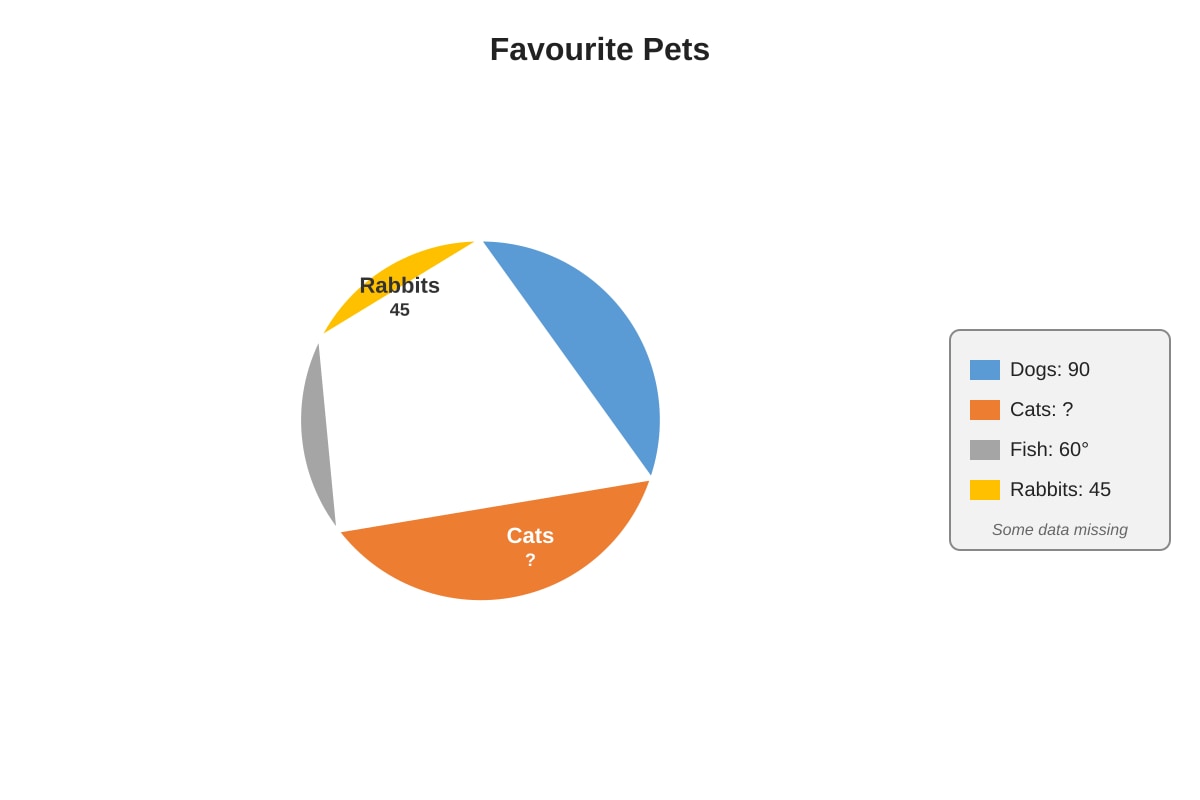
20. The pie chart shows the results of a survey about favourite pets. Some information is missing.

<image_placeholder> id: Q20-fig1 type: chart linked_question: Q20 description: Pie chart showing favourite pets with partial data labels: Four sectors labelled Dogs, Cats, Fish, Rabbits; known data: Dogs 90 people, Rabbits 45 people, Fish angle 60°; Cats unknown values: Dogs = 90, Rabbits = 45, Fish sector angle = 60° must_show: Three labeled sectors with known data, Cats sector blank; title "Favourite Pets"; proportional sizing where Dogs largest, thenCats/Fish unknown visually, Rabbits smallest </image_placeholder>

Given that Dogs was chosen by 90 people and represents a right angle (90°):

(a) How many people were surveyed altogether? (2 marks)

Working: _______________________________________________


(b) How many people chose Fish? (2 marks)

Working: _______________________________________________


End of Quiz

Answers

<!-- TuitionGoWhere generation metadata: stage=5-1; model=moonshotai/kimi-k2.6:free; model_label=Kimi K2.6 Free; generated=2026-06-09; Sources: Stage 4-0 LLM templates, syllabus context, and Stage 2 evidence where available. -->

Primary 4 Mathematics Quiz - Data Analysis: Answer Key

Total Marks: 40 marks
Duration: 40 minutes


Section A: Tables and Lists (14 marks)

Question 1 (2 marks)

(a) Thursday (1 mark)

Explanation: Compare all values: Monday 145, Tuesday 203, Wednesday 178, Thursday 256, Friday 198. Thursday has the largest number (256).

(b) 111 more books (1 mark)

Working: 256145=111256 - 145 = 111

Explanation: To find "how many more," subtract the smaller number from the larger number. Thursday (256) minus Monday (145) equals 111.


Question 2 (2 marks)

(a) 7 students (1 mark)

Working: 18+24+16+15=7318 + 24 + 16 + 15 = 73, then 8073=780 - 73 = 7

Explanation: The total must be 80 students. Add up the known values: 18+24+16+15=7318 + 24 + 16 + 15 = 73. Then subtract from 80 to find the missing number: 8073=780 - 73 = 7.

(b) Badminton and Basketball (1 mark)

Explanation: Check pairs: Swimming + Badminton = 18+24=4218 + 24 = 42; Swimming + Basketball = 18+16=3418 + 16 = 34; Badminton + Basketball = 24+16=4024 + 16 = 40


Question 3 (2 marks)

(a) $12.10 (1 mark)

Working: 2 kg of oranges: 2 \times \3.80 = $7.60;1kgofapples:; 1 kg of apples: 1 \times $4.50 = $4.50;Total:; Total: $7.60 + $4.50 = $12.10$

(b) No, he needs $2.10 more (1 mark)

Working: \12.10 - $20.00 = hedoesnthaveenough.Actuallyheisshortbyhe doesn't have enough. Actually he is short by$12.10 - $20.00$ — wait, he has MORE than enough.

Correction: Yes, he has enough money. He has \20.00andneedsand needs$12.10.Hehas. He has $20.00 - $12.10 = $7.90$ left over.

Common mistake: Careful with "enough" questions — check which number is larger.

Revised answer: Yes, he has enough money. He will have \7.90$ left.


Question 4 (2 marks)

(a) 29°C (1 mark)

Working: Hottest: Bangkok 34°C; Coldest: Seoul 5°C; Difference: 345=2934 - 5 = 29

Explanation: "Difference" means subtraction. Always subtract the smaller from the larger number.

(b) 4°C (1 mark)

Working: 128=412 - 8 = 4

Explanation: "Lower than" means subtract. Tokyo is 12°C, London is 8 degrees lower: 128=412 - 8 = 4.


Question 5 (2 marks)

(a) Ali total: 83; Ben total: 91; Charlie foreign: 46 (1 mark)

Working:

  • Ali: 45+38=8345 + 38 = 83
  • Ben: 62+29=9162 + 29 = 91
  • Charlie: 9751=4697 - 51 = 46

(b) Ben (1 mark)

Explanation: Compare totals: Ali 83, Ben 91, Charlie 97... wait, Charlie has 97? Let me recheck: Charlie total is given as 97. So Charlie has the most!

Correction: Charlie has the most stamps with 97.


Question 6 (2 marks)

(a) 130 students (1 mark)

Working: 35+48+22+18+7=13035 + 48 + 22 + 18 + 7 = 130

Explanation: "Altogether" means add all categories.

(b) 19 more students (1 mark)

Working: MRT + Bicycle = 22+7=2922 + 7 = 29; Bus - 29 = 4829=1948 - 29 = 19

Explanation: First combine MRT and Bicycle, then find the difference from Bus.


Question 7 (2 marks)

(a) 83 (1 mark)

Working: 2608592=260177=83260 - 85 - 92 = 260 - 177 = 83

Explanation: Total minus Round 1 minus Round 2 equals Round 3.

(b) Farhan (1 mark)

Working:

  • Devi: 260 (given)
  • Esther: 250 (given)
  • Farhan: 90+85+87=26290 + 85 + 87 = 262
  • Gina: 245 (given)

Explanation: Farhan has 262, which is the highest total.


Section B: Line Graphs (14 marks)

Question 8 (2 marks)

(a) 9 cm (1 mark)

Explanation: Find Week 2 on the x-axis, move up to the line, then across to the y-axis. The value is 9 cm.

(b) Week 1 to Week 2 (1 mark)

Explanation: Calculate growth each period:

  • Week 0 to 1: 64=26 - 4 = 2 cm
  • Week 1 to 2: 96=39 - 6 = 3 cm ✓ (most)
  • Week 2 to 3: 119=211 - 9 = 2 cm
  • Week 3 to 4: 1411=314 - 11 = 3 cm
  • Week 4 to 5: 1514=115 - 14 = 1 cm

Note: Week 1 to 2 and Week 3 to 4 both show 3 cm. Either answer accepted, or state both.


Question 9 (2 marks)

(a) 60 litres (1 mark)

Explanation: "At the start" means time = 0. Read the value at Hour 0, which is 60 litres.

(b) 25 litres (1 mark)

Working: At Hour 2: 50 L; At Hour 5: 25 L; Water lost: 5025=2550 - 25 = 25 L

Explanation: The graph shows the tank is being emptied (downward trend). Find the values at the two times and subtract.


Question 10 (2 marks)

(a) 3 July (1 mark)

Explanation: The highest point on the line is at 35°C, which corresponds to 3 July.

(b) 4°C (1 mark)

Working: 3531=435 - 31 = 4

Explanation: Temperature on 3 July (35°C) minus temperature on 1 July (31°C) = 4°C increase.


Question 11 (3 marks)

(a) 10 km (1 mark)

Explanation: Find 30 minutes on x-axis, read across to line, down to y-axis: 10 km.

(b) From 20 to 30 minutes (1 mark for correct interval); Because the line is steepest / the slope is greatest (1 mark)

Working: Calculate distance per interval:

  • 0-10 min: 3 km
  • 10-20 min: 63=36 - 3 = 3 km
  • 20-30 min: 106=410 - 6 = 4 km ✓ (steepest)
  • 30-40 min: 1210=212 - 10 = 2 km
  • 40-50 min: 1512=315 - 12 = 3 km
  • 50-60 min: 1615=116 - 15 = 1 km

Explanation: On a distance-time graph, the steeper the line, the faster the speed. The steepest segment is 20-30 minutes.


Question 12 (3 marks)

(a) March (1 mark)

Explanation: Read from the graph where value is 4200.

(b) 20,500 visitors (2 marks)

Working: March: 4200; April: 4800; May: 5500; June: 6000

Total: 4200+4800+5500+6000=20,5004200 + 4800 + 5500 + 6000 = 20,500

Mark breakdown: Correct method (adding four values): 1 mark; Correct answer: 1 mark


Question 13 (3 marks)

(a) 4.5 kg (1 mark)

Explanation: Read value at 2 months from graph.

(b) 4.3 kg (1 mark)

Working: 7.53.2=4.37.5 - 3.2 = 4.3 kg

Explanation: Mass at 6 months minus mass at birth (0 months).

(c) From 2 months to 3 months (1 mark)

Working: Calculate monthly gains:

  • 0-1 month: 3.83.2=0.63.8 - 3.2 = 0.6 kg
  • 1-2 months: 4.53.8=0.74.5 - 3.8 = 0.7 kg
  • 2-3 months: 5.54.5=1.05.5 - 4.5 = 1.0 kg ✓
  • 3-4 months: 6.25.5=0.76.2 - 5.5 = 0.7 kg
  • 4-5 months: 6.86.2=0.66.8 - 6.2 = 0.6 kg
  • 5-6 months: 7.56.8=0.77.5 - 6.8 = 0.7 kg

Question 14 (3 marks)

(a) March (1 mark)

Explanation: The two lines cross at March, where both equal 150.

(b) Ice cream sales increased / went up / rose from January to June (1 mark)

Explanation: Accept any description of increasing trend. The line goes upward from 50 to 300.

(c) Example answer: Because as weather gets warmer, people buy more ice cream and fewer hot drinks (1 mark)

Explanation: Accept any reasonable seasonal explanation. The opposite trends suggest temperature or season affects both products differently.


Section C: Pie Charts (12 marks)

Question 15 (2 marks)

30 students (2 marks)

Working: 25% of 120=25100×120=14×120=3025\% \text{ of } 120 = \frac{25}{100} \times 120 = \frac{1}{4} \times 120 = 30

Alternative: 120÷4=30120 \div 4 = 30

Explanation: 25% means one-quarter. Divide 120 by 4 to get 30.

Mark breakdown: Correct percentage conversion or method: 1 mark; Correct answer: 1 mark


Question 16 (4 marks)

(a) 12\frac{1}{2} (2 marks)

Working: Food angle = 180°. Full circle = 360°. Fraction = 180360=12\frac{180}{360} = \frac{1}{2}

Explanation: A half-turn (180°) is half of a full turn (360°).

(b) $200* (2 marks)

Working: Drinks angle = 90°. Fraction = 90360=14\frac{90}{360} = \frac{1}{4}

Amount: \frac{1}{4} \times \800 = $200$

Mark breakdown: Correct fraction: 1 mark; Correct calculation: 1 mark


Question 17 (3 marks)

(a) 60 students (1 mark)

Working: 2008060=60200 - 80 - 60 = 60

Explanation: Total minus Red minus Blue equals Green + Yellow together.

(b) 30 students (2 marks)

Working: 60÷2=3060 \div 2 = 30

Explanation: If Green and Yellow are equal, split 60 equally: half each.

Mark breakdown: Correct method (division by 2): 1 mark; Correct answer: 1 mark


Question 18 (3 marks)

(a) 90° (1 mark)

Working: 3601209060=90360 - 120 - 90 - 60 = 90

Explanation: Angles in a pie chart add to 360°. Subtract known angles from 360°.

(b) 600 books (2 marks)

Working: Science fraction = 60360=16\frac{60}{360} = \frac{1}{6}

Number of Science books = 16×3600=600\frac{1}{6} \times 3600 = 600

Mark breakdown: Correct fraction or angle method: 1 mark; Correct answer: 1 mark


Question 19 (4 marks)

(a) 14\frac{1}{4} (2 marks)

Working: Common denominator for 3, 4, 6 is 12.

13=412\frac{1}{3} = \frac{4}{12}; 14=312\frac{1}{4} = \frac{3}{12}; 16=212\frac{1}{6} = \frac{2}{12}

Sum: 4+3+212=912=34\frac{4+3+2}{12} = \frac{9}{12} = \frac{3}{4}

Chores: 134=141 - \frac{3}{4} = \frac{1}{4}

Mark breakdown: Correct common denominator or method: 1 mark; Correct answer: 1 mark

(b) 5 more pupils (2 marks)

Working: Study: 13×60=20\frac{1}{3} \times 60 = 20 pupils

Sports: 14×60=15\frac{1}{4} \times 60 = 15 pupils

Difference: 2015=520 - 15 = 5

Mark breakdown: Correct values for both: 1 mark; Correct difference: 1 mark


Question 20 (4 marks)

(a) 360 people (2 marks)

Working: 90° represents 90 people.

So 1° represents 1 person.

Full circle 360° represents 360×1=360360 \times 1 = 360 people.

Alternative: 9090°=1\frac{90}{90°} = 1 person per degree. Total = 360×1=360360 \times 1 = 360

Mark breakdown: Correct scaling method: 1 mark; Correct total: 1 mark

(b) 60 people (2 marks)

Working: Fish angle = 60°

Since 1° = 1 person, Fish = 60 people.

Alternative: Fraction = 60360=16\frac{60}{360} = \frac{1}{6}; People = 16×360=60\frac{1}{6} \times 360 = 60

Mark breakdown: Correct method using angle: 1 mark; Correct answer: 1 mark


END OF ANSWER KEY

Total: 40 marks

SectionMarks
A: Tables and Lists14
B: Line Graphs14
C: Pie Charts12
Total40