From Real Exams Quiz
Primary 4 Mathematics Multiplication Division Quiz
Free P4 Maths Multiplication Division quiz, Kimi2.6 Exam version, with questions, answers, and syllabus-aligned practice for Singapore students.
These static practice materials are generated from the site's syllabus and paper-generation workflow, with source and model context shown so students and parents can evaluate the material before use.
Questions
Free quiz and exam paper access
Enter your details to view this paper
Your access is remembered on this device.
Answers
Primary 4 Mathematics Quiz - Multiplication Division: Answer Key
Total Marks: 40
Section A: Multiple Choice Questions (5 marks)
1. What is the value of (7 \times 8000)?
Answer: A) 56,000
Method:
- (7 \times 8000 = 7 \times 8 \times 1000) (breaking 8000 into (8 \times 1000))
- (7 \times 8 = 56)
- (56 \times 1000 = 56,000)
Common mistake: Forgetting to add the zeros from 8000, leading to answer B (5,600).
2. Which of the following is equal to (3600 \div 9)?
Answer: A) (3600 \div 3 \div 3)
Method:
- Division by 9 can be split into division by 3 followed by division by 3, because (9 = 3 \times 3).
- So (3600 \div 9 = 3600 \div (3 \times 3) = 3600 \div 3 \div 3)
- Check: (3600 \div 3 = 1200), then (1200 \div 3 = 400)
- And (3600 \div 9 = 400) ✓
Common mistake: Choosing B or C which involve multiplication by 3, which increases the value instead of dividing.
3. A factory packs 1250 bottles of juice into boxes of 8. How many bottles are left over after packing as many full boxes as possible?
Answer: A) 2
Method:
- Find how many full boxes: (1250 \div 8)
- (1250 \div 8 = 156) remainder (2)
- Check: (156 \times 8 = 1248), and (1250 - 1248 = 2)
- The remainder is the number of bottles left over.
Common mistake: Finding the quotient (156) instead of the remainder, or miscalculating the division.
4. Mandy bought 15 packets of stickers. Each packet contains 48 stickers. She gave away 180 stickers to her friends. How many stickers does she have left?
Answer: A) 540
Method:
- Step 1: Find total stickers bought
- (15 \times 48 = 720) stickers
- Step 2: Subtract stickers given away
- (720 - 180 = 540) stickers
Common mistake: Adding instead of subtracting, or calculating (15 + 48) instead of multiplying.
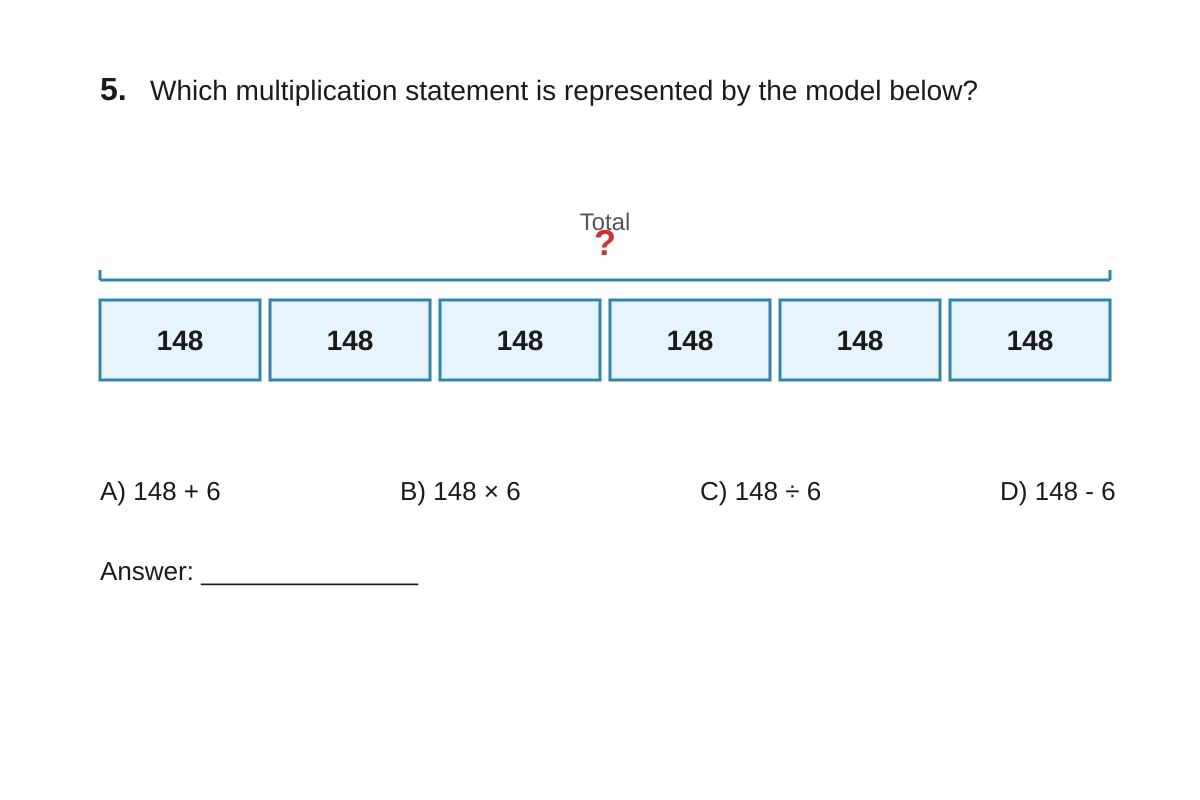
5. Which multiplication statement is represented by the model?
Answer: B) (148 \times 6)
Method:
- The bar model shows 6 equal parts, each with value 148.
- The total is found by adding 148 six times, which is (148 \times 6).
- This is the multiplication meaning of "equal groups": 6 groups of 148.
Common mistake: Choosing A ((148 + 6)) which would mean adding 6 to 148, not 6 groups of 148.
Section B: Short Answer Questions (15 marks)
6. Calculate (25 \times 16 \times 4). [2 marks]
Answer: 1600
Method:
- Use the associative property to rearrange: (25 \times 4 \times 16)
- This is easier because (25 \times 4 = 100)
- Then (100 \times 16 = 1600)
Marking: [1 mark] for correct use of associative property or correct partial working; [1 mark] for final answer 1600.
Teaching note: When multiplying three numbers, look for pairs that make "friendly" numbers like 10, 100, or 1000. This is called making use of number bonds.
7. Find the value of (5040 \div 7). [2 marks]
Answer: 720
Method:
- Use long division or recognize that (5040 = 504 \times 10)
- (504 \div 7 = 72) (since (7 \times 72 = 504))
- So (5040 \div 7 = 72 \times 10 = 720)
Verification: (720 \times 7 = 5040) ✓
Marking: [1 mark] for correct method/ partial working; [1 mark] for final answer 720.
Teaching note: Breaking into known facts: (5040 \div 7 = (4900 + 140) \div 7 = 700 + 20 = 720).
8. A bookshop sold 48 boxes of coloured pencils. Each box contained 36 pencils. How many coloured pencils were sold altogether? [2 marks]
Answer: 1728 pencils
Method:
- Total pencils = number of boxes × pencils per box
- (48 \times 36)
- (48 \times 30 = 1440)
- (48 \times 6 = 288)
- (1440 + 288 = 1728)
Marking: [1 mark] for correct multiplication method; [1 mark] for correct answer with units.
9. Mr Tan has 850 m of rope. He cuts it into equal pieces of 25 m each. How many pieces of rope does he get? [2 marks]
Answer: 34 pieces
Method:
- Number of pieces = total length ÷ length per piece
- (850 \div 25)
- Method: (850 \div 25 = (850 \times 4) \div (25 \times 4) = 3400 \div 100 = 34)
Or using division:
- (85 \div 25 = 3) remainder 10
- Bring down 0: (100 \div 25 = 4)
- So (850 \div 25 = 34)
Marking: [1 mark] for correct method; [1 mark] for final answer with correct interpretation (pieces).
10. Complete the following by filling in the missing numbers. [3 marks total, 1 mark each]
(a) ( \boxed{80} \times 40 = 3200)
Method: (3200 \div 40 = 320 \div 4 = 80)
(b) ( 7200 \div \boxed{80} = 90)
Method: (7200 \div 90 = 720 \div 9 = 80)
(c) ( \boxed{9000} \div 60 = 150)
Method: (150 \times 60 = 15 \times 6 \times 100 = 90 \times 100 = 9000)
Teaching note: These are inverse operations. For multiplication-division fact families: if (a \times b = c), then (c \div a = b) and (c \div b = a).
11. A school has 24 classes. Each class has 35 students. During an assembly, the students are arranged equally into 8 rows. How many students are there in each row? [3 marks]
Answer: 105 students
Method:
-
Step 1: Find total number of students
- (24 \times 35 = 840) students
- Working: (24 \times 35 = 24 \times 30 + 24 \times 5 = 720 + 120 = 840)
-
Step 2: Divide into 8 rows
- (840 \div 8 = 105) students per row
- Working: (800 \div 8 = 100), (40 \div 8 = 5), so (100 + 5 = 105)
Marking: [1 mark] for finding total students (840); [1 mark] for correct division method; [1 mark] for final answer with context.
Teaching note: This is a two-step problem. Identify what you need to find first (total), then use it to find the answer.
12. Find the remainder when 1000 is divided by 7. [2 marks]
Answer: 6
Method:
- (1000 \div 7)
- (7 \times 140 = 980)
- (1000 - 980 = 20)
- (7 \times 2 = 14)
- Remainder: (20 - 14 = 6)
So (1000 \div 7 = 142) remainder 6
Marking: [1 mark] for correct quotient or method; [1 mark] for correct remainder (not the quotient).
Common mistake: Giving 142 as the answer — 142 is the quotient, not the remainder.
Section C: Long Answer Questions (20 marks)
13. A supermarket received 45 cartons of mineral water. Each carton contained 24 bottles. After selling some bottles, there were 568 bottles left. How many bottles were sold? [4 marks]
Answer: 512 bottles
Method:
-
Step 1: Find total bottles received
- (45 \times 24 = 1080) bottles
- Working: (45 \times 24 = 45 \times 20 + 45 \times 4 = 900 + 180 = 1080)
-
Step 2: Subtract bottles remaining
- (1080 - 568 = 512) bottles sold
-
Alternative working for subtraction:
- (1080 - 500 = 580)
- (580 - 68 = 512)
Marking: [1 mark] for finding total (1080); [1 mark] for identifying subtraction needed; [1 mark] for correct subtraction method; [1 mark] for final answer with units.
Teaching note: "After selling some... left" means total − sold = remaining, so sold = total − remaining.
14. Mrs Lim baked 360 cupcakes. She packed them into boxes of 8. She sold each box for $15. How much money did she receive from selling all the boxes? [4 marks]
Answer: $675
Method:
-
Step 1: Find number of boxes
- (360 \div 8 = 45) boxes
- Working: (360 \div 8 = (320 + 40) \div 8 = 40 + 5 = 45)
-
Step 2: Calculate total money
- (45 \times 15 = 675)
- Working: (45 \times 15 = 45 \times 10 + 45 \times 5 = 450 + 225 = 675)
Marking: [1 mark] for finding number of boxes (45); [1 mark] for correct method to find money; [1 mark] for correct multiplication working; [1 mark] for final answer with correct units ($).
Teaching note: Unit consistency — boxes in step 1 must match "per box" in step 2. Always check that your answer makes sense: 45 boxes at 450-$900.
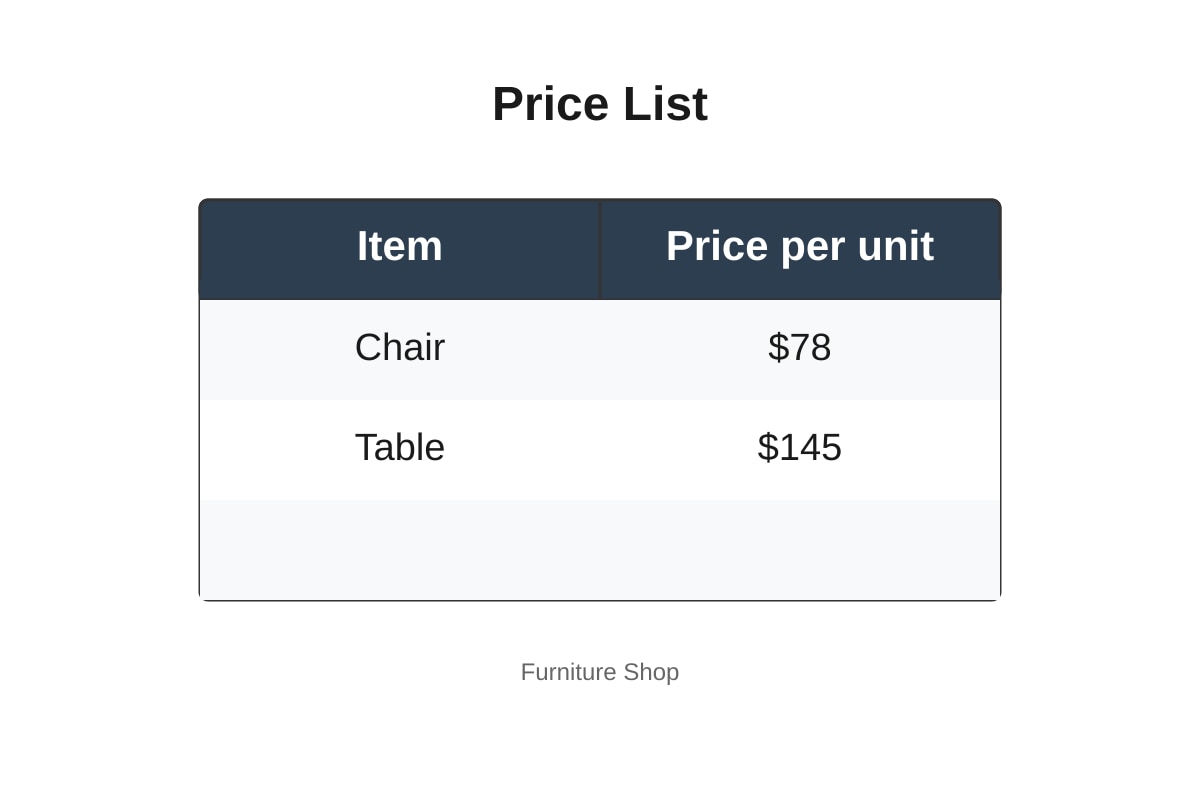
15. The table shows the price of chairs and tables.
(a) Mr Goh bought 6 chairs and 2 tables. How much did he pay altogether? [3 marks]
Answer: $758
Method:
-
Cost of chairs: (6 \times 78 = 468)
- Working: (6 \times 78 = 6 \times 70 + 6 \times 8 = 420 + 48 = 468)
-
Cost of tables: (2 \times 145 = 290)
-
Total: (468 + 290 = 758)
- Working: (468 + 290 = 468 + 300 - 10 = 768 - 10 = 758)
Marking: [1 mark] for cost of chairs (290); [1 mark] for correct total with units.
(b) Mrs Tan has $500. She wants to buy 4 tables. How much more money does she need? [2 marks]
Answer: $80
Method:
-
Cost of 4 tables: (4 \times 145 = 580)
- Working: (4 \times 145 = 4 \times 100 + 4 \times 40 + 4 \times 5 = 400 + 160 + 20 = 580)
-
More money needed: (580 - 500 = 80)
Marking: [1 mark] for cost of 4 tables ($580); [1 mark] for correct difference.
Teaching note: "How much more" means subtraction when you don't have enough, or comparison of two amounts.
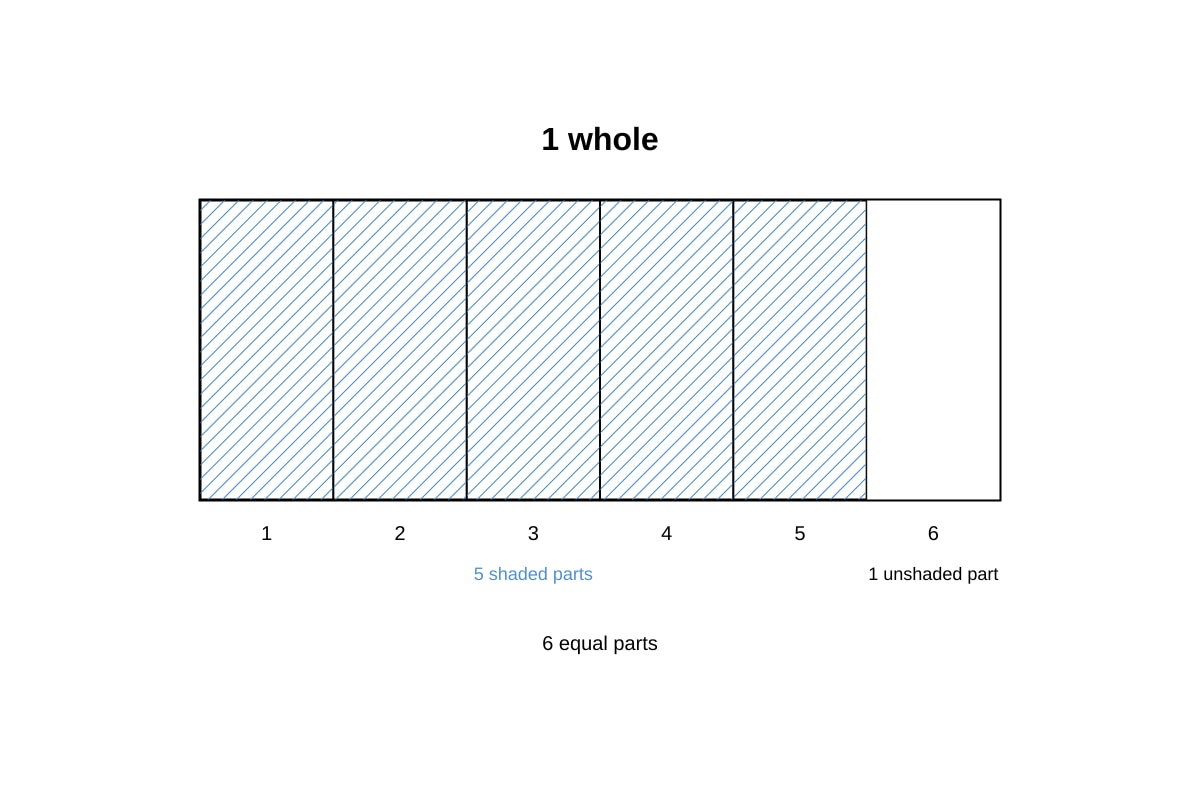
16. Rectangle divided into 6 equal parts with 5 parts shaded.
(a) What fraction of the rectangle is shaded? [1 mark]
Answer: (\frac{5}{6})
Method: 5 out of 6 equal parts are shaded. The fraction is (\frac{\text{shaded parts}}{\text{total parts}} = \frac{5}{6}).
(b) If the area of the shaded parts is 150 cm², what is the area of 1 part? [2 marks]
Answer: 30 cm²
Method:
- 5 parts = 150 cm²
- 1 part = (150 \div 5 = 30) cm²
- Working: (150 \div 5 = (150 \div 10) \times 2 = 15 \times 2 = 30)
Marking: [1 mark] for correct division identified; [1 mark] for correct answer with units.
(c) What is the area of the whole rectangle? [1 mark]
Answer: 180 cm²
Method:
- 6 parts × 30 cm² per part = 180 cm²
- Or: shaded (150) + unshaded (30) = 180 cm²
17. A bus can carry 46 passengers. A train can carry 8 times as many passengers as the bus.
(a) How many passengers can the train carry? [2 marks]
Answer: 368 passengers
Method:
- Train capacity = (46 \times 8)
- (46 \times 8 = 46 \times 4 \times 2 = 184 \times 2 = 368)
- Or: (40 \times 8 + 6 \times 8 = 320 + 48 = 368)
Marking: [1 mark] for correct multiplication; [1 mark] for answer with units.
(b) On a particular day, 5 buses and 2 trains were used. How many passengers could be transported altogether? [3 marks]
Answer: 966 passengers
Method:
-
5 buses: (5 \times 46 = 230) passengers
- Working: (5 \times 46 = 5 \times 40 + 5 \times 6 = 200 + 30 = 230)
-
2 trains: (2 \times 368 = 736) passengers
- Working: (2 \times 368 = 600 + 120 + 16 = 736)
-
Total: (230 + 736 = 966) passengers
Marking: [1 mark] for 5 buses total; [1 mark] for 2 trains total; [1 mark] for correct final sum.
Teaching note: "Times as many" means multiplication. "Altogether" means addition of different groups.
18. Sarah had $240. She spent (\frac{3}{8}) of her money on a bag and (\frac{1}{4}) of her money on a pair of shoes.
(a) How much did she spend on the bag? [2 marks]
Answer: $90
Method:
- Bag: (\frac{3}{8}) of $240
- (240 \div 8 = 30) (finding one part)
- (30 \times 3 = 90)
Marking: [1 mark] for finding (\frac{1}{8}) ($30); [1 mark] for correct answer.
(b) How much money did she have left? [3 marks]
Answer: $90
Method:
-
Shoes: (\frac{1}{4}) of $240 = (240 \div 4 = 60)
-
Total spent: (90 + 60 = 150)
-
Money left: (240 - 150 = 90)
Alternative method using fractions:
- Total fraction spent: (\frac{3}{8} + \frac{1}{4} = \frac{3}{8} + \frac{2}{8} = \frac{5}{8})
- Fraction left: (1 - \frac{5}{8} = \frac{3}{8})
- Money left: (\frac{3}{8} \times 240 = 90)
Marking: [1 mark] for shoes cost or fraction conversion; [1 mark] for total spent or fraction left; [1 mark] for correct final answer.
Teaching note: Two approaches — find amounts then subtract, or work entirely in fractions. Both are valid. Check that (\frac{1}{4} = \frac{2}{8}) for common denominators.
19. A farmer harvested 1860 apples. He packed them into bags of 6 apples each. He sold each bag for $5.
(a) How many bags of apples did the farmer pack? [2 marks]
Answer: 310 bags
Method:
- (1860 \div 6 = 310)
- Working: (1800 \div 6 = 300), (60 \div 6 = 10), so (300 + 10 = 310)
Marking: [1 mark] for correct division method; [1 mark] for answer.
(b) The farmer sold 240 bags in the morning and the rest in the afternoon. How much money did he receive in the afternoon? [3 marks]
Answer: $350
Method:
- Bags sold in afternoon: (310 - 240 = 70) bags
- Money in afternoon: (70 \times 5 = 350)
Marking: [1 mark] for afternoon bags (70); [1 mark] for correct multiplication; [1 mark] for final answer with units ($).
Teaching note: "The rest" means subtraction from total. Always identify which quantity is being asked about — here it's afternoon sales, not morning.
20. Number pattern:
(a) Complete the next line: [1 mark]
Answer: (12345 \times 8 + 5 = 98765)
Method:
- Pattern in first factor: 1, 12, 123, 1234, so next is 12345
- Pattern in added number: 1, 2, 3, 4, so next is 5
- Pattern in result: 9, 98, 987, 9876, so next is 98765
(b) Using the pattern, find the value of (12345 \times 8 + 5). [1 mark]
Answer: 98765
(c) What should replace (\square)? [1 mark]
Answer: 7
Method:
- In the pattern, the added number equals the number of digits in the first factor.
- 1234567 has 7 digits, so we add 7.
- Result: 9876543 has 7 digits, confirming.
Teaching note: Look for two patterns — what's changing (the numbers growing) and what's staying the same (multiply by 8, then add the digit count).
Marking Summary
| Question | Marks | Topic Focus |
|---|---|---|
| 1 | 1 | Multiplication by thousands |
| 2 | 1 | Division as repeated division |
| 3 | 1 | Division with remainder |
| 4 | 1 | Multiplication then subtraction |
| 5 | 1 | Bar model → multiplication |
| 6 | 2 | Associative property |
| 7 | 2 | Division by single digit |
| 8 | 2 | Multiplication in context |
| 9 | 2 | Division in context |
| 10abc | 3 | Inverse operations |
| 11 | 3 | Two-step problem |
| 12 | 2 | Remainder concept |
| 13 | 4 | Two-step: multiply then subtract |
| 14 | 4 | Two-step: divide then multiply |
| 15a | 3 | Table data, multiple operations |
| 15b | 2 | Table data, comparison |
| 16a | 1 | Fraction from diagram |
| 16b | 2 | Division with fractions |
| 16c | 1 | Multiplication with fractions |
| 17a | 2 | "Times as many" |
| 17b | 3 | Multiple groups, total |
| 18a | 2 | Fraction of a quantity |
| 18b | 3 | Fractions, remaining amount |
| 19a | 2 | Division in context |
| 19b | 3 | Subset and value |
| 20abc | 3 | Number pattern recognition |
| Total | 40 |