From Real Exams Quiz
Primary 4 Mathematics Money Quiz
Free P4 Maths Money quiz, Exam version, with questions, answers, and syllabus-aligned practice for Singapore students.
These static practice materials are generated from the site's syllabus and paper-generation workflow, with source and model context shown so students and parents can evaluate the material before use.
Questions
Free quiz and exam paper access
Enter your details to view this paper
Your access is remembered on this device.
Answers
Answer Key - Primary 4 Mathematics Quiz - Money
Total Marks: 40
Section A: Multiple-Choice Questions (10 marks)
Each question is 1 mark.
-
(1) 12 dollars and 45 cents
- Explanation: The decimal separates the dollars from the cents. 12.45, but the question asks for the same as the written form $12.45, not the value in cents. "12 dollars and 45 cents" is the direct reading.
- Common Mistake: Students might confuse the decimal as a comma and choose (4) or misinterpret cents and dollars.
-
(1) $16.10
- Working: 8.90 = $16.10
- Explanation: To find the amount left, we subtract the cost of the book from the money Siti had. Align the decimal points to subtract: 25.00 - 8.90 = 16.10.
- Common Mistake: Forgetting to "borrow" when subtracting 90 cents from 0 cents.
-
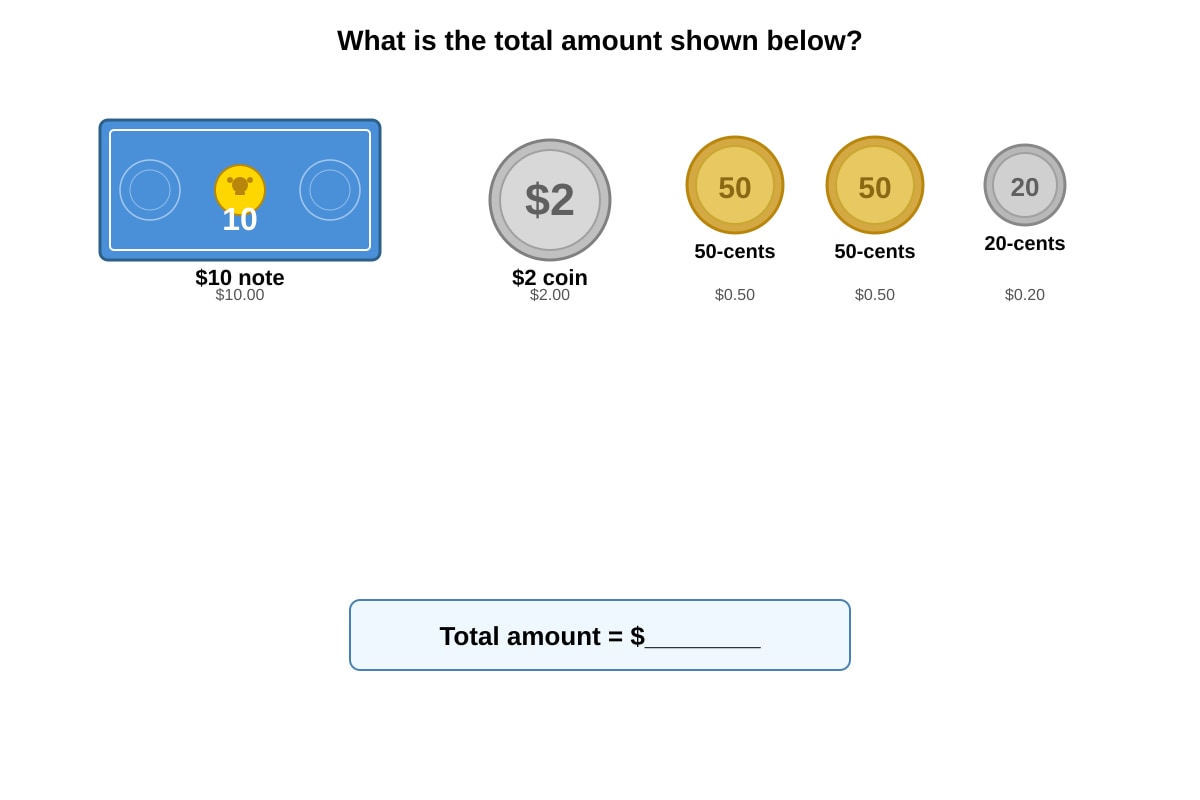
(2) $13.20
- Working: 2 + 0.50 + 13.20
- Explanation: Add the value of each coin and note. The two 50-cent coins make 10 + 0.50 + 0.20 = 2 + 0.20 = $13.20.
-
(2) $12.00
- Working: 12.00
- Explanation: The cost of one pen multiplied by the number of pens gives the total cost. 12.00.
-
(2) $6.50
- Working: 3.50 = $6.50
- Explanation: The change is the amount paid minus the cost. 3.50 = $6.50.
-
(1) $21.25
- Working: 8.75 = $21.25
- Explanation: To find the total spent, we add the cost of the toy and the book.
- Common Mistake: Students might subtract instead of adding.
-
(1) $6.50
- Working: 1.50 = $6.50
- Explanation: A discount means the price is reduced. We subtract the discount from the original price.
-
(3) 2 twenty-cent coins and 1 five-cent coin
- Working: (2 × 0.05 = 0.05 = $0.45
- Explanation: Check each option: (1) 0.10 + 0.40 (2) 0.10 = 0.20 + 0.05 = 0.20 + 0.05 = $0.35
-
(2) $2.50
- Working: (5 × 0.50) = 2.00 = $2.50
- Explanation: Calculate the value of the ten-cent coins and fifty-cent coins separately, then add them.
-
(2) $2.00
- Working: Total spent = 9.40 = 30.00 - 2.00.
- Explanation: Find the total amount spent first, then subtract from the amount he had at first.
- Common Mistake: Subtracting only one item from $30.
Section B: Short-Answer Questions (15 marks)
Each question is 2 marks. 1 mark for correct method, 1 mark for correct final answer. Award 0 marks for correct answer without working.
-
$7.95
- Working:
$5.60 + $2.35 -------- $7.95- Explanation: Align the decimal points and add. 60 cents + 35 cents = 95 cents.
-
$21.30
- Working: 8.80 = $21.30
- Explanation: To find the total amount spent, add the cost of the present and the card.
- Marking: 1 mark for correct addition, 1 mark for correct answer with dollar sign.
-
$3.05
- Working: 6.95 = $3.05
- Explanation: Calculate the change by subtracting the cost from the amount paid. 6.95 = $3.05.
- Key Concept: This involves subtraction with "borrowing" across the decimal.
-
$2.90
- Working: 2.90
- Explanation: To find the cost of one notebook, divide the total cost by the number of notebooks. 2.90.
- Common Mistake: Students might multiply instead of dividing.
-
$4.00
- Working: Total spent = 3.60 = 20.00 - 4.00.
- Explanation: First, find the total amount spent. Then, subtract that from the starting amount.
- Common Mistake: Subtracting only one item from $20.
-
$12.30
- Working: 7.50 = $12.30
- Explanation: The total amount paid is the sum of the cost of the rice and the chicken.
Section C: Problem-Solving Questions (15 marks)
Each question is 3 marks. Award marks for correct method and steps. 1 mark for correct answer with no or limited working.
-
$30
- Working:
- The toy car cost \frac{1}{2}$ of his money.
- This means his total money is twice the cost of the car.
- Total money = 2 × 30
- Explanation: Since half of his money was spent on the car, the total money is the whole (which is two halves). So, total = 2 × cost of car.
- Key Concept: Fractions of a quantity. Finding the whole when given a part.
- Marking: 1 mark for identifying = $15. 1 mark for correct method (2 × 15). 1 mark for final answer.
- Working:
-
$20
- Working:
- Jenny had $50 at first.
- After buying the dress, she had some money left.
- She spent of the remaining money on a bag and had $15 left.
- This means \frac{1}{2}$ of the money left after buying the dress.
- So, the money left after buying the dress was 2 × 30.
- The dress cost 30 = $20.
- Explanation: This is a working backwards problem. Start from the end. The 50 to find the cost of the dress.
- Key Concept: Working backwards with fractions.
- Marking: 1 mark for identifying 30). 1 mark for final answer ($20).
- Working:
-
$10.80
- Working:
- The promotion is "buy 3, get 1 free." This means you get 4 muffins for the price of 3.
- To get 8 muffins, the customer can buy 2 groups of 4.
- For the first 4 muffins, she pays for 3: 3 × 5.40
- For the second 4 muffins, she pays for 3: 3 × 5.40
- Total cost = 5.40 = $10.80.
- Explanation: Identify the deal: you get 4 for the price of 3. For 8 muffins, you get two such deals, so you pay for 6 muffins.
- Key Concept: Multi-step problem solving involving the concept of "free" items.
- Marking: 1 mark for identifying the deal (pay for 3, get 4). 1 mark for finding number of groups (2 groups). 1 mark for final answer ($10.80).
- Working:
-
$77
- Working:
- Sam received: $15
- Tom received: 8 = $23
- Uma received: 2 × 46
- Total amount: 23 + 77
- Explanation: Break down the problem step-by-step. Find how much each person received, then add them together.
- Key Concept: Multi-step word problems with comparison.
- Marking: 1 mark for finding Tom's share. 1 mark for finding Uma's share. 1 mark for correct total.
- Working: