From Real Exams Quiz
Primary 4 Mathematics Geometry Quiz
Free P4 Maths Geometry quiz, GLM5.3 Exam version, with questions, answers, and syllabus-aligned practice for Singapore students.
These static practice materials are generated from the site's syllabus and paper-generation workflow, with source and model context shown so students and parents can evaluate the material before use.
Questions
Free quiz and exam paper access
Enter your details to view this paper
Your access is remembered on this device.
Answers
Primary 4 Mathematics Quiz - Geometry: Answer Key
Total Marks: 45
Answer 1.
Answer: A) Acute angle [1]
Teaching note: An acute angle is smaller than ; a right angle is exactly ; an obtuse angle is between and . Since , it is acute. Common mistake: choosing B because 89 is "close to" 90 - close is not exact.
Answer 2.
(a) (also accept ) [1]
(b) Acute angle [1]
Teaching note: In angle notation, the vertex (the corner) always goes in the middle letter. Here the corner is at Q, so Q must be the middle letter. Any angle under is acute, and . Common mistake: writing , which puts the wrong letter in the middle.
Answer 3.
[1]
Method: A full turn is . A quarter turn is . This is why a right angle equals .
Answer 4.
4 lines of symmetry [1]
Teaching note: The 4 lines are the vertical line, the horizontal line and the two diagonals, all passing through the centre. Each line folds the square onto itself so both halves match exactly.
Answer 5.
(a) Cube [1] - A cube has exactly 6 identical square faces, so its net needs 6 squares.
(b) Triangular prism [1] - A triangular prism has 2 identical triangular ends and 3 rectangular faces joining them.
Marking note: Accept "rectangular prism/triangular tube" descriptions only if the solid named matches the faces listed.
Answer 6.
(accept to for drawing tolerance) [2]
Method:
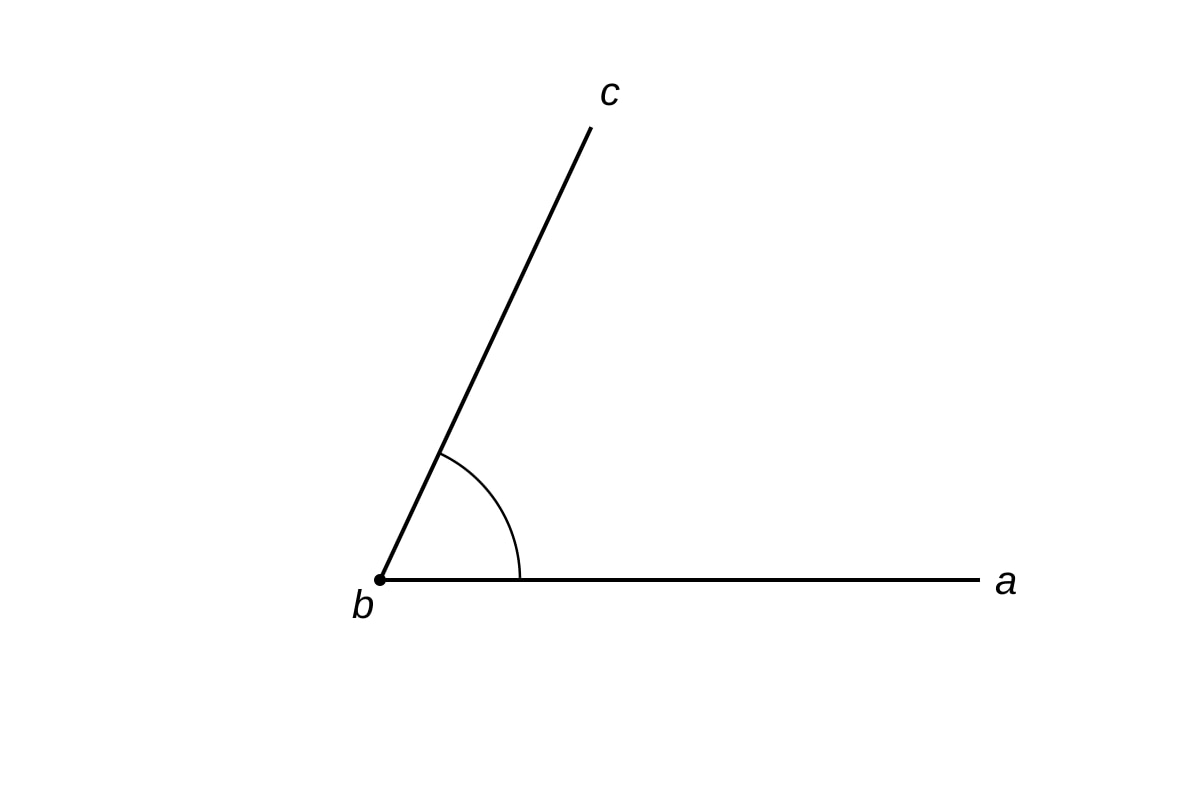
- Place the protractor centre on vertex b and the baseline along ray ba. [M1]
- Read the scale that starts at on ray ba, following it round to ray bc: . [A1]
Common mistakes: reading the outer scale instead of the inner scale (giving ), or not lining up the centre mark with b.
Visual check: In Q6-fig1, ray bc must be drawn exactly anticlockwise from ray ba so the intended reading is unambiguous.
Answer 7.
Steps for full credit: [2]
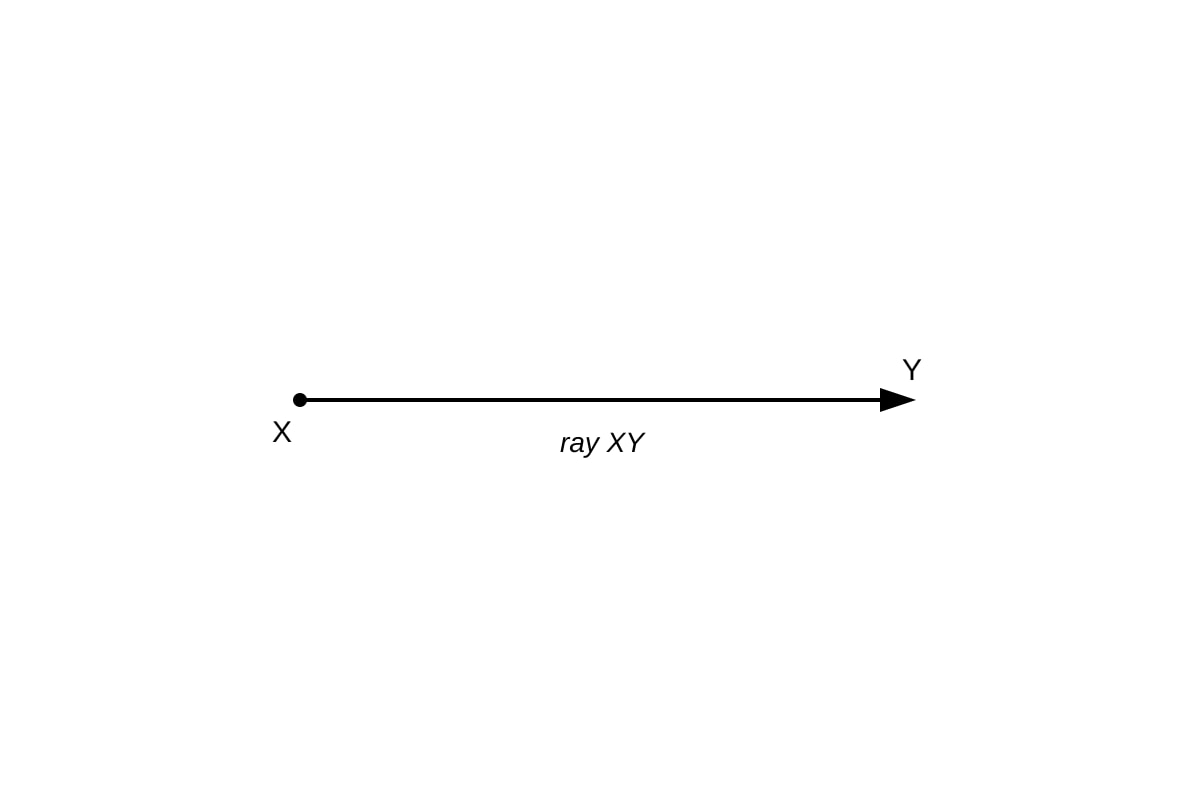
- Place the protractor centre at X with the baseline along ray XY. [M1]
- Starting from on ray XY, mark above the ray, remove the protractor, and draw ray XZ through the mark with a ruler. Label the angle. [A1]
Check: The angle between XZ and XY should look obtuse (more than a right angle). If the student reads the wrong scale they get , which looks acute - always compare with the expected angle type.
Answer 8.
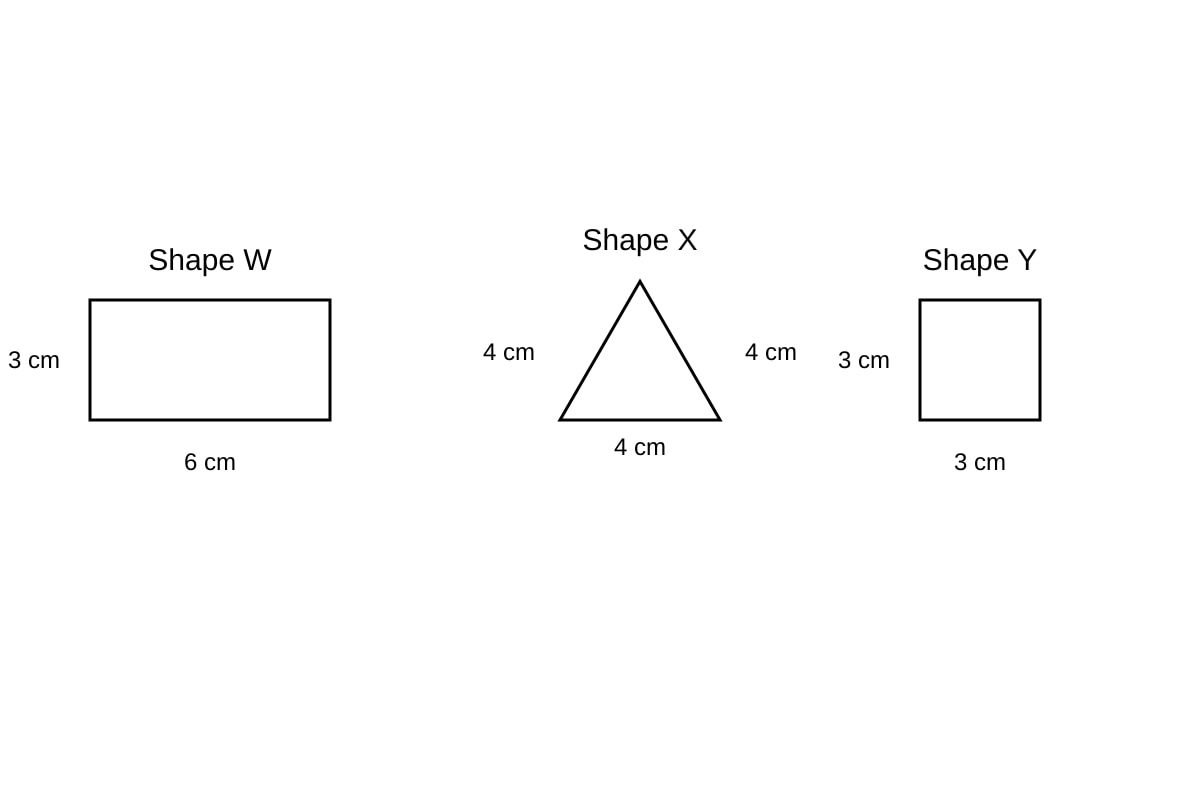
- Shape W (rectangle): 2 lines of symmetry - one vertical, one horizontal through the centre. [1]
- Shape X (equilateral triangle): 3 lines of symmetry - each runs from a corner to the midpoint of the opposite side. [1]
- Shape Y (square): 4 lines of symmetry - vertical, horizontal and both diagonals. [1]
Key concept: A line of symmetry folds the shape into two halves that match exactly. Common mistake: drawing the diagonals of the rectangle - folding a 6 cm by 3 cm rectangle along a diagonal does not make the halves match, so diagonals are not symmetry lines here.
Answer 9.
Yes, Ravi is correct. [1 for choice, 1 for explanation]
Explanation: A rectangle is a quadrilateral with 4 right angles and opposite sides equal. A square has 4 right angles and opposite sides equal (
<stage3_quiz_answers_md>
Primary 4 Mathematics Quiz - Geometry: Answer Key
Total Marks: 45
Answer 1.
Answer: A) Acute angle [1]
Teaching note: An acute angle is smaller than . Since , it is acute. Common mistake: choosing B because 89 is "close to" 90 — close is not exact.
Answer 2.
(a) (also accept ) [1]
(b) Acute angle [1]
Teaching note: The vertex always goes in the middle letter of angle notation; here the corner is at Q. Any angle under is acute. Common mistake: writing , which puts the wrong letter in the middle.
Answer 3.
[1]
Method: A full turn is , so a quarter turn is (a right angle).
Answer 4.
4 lines of symmetry [1]
Teaching note: The vertical line, the horizontal line and the two diagonals, all passing through the centre. Each line folds the square onto itself exactly.
Answer 5.
(a) Cube [1] — a cube has exactly 6 identical square faces, so its net needs 6 squares.
(b) Triangular prism [1] — 2 identical triangular ends joined by 3 rectangular faces.
Marking note: Accept the solid name only if it matches the faces listed.
Answer 6.
(accept to for drawing tolerance) [2]
Method:
- Place the protractor centre on vertex b with the baseline along ray ba. [M1]
- Read the scale that starts at on ray ba, following it round to ray bc: . [A1]
Common mistakes: reading the outer scale instead of the inner scale (giving ), or not lining up the centre mark with b.
Visual check: In Q6-fig1, ray bc must be drawn exactly anticlockwise from ray ba so the intended reading is unambiguous.
Answer 7.
Steps for full credit: [2]
- Place the protractor centre at X with the baseline along ray XY. [M1]
- Starting from on ray XY, mark , remove the protractor, and draw ray XZ through the mark with a ruler. Label the new ray XZ. [A1]
Check: The angle between XZ and XY should look obtuse (more than a right angle). Reading the wrong scale gives , which looks acute — always compare with the expected angle type.
Answer 8.
- Shape W (rectangle): 2 lines of symmetry — one vertical, one horizontal through the centre. [1]
- Shape X (equilateral triangle): 3 lines of symmetry — each runs from a corner to the midpoint of the opposite side. [1]
- Shape Y (square): 4 lines of symmetry — vertical, horizontal and both diagonals. [1]
Key concept: A line of symmetry folds the shape into two halves that match exactly. Common mistake: drawing the diagonals of the rectangle — folding a 6 cm by 3 cm rectangle along a diagonal does not make the halves match, so diagonals are not symmetry lines here.
Answer 9.
Yes, Ravi is correct. [1 for choice, 1 for explanation]
Explanation: A rectangle is a quadrilateral with 4 right angles and opposite sides equal. A square has 4 right angles and opposite sides equal (in fact all 4 sides equal), so a square satisfies every property of a rectangle. Every square is a special rectangle, but not every rectangle is a square.
Answer 10.
[2]
Method:
- From 12 to 8 is 8 hour-markers; per marker. [M1]
- . [A1]
Answer 11.
(a) Square pyramid [1] — a square base with 4 triangles meeting at a point.
(b) Cuboid (accept rectangular prism) [1] — 6 rectangular faces, not all identical.
Answer 12.
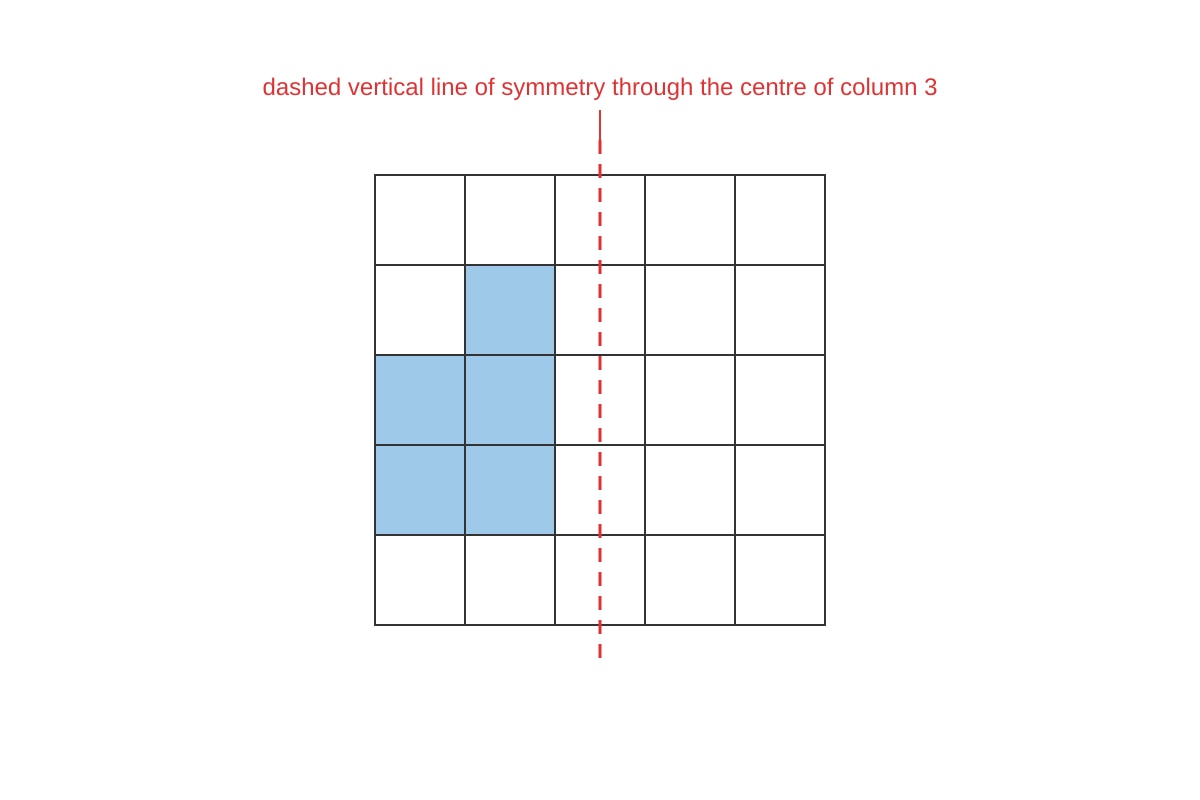
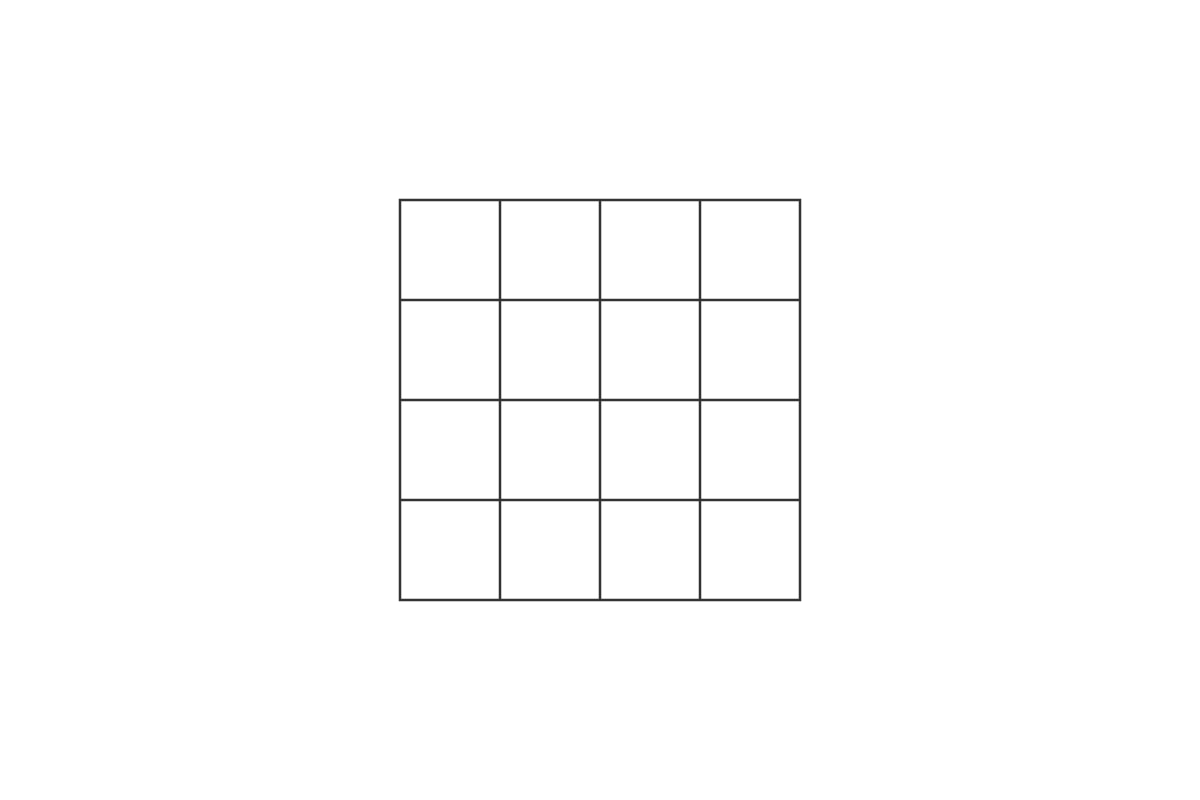
Shade the mirror image of each shaded cell across the dashed line through the middle of column 3: [2]
- Row 2: shade column 4 (mirror of column 2).
- Row 3: shade columns 4 and 5 (mirrors of columns 2 and 1).
- Row 4: shade columns 4 and 5 (mirrors of columns 2 and 1).
Each reflected cell must be the same distance from the line of symmetry as its partner. Award [M1] for correctly reflecting at least two cells, [A1] for all six cells correct.
Answer 13.
She read the wrong scale on the protractor — she counted from the on the wrong side, turning into (). To avoid this: before measuring, decide whether the angle should be acute or obtuse, then check the reading matches that type; always start from the mark lying on the given ray. [2]
Answer 14.
Answer: B) An equilateral triangle has 3 lines of symmetry. [2]
Why the others are false:
- A) A rectangle has only 2 lines of symmetry, not 4.
- C) A square has 4 lines of symmetry, not 2.
- D) An isosceles triangle has only 1 line of symmetry, not 3.
Answer 15.
(a) Face E [1]
(b) Face F [1]
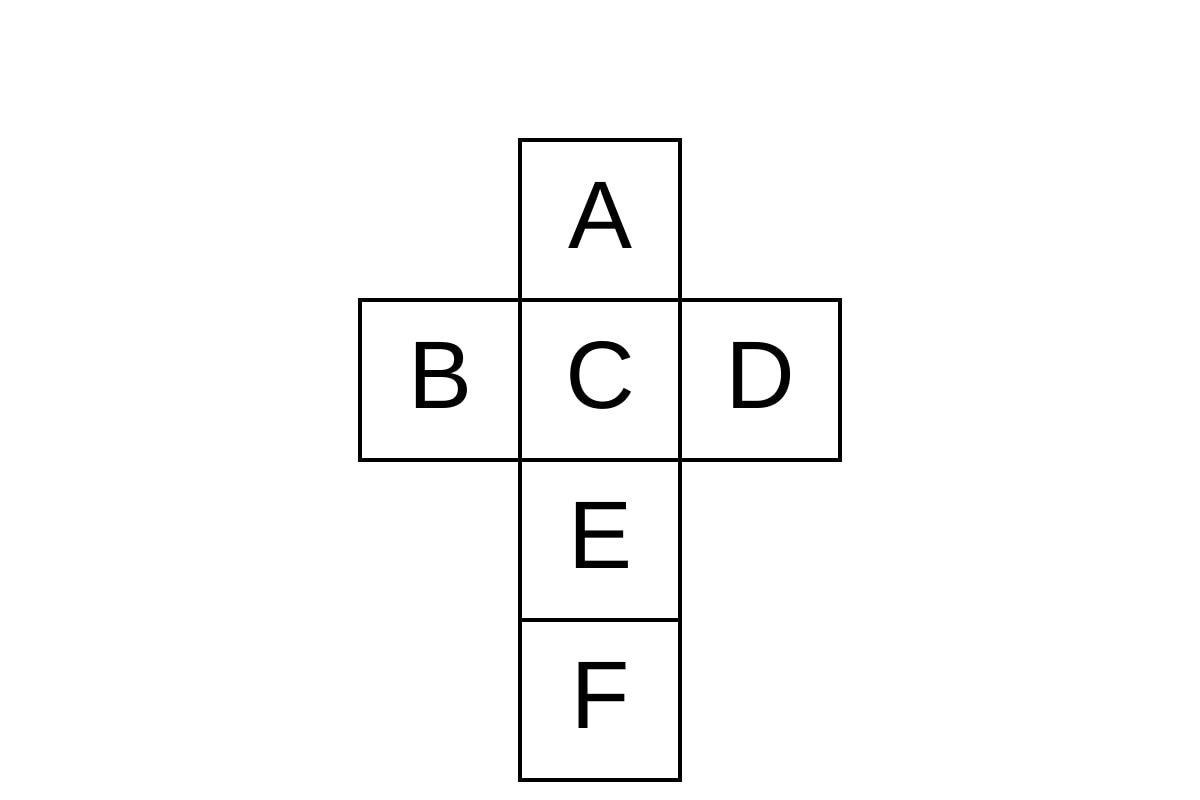
(c) In the vertical strip of four squares A, C, E, F, every second square becomes an opposite pair when folded. Folding the net, C and F end up as parallel faces, so F is opposite C. (Likewise A is opposite E, and B is opposite D.) [1]
Answer 16.
[3]
Working:
- Angles of a triangle add up to . [M1]
- . [M1]
- . [A1]
Answer 17.
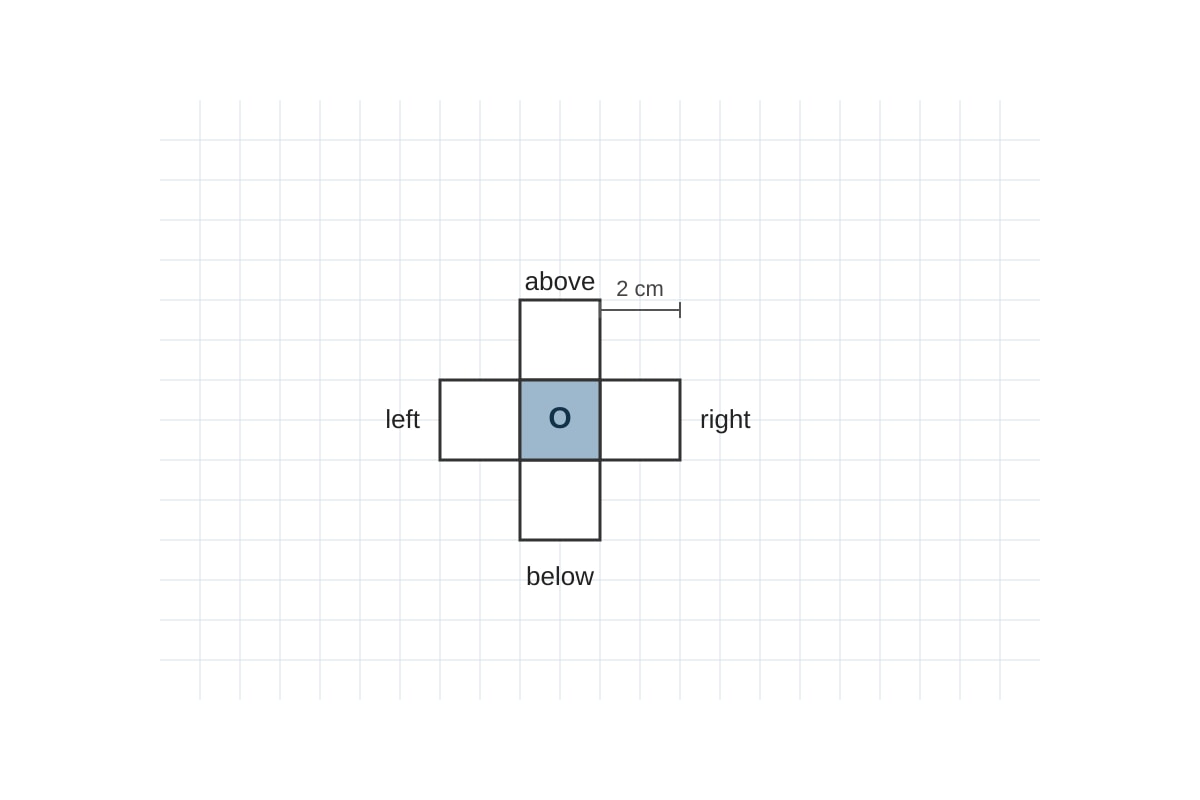
Draw 4 lines of symmetry, all passing through the centre square O: [3]
- One vertical line through O.
- One horizontal line through O.
- Two diagonal lines through O.
Number of lines of symmetry: 4
Award [1] for each correct line drawn (each must pass through O). Common mistake: drawing only 2 lines and forgetting the diagonals — because the figure is built from squares, the diagonals also fold it onto itself.
Answer 18.
(a) 5 square faces [1] — a cube has 6 faces; with no lid, one face is removed.
(b) One possible net: [2]
- Draw a row of 4 squares in a straight line, with 1 extra square attached below any one of them (for example, below the second square).
- Accept any arrangement of 5 connected squares that folds into an open cube: the squares must not overlap when folded and must form 4 walls around 1 base.
Award [1] for exactly 5 squares in a connected arrangement, [2] for a net that truly folds into an open box.
Answer 19.
(a) [1]
(b) [2]
- Method: 3 slices at each; . [M1 method, A1 answer]
(c) [1] — 3 slices out of 8 equal slices; already in simplest form since 3 and 8 have no common factor other than 1.
Answer 20.
(a) The corners measuring and are not right angles. [1]
(b) Each corner is off by : too big; too small. [1]
(c) By definition, a rectangle is a quadrilateral with four right angles. If any corner is not exactly , the shape fails this property and is not a true rectangle — the frame would be slightly slanted. [1]
END OF ANSWER KEY