From Real Exams Quiz

Primary 4 Mathematics Fractions Quiz

Free Exam-Derived Qwen3.7 Plus Primary 4 Mathematics Fractions quiz with questions and answers for Singapore students. This page is rendered as a direct URL so the questions and answers can be discovered without pressing in-page buttons.

These static practice materials are generated from the site's syllabus and paper-generation workflow, with source and model context shown so students and parents can evaluate the material before use.

Primary 4 Mathematics From Real Exams Generated by Qwen3.7 Plus Updated 2026-06-04

Questions

<!-- TuitionGoWhere generation metadata: stage=3-0; model=qwen/qwen3.7-plus; model_label=Qwen3.7 Plus; generated=2026-06-04; Sources: Stage 2-1 real exam-derived templates and Stage 2-2 exam-enriched syllabus. -->

Primary 4 Mathematics Quiz - Fractions

Name: __________________________
Class: __________________________
Date: __________________________
Score: ________ / 40

Duration: 1 hour 15 minutes
Total Marks: 40

Instructions to Candidates:

  1. This quiz consists of 20 questions.
  2. Answer all questions.
  3. Write your answers in the spaces provided.
  4. For questions requiring working, show all necessary steps clearly.
  5. Unless otherwise stated, give your answers in the simplest form.

Section A: Multiple Choice Questions (Questions 1–10)

Each question carries 1 mark. Choose the correct answer and write its number (1, 2, 3, or 4) in the brackets provided.

1. Which of the following fractions is equivalent to 35\frac{3}{5}? (1) 615\frac{6}{15} (2) 915\frac{9}{15} (3) 1225\frac{12}{25} (4) 1520\frac{15}{20} [ ]

2. Express 1824\frac{18}{24} in its simplest form. (1) 34\frac{3}{4} (2) 68\frac{6}{8} (3) 912\frac{9}{12} (4) 23\frac{2}{3} [ ]

3. Which of the following shows the fractions arranged in ascending order? (1) 13,12,23\frac{1}{3}, \frac{1}{2}, \frac{2}{3} (2) 23,12,13\frac{2}{3}, \frac{1}{2}, \frac{1}{3} (3) 12,13,23\frac{1}{2}, \frac{1}{3}, \frac{2}{3} (4) 13,23,12\frac{1}{3}, \frac{2}{3}, \frac{1}{2} [ ]

4. What is the value of 214+1122 \frac{1}{4} + 1 \frac{1}{2}? (1) 3163 \frac{1}{6} (2) 3343 \frac{3}{4} (3) 3263 \frac{2}{6} (4) 4144 \frac{1}{4} [ ]

5. Subtract 58\frac{5}{8} from 78\frac{7}{8}. Give your answer in the simplest form. (1) 28\frac{2}{8} (2) 14\frac{1}{4} (3) 12\frac{1}{2} (4) 34\frac{3}{4} [ ]

6. Mrs. Tan baked a cake. She cut it into 12 equal slices. Her family ate 5 slices. What fraction of the cake was left? (1) 512\frac{5}{12} (2) 712\frac{7}{12} (3) 57\frac{5}{7} (4) 75\frac{7}{5} [ ]

7. Find the sum of 23\frac{2}{3} and 14\frac{1}{4}. (1) 37\frac{3}{7} (2) 312\frac{3}{12} (3) 1112\frac{11}{12} (4) 11121 \frac{1}{12} [ ]

8. Which of the following is equal to 4254 - \frac{2}{5}? (1) 3253 \frac{2}{5} (2) 3353 \frac{3}{5} (3) 4254 \frac{2}{5} (4) 2352 \frac{3}{5} [ ]

9. 37\frac{3}{7} of a rope is 12 m long. What is the length of the whole rope? (1) 4 m (2) 21 m (3) 28 m (4) 36 m [ ]

10. Sarah has 34\frac{3}{4} kg of flour. She uses 12\frac{1}{2} kg to bake cookies. How much flour does she have left? (1) 14\frac{1}{4} kg (2) 12\frac{1}{2} kg (3) 24\frac{2}{4} kg (4) 38\frac{3}{8} kg [ ]


Section B: Short Answer Questions (Questions 11–15)

Each question carries 2 marks. Show your working where necessary.

11. Convert the improper fraction 296\frac{29}{6} into a mixed number in its simplest form.

<br> <br> Answer: __________________________

12. Arrange the following fractions in descending order: 34,58,23\frac{3}{4}, \quad \frac{5}{8}, \quad \frac{2}{3}

<br> <br> Answer: __________________________

13. Calculate the value of 31513103 \frac{1}{5} - 1 \frac{3}{10}. Give your answer as a mixed number in its simplest form.

<br> <br> <br> Answer: __________________________

14. There are 40 students in a class. 38\frac{3}{8} of them are boys. How many girls are there in the class?

<br> <br> <br> Answer: __________________________

15. Mr. Lim bought 2122 \frac{1}{2} kg of apples and 1341 \frac{3}{4} kg of oranges. What is the total mass of the fruits he bought?

<br> <br> <br> Answer: __________________________

Section C: Long Answer / Problem Solving (Questions 16–20)

Questions 16–19 carry 3 marks each. Question 20 carries 4 marks. Show all necessary working.

16. A tank was 25\frac{2}{5} filled with water. After adding 12 litres of water, the tank became 45\frac{4}{5} filled. What is the capacity of the tank?

<br> <br> <br> <br> Answer: __________________________

17. Jenny spent 13\frac{1}{3} of her money on a book and 14\frac{1}{4} of her money on a pen. (a) What fraction of her money did she spend altogether? (b) What fraction of her money was left?

<br> <br> <br> <br> <br> (a) Answer: __________________________ (b) Answer: __________________________

18. A baker made some muffins. He sold 25\frac{2}{5} of them in the morning and 13\frac{1}{3} of them in the afternoon. If he had 24 muffins left, how many muffins did he make at first?

<br> <br> <br> <br> <br> Answer: __________________________

19. Ribbon A is 34\frac{3}{4} m long. Ribbon B is 16\frac{1}{6} m shorter than Ribbon A. Ribbon C is twice as long as Ribbon B. (a) Find the length of Ribbon B. (b) Find the total length of Ribbon A and Ribbon C.

<br> <br> <br> <br> <br> <br> (a) Answer: __________________________ (b) Answer: __________________________

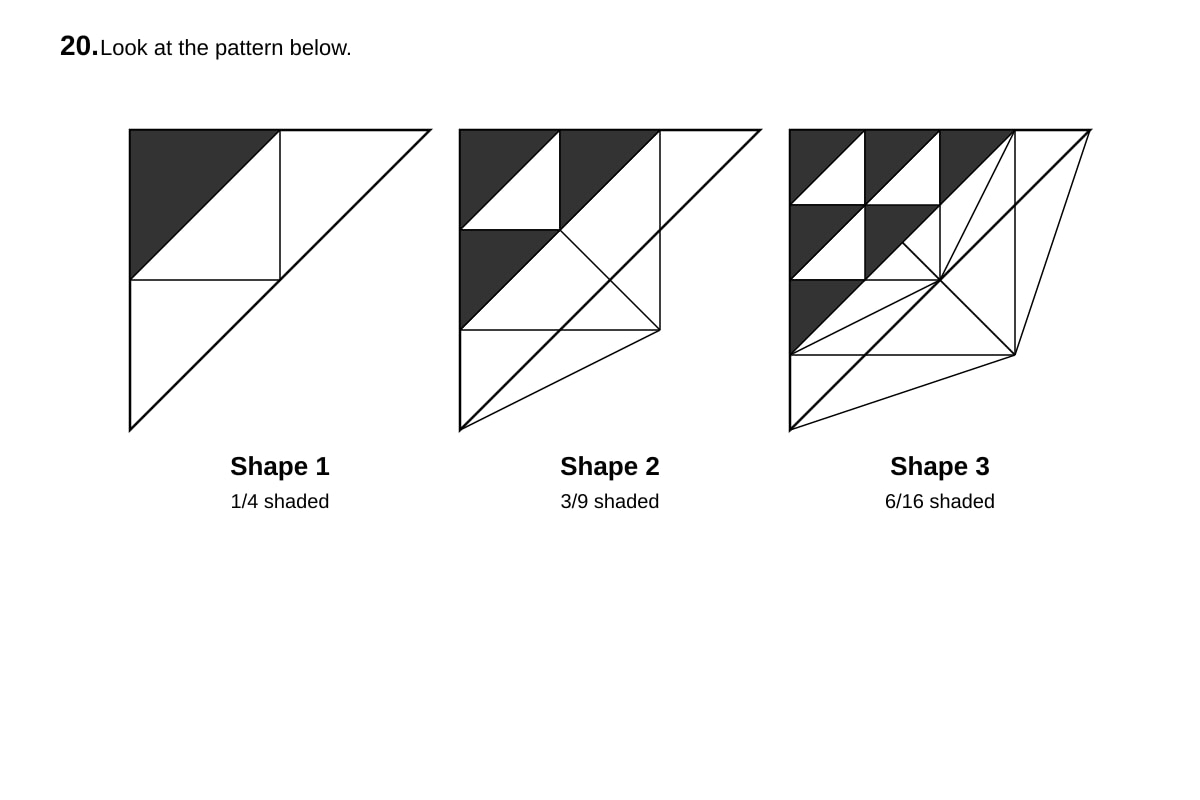
20. Look at the pattern below.

<image_placeholder> id: Q20-fig1 type: diagram linked_question: Q20 description: A sequence of three shapes made of shaded and unshaded triangles. Shape 1 is a large triangle divided into 4 smaller triangles, with 1 shaded. Shape 2 is a large triangle divided into 9 smaller triangles, with 3 shaded. Shape 3 is a large triangle divided into 16 smaller triangles, with 6 shaded. labels: Shape 1, Shape 2, Shape 3 values: Shape 1: 1/4 shaded. Shape 2: 3/9 shaded. Shape 3: 6/16 shaded. must_show: The grid lines dividing the large triangles into smaller equal triangles. The shaded regions must be clearly distinct. </image_placeholder>

(a) What fraction of Shape 4 is shaded? (Assume the pattern continues with the next triangular number of shaded parts over the next square number of total parts). (b) Explain how you found your answer.

<br> <br> <br> <br> <br> <br> (a) Answer: __________________________ (b) Explanation: <br> <br> <br>

Answers

<!-- TuitionGoWhere generation metadata: stage=3-0; model=qwen/qwen3.7-plus; model_label=Qwen3.7 Plus; generated=2026-06-04; Sources: Stage 2-1 real exam-derived templates and Stage 2-2 exam-enriched syllabus. -->

Primary 4 Mathematics Quiz - Fractions (Answer Key)

Total Marks: 40


Section A: Multiple Choice Questions (10 Marks)

1. (2)

  • Reasoning: To find an equivalent fraction, multiply the numerator and denominator by the same number. 3×35×3=915\frac{3 \times 3}{5 \times 3} = \frac{9}{15}.
  • Check: 615=25\frac{6}{15} = \frac{2}{5}, 1225\frac{12}{25} is not equivalent, 1520=34\frac{15}{20} = \frac{3}{4}.

2. (1)

  • Reasoning: Simplify 1824\frac{18}{24} by dividing numerator and denominator by their Highest Common Factor (HCF), which is 6. 18÷6=318 \div 6 = 3 24÷6=424 \div 6 = 4 Answer: 34\frac{3}{4}.

3. (1)

  • Reasoning: Ascending order means from smallest to largest. Convert to common denominator (6): 13=26\frac{1}{3} = \frac{2}{6} 12=36\frac{1}{2} = \frac{3}{6} 23=46\frac{2}{3} = \frac{4}{6} Order: 26,36,4613,12,23\frac{2}{6}, \frac{3}{6}, \frac{4}{6} \rightarrow \frac{1}{3}, \frac{1}{2}, \frac{2}{3}.

4. (2)

  • Reasoning: Add whole numbers and fractions separately. Whole numbers: 2+1=32 + 1 = 3. Fractions: 14+12=14+24=34\frac{1}{4} + \frac{1}{2} = \frac{1}{4} + \frac{2}{4} = \frac{3}{4}. Total: 3343 \frac{3}{4}.

5. (2)

  • Reasoning: 7858=28\frac{7}{8} - \frac{5}{8} = \frac{2}{8}. Simplify 28\frac{2}{8} by dividing by 2: 14\frac{1}{4}.

6. (2)

  • Reasoning: Total slices = 12. Eaten = 5. Left = 125=712 - 5 = 7 slices. Fraction left = 712\frac{7}{12}.

7. (3)

  • Reasoning: Common denominator for 3 and 4 is 12. 23=812\frac{2}{3} = \frac{8}{12} 14=312\frac{1}{4} = \frac{3}{12} Sum: 812+312=1112\frac{8}{12} + \frac{3}{12} = \frac{11}{12}.

8. (2)

  • Reasoning: 4254 - \frac{2}{5}. Borrow 1 from 4 to make it 3553 \frac{5}{5}. 35525=3353 \frac{5}{5} - \frac{2}{5} = 3 \frac{3}{5}.

9. (3)

  • Reasoning: 37\frac{3}{7} of Rope = 12 m. 17\frac{1}{7} of Rope = 12÷3=412 \div 3 = 4 m. Whole rope (77\frac{7}{7}) = 4×7=284 \times 7 = 28 m.

10. (1)

  • Reasoning: 3412\frac{3}{4} - \frac{1}{2}. Common denominator is 4. 12=24\frac{1}{2} = \frac{2}{4}. 3424=14\frac{3}{4} - \frac{2}{4} = \frac{1}{4} kg.

Section B: Short Answer Questions (10 Marks)

11. 4564 \frac{5}{6} (2 marks)

  • Working: 29÷6=429 \div 6 = 4 remainder 55. So, 296=456\frac{29}{6} = 4 \frac{5}{6}. 56\frac{5}{6} is already in simplest form.
  • Marking: 1 mark for correct whole number and fraction parts, 1 mark for simplest form.

12. 34,23,58\frac{3}{4}, \frac{2}{3}, \frac{5}{8} (2 marks)

  • Working: Find common denominator for 4, 3, 8. LCM is 24. 34=1824\frac{3}{4} = \frac{18}{24} 58=1524\frac{5}{8} = \frac{15}{24} 23=1624\frac{2}{3} = \frac{16}{24} Descending order (largest to smallest): 1824,1624,1524\frac{18}{24}, \frac{16}{24}, \frac{15}{24}. Answer: 34,23,58\frac{3}{4}, \frac{2}{3}, \frac{5}{8}.
  • Marking: 1 mark for correct conversion/comparison, 1 mark for correct order.

13. 19101 \frac{9}{10} (2 marks)

  • Working: 31513103 \frac{1}{5} - 1 \frac{3}{10} Convert fractions to common denominator (10): 321013103 \frac{2}{10} - 1 \frac{3}{10}. Since 210<310\frac{2}{10} < \frac{3}{10}, borrow 1 from 3. 2121013102 \frac{12}{10} - 1 \frac{3}{10} Whole numbers: 21=12 - 1 = 1. Fractions: 1210310=910\frac{12}{10} - \frac{3}{10} = \frac{9}{10}. Answer: 19101 \frac{9}{10}.
  • Marking: 1 mark for correct borrowing/conversion, 1 mark for final answer.

14. 25 girls (2 marks)

  • Working: Fraction of boys = 38\frac{3}{8}. Fraction of girls = 138=581 - \frac{3}{8} = \frac{5}{8}. Number of girls = 58×40\frac{5}{8} \times 40. 40÷8=540 \div 8 = 5. 5×5=255 \times 5 = 25.
  • Alternative: Boys = 38×40=15\frac{3}{8} \times 40 = 15. Girls = 4015=2540 - 15 = 25.
  • Marking: 1 mark for finding fraction of girls or number of boys, 1 mark for final answer.

15. 4144 \frac{1}{4} kg (2 marks)

  • Working: 212+1342 \frac{1}{2} + 1 \frac{3}{4} Common denominator (4): 224+1342 \frac{2}{4} + 1 \frac{3}{4}. Whole numbers: 2+1=32 + 1 = 3. Fractions: 24+34=54=114\frac{2}{4} + \frac{3}{4} = \frac{5}{4} = 1 \frac{1}{4}. Total: 3+114=4143 + 1 \frac{1}{4} = 4 \frac{1}{4}.
  • Marking: 1 mark for correct addition process, 1 mark for simplest form.

Section C: Long Answer / Problem Solving (20 Marks)

16. 30 litres (3 marks)

  • Working: Fraction of water added = 4525=25\frac{4}{5} - \frac{2}{5} = \frac{2}{5}. 25\frac{2}{5} of capacity = 12 litres. 15\frac{1}{5} of capacity = 12÷2=612 \div 2 = 6 litres. Total capacity (55\frac{5}{5}) = 6×5=306 \times 5 = 30 litres.
  • Marking: 1 mark for finding fraction difference (25\frac{2}{5}). 1 mark for finding unit value (15=6\frac{1}{5} = 6). 1 mark for final answer.

17. (a) 712\frac{7}{12}, (b) 512\frac{5}{12} (3 marks)

  • Working (a): Spent on book = 13=412\frac{1}{3} = \frac{4}{12}. Spent on pen = 14=312\frac{1}{4} = \frac{3}{12}. Total spent = 412+312=712\frac{4}{12} + \frac{3}{12} = \frac{7}{12}.
  • Working (b): Left = 1712=5121 - \frac{7}{12} = \frac{5}{12}.
  • Marking: 1 mark for common denominator/adding fractions in (a). 1 mark for correct answer in (a). 1 mark for correct answer in (b).

18. 90 muffins (3 marks)

  • Working: Fraction sold in morning = 25=615\frac{2}{5} = \frac{6}{15}. Fraction sold in afternoon = 13=515\frac{1}{3} = \frac{5}{15}. Total fraction sold = 615+515=1115\frac{6}{15} + \frac{5}{15} = \frac{11}{15}. Fraction left = 11115=4151 - \frac{11}{15} = \frac{4}{15}. 415\frac{4}{15} of total = 24 muffins. 115\frac{1}{15} of total = 24÷4=624 \div 4 = 6 muffins. Total (1515\frac{15}{15}) = 6×15=906 \times 15 = 90 muffins.
  • Marking: 1 mark for finding fraction left (415\frac{4}{15}). 1 mark for finding unit value (115=6\frac{1}{15} = 6). 1 mark for final answer.

19. (a) 712\frac{7}{12} m, (b) 136\frac{13}{6} m or 2162 \frac{1}{6} m (3 marks)

  • Working (a): Length of B = Length of A - 16\frac{1}{6}. 3416\frac{3}{4} - \frac{1}{6}. Common denominator 12. 912212=712\frac{9}{12} - \frac{2}{12} = \frac{7}{12} m.
  • Working (b): Length of C = 2×2 \times Length of B = 2×712=1412=762 \times \frac{7}{12} = \frac{14}{12} = \frac{7}{6} m. Total A + C = 34+76\frac{3}{4} + \frac{7}{6}. Common denominator 12: 912+1412=2312\frac{9}{12} + \frac{14}{12} = \frac{23}{12} m. Correction in logic check: Wait, 2312\frac{23}{12} is 111121 \frac{11}{12}. Let's re-read carefully. Ribbon A = 34\frac{3}{4}. Ribbon C = 76\frac{7}{6}. Sum = 912+1412=2312\frac{9}{12} + \frac{14}{12} = \frac{23}{12} m. Simplest form: 111121 \frac{11}{12} m.
  • Marking: 1 mark for correct length of B. 1 mark for correct length of C. 1 mark for correct total sum.

20. (a) 1025\frac{10}{25} or 25\frac{2}{5}, (b) Explanation (4 marks)

  • Working (a): Analyze the pattern: Shape 1: Total triangles 22=42^2=4? No, side length 2 units? Let's look at the image description. Shape 1: 4 small triangles total. Shaded 1. (1=1(1+1)21 = \frac{1(1+1)}{2}? No, 1 is triangular number T1T_1). Denominator 22=42^2=4. Shape 2: 9 small triangles total. Shaded 3. (3=T2=1+23 = T_2 = 1+2). Denominator 32=93^2=9. Shape 3: 16 small triangles total. Shaded 6. (6=T3=1+2+36 = T_3 = 1+2+3). Denominator 42=164^2=16.

    Pattern for Shape nn: Total triangles = (n+1)2(n+1)^2. Shaded triangles = Tn=n(n+1)2T_n = \frac{n(n+1)}{2}.

    For Shape 4 (n=4n=4): Total triangles = (4+1)2=52=25(4+1)^2 = 5^2 = 25. Shaded triangles = T4=1+2+3+4=10T_4 = 1+2+3+4 = 10. Fraction = 1025\frac{10}{25}. Simplest form = 25\frac{2}{5}.

  • Explanation (b): The number of total small triangles follows the square numbers sequence starting from 222^2: 4,9,16,254, 9, 16, 25. The number of shaded triangles follows the triangular numbers sequence: 1,3,6,101, 3, 6, 10. Therefore, for Shape 4, the fraction is 1025\frac{10}{25}, which simplifies to 25\frac{2}{5}.

  • Marking: 1 mark for identifying denominator pattern (25). 1 mark for identifying numerator pattern (10). 1 mark for correct fraction 1025\frac{10}{25} or 25\frac{2}{5}. 1 mark for clear explanation linking triangular/square numbers or the specific addition pattern.