From Real Exams Quiz
Primary 4 Mathematics Decimals Quiz
Free P4 Maths Decimals quiz, Exam version, with questions, answers, and syllabus-aligned practice for Singapore students.
These static practice materials are generated from the site's syllabus and paper-generation workflow, with source and model context shown so students and parents can evaluate the material before use.
Questions
Free quiz and exam paper access
Enter your details to view this paper
Your access is remembered on this device.
Answers
Primary 4 Mathematics Quiz - Decimals: Answer Key
Total Marks: 40
Section A: Multiple-Choice Questions (5 questions x 2 marks = 10 marks)
1. Answer: B) 7 hundredths
- Marks: 2
- Explanation: In the number 3.075, the digit 7 is in the hundredths place. The place values after the decimal point are: tenths (0.1), hundredths (0.01), thousandths (0.001). So, 7 is in the hundredths place, meaning it represents 7 hundredths or 0.07.
- Common Mistake: Students might confuse hundredths with thousandths. The digit 5 is in the thousandths place.
2. Answer: C) 0.5
- Marks: 2
- Explanation: To compare decimals, align them by place value:
- 0.5 = 0.500
- 0.45 = 0.450
- 0.405 = 0.405
- 0.054 = 0.054 Comparing the tenths place: 0.5 has 5 tenths, which is the largest. 0.45 and 0.405 have 4 tenths, and 0.054 has 0 tenths.
- Common Mistake: Students might think 0.45 is larger than 0.5 because 45 is larger than 5, forgetting to compare place values.
3. Answer: B) 0.7
- Marks: 2
- Explanation: means 7 tenths. In decimal form, this is written as 0.7. The first digit after the decimal point represents tenths.
- Common Mistake: Students might write 0.07, confusing tenths with hundredths.
4. Answer: A) 4.8
- Marks: 2
- Explanation: To round 4.836 to 1 decimal place, we look at the digit in the second decimal place (hundredths), which is 3. Since 3 is less than 5, we round down, meaning the digit in the first decimal place (tenths) stays the same. So, 4.836 rounded to 1 decimal place is 4.8.
- Common Mistake: Students might round up because they see 36, forgetting to only look at the digit immediately to the right of the rounding place.
5. Answer: B)
- Marks: 2
- Explanation: 0.06 is read as "six hundredths". The digit 6 is in the hundredths place. Therefore, it is equal to .
- Common Mistake: Students might choose (0.6) or (0.60).
Section B: Short-Answer Questions (10 questions x 2 marks = 20 marks)
6. Answer: 0.37
- Marks: 2 (1 mark for correct method, 1 mark for correct answer)
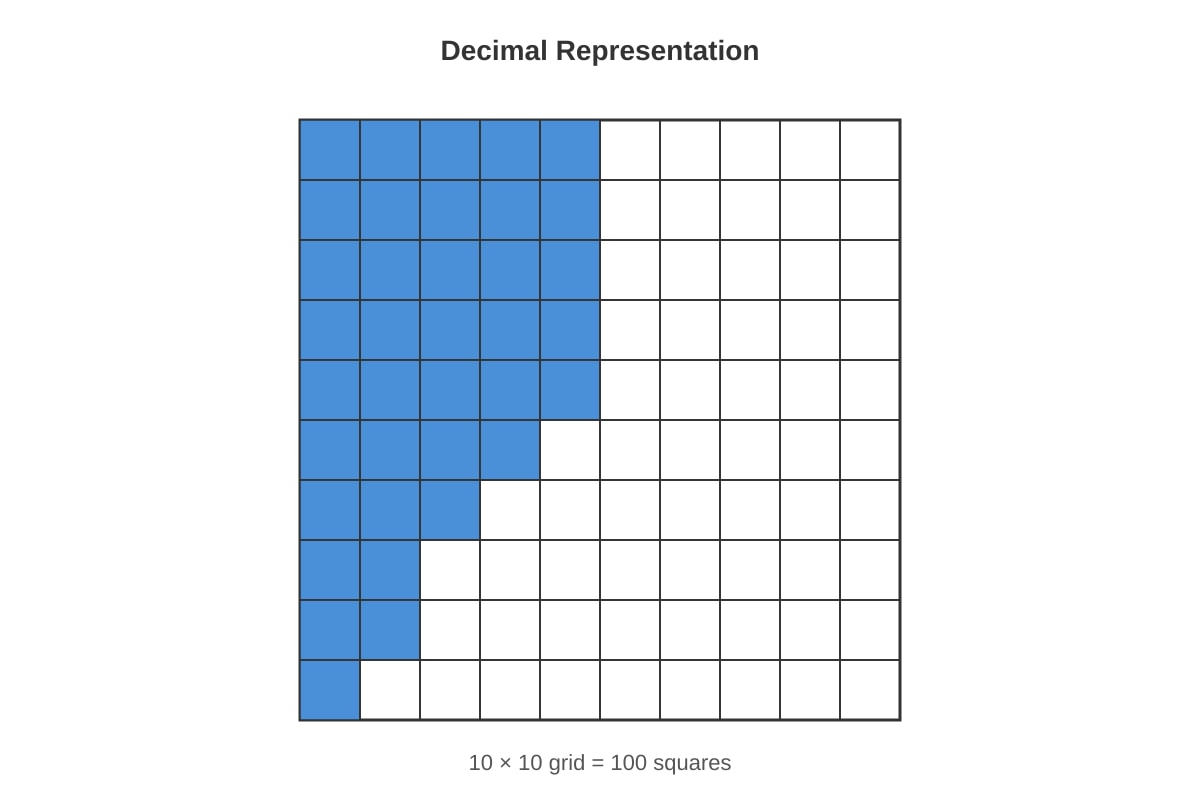
- Explanation: The diagram is a 10x10 grid, which represents 100 equal parts. 37 squares are shaded. This represents 37 out of 100, or , which is written as the decimal 0.37.
- Marking Note: Accept 0.37 or .
7. Answer: 0.208, 0.28, 0.802, 0.82
- Marks: 2 (1 mark for correct order, but not starting with the smallest)
- Explanation: To compare, write them with the same number of decimal places:
- 0.82 = 0.820
- 0.28 = 0.280
- 0.802 = 0.802
- 0.208 = 0.208 Now compare the digits from left to right. The smallest is 0.208 (0 tenths), then 0.280 (2 tenths), then 0.802 (8 tenths), then 0.820 (8 tenths, but 0.802 has 0 hundredths while 0.820 has 2 hundredths, so 0.802 is smaller).
- Common Mistake: Students might order by the number of digits (e.g., putting 0.82 before 0.802).
8. Answer: 8.25
- Marks: 2 (1 mark for correct method, 1 mark for correct answer)
- Explanation: Align the decimal points and add:
5.90 + 2.35 ------ 8.25 - Working: 5.9 + 2.35 = 5.90 + 2.35 = 8.25
9. Answer: 4.72
- Marks: 2 (1 mark for correct method, 1 mark for correct answer)
- Explanation: Align the decimal points and subtract:
6.20 - 1.48 ------ 4.72 - Working: 6.2 - 1.48 = 6.20 - 1.48 = 4.72
10. Answer: 20.4
- Marks: 2 (1 mark for correct method, 1 mark for correct answer)
- Explanation: Multiply 3.4 by 6 as if it were a whole number (34 x 6 = 204). Since 3.4 has 1 decimal place, the answer must also have 1 decimal place. So, 204 becomes 20.4.
- Working: 3.4 x 6 = 20.4
11. Answer: 1.2
- Marks: 2 (1 mark for correct method, 1 mark for correct answer)
- Explanation: Divide 8.4 by 7. 7 goes into 8 once, with 1 remainder. Bring down the 4 to make 14. 7 goes into 14 twice. Place the decimal point directly above the decimal point in the dividend. So, 8.4 ÷ 7 = 1.2.
- Working: 8.4 ÷ 7 = 1.2
12. Answer: 0.6
- Marks: 2 (1 mark for correct method, 1 mark for correct answer)
- Explanation: To express as a decimal, find an equivalent fraction with a denominator of 10. Multiply the numerator and denominator by 2: .
- Alternative Method: Divide the numerator by the denominator: 3 ÷ 5 = 0.6.
13. Answer: 12.68
- Marks: 2 (1 mark for correct method, 1 mark for correct answer)
- Explanation: To round 12.679 to 2 decimal places, we look at the digit in the third decimal place (thousandths), which is 9. Since 9 is greater than or equal to 5, we round up the digit in the second decimal place (hundredths) from 7 to 8. So, 12.679 rounded to 2 decimal places is 12.68.
- Common Mistake: Students might forget to round up the 7 to 8.
14. Answer: 40
- Marks: 2
- Explanation: Multiplying a decimal by 100 moves the decimal point two places to the right. 0.4 x 100 = 40. (0.4 → 04.0 → 40)
- Common Mistake: Students might think the answer is 0.400 or 400.
15. Answer: 0.5 m
- Marks: 2 (1 mark for correct method, 1 mark for correct answer)
- Explanation: The ribbon is 2.5 m long and is cut into 5 equal pieces. To find the length of each piece, divide 2.5 by 5. 2.5 ÷ 5 = 0.5. Each piece is 0.5 m long.
- Working: 2.5 ÷ 5 = 0.5
Section C: Problem-Solving Questions (5 questions x 2 marks = 10 marks)
16. Answer: 2.25 litres
- Marks: 2 (1 mark for correct method, 1 mark for correct answer)
- Explanation: To find the total amount of water, add the amounts in both bottles. 1.5 + 0.75 = 2.25 litres.
- Working: 1.50 + 0.75 = 2.25
17. Answer: 1.75 m
- Marks: 2 (1 mark for correct method, 1 mark for correct answer)
- Explanation: To find the amount of cloth left, subtract the amount used from the original length. 3.6 - 1.85 = 1.75 m.
- Working: 3.60 - 1.85 = 1.75
18. Answer: 2 kg
- Marks: 2 (1 mark for correct method, 1 mark for correct answer)
- Explanation: To find the total mass of 8 packets, multiply the mass of one packet by 8. 0.25 x 8 = 2 kg.
- Working: 0.25 x 8 = 2.00 = 2
19. Answer: 0.4 litres
- Marks: 2 (1 mark for correct method, 1 mark for correct answer)
- Explanation: To find the amount of juice in each glass, divide the total amount of juice by the number of glasses. 2.4 ÷ 6 = 0.4 litres.
- Working: 2.4 ÷ 6 = 0.4
20. Answer: $4.90
- Marks: 2 (1 mark for correct method, 1 mark for correct answer)
- Explanation:
- Find the cost of the pen: $1.20 + $2.50 = $3.70
- Find the total cost: $1.20 + $3.70 = $4.90
- Working:
- Pen: $1.20 + $2.50 = $3.70
- Total: $1.20 + $3.70 = $4.90