From Real Exams Quiz
Primary 4 Mathematics Area Perimeter Quiz
Free P4 Maths Area Perimeter quiz, Exam version, with questions, answers, and syllabus-aligned practice for Singapore students.
These static practice materials are generated from the site's syllabus and paper-generation workflow, with source and model context shown so students and parents can evaluate the material before use.
Questions
Free quiz and exam paper access
Enter your details to view this paper
Your access is remembered on this device.
Answers
Primary 4 Mathematics Quiz - Area Perimeter: Answer Key
Section A: Multiple-Choice Questions
1. B (40 cm) [1 mark]
- Working: Perimeter = 2 × (Length + Width) = 2 × (12 + 8) = 2 × 20 = 40 cm.
- Teaching Notes: Remember that perimeter is the total distance around a shape. For a rectangle, we add the length and width and then multiply by 2. Option 3 (96 cm²) is the area, not the perimeter. Option 1 (20 cm) is just L+W without multiplying by 2.
- Common Mistake: Confusing perimeter with area (using cm² for perimeter).
2. C (81 cm²) [1 mark]
- Working: Area of square = side × side = 9 × 9 = 81 cm².
- Teaching Notes: Area is the amount of space inside a shape. For a square, we multiply the side length by itself. The unit for area is square units (cm², m², etc.).
- Common Mistake: Using cm instead of cm² for area.
3. A (10 cm) [1 mark]
- Working: Perimeter = 2(L + W) = 50 cm, so L + W = 50 ÷ 2 = 25 cm. Width = 25 - 15 = 10 cm.
- Teaching Notes: First divide the perimeter by 2 to get the sum of length and width. Then subtract the known length to find the width.
- Common Mistake: Students may subtract 15 from 50 directly, getting 35 cm.
4. A (8 m) [1 mark]
- Working: Area of square = side × side = 64 m². Since 8 × 8 = 64, side = 8 m.
- Teaching Notes: To find the side length of a square given its area, find the number that when multiplied by itself equals the area. This is finding the square root, which at P4 level means knowing multiplication facts.
- Common Mistake: Dividing 64 by 4 (getting 16 m) instead of finding the square root.
5. A (30 m²) [1 mark]
- Working: Option A: 5 × 6 = 30 m². Option B: 5 × 5 = 25 m². Option C: 7 × 4 = 28 m². Option D: 8 × 3 = 24 m².
- Teaching Notes: Calculate the area of each option and compare. The largest area is 30 m².
- Common Mistake: Not calculating all options before choosing.
6. B (81 cm²) [1 mark]
- Working: Perimeter = 4 × side = 36 cm, so side = 36 ÷ 4 = 9 cm. Area = 9 × 9 = 81 cm².
- Teaching Notes: This is a two-step problem. First find the side length using the perimeter, then find the area using the side length.
- Common Mistake: Using 36 directly as the side length and calculating 36 × 36 = 1296 cm².
7. B (46 m) [1 mark]
- Working: Perimeter = 2 × (14 + 9) = 2 × 23 = 46 m.
- Teaching Notes: Carefully add the length and width first, then multiply by 2.
- Common Mistake: Option A (126 m²) is the area, not the perimeter.
8. A (8 cm) [1 mark]
- Working: Length of string = perimeter of square = 4 × 10 = 40 cm. Perimeter of rectangle = 2(L + W) = 40 cm. L + W = 40 ÷ 2 = 20 cm. Width = 20 - 12 = 8 cm.
- Teaching Notes: The key idea is that the same string length becomes the perimeter of both shapes. Find the string length first from the square, then use it to find the rectangle's width.
- Common Mistake: Not realizing the string length is the same for both shapes.
9. C (34 cm) [1 mark]
- Working: Area = L × W = 72 cm², so W = 72 ÷ 9 = 8 cm. Perimeter = 2 × (9 + 8) = 2 × 17 = 34 cm.
- Teaching Notes: First find the width using the area and length, then find the perimeter.
- Common Mistake: Using the area formula without first finding the width.
10. A (2 cm by 18 cm) [1 mark]
- Working: Area of square = 6 × 6 = 36 cm². Option A: 2 × 18 = 36 cm². Option B: 3 × 13 = 39 cm². Option C: 4 × 8 = 32 cm². Option D: 5 × 12 = 60 cm².
- Teaching Notes: Find the area of the square first, then check which rectangle has the same area. Only option A gives 36 cm².
- Common Mistake: Not calculating all options systematically.
Section B: Short-Answer Questions
11. Perimeter = 86 m [2 marks]
- Working:
- Step 1: Add length and width: 25 + 18 = 43 m
- Step 2: Multiply by 2: 43 × 2 = 86 m
- OR directly: 2 × (25 + 18) = 2 × 43 = 86 m
- Answer: 86 m
- Marking Scheme:
- 1 mark for correct method (finding sum of L+W)
- 1 mark for correct final answer with unit
12. Area = 225 cm² [2 marks]
- Working:
- Step 1: Find side of square: Perimeter ÷ 4 = 60 ÷ 4 = 15 cm
- Step 2: Find area: side × side = 15 × 15 = 225 cm²
- Answer: 225 cm²
- Marking Scheme:
- 1 mark for finding side length correctly (15 cm)
- 1 mark for correct area with correct unit (cm²)
13. Area = 1350 m² [2 marks]
- Working:
- Area = length × width = 45 × 30 = 1350 m²
- (45 × 30 = 45 × 3 × 10 = 135 × 10 = 1350)
- Answer: 1350 m²
- Marking Scheme:
- 1 mark for correct formula/process
- 1 mark for correct answer with unit
14. Width = 12 cm [2 marks]
- Working:
- Step 1: L + W = Perimeter ÷ 2 = 64 ÷ 2 = 32 cm
- Step 2: Width = 32 - length = 32 - 20 = 12 cm
- Answer: 12 cm
- Marking Scheme:
- 1 mark for finding sum of L+W correctly
- 1 mark for correct answer
15. Perimeter = 40 cm [2 marks]
- Working:
- Step 1: Find length: Area ÷ width = 96 ÷ 8 = 12 cm
- Step 2: Find perimeter: 2 × (12 + 8) = 2 × 20 = 40 cm
- Answer: 40 cm
- Marking Scheme:
- 1 mark for finding length correctly (12 cm)
- 1 mark for correct perimeter with working
Section C: Problem-Solving Questions
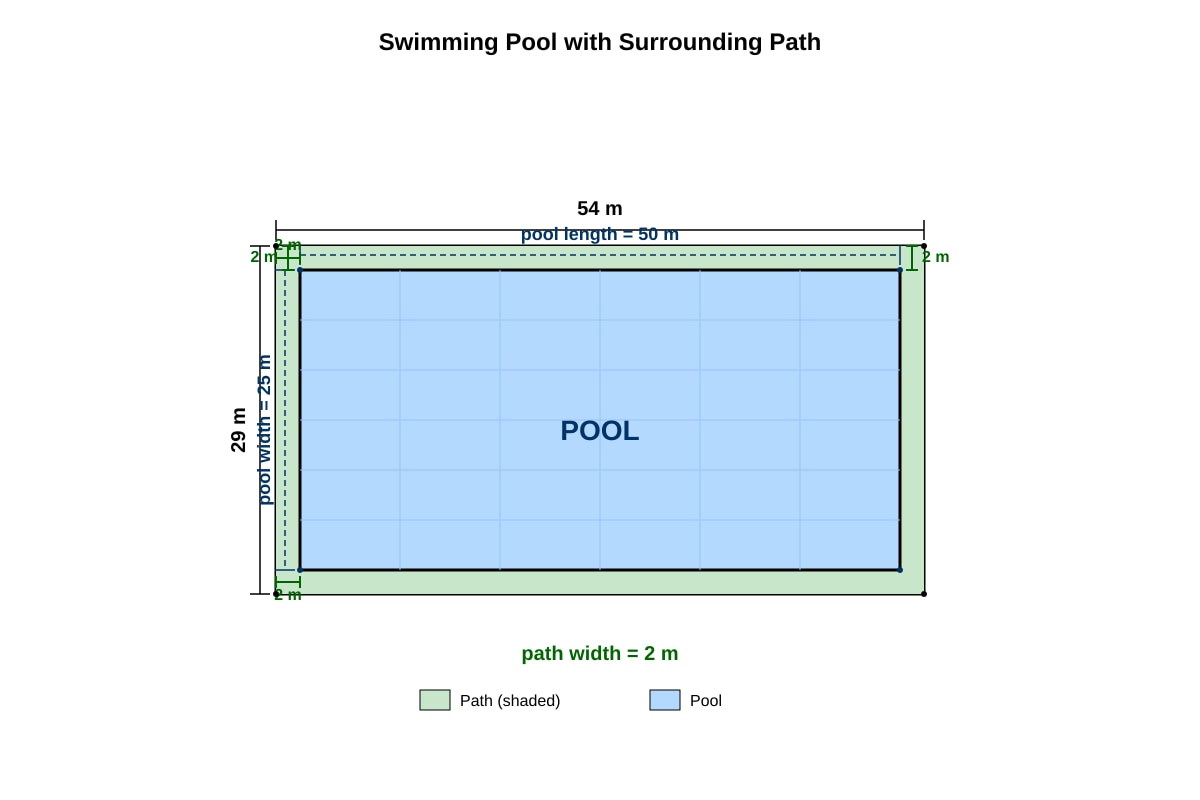
16. Area of path = 316 m² [2 marks]
- Working:
- Step 1: Find dimensions of outer rectangle (pool + path): Length = 50 + 2 + 2 = 54 m, Width = 25 + 2 + 2 = 29 m
- Step 2: Area of outer rectangle = 54 × 29 = 1566 m²
- Step 3: Area of pool = 50 × 25 = 1250 m²
- Step 4: Area of path = 1566 - 1250 = 316 m²
- Answer: 316 m²
- Teaching Notes: The path goes around the entire pool, so we add 2 m on each side (top, bottom, left, right). This means we add 4 m to both the length and the width of the pool to get the outer dimensions.
- Common Mistake: Adding only 2 m instead of 4 m to the length and width (forgetting there are two
<stage3_quiz_answers_md>
Primary 4 Mathematics Quiz - Area Perimeter: Answer Key
Section A: Multiple-Choice Questions
1. B (40 cm) [1 mark]
- Working: Perimeter = 2 × (Length + Width) = 2 × (12 + 8) = 2 × 20 = 40 cm.
- Teaching Notes: Remember that perimeter is the total distance around a shape. For a rectangle, we add the length and width and then multiply by 2. Option 3 (96 cm²) is the area, not the perimeter. Option 1 (20 cm) is just L+W without multiplying by 2.
- Common Mistake: Confusing perimeter with area (using cm² for perimeter).
2. C (81 cm²) [1 mark]
- Working: Area of square = side × side = 9 × 9 = 81 cm².
- Teaching Notes: Area is the amount of space inside a shape. For a square, we multiply the side length by itself. The unit for area is square units (cm², m², etc.).
- Common Mistake: Using cm instead of cm² for area.
3. A (10 cm) [1 mark]
- Working: Perimeter = 2(L + W) = 50 cm, so L + W = 50 ÷ 2 = 25 cm. Width = 25 - 15 = 10 cm.
- Teaching Notes: First divide the perimeter by 2 to get the sum of length and width. Then subtract the known length to find the width.
- Common Mistake: Students may subtract 15 from 50 directly, getting 35 cm.
4. A (8 m) [1 mark]
- Working: Area of square = side × side = 64 m². Since 8 × 8 = 64, side = 8 m.
- Teaching Notes: To find the side length of a square given its area, find the number that when multiplied by itself equals the area. This is finding the square root, which at P4 level means knowing multiplication facts.
- Common Mistake: Dividing 64 by 4 (getting 16 m) instead of finding the square root.
5. A (30 m²) [1 mark]
- Working: Option A: 5 × 6 = 30 m². Option B: 5 × 5 = 25 m². Option C: 7 × 4 = 28 m². Option D: 8 × 3 = 24 m².
- Teaching Notes: Calculate the area of each option and compare. The largest area is 30 m².
- Common Mistake: Not calculating all options before choosing.
6. B (81 cm²) [1 mark]
- Working: Perimeter = 4 × side = 36 cm, so side = 36 ÷ 4 = 9 cm. Area = 9 × 9 = 81 cm².
- Teaching Notes: This is a two-step problem. First find the side length using the perimeter, then find the area using the side length.
- Common Mistake: Using 36 directly as the side length and calculating 36 × 36 = 1296 cm².
7. B (46 m) [1 mark]
- Working: Perimeter = 2 × (14 + 9) = 2 × 23 = 46 m.
- Teaching Notes: Carefully add the length and width first, then multiply by 2.
- Common Mistake: Option A (126 m²) is the area, not the perimeter.
8. A (8 cm) [1 mark]
- Working: Length of string = perimeter of square = 4 × 10 = 40 cm. Perimeter of rectangle = 2(L + W) = 40 cm. L + W = 40 ÷ 2 = 20 cm. Width = 20 - 12 = 8 cm.
- Teaching Notes: The key idea is that the same string length becomes the perimeter of both shapes. Find the string length first from the square, then use it to find the rectangle's width.
- Common Mistake: Not realizing the string length is the same for both shapes.
9. C (34 cm) [1 mark]
- Working: Area = L × W = 72 cm², so W = 72 ÷ 9 = 8 cm. Perimeter = 2 × (9 + 8) = 2 × 17 = 34 cm.
- Teaching Notes: First find the width using the area and length, then find the perimeter.
- Common Mistake: Using the area formula without first finding the width.
10. A (2 cm by 18 cm) [1 mark]
- Working: Area of square = 6 × 6 = 36 cm². Option A: 2 × 18 = 36 cm². Option B: 3 × 13 = 39 cm². Option C: 4 × 8 = 32 cm². Option D: 5 × 12 = 60 cm².
- Teaching Notes: Find the area of the square first, then check which rectangle has the same area. Only option A gives 36 cm².
- Common Mistake: Not calculating all options systematically.
Section B: Short-Answer Questions
11. Perimeter = 86 m [2 marks]
- Working:
- Step 1: Add length and width: 25 + 18 = 43 m
- Step 2: Multiply by 2: 43 × 2 = 86 m
- OR directly: 2 × (25 + 18) = 2 × 43 = 86 m
- Answer: 86 m
- Marking Scheme:
- 1 mark for correct method (finding sum of L+W)
- 1 mark for correct final answer with unit
12. Area = 225 cm² [2 marks]
- Working:
- Step 1: Find side of square: Perimeter ÷ 4 = 60 ÷ 4 = 15 cm
- Step 2: Find area: side × side = 15 × 15 = 225 cm²
- Answer: 225 cm²
- Marking Scheme:
- 1 mark for finding side length correctly (15 cm)
- 1 mark for correct area with correct unit (cm²)
13. Area = 1350 m² [2 marks]
- Working:
- Area = length × width = 45 × 30 = 1350 m²
- (45 × 30 = 45 × 3 × 10 = 135 × 10 = 1350)
- Answer: 1350 m²
- Marking Scheme:
- 1 mark for correct formula/process
- 1 mark for correct answer with unit
14. Width = 12 cm [2 marks]
- Working:
- Step 1: L + W = Perimeter ÷ 2 = 64 ÷ 2 = 32 cm
- Step 2: Width = 32 - length = 32 - 20 = 12 cm
- Answer: 12 cm
- Marking Scheme:
- 1 mark for finding sum of L+W correctly
- 1 mark for correct answer
15. Perimeter = 40 cm [2 marks]
- Working:
- Step 1: Find length: Area ÷ width = 96 ÷ 8 = 12 cm
- Step 2: Find perimeter: 2 × (12 + 8) = 2 × 20 = 40 cm
- Answer: 40 cm
- Marking Scheme:
- 1 mark for finding length correctly (12 cm)
- 1 mark for correct perimeter with working
Section C: Problem-Solving Questions
16. Area of path = 316 m² [2 marks]
- Working:
- Step 1: Find dimensions of outer rectangle (pool + path): Length = 50 + 2 + 2 = 54 m, Width = 25 + 2 + 2 = 29 m
- Step 2: Area of outer rectangle = 54 × 29 = 1566 m²
- Step 3: Area of pool = 50 × 25 = 1250 m²
- Step 4: Area of path = 1566 - 1250 = 316 m²
- Answer: 316 m²
- Teaching Notes: The path goes around the entire pool, so we add 2 m on each side (top, bottom, left, right). This means we add 4 m to both the length and the width of the pool to get the outer dimensions.
- Common Mistake: Adding only 2 m instead of 4 m to the length and width (forgetting there are two sides).
17. Number of fence posts = 20 [2 marks]
- Working:
- Step 1: Find perimeter of flower bed: 2 × (12 + 8) = 2 × 20 = 40 m
- Step 2: Number of posts = perimeter ÷ distance between posts = 40 ÷ 2 = 20 posts
- Answer: 20 posts
- Teaching Notes: The fence posts are placed along the perimeter at regular intervals. Divide the total perimeter by the spacing to find the number of posts.
- Common Mistake: Forgetting that for a closed shape, the number of posts equals the number of intervals (no need to add 1).
18. Area of square = 225 cm² [2 marks]
- Working:
- Step 1: Find perimeter of rectangle: 2 × (18 + 12) = 2 × 30 = 60 cm
- Step 2: This is also the perimeter of the square: 4 × side = 60 cm, so side = 60 ÷ 4 = 15 cm
- Step 3: Area of square = 15 × 15 = 225 cm²
- Answer: 225 cm²
- Teaching Notes: The wire length remains the same when reshaped. Find the perimeter of the rectangle first, then use it to find the side of the square.
- Common Mistake: Using the area of the rectangle instead of the perimeter.
19. Number of tiles = 200 [2 marks]
- Working:
- Step 1: Convert all measurements to the same unit: Wall: 6 m = 600 cm, 3 m = 300 cm. Tile side = 30 cm.
- Step 2: Find area of wall: 600 × 300 = 180,000 cm²
- Step 3: Find area of one tile: 30 × 30 = 900 cm²
- Step 4: Number of tiles = 180,000 ÷ 900 = 200 tiles
- Alternative: Number along length = 600 ÷ 30 = 20 tiles, number along width = 300 ÷ 30 = 10 tiles, total = 20 × 10 = 200 tiles
- Answer: 200 tiles
- Teaching Notes: Ensure units are consistent (convert m to cm). The alternative method using division along each side is often easier and avoids large numbers.
- Common Mistake: Mixing units (using m and cm without conversion).
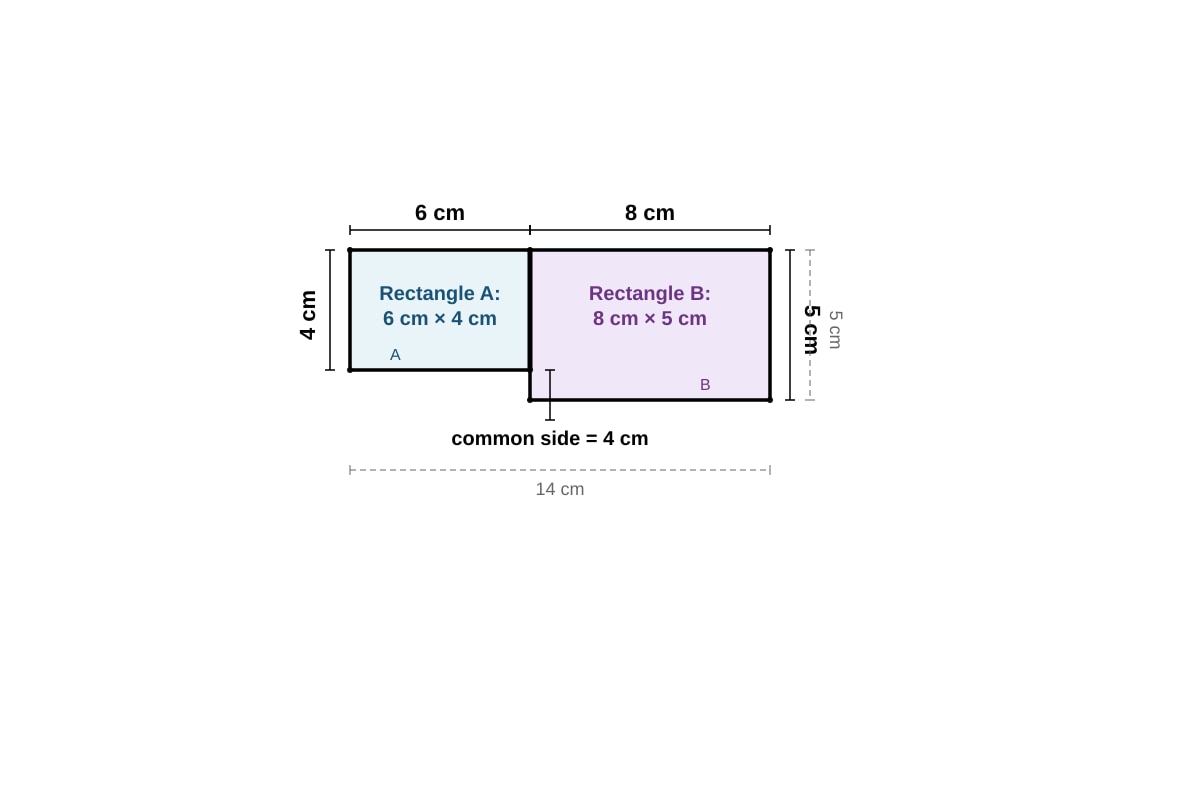
20. Total area = 64 cm² [2 marks]
- Working:
- Step 1: Area of Rectangle A = 6 × 4 = 24 cm²
- Step 2: Area of Rectangle B = 8 × 5 = 40 cm²
- Step 3: Total area = 24 + 40 = 64 cm²
- Answer: 64 cm²
- Teaching Notes: When a shape is made up of multiple rectangles, find the area of each rectangle separately and then add them together.
- Common Mistake: Trying to find overall dimensions and using a single formula, which may be incorrect if the rectangles overlap or are arranged in a complex way.