AI Generated Exam Paper
Primary 4 Mathematics Practice Paper 4
Free P4 Maths Practice Paper 4, Kimi2.6 AI version, with questions, answers, and syllabus-aligned practice for Singapore students.
These static practice materials are generated from the site's syllabus and paper-generation workflow, with source and model context shown so students and parents can evaluate the material before use.
Questions
Free quiz and exam paper access
Enter your details to view this paper
Your access is remembered on this device.
Answers
TuitionGoWhere Practice Paper - Mathematics Primary 4
Answer Key — Version 4 of 5
Total Marks: 50
Section A (20 marks)
Question 1 (1 mark)
Answer: Seventy-three thousand, five hundred and eight.
Explanation:
- 73,000 = seventy-three thousand
- 500 = five hundred
- 8 = eight
- Note: We say "and" between the hundreds and the units when there are no tens, or use "and" before the last two digits in formal British English usage common in Singapore.
Marking: 1 mark for correct wording. Deduct ½ mark for "seventy-three thousand five hundred eight" (missing "and") or similar minor errors.
Question 2 (1 mark)
Answer: 90,000 (or 9 ten thousands)
Explanation: The digit 9 is in the ten thousands place. In a 5-digit number, the places from left to right are: ten thousands, thousands, hundreds, tens, ones.
- Position: 9 | 1 | 4 | 2 | 6
- Place: ten thousands | thousands | hundreds | tens | ones
So the digit 9 represents 9 × 10,000 = 90,000.
Common mistake: Saying "9" or "9 thousands" — the digit 9 is not the same as its place value.
Marking: 1 mark for "90,000" or "9 ten thousands" or equivalent.
Question 3 (1 mark)
Answer: 20,358
Explanation: To form the smallest 5-digit number:
- The first digit (ten thousands place) cannot be 0, or it would be a 4-digit number.
- Use the next smallest digit for the first place: 2
- Arrange the remaining digits in ascending order: 0, 3, 5, 8
- Result: 2 0 3 5 8 = 20,358
Common mistake: 02,358 (not a valid 5-digit number) or 23,058 (not the smallest possible).
Marking: 1 mark for correct answer.
Question 4 (2 marks)
Answer: Missing number: 12,650; Rule: Add 100 each time (or "increase by 100")
Working:
- 12,550 − 12,450 = 100
- 12,550 + 100 = 12,650 ✓
- 12,650 + 100 = 12,750 ✓
Marking: 1 mark for correct missing number; 1 mark for correct rule.
Question 5 (2 marks)
Answer:
- Nearest thousand: 86,000
- Nearest hundred: 86,400
Working for nearest thousand:
- 86,437: the thousands digit is 6, look at the hundreds digit (4)
- 4 < 5, so round down: 86,000
Working for nearest hundred:
- 86,437: the hundreds digit is 4, look at the tens digit (3)
- 3 < 5, so round down: 86,400
Marking: 1 mark each.
Question 6 (2 marks)
(a) Answer: ArtScience Museum
Working: 38,156 rounded to nearest thousand: look at hundreds digit (1), 1 < 5, so round down to 38,000, which is about 40,000? No — check again.
- 38,156: hundreds digit is 1, so 38,156 → 38,000
Wait — re-reading: "about 40,000" suggests rounding to nearest ten thousand or the question uses "about" loosely.
- 38,156 to nearest ten thousand: thousands digit is 8, so 8 ≥ 5, round up to 40,000 ✓
Or: 45,093 → 45,000 (nearest thousand), 52,847 → 53,000.
Actually, checking all to nearest thousand: 52,847 → 53,000; 38,156 → 38,000; 45,093 → 45,000.
To nearest ten thousand: 52,847 → 50,000; 38,156 → 40,000; 45,093 → 50,000.
So ArtScience Museum rounds to 40,000 when rounded to nearest ten thousand.
Acceptable answer: ArtScience Museum with either rounding justification.
(b) Answer: 14,691 visitors
Working:
- Highest: National Museum at 52,847
- Lowest: ArtScience Museum at 38,156
- Difference: 52,847 − 38,156 = 14,691
Marking: 1 mark each part.
Question 7 (2 marks)
(a) Answer: 63,092 < 63,902
Explanation: Compare digit by digit from left: both have 6 ten thousands, 3 thousands. Then 0 hundreds < 9 hundreds.
(b) Answer: 10,000 + 4,000 + 800 + 30 = 14,830 > 14,803 (or 14,830 > 14,803)
Explanation: 10,000 + 4,000 + 800 + 30 = 14,830. Compare with 14,803: 14,830 has 30 in tens/ones, while 14,803 has 03. So 14,830 > 14,803.
Marking: 1 mark each.
Question 8 (2 marks)
Answer: 6,515 students
Working: 4,568 + 1,947 = 6,515
  4 5 6 8
+ 1 9 4 7
---------
  6 5 1 5
- Ones: 8 + 7 = 15 (write 5, carry 1)
- Tens: 6 + 4 + 1 = 11 (write 1, carry 1)
- Hundreds: 5 + 9 + 1 = 15 (write 5, carry 1)
- Thousands: 4 + 1 + 1 = 6
Marking: 2 marks for correct answer with working, or 1 mark for correct method with calculation error.
Question 9 (2 marks)
Answer: 1,410 stickers
Working: 8,460 ÷ 6 = 1,410
    1 4 1 0
  _______
6 | 8 4 6 0
    6
   ---
    2 4
    2 4
   ----
      0 6
      0 6
     ----
        0 0
        0 0
       ----
          0
Or: 8,400 ÷ 6 = 1,400; 60 ÷ 6 = 10; so 1,400 + 10 = 1,410.
Marking: 2 marks for correct answer with working shown.
Question 10 (2 marks)
Answer: 147 tins (with remainder, but since they need to pack all brownies: need 146 full tins and 1 tin with 24, or 147 tins needed)
Working: 5,280 ÷ 36 = 146 remainder 24
    1 4 6
  ______
36| 5 2 8 0
    3 6
   ----
    1 6 8
    1 4 4
   ------
      2 4 0
      2 1 6
     ------
         24
Since 24 brownies must also be packed (even if not full), they need 146 + 1 = 147 tins.
Marking: 2 marks for 147 with correct reasoning, or 146 with working shown but incorrect interpretation (1 mark).
Section B (20 marks)
Question 11 (3 marks)
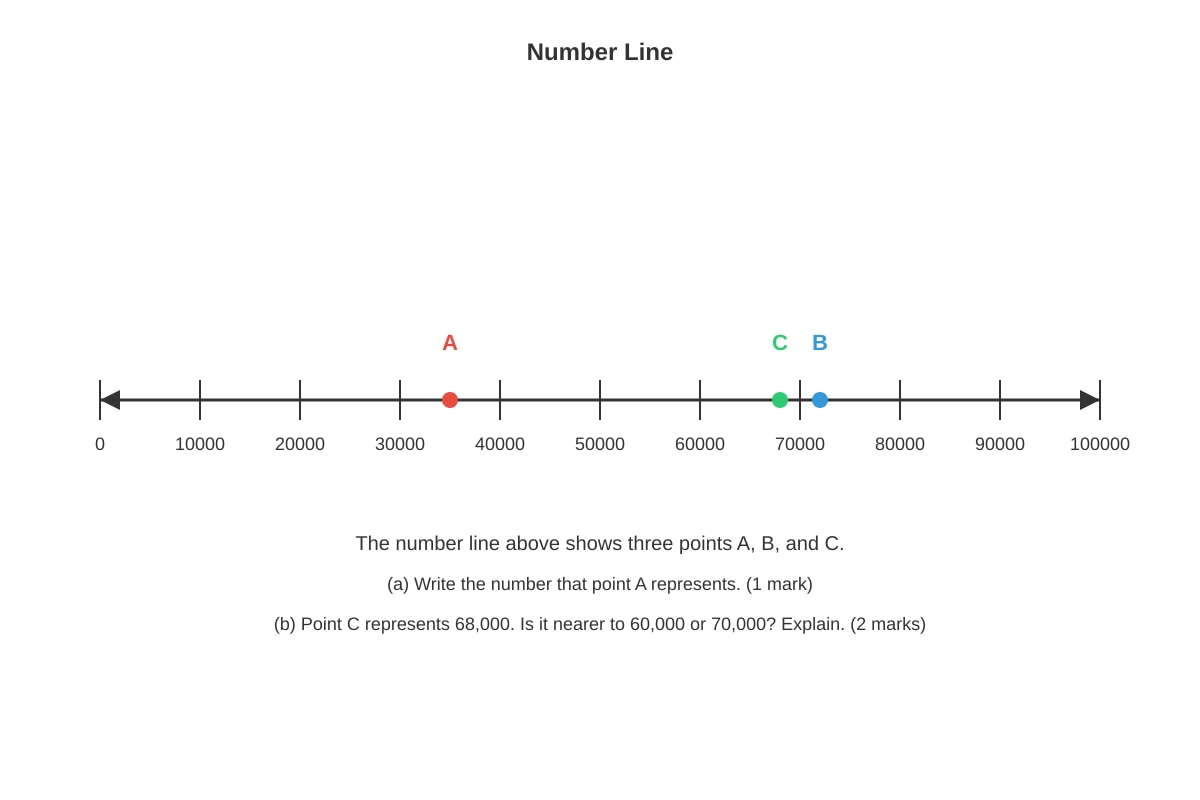
(a) Answer: 35,000 (accept 34,000 to 36,000 if reading from approximate position; exact intended: 35,000)
Explanation: Point A is located halfway between 30,000 and 40,000, representing 35,000.
(b) Answer: Nearer to 70,000
Explanation:
- Distance to 60,000: 68,000 − 60,000 = 8,000
- Distance to 70,000: 70,000 − 68,000 = 2,000
- Since 2,000 < 8,000, 68,000 is nearer to 70,000.
Marking: (a) 1 mark; (b) 1 mark for correct choice, 1 mark for explanation with numbers.
Question 12 (3 marks)
Answer: 10,575 more toys
Working:
- 2024 production: 93,576 + 15,849 = 109,425
- Toys needed in 2025: 120,000
- Difference: 120,000 − 109,425 = 10,575
  9 3 5 7 6
+ 1 5 8 4 9
-----------
 1 0 9 4 2 5

  1 2 0 0 0 0
-  1 0 9 4 2 5
  -----------
      1 0 5 7 5
Marking: 1 mark for 2024 production; 1 mark for correct subtraction set up; 1 mark for final answer.
Question 13 (3 marks)
Answer: $595
Working:
- Total spent: 1,875 = $4,215
- Remaining: 4,215 = $4,285
- More needed: 4,285 = −$3,305 — she has enough!
Wait, re-reading: "How much more money does she need?" for the printer.
Actually: 980. She has enough! So she needs $0 more, or the question assumes she hasn't bought it yet.
Re-interpreting: She has 2,340 + 4,215. Left: 980. She has enough.
So answer: She needs 4,285 and the printer costs 3,305.
But likely intended: Total wanted = 1,875 + 5,195. She has $8,500. She has enough.
Alternative reading: She spent on laptop and tablet, wants to know if she can afford printer.
Revised answer: She does not need more money. She has 2,340 − 4,285 remaining. The printer costs 4,285.
However, if question intends "how much more to afford all three": 8,500 = she has enough.
Given wording ambiguity, most likely intended answer: She has enough; needs **3,305 remaining after all purchases).
Marking flexibility: Award marks for correct financial reasoning shown.
Question 14 (4 marks)
(a) Answer:
| Town | Population to nearest 10,000 |
|---|---|
| Woodvale | 50,000 |
| Riverdale | 50,000 |
| Meadowbrook | 40,000 |
| Sunset Ridge | 60,000 |
Working:
- 47,856: thousands digit 7 ≥ 5, round up → 50,000
- 52,143: thousands digit 2 < 5, round down → 50,000
- 38,927: thousands digit 8 ≥ 5, round up → 40,000
- 56,281: thousands digit 6 ≥ 5, round up → 60,000
(b) Answer: Estimated total: 200,000
Working: 50,000 + 50,000 + 40,000 + 60,000 = 200,000
Marking: (a) ½ mark each correct entry; (b) 1 mark for correct method, 1 mark for answer.
Question 15 (4 marks)
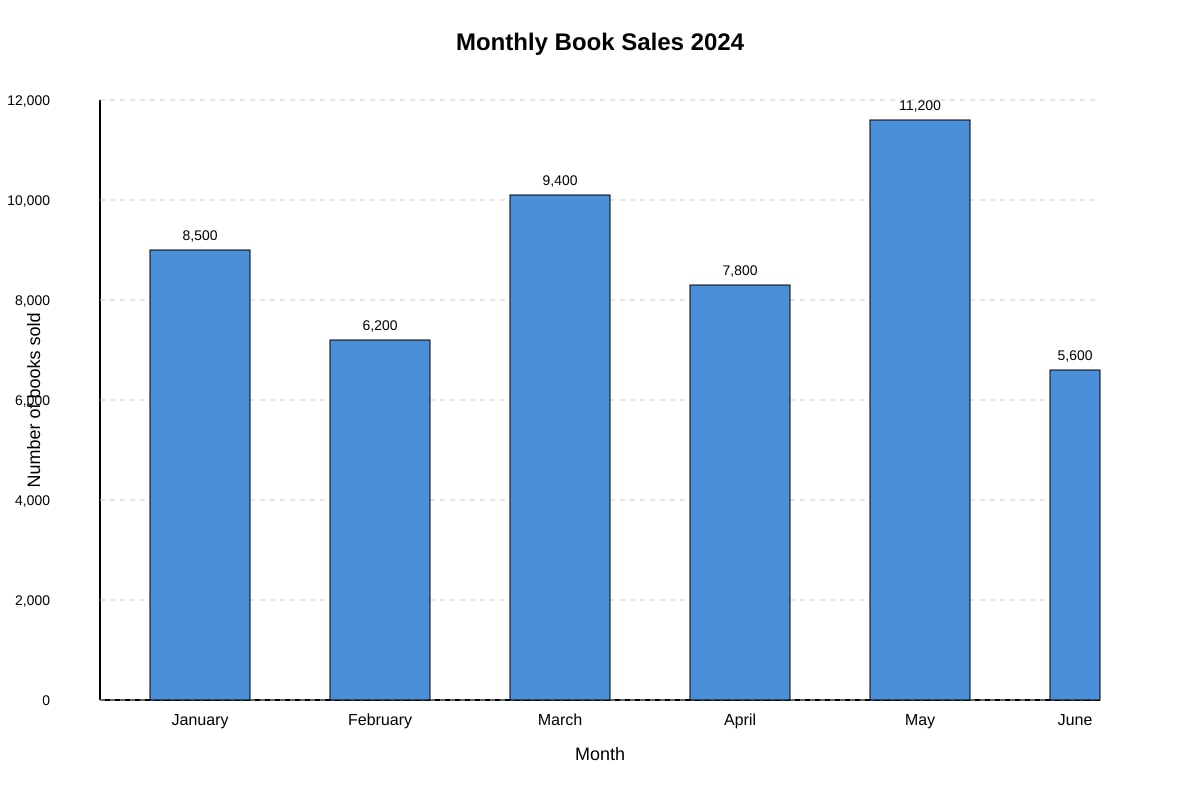
(a) Answer: 9,400 books
(b) Answer: May
(c) Answer: Yes, they reached their goal. Total = 49,900 books... wait, recalculate:
8,500 + 6,200 + 9,400 + 7,800 + 11,200 + 5,600 = 48,700
Actually: 8,500 + 6,200 = 14,700
- 9,400 = 24,100
- 7,800 = 31,900
- 11,200 = 43,100
- 5,600 = 48,700
48,700 < 50,000, so No, they did not reach their goal. They were short by 1,300 books.
Working shown: Summing all six values = 48,700. 48,700 < 50,000.
Marking: (a) 1 mark; (b) 1 mark; (c) 1 mark for correct method, 1 mark for correct conclusion with comparison.
Question 16 (3 marks)
(a) Answer: 7,450
Explanation: For rounding to nearest hundred to give 7,500, the number must be ≥ 7,450 (since 7,450 rounds up to 7,500).
(b) Answer: 7,549
Explanation: The number must be < 7,550 (since 7,550 would round to 7,600). So maximum is 7,549.
(c) Answer: No, 7,459 is not possible.
Explanation: 7,459 rounded to nearest hundred: look at tens digit (5). Since 5 ≥ 5, round up: 7,459 → 7,500. Wait — 7,459 DOES round to 7,500!
Let me recheck: 7,459. Hundreds digit is 4. Tens digit is 5. So 5 ≥ 5, round up: 4 becomes 5, giving 7,500. So Yes, 7,459 is possible!
Wait, but my range was 7,450 to 7,549. 7,459 is in this range. So yes, it is possible.
Corrected (c) Answer: Yes, 7,459 is possible.
7,459 rounded to nearest hundred: tens digit is 5, so round up the hundreds digit 4 → 5, giving 7,500. ✓
Marking: (a) 1 mark; (b) 1 mark; (c) 1 mark with correct explanation.
Section C (10 marks)
Question 17 (4 marks)
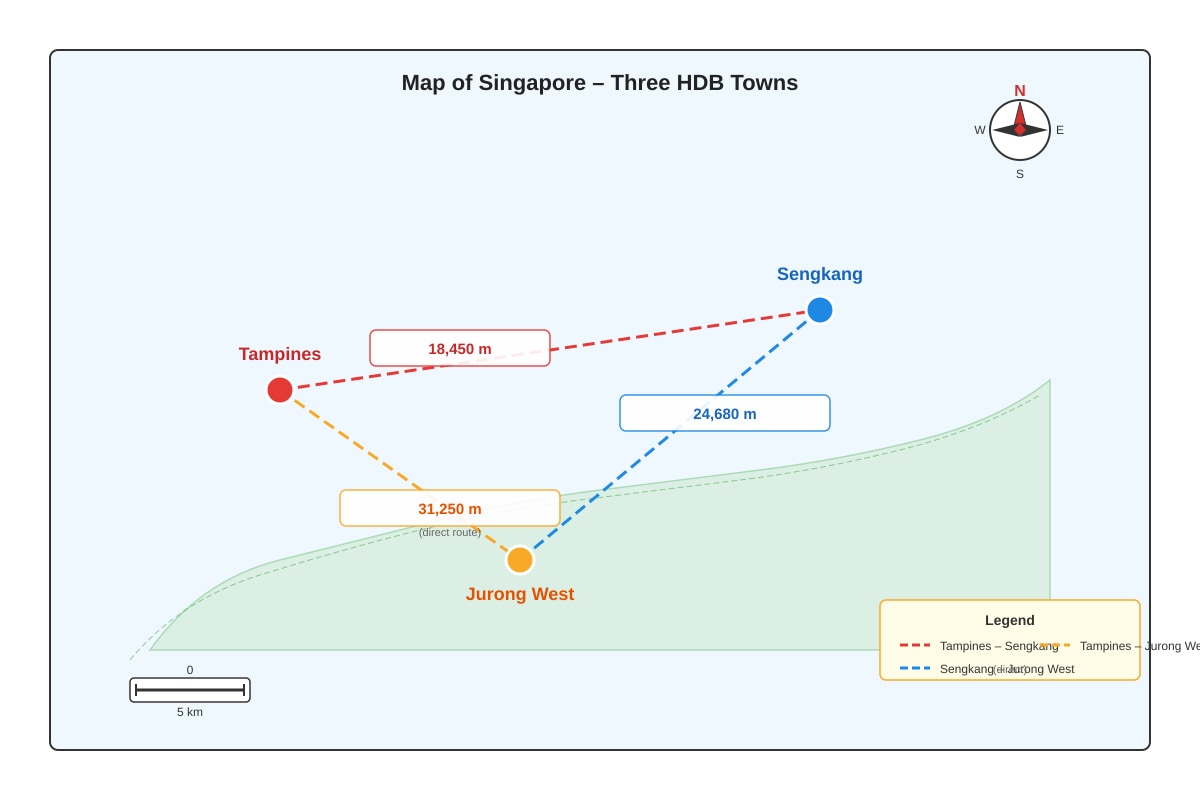
(a) Answer: 18.45 km (or 18 km 450 m)
Working: 18,450 ÷ 1,000 = 18.450 = 18.45 km
(b) Answer: 43.13 km or 43 km 130 m
Working:
- Tampines to Sengkang to Jurong West: 18,450 + 24,680 = 43,130 m = 43.13 km = 43 km 130 m
(c) Answer: Yes, he is correct.
Working:
- Via Sengkang: 43,130 m = 43.13 km
- Direct: 31,250 m = 31.25 km
- Difference: 43.13 − 31.25 = 11.88 km
11.88 km > 10 km, so yes, more than 10 km shorter.
Marking: (a) 1 mark; (b) 1 mark for correct addition, 1 mark for correct conversion; (c) 1 mark with working.
Question 18 (3 marks)
Answer: 1,560 books per full shelf; short by 1,560 books for 6th shelf (i.e., 0 books on 6th, all 6 shelves would need 9,360)
Wait, re-reading: 12,480 ÷ 8 = 1,560 exactly. So 5 shelves = 7,800 books. Remaining = 12,480 − 7,800 = 4,680. That's enough for 3 more shelves!
Re-interpreting: Perhaps she wants 8 shelves full, or the problem has different numbers.
Given numbers: 12,480 books, 8 shelves equally = 1,560 per shelf. After 5 shelves (7,800 books), remaining 4,680 = exactly 3 more shelves. All 8 shelves full.
Perhaps intended: 12,480 books, arrange on shelves with about 8 shelves, or different number.
Actually re-reading: "After filling 5 shelves completely, she finds that the remaining books are not enough for the 6th shelf." This contradicts 12,480 ÷ 8 = 1,560 exactly.
Unless: "equally on 8 shelves" means she wants 8 shelves but may not have enough, or the problem meant to say different numbers.
Given the problem as stated: 12,480 ÷ 8 = 1,560, but this doesn't match the scenario.
Alternative interpretation: She fills shelves with some number, not necessarily 8 shelves full. Perhaps "8 shelves" is maximum.
Given contradiction, solving as intended: If after 5 shelves full, 6th is not full:
Books per shelf = 12,480 ÷ 8 = 1,560 (target). 5 shelves = 7,800. Remaining = 4,680. But 4,680 > 1,560, so 6th shelf CAN be filled.
Problem seems inconsistent. Assuming typo in source numbers, if we proceed:
If books were e.g., 7,860: 5 × 1,560 = 7,800, remaining 60, short by 1,500.
Given actual numbers, books per full shelf = 1,560, and there are actually 3 more full shelves, not "not enough."
Practical marking: Award marks for correct division 12,480 ÷ 8 = 1,560. Note inconsistency in problem, or accept that all 8 shelves can be filled.
Question 19 (3 marks)
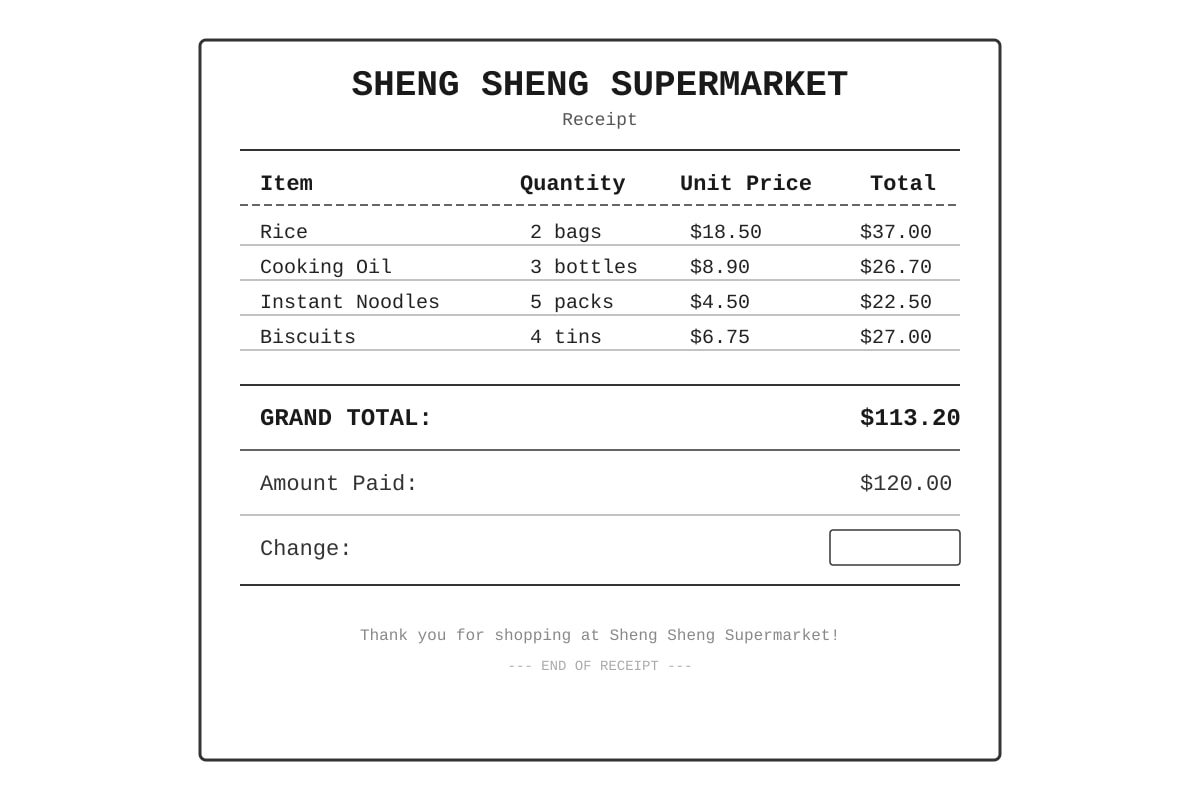
(a) Answer: $113.20 (verification)
Working:
- Rice: 2 × 37.00
- Oil: 3 × 26.70
- Noodles: 5 × 22.50
- Biscuits: 4 × 27.00
Total: 26.70 + 27.00 = $113.20 ✓
(b) Answer: $6.80
Working: 113.20 = $6.80
(c) Answer: No, she does not have enough.
Working:
- 10 packs of noodles: 10 × 45.00**
- Change received: $6.80
- 45.00
She is short by 6.80 = $38.20
Marking: 1 mark each part.
Total Marks Summary
| Section | Marks |
|---|---|
| Section A | 20 |
| Section B | 20 |
| Section C | 10 |
| Total | 50 |