AI Generated Exam Paper
Primary 4 Mathematics Practice Paper 1
Free P4 Maths Practice Paper 1, Kimi2.6 AI version, with questions, answers, and syllabus-aligned practice for Singapore students.
These static practice materials are generated from the site's syllabus and paper-generation workflow, with source and model context shown so students and parents can evaluate the material before use.
Questions
Free quiz and exam paper access
Enter your details to view this paper
Your access is remembered on this device.
Answers
TuitionGoWhere Practice Paper Answer Key - Mathematics Primary 4
Version 1 of 5
Section A: Multiple Choice Questions [10 marks]
| Question | Answer | Explanation |
|---|---|---|
| 1 | B | In 87,456: 8 is ten thousands, 7 is thousands, 4 is hundreds, 5 is tens, 6 is ones. The digit in the thousands place is 7. |
| 2 | D | In 45,932: the digit 5 is in the thousands place, so it stands for 5,000 (5 × 1,000). |
| 3 | B | Sixty-three thousand = 63,000; seventy-two = 72. Combined: 63,072. |
| 4 | D | 47,856: look at the hundreds digit (8). Since 8 ≥ 5, round up the thousands digit from 7 to 8. Answer: 48,000. |
| 5 | A | For rounding to nearest ten thousand: 3□,987 → 40,000. Need the ten thousands digit to round up from 3 to 4. The thousands digit must be 5 or more. Smallest digit: 5. |
| 6 | D | Compare digit by digit from left: all have 78 thousands. Compare hundreds: 6 > 5. So 78,654 > 78,645 > 78,564 > 78,456. Greatest: 78,654. |
| 7 | A | 8 ten thousands = 80,000; 5 hundreds = 500; 3 tens = 30; 7 ones = 7. Total: 80,000 + 500 + 30 + 7 = 80,537. |
| 8 | A | 52,847: look at tens digit (4). Since 4 < 5, keep hundreds digit as 8. Answer: 52,800. |
| 9 | C | (A) 59,500 → 60,000 ✓; (B) 60,499 → 60,000 ✓; (C) 59,499 → 59,000 ✗; (D) 60,128 → 60,000 ✓. Answer: C |
| 10 | A | Smaller number = 72,340 − 5,000 = 67,340. |
Section B: Short Answer Questions [20 marks]
11. Write fifty-three thousand, four hundred and eight in figures. [2]
Answer: 53,408
Method:
- Fifty-three thousand = 53,000
- Four hundred = 400
- Eight = 8
- Total: 53,000 + 400 + 8 = 53,408
Marking: Correct answer only [2]. If figures incorrect but place value understanding shown [1].
12. In the number 91,506, which digit has the greatest value? What does it stand for? [2]
Answer: Digit: 9
It stands for: 90,000 (or 9 ten thousands)
Method:
- 9 is in the ten thousands place → 90,000
- 1 is in the thousands place → 1,000
- 5 is in the hundreds place → 500
- 0 is in the tens place → 0
- 6 is in the ones place → 6
The digit 9 has the greatest value because 90,000 > 1,000 > 500 > 6.
Marking: Correct digit [1]; correct value [1].
Common mistake: Students may say "9" without specifying what it stands for, or confuse "digit" with "place value."
13. Round 68,349 to (a) the nearest ten, (b) the nearest hundred, (c) the nearest thousand. [2]
Answer: (a) 68,350 (b) 68,300 (c) 68,000
Method:
- (a) Nearest ten: Look at ones digit (9). Since 9 ≥ 5, round up tens digit from 4 to 5. 68,349 → 68,350
- (b) Nearest hundred: Look at tens digit (4). Since 4 < 5, keep hundreds digit as 3. 68,349 → 68,300
- (c) Nearest thousand: Look at hundreds digit (3). Since 3 < 5, keep thousands digit as 8. 68,349 → 68,000
Marking: All three correct [2]; two correct [1]; one or none correct [0].
Teaching note: Emphasize that we look at the digit immediately to the right of the place we're rounding to.
14. Arrange in ascending order: 94,056, 94,506, 94,056, 94,650, 94,605 [2]
Answer: 94,056, 94,056, 94,506, 94,605, 94,650
Method:
- All numbers have 94 thousands, so compare hundreds: 0 < 5 < 6
- For 94,506 vs 94,605: 506 < 605
- For 94,605 vs 94,650: 605 < 650
- 94,056 appears twice (note: this tests careful reading)
Marking: Correct order [2]; reversed order (descending) [1]; minor error [1].
15. Find the sum of 38,456 and 24,987. Round to the nearest hundred. [2]
Answer: 63,400
Method:
- 38,456 + 24,987 = 63,443
- To round to nearest hundred: look at tens digit (4). Since 4 < 5, keep hundreds digit as 4.
- Rounded answer: 63,400
Marking: Correct sum [1]; correct rounding [1]. If only final answer 63,400 with no working shown [2]; if sum wrong but correctly rounded [1].
16. A number rounded to the nearest thousand is 50,000. [2]
(a) Greatest possible number: 50,499 (b) Smallest possible number: 49,500
Method:
- For rounding to 50,000: the number must be from 49,500 to 50,499 inclusive
- (a) Greatest: just before rounding up to 51,000 → 50,499 (50,500 would round to 51,000)
- (b) Smallest: the first number that rounds up to 50,000 → 49,500 (49,499 would round to 49,000)
Marking: (a) correct [1]; (b) correct [1].
Common mistake: Students often write 50,499 for (a) but 49,000 or 49,999 for (b). Emphasise the "halfway" rule: 49,500 is exactly halfway and rounds up by convention.
17. Mrs. Tan sold 18,450 in January and 23,780 in February. Total? Round to nearest thousand. [2]
Answer: 43,000 packets
Method:
- 18,450 + 23,780 = 42,230
- Round to nearest thousand: look at hundreds digit (2). Since 2 < 5, keep thousands digit as 2.
- Wait—correction: 42,230, hundreds digit is 2, so we keep 42. But thousands digit is 2, so 42,000? No: 42,230 thousands digit is 2, but actually 42,230: the thousands place is 2 (in 42 thousand). Hundreds digit is 2. So 42,230 → 42,000?
Let me recheck: 18,450 + 23,780 = 42,230.
- Nearest thousand: look at hundreds digit (2). 2 < 5, so we keep 42. Result: 42,000
Corrected Answer: 42,000 packets
Method (corrected):
- 18,450 + 23,780 = 42,230
- Round 42,230 to nearest thousand: hundreds digit is 2, so round down to 42,000
Marking: Correct total [1]; correct rounding [1].
18. Subtract 14,567 from 82,003. Round to nearest hundred. [2]
Answer: 67,400
Method:
- 82,003 − 14,567 = 67,436
- Round to nearest hundred: tens digit is 3. Since 3 < 5, keep hundreds digit as 4.
- Answer: 67,400
Marking: Correct difference [1]; correct rounding [1].
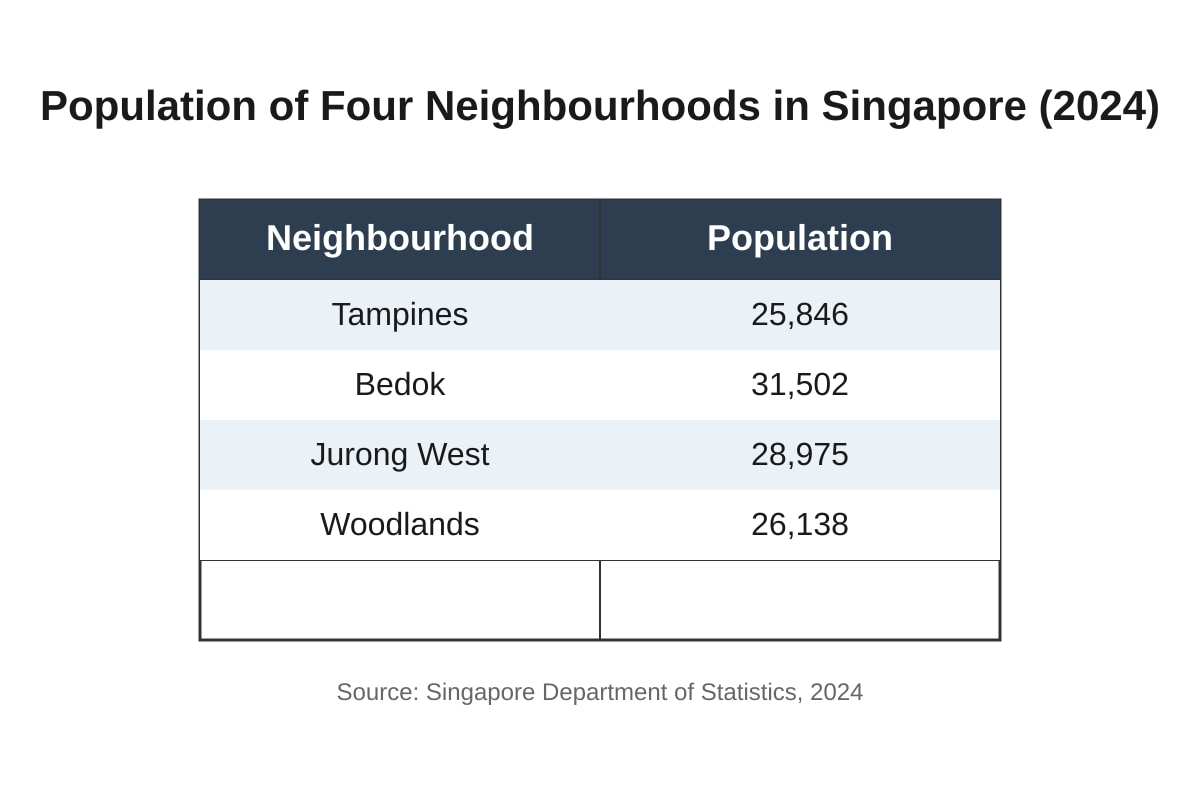
19. Neighbourhood populations: Tampines 25,846; Bedok 31,502; Jurong West 28,975; Woodlands 26,138
(a) Bedok [1]
(b) Total of Tampines and Jurong West, rounded to nearest thousand: 55,000 [1]
Method (b):
- 25,846 + 28,975 = 54,821
- Round to nearest thousand: hundreds digit is 8. Since 8 ≥ 5, round up from 54 to 55.
- Answer: 55,000
Marking: (a) [1]; (b) correct total and rounding [1], or correct method but arithmetic error [1].
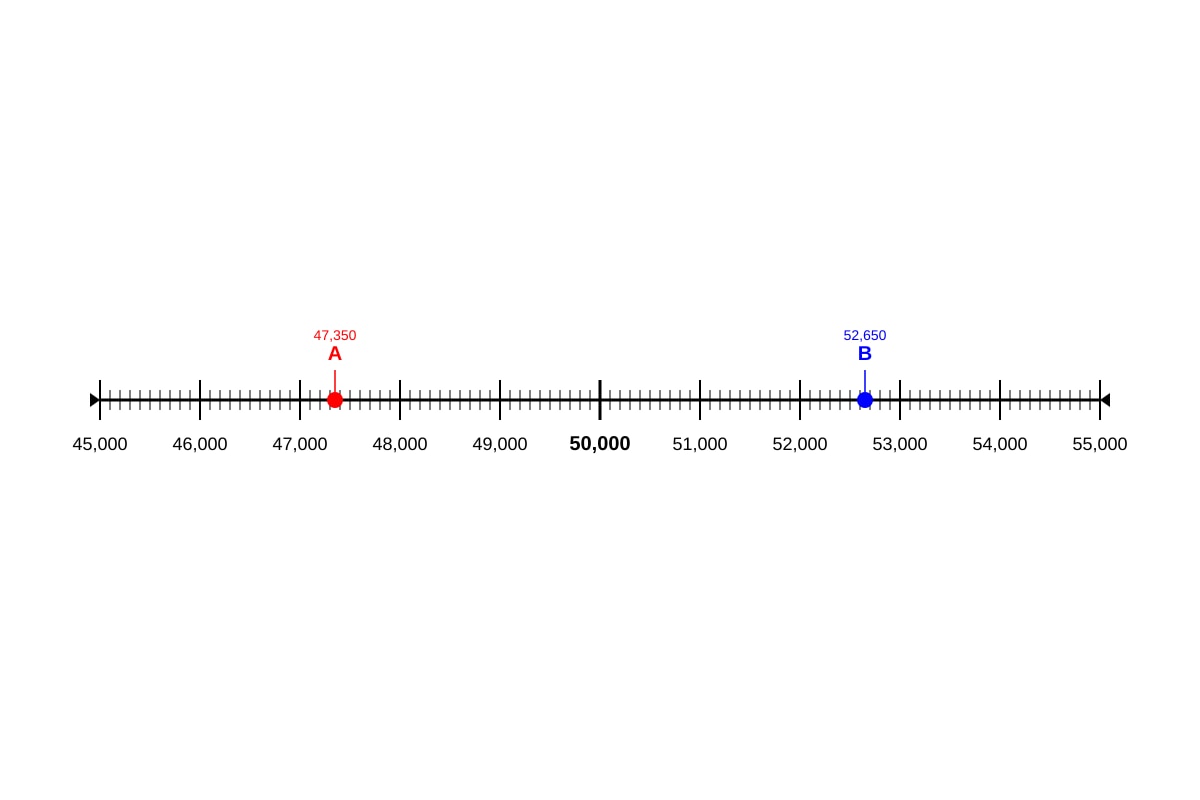
20. Number line: Point A at 47,350; Point B at 52,650
(a) 47,350 [1]
(b) Difference: 5,300 [1]
Method (b):
- 52,650 − 47,350 = 5,300
- Or: 52,650 − 47,350 = (52,650 − 47,000) − 350 = 5,650 − 350 = 5,300
Marking: (a) [1]; (b) [1].
Section C: Longer Problems [30 marks]
21. Museum visitors [4 marks]
(a) Round 15,230 to nearest thousand. [1]
Answer (a): 15,000
Method: Hundreds digit is 2. Since 2 < 5, keep thousands digit as 5. 15,000
(b) Total visitors to National Museum and Gardens by the Bay. [2]
Answer (b): 43,954
Method:
- National Museum: 12,456
- Gardens by the Bay: 31,498
- Total: 12,456 + 31,498 = 43,954
Working:
  12,456
+ 31,498
--------
  43,954
Marking: Correct method with working [1]; correct answer [1].
(c) How many more visitors to Singapore Zoo than ArtScience Museum? [1]
Answer (c): 13,535
Method: 28,765 − 15,230 = 13,535
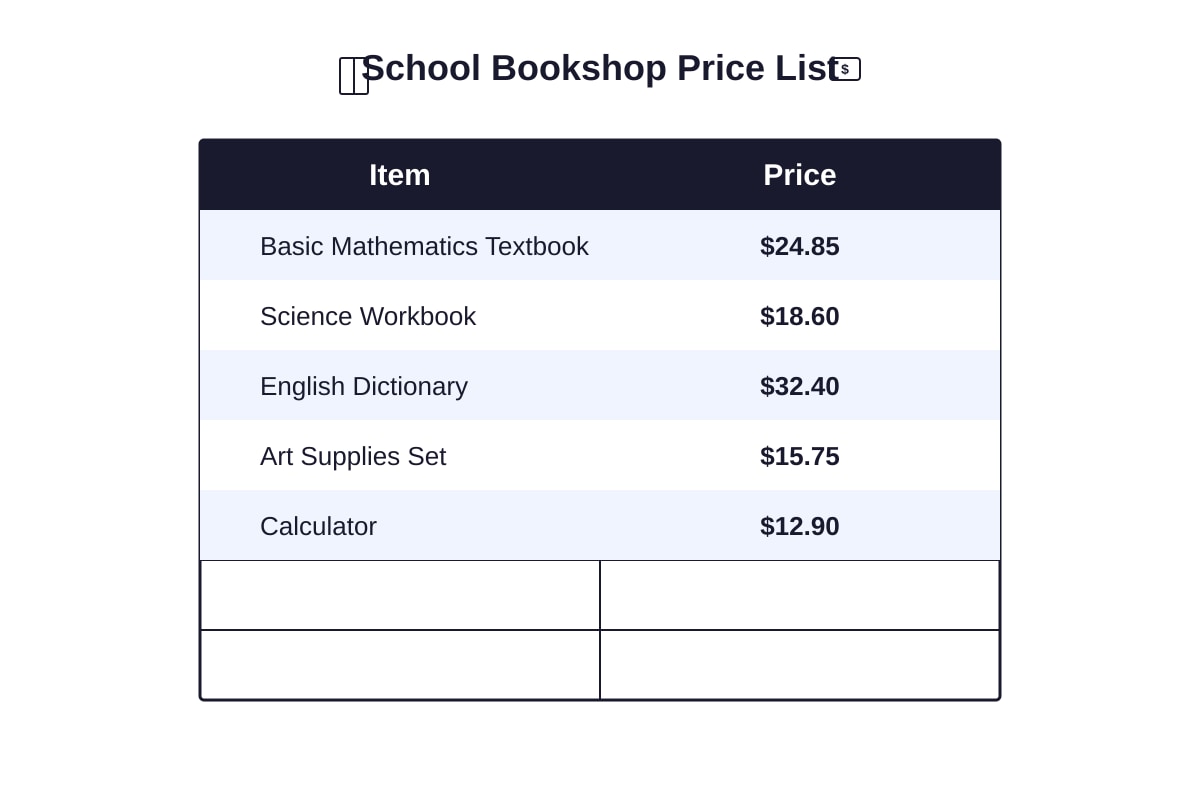
22. School bookshop [4 marks]
(a) Cost of Mathematics Textbook (32.40) [2]
Answer (a): $57.25
Method:
- 32.40 = $57.25
- Working with decimals: align decimal points
  24.85
+ 32.40
-------
  57.25
Marking: Correct method [1]; correct answer [1].
(b) Change from $100 [2]
Answer (b): $42.75
Method:
- 57.25 = $42.75
- Working:
 100.00
- 57.25
-------
  42.75
- Or: 57 = 43 − 42.75**
Marking: Correct method [1]; correct answer [1].
Common mistake: Forgetting to "borrow" across the decimal point. Students may write 100 − 57.25 = 43.25.
23. Stamp collection [4 marks]
(a) Jason's sister's stamps [2]
Answer (a): 33,150 stamps
Method:
- Jason: 45,600
- Sister has 12,450 fewer: 45,600 − 12,450 = 33,150
Working:
  45,600
- 12,450
--------
  33,150
Marking: Correct subtraction method [1]; correct answer [1].
(b) Cousin's stamps [2]
Answer (b): 41,900 stamps
Method:
- Sister: 33,150
- Cousin has 8,750 more: 33,150 + 8,750 = 41,900
Working:
  33,150
+  8,750
--------
  41,900
Marking: Correct addition method [1]; correct answer [1].
Note: This is a two-step problem. Students must use their answer from (a) or restart with Jason's number. Either approach acceptable if correct.
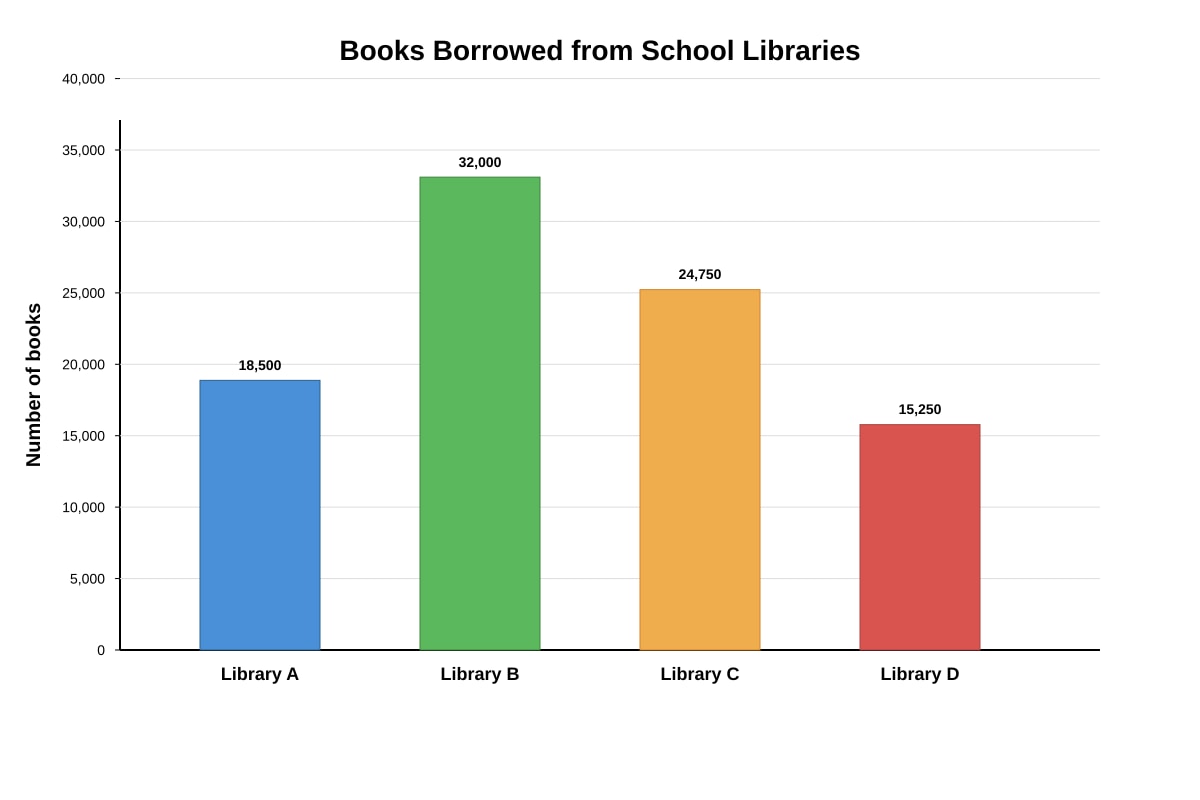
24. Bar chart: Library books borrowed [4 marks]
(a) Library with most books [1]
Answer (a): Library B
Expected visual: From the bar chart (described in placeholder), Library B has the tallest bar at 32,000, which exceeds Library C (24,750), Tampines equivalent (18,500), and Library D (15,250).
(b) Difference between greatest and least [2]
Answer (b): 16,750 books
Method:
- Greatest: Library B = 32,000
- Least: Library D = 15,250
- Difference: 32,000 − 15,250 = 16,750
Working:
  32,000
- 15,250
--------
  16,750
Marking: Correctly identify greatest and least from chart [1]; correct calculation [1].
(c) Library E borrowed 5,250 more than Library C [1]
Answer (c): 30,000 books
Method:
- Library C: 24,750
- Library E: 24,750 + 5,250 = 30,000
25. 5-digit number using 7, 3, 0, 5, 9 [4 marks]
(a) Greatest 5-digit number [1]
Answer (a): 97,530
Method: Arrange digits in descending order: 9 > 7 > 5 > 3 > 0 → 97,530
Note: Must be 5-digit, so cannot start with 0. 97,530 is valid.
(b) Smallest 5-digit number [1]
Answer (b): 30,579
Method: Arrange with smallest non-zero digit first, then remaining digits in ascending order: 3 > 0 > 5 > 7 > 9 → 30,579
Note: Cannot start with 0 (would be 4-digit). So 3 is first, then 0, then 5, 7, 9.
Common mistake: 03,579 or 30,579. The first is not a 5-digit number (it's 3,579). Must be 30,579.
(c) Round 97,530 to nearest thousand [1]
Answer (c): 98,000
Method: 97,530: hundreds digit is 5. Since 5 ≥ 5, round up from 97 to 98. 98,000
(d) Difference between (a) and (b) [1]
Answer (d): 66,951
Method: 97,530 − 30,579 = 66,951
Working:
  97,530
- 30,579
--------
  66,951
Marking: Correct subtraction [1].
Summary Mark Scheme
| Question | Marks | Topic |
|---|---|---|
| 1–10 | 10 | Place value, rounding, operations, number sense |
| 11–15 | 10 | Writing numbers, place value, rounding, ordering, addition with rounding |
| 16–20 | 10 | Rounding range, word problems, data interpretation, number lines |
| 21 | 4 | Data table: rounding, addition, subtraction |
| 22 | 4 | Money: decimal addition, finding change |
| 23 | 4 | Multi-step word problem: subtraction, addition |
| 24 | 4 | Bar chart interpretation: reading, comparison, calculation |
| 25 | 4 | Digit arrangement, rounding, subtraction |
| Total | 60 |
End of Answer Key
Note: This is Version 1 of 5. Questions vary in number values, contexts, and ordering across versions while maintaining the same syllabus coverage and difficulty distribution.