From Real Exams Exam Paper
Primary 4 Mathematics Semestral Assessment 2 (End of Year) Paper 3
Free P4 Maths SA2 Paper 3, Kimi2.6 Exam version, with questions, answers, and syllabus-aligned practice for Singapore students.
These static practice materials are generated from the site's syllabus and paper-generation workflow, with source and model context shown so students and parents can evaluate the material before use.
Questions
Free quiz and exam paper access
Enter your details to view this paper
Your access is remembered on this device.
Answers
TuitionGoWhere Exam Practice (AI) - SA2
Mathematics Primary 4 - Whole Numbers
Version 3 of 5 — Answer Key
Section A: Multiple Choice Questions (10 marks)
Question 1 (1 mark)
Answer: B) 7
Working/Explanation:
To find which digit is in the thousands place, we use a place value table:
| Ten Thousands | Thousands | Hundreds | Tens | Ones |
|---|---|---|---|---|
| 8 | 7 | 6 | 5 | 4 |
- The thousands place is the third position from the right (or second from the left in a 5-digit number).
- In 87,654, the digit 7 is in the thousands place.
- Common mistake: Confusing "thousands" with "thousands place" — the digit 8 stands for 80,000 (eight ten thousands), not eight thousands.
Question 2 (1 mark)
Answer: B) 4,000
Working/Explanation:
Place value analysis of 94,726:
| Ten Thousands | Thousands | Hundreds | Tens | Ones |
|---|---|---|---|---|
| 9 | 4 | 7 | 2 | 6 |
- The digit 4 is in the thousands place.
- Therefore, the digit 4 stands for: 4 × 1,000 = 4,000
- Key concept: "Stand for" asks for the value of the digit, not just its position. Many students answer "4 thousands" which is acceptable wording, but the numerical value is 4,000.
Question 3 (1 mark)
Answer: D) 79,089
Working/Explanation:
Compare digit by digit from the left (highest place value):
| Number | Ten Thousands | Thousands | Hundreds | Tens | Ones |
|---|---|---|---|---|---|
| 78,099 | 7 | 8 | 0 | 9 | 9 |
| 78,909 | 7 | 8 | 9 | 0 | 9 |
| 78,990 | 7 | 8 | 9 | 9 | 0 |
| 79,089 | 7 | 9 | 0 | 8 | 9 |
- All numbers have 7 ten thousands.
- Comparing thousands: 78,099 and 78,909/78,990 have 8 thousands; 79,089 has 9 thousands.
- Therefore 79,089 is the greatest.
- Method: When comparing whole numbers, always start from the leftmost digit and move right until you find a difference.
Question 4 (1 mark)
Answer: C) 64,000
Working/Explanation:
Rounding 63,749 to the nearest thousand:
- Identify the thousands digit: 3 (in 63,749)
- Look at the digit to its right (hundreds digit): 7
- Rule: If this digit is 5 or more, round the thousands digit up.
- Since 7 ≥ 5, round 3 up to 4.
- Change all digits to the right to zeros: 64,000
- Common mistake: Some students look at the 4 (tens digit) instead of the 7 (hundreds digit). Always look at the digit immediately to the right of your target place value.
Question 5 (1 mark)
Answer: A) 40,500
Working/Explanation:
Follow order of operations (left to right for addition and subtraction):
- Verification: 40,500 + 12,500 = 53,000 ✓ and 53,000 − 8,000 = 45,000 ✓
Question 6 (1 mark)
Answer: B) 82,640
Working/Explanation:
For a number to round to 82,600 when rounded to the nearest hundred:
- The hundreds digit must be 6 (so we're rounding to 82,600)
- The tens digit must be 0–4 (round down) or 5–9 (round up to 82,700)
Wait — let me re-analyze. 82,600 as a rounded value means:
- If rounding down: original number is 82,600 to 82,649 (tens digit 0–4, keep 600)
- If rounding up: original number is 82,550 to 82,599 (tens digit 5–9, round 550 up to 600)
So possible range: 82,550 to 82,649
Checking options:
- A) 82,549 → rounds to 82,500 (tens digit 4, so round down: 82,500) ✗
- B) 82,640 → tens digit is 4, so round down: 82,600 ✓
- C) 82,660 → tens digit is 6, so round up: 82,700 ✗
- D) 82,699 → tens digit is 9, so round up: 82,700 ✗
Answer: B
Question 7 (1 mark)
Answer: A) Seventy-two thousand and fifty
Working/Explanation:
Break down 72,050 using place value:
| Ten Thousands | Thousands | Hundreds | Tens | Ones |
|---|---|---|---|---|
| 7 | 2 | 0 | 5 | 0 |
- 72,050 = 70,000 + 2,000 + 50 = seventy-two thousand + fifty
- Since there are no hundreds, we say "seventy-two thousand and fifty"
- Singapore convention: We include "and" before the last part when there are gaps (no hundreds here).
| Option | Analysis |
|---|---|
| A | Correct: "Seventy-two thousand and fifty" |
| B | Wrong: says "five hundred" instead of "fifty" |
| C | Wrong: completely wrong magnitude |
| D | Wrong: missing "and" before fifty |
Question 8 (1 mark)
Answer: A) 10
Working/Explanation:
To find the missing multiplier:
- Shortcut: Count zeros — 150,000 has one more zero than 15,000, so multiply by 10.
- Concept: 15,000 × 10 = 15,000 × (10 ones) = 150,000
Question 9 (1 mark)
Answer: C) 8
Working/Explanation:
This is a division problem:
- Interpretation: We need 8 groups of 6 buns to make 48 buns total.
- Verification: 8 × 6 = 48 ✓
Question 10 (1 mark)
Answer: C) 24 × 5 + 36 × 5
Working/Explanation:
This tests the distributive property:
Checking options:
| Option | Value | Correct? |
|---|---|---|
| A) 24 + 36 × 5 | 24 + 180 = 204 | ✗ (wrong order of operations) |
| B) 24 × 5 + 36 | 120 + 36 = 156 | ✗ |
| C) 24 × 5 + 36 × 5 | 120 + 180 = 300 | ✓ |
| D) 24 + 36 + 5 | 65 | ✗ |
Section B: Short Answer Questions (20 marks)
Question 11 (2 marks)
Answer: 74,008
Working/Explanation:
Break down "seventy-four thousand and eight":
- "Seventy-four thousand" = 74,000
- "and eight" = 8 (no hundreds, no tens, just 8 ones)
- Total: 74,000 + 8 = 74,008
| Place Value | Digit |
|---|---|
| Ten Thousands | 7 |
| Thousands | 4 |
| Hundreds | 0 |
| Tens | 0 |
| Ones | 8 |
- Common mistake: Writing 74,800 (swapping the 8 into hundreds place) or 74,080 (putting 8 in tens place). The word "and" signals we need to be careful about which place gets the last mentioned value.
Question 12 (2 marks)
Answer: 47,036, 47,306, 47,603, 47,630
Working/Explanation:
All numbers have the same ten thousands (4) and thousands (7). Compare from the left:
| Number | Hundreds | Tens | Ones |
|---|---|---|---|
| 47,306 | 3 | 0 | 6 |
| 47,603 | 6 | 0 | 3 |
| 47,036 | 0 | 3 | 6 |
| 47,630 | 6 | 3 | 0 |
Step-by-step ordering:
- 47,036 — smallest (0 hundreds)
- 47,306 — next (3 hundreds, 0 tens... wait, let me re-check)
Actually, correct comparison:
- 47,036: hundreds digit is 0 → smallest ✓
- 47,306: hundreds digit is 3 → second smallest
- 47,603 vs 47,630: both have 6 hundreds, so compare tens: 0 vs 3
Order: 47,036 < 47,306 < 47,603 < 47,630
- Method: When digits match from the left, keep moving right until you find a difference.
Question 13 (2 marks)
Answer: 20,479
Working/Explanation:
To form the smallest 5-digit number using digits 4, 7, 0, 2, 9:
Critical rule: A 5-digit number cannot start with 0.
- Choose the smallest non-zero digit for ten thousands place: 2
- Arrange remaining digits (4, 7, 0, 9) in ascending order for the rest: 0, 4, 7, 9
Result: 20,479
| Position | Digit | Reasoning |
|---|---|---|
| Ten Thousands | 2 | Smallest non-zero available |
| Thousands | 0 | Smallest remaining |
| Hundreds | 4 | Next smallest |
| Tens | 7 | Next smallest |
| Ones | 9 | Largest remaining |
- Common mistake: 04,279 = 4,279 is a 4-digit number, not valid!
Question 14 (2 marks)
(a) Answer: 95,440 (1 mark)
(b) Answer: 95,000 (1 mark)
Working/Explanation:
(a) Rounding to nearest ten:
- Tens digit: 3, ones digit: 8
- Look at ones digit: 8 ≥ 5, so round tens digit up from 3 to 4
- Result: 95,440
(b) Rounding to nearest thousand:
- Thousands digit: 5, hundreds digit: 4
- Look at hundreds digit: 4 < 5, so keep thousands digit as 5
- Result: 95,000
| Place Value | Original | Round to Ten | Round to Thousand |
|---|---|---|---|
| Number | 95,438 | 95,440 | 95,000 |
| Key digit | ones=8 | tens=3, ones=8 | thousands=5, hundreds=4 |
| Decision | — | round up | round down |
Question 15 (2 marks)
Answer: 12,750, 12,850
Working/Explanation:
Find the pattern:
- 12,550 − 12,450 = 100
- 12,650 − 12,550 = 100
The pattern increases by 100 each time.
Continuing:
-
12,650 + 100 = 12,750
-
12,750 + 100 = 12,850
-
Verify: 12,850 + 100 = 12,950 ✓
-
Method: First identify the constant difference (common difference), then apply it repeatedly.
Question 16 (2 marks)
Answer: 13,750 eggs
Working/Explanation:
This is a subtraction problem: eggs sold = eggs at start − eggs left
Step-by-step:
  52,400
- 38,650
---------
- Ones: 0 − 0 = 0
- Tens: 0 − 5, need to borrow: 10 − 5 = 5
- Hundreds: (3 after borrow) − 6, need to borrow: 13 − 6 = 7
- Thousands: (1 after borrow) − 8, need to borrow: 11 − 8 = 3
- Ten Thousands: (4 after borrow) − 3 = 1
Result: 13,750
Verification: 38,650 + 13,750 = 52,400 ✓
Question 17 (2 marks)
Answer: 330 chocolates
Working/Explanation:
This is a two-step problem (multiplication then subtraction):
Step 1: Find total chocolates bought
Step 2: Find chocolates left after giving away
Alternative working:
- Common mistake: Adding 120 instead of subtracting, or calculating 25 + 18 instead of multiplying.
Question 18 (2 marks)
Answer: 126,750 toys
Working/Explanation:
This is multiplication: daily production × number of days
Break down using distributive property:
Standard multiplication:
   8,450
 ×    15
 -------
  42,250  (8,450 × 5)
 84,500   (8,450 × 10, shifted left)
 -------
 126,750
Question 19 (2 marks)
Answer: 1,824 stamps
Working/Explanation:
This is a two-step problem with the concept of "times as many":
Step 1: Find Jerry's stamps
Step 2: Find total stamps
Alternative:
- Common mistake: Forgetting to add Tom's stamps and only giving Jerry's amount (1,368). The question asks for "altogether."
Question 20 (2 marks)
Answer: 45 kg
Working/Explanation:
This is a unit-rate problem (two steps: find one unit, then find total):
Step 1: Find mass of 1 bag
Step 2: Find mass of 15 bags
Alternative (ratio method):
- Verification: 15 bags × 3 kg/bag = 45 kg, and 8 bags × 3 kg = 24 kg ✓
Section C: Long Answer Questions (20 marks)
Question 21 (4 marks)
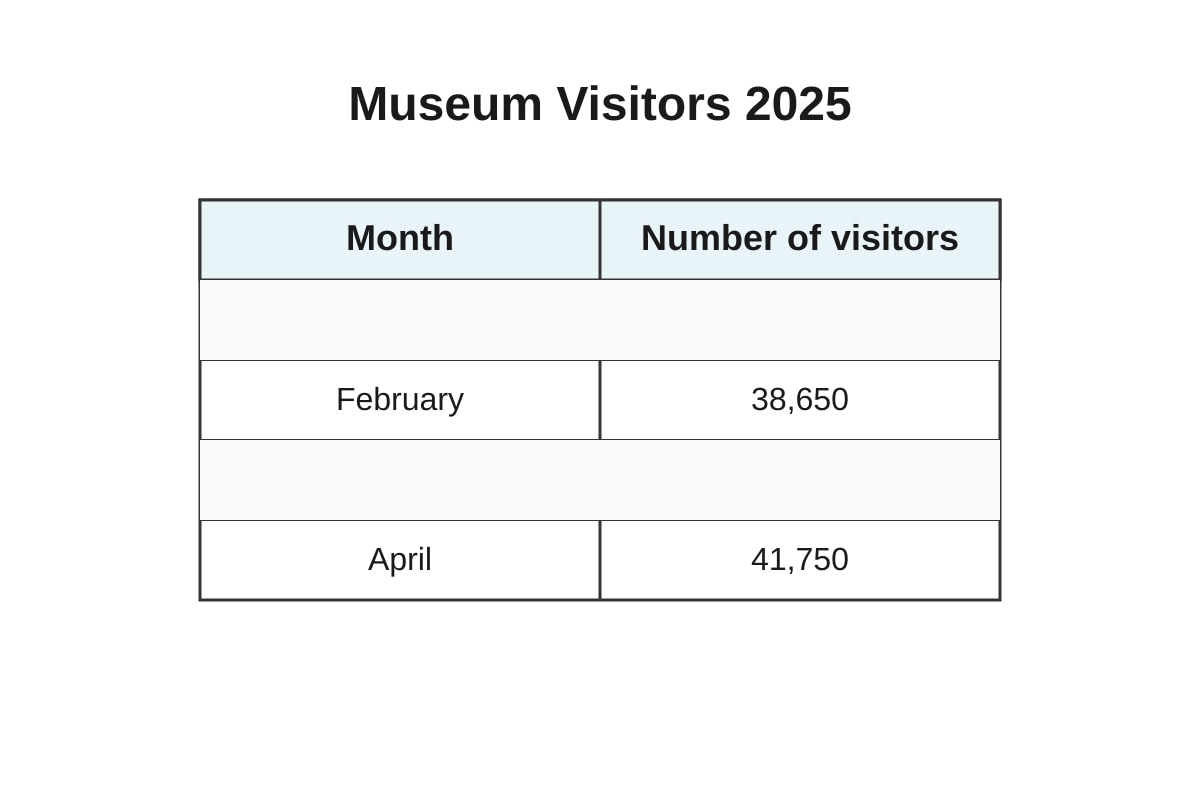
Visual reference expected: Table with four months of visitor data: January 45,280; February 38,650; March 52,400; April 41,750
(a) Answer: March (1 mark)
Working/Explanation:
Compare all four values:
- January: 45,280
- February: 38,650 (smallest)
- March: 52,400 (largest)
- April: 41,750
March has 52,400 visitors, which is greater than all other months.
(b) Answer: 83,930 visitors (1 mark)
Working/Explanation:
Step-by-step addition:
  45,280
+ 38,650
--------
  83,930
- Ones: 0 + 0 = 0
- Tens: 8 + 5 = 13, write 3, carry 1
- Hundreds: 2 + 6 + 1 = 9
- Thousands: 5 + 8 = 13, write 3, carry 1
- Ten Thousands: 4 + 3 + 1 = 8
(c) Answer: 52,000 visitors (2 marks)
Working/Explanation:
Rounding 52,400 to the nearest thousand:
- Thousands digit: 2
- Hundreds digit to the right: 4
- Since 4 < 5, we round down (keep the thousands digit as 2)
- Change remaining digits to zeros: 52,000
- Marking: 1 mark for correct method (identifying 4 < 5), 1 mark for correct answer.
Question 22 (4 marks)
(a) Answer: 2,392 girls (1 mark)
Working/Explanation:
  3,648
- 1,256
-------
  2,392
(b) Answer: 299 girls (1 mark)
Working/Explanation:
Division working:
     299
   _____
8 | 2,392
    2 4        (8 × 300 = 2,400, too big; 8 × 200 = 1,600... let's do properly)
Step-by-step:
- 23 ÷ 8 = 2 remainder 7 (8 × 2 = 16)
- 79 ÷ 8 = 9 remainder 7 (8 × 9 = 72)
- 72 ÷ 8 = 9 (8 × 9 = 72)
Answer: 299
Verification: 299 × 8 = 2,392 ✓
(c) Answer: 123 girls (2 marks)
Working/Explanation:
Step 1: Find total new pupils who are girls
Alternatively, simpler approach:
- New total pupils: 3,648 + 145 = 3,793
- New number of boys: 1,380
- New total girls: 3,793 − 1,380 = 2,413
Step 2: Find how many new girls joined
Wait — let me recheck. The question says 145 new pupils join, and there are NOW 1,380 boys.
Original: 1,256 boys, 2,392 girls Now: ? boys, ? girls
Actually: New boys = 1,380 − 1,256 = 124 So new girls = 145 − 124 = 21
Answer: 21 girls
Marking: 1 mark for finding new boys = 124, 1 mark for finding new girls = 21.
Question 23 (4 marks)
(a) Answer: 512 bags (1 mark)
Working/Explanation:
Working:
Or direct division: 12,800 ÷ 25 = 512 exactly.
Verification: 512 × 25 = 12,800 ✓
(b) Answer: 0 apples (1 mark)
Working/Explanation:
Since 12,800 ÷ 25 = 512 exactly with no remainder:
(c) Answer: $9,216 (2 marks)
Working/Explanation:
Working:
   512
 ×  18
------
  4,096  (512 × 8)
  5,120  (512 × 10)
------
  9,216
Marking: 1 mark for correct multiplication working, 1 mark for final answer with correct unit ($).
Question 24 (4 marks)
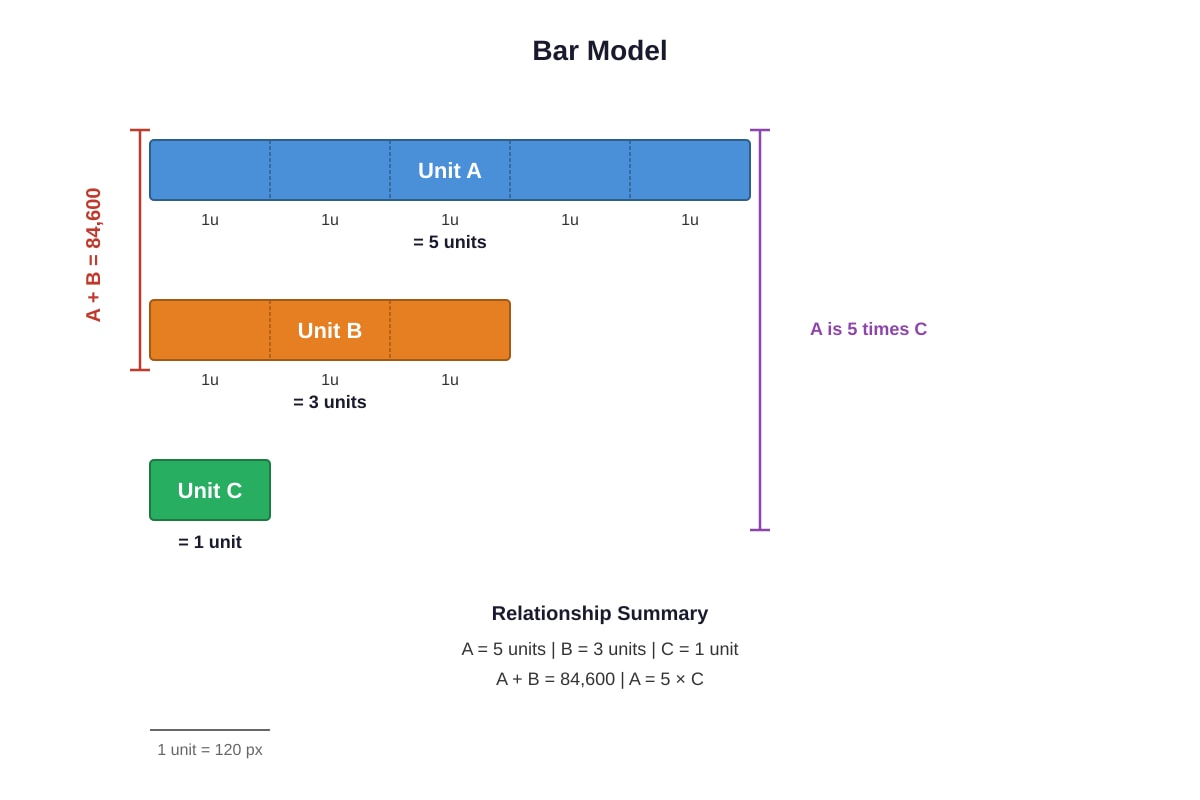
Visual reference expected: Bar model showing A = 5 units, B = 3 units, C = 1 unit, with A + B = 84,600
(a) Answer: 8 units (1 mark)
Working/Explanation:
From the bar model: A = 5 units, B = 3 units
(b) Answer: 10,575 (1 mark)
Working/Explanation:
Given: 8 units = 84,600
Working:
Verification: 10,575 × 8 = 84,600 ✓
(c) Answer: 52,875 (1 mark)
Working/Explanation:
Working:
(d) Answer: 42,300 (1 mark)
Working/Explanation:
Or using units: A − C = 5 units − 1 unit = 4 units = 4 × 10,575 = 42,300
- Concept check: The bar model uses "units" as a common measure. Always convert the given total to "per unit" first, then find any quantity needed.
Mark Allocation Summary
| Section | Question Range | Marks Per Question | Subtotal |
|---|---|---|---|
| A | 1–10 | 1 | 10 |
| B | 11–20 | 2 | 20 |
| C | 21–24 | 4 each (with parts) | 20 |
| Total | 50 |
Common Errors and Teaching Notes
| Error Type | Where It Appears | Prevention Strategy |
|---|---|---|
| Confusing "digit" and "place value" | Q1, Q2 | Emphasize: position vs. value |
| Rounding to wrong place value | Q4, Q14, Q21(c) | Always identify target digit first, then look immediately right |
| Forgetting "0" in number words | Q11 | Use place value table; check every position |
| Not starting with smallest non-zero digit | Q13 | Stress: 5-digit number cannot begin with 0 |
| Two-step problem confusion | Q16–20 | Underline what the final answer should represent |
| "Altogether" vs. "how many more" | Q19 | Highlight keywords before calculating |
| Unit rate: dividing vs. multiplying | Q20 | First step always "find one unit" |
| Bar model: not converting to unit value first | Q24 | Drill: "Given total → find 1 unit → find answer" |