From Real Exams Exam Paper

Primary 4 Mathematics Semestral Assessment 1 (Mid-Year) Paper 1

Free Exam-Derived Qwen3.7 Plus Primary 4 Mathematics Semestral Assessment 1 (Mid-Year) Paper 1 practice paper with questions and answers for Singapore students. This page is rendered as a direct URL so the questions and answers can be discovered without pressing in-page buttons.

These static practice materials are generated from the site's syllabus and paper-generation workflow, with source and model context shown so students and parents can evaluate the material before use.

Primary 4 Mathematics From Real Exams Generated by Qwen3.7 Plus Updated 2026-06-04

Questions

<!-- TuitionGoWhere generation metadata: stage=3-1; model=qwen/qwen3.7-plus; model_label=Qwen3.7 Plus; generated=2026-06-04; Sources: Stage 2-1 real exam-derived templates and Stage 2-2 exam-enriched syllabus. -->

TuitionGoWhere Exam Practice (AI)

Primary 4 Mathematics – Semester Assessment 1 (SA1)

Version: 1 of 5
Topic Focus: Whole Numbers (Numbers up to 100,000)

Name: __________________________
Class: _____________
Date: _________________
Duration: 1 hour 30 minutes
Total Marks: 50

Instructions to Candidates:

  1. This paper consists of 20 questions.
  2. Answer all questions.
  3. Write your answers in the spaces provided.
  4. For questions requiring working, show your working clearly. Marks may be awarded for method even if the final answer is incorrect.
  5. Unless otherwise stated, give your answers in the simplest form or to the specified degree of accuracy.

Section A: Multiple Choice Questions (Questions 1 – 10)

For each question, four options are given. Choose the correct answer and write its number (1, 2, 3, or 4) in the brackets provided. Each question carries 1 mark.

1. In the number 48,295, what is the value of the digit 8? (1) 8 (2) 80 (3) 800 (4) 8,000

[ ]

2. Which of the following numbers is the largest? (1) 60,999 (2) 61,001 (3) 60,199 (4) 61,010

[ ]

3. Write Seventy-two thousand and forty-five in numerals. (1) 72,450 (2) 72,045 (3) 70,245 (4) 72,405

[ ]

4. Round off 54,872 to the nearest thousand. (1) 54,000 (2) 54,800 (3) 54,900 (4) 55,000

[ ]

5. Which of the following shows the correct order from smallest to largest? (1) 30,500; 30,050; 35,000 (2) 30,050; 30,500; 35,000 (3) 35,000; 30,500; 30,050 (4) 30,500; 35,000; 30,050

[ ]

6. What is the result of 24,500+15,50024,500 + 15,500? (1) 39,000 (2) 40,000 (3) 41,000 (4) 39,100

[ ]

7. A factory produced 9,850 toys in January and 10,150 toys in February. How many toys were produced in total? (1) 19,000 (2) 20,000 (3) 21,000 (4) 19,900

[ ]

8. Which number is 10,000 less than 82,450? (1) 72,450 (2) 81,450 (3) 82,350 (4) 92,450

[ ]

9. Look at the number pattern below: 12,500,12,600,12,700,,12,90012,500, \quad 12,600, \quad 12,700, \quad \underline{\hspace{1cm}}, \quad 12,900 What is the missing number? (1) 12,750 (2) 12,800 (3) 12,850 (4) 13,000

[ ]

10. The population of Town A is 45,678. The population of Town B is 45,687. Which statement is true? (1) Town A has a larger population. (2) Town B has a larger population. (3) Both towns have the same population. (4) It is impossible to tell.

[ ]


Section B: Short Answer Questions (Questions 11 – 15)

Write your answers in the spaces provided. Each question carries 2 marks.

11. In the number 93,047, which digit is in the thousands place?

Answer: __________________________

12. Round off 67,439 to the nearest hundred.

Answer: __________________________

13. Find the sum of 23,456 and 14,321.

Answer: __________________________

14. Subtract 8,500 from 50,000.

Answer: __________________________

15. Arrange the following numbers in descending order (largest to smallest): 40,400,44,000,40,040,44,40040,400, \quad 44,000, \quad 40,040, \quad 44,400

Answer: __________________________, __________________________, __________________________, __________________________


Section C: Structured Questions (Questions 16 – 20)

Show your working clearly. Marks are awarded for method and correct answers.

16. Mr. Tan owns a bookstore. In the first week of May, he sold 12,450 books. In the second week, he sold 3,200 more books than in the first week. (a) How many books did he sell in the second week? [2]

<br> <br>

(b) How many books did he sell in total for the two weeks? [2]

<br> <br>

Answer: (a) __________________________ (b) __________________________

17. A warehouse stores 85,000 boxes of cereal. Due to a shipment error, 12,500 boxes were damaged and had to be discarded. Later, a new shipment of 20,000 boxes arrived. How many boxes of cereal are there in the warehouse now? [3]

<br> <br> <br>

Answer: __________________________

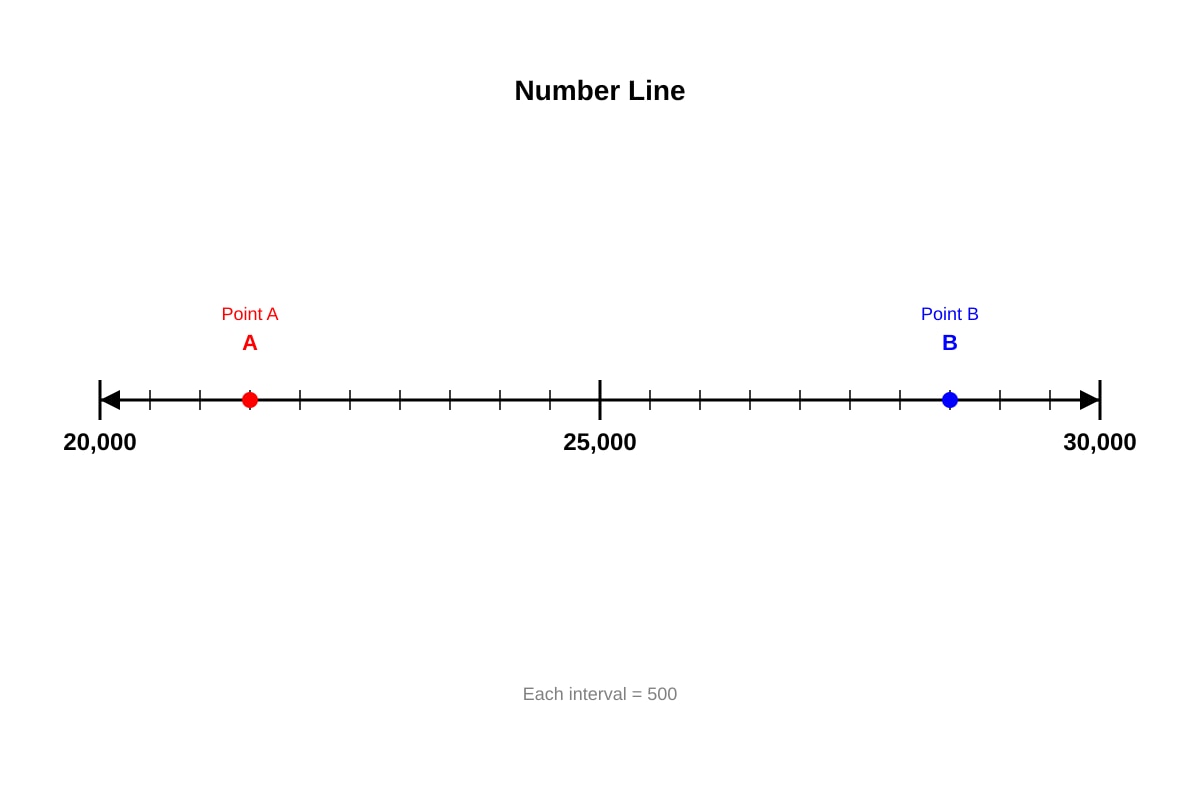
18. Study the number line below.

<image_placeholder> id: Q18-fig1 type: diagram linked_question: Q18 description: A horizontal number line ranging from 20,000 to 30,000. Major tick marks are labelled at 20,000, 25,000, and 30,000. There are 10 equal intervals between 20,000 and 25,000, and 10 equal intervals between 25,000 and 30,000. Point A is located at the 3rd tick mark after 20,000. Point B is located at the 7th tick mark after 25,000. labels: Start: 20,000; Middle: 25,000; End: 30,000; Point A; Point B values: Interval size: 500 (since 5000/10 = 500) must_show: Point A is at 21,500. Point B is at 28,500. </image_placeholder>

(a) What is the value of Point A? [1]

<br>

(b) What is the value of Point B? [1]

<br>

(c) Find the difference between the value of Point B and Point A. [2]

<br> <br>

Answer: (a) __________________________ (b) __________________________ (c) __________________________

19. A school library has 45,600 books. The library plans to buy more books to reach a total of 50,000 books. (a) How many more books does the library need to buy? [2]

<br> <br>

(b) If each book costs $10, how much will the library spend on the new books? [2]

<br> <br>

Answer: (a) __________________________ (b) __________________________

20. The table below shows the number of visitors to a museum over three days.

DayNumber of Visitors
Friday12,450
Saturday18,300
Sunday15,250

(a) How many more visitors were there on Saturday than on Friday? [2]

<br> <br>

(b) Round off the number of visitors on Sunday to the nearest thousand. [1]

<br>

(c) What is the total number of visitors for the three days? [2]

<br> <br>

Answer: (a) __________________________ (b) __________________________ (c) __________________________

*** End of Paper ***

Answers

<!-- TuitionGoWhere generation metadata: stage=3-1; model=qwen/qwen3.7-plus; model_label=Qwen3.7 Plus; generated=2026-06-04; Sources: Stage 2-1 real exam-derived templates and Stage 2-2 exam-enriched syllabus. -->

Answer Key & Marking Scheme

Primary 4 Mathematics – SA1 (Whole Numbers)

Version: 1 of 5

General Marking Notes:

  • Method marks (M) are awarded for correct working steps even if the final answer is wrong.
  • Answer marks (A) are awarded for the correct final answer.
  • Units (e.g., books, $) are required for word problems unless the question asks for a number only.
  • Spelling errors in numbers written in words may result in loss of marks if the meaning is ambiguous.

Section A: Multiple Choice Questions (10 Marks)

1. (4)

  • Reasoning: The digit 8 is in the thousands place. Its value is 8×1,000=8,0008 \times 1,000 = 8,000.
  • Common Mistake: Choosing (3) 800 (hundreds place) or (2) 80 (tens place).

2. (4)

  • Reasoning: Compare the ten-thousands digit (all are 6). Compare the thousands digit: 0, 1, 0, 1. The numbers with 1 in the thousands place are 61,001 and 61,010. Compare the tens/ones: 61,010 > 61,001.
  • Common Mistake: Choosing (2) 61,001 without checking the last two digits.

3. (2)

  • Reasoning: "Seventy-two thousand" = 72,000. "and forty-five" = 45. Combined: 72,045. Note the zero in the hundreds place.
  • Common Mistake: Choosing (1) 72,450 (misinterpreting "forty-five" as 450) or (4) 72,405.

4. (4)

  • Reasoning: To round 54,872 to the nearest thousand, look at the hundreds digit (8). Since 858 \ge 5, round up the thousands digit. 54,00055,00054,000 \rightarrow 55,000.
  • Common Mistake: Rounding down to 54,000.

5. (2)

  • Reasoning: Smallest to Largest.
    • 30,050 (Smallest)
    • 30,500
    • 35,000 (Largest)
  • Common Mistake: Confusing ascending and descending order.

6. (2)

  • Reasoning: 24,500+15,50024,500 + 15,500.
    • 500+500=1,000500 + 500 = 1,000 (carry over 1)
    • 4+5+1=104 + 5 + 1 = 10 (carry over 1)
    • 2+1+1=42 + 1 + 1 = 4
    • Result: 40,000.

7. (2)

  • Reasoning: 9,850+10,1509,850 + 10,150.
    • 850+150=1,000850 + 150 = 1,000
    • 9,000+10,000+1,000=20,0009,000 + 10,000 + 1,000 = 20,000.

8. (1)

  • Reasoning: "10,000 less" means subtraction. 82,45010,000=72,45082,450 - 10,000 = 72,450. Only the ten-thousands digit changes.

9. (2)

  • Reasoning: The pattern increases by 100 each time (12,60012,500=10012,600 - 12,500 = 100).
    • 12,700+100=12,80012,700 + 100 = 12,800.
    • Check: 12,800+100=12,90012,800 + 100 = 12,900. Correct.

10. (2)

  • Reasoning: Compare 45,678 and 45,687.
    • Ten-thousands, thousands, and hundreds are the same (45,6xx).
    • Tens digit: 7 vs 8. Since 8>78 > 7, 45,687 is larger. Town B is larger.

Section B: Short Answer Questions (10 Marks)

11. 3

  • Reasoning: In 93,047:
    • 7 is in the ones place.
    • 4 is in the tens place.
    • 0 is in the hundreds place.
    • 3 is in the thousands place.
    • 9 is in the ten-thousands place.

12. 67,400

  • Reasoning: Round 67,439 to the nearest hundred.
    • Look at the tens digit: 3.
    • Since 3<53 < 5, round down (keep the hundreds digit same).
    • Result: 67,400.

13. 37,777

  • Working: 23,456+14,32137,777\begin{array}{r} 23,456 \\ + 14,321 \\ \hline 37,777 \end{array}
  • Note: No carrying is required in this specific sum.

14. 41,500

  • Working: 50,00008,50041,500\begin{array}{r} 50,000 \\ - \phantom{0}8,500 \\ \hline 41,500 \end{array}
  • Method: 50,0008,000=42,00050,000 - 8,000 = 42,000. 42,000500=41,50042,000 - 500 = 41,500.

15. 44,400, 44,000, 40,400, 40,040

  • Reasoning: Descending means largest to smallest.
    1. 44,400 (Largest)
    2. 44,000
    3. 40,400
    4. 40,040 (Smallest)

Section C: Structured Questions (30 Marks)

16. Bookstore Sales (a) Books sold in the second week [2 marks]

  • Concept: "3,200 more than" means addition.
  • Working: 12,450+3,200=15,65012,450 + 3,200 = 15,650
  • Answer: 15,650 books

(b) Total books sold in two weeks [2 marks]

  • Concept: Sum of Week 1 and Week 2.
  • Working: 12,450 (Week 1)+15,650 (Week 2)=28,10012,450 \text{ (Week 1)} + 15,650 \text{ (Week 2)} = 28,100
  • Answer: 28,100 books
  • Common Mistake: Forgetting to add Week 1's sales to the final total, only giving Week 2's sales.

17. Warehouse Boxes [3 marks]

  • Concept: Two-step problem involving subtraction and addition.
  • Step 1: Discard damaged boxes. 85,00012,500=72,50085,000 - 12,500 = 72,500
  • Step 2: Add new shipment. 72,500+20,000=92,50072,500 + 20,000 = 92,500
  • Answer: 92,500 boxes
  • Marking: 1 mark for correct subtraction, 1 mark for correct addition, 1 mark for final answer with unit.

18. Number Line (a) Value of Point A [1 mark]

  • Analysis: The interval from 20,000 to 25,000 is 5,000. There are 10 spaces. Each space = 5,000÷10=5005,000 \div 10 = 500.
  • Point A is 3 ticks after 20,000. 20,000+(3×500)=20,000+1,500=21,50020,000 + (3 \times 500) = 20,000 + 1,500 = 21,500
  • Answer: 21,500

(b) Value of Point B [1 mark]

  • Analysis: Point B is 7 ticks after 25,000. 25,000+(7×500)=25,000+3,500=28,50025,000 + (7 \times 500) = 25,000 + 3,500 = 28,500
  • Answer: 28,500

(c) Difference between B and A [2 marks]

  • Working: 28,50021,500=7,00028,500 - 21,500 = 7,000
  • Answer: 7,000
  • Note: Accept method of counting ticks (10 ticks difference ×\times 500 = 5,000? No, wait. A is at tick 3, B is at tick 17 relative to start? Let's stick to values. 28,50021,500=7,00028,500 - 21,500 = 7,000).

19. Library Books (a) Books needed [2 marks]

  • Concept: Difference between target and current.
  • Working: 50,00045,600=4,40050,000 - 45,600 = 4,400
  • Answer: 4,400 books

(b) Cost of new books [2 marks]

  • Concept: Multiplication.
  • Working: 4,400×10=44,0004,400 \times 10 = 44,000
  • Answer: $44,000
  • Note: Ensure the dollar sign is included.

20. Museum Visitors (a) Difference between Saturday and Friday [2 marks]

  • Working: 18,30012,45018,300 - 12,450 18,30012,000=6,30018,300 - 12,000 = 6,300 6,300450=5,8506,300 - 450 = 5,850
  • Answer: 5,850 visitors

(b) Round Sunday to nearest thousand [1 mark]

  • Analysis: Sunday = 15,250. Look at hundreds digit (2). Since 2<52 < 5, round down.
  • Answer: 15,000

(c) Total visitors [2 marks]

  • Working: 12,450+18,300+15,25012,450 + 18,300 + 15,250 Group for easier addition: 12,450+15,250=27,70012,450 + 15,250 = 27,700 27,700+18,300=46,00027,700 + 18,300 = 46,000
  • Answer: 46,000 visitors
  • Marking: 1 mark for correct addition method/intermediate step, 1 mark for final answer.