AI Generated Quiz
Primary 4 English Oral Quiz
Free P4 English Oral quiz, AI version, with questions, answers, and syllabus-aligned practice for Singapore students.
These static practice materials are generated from the site's syllabus and paper-generation workflow, with source and model context shown so students and parents can evaluate the material before use.
Questions
Free quiz and exam paper access
Enter your details to view this paper
Your access is remembered on this device.
Answers
Primary 4 English Quiz - Oral: Answer Key
Total Marks: 20
Section A: Speaking Clearly and Fluently (Questions 1 - 5)
Question 1
Marks: 2
Answer: The sentence written correctly: "The little kitten hid under the wooden bench during the heavy rain."
The word that should be stressed most strongly: "hid" (or "heavy" — accept either with a reasonable justification).
Teaching Notes:
- Stress means saying a word with more force, volume, or emphasis.
- In this sentence, the most important action is "hid" because it tells us what the kitten did. Stressing "heavy" is also acceptable because it gives important information about the rain.
- Award 1 mark for correctly writing the sentence and 1 mark for identifying a reasonable stressed word.
Common Mistake: Students may underline a function word like "the" or "under." These are not usually stressed because they are not the most important words for meaning.
Question 2
Marks: 2
Answer: The two words that should be stressed most strongly are: "enormous" and "roared".
Teaching Notes:
- "Enormous" is an adjective that describes the size of the animal — it creates a vivid picture.
- "Roared" is a strong action verb that describes a loud sound — it creates excitement.
- "Walked" and "saw" are common verbs that do not need special emphasis. "Slowly" is an adverb, but it is less dramatic than "roared."
- Award 1 mark for each correctly identified word.
Common Mistake: Students may choose "saw" because it is an action, but it is a weak verb compared to "roared."
Question 3
Marks: 1
Answer: B
Teaching Notes:
- In sentence B, "present" is a noun that means a gift.
- In sentence A, "present" is a verb that means to show or give a presentation.
- This question tests the student's ability to use context clues to determine word meaning.
Common Mistake: Students may choose A because they associate "present" with presenting in class, but the question specifically asks for the meaning "a gift."
Question 4
Marks: 1
Answer: 3 (three)
Teaching Notes:
- "Comfortable" is pronounced "comf-ta-ble" — three syllables.
- When spoken naturally, the middle syllable is often reduced, but the word still has three syllables.
- Clap the syllables to help students hear them: comf (clap) - ta (clap) - ble (clap).
Common Mistake: Students may say 4 syllables if they pronounce it "com-for-ta-ble," but the standard pronunciation is 3 syllables.
Question 5
Marks: 2
Answer: "The magician pulled a rabbit out of his hat!"
Teaching Notes:
- The sentence should end with an exclamation mark (!) to show surprise.
- Award 1 mark for writing the sentence correctly and 1 mark for adding the exclamation mark.
- An exclamation mark shows strong emotion such as surprise, excitement, or shock.
- When reading aloud, the voice should go up and sound excited.
Common Mistake: Students may add a question mark. This is incorrect because the sentence is a statement, not a question.
Section B: Expressing Ideas and Opinions (Questions 6 - 10)
Question 6
Marks: 2
Answer (Example): "Having a Green Day is a good idea because it teaches us to take care of the environment. We can learn how to recycle and save water."
Marking Notes:
- Award 2 marks for a clear reason that is relevant to the idea of a "Green Day" (e.g., caring for the environment, learning about recycling, saving energy).
- Award 1 mark for a partially developed or vague reason (e.g., "It is fun").
- Award 0 marks for an unrelated answer.
Teaching Notes:
- A "Green Day" is a day focused on environmental awareness.
- A good reason should connect to the purpose of the event.
- Encourage students to give a reason and a short explanation.
Question 7
Marks: 2
Answer (Example): Step 1: "Choose a book you want to borrow from the shelves." Step 2: "Bring the book to the counter and show your library card to the librarian."
Marking Notes:
- Award 1 mark for each logical, clear step.
- Steps must be in a sensible order and related to borrowing a book from a library.
Teaching Notes:
- This question tests the ability to give clear instructions.
- Steps should be simple and easy to follow.
- Accept a variety of correct steps, such as: find a book, check the due date, scan the book, etc.
Common Mistake: Students may give steps that are too general (e.g., "Go to the library") or out of order.
Question 8
Marks: 2
Answer (Example): "I agree because having a pet teaches children to be responsible. They learn to feed and care for the animal every day."
OR
"I disagree because some children may be too young to take care of a pet. The parents might end up doing all the work."
Marking Notes:
- Award 2 marks for a clear opinion with one relevant reason.
- Award 1 mark for stating an opinion without a reason, or giving a weak reason.
- Either "agree" or "disagree" is acceptable as long as the reason supports the opinion.
Teaching Notes:
- This question tests the ability to express and support an opinion.
- A good answer states the opinion clearly and gives a reason.
- The reason should explain why the student holds that opinion.
Question 9
Marks: 2
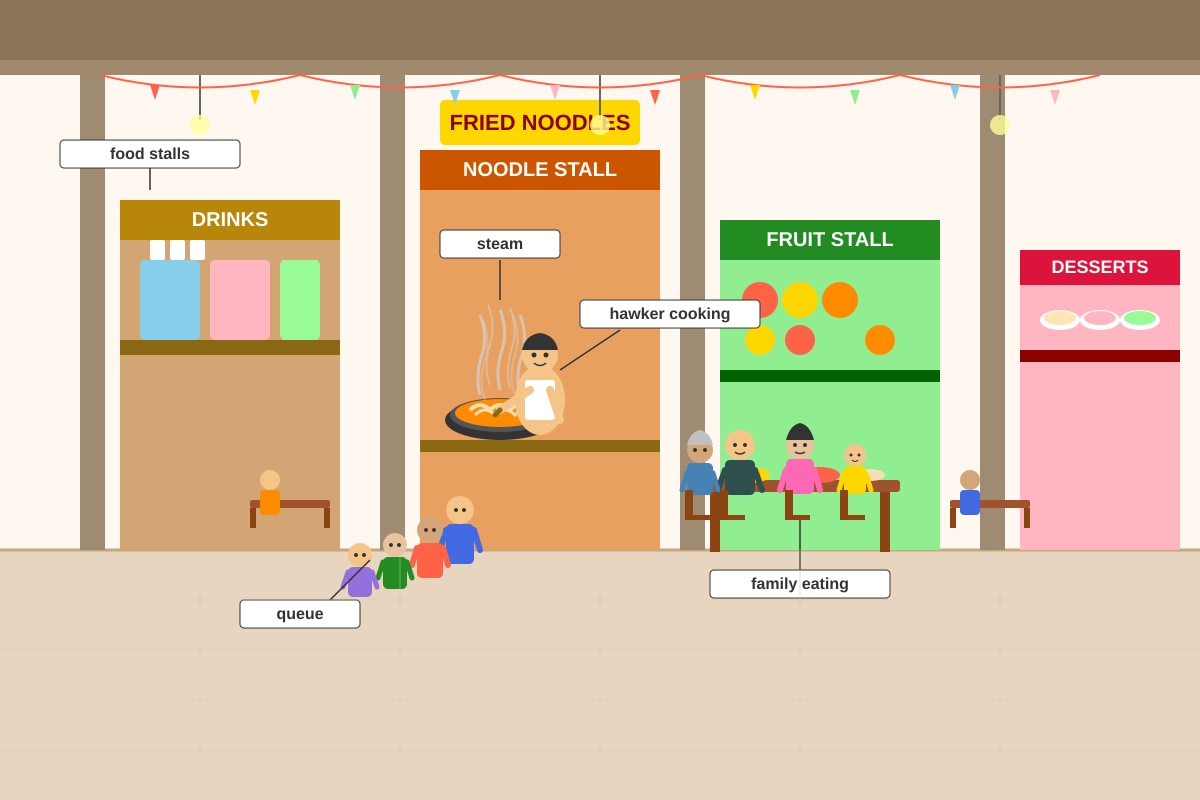
Answer (Example): Thing 1: "People are queuing at one of the food stalls to buy their food." Thing 2: "A hawker is cooking noodles in a big wok and steam is rising from the pan."
Marking Notes:
- Award 1 mark for each correct observation that is clearly visible in the picture.
- Observations must be specific and describe what is happening, not just what is present.
Teaching Notes:
- This question tests observation and descriptive skills.
- Students should describe actions (what people are doing), not just list objects.
- The image placeholder shows: a queue, a family eating, a hawker cooking, and steam.
Common Mistake: Students may say "There is food" without describing what is happening.
Question 10
Marks: 2
Answer (Example): "My favourite food is chicken rice. The chicken is soft and juicy, and the rice smells like ginger and pandan. It tastes savoury and delicious."
Marking Notes:
- Award 2 marks for two sentences that describe both appearance (what it looks like) and taste.
- Award 1 mark for a description that only covers one aspect (looks OR taste) or is only one sentence.
Teaching Notes:
- This question tests descriptive vocabulary.
- "Looks like" refers to appearance — colour, shape, texture.
- "Tastes like" refers to flavour — sweet, salty, sour, savoury.
- Encourage students to use descriptive words (adjectives).
Section C: Listening and Responding (Questions 11 - 15)
Question 11
Marks: 1
Answer (Example): "Oh no! That's too bad. Did you check the lost and found box?"
Marking Notes:
- Award 1 mark for a response that shows empathy (care/concern) and/or offers help.
- A simple "That's sad" is acceptable but a response that offers help is better.
Teaching Notes:
- This question tests active listening and empathy.
- A good response shows the listener understood the speaker's feelings.
- Phrases like "I'm sorry to hear that" or "Let me help you look" show care.
Question 12
Marks: 1
Answer: Take out the English textbook.
Marking Notes:
- Award 1 mark for identifying the first action: taking out the English textbook.
- Turning to page twenty-five is the second step.
Teaching Notes:
- This question tests the ability to follow instructions in sequence.
- The instruction has two parts: (1) take out the textbook, (2) turn to page 25.
- The first action is to take out the book.
Common Mistake: Students may say "turn to page 25" without mentioning taking out the book first.
Question 13
Marks: 1
Answer: The durian (or the durian fruit).
Marking Notes:
- Award 1 mark for identifying "durian" as the main topic.
- Accept "a fruit with a strong smell" if the student does not name the fruit.
Teaching Notes:
- The main topic is what the description is mostly about.
- The description talks about the durian's smell and how people react to it.
- The durian is mentioned at the start and is the subject of both sentences.
Question 14
Marks: 1
Answer: Happy (or excited, joyful, glad).
Marking Notes:
- Award 1 mark for any emotion word that matches "so happy."
- Accept "excited" or "joyful" as synonyms.
Teaching Notes:
- This question tests the ability to identify emotions from context.
- The clue is "so happy" and "my team won."
- Winning a match usually makes people feel happy or excited.
Question 15
Marks: 2
Answer (Example): "The guide gives this instruction so that the exhibits will not be damaged. If everyone touches them, the exhibits may break or get dirty."
Marking Notes:
- Award 2 marks for a clear reason related to protecting the exhibits or keeping visitors safe.
- Award 1 mark for a partial reason (e.g., "so we don't break things").
Teaching Notes:
- This question tests the ability to infer reasons behind instructions.
- Museums protect their exhibits because they are valuable and fragile.
- The instruction also keeps visitors safe and ensures everyone can enjoy the exhibits.
Section D: Oral Interaction and Discussion (Questions 16 - 20)
Question 16
Marks: 1
Answer (Example): "That's a good idea, but what if we also tried my idea? Maybe we can combine both."
Marking Notes:
- Award 1 mark for a polite response that acknowledges the friend's idea before sharing a different one.
- The response should not be rude or dismissive.
Teaching Notes:
- In a discussion, it is important to be respectful.
- A good response uses phrases like "That's a good idea, but..." or "I see your point. What about...?"
- This shows the speaker is listening and values the other person's contribution.
Common Mistake: Students may say "That's wrong, my idea is better," which is not polite.
Question 17
Marks: 2
Answer (Example): "We should have a class roster to assign cleaning duties. This is helpful because everyone will know their job and the classroom will stay clean."
Marking Notes:
- Award 2 marks for a clear suggestion with a relevant explanation of why it is helpful.
- Award 1 mark for a suggestion without an explanation.
Teaching Notes:
- This question tests the ability to contribute ideas in a discussion.
- A good answer has two parts: (1) the suggestion, (2) the reason.
- The reason should explain how the suggestion solves the problem.
Question 18
Marks: 2
Answer (Example): "I noticed you haven't done your part of the project yet. Can we work on it together after school so we can finish on time?"
Marking Notes:
- Award 2 marks for a response that is firm (addresses the problem) and kind (offers help or uses a polite tone).
- Award 1 mark for a response that is either firm OR kind but not both.
Teaching Notes:
- This question tests conflict resolution and communication skills.
- A good response:
- States the problem clearly.
- Uses a calm, polite tone.
- Offers a solution or help.
- Avoid blaming or shouting.
Question 19
Marks: 2
Answer (Example): In favour: "School uniforms make everyone look the same, so students will not be teased about their clothes." Against: "School uniforms can be uncomfortable, and students cannot express their own style."
Marking Notes:
- Award 1 mark for each valid point (one in favour, one against).
- Points must be relevant to the topic of school uniforms.
Teaching Notes:
- This question tests the ability to see both sides of an issue.
- Points in favour might include: equality, saving money, school identity, less distraction.
- Points against might include: lack of freedom, comfort, cost of buying uniforms.
Question 20
Marks: 2
Answer (Example): "Good morning, everyone. Today I am going to talk about my favourite place in Singapore, which is the Botanic Gardens. I love going there because it is peaceful and full of beautiful trees and flowers."
Marking Notes:
- Award 2 marks for two sentences that form a clear introduction to a talk.
- Award 1 mark for two sentences that are not connected or do not introduce the topic clearly.
Teaching Notes:
- A good talk introduction should:
- Greet the audience.
- State the topic.
- Give a hint of what will be shared.
- The first sentence should get the audience's attention.
- The second sentence should introduce the place and a reason for choosing it.
Common Mistake: Students may start with "My favourite place is..." without a greeting or engaging opening.
END OF ANSWER KEY