AI Generated Quiz
Primary 4 English Oral Quiz
Free P4 English Oral quiz, AI version, with questions, answers, and syllabus-aligned practice for Singapore students.
These static practice materials are generated from the site's syllabus and paper-generation workflow, with source and model context shown so students and parents can evaluate the material before use.
Questions
Free quiz and exam paper access
Enter your details to view this paper
Your access is remembered on this device.
Answers
Primary 4 English Quiz - Oral: Answer Key
Total Marks: 40
Section A: Reading Aloud (10 marks)
Passage 1 (5 marks)
Marking Scheme:
- Pronunciation (2 marks): Reads all words clearly and correctly. Common words to watch: rustle (should be /ˈrʌs.əl/), peaceful (/ˈpiːs.fəl/).
- Fluency (2 marks): Reads at a steady pace without long pauses. Groups words into meaningful phrases (e.g., "The sun was setting / over the calm sea").
- Expression (1 mark): Uses appropriate tone and emotion to convey the peaceful mood of the passage. Voice should sound calm and reflective.
Teaching Notes:
- Remind students to look ahead at punctuation. A full stop means a longer pause; a comma means a short pause.
- The passage has a calm, descriptive tone. Students should not read it too quickly or in a flat voice.
- Practise reading with feeling: imagine you are describing a beautiful sunset to a friend.
Common Mistakes:
- Rushing through the passage without pausing at commas and full stops.
- Reading in a monotone without expression.
- Mispronouncing "rustle" (sometimes read as "rustle" with a hard 't').
Passage 2 (5 marks)
Marking Scheme:
- Pronunciation (2 marks): Reads all words clearly. Key words: solar (/ˈsəʊ.lər/), astronauts (/ˈæs.trə.nɔːts/), educational (/ˌedʒ.uˈkeɪ.ʃən.əl/).
- Fluency (2 marks): Smooth reading with appropriate phrasing and pacing.
- Expression (1 mark): Uses an enthusiastic and interested tone to match the exciting topic of the field trip.
Teaching Notes:
- This passage is about an exciting experience. Students should sound interested and engaged.
- The word "educational" has five syllables. Break it down: ed-u-ca-tion-al.
- Practise reading with a slight smile to sound enthusiastic.
Common Mistakes:
- Mispronouncing "solar system" as "solar system" with equal stress on both words. The stress should be on the first syllable of "solar".
- Reading the last sentence too quickly, losing the positive tone.
Section B: Picture Discussion (15 marks)
Question 3 (5 marks)
Expected Response Points:
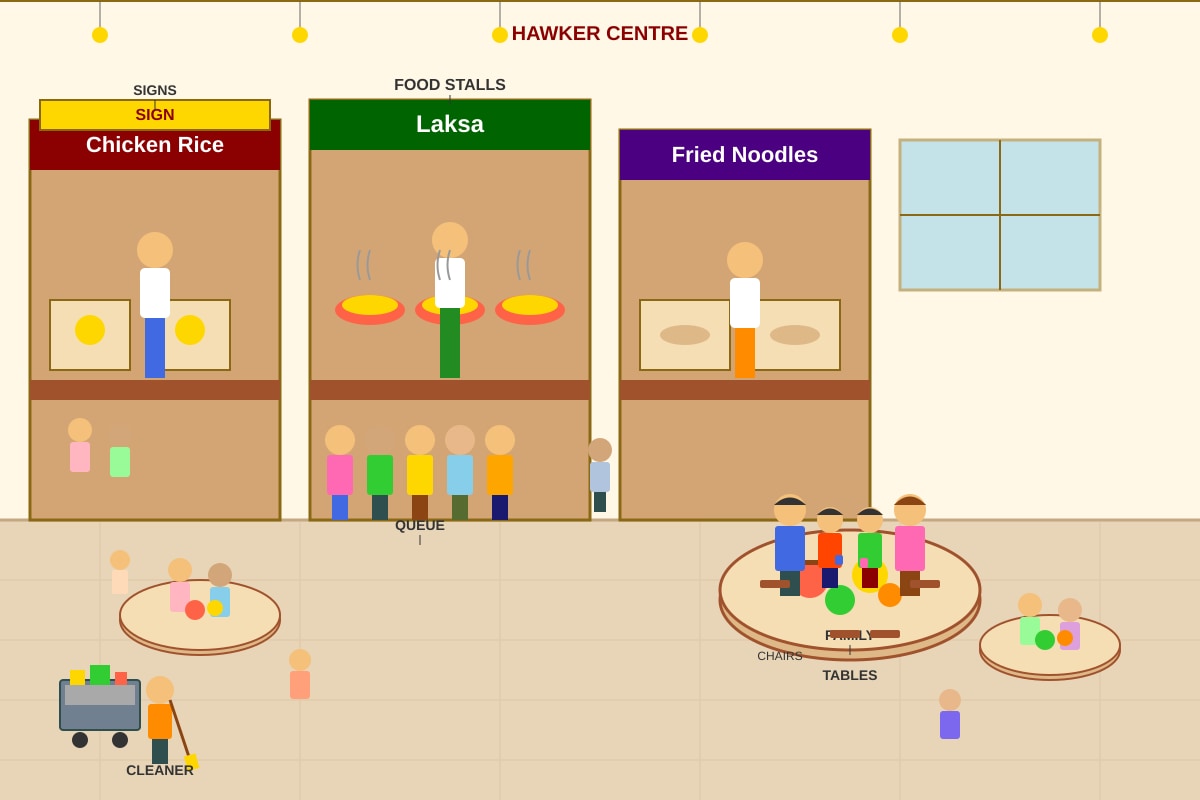
- Setting: A hawker centre in Singapore. It is lunchtime and very busy.
- People: Many people are eating at tables. Some are queuing at food stalls. A family is sharing a meal. A cleaner is clearing tables.
- Actions: People are eating, talking, queuing, and cleaning.
- Feelings: People look happy and satisfied. The family looks like they are enjoying their time together. The cleaner looks busy but hardworking.
- Sensory details: The air probably smells like delicious food. There is a lot of noise from people talking and cooking.
Marking Scheme:
- Content (2 marks): Mentions at least three different details from the picture (people, place, actions).
- Organisation (1 mark): Describes the scene in a logical order (e.g., overall scene → specific details).
- Vocabulary (1 mark): Uses descriptive words (e.g., "bustling", "crowded", "delicious", "busy").
- Elaboration (1 mark): Adds opinions or feelings about the scene (e.g., "I think the family is happy because they are eating together.").
Teaching Notes:
- Teach students the P-E-E structure: Point (what you see), Evidence (describe it), Elaboration (what it means or how it feels).
- Encourage students to use a variety of sentence starters: "In the picture, I can see...", "There is/are...", "In the background...", "The people are...".
- Practise using adjectives: busy, crowded, colourful, delicious, happy, hardworking.
Common Mistakes:
- Only listing what they see without describing or explaining.
- Using the same sentence structure repeatedly ("I see... I see... I see...").
- Speaking too softly or mumbling.
Question 4 (5 marks)
Expected Response Points:
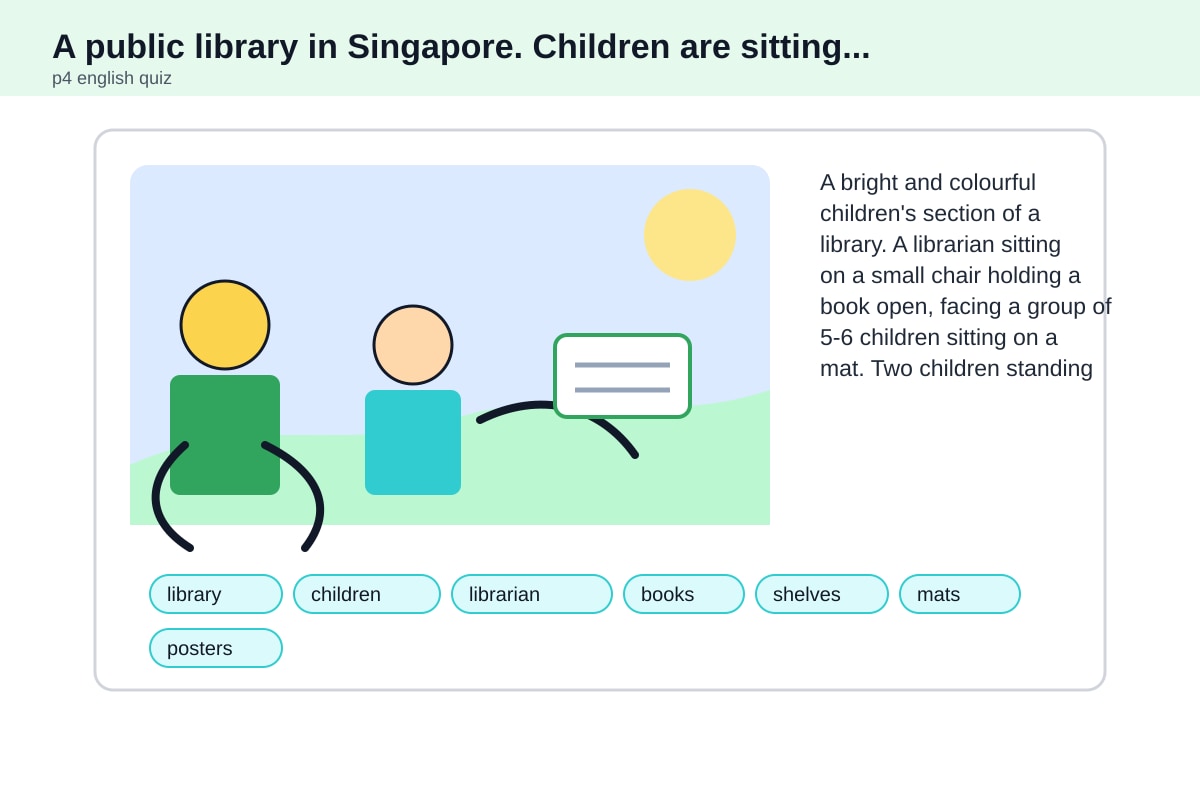
- Setting: A children's section in a public library. It is bright and colourful.
- People: A librarian is reading a story to a group of children. Other children are looking at books on shelves.
- Actions: The librarian is reading aloud. The children are listening carefully. Some children are choosing books.
- Feelings: The children look interested and happy. The librarian looks kind and patient.
- Sensory details: It is probably quiet except for the librarian's voice. The room feels calm and cosy.
Marking Scheme:
- Content (2 marks): Mentions at least three different details.
- Organisation (1 mark): Describes in a logical order.
- Vocabulary (1 mark): Uses descriptive words (e.g., "colourful", "quiet", "interested", "cosy").
- Elaboration (1 mark): Adds opinions or feelings.
Teaching Notes:
- Remind students to look at the whole picture before starting to speak.
- Use prepositions of place: "on the mat", "next to the bookshelf", "in front of the librarian".
- Connect the scene to personal experience: "This reminds me of when I went to the library with my class."
Common Mistakes:
- Focusing only on one part of the picture and ignoring other details.
- Not using any descriptive vocabulary.
- Speaking in a monotone without enthusiasm.
Question 5 (5 marks)
Expected Response Points:
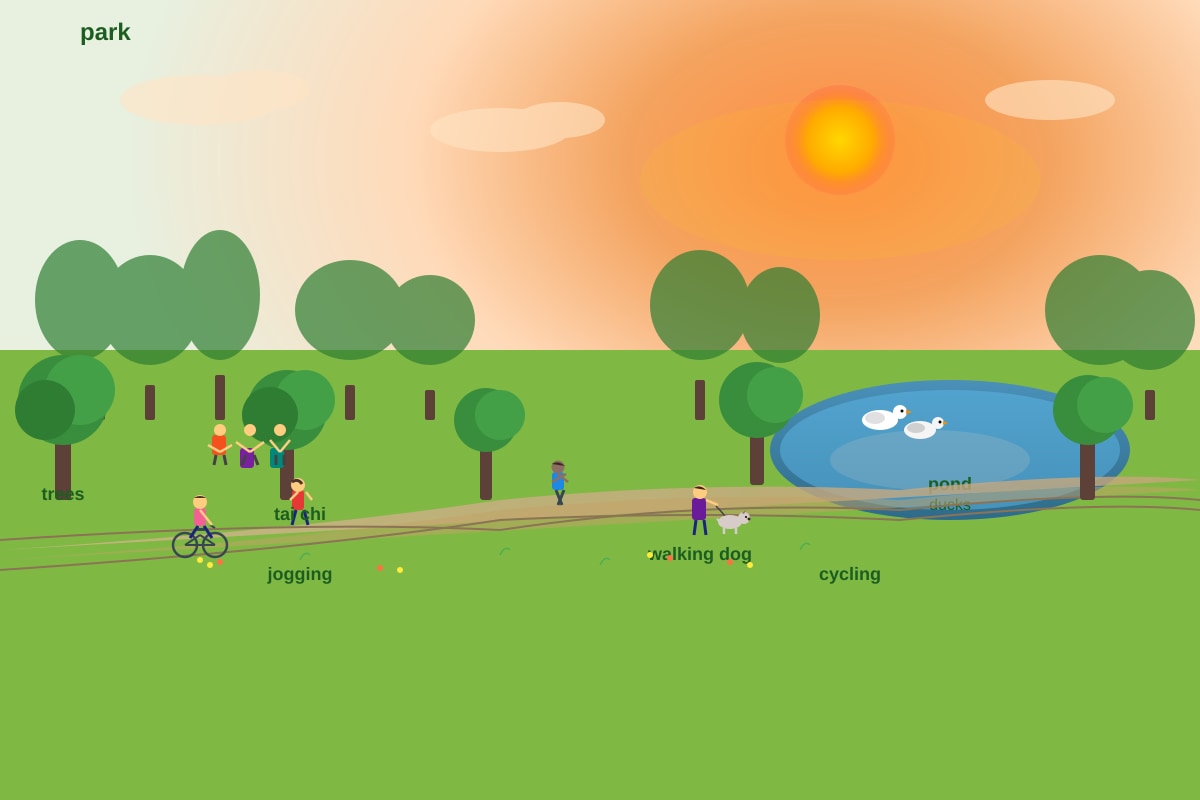
- Setting: A park in Singapore in the evening. The sky is beautiful with sunset colours.
- People: People are jogging, doing tai chi, walking a dog, and cycling.
- Actions: Jogging on the path, doing slow tai chi movements, walking a dog on a leash, cycling on the path.
- Feelings: People look relaxed and healthy. They are enjoying the fresh air and exercise.
- Sensory details: The air is cool and fresh. The park is peaceful. You can hear birds and the sound of leaves rustling.
Marking Scheme:
- Content (2 marks): Mentions at least three different details.
- Organisation (1 mark): Describes in a logical order.
- Vocabulary (1 mark): Uses descriptive words (e.g., "peaceful", "active", "relaxed", "beautiful").
- Elaboration (1 mark): Adds opinions or feelings.
Teaching Notes:
- Teach students to describe the scene from general to specific: first the overall park, then each group of people.
- Use action verbs: jogging, cycling, walking, stretching, exercising.
- Encourage students to explain why people are at the park: to exercise, relax, spend time with family, enjoy nature.
Common Mistakes:
- Not mentioning all the different activities happening.
- Using only simple sentences without connecting words (and, but, because, so).
- Forgetting to describe the setting (trees, pond, sky).
Section C: Conversation (15 marks)
Question 6 (3 marks)
Sample Response: "My favourite food is chicken rice. I like it because the chicken is very tender and the rice is fragrant with ginger and pandan leaves. I usually eat it on Sundays when my family goes to the hawker centre for lunch. It makes me feel happy because it reminds me of spending time with my family."
Marking Scheme:
- Content (1 mark): Clearly states a favourite food.
- Reason (1 mark): Gives at least one reason why they like it.
- Elaboration (1 mark): Provides additional details (when they eat it, how it makes them feel, etc.).
Teaching Notes:
- Encourage students to give specific reasons, not just "because it is nice". For example: "I like the crispy skin" or "The sauce is very tasty."
- Teach students to use descriptive words: tasty, delicious, sweet, savoury, crunchy, soft.
- Remind students to answer all parts of the question: what, why, and when.
Common Mistakes:
- Giving a one-word answer without explanation.
- Saying "I don't know" or "I like everything."
- Not answering all parts of the question.
Question 7 (3 marks)
Sample Response: "I prefer playing outdoors. First, I can run around and play games like football and tag, which is good exercise. Second, I can enjoy the fresh air and sunshine. Playing outdoors makes me feel energetic and happy."
Marking Scheme:
- Choice (1 mark): Clearly states a preference (indoors or outdoors).
- Reason 1 (1 mark): Gives a clear reason with some explanation.
- Reason 2 (1 mark): Gives a second clear reason with some explanation.
Teaching Notes:
- Teach students to use sequencing words: "First...", "Second...", "Also...", "Another reason is...".
- Encourage students to give examples to support their reasons.
- Accept either choice as long as reasons are logical and well-explained.
Common Mistakes:
- Changing their mind halfway through the response.
- Giving two reasons that are very similar (e.g., "I like running" and "I like jumping").
- Not explaining why the reasons matter.
Question 8 (3 marks)
Sample Response: "I helped my friend with his homework last week. He did not understand the maths problem, so I explained it to him step by step. After that, he could solve it by himself. I felt very happy because I could help him. It made me feel proud that I was a good friend."
Marking Scheme:
- Situation (1 mark): Describes a specific time they helped someone.
- Action (1 mark): Explains what they did to help.
- Feeling (1 mark): Describes how they felt and why.
Teaching Notes:
- Encourage students to tell a short story with a beginning, middle, and end.
- Use past tense consistently: "I helped...", "He did not understand...", "I explained...".
- Teach feeling words: happy, proud, good, warm, satisfied.
Common Mistakes:
- Giving a vague answer without a specific example.
- Using present tense instead of past tense.
- Not explaining why they felt a certain way.
Question 9 (3 marks)
Sample Response: "I would like to change the school canteen food. Sometimes the food is not very tasty. I would add more choices like pasta and sushi. I think students would eat more and be happier during recess if there were more options."
Marking Scheme:
- Change (1 mark): Clearly states one thing they would change.
- Reason (1 mark): Explains why they want to change it.
- Elaboration (1 mark): Describes how the change would make things better.
Teaching Notes:
- Encourage students to think of realistic changes that would benefit many students.
- Teach students to explain the problem first, then the solution.
- Use conditional language: "If we had... then students would..."
Common Mistakes:
- Suggesting something impossible or unrelated to school.
- Not explaining why the change is needed.
- Only stating the change without describing the positive outcome.
Question 10 (3 marks)
Sample Response: "If I could be any animal for a day, I would be a dolphin. Dolphins are very smart and friendly. They can swim fast and jump out of the water. I would swim in the ocean, play with other dolphins, and explore the coral reef. It would be so much fun to be free in the sea."
Marking Scheme:
- Animal (1 mark): Clearly states which animal they would be.
- Reason (1 mark): Gives a reason for choosing that animal.
- Elaboration (1 mark): Describes what they would do as that animal.
Teaching Notes:
- Encourage creativity and imagination.
- Teach students to use descriptive language to paint a picture: "I would soar through the sky like an eagle" or "I would swing from tree to tree like a monkey."
- Remind students to explain why they chose that specific animal.
Common Mistakes:
- Choosing an animal without knowing anything about it.
- Not describing what they would actually do as that animal.
- Giving a very short, unelaborated answer.
Section D: Reading Aloud (10 marks)
Passage 3 (5 marks)
Marking Scheme:
- Pronunciation (2 marks): Reads all words clearly. Key words: Merlion (/ˈmɜː.li.ɒn/), symbols (/ˈsɪm.bəlz/), Sanskrit (/ˈsæn.skrɪt/), tourist (/ˈtʊə.rɪst/), attraction (/əˈtræk.ʃən/).
- Fluency (2 marks): Smooth reading with appropriate phrasing and pacing.
- Expression (1 mark): Uses an informative and slightly proud tone to match the topic about Singapore's symbol.
Teaching Notes:
- This passage is informative. Students should sound knowledgeable and clear.
- Practise proper nouns: "Merlion", "Singapura", "Sanskrit".
- The passage has a mix of short and long sentences. Students should adjust their pace accordingly.
Common Mistakes:
- Mispronouncing "Merlion" (sometimes said as "Mer-lee-on" instead of "Mer-li-on").
- Rushing through the factual information without pausing.
- Not showing any expression or interest in the topic.
Passage 4 (5 marks)
Marking Scheme:
- Pronunciation (2 marks): Reads all words clearly. Key words: recycling (/riːˈsaɪ.klɪŋ/), environment (/ɪnˈvaɪ.rən.mənt/), recycle (/riːˈsaɪ.kəl/).
- Fluency (2 marks): Smooth reading with appropriate phrasing and pacing.
- Expression (1 mark): Uses a persuasive and encouraging tone to match the message about helping the environment.
Teaching Notes:
- This passage has a message. Students should sound like they believe in what they are reading.
- Emphasise key words: "important", "recycle", "everyone", "clean and green".
- Practise reading with conviction, as if trying to convince someone to recycle.
Common Mistakes:
- Reading in a flat, uninterested tone.
- Mispronouncing "recycling" (sometimes said as "re-cy-cling" with wrong syllable stress).
- Not pausing at the full stop before "Everyone should try to recycle more."
Section E: Picture Discussion (15 marks)
Question 13 (5 marks)
Expected Response Points:
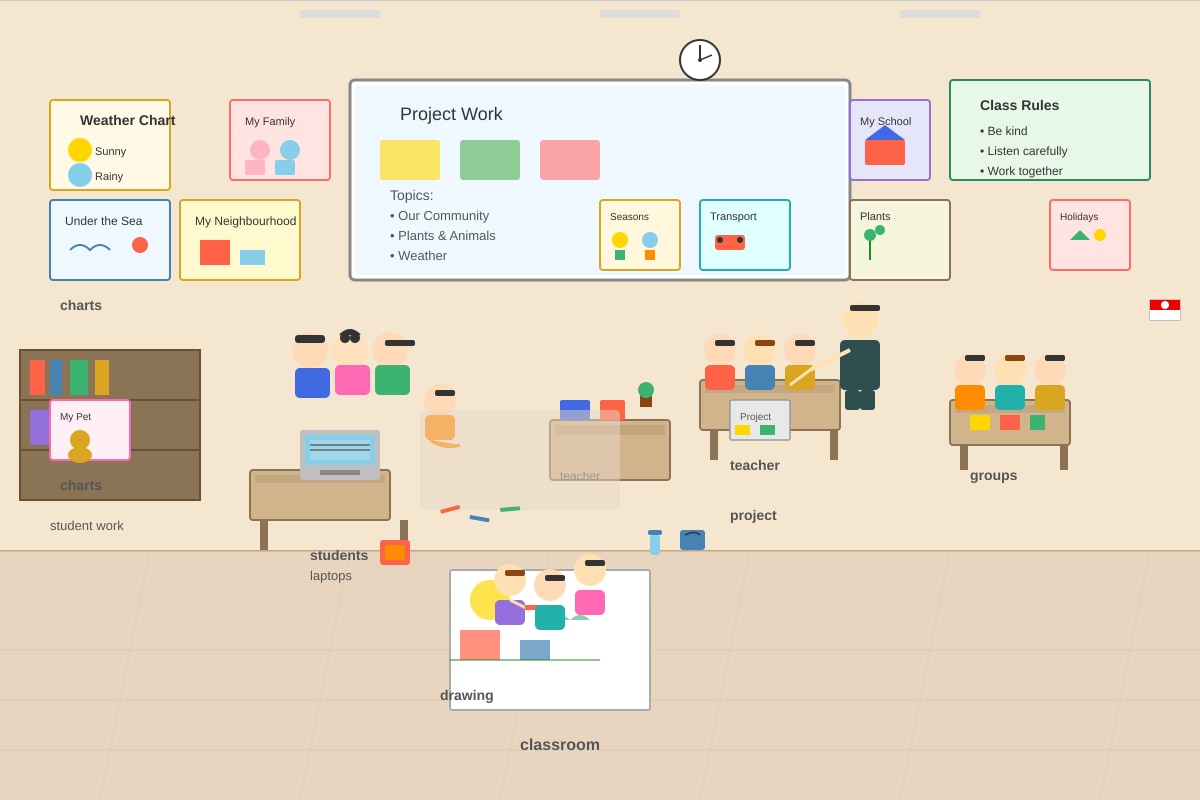
- Setting: A classroom in a Singapore primary school. It is bright and well-decorated.
- People: Students are working in groups. A teacher is helping one group.
- Actions: Some students are using laptops. Others are drawing on a large piece of paper. The teacher is pointing and explaining.
- Feelings: Students look focused and engaged. The teacher looks helpful and patient.
- Sensory details: The classroom probably sounds like quiet talking and discussion. It smells like markers and paper.
Marking Scheme:
- Content (2 marks): Mentions at least three different details.
- Organisation (1 mark): Describes in a logical order.
- Vocabulary (1 mark): Uses descriptive words (e.g., "focused", "collaborative", "creative", "helpful").
- Elaboration (1 mark): Adds opinions or feelings about group work.
Teaching Notes:
- Teach students to describe group work: "They are working together", "They are sharing ideas", "They are helping each other".
- Use words like "project", "collaborate", "discuss", "create".
- Encourage students to connect to their own experiences: "This looks like when my class did a project on..."
Common Mistakes:
- Only describing one group and ignoring the rest of the scene.
- Not using any vocabulary related to collaboration.
- Speaking too quickly or unclearly.
Question 14 (5 marks)
Expected Response Points:
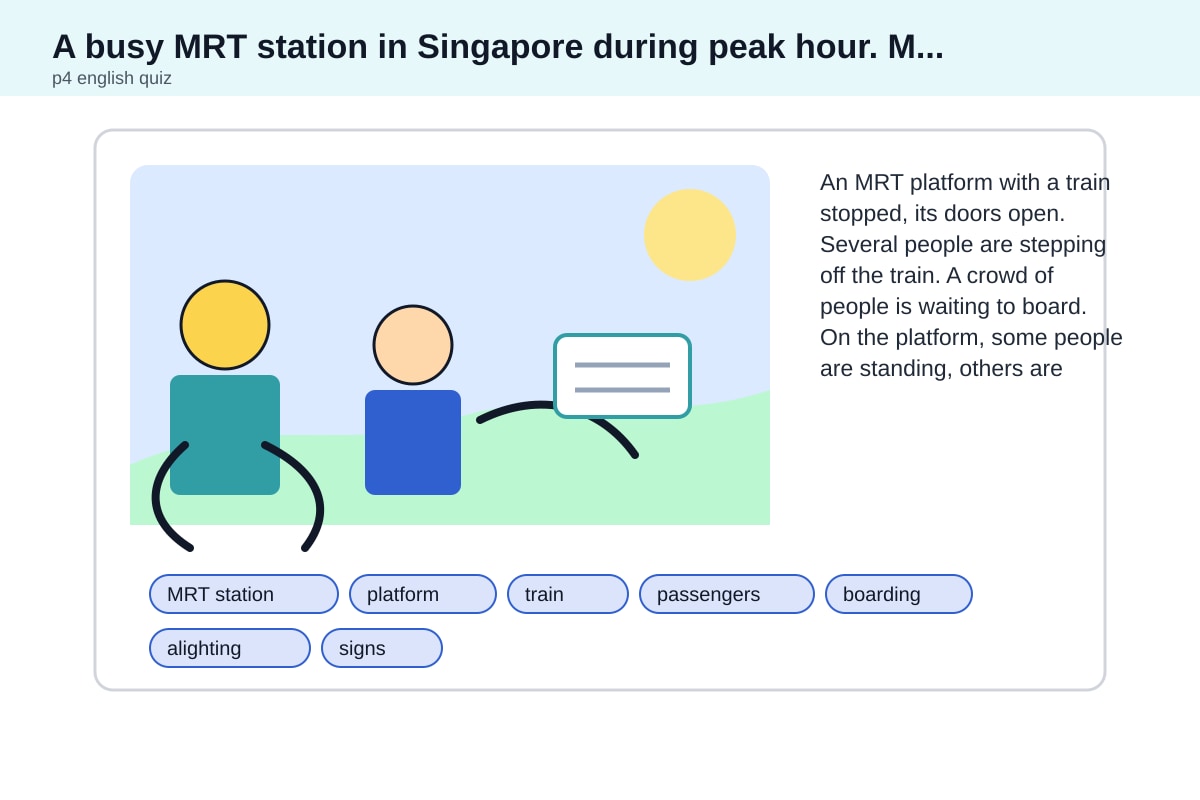
- Setting: An MRT station platform during peak hour. It is very busy.
- People: Many passengers are waiting, boarding, and alighting.
- Actions: A train has arrived. People are getting off and on. Some are standing, others are walking.
- Feelings: People look rushed and busy. Some might be tired after a long day. Others might be in a hurry to get home.
- Sensory details: It is noisy with train sounds and announcements. The platform is crowded and warm.
Marking Scheme:
- Content (2 marks): Mentions at least three different details.
- Organisation (1 mark): Describes in a logical order.
- Vocabulary (1 mark): Uses descriptive words (e.g., "crowded", "busy", "rushed", "noisy").
- Elaboration (1 mark): Adds opinions or feelings about the scene.
Teaching Notes:
- Teach students to describe movement: "boarding", "alighting", "waiting", "walking", "rushing".
- Use words related to transport: "platform", "train", "passengers", "signs", "doors".
- Encourage students to infer feelings based on body language: "The people look tired because they are not smiling."
Common Mistakes:
- Not mentioning both the train and the people on the platform.
- Using only basic vocabulary (e.g., "many people" without describing them).
- Forgetting to describe the setting (signs, platform, tracks).
Question 15 (5 marks)
Expected Response Points:
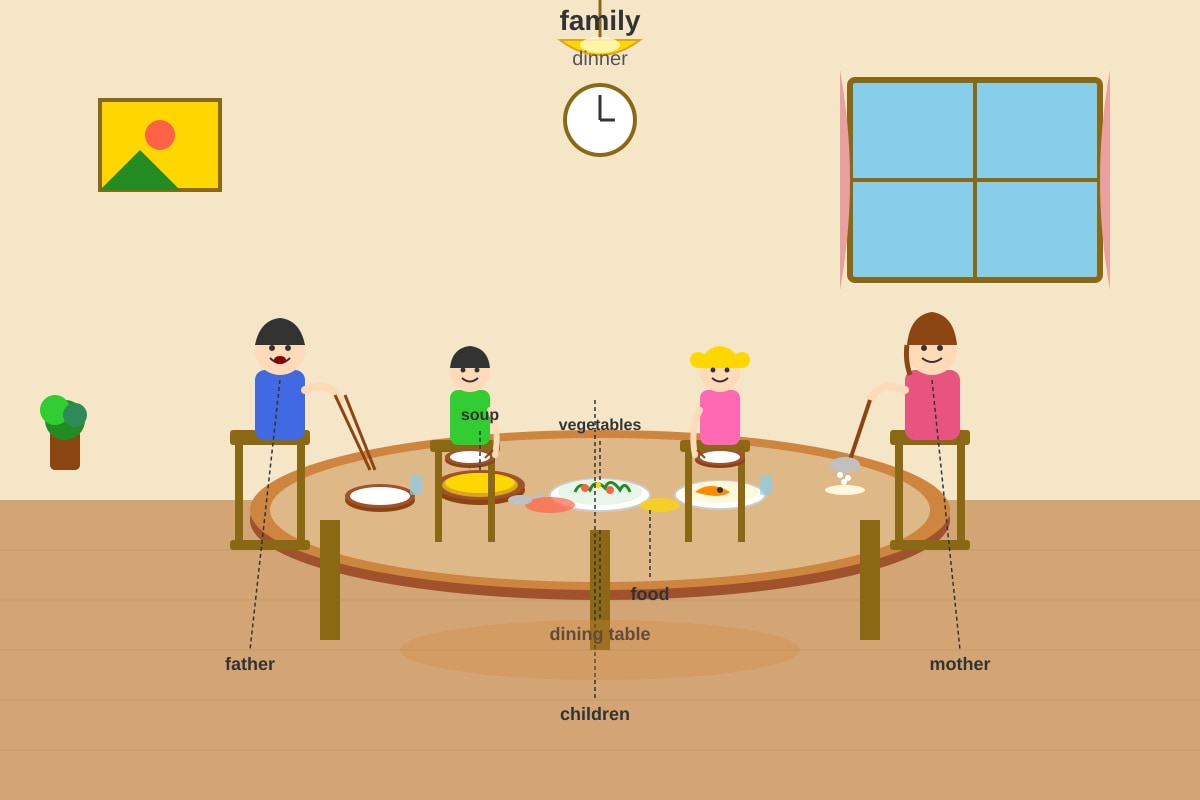
- Setting: A family's dining room at home. It is warm and cosy.
- People: A family of four: mother, father, boy, and girl.
- Actions: The mother is serving rice. The father is talking. The children are eating and smiling.
- Feelings: Everyone looks happy and relaxed. They are enjoying each other's company.
- Sensory details: The room smells like home-cooked food. You can hear laughter and the clinking of chopsticks.
Marking Scheme:
- Content (2 marks): Mentions at least three different details.
- Organisation (1 mark): Describes in a logical order.
- Vocabulary (1 mark): Uses descriptive words (e.g., "cosy", "happy", "warm", "delicious").
- Elaboration (1 mark): Explains why dinner time is important for families.
Teaching Notes:
- Teach students to describe family relationships: "They look like a close family", "They are spending quality time together".
- Use words related to meals: "serving", "eating", "sharing", "talking", "laughing".
- Encourage students to explain the importance of family meals: bonding, sharing stories, eating healthy food together.
Common Mistakes:
- Only describing the food and not the family interaction.
- Not explaining why dinner time is important.
- Using very simple sentences without connecting ideas.
Section F: Conversation (15 marks)
Question 16 (3 marks)
Sample Response: "On weekends, I like to go to East Coast Park with my family. We ride bicycles along the park connector. Sometimes we stop for ice cream. I enjoy it because we can exercise together and have fun. It is a good way to spend time as a family."
Marking Scheme:
- Activity (1 mark): Clearly states an activity they do with family.
- Description (1 mark): Describes what they do during the activity.
- Reason (1 mark): Explains why they enjoy it.
Teaching Notes:
- Encourage students to describe a specific activity, not just a general statement.
- Use present tense to describe regular activities: "We go...", "We ride...", "We eat...".
- Teach students to explain why the activity is meaningful to them.
Common Mistakes:
- Saying "I don't do anything with my family" or giving a very vague answer.
- Not describing the activity in enough detail.
- Forgetting to explain why they enjoy it.
Question 17 (3 marks)
Sample Response: "My favourite subject is Science. I like it because we learn about interesting things like plants, animals, and the human body. Last week, we learned about the life cycle of a butterfly. It was amazing to see how a caterpillar turns into a butterfly. Science makes me curious about the world."
Marking Scheme:
- Subject (1 mark): Clearly states a favourite subject.
- Reason (1 mark): Gives a reason for liking the subject.
- Example (1 mark): Provides a specific example of something learned.
Teaching Notes:
- Encourage students to give a real example from their lessons.
- Use words like "interesting", "fun", "fascinating", "amazing".
- Teach students to connect the subject to their interests: "I like Science because I want to be a doctor."
Common Mistakes:
- Saying "I like all subjects" without choosing one.
- Giving a reason without an example.
- Giving an example that is too vague (e.g., "We learned about things").
Question 18 (3 marks)
Sample Response: "I recently read a book called 'The BFG' by Roald Dahl. It is about a friendly giant who catches dreams and gives them to children. I really liked it because the story was very imaginative and funny. My favourite part was when the giant used his big ears to listen to dreams. I would recommend this book to my friends."
Marking Scheme:
- Book (1 mark): Names a specific book.
- Summary (1 mark): Briefly describes what the book is about.
- Opinion (1 mark): States whether they liked it and why.
Teaching Notes:
- Encourage students to remember the title and author of the book.
- Teach students to give a short summary without giving away the ending.
- Use opinion words: "I liked it because...", "My favourite part was...", "I would recommend it because...".
Common Mistakes:
- Not remembering the title of the book.
- Giving a very long summary that takes too much time.
- Saying "I liked it" without explaining why.
Question 19 (3 marks)
Sample Response: "I would invent a robot that helps clean the environment. It would pick up litter from the ground and sort it into recycling bins. It could also plant trees. This would help keep Singapore clean and green. It would also save people time because they would not have to pick up litter themselves."
Marking Scheme:
- Invention (1 mark): Clearly describes the invention.
- Function (1 mark): Explains how it works or what it does.
- Benefit (1 mark): Describes how it would help people.
Teaching Notes:
- Encourage creativity and problem-solving.
- Teach students to think about problems in the world and how to solve them.
- Use words like "invent", "create", "design", "help", "solve".
Common Mistakes:
- Describing an invention that already exists.
- Not explaining how the invention would actually work.
- Forgetting to explain how it helps people.
Question 20 (3 marks)
Sample Response: "Yes, I think it is very important to be kind to others. When we are kind, we make others feel happy and valued. At school, I can show kindness by sharing my snacks with a friend who forgot to bring food. I can also help a classmate who does not understand a lesson. Kindness makes the world a better place."
Marking Scheme:
- Opinion (1 mark): Clearly states whether they think kindness is important.
- Reason (1 mark): Gives a reason for their opinion.
- Example (1 mark): Provides a specific example of showing kindness at school.
Teaching Notes:
- Teach students to state their opinion clearly at the beginning.
- Use words like "important", "kind", "helpful", "caring", "thoughtful".
- Encourage students to give a real or realistic example from school life.
Common Mistakes:
- Saying "I don't know" or giving a very short answer.
- Giving a reason without an example.
- Giving an example that is not realistic (e.g., "I would give all my money to charity").