AI Generated Quiz
Primary 4 English Oral Quiz
Free P4 English Oral quiz, AI version, with questions, answers, and syllabus-aligned practice for Singapore students.
These static practice materials are generated from the site's syllabus and paper-generation workflow, with source and model context shown so students and parents can evaluate the material before use.
Questions
Free quiz and exam paper access
Enter your details to view this paper
Your access is remembered on this device.
Answers
Primary 4 English Quiz - Oral (Answer Key)
Total Marks: 20
Section A: Speaking Clearly and Fluently (Questions 1–5)
1. [1 mark] Sample Answer: "My favourite food is chicken rice. It is delicious and I like the rice because it is fragrant. I usually eat it with my family on weekends."
Explanation: The student should speak in complete sentences and clearly state their favourite food. The answer should include a reason why they like it. Accept any reasonable answer that is clear and uses full sentences.
Marking: 1 mark for a clear, complete-sentence response about a favourite food.
2. [1 mark] Answer: "Wow, what a beautiful day it is!"
Explanation: The sentence expresses strong emotion (wow), so it needs an exclamation mark. A comma is also needed after "Wow" to separate the interjection from the rest of the sentence.
Common Mistake: Using a full stop instead of an exclamation mark. Remind students that "Wow" shows excitement.
Marking: 1 mark for correct punctuation (comma after "Wow" and exclamation mark at the end).
3. [1 mark] Sample Answer: "Excuse me, Miss Tan. I am having trouble with this maths problem. Could you please help me understand it?"
Explanation: The student should use polite language ("Excuse me," "please"), address the teacher respectfully, and clearly state the problem. This shows awareness of formal register when speaking to a teacher.
Marking: 1 mark for a polite and clear request for help.
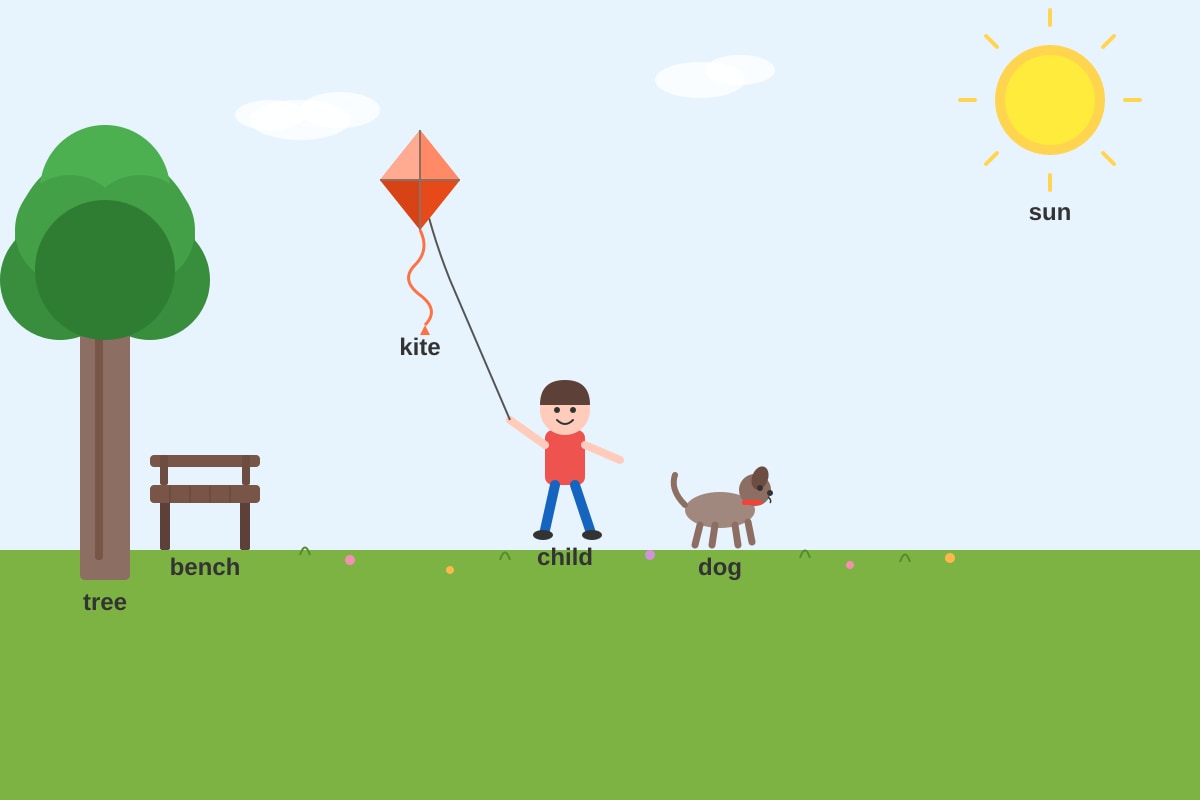
4. [1 mark] Sample Answer: "In the park, there is a big green tree on the left. A child is flying a kite in the middle while a small dog runs beside him."
Explanation: The student should describe what they see in the picture using descriptive words (e.g., "big," "green," "small") and complete sentences. The answer should help the listener visualise the scene.
Marking: 1 mark for two complete sentences that describe the picture with some detail.
5. [1 mark] Sample Answer: "Good morning, everyone. Let's start our discussion. We need to choose a topic for our project. Does anyone have any ideas?"
Explanation: The student should show leadership by starting the discussion, inviting others to share ideas, and using inclusive language ("everyone," "we").
Marking: 1 mark for an appropriate opening statement that invites discussion.
Section B: Organising Ideas and Presenting (Questions 6–10)
6. [1 mark] Sample Answer: "Good morning, everyone. Today, I am going to talk about how to make a sandwich. It is very easy and fun to do."
Explanation: A good introduction should greet the audience, state the topic clearly, and give a hint of what to expect. This helps the listener know what the talk will be about.
Marking: 1 mark for a clear introduction that states the topic.
7. [1 mark] Sample Answer: "First, put some toothpaste on your toothbrush. Next, brush your teeth in small circles for two minutes."
Explanation: The student should use sequence words ("first," "next") to show the order of steps. The steps should be logical and easy to follow.
Marking: 1 mark for two correct steps in order with sequence words.
8. [1 mark] Sample Answer: "In my opinion, children should not have homework every day because they need time to play and rest after school."
Explanation: The student should state their opinion clearly and provide a reason to support it. The answer should start with a phrase like "I think" or "In my opinion."
Marking: 1 mark for a clear opinion with a supporting reason.
9. [1 mark] Sample Answer: "The puppy wandered into a busy street and felt very scared. A kind girl saw the puppy and picked it up gently."
Explanation: The student should write the middle part of the story, showing what happens after the puppy gets lost. The sentences should be connected and move the story forward.
Marking: 1 mark for two sentences that continue the story logically.
10. [1 mark] Sample Answer: "Thank you for listening to my presentation about my favourite animal, the dolphin. I hope you learned something new today."
Explanation: A good conclusion should thank the audience and summarise the main point. This shows good presentation skills.
Marking: 1 mark for an appropriate concluding sentence that thanks the audience.
Section C: Listening and Responding (Questions 11–15)
11. [1 mark] Sample Answer: "That sounds like so much fun! What animals are you most excited to see?"
Explanation: A good response shows interest by asking a follow-up question or expressing excitement. This shows the listener is engaged and paying attention.
Marking: 1 mark for a response that shows interest and engagement.
12. [1 mark] Sample Answer: "I think the most important rule is to raise your hand before speaking. This way, everyone gets a turn to share their ideas."
Explanation: The student should give a clear opinion and explain why they think it is important. The answer should be relevant to the classroom context.
Marking: 1 mark for a clear opinion with a brief explanation.
13. [1 mark] Sample Answer: "I am sorry to hear that. I know how it feels to lose something you like. Maybe we can look for it together?"
Explanation: A kind response shows empathy (understanding how someone feels) and offers help. This is an important social skill.
Marking: 1 mark for a response that shows empathy and kindness.
14. [1 mark] Sample Answer: "I understand your idea, but I think we should wait until after our exams. What do you all think?"
Explanation: The student should disagree politely by acknowledging the other person's idea first, then giving a reason, and inviting others to share their thoughts. This shows good discussion skills.
Marking: 1 mark for a polite disagreement with a reason.
15. [1 mark] Sample Answer: "Of course! Which part are you stuck on? Let's look at it together."
Explanation: A helpful response offers assistance and asks a clarifying question. This shows willingness to help and good communication.
Marking: 1 mark for a helpful and supportive response.
Section D: Using Appropriate Language (Questions 16–20)
16. [1 mark] Answer: (B) "Excuse me, could you please tell me where the library is?"
Explanation: When speaking to the principal, we should use formal and polite language. Option (B) uses "Excuse me," "could you please," and a complete sentence. Option (A) is too casual and informal for a conversation with the principal.
Marking: 1 mark for circling (B).
17. [1 mark] Sample Answer: "Hey, did you finish your homework?"
Explanation: When talking to a best friend, we can use casual and natural language. The original sentence is too formal. The rewritten version should sound like a friendly conversation.
Marking: 1 mark for a natural, casual rewrite appropriate for a friend.
18. [1 mark] Sample Answer: "Today, I am going to tell you about the water cycle. It is very important for our planet."
Explanation: When giving a speech, the student should speak clearly and loudly. The sentence should be easy to understand and well-paced.
Marking: 1 mark for a clear, audible sentence suitable for a speech.
19. [1 mark] Sample Answer: "I should speak louder and more slowly so my grandmother can hear me."
Explanation: When someone cannot hear well, we should speak louder, slow down, and speak clearly. We should not shout or get frustrated.
Marking: 1 mark for a reasonable strategy (speak louder, slower, or clearer).
20. [1 mark] Sample Answer: "We are doing an experiment to see if plants need sunlight to grow. We put one plant in the sun and one in the dark."
Explanation: The student should use simple words and short sentences so the new student can understand. Avoid using difficult scientific terms without explanation.
Marking: 1 mark for a clear, simple explanation suitable for a new student.