From Real Exams Quiz
Primary 4 English Oral Quiz
Free P4 English Oral quiz, Kimi2.6 Exam version, with questions, answers, and syllabus-aligned practice for Singapore students.
These static practice materials are generated from the site's syllabus and paper-generation workflow, with source and model context shown so students and parents can evaluate the material before use.
Questions
Free quiz and exam paper access
Enter your details to view this paper
Your access is remembered on this device.
Answers
Primary 4 English Quiz - Oral (Answer Key)
Total Marks: 20
Section A: Reading Aloud Preparation (Questions 1–5)
1. (1 mark)
Answer: "eagerly" (or "eagerly, waiting for his turn")
Teaching note: "Eagerly" expresses excited anticipation. A rising tone on this word makes Ethan's excitement audible to listeners. Other acceptable answers: "jump" (if showing the surprise/jump connection), but "eagerly" best matches the "excited anticipation" requirement.
Why correct: Rising pitch communicates expectation and enthusiasm; it draws listeners into the character's feelings.
Common mistake: Using a falling tone, which sounds disappointed rather than excited.
2. (1 mark)
Answer: Use a softer, warmer tone; slightly slower pace with a gentle, affectionate quality.
Teaching note: "Twinkling" suggests fondness and secret-sharing. The voice should become more intimate and playful.
Why correct: Vocal warmth mirrors the emotional content. Twinkling eyes signal positive emotion, so harsh or fast delivery would contradict the text.
How to do it: Imagine telling a friend something special—your voice naturally softens. Apply that same quality here.
3. (1 mark)
Answer: "rang" (or "loudly")
Teaching note: "Rang" is onomatopoeic—it echoes the actual sound of a bell. Read it with abrupt emphasis and slightly louder volume, then pause briefly.
Why correct: Onomatopoeia invites auditory performance. The sudden emphasis reproduces the surprise in the story.
How to do it: Snap the word slightly; make it punchier than surrounding words. Follow with a micro-pause before "making everyone jump."
Common mistake: Blending "rang" smoothly into the sentence, losing the sound effect.
4. (1 mark)
Answer: Speak faster/with increased pace; use an enthusiastic, joyful tone.
Teaching note: Grandmother has just been surprised by the timer, then laughs. Her line expresses happy anticipation. Faster pace shows energy; excitement colours the delivery.
Why correct: The context (laughter, treat-checking) rewards brisk, cheerful delivery. Slow, flat reading would sound tired or worried.
5. (1 mark)
Answer: "Grandmother carefully rolled out the dough on the wooden table while Maya shaped the small tarts with patient fingers."
Delivery: Slow, steady pace; soft, even tone; gentle rhythm. Then accelerate and sharpen for "Suddenly, the oven timer rang loudly, making everyone jump!"
Teaching note: The calm sentence uses words like "carefully," "patient"—they demand unhurried delivery. The contrast with the sudden action sharpens the surprise.
Why correct: Contrast is a core oral skill. Building calm makes disruption impactful.
Section B: Visual Stimulus-Based Responses (Questions 6–12)
6. (1 mark)
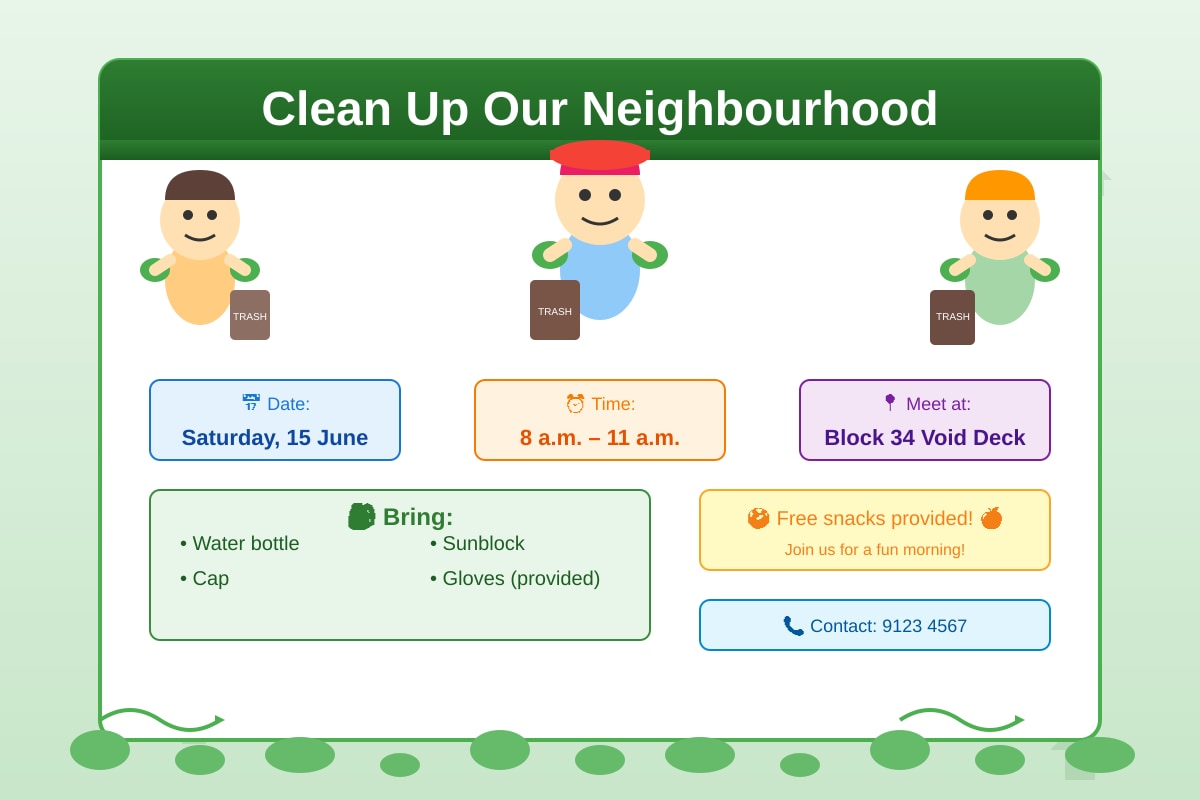
Answer: [✓] To invite people to join a neighbourhood activity
Teaching note: Check all elements—title says "Clean Up," date/time indicate event, "Meet at" signals gathering, activities described are collective.
Why others wrong: No products/prices (not selling), no fines mentioned (not warning), snacks are free bonus not main purpose (not advertising shop).
7. (1 mark)
Answer: Any two from: cartoon children smiling; "Free snacks provided!"; bright cheerful colours; friendly design; children looking happy while working.
Teaching note: These features signal fun rather than obligation. "Smiling" and "free snacks" are explicit enjoyment markers.
Why correct: Visual happiness cues (smiles, bright colours) and rewards (snacks) frame work as pleasant community bonding.
8. (1 mark)
Answer: Call the contact number on the poster.
Teaching note: When lost, the contact number is the designated help resource. No map is shown, so phone contact is logical.
Why correct: Posters provide contact precisely for such problems. No other navigation aid is visible.
9. (1 mark)
Answer: Any one from: to attract more people to join; to reward participants; to make the activity sound more fun; to encourage children to come.
Teaching note: Free food is an incentive. Organisers use incentives to boost attendance, especially for volunteer events.
Why correct: Incentives reduce perceived cost (time, effort) and increase perceived benefit of participating.
10. (1 mark)
Answer: Water bottle, cap, sunblock (all three needed for mark)
Teaching note: Direct information extraction. The list is explicit in the poster.
Delivery note: In real oral exam, speak clearly, list systematically, perhaps add "The poster says to bring..."
11. (1 mark)
Answer: Bright colours catch attention so more people notice the poster; cartoon children make the activity look child-friendly and welcoming; together they make community clean-up seem enjoyable rather than dull work.
Teaching note: Design choices serve function. Brightness = visibility; cartoons = relatability for families.
Why correct: Visual design is purposeful communication. Every element should connect to poster's goal (attracting participants).
12. (1 mark)
Answer structure: Poster-based reason + personal reason
Example answer: Yes, I would join because the poster shows free snacks and it looks fun with other children. My own reason is that I want to make my neighbourhood cleaner for my grandmother who lives here.
Teaching note: Two-part answers need balance. First part grounds in evidence; second shows personal reflection.
Marking: 0.5 for poster-based reason, 0.5 for personal reason with clear explanation.
Section C: Listening Comprehension Preparation (Questions 13–17)
13. (1 mark)
Acceptable predictions: Any three from—practising routines; choosing costumes; rehearsing songs/dances; feeling nervous; auditioning; helping with stage setup; memorising lines.
Teaching note: Predictions activate prior knowledge. Talent show schema includes preparation elements. No single "correct" answer—plausibility matters.
Why useful: Prediction focuses listening, making subsequent comprehension more efficient.
14. (1 mark)
Answer: Time words show the order of events/sequence. They help you organise what happened first, next, and last in your notes and retelling.
Teaching note: Sequential markers are structural cues. Identifying them prevents jumbled recall.
Why correct: Spoken texts lack paragraph breaks; time words substitute as organisers.
15. (1 mark)
Answer: Feeling change: nervous → more confident/less worried. Voice: probably started shaky/soft, then became steadier and stronger.
Teaching note: "At first...but then..." signals contrast. Voice mirrors emotional journey.
Why correct: Effective speakers unconsciously reveal feeling states through pitch, pace, and volume changes. Close listening catches these.
16. (1 mark)
Answer: Hyperbole (exaggeration). Ears do not literally "ring" from clapping; the speaker exaggerates to emphasise how very loud and enthusiastic the applause was.
Teaching note: Distinguish literal from figurative. Hyperbole intensifies without deceiving—listeners recognise the rhetorical move.
Why correct: Literal ringing requires medical condition or actual bell; context (applause) makes hyperbole the only sensible reading.
17. (1 mark)
Answer: Any two from—use time order (first, next, finally); group by main idea and details; use a story mountain (beginning, middle, end); mention the speaker's main message first then supporting points.
Teaching note: Organisation strategies make retelling coherent rather than chaotic.
Why correct: Structure aids both speaker memory and listener comprehension.
Section D: Spoken Expression & Communication (Questions 18–20)
18. (1 mark)
Three qualities example: cooperative, responsible, encouraging, punctual, helpful, respectful, adaptable.
Explanation with example: "Someone cooperative works well with others. For example, in group projects, they share tasks fairly and listen to everyone's ideas instead of doing everything alone."
Marking: 0.5 for three qualities listed; 0.5 for one explained with concrete school example.
Teaching note: Specific examples ("in group projects") trump vague claims ("in school").
19. (1 mark)
Answer: Any two appropriate techniques with brief explanation:
| Technique | How it keeps interest |
|---|---|
| Varied tone/pitch | Prevents monotone boredom |
| Pauses before exciting parts | Builds suspense |
| Asking rhetorical questions | Engages listener mentally |
| Using descriptive details | Creates mental images |
| Showing the book cover | Visual aid adds interest |
Marking: 0.5 per technique (name + how it works).
20. (1 mark)
Answer structure: Acknowledge friend's view + present different view respectfully
Example: "I understand you really enjoy sports CCAs and they keep you active. I think CCAs like robotics and art are also good because they let students express creativity and solve problems in different ways. All CCAs help us grow, just in different skills."
Teaching note: Respectful disagreement requires validation before contrast. "I understand..." or "You make a good point, but..." frames tone.
Marking: 0.5 for acknowledging/validating; 0.5 for clear alternative view with supporting reason.
Common mistake: Dismissing friend's opinion ("That's wrong") or being apologetic about own view ("Sorry, but maybe...").
Answer Key Complete