From Real Exams Quiz
Primary 4 English Comprehension Quiz
Free P4 English Comprehension quiz, Kimi2.6 Exam version, with questions, answers, and syllabus-aligned practice for Singapore students.
These static practice materials are generated from the site's syllabus and paper-generation workflow, with source and model context shown so students and parents can evaluate the material before use.
Questions
Free quiz and exam paper access
Enter your details to view this paper
Your access is remembered on this device.
Answers
Primary 4 English Quiz - Comprehension
Answer Key
Total Marks: 40
Section A: Visual Text Comprehension
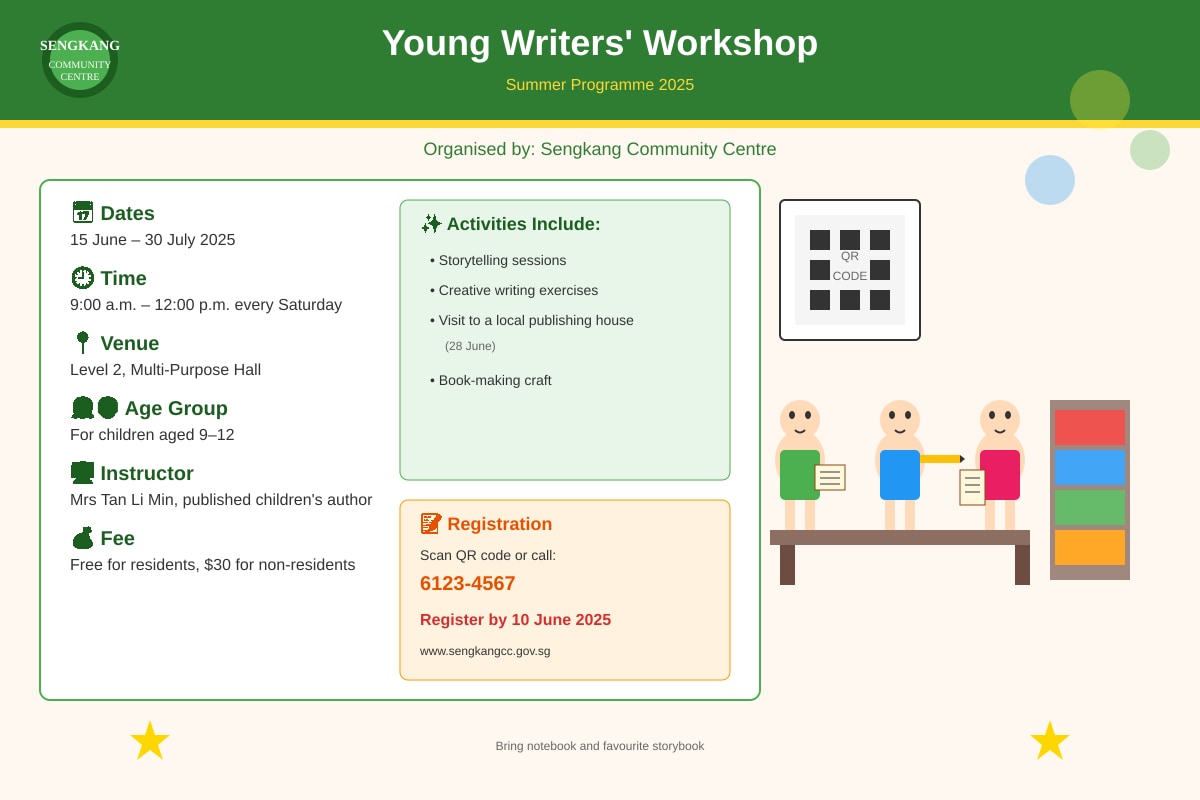
1. The correct answer is (3) tell children about a writing workshop they can join. (1 mark)
Reasoning: The poster's title is "Young Writers' Workshop" and it provides details about dates, time, venue, and activities—all aimed at attracting children to participate. Options (1) and (2) are incorrect because no books are sold and no volunteers are recruited. Option (4) is wrong because Mrs Tan is already named as the instructor; the poster is not advertising her job position.
Common mistake: Choosing (1) because books are mentioned—books are for bringing and activities, not for sale.
2. The workshop states it is "For children aged 9–12". Mabel is 10, which falls within this range. (1 mark)
Teaching note: Look for explicit matching criteria in visual texts. The age requirement directly confirms suitability.
3. a local publishing house (1 mark)
Teaching note: Always check bullet points and special dates carefully. The visit is listed as a special activity with its date in parentheses.
4. The correct answer is (3) $30. (1 mark)
Reasoning: The poster states "Free for residents, $30 for non-residents." Felix is not a resident, so he pays the non-resident fee.
Common mistake: Choosing (1) without noticing the resident/non-resident distinction.
5. "published children's author" (1 mark)
Reasoning: This phrase tells us Mrs Tan has real experience—her books have been published professionally. "Published" means her work was approved by editors and printing companies, showing she has proven skill.
6. Two pieces of advice (any two of the following, 1 mark each):
- Call 6123-4567 to ask if late registration is possible.
- Check the website www.sengkangcc.gov.sg for updated information or contact details.
- Visit Sengkang Community Centre in person to explain his situation. (2 marks)
Teaching note: Effective advice must be actionable and derived from poster information. Vague advice like "ask someone" without using provided contact methods earns no marks.
Section B: Factual Comprehension
7. At 6:30 a.m. / 6:30 a.m. (1 mark)
Direct evidence: "Every morning, Mr Kumar arrived at Sunrise Primary School at 6:30 a.m."
8. Twelve years / 12 years / For twelve years (1 mark)
Direct evidence: "He had been the school security guard for twelve years."
9. Any two of: (1 mark each, 2 marks total)
- Spare umbrellas (for rainy days)
- A box of bandages (for scraped knees)
Teaching note: Both items are explicitly listed in paragraph 2. "His small guardhouse" is the location, not an item he kept for pupils.
10. Mr Kumar said this because: (1 mark each, 2 marks total)
- He wanted to help without embarrassing the pupils—saying "pay me back" let them keep their dignity.
- He never intended to actually collect the money—he cared more about the children eating than being repaid.
- He was kind and generous, and keeping records would make his help feel like a loan rather than genuine care.
Accept any well-reasoned inference supported by text evidence.
11. knelt (1 mark)
Teaching note: "Knelt" is the past tense of "kneel," meaning to bend one's legs to lower the body. Context clue: Mr Kumar needed to be at Mei's height to comfort her.
12. Any two reasons with evidence: (1 mark each, 2 marks total)
- He went beyond his official duties—memorised names, comforted worried children, provided umbrellas and bandages, bought meals (paragraphs 2–3).
- He showed genuine care and kindness—remembering pupils' situations, calming Mei during the fire drill (paragraph 4).
- He made the school feel like home—his retirement speech shows emotional connection to the community (paragraph 6).
- He built lasting relationships—pupils from all levels wanted to honour him, showing years of positive impact.
13. Yes/No with reasoned explanation: (1 mark for opinion, 1 mark for evidence-based explanation)
Sample "Yes" answer: Yes, because the bench is at the school pond, a peaceful place where pupils gather, so they will remember Mr Kumar whenever they sit there. The name "Kumar's Corner" also personalises the space just as he personalised his care for each pupil. (2 marks)
Sample "No" answer: No, because a bench only lasts for physical years and might be removed; his real legacy lives in the pupils' memories and kindness they learned from him, which the scrapbook better represents. Accept if well-reasoned. (2 marks)
Section C: Inferential Comprehension
14. The "neat cursive" suggests: (1 mark each, 2 marks total)
- The writer is deliberate and careful—they took time to write clearly, suggesting planning rather than a rushed prank.
- The mystery is friendly, not threatening—neat handwriting feels personal and inviting, not scary or messy like a warning.
- The note-giver wants to be taken seriously—illegible writing might be ignored, but cursive shows effort and respect for Aiden.
Accept any inference about personality, intention, or tone supported by the description.
15. The phrase "where words sleep" made Bella think of books because books contain written words that stay still and silent until someone reads them—they "sleep" on the page. (1 mark)
Teaching note: Bella makes a literal interpretation first. The "where" suggests a place, and a library/book is the obvious place for words.
16. This suggests the note-writer: (1 mark each, 2 marks total)
- Planned a challenging, multi-step puzzle—not a simple hide-and-seek but a riddle requiring creative thinking.
- Knew the children's habits or expected them to think deeper—the library was a reasonable but incorrect first guess, pushing them to reconsider.
- Wanted the children to learn and persist, not just find something quickly—frustration followed by success builds engagement.
17. Bella changed from literal to more abstract thinking: (1 mark for change, 1 mark for evidence)
On Wednesday, she interpreted "sleep" literally—books are where words lie still (physical place). On Thursday, she reconsidered: "Words sleep when we don't speak them" or "when they're written down"—she thought about states of words, not just locations. Her eyes widening and the rush to the recycling bin show her excitement at this new interpretation. (2 marks)
18. Brass suggests: (1 mark each, 2 marks total)
- Durability and longevity—brass is a metal that lasts; this compass is meant for real adventures, not toy play.
- Historical/authentic feel—brass compasses appear in real exploration stories, matching the "treasure" and "adventure" theme.
- Value and seriousness—the giver invested in a quality object, showing this is a significant gift, not a casual trick.
19. Likely destination with evidence: (1 mark for location, 1 mark for supporting clues)
East Coast Park or a beach/other East-facing location—the compass points east toward the rising sun, and "dawn" means sunrise. Singapore's eastern coastline faces the sunrise. Alternatively, Changi or any Singapore eastern landmark. (2 marks)
Accept any reasonable Singapore location east of the school with textual justification.
20. Yes, with two reasons: (1 mark per reason, 1 mark for clear organisation/expression, 3 marks total)
- Unresolved mystery: The map of Singapore with "unfamiliar symbols" suggests more clues exist that have not been explained.
- Open-ended invitation: "The real adventure begins at dawn" directly promises future action rather than closing the story.
- Purposeful final image: The compass needle "trembled" pointing east creates suspense and forward momentum, classic sequel preparation.
Teaching note: Strong answers name specific techniques the writer uses (unexplained symbols, direct address to future events, suspenseful final image). Weak answers merely say "there could be more" without textual support.
END OF ANSWER KEY