Primary 4 English Quiz - Comprehension
Subject: English | Level: Primary 4
Topic: Comprehension | Assessment: SA2 Practice (Version 1 of 5)
Duration: 45 minutes | Total Marks: 30
Name: ______________________
Class: ____________________
Date: _____________________
Score: ________ / 30
Instructions
- Answer all 20 questions. Every question is based on a source given in the paper.
- Section A is based on a poster. Sections B, C and D are each based on one passage. Read each source carefully before answering.
- For multiple-choice questions, write the number of the correct option — (1), (2), (3) or (4) — in the brackets provided.
- For open-ended questions, answer in complete sentences and support your answers with evidence from the passage.
- The marks for each question are shown in brackets.
Section A: Visual Text Comprehension (Questions 1-5, 5 marks)
Study the poster below carefully, then answer Questions 1 to 5.
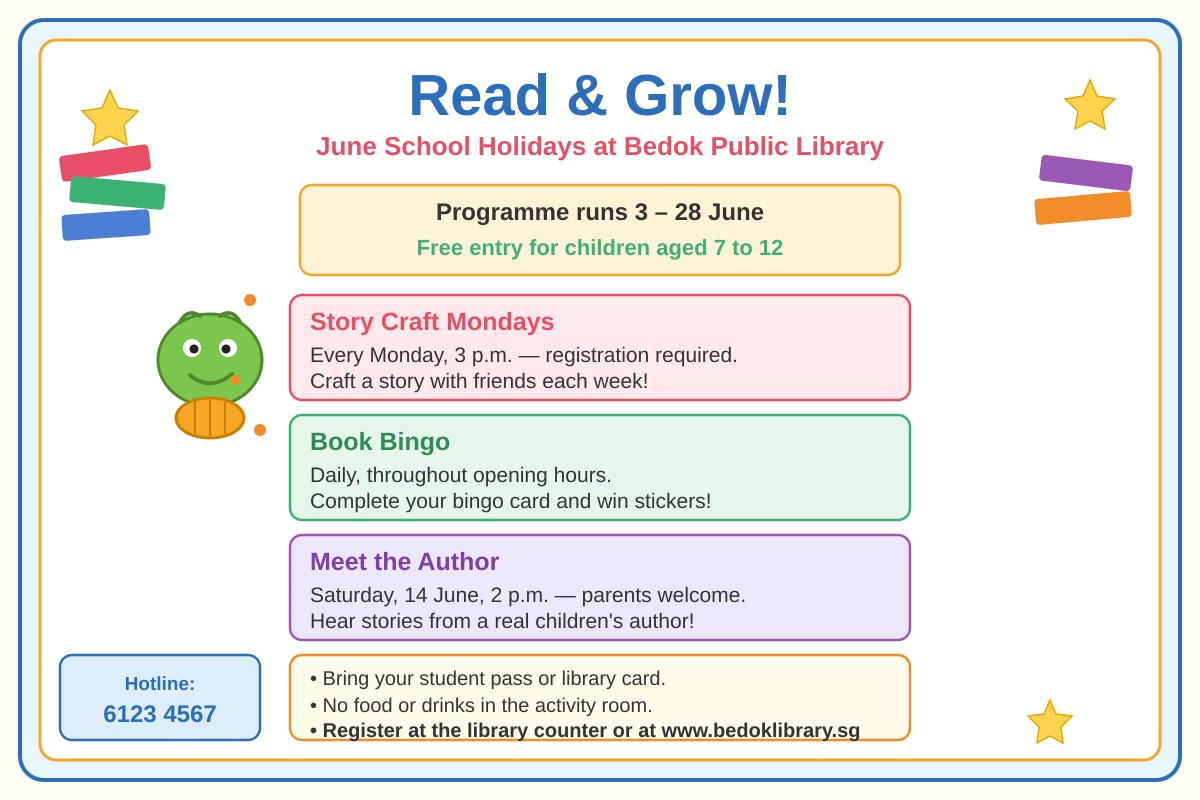
Generated source_image for Q1.
Question 1.
The holiday reading programme is mainly for ______.
(1) toddlers
(2) children aged 7 to 12
(3) teenagers
(4) adults
Ans: ( ________ ) [1]
Question 2.
On which date and at what time will the Meet-the-Author session be held?
Ans: ____________________________________________________________ [1]
Question 3.
What must Mei Ling do before she attends a Story Craft session?
Ans: ____________________________________________________________ [1]
Question 4.
Which statement is true according to the poster?
(1) Only children may attend the Meet-the-Author session.
(2) Participants may eat snacks in the activity room.
(3) It does not cost anything to join the programme.
(4) Book Bingo takes place only on Mondays.
Ans: ( ________ ) [1]
Question 5.
Mr Lim's son will turn 13 in July. He wants to join Book Bingo during the June holidays. Based on the poster, explain whether he may take part.
Ans: ____________________________________________________________
________________________________________________________________ [1]
Section B: Comprehension MCQ (Questions 6-10, 5 marks)
Read the passage below carefully, then answer Questions 6 to 10.
Passage 1: The Bright Red Kite
Amir clutched the string tightly as his bright red kite danced in the wind above Marina Barrage. It was his first time flying a kite, and his grandfather had promised to teach him.
"Keep your eyes on the sky, not on your feet," Grandpa advised with a chuckle. Amir nodded, but soon the wind tugged hard and the kite dived towards a tree. Amir pulled the string in a panic. The kite spun wildly and crashed into the branches.
Amir's shoulders slumped. "I've ruined everything," he muttered.
Grandpa said nothing at first. He walked slowly to a bench, picked up a long pole that a park keeper had left there, and gently lifted the kite free.
"You see," he said, handing the kite back, "rushing makes things worse. Next time, let the wind do the work."
Amir smiled. This time, he waited patiently for a steady breeze before releasing the string. Soon, the red kite was soaring higher than ever.
Question 6.
Why did Amir go to Marina Barrage that day?
(1) To take part in a kite competition.
(2) To learn to fly a kite from his grandfather.
(3) To help the park keeper pick up litter.
(4) To buy a bright red kite.
Ans: ( ________ ) [1]
Question 7.
What happened when the wind tugged hard at the kite?
(1) The string snapped in two.
(2) The kite flew higher than ever.
(3) The kite crashed into a tree.
(4) Grandpa caught the kite in time.
Ans: ( ________ ) [1]
Question 8.
Which word best describes how Amir felt after the kite crashed?
(1) proud
(2) relieved
(3) curious
(4) discouraged
Ans: ( ________ ) [1]
Question 9.
How did Grandpa free the kite from the tree?
(1) He climbed the tree quickly.
(2) He shook the branch until it fell.
(3) He used a long pole to lift it out.
(4) He asked Amir to pull the string harder.
Ans: ( ________ ) [1]
Question 10.
What lesson did Amir learn from the morning?
(1) Flying kites is too difficult for children.
(2) Rushing can make a problem worse.
(3) Park keepers always carry long poles.
(4) Strong winds are dangerous for everyone.
Ans: ( ________ ) [1]
Section C: Comprehension Open-Ended (Questions 11-15, 9 marks)
Read the passage below carefully, then answer Questions 11 to 15 in complete sentences.
Passage 2: Guardians of the Shore
Along some parts of Singapore's coast grow special trees called mangroves. Mangroves are able to live in salty water where most trees would die. Their roots filter out most of the salt, and some types push up pointed roots, known as pneumatophores, to breathe in the waterlogged soil.
Mangroves protect our shores too. During big storms, their thick, tangled roots break the force of the waves before the waves reach the land. Without this natural wall, beaches would wash away much faster and homes near the coast could be flooded.
Mangroves are also busy nurseries for sea life. Tiny fish hide among the roots until they are big enough to swim out to open water. Birds such as kingfishers perch on the branches, hunting for a meal.
Sadly, Singapore had lost many mangrove areas as the country developed. Today, places like Sungei Buloh Wetland Reserve protect the remaining mangroves, and volunteers plant new seedlings so that these quiet guardians will stand watch for many years to come.
Question 11.
According to the passage, where do mangroves grow?
Ans: ____________________________________________________________ [1]
Question 12.
What are pneumatophores, and what do they help mangroves do?
Ans: ____________________________________________________________
________________________________________________________________ [2]
Question 13.
How do mangrove roots protect the shore during big storms? Explain in your own words.
Ans: ____________________________________________________________
________________________________________________________________ [2]
Question 14.
Why does the writer call mangroves "busy nurseries"? Give two pieces of information from the passage.
Ans: ____________________________________________________________
________________________________________________________________ [2]
Question 15.
Explain why the writer describes mangroves as "quiet guardians". Use ideas from the passage in your answer.
Ans: ____________________________________________________________
________________________________________________________________ [2]
Section D: Comprehension Open-Ended (Questions 16-20, 11 marks)
Read the passage below carefully, then answer Questions 16 to 20 in complete sentences.
Passage 3: A Lesson at the Food Bank
Last Saturday, my classmates and I volunteered at a food bank in Jurong. At first, I thought we would simply pack canned food into boxes. I did not expect to learn so much.
Our task was to sort donations. Some cans were dented and some packets had torn wrappers. "We cannot send damaged goods out," Mrs Goh, the manager, explained. "Families deserve food that is safe and whole." I sorted carefully, checking every label for its expiry date.
Then a volunteer showed us a storeroom almost empty of rice and oil. She told us that demand had risen because more families needed help. My cheeks burned as I remembered how I had complained that very week about having the same dinner twice.
Before we left, Mrs Goh thanked us. "Remember," she said kindly, "kindness is not only about giving things away. Giving your time and care matters too." On the bus home, although I had given nothing of my own away, my heart felt full.
Question 16.
Why could the dented cans and torn packets not be sent out? Give a reason from the passage.
Ans: ____________________________________________________________
________________________________________________________________ [2]
Question 17.
Why did the writer's cheeks burn? What does this show about how he felt?
Ans: ____________________________________________________________
________________________________________________________________ [2]
Question 18.
What did Mrs Goh mean when she said, "kindness is not only about giving things away"? Explain in your own words.
Ans: ____________________________________________________________
________________________________________________________________ [3]
Question 19.
Explain why the writer's heart felt full even though he had given nothing of his own away.
Ans: ____________________________________________________________
________________________________________________________________ [2]
Question 20.
What lesson did the writer learn that day? Support your answer with evidence from the passage.
Ans: ____________________________________________________________
________________________________________________________________ [2]