From Real Exams Quiz
Primary 4 English Composition Quiz
Free P4 English Composition quiz, Kimi2.6 Exam version, with questions, answers, and syllabus-aligned practice for Singapore students.
These static practice materials are generated from the site's syllabus and paper-generation workflow, with source and model context shown so students and parents can evaluate the material before use.
Questions
Free quiz and exam paper access
Enter your details to view this paper
Your access is remembered on this device.
Answers
Primary 4 English Quiz — Composition: Answer Key
Total Marks: 20
Section A: Planning and Organisation (1–5)
1. [1 mark] Answer: The setting tells the reader where and when the story happens, which helps create the right atmosphere and makes the story believable.
Teaching note: Setting = place + time. Without a clear setting, readers feel lost. A good setting also helps you choose appropriate details (you wouldn't write about snow in Singapore!).
2. [1 mark] Answer: The conflict / problem / rising action.
Teaching note: Every story needs a problem for the character to solve. This is called the "conflict" or "complication." It makes the reader want to find out what happens. The conflict belongs in the middle of the story, after the introduction.
3. [2 marks — 1 mark each] Possible answers: (i) Add a twist or surprise ending (ii) Show how the character has changed or learned something (iii) Link back to something from the beginning (circular ending) (iv) End with a question or hint of future events (v) Use a memorable final image or line of dialogue
Teaching note: A weak ending just stops the story. A strong ending gives the reader satisfaction or something to think about. The best endings often connect to the story's theme or show character growth.
4. [1 mark] Answer: The writer creates interest by (any one):
- starting with a question/unanswered mystery (will the letter arrive?)
- using sensory detail (rain, watching droplets)
- showing the character's thoughts/wondering
- creating a calm but slightly worried mood
Teaching note: Good story openings hook the reader by making them curious. This opening uses the "mystery" technique—we want to know what letter and why it matters.
5. [1 mark] Possible answers:
- The boy trudged through the puddles, his schoolbag bouncing against his back.
- With a spring in his step, the boy raced towards the school gates.
- The boy dragged his feet, staring at the cracks in the pavement.
Teaching note: "Show, not tell" means using actions, descriptions, and details instead of plain statements. "Walked" is boring because it tells nothing about how he walked or what he felt.
Section B: Character Development (6–10)
6. [1 mark] Answer: B) John clenched his fists and blinked back tears.
Teaching note: This shows feelings through actions (clenched fists, blinked back tears = trying not to cry/angry). A and C tell facts about John. D tells a routine. "Show, not tell" makes characters come alive.
Common mistake: Choosing C because it has details— but "having a dog" doesn't show personality or feelings.
7. [1 mark] Answer: The sentence shows Sarah is uncertain and worried about others' opinions. She wants to tell the truth (good intention) but fears being laughed at (fear of embarrassment). This makes her relatable.
Teaching note: Internal thoughts (direct thoughts or indirect free indirect style) reveal a character's true feelings, which may differ from what they say or do.
8. [1 mark] Possible answers:
- Raj's hands shook as he tightened his swimming goggles.
- Raj kept wiping his palms on his towel and checking the starting block.
- "What if I false start?" Raj wondered, his stomach doing flips.
Teaching note: Show nervousness through physical reactions (shaking, sweating, stomach feelings) or mental worries. Never use the emotion word itself—that's "telling."
Common mistake: Writing "Raj felt nervous" or using adverbs like "Raj walked nervously." Both are telling, not showing.
9. [1 mark] Answer: Dialogue reveals personality through:
- what the character chooses to say (kind? rude? funny?)
- how they say it (word choice, sentence length)
- it makes the character sound real and distinct from others
Teaching note: "I don't care what you think!" sounds different from "Oh my, I do hope I haven't offended anyone." Same situation, completely different personalities shown through speech.
10. [1 mark] Possible answers:
- Her sharp eyes scanned the room, missing nothing.
- She tapped her ruler against her palm, waiting for silence.
- A warm smile crinkled the corners of her eyes.
Teaching note: Character description should reveal personality, not just appearance. "She had grey hair" = boring fact. "Her sharp eyes scanned the room" = strict/observant personality.
Section C: Language and Style (11–15)
11. [1 mark] Answer: "like a bird set free from its cage" (or just identifying "like a bird")
Teaching note: A simile compares two things using "like" or "as." It helps readers picture something unfamiliar (a kite) by connecting it to something familiar (a free bird).
12. [1 mark] Possible answers:
- The wind whispered secrets through the dancing leaves.
- The wind howled and tore at the branches, angry and fierce.
- The wind sighed softly, rocking the trees to sleep.
Teaching note: Personification = giving human qualities to non-human things. "Whispered" "angry" "sighed" are human actions/feelings. Choose a mood that matches the weather you want to describe.
13. [1 mark] Answer: B) My heart hammered against my ribs and my legs froze to the spot.
Teaching note: This is classic "show, not tell"—physical reactions that readers recognise as fear without the word being used. A says "scared" directly (telling). C describes the spider neutrally. D is a general opinion.
14. [2 marks — 1 for identifying error, 1 for correction]
The error: The speech tag "shouted Tom angrily" is split by the dialogue. When a speech tag interrupts dialogue, it should end with a comma, and the second part of dialogue should start lowercase (unless a new sentence).
Corrected sentence:
"Hurry up!" shouted Tom angrily. "We're going to be late!"
OR with a comma splice fix (accept either): "Hurry up," shouted Tom angrily. "We're going to be late!"
Teaching note: Two complete exclamations = separate sentences with the speech tag in between OR use lower case for continuation. The key rule: if the speech tag ends the first bit of dialogue, use comma inside quotes "Hurry up," Tom shouted.
Common mistake: Keeping the comma after "angrily" and lowercase "we're"—this creates a run-together error when both parts are complete sentences.
15. [1 mark] Possible answers:
- The market was busy in the morning, the smell of frying you tiao mixing with fresh curry.
- Vendors shouted prices as the market was busy in the morning.
- The market was busy in the morning, and my sandals stuck to the damp floor.
Teaching note: Sensory details engage one of five senses. Smell and sound are especially powerful for creating atmosphere. Visual details alone ("many people") are weaker.
Section D: Applying Your Skills (16–20)
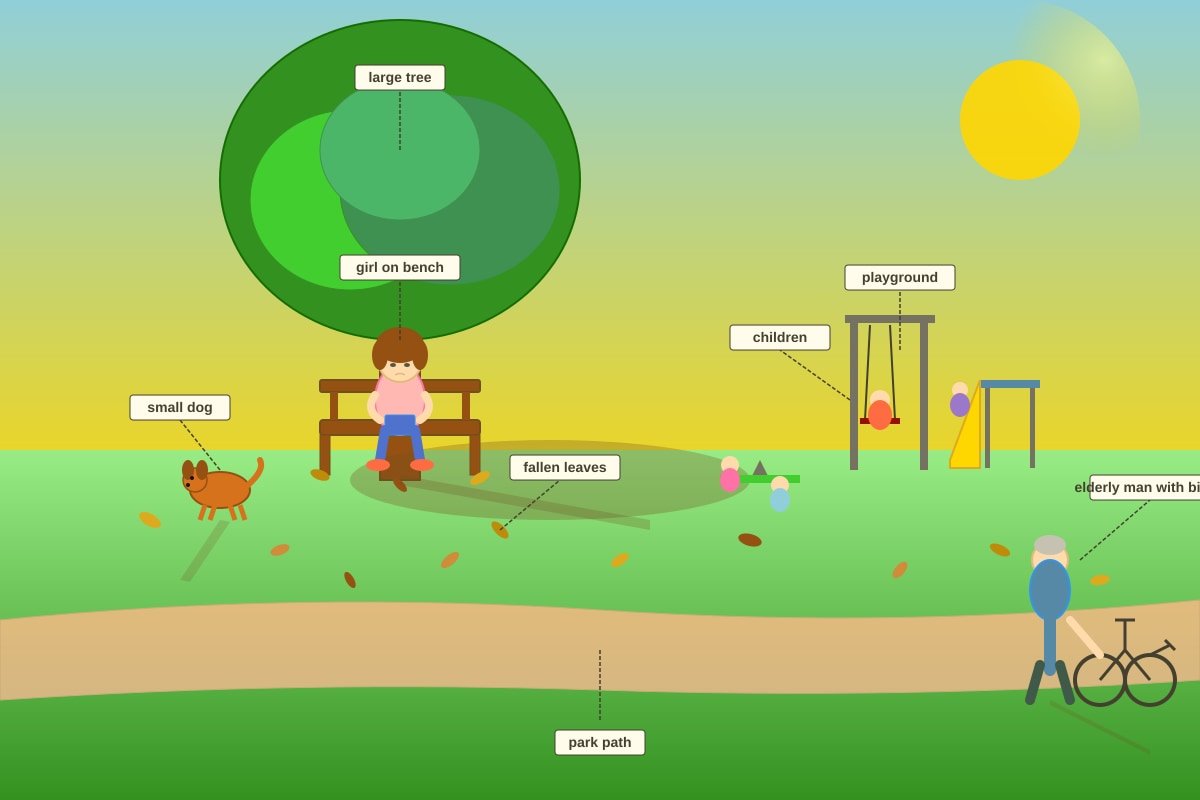
16. [2 marks — 1 each] Possible adjectives: lonely, peaceful, melancholy, hopeful, quiet, isolated, golden, calm, pensive, contemplative, serene
Teaching note: The scene has contrasting moods: the girl seems alone/sad, but the lighting is warm and beautiful. Good answers recognise either mood or the tension between them.
17. [1 mark] Possible inferences based on visual evidence:
- She is waiting for someone who hasn't come
- She has lost or broken something she is holding
- She feels left out while others play at the playground
- She is new to the area and has no friends yet
Teaching note: Picture comprehension requires evidence from the image. Accept any reasonable inference that connects to visible details: her posture (downcast), separation from playground, small object in hands, dog approaching as potential comfort.
18. [1 mark] Possible answers:
- While the elderly man walked steadily onward with his bicycle, the girl sat as if rooted to the bench, the path ahead uncertain.
- The elderly man seemed content with his simple walk, but the girl's stillness suggested a heavier heart.
- Unlike the purposeful stride of the man with his bicycle, the girl had nowhere to go.
Teaching note: Contrast shows difference. The man is moving, purposeful, older but active versus the girl still, passive, young but withdrawn. Effective contrast deepens meaning beyond simple description.
19. [3 marks — 1 per event, must show logical progression]
| Event | What happens |
|---|---|
| Beginning | [1] |
| Middle | [1] |
| End | [1] |
Possible plan:
| Event | What happens |
|---|---|
| Beginning | The girl sits alone with a lost dog collar, sad that her dog ran away |
| Middle | The small dog approaches; she recognises it as hers; they reunite happily |
| End | She thanks the elderly man who found her dog; they walk home together |
Alternative plan:
| Event | What happens |
|---|---|
| Beginning | The girl failed her test and hides in the park, too ashamed to go home |
| Middle | The elderly man notices her distress and shares a story about his own childhood failure |
| End | She realises everyone makes mistakes; she goes home to face her parents |
Teaching note: Events must form a coherent story arc with clear cause-effect. Check: does the middle grow from the beginning? Does the ending resolve the problem?
20. [4 marks]
Marking descriptors:
| Marks | Description |
|---|---|
| 4 | Excellent: clear setting (time/place implied), character introduced with specific detail, strong hook/forward momentum, vivid language with at least one language technique |
| 3 | Good: setting and character present, some sense of what comes next, generally clear writing |
| 2 | Adequate: basic setting and character mentioned, but flat or predictable, weak forward momentum |
| 1 | Limited: unclear setting OR character, little engagement for reader |
| 0 | No relevant content |
Example 4-mark response:
The late afternoon sun stretched long fingers across the empty bench where Mira sat, her sneakers scuffing at the fallen leaves. She cupped the cracked photograph in her palms—herself and Bao, grinning with their arms around the fluffy terrier now missing for three days. A rustle of paws made her look up. A scruffy shape was trotting toward her, something red dangling from its mouth. Mira's heart stumbled. Could it be...?
Teaching note: This paragraph establishes: setting (late afternoon, bench, leaves), character (Mira, sad, looking for lost dog), forward momentum (dog approaching, red object, question). It uses personification ("sun stretched fingers") and shows emotion through action.
Common mistakes to avoid in marking:
- Starting with "One day I was at the park" (too plain, no hook)
- Describing the picture without a story emerging
- No hint of what will happen next
- Overly long description without character focus
[Total: 20 marks]