AI Generated Exam Paper
Primary 4 English Practice Paper 5
Free P4 English Practice Paper 5, Kimi2.6 AI version, with questions, answers, and syllabus-aligned practice for Singapore students.
These static practice materials are generated from the site's syllabus and paper-generation workflow, with source and model context shown so students and parents can evaluate the material before use.
Questions
Free quiz and exam paper access
Enter your details to view this paper
Your access is remembered on this device.
Answers
TuitionGoWhere Practice Paper Answers - English Primary 4
Version: 5 of 5
Subject: English
Level: Primary 4
Paper: Practice Paper
Total Marks: 50
Booklet A: Answers
Section A: Grammar MCQ (10 marks)
| Question | Answer | Explanation |
|---|---|---|
| 1 | (1) waits | Subject-verb agreement with collective nouns. "The group" is a collective noun that can take singular or plural verbs. In Singapore English and formal contexts, "waits" (singular) is preferred when the group acts as a unit. Teaching note: Collective nouns like "team," "class," and "group" usually take singular verbs in standard Singapore English. Common mistake: choosing "wait" because of "pupils" nearby—always identify the actual subject. |
| 2 | (2) nor | Correlative conjunctions. "Neither... nor" is the correct pair. "Neither... or" is grammatically incorrect. Teaching note: Think of these as fixed pairs: neither/nor, either/or, both/and, not only/but also. The subject near "nor" determines the verb in formal usage, but here the test focuses on the conjunction pair itself. |
| 3 | (2) goes | Subject-verb agreement with intervening phrases. The subject is "My sister" (singular), not "her friends." The phrase "together with her friends" is parenthetical. Teaching note: When you see phrases like "together with," "as well as," or "accompanied by," cross them out mentally to find the true subject. The verb must agree with "My sister." |
| 4 | (2) rains | First conditional. "If + simple present, will + base verb." For possible future conditions, use present tense in the if-clause, not future. Teaching note: Never use "will" after "if" in conditional sentences. Common mistake: "If it will rain"—this is never correct in standard conditional structures. |
| 5 | (4) are | Subject-verb agreement with prepositional phrases. The subject is "The books" (plural), not "the shelf." Prepositional phrases ("on the shelf") do not change the number of the subject. Teaching note: Find the subject before any prepositional phrase. "Books" is plural, so choose "are." Common mistake: choosing "is" because of proximity to "shelf." |
| 6 | (2) would | Reported speech with tense backshift. Direct speech "will" becomes "would" in reported speech when the reporting verb ("promised") is past tense. Teaching note: The backshift rule: present tenses → past tenses, will → would, can → could, may → might. Common mistake: keeping "will"—this fails to show the tense shift required by "promised." |
| 7 | (3) cried | Simple past tense consistency. The sentence has "was" (past tense), so the main verb must be past tense too. "Cried" indicates a completed action in the past. Teaching note: Look for time markers and verb clues. "Because she was hungry" establishesthe past time frame. The baby cried (one completed action) because of her state (was hungry). |
| 8 | (3) When | Subordinating conjunctions for time conditions. "When" introduces a time condition: finishing dinner enables the result (having dessert). Teaching note: "Until" suggests waiting; "Unless" suggests exception (negative condition); "Because" suggests cause, but finishing dinner is a time trigger, not a cause. "When" best fits the conditional time relationship. |
| 9 | (2) who | Relative pronouns for people. "Who" is used for people as subjects of relative clauses. "Which" is for things; "whom" is for object position; "whose" shows possession. Teaching note: Test by replacing with "he" or "him." "He won the competition" → subject position → "who." If you can use "he," use "who"; if "him," use "whom." |
| 10 | (3) is | Subject-verb agreement with quantity phrases. "A packet" is singular; the "of biscuits" is a prepositional phrase that does not change the subject's number. Teaching note: The pattern "A [quantity] of [plural noun]" usually takes a singular verb when the quantity word is singular. Compare: "Two packets are empty" vs. "A packet is empty." |
Section A Subtotal: 10 marks
Section B: Vocabulary MCQ (5 marks)
| Question | Answer | Explanation |
|---|---|---|
| 11 | (2) brave | Context clue: positive trait for dangerous action. Firefighters risking their lives to save animals demonstrate courage. "Cowardly" is opposite; "foolish" and "careless" are negative but inappropriate for a heroic act. Teaching note: Read the entire sentence for emotional tone. The context of "entering a burning building" signals bravery, not foolishness. |
| 12 | (2) lower | Context clue: protecting sleeping baby. Lowering volume is the logical action. "Increase" would wake the baby; "maintain" or "ignore" don't solve the problem. Teaching note: Cause-effect reasoning: baby sleeping → need quiet → reduce volume. |
| 13 | (2) trembled | Context clue: old man + fragile object. Trembling suggests shaking from age or nervousness, fitting the careful, delicate action described. "Steadied" contradicts the fragility; "gripped" and "relaxed" don't match the tension of the scene. Teaching note: Clue words: "old," "carefully," "fragile" all suggest unsteadiness and caution. |
| 14 | (2) delicious | Context clue: "made everyone rush to see." An irresistible, appealing smell would draw people. "Unpleasant" would repel; "familiar" or "strange" don't explain the eager reaction. Teaching note: The effect (rushing to see) reveals the cause (attractive smell). This is inferential vocabulary. |
| 15 | (3) solve | Context clue: "before it becomes worse." Problems need solving; delaying (ignore, avoid) or starting (create) worsens the situation. Teaching note: Collocation awareness: "solve a problem" is a fixed English expression. |
Section B Subtotal: 5 marks
Section C: Visual Text Comprehension (5 marks)
| Question | Answer | Explanation |
|---|---|---|
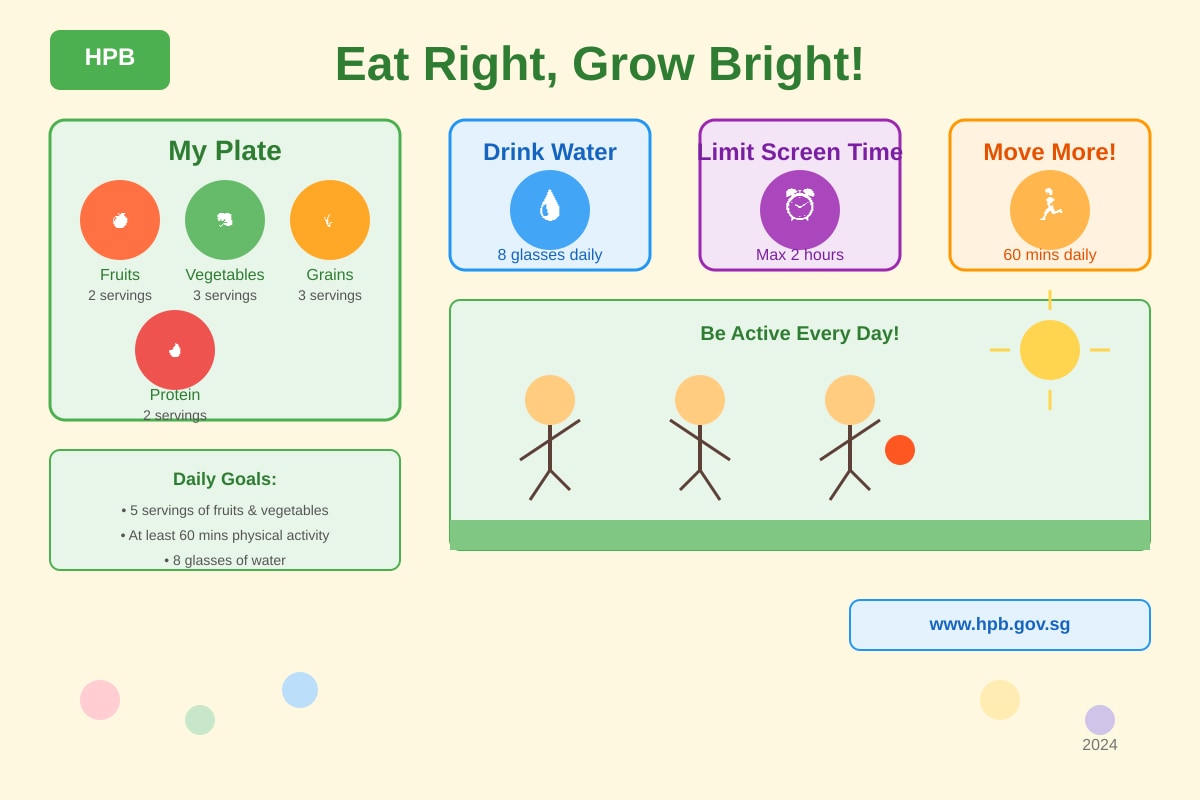
| 16 | (3) 2 hours | Direct visual retrieval from image placeholder. The poster's "Limit Screen Time" section shows a clock with "2 hours" as the maximum recommendation. Teaching note: Visual comprehension requires careful label reading. Do not infer beyond what is shown; match text to exact visual element. |
| 17 | (3) grow up healthy and smart | Inference from slogan wordplay. "Bright" suggests intelligence/smarts; "Grow" suggests healthy development. The slogan connects eating right to overall positive growth. Teaching note: Slogans use figurative language. "Bright" = clever/smart; combined with "grow" = healthy development. Avoid literal interpretations like "taller quickly." |
| 18 | (3) Sleeping eight hours | Verification against image placeholder content. The poster shows: fruits/vegetables (My Plate), water (Drink Water), physical activity (Move More!), screen time limit. Sleep duration is not displayed. Teaching note: For "NOT mentioned" questions, verify each option against the visual systematically. Do not assume common knowledge. |
| 19 | (3) persuade children to adopt healthy habits | Purpose recognition: persuasive poster. Health Promotion Board posters aim to influence behaviour, not sell (1), entertain primarily (2), or teach specific skills like cooking (4). Teaching note: Identify the source (HPB = government health promotion) and genre (poster = persuasive). Common mistake: choosing "teach how to cook" from the food imagery. |
| 20 | (2) Parents and children | Target audience inference. A child-friendly poster about children's health habits with cartoon characters targets both children (primary audience) and parents (who control habits). Teaching note: Consider who can act on the advice: children need parental support for diet and screen time. Restaurant owners (1), athletes (3), and TV producers (4) are not the intended audience. |
Section C Subtotal: 5 marks
Booklet A Total: 20 marks
Booklet B: Answers
Section D: Grammar Cloze (8 marks)
| Question | Answer | Explanation |
|---|---|---|
| 21 | 2 (went) | Simple past tense for completed past event. "Last Saturday" establishes definite past time. The base form "go" and present "goes" are wrong tense; "gone" needs an auxiliary verb. Teaching note: Time markers like "last Saturday," "yesterday," "ago" signal simple past. Common mistake: choosing "go" by not noticing the time marker. |
| 22 | 3 (arrived) | Simple past tense, parallel with "went." Actions in sequence in the same time frame use the same tense. "Arrive" is base form; "arrives" is present; "arriving" needs auxiliary. Teaching note: In narrative sequences, maintain consistent past tense unless there's a reason to shift. |
| 23 | 2 (were) | Subject-verb agreement; plural subject with "there be." "So many different animals" is plural, so "were." "There was" = singular; "is/are" = present tense (wrong time frame). Teaching note: In "there is/are," the real subject follows. Here, "animals" = plural, so "were" (past plural). |
| 24 | 3 (did) | Simple past tense narrative; auxiliary for emphasis or question structure incorrect here—actually simple past of "do tricks." Wait: "did very clever tricks" uses "did" as the past tense of "do." The elephants performed tricks. Teaching note: "Do tricks" is a collocation. Past tense: "did tricks." Common mistake: confusing with auxiliary "did" in questions. |
| 25 | 3 (ate) | Simple past tense for completed meal. After the show → sequence of past events. "Eat/eats" = present; "eaten" needs auxiliary (have eaten). Teaching note: "Have eaten" would be present perfect, but we're in simple past narrative time. |
| 26 | 3 (ordered) | Simple past tense for food order. Parallel with "ate" above. "Order/orders" = present; "ordering" = continuous, needs was/were. Teaching note: Sequence: arrived → saw show → ate lunch → ordered food. All actions in simple past. |
| 27 | 3 (chose) | Simple past tense; irregular verb form. "Choose" → past = "chose" (not "chosed"—no such word). "Choose/chooses" = present; "chosen" = past participle, needs auxiliary. Teaching note: Common irregular verb: choose/chose/chosen. Common mistake: regularising to "choosed." |
| 28 | 3 (tasted) | Simple past tense for sensory experience. Linking verb "taste" describing the food's quality in past time. "Taste/tastes" = present; "tasting" = continuous, needs was/were. Teaching note: Sensory verbs (taste, smell, look, feel, sound) can be linking verbs in simple past: "The food tasted delicious." |
Section D Subtotal: 8 marks
Section E: Sentence Synthesis & Transformation (4 marks)
29. Mrs Tan, who helps everyone in need, is kind. / Mrs Tan is kind and helps everyone in need. → Wait, instruction specifies "using the word who": Mrs Tan, who helps everyone in need, is kind.
Marking scheme [2 marks]:
- [1 mark] Correct relative clause structure with "who" used appropriately
- [1 mark] Meaning preserved; commas correctly placed around non-defining clause (or meaning clear if defining)
Teaching note: "Who" refers to people and acts as subject of the relative clause. The clause "who helps everyone in need" gives extra information about Mrs Tan. Punctuation: commas separate non-defining relative clauses from the main clause. Without commas, it becomes defining (restricting which Mrs Tan), which changes meaning subtly.
30. David told the teacher (that) he had lost his water bottle. / David told the teacher (that) he had lost his water bottle.
Marking scheme [2 marks]:
- [1 mark] Correct reporting verb change ("said to" → "told" or correct structure with "said to")
- [1 mark] Correct tense backshift: "have lost" (present perfect) → "had lost" (past perfect); pronoun "I" → "he"
Teaching note: Two changes required in reported speech: (1) "said to [person]" → "told [person]" (OR keep "said to" but remove quotation marks and add "that"); (2) tense backshift: present perfect → past perfect because reporting is past tense. Pronoun shift: first person "I" → third person "he" to match David. Common mistake: "David said to the teacher that he has lost"—failing to backshift tense.
Section E Subtotal: 4 marks
Section F: Comprehension (12 marks)
31. What did Ravi hear when he was walking home from school? [1 mark]
Answer: He heard a soft whimpering sound (coming from behind a large dustbin).
OR: A soft whimpering sound.
Marking point: [1 mark] for identifying the sound; accept "a puppy whimpering" if implied.
Teaching note: Literal comprehension—direct retrieval from first sentence. "Whimpering" = soft crying sound, usually of animals or young children. The location detail is bonus but not required.
32. How did Ravi try to keep the puppy warm? [1 mark]
Answer: He picked up the puppy and tucked it inside his jacket. / He tucked it inside his jacket to keep it warm.
Marking point: [1 mark] for the specific action of putting the puppy in his jacket.
Teaching note: Literal comprehension with explicit action. "Carefully" and "to keep it warm" are supporting details. Common mistake: answering "he picked it up" only—insufficient, as the warming method was using his jacket.
33. Why was Mrs Kumar initially worried about keeping the puppy? Use your own words. [2 marks]
Answer: Ravi's father / Ravi's dad is allergic to dogs. / Because Ravi's father would have an allergic reaction to the dog.
Marking scheme:
- [1 mark] For identifying father/husband as the reason
- [1 mark] For specifying allergy to dogs/allergic reaction
Teaching note: "Use your own words" allows paraphrase but must preserve meaning. The direct quote: "Your father is allergic to dogs." Students may write "because the dog might make Ravi's father sick"—acceptable if meaning clear. Do not accept merely "because they couldn't keep it" without the allergy reason.
34. What does the word shivering in paragraph 1 tell you about how the puppy felt? [2 marks]
Answer: It tells us the puppy was very cold / freezing / chilled. [1 mark] It also shows the puppy was frightened/scared/afraid. [1 mark]
OR: The puppy was cold and frightened.
Marking scheme:
- [1 mark] Physical state: cold/chilly (from weather and wet fur)
- [1 mark] Emotional state: frightened/afraid/scared (from being lost and alone)
Teaching note: "Shivering" has dual meaning here: physical (cold) and emotional (fear). The context supports both: "rainy afternoon," "cold," "frightened" (stated nearby). Students should infer the puppy's vulnerable state from this descriptive word. Common mistake: only stating "cold" and missing the emotional dimension.
35. Ravi "felt sad but proud" at the end of the story. Why do you think he felt this way? Answer with two reasons, one for "sad" and one for "proud." [2 marks]
Answer:
- Sad: [1 mark] Because he had to say goodbye to Brownie / he could not keep the puppy / he would miss the puppy he had named and cared for.
- Proud: [1 mark] Because he had saved/helped/rescued the puppy / he had done the right thing / the staff thanked him for his kindness / he knew Brownie would get proper care.
Marking scheme: One mark per correctly attributed reason. Must distinguish the two emotions with specific evidence.
Teaching note: "Sad but proud" is a complex emotion requiring balanced interpretation. The conjunction "but" signals contrasting emotions—both genuine. Sadness comes from loss (attachment formed); pride from moral action (doing right despite wanting to keep Brownie). Common mistake: giving two reasons for one emotion only.
36. Do you think Ravi made the right decision? Explain your answer with evidence from the passage. [2 marks]
Answer: Yes, Ravi made the right decision. [1 mark for position] Evidence: His father was allergic to dogs so they couldn't keep it; the shelter would give Brownie proper care and find him a good home; the puppy was hurt and needed medical attention. [1 mark for supporting evidence]
OR: No, with valid reasoning supported by text (accept but evidence must be text-based, e.g., he could have asked a relative first).
Marking scheme:
- [1 mark] Clear position stated (Yes/No with implicit judgment)
- [1 mark] Specific evidence from passage supporting that position
Teaching note: Evaluation question requiring text evidence. The passage clearly supports "Yes"—Ravi's father's allergy and the shelter's proper care are explicit reasons. Students must cite, not just mention, the evidence. "He couldn't keep it" is weak; "his father is allergic to dogs" is specific evidence.
37. What would be a good moral lesson for this story? Give a reason for your choice. [2 marks]
Answer: We should help animals/others in need even if we don't benefit. [1 mark] Reason: Ravi rescued the puppy even though he couldn't keep it and felt sad saying goodbye. [1 mark]
OR: Kindness means doing what's best for others, not what we want. Reason: Ravi wanted to keep Brownie but chose the shelter for Brownie's wellbeing.
OR: Doing the right thing brings pride even when it's hard. Reason: Ravi felt proud despite being sad about giving Brownie away.
Marking scheme:
- [1 mark] General moral lesson stated clearly
- [1 mark] Specific connection to Ravi's actions in the story
Teaching note: Moral lessons should be generalisable beyond the story but grounded in it. Avoid overly specific morals like "Take puppies to SPCA"—this is action, not principle. Good morals address character virtue (kindness, responsibility, selflessness) or decision-making (doing right over wanted). Common mistake: giving a moral without explaining how the story exemplifies it.
Section F Subtotal: 12 marks
Section G: Guided Writing (6 marks)
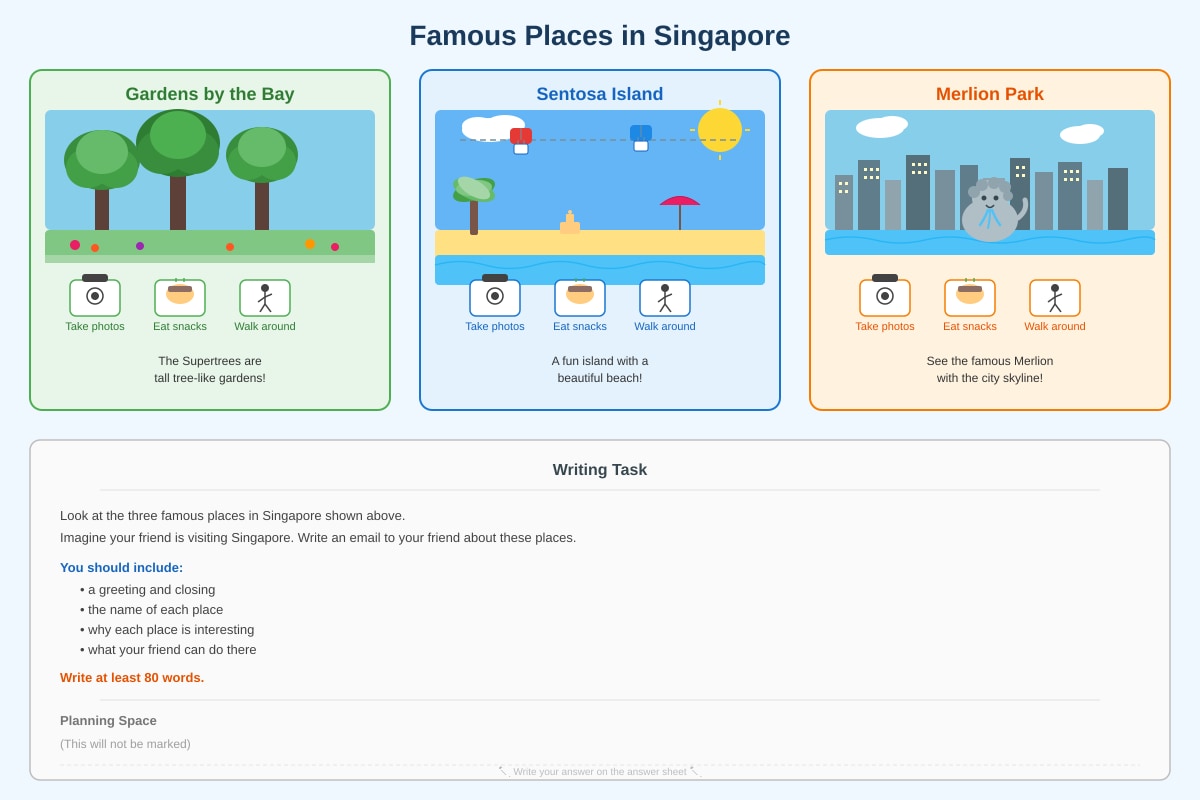
Task: Write an email to a friend about three interesting places to visit in Singapore.
Marking scheme for 6 marks:
| Band | Marks | Descriptors |
|---|---|---|
| Excellent | 5-6 | All 4 bullet points addressed with elaboration; clear greeting and closing; coherent organisation; varied, accurate sentences; at least 80 words. Minor errors do not impede meaning. |
| Good | 3-4 | 3 bullet points addressed; greeting and closing present; mostly coherent; adequate vocabulary; 60-79 words or slightly underdeveloped content. Some errors but meaning clear. |
| Developing | 1-2 | 1-2 bullet points addressed; greeting or closing missing or inappropriate; simple sentences; organisation weak; under 60 words; frequent errors impeding meaning. |
| Insufficient | 0 | Not attempted, irrelevant, or copied from question; no discernible email format. |
Content points to award (1 mark each, max 4):
- [1 mark] Greeting and closing appropriate for email to friend
- [1 mark] Place 1 named + why interesting + what to do
- [1 mark] Place 2 named + why interesting + what to do
- [1 mark] Place 3 named + why interesting + what to do
Language points (0-2 marks):
- [2 marks] Generally accurate grammar, spelling, punctuation; varied sentence structures
- [1 mark] Frequent errors but meaning mostly clear; simple sentence patterns
- [0 marks] Errors impede understanding; very limited language
Suggested response structure:
Dear [Friend's name],

How are you? I am excited that you are coming to Singapore! Let me tell you about three interesting places to visit.

First, you should go to Gardens by the Bay. It is amazing because there are huge Supertrees that light up at night. You can walk on the Skyway to see the city from high up. The Flower Dome and Cloud Forest are also very beautiful.

Next, Sentosa Island is great for fun. You can swim at the beach, ride the cable car, or visit Universal Studios. There are many exciting rides and shows for everyone.

Finally, visit Merlion Park to see the famous Merlion statue. It is Singapore's symbol and you can take nice photos with the city skyline behind you.

I hope you will enjoy visiting these places. Write to me soon!

Your friend,
[Name]
Teaching note: The planning space allows students to organise before writing—emphasise using it. Email format: clear subject line optional, greeting essential, body paragraphs for each place, closing with signature. Each place needs three elements: name, reason for interest, and activity. Common mistakes: forgetting greeting/closing, listing places without explanation, writing letter instead of email format, under length.
Section G Subtotal: 6 marks
Summary of Marks
| Section | Marks |
|---|---|
| Booklet A | |
| Section A: Grammar MCQ | 10 |
| Section B: Vocabulary MCQ | 5 |
| Section C: Visual Text | 5 |
| Booklet A Total | 20 |
| Booklet B | |
| Section D: Grammar Cloze | 8 |
| Section E: Sentence Synthesis | 4 |
| Section F: Comprehension | 12 |
| Section G: Guided Writing | 6 |
| Booklet B Total | 30 |
| GRAND TOTAL | 50 |