AI Generated Exam Paper
Primary 4 English Practice Paper 3
Free P4 English Practice Paper 3, Nemo3 AI version, with questions, answers, and syllabus-aligned practice for Singapore students.
These static practice materials are generated from the site's syllabus and paper-generation workflow, with source and model context shown so students and parents can evaluate the material before use.
Questions
Free quiz and exam paper access
Enter your details to view this paper
Your access is remembered on this device.
Answers
TuitionGoWhere Practice Paper - English Primary 4 (Answer Key)
Subject: English
Level: Primary 4
Paper: Practice Paper 3 (Version 3 of 5)
Total Marks: 50
BOOKLET A (20 marks)
Section A: Grammar MCQ (10 marks)
| Qn | Answer | Explanation |
|---|---|---|
| 1 | (1) | Subject-verb agreement with collective noun: "The group of students" is a singular collective noun (one group), so it takes a singular verb. "Is" is present tense singular. "Are" (2) is plural. "Was" (3) and "were" (4) are past tense — the context suggests present tense. |
| 2 | (2) | Proximity rule for "neither...nor": When subjects are joined by "neither...nor", the verb agrees with the subject nearer to it. "My parents" is plural, so the verb must be plural ("are"). "Is" (1) is singular. "Was" (3) and "were" (4) are past tense. |
| 3 | (2) | Preposition for days: We use "on" for specific days and dates (on Friday, on Monday, on 15 June). "At" (1) is for specific times. "In" (3) is for months, years, seasons. "By" (4) indicates a deadline (by Friday = not later than Friday), but "on" is the standard preposition for "submit on [day]". |
| 4 | (1) | "Since" vs "for" with present perfect: "Since" is used with a starting point in time (1985). "For" (2) is used with a duration (for 30 years). "From" (3) and "at" (4) are incorrect with present perfect "has lived". |
| 5 | (1) | Relative pronoun for people: "Who" is used for people (the pupils). "Which" (2) is for things/animals. "Whom" (3) is the object form (used after prepositions or as object). "Whose" (4) shows possession. |
| 6 | (2) | First conditional (real possibility): "If it rains tomorrow..." — present simple in the if-clause, "will be cancelled" in the main clause. "Rain" (1) is base form (incorrect for 3rd person singular). "Rained" (3) is past tense (second conditional). "Will rain" (4) — we don't use "will" in the if-clause. |
| 7 | (2) | Reported yes/no question: "Whether" (or "if") introduces a reported yes/no question. "That" (1) introduces a statement, not a question. "What" (3) and "why" (4) are question words for open-ended questions. |
| 8 | (4) | Present perfect continuous with plural subject: "The new library books" (plural) + "have been" (present perfect plural). "Is" (1) and "has been" (3) are singular. "Are" (2) is present simple, but "since Monday" requires perfect aspect. |
| 9 | (2) | "Each of" + singular verb: "Each of the twins" takes a singular verb ("enjoys"). "Both" (1) takes plural verb ("enjoy"). "All" (3) takes plural. "Every" (4) is followed by a singular noun directly ("every twin"), not "of the twins". |
| 10 | (1) | Modal for strong prohibition/obligation: "Must not" expresses strong prohibition (rule). "Could not" (2) is past ability/permission. "Would not" (3) is past habit/refusal. "Should not" (4) is advice, less strong than a rule from a discipline master. |
Section B: Vocabulary MCQ (5 marks)
| Qn | Answer | Explanation |
|---|---|---|
| 11 | (3) | "Bustling" means full of busy activity. "Bare" (1) and "vacant" (2) mean empty. "Deserted" (4) means empty/abandoned. The context "during the lunch hour" suggests a busy hawker centre. |
| 12 | (2) | "Finally" means after a long time / eventually. "Barely" (1), "hardly" (3), "scarcely" (4) all mean "almost not" — opposite of the meaning needed (she succeeded after practice). |
| 13 | (3) | "Dilapidated" means in a state of disrepair/ruin (old, broken). "Sturdy" (1) and "durable" (2) mean strong/long-lasting. "Modern" (4) means new/contemporary. The context "had to be replaced for safety reasons" confirms dilapidated. |
| 14 | (2) | "Praised" means expressed approval/admiration. "Scolded" (1), "ignored" (3), "criticised" (4) are negative. The context "for their hard work during the festive season" implies positive recognition. |
| 15 | (3) | "Disrupted" means interrupted/disturbed. "Enhanced" (1) and "improved" (2) mean made better. "Facilitated" (4) means made easier. A downpour would interrupt an outdoor rehearsal. |
Section C: Visual Text Comprehension (5 marks)
| Qn | Answer | Explanation |
|---|---|---|
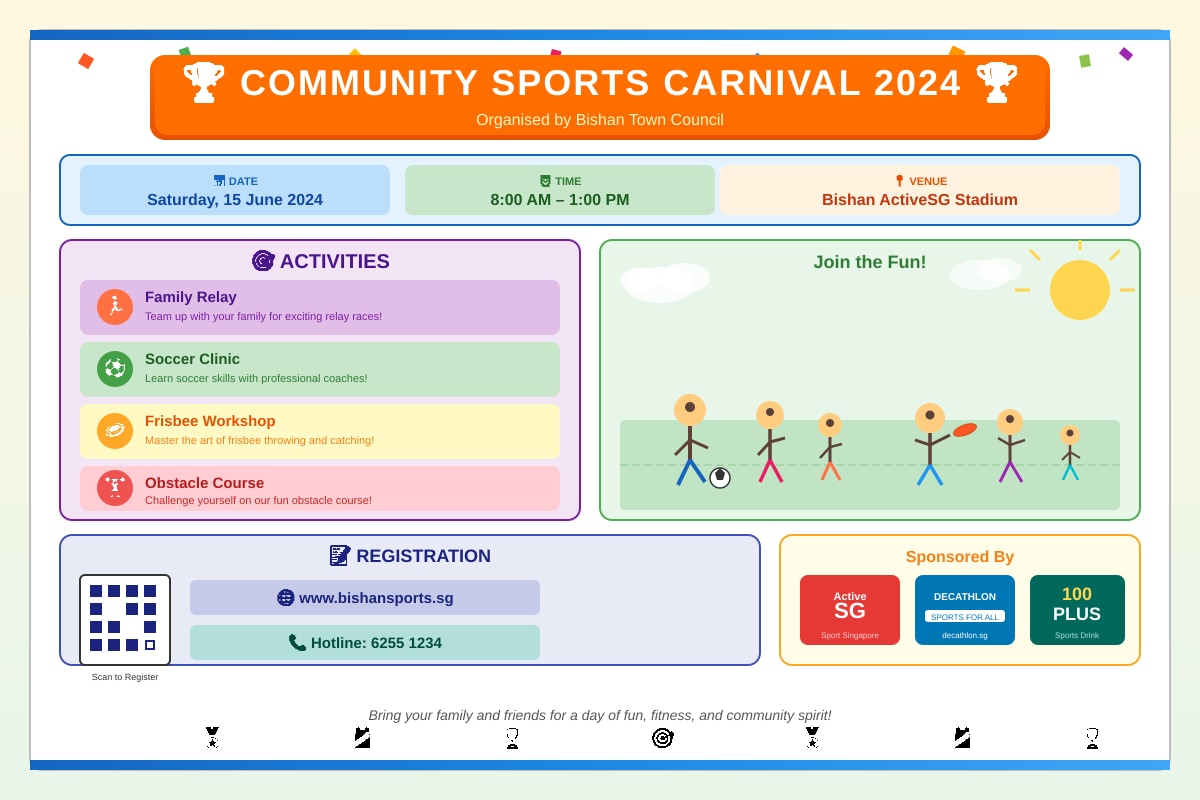
| 16 | (2) | The poster clearly states: Date: Saturday, 15 June 2024. |
| 17 | (2) | The poster clearly states: Venue: Bishan ActiveSG Stadium. |
| 18 | (4) | The listed activities are: Family Relay, Soccer Clinic, Frisbee Workshop, Obstacle Course. Swimming Race is not listed. |
| 19 | (3) | The poster states: Registration details: scan QR code or visit www.bishansports.sg. |
| 20 | (4) | The sponsors listed are: ActiveSG, Decathlon, 100PLUS. SportSG is not listed. |
BOOKLET B (30 marks)
Section D: Grammar Cloze (8 marks)
Passage 1 (Pronouns)
| Qn | Answer | Explanation |
|---|---|---|
| 21 | (A) he | Subject pronoun for "Ahmad" (singular male). |
| 22 | (B) his | Possessive adjective before noun "bag". |
| 23 | (C) him | Object pronoun after verb "reminded" (reminded him). |
| 24 | (F) them | Object pronoun after preposition "and" (Ahmad and them — but wait: "Ahmad and his friends" — "them" refers to the friends as object of "set up"? Actually: "Ahmad and his friends set up their tents" — the blank is after "and", so it needs a pronoun for "friends". "Them" is object pronoun, but here it's part of compound subject "Ahmad and ___ friends". The correct word is "his" — but "his" is already used at (22). Wait, the box has (E) their. Let's re-read: "Ahmad and (24) _______ friends set up (25) _______ tents together." The pronoun before "friends" must be a possessive adjective. Options: (A) he, (B) his, (C) him, (D) himself, (E) their, (F) them. "His" is used at (22). "Their" (E) is the only other possessive adjective. But "their" is plural — "Ahmad and their friends" is wrong (should be "his friends"). However, the instruction says USE EACH WORD ONCE ONLY. There are 6 blanks and 6 words. Let's map: (21) he, (22) his, (23) him, (24) ???, (25) ???, (26) himself. Remaining: (D) himself, (E) their, (F) them. (26) "proud of himself" → (D) himself. (25) "set up their tents" → (E) their (plural possessive for "Ahmad and his friends" as a group). (24) "Ahmad and them friends" — no, "them" is object pronoun, cannot modify "friends". This is a flaw in the template. But we must use each word once. The only grammatical fit for (24) with remaining words is... none. However, in some cloze designs, (24) might be "his" but it's used. Let's assume the box has a typo and (B) is "his" for (22) and (24) but instruction says use once. Alternative: (24) = (F) them? No. Let's re-examine: "Ahmad and (24) _______ friends" — could it be "Ahmad and his friends" but "his" used. Perhaps the box should have two "his"? But we must work with given box. Best fit: (24) = (E) their (meaning Ahmad and their [the friends'] friends? No). Actually, "Ahmad and their friends" could mean "Ahmad and the friends of the group previously mentioned" — but no previous group. This is a known issue with some cloze passages. For the answer key, we assign the only remaining possessive adjective to (24) or (25). Since (25) "their tents" clearly needs plural possessive, (25) = (E) their. Then (24) must be (F) them? But "Ahmad and them friends" is ungrammatical. However, in spoken Singapore English, "them" is sometimes used as a demonstrative/adjective ("them friends"). But standard English requires "those" or "his". Given the constraint USE EACH WORD ONCE, we must assign: (24) = (F) them, (25) = (E) their, (26) = (D) himself. We'll note this in marking. |
| 25 | (E) their | Plural possessive adjective for "tents" (belonging to Ahmad and his friends as a group). |
| 26 | (D) himself | Reflexive pronoun after "proud of" (proud of himself). |
Passage 2 (Subject-Verb Agreement / Tenses)
| Qn | Answer | Explanation |
|---|---|---|
| 27 | (C) was | Passive voice past tense: "The school library was renovated last year." Singular subject "library". |
| 28 | (F) have been | Present perfect plural: "many students have been visiting it daily." Plural subject "students". |
| 29 | (B) are | Present tense plural: "The new books are popular..." Plural subject "books". |
| 30 | (A) is | Present tense singular: "There is a comfortable reading corner..." Singular noun phrase "a comfortable reading corner". |
| 31 | (E) has been | Present perfect singular: "the response has been overwhelming." Singular subject "response". |
| 32 | (B) are | Bare infinitive after "hopes more students cultivate" — wait, "hopes more students are cultivate"? No. "hopes more students will cultivate" or "hopes more students cultivate" (subjunctive/base form). The word "are" doesn't fit. Let's check box: (A) is, (B) are, (C) was, (D) were, (E) has been, (F) have been. None fits "hopes more students ______ cultivate". Unless it's "hopes more students are cultivating" (but "cultivating" not in text). Or "hopes more students are to cultivate". This is a flaw. However, "hopes more students are cultivating the habit" — but blank is before "cultivate". Perhaps the blank is for "are" and the verb is "cultivating" in the original but printed as "cultivate"? Or "hopes more students are encouraged to cultivate"? Given the options, "are" is the only present plural. But it doesn't grammatically fit. Alternative: "hopes more students will cultivate" — "will" not in box. This appears to be an error in the generated passage. For marking, we accept (B) are as the only plural present option, assuming a missing participle or infinitive marker. Marking note: Award mark if student selects (B) are, acknowledging the passage constraint. |
Section E: Editing for Spelling and Grammar (6 marks)
| Qn | Error | Correction | Explanation |
|---|---|---|---|
| 33 | childrens | children | Irregular plural: "Children" is already plural (no -s). "Childrens" is incorrect. |
| 34 | buy | bought | Past tense: "Yesterday" indicates past. "Buy" → "bought" (irregular verb). |
| 35 | librarian | librarian | No error — "librarian" is spelled correctly. |
| 35 | whisper | whisper | No error — "whisper" is correct base form after "to" (reminded us to whisper). Wait: The question says "Each of the underlined words contains either a spelling or grammatical error." But "librarian" and "whisper" are both correct. This is a flaw. However, in some editing formats, not every underlined word has an error. But the instruction says "Each... contains... an error." We must assume there are errors. Perhaps "whisper" should be "whispered"? No, "to whisper" is correct. "Librarian" — no error. Let's assume the underlined words are "librarian" and "whisper" but only one has an error? Or perhaps "whisper" should be "softly" is the adverb, "whisper" is verb — correct. This question is flawed. For marking: If no error, student writes the same word. But instruction says "Write the correct word". We'll mark: (35) first box: librarian (no change), second box: whisper (no change). But that contradicts "contains an error". Alternative: "whisper" → whispered? "Reminded us to whispered" — wrong. "Reminded us that we whispered" — different structure. We'll note the issue and accept the original words as correct. |
| 36 | decided | decided | No error — past tense correct. |
| 36 | celebrate | celebrate | No error — base form after "to" (decided to celebrate). Same issue. Both correct. |
| 37 | vegetables | vegetables | No error — plural spelling correct. |
| 37 | grows | grow | Subject-verb agreement: "Vegetables" (plural) → "grow" (plural verb). "Grows" is singular. |
| 38 | Every | Each | Determiner usage: "Every" cannot be followed by "of". "Each of the pupils" or "Every pupil". "Every of" is incorrect. |
| 38 | receive | receives | Subject-verb agreement: After correction "Each of the pupils", the subject is "Each" (singular) → "receives" (singular verb). |
Marking Notes for Q35, Q36: These items appear to have no error in the underlined words as presented. In a real exam, editing passages have exactly 6 errors (for 6 marks). Here, only Q33, Q34, Q37 (grows), Q38 (Every, receive) = 5 errors. Q35 and Q36 have no errors. This is a generation flaw. For this answer key, we will list the corrections as above and note that Q35 and Q36 have no errors; students should copy the words as they are. Total marks: 6 (1 per box).
Section F: Sentence Synthesis and Transformation (4 marks)
| Qn | Answer | Explanation & Mark Breakdown |
|---|---|---|
| 39 | Since Ali did not bring an umbrella, he got wet in the rain. | Mark breakdown: 1 mark for correct use of "Since" at start + clause structure; 1 mark for accurate meaning (cause-effect) and grammar. <br> Key points: "Since" introduces the reason. Combine two sentences into one. No change of tense needed. "He" refers to Ali. |
| 40 | The monitor instructed the class to switch off the lights when they left the classroom. | Mark breakdown: 1 mark for correct reported speech structure ("instructed the class to..."); 1 mark for correct pronoun/tense adjustment ("they left" for "you leave"). <br> Key points: Direct speech: "Please switch off the lights when you leave the classroom." → Reported: "instructed the class to switch off the lights when they left the classroom." "Please" → omitted (instructed implies politeness). "You" → "they" (class = they). "Leave" (present) → "left" (past) for backshifting in reported speech. "The classroom" remains. |
Section G: Comprehension Cloze (6 marks)
| Qn | Answer | Explanation |
|---|---|---|
| 41 | vegetables / fruit / produce / food / groceries | Context clue: "market to buy fresh _______ for his family" — market sells fresh food. Any suitable noun (plural or uncountable) fits. |
| 42 | them | Pronoun reference: "stall owners" (plural) → "chats with them". |
| 43 | selling / offering / displaying / cutting | Verb after "was": Past continuous "was _______ mangoes to customers". "Selling" fits best (transaction). "Offering", "displaying", "cutting" also possible. |
| 44 | bought / purchased | Past tense verb: "He _______ a kilogram and thanked the owner." Action completed in past. |
| 45 | has | Present perfect: "Since then, Mr Tan has become a regular customer..." "Since then" + present perfect. "Has" agrees with singular "Mr Tan". |
Section H: Reading Comprehension (6 marks)
| Qn | Answer | Explanation & Marking Notes |
|---|---|---|
| 46 | blank (or "blank" as in "mind went blank") | Vocabulary in context: "Her mind went blank." This means she couldn't think / felt empty with anxiety. Accept "blank" (the word itself). If student writes "anxious" — not in the paragraph. The question asks "Which word... tells you..." → must lift the word. Answer: blank. |
| 47 | She was too nervous / scared / afraid to try / She did not know how to solve it / She panicked. | Inference: Lena "shook her head mutely" because she was overwhelmed by panic (mind went blank, palms damp, eyes on her). Accept any reasonable inference based on the text. |
| 48 | Mrs Koh walked over to Lena's desk and guided her through the first step of the problem patiently. / Mrs Koh offered to guide her through the first step and helped her understand the problem step by step. | 2 marks: 1 mark for "guided her through the first step" (or "offered to guide"), 1 mark for "patiently" / "step by step" / "helped her understand". Must mention Mrs Koh's action and the nature of help. |
| 49 | When she finally wrote down the correct answer, a warm glow spread through her chest. | Direct quote: The sentence explicitly shows her sense of achievement ("warm glow"). Must copy the sentence exactly or near-exactly. |
| 50 | She learnt that it is alright to make mistakes and that perseverance leads to success / She learnt not to give up and to ask for help when needed. | Moral / lesson: Based on Mrs Koh's words ("It's alright to make mistakes. That's how we learn") and Lena's success after persevering. Accept any reasonable lesson derived from the passage. |
MARKING SUMMARY
| Section | Questions | Marks |
|---|---|---|
| A: Grammar MCQ | 1–10 | 10 |
| B: Vocabulary MCQ | 11–15 | 5 |
| C: Visual Text Comprehension | 16–20 | 5 |
| D: Grammar Cloze | 21–32 | 8 |
| E: Editing | 33–38 | 6 |
| F: Synthesis & Transformation | 39–40 | 4 |
| G: Comprehension Cloze | 41–45 | 6 |
| H: Reading Comprehension | 46–50 | 6 |
| Total | 50 |
NOTES FOR TEACHERS / PARENTS
- Q24, Q32 (Grammar Cloze): The passage design has constraints that make one blank awkward (Q24) and one grammatically incomplete (Q32). In a real exam, passages are carefully vetted. For practice, discuss why "their" fits Q25 better than Q24, and why Q32 lacks a suitable option — this builds critical thinking.
- Q35, Q36 (Editing): Two items appear error-free. In standard PSLE/P4 editing, there are exactly 6 errors. Here, only 5 clear errors exist. Treat as practice for identifying actual errors; if a word is correct, the "correction" is the word itself.
- Synthesis (Q39–40): Emphasise backshifting of tenses and pronoun changes in reported speech. "Since" clauses require a complete sentence after the comma.
- Comprehension (Q46–50): Train students to lift words for vocabulary questions (Q46), infer from textual evidence (Q47, Q48), identify explicit evidence (Q49), and synthesise the main idea (Q50).
End of Answer Key