AI Generated Exam Paper
Primary 4 English Practice Paper 2
Free P4 English Practice Paper 2, Kimi2.6 AI version, with questions, answers, and syllabus-aligned practice for Singapore students.
These static practice materials are generated from the site's syllabus and paper-generation workflow, with source and model context shown so students and parents can evaluate the material before use.
Questions
Free quiz and exam paper access
Enter your details to view this paper
Your access is remembered on this device.
Answers
TuitionGoWhere Practice Paper - English Primary 4: Answer Key
Version 2 of 5 | Total Marks: 50
Section A: Grammar Multiple Choice (Questions 1–10)
| Question | Answer | Explanation |
|---|---|---|
| 1 | (2) are waiting | The subject is "The group of pupils." In Singapore English and standard British grammar, collective nouns with "of + plural noun" typically take plural verbs when the emphasis is on the individual members. The pupils are acting individually (waiting excitedly), so "are waiting" is correct. Common mistake: Choosing "is waiting"—this would only work if emphasizing the group as a single unit. |
| 2 | (2) nor | "Neither" must pair with "nor" in correlative conjunctions. The pattern is "neither...nor..." to show that both options are negative. Common mistake: "Or" is used with "either," not "neither." |
| 3 | (4) has lived | "For twenty years" indicates duration from the past continuing to a recent point in time (she just moved last month). Present perfect "has lived" shows this continuing connection. "Lived" (simple past) would work but loses the sense of duration; "has lived" is more precise. |
| 4 | (1) rains | First conditional: If + present simple, will + base verb. The condition is real/possible (weather forecast). "Rains" is correct for third-person singular present. Common mistake: "Will rain"—do not use "will" in the if-clause of first conditional. |
| 5 | (2) were | The grammatical subject is "The books" (plural), not "the shelf." Prepositional phrases starting with "on/upon/beside" do not change subject number. "Were borrowed" is passive voice plural past tense. |
| 6 | (1) take off | Imperative mood: base verb form after "Please." The mother is giving a direct command/instruction. Common mistake: "Takes off" would need a subject like "he/she"; "taking off" would need "is/was"; "took off" is past tense, inappropriate for an immediate command. |
| 7 | (1) When | "When" introduces a time condition: after homework completion, television is permitted. The logical relationship is sequential/time-based. "Unless" would mean "if not," creating opposite meaning. "Although" and "Because" create illogical relationships. |
| 8 | (3) to | "Cling to" is a phrasal verb/idiomatic preposition pairing. Some verbs require specific prepositions that must be memorised. Other examples: depend on, agree with, listen to, look at. |
| 9 | (2) had | Past perfect "had left" shows the train departed before another past action ("reached"). This is the "past of the past"—necessary when two past actions occur, with one clearly earlier. Common mistake: "Has left" would be present perfect, mixing tenses illogically. |
| 10 | (2) wears | "Each of + plural noun/pronoun" takes a singular verb. The subject is "Each" (singular), not "dancers." This is a classic subject-verb agreement trap. Common mistake: "Wear"—students see "dancers" and choose plural, forgetting "Each" is the grammatical subject. |
Section A Total: 10 marks
Section B: Grammar Cloze (Questions 11–18)
| Question | Answer | Explanation |
|---|---|---|
| 11 | which | Non-defining relative clause for things/places (the Singapore Zoo). "Which" introduces extra information about the zoo. Commas separate non-defining clauses. Cannot use "that" after comma in non-defining clauses (though this distinction is often less strict in Singapore usage, "which" is the formally correct choice here). |
| 12 | whose | Possessive relative pronoun showing the guide possesses the name Mr. Tan. "Whose" can refer to people or things (unlike "who/whom" which are purely for people, non-possessive). |
| 13 | where | Relative adverb for place. The antecedent is "enclosure" (a place/location). "Where" replaces "in which"—we watched the orangutans in/at the enclosure. |
| 14 | who | Defining relative clause for people (subject position). The young orangutan performs the action ("was learning"). "Who" is subject relative pronoun for animate nouns. |
| 15 | because | Subordinating conjunction showing cause and effect. Mr. Tan explains the reason (deforestation) for the animals' endangered status. Alternative: "that" would also work if treating this as a noun clause, but "because" makes the causal logic explicit. |
| 16 | Although | Concessive conjunction showing contrast between heat (expected to stop activity) and continued exploration (unexpected persistence). Note capitalisation at sentence start. Alternative: "Though" also acceptable. Not: "Despite" (requires noun/gerund, not full clause). |
| 17 | where | Relative adverb for place. The antecedent is "the food court" (a location). We had ice kachang at the food court. |
| 18 | because | Subordinating conjunction showing reason/cause. The day is memorable for the reason that it was his first close encounter with orangutans. Alternative: "as" or "since" (more formal synonyms). |
Section B Total: 8 marks
Section C: Sentence Transformation (Questions 19–22)
| Question | Model Answer | Marking Notes |
|---|---|---|
| 19 | Jane promised her classmate that she would help her with her Science project the next day. | 2 marks: Correct reporting verb structure "promised...that" (0.5); backshift of tense "will→would" (0.5); pronoun shift "I→she" and "you→her classmate→her" (0.5); time expression "tomorrow→the next day" (0.5). Common mistake: Keeping "tomorrow" in reported speech, or failing to shift "will" to "would promised." |
| 20 | The classroom floor was swept by the cleaner. | 2 marks: Correct passive auxiliary "was + past participle swept" (1); by-agent included correctly "by the cleaner" (0.5); object becomes subject "The classroom floor" (0.5). Alternative: "The floor of the classroom was swept by the cleaner." Common mistake: "The cleaner was swept by the classroom floor" (wrong subject-object reversal). |
| 21 | Despite feeling unwell, Mei Ling still attended the concert. OR Despite the fact that Mei Ling was feeling unwell, she still attended the concert. | 2 marks: "Despite" must be followed by noun/gerund phrase, not full clause (unless using "the fact that" construction). "Feeling unwell" = gerund phrase (1); main clause retained correctly (1). Common mistake: "Despite she was feeling unwell"—incorrect because "despite" cannot introduce a finite clause directly. Alternative accepted: "In spite of feeling unwell..." |
| 22 | I did not study harder, so I did not pass the examination. OR I did not study harder; therefore, I did not pass the examination. | 2 marks: Correct negation of condition "did not study" (1); correct negation of result "did not pass" (1); appropriate conjunction showing consequence. Alternative: "I did not study harder, and as a result, I failed the examination." Common mistake: "I did not study harder, so I would not pass"—keeping conditional "would" when simple past is needed for factual restatement. |
Section C Total: 8 marks
Section D: Editing for Grammar (Questions 23–26)
| Question | Error Location | Correction | Explanation |
|---|---|---|---|
| 23 | "my brother and I wants nasi lemak" | wanted | Subject-verb agreement with compound subject. "My brother and I" = plural subject (two people). Past tense narrative context requires "wanted," not "wants" (present tense). Common mistake: Students see "I" and think singular, or don't recognise compound subjects as plural. |
| 24 | "My mother... choose a bowl of fish porridge" | chose | Simple past tense irregular verb. "Choose" is present; "chose" is past; "chosen" is past participle. The passage narrates past events. Pattern reminder: choose/chose/chosen (like freeze/froze/frozen). |
| 25 | "we was eating" | were | Subject-verb agreement: "we" is first person plural, requiring "were" not "was." Past continuous tense. Common mistake: Singular "was" sometimes overgeneralised in vernacular Singapore English; standard English requires plural agreement. |
| 26 | "he felt sadly for the uncle" | sad | Predicate adjective after linking verb "felt." Adjectives describe subject state; adverbs describe verb manner. "Felt sadly" would mean his feeling-action was performed sadly, not that he experienced sadness. Rule: linking verbs (be, seem, become, feel, look) take adjectives, not adverbs. |
Section D Total: 8 marks
Section E: Visual Text and Grammar Application (Questions 27–30)
| Question | Answer | Marks | Explanation |
|---|---|---|---|
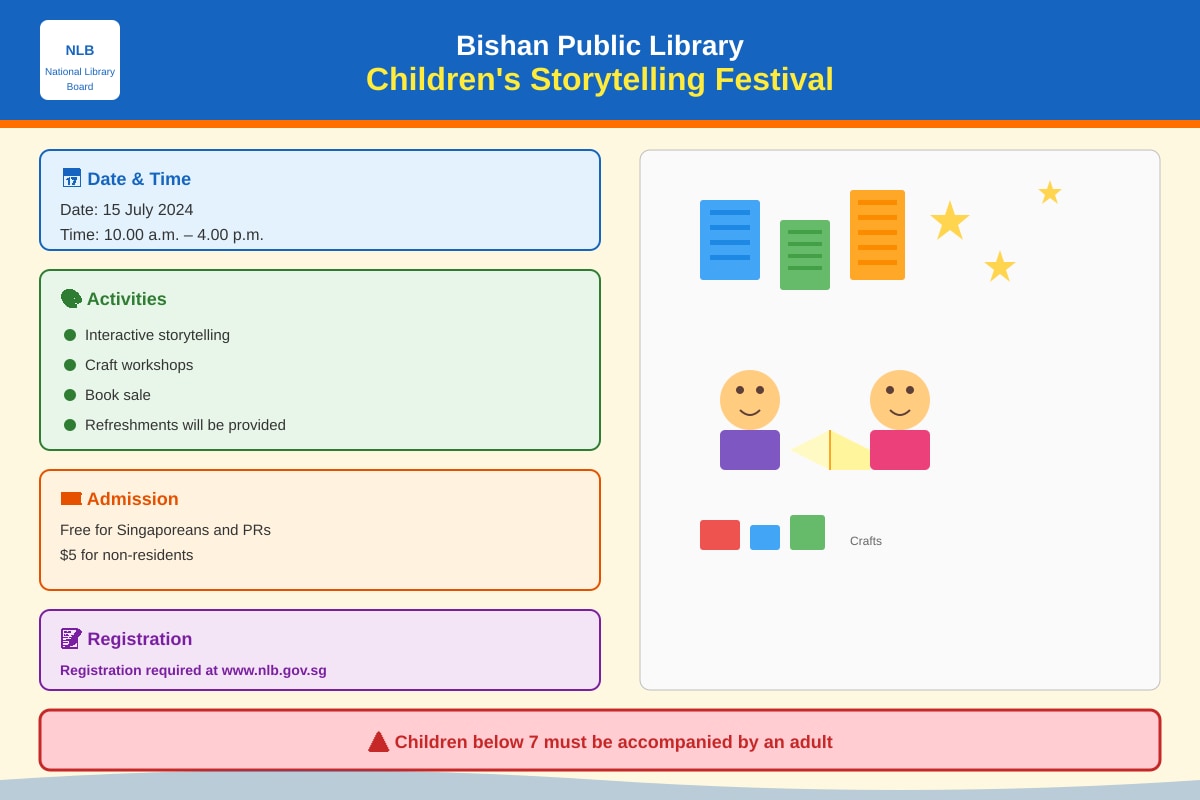
| 27 | (3) was | 1 mark | With subjects joined by "together with," "as well as," or "in addition to," the verb agrees with the main subject before the phrase. Here "The festival" is singular, so "was." The phrase "together with the craft workshops" is parenthetical additional information, not a compound subject. Trick pattern: Students see two things (festival + workshops) and choose plural—incorrect for this grammar rule. |
| 28 | The book sale offers discounted titles, which include popular Singapore children's books. OR The book sale offers discounted titles that include popular Singapore children's books. | 2 marks | "Which" (non-defining, with comma) or "that" (defining, no comma) both acceptable. Relative pronoun replaces "The discounted titles" (1); clause structure correct (1). Full mark alternative: "The book sale offers discounted titles, among which are popular Singapore children's books." |
| 29 | An adult must accompany children below 7. OR Children below 7 must be accompanied by an adult. (if rewriting requirement interpreted as transformation) | 2 marks | Passive to active transformation: original agent "an adult" becomes subject. "Must be accompanied" (passive modal) → "must accompany" (active modal). Subject-object swap correct (1); modality retained (1). If student wrote: "An adult must accompany children below 7" — this is correct active form. If student missed: "must" or wrote "An adult is accompanied by children" — deduct 1 mark for garbled meaning. |
| 30 | Accept any two valid points with grammatical terminology and explanation: | 4 marks (2 each) | Exemplar points: (1) Short imperative sentences ("Registration required")—direct, easy to scan; reader knows exactly what action to take. (2) Passive voice ("Refreshments will be provided")—focuses on the attendee's benefit, hides who provides (organisers irrelevant); sounds more formal and hospitable. (3) Simple present tense for facts ("Admission: Free")—establishes timeless truth/event certainty. (4) Modal "must" for obligation ("must be accompanied")—clear rule stated with authority. (5) Compound sentence with colon for list ("Activities: ...")—efficient information packaging. Marking: Identify feature (0.5); name grammatical structure correctly (0.5); explain effect on audience (1). |
Section E Total: 8 marks
Section F: Comprehension and Grammar Analysis (Questions 31–34)
| Question | Answer | Marks | Explanation |
|---|---|---|---|
| 31 | Parallelism (or tricolon) — three nouns/phrases with same grammatical structure (adjective + noun). Effect: creates rhythm and builds momentum; the list seems endless, mirroring how relentless urban redevelopment feels to Mrs. Lim; the repetition of "new" emphasises loss of the old; the rule of three makes the transformation seem complete and overwhelming. | 2 marks | Structural identification: "parallelism" or "tricolon" or "rule of three" (1). Effect analysis connecting form to meaning—rhythm, completeness, emotional impact (1). Partial credit: Identifying "listing" or "repetition" without technical term = 0.5 for identification. |
| 32 | The dough is like a creature that senses when your attention wanders. OR Working the dough is like talking to a friend who knows when you are not truly listening. | 2 marks | Simile must use "like" or "as" explicitly (1); must preserve meaning that inattention/insincerity is detectable during the activity (1). Marking descriptor: Explicit comparison marker (0.5); appropriate vehicle for tenor (0.5); preserved meaning of attentiveness required (1). |
| 33 | Past tense ("bent together") narrates completed actions, factual events in the story's timeline. Present participles ("looming," "threatened" — actually past tense here, accept "looming" if student identifies "-ing" forms in surrounding context, or note: "threatened" is past tense; more precise answer: "looming" is present participle used as adjective/modifier). The shift creates tension: the narrative past shows what happened, while participles/adjectival forms suggest ongoing, unresolved threats (the cranes still loom, the rain still threatens). The grammar mirrors Mrs. Lim's precarious position—her craft is a completed story ("bent") but destruction is still approaching. Accept: Past tense for completed action; present participle for continuing/imminent action; effect = contrast between completed heritage and ongoing threat. | 2 marks | Tense identification accurate (0.5); grammatical terminology used (0.5); explanation of why writer chose this shift—contrast, tension, thematic resonance (1). Note: "Threatened" is technically simple past, but appears to be present participle in "-ing" form confusion; generous marking if student discusses "looming" as participle with "threatened" as past tense in contrast. |
| 34 | Because Mrs. Lim's shophouse would be demolished, she wanted to pass her skills to someone who valued them. OR Mrs. Lim wanted to pass her skills to someone who valued them because her shophouse would be demolished. OR Although her shophouse would be demolished, Mrs. Lim wanted to pass her skills to someone who valued them. | 2 marks | Correct subordinating conjunction showing logical relationship—causal with "because" or concessive with "although" (context supports either: demolition causes urgency, OR despite impending loss, value remains) (1); sentence structure grammatically correct with proper clause attachment (1). Not accepted: "And" or "but" without subordinating conjunction (these are coordinating conjunctions). |
Section F Total: 8 marks
Summary Marking Scheme
| Section | Question Range | Marks |
|---|---|---|
| A | 1–10 | 10 |
| B | 11–18 | 8 |
| C | 19–22 | 8 |
| D | 23–26 | 8 |
| E | 27–30 | 8 |
| F | 31–34 | 8 |
| TOTAL | 50 |
Common Errors to Flag for Students
- Subject-verb agreement with intervening phrases: Prepositional phrases ("of pupils," "on the shelf") and appositives ("together with") do not change the grammatical number of the subject.
- Reported speech tense backshift: Present → past; past → past perfect; will → would; can → could; may → might.
- "Despite" vs. "Although": "Despite" + noun/gerund; "Although" + full clause. Cannot interchange structures directly.
- Linking verb + adjective: Feel bad (not badly); taste good (not well); seem happy (not happily).
- Relative pronoun selection: "Who" for people as subjects; "whom" for people as objects (rarely tested at P4); "which" for things; "whose" for possession; "where" for places.
Difficulty Calibration Notes
- Easy (Questions 1–2, 4, 6, 7, 8, 11–14, 19, 20): Direct grammar rule application, common patterns
- Medium (Questions 3, 5, 9, 10, 15–18, 21, 22, 23–26): Requires parsing complex subjects, identifying less common patterns, transformation precision
- Challenging (Questions 29, 30, 31–34): Application to authentic context, stylistic analysis, synthesis of grammar knowledge with interpretive reading
All questions align with P4 syllabus: tenses, subject-verb agreement, reported speech, active/passive voice, conjunctions, relative clauses, sentence transformation, and editing for grammar.