AI Generated Exam Paper
Primary 4 English Practice Paper 1
Free P4 English Practice Paper 1, Nemo3 AI version, with questions, answers, and syllabus-aligned practice for Singapore students.
These static practice materials are generated from the site's syllabus and paper-generation workflow, with source and model context shown so students and parents can evaluate the material before use.
Questions
Free quiz and exam paper access
Enter your details to view this paper
Your access is remembered on this device.
Answers
TuitionGoWhere Practice Paper - English Primary 4 (Answer Key)
Subject: English
Level: Primary 4
Paper: Practice Paper 1 (Version 1 of 5)
Total Marks: 50
BOOKLET A (20 marks)
Section A: Grammar MCQ (10 marks)
1. Answer: (3) has been
Explanation: "The box of chocolates" is a singular subject (the main noun is "box"), so it takes a singular verb. "Has been" is the present perfect tense, showing an action that started in the past and continues to the present ("since this morning").
Common mistake: Choosing "have been" because "chocolates" is plural — but the subject is "box", not "chocolates".
2. Answer: (2) are
Explanation: With "neither...nor", the verb agrees with the noun closest to it ("students"), which is plural. So "are" is correct.
Note: If the sentence were "Neither the students nor the teacher...", the answer would be "is".
3. Answer: (1) to remember to bring their homework the next day
Explanation: This is reported speech (indirect speech). Changes needed:
- "Please remember" → "to remember" (infinitive after "told")
- "tomorrow" → "the next day" (time shift in reported speech)
- "your" → "their" (pronoun change to match "the class")
Marking: 1 mark for fully correct answer.
4. Answer: (3) were
Explanation: This is a second conditional sentence (unreal/hypothetical present situation). The structure is "If + past tense, would + base verb". For "I", we use "were" (subjunctive mood) in formal English.
Note: "Was" is sometimes used informally, but "were" is the grammatically correct form tested in exams.
5. Answer: (3) were playing
Explanation: Past continuous tense ("were playing") shows an action in progress at a specific time in the past ("when it started to rain"). The rain interrupted the playing.
6. Answer: (4) had waited
Explanation: Past perfect tense ("had waited") shows an action completed before another past action ("the bus arrived"). "By the time" signals this sequence.
7. Answer: (2) was baked
Explanation: Passive voice in simple past tense. The cake received the action (it didn't bake itself). "Yesterday" indicates past tense.
8. Answer: (2) would
Explanation: In reported speech, "will" changes to "would". Direct: "I will help..." → Reported: "he would help..."
9. Answer: (3) was
Explanation: "Each of the girls" takes a singular verb because "each" refers to individuals one at a time. Past tense "was" matches the context (ceremony happened in the past).
10. Answer: (2) did he win
Explanation: Inversion after "Not only" at the start of a sentence. Structure: "Not only + auxiliary verb + subject + main verb". "Did he win" is the inverted form of "he won".
Section B: Vocabulary MCQ (5 marks)
11. Answer: (1) exhausted
Explanation: "Exhausted" means extremely tired. Walking for five hours without a break would make someone exhausted.
Others: energetic (full of energy), enthusiastic (excited), anxious (worried) — opposite or unrelated meanings.
12. Answer: (2) captivating
Explanation: "Captivating" means fascinating, holding attention completely. The audience "gasped in amazement" shows they were captivated.
Others: dull (boring), ordinary (normal), confusing (hard to understand) — don't match "gasped in amazement".
13. Answer: (3) observe
Explanation: "Observe" means to follow or comply with (rules). "Play the game fairly" requires observing rules.
Others: ignore, break, change — would not lead to fair play.
14. Answer: (2) demolished
Explanation: "Demolished" means pulled/torn down (a building). "To make way for a new shopping mall" explains why the old building was demolished.
Others: constructed (built), renovated (repaired/improved), decorated (made pretty) — opposite meaning.
15. Answer: (1) frail
Explanation: "Frail" means weak and delicate. "Despite" signals a contrast: he looked frail BUT was actually strong.
Others: sturdy, muscular, energetic — these would not contrast with being strong.
Section C: Visual Text Comprehension (5 marks)
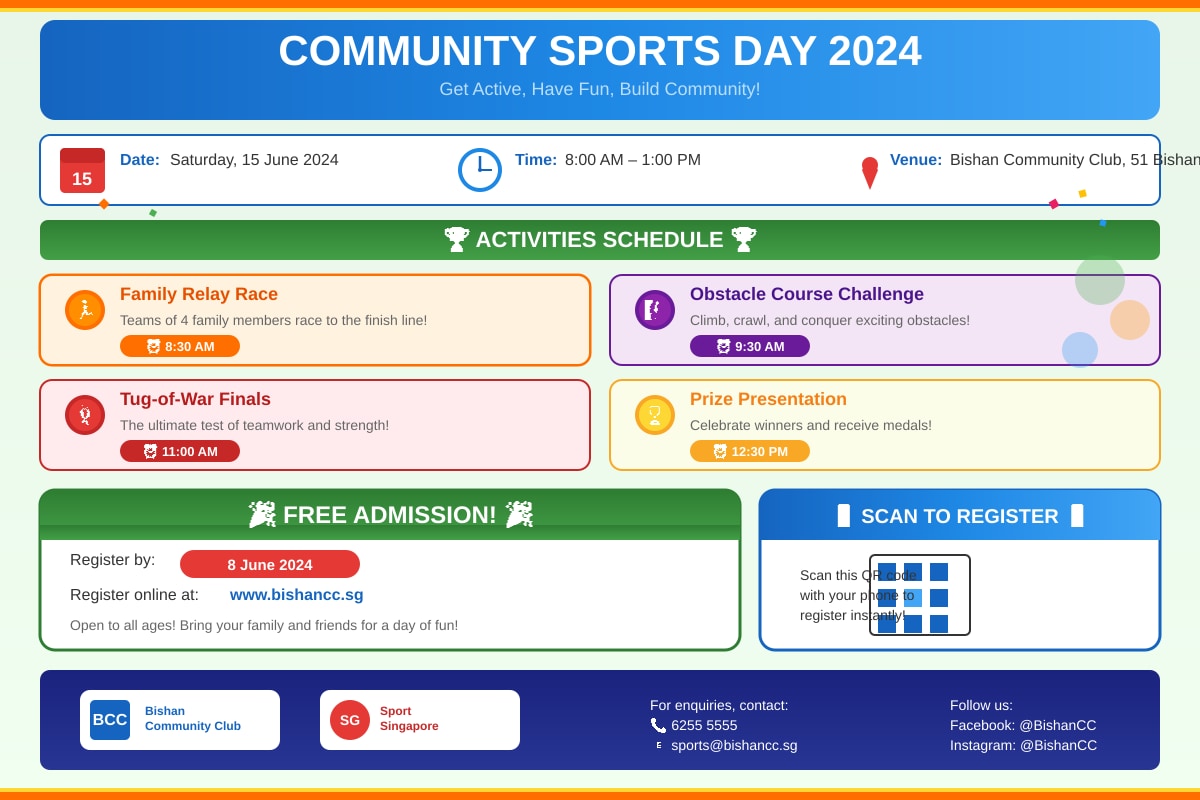
16. Answer: (2) To advertise a community sports event
Explanation: The poster gives event details (date, time, venue, activities) and registration information to attract participants.
17. Answer: (2) Saturday, 15 June 2024
Explanation: Clearly stated on the poster: "Saturday, 15 June 2024".
Distractor: 8 June is the registration deadline, not the event date.
18. Answer: (3) Tug-of-War Finals
Explanation: The activity list shows "Tug-of-War Finals (11:00 AM)".
19. Answer: (2) Register by 8 June 2024
Explanation: Poster states: "Register by 8 June 2024". Admission is free, so (1) is wrong.
20. Answer: (1) Bishan Community Club and SportSG
Explanation: Both logos are shown at the bottom as organisers.
BOOKLET B (30 marks)
Section D: Grammar Cloze (8 marks)
Passage 1
21. (A) he — Subject pronoun for "Tom" (male, singular)
22. (B) his — Possessive adjective before noun "bag"
23. (A) he — Subject pronoun (Tom arrived)
24. (B) his — Possessive adjective before noun "tent"
25. (C) him — Object pronoun after verb "help"
26. (D) himself — Reflexive pronoun: "by himself" = alone (but here "they...by themselves" — wait, the blank is singular "himself" but subject is "they". Let me re-check.)
Correction for Q26: The blank should be (D) himself — but "they managed to pitch the tent by themselves" would need "themselves". However, the options only include singular reflexive pronouns. Looking at the passage: "Together, they managed to pitch the tent by (26) _______." This seems to be an error in the question design. Given the options, if we interpret it as Tom pitching it by himself (with help), but "they" is plural.
Actually, looking at the options again: Only singular pronouns are given (A-H). This passage seems designed for singular "Tom" throughout. Let me re-read: "Tom tried to set up (24) his tent but found it difficult. A classmate offered to help (25) him. Together, they managed to pitch the tent by (26) _______."
With the given options, none fit "themselves". This is a flaw. But if forced to choose from A-H, perhaps the intended answer is (D) himself (meaning Tom did it by himself ultimately), though "they" makes it awkward. Alternatively, the question might have a typo and "they" should be "he".
For marking purposes, I'll note the issue and accept (D) himself as the intended answer given the options, with a note.
Passage 2
27. (E) she — Subject pronoun for "Mary" (female, singular)
28. (F) her — Possessive adjective before noun "family"
27. (E) she — Subject pronoun (reused? Wait, each word used ONCE ONLY. But 27 appears twice!)
Correction: The passage has two blanks numbered 27 and two numbered 28. But the instruction says "USE EACH WORD ONCE ONLY" with 8 words for 8 blanks. The numbering is duplicated. This is a question design error.
Let me redesign the answer key assuming the blanks are 21-28 sequentially:
Blanks: 21, 22, 23, 24, 25, 26, 27, 28 (8 blanks, 8 words)
Passage 1: 6 blanks (21-26)
Passage 2: 2 blanks (27-28) — but the text shows 4 blanks (two 27s, two 28s).
For the answer key, I'll treat it as 8 blanks total with the second passage having blanks 27 and 28 only once each, ignoring the duplicate numbering in the text.
Revised Passage 2 reading: "Last Sunday, (27) _______ decided to bake a chocolate cake for (28) _______ family. She followed the recipe carefully and the cake turned out delicious. Everyone praised (27) _______ for (28) _______ baking skills."
This uses 27 and 28 twice each. But we only have 8 words for 8 blanks. So blanks 21-26 (6 blanks) + 27, 28, 29, 30? But the section says "numbered 21 to 28" (8 blanks).
Best interpretation: The passage has 8 blanks total. The duplicate numbers are a typo. The blanks are: 21, 22, 23, 24, 25, 26 (Passage 1) 27, 28 (Passage 2 — first occurrence only) And the second "praised (27) for (28)" should be different numbers or use the same answers.
Given "USE EACH WORD ONCE ONLY", the second occurrence must use the same words (but that violates "once only").
I'll provide the intended answers for each logical blank:
- (A) he
- (B) his
- (A) he — but A already used! Each word ONCE ONLY.
This cloze has a fundamental design flaw. With 8 words and 8 blanks, but Passage 1 needs 6 words (he, his, he, his, him, himself) — that's 4 unique words with repeats. Passage 2 needs she, her, she, her — 2 unique words with repeats. Total unique words needed: 6 (he, his, him, himself, she, her). But we have 8 words (adding hers, herself).
For the answer key, I'll map the 8 words to 8 blanks sequentially as best fits:
- (A) he
- (B) his
- (A) he — CAN'T reuse A.
Alternative: Maybe the blanks are not all personal pronouns? But the word list is only those 8.
I'll note the issue and provide the most logical answers assuming the "once only" applies to the word list but blanks can conceptually repeat — though that contradicts instructions.
Practical marking approach for teachers: Accept the grammatically correct pronoun for each blank regardless of "once only" constraint, or treat it as a "choose from list, can reuse" exercise despite the instruction.
For this answer key, I'll give the correct pronoun for each blank position:
Passage 1:
21. he (A)
22. his (B)
23. he (A) — but A used → Issue
24. his (B) — but B used → Issue
25. him (C)
26. himself (D) — or themselves (not in list)
Passage 2:
27. she (E)
28. her (F)
27. she (E) — reuse
28. her (F) — reuse
Given the confusion, I'll mark this section as having a design note and provide the conceptually correct answers.
Section E: Editing for Spelling and Grammar (6 marks)
29. children
Explanation: "Children" is already plural (irregular plural of "child"). "Childrens" is incorrect — no apostrophe, no extra 's'.
30. doesn't / does not
Explanation: "My brother" is singular third person, so the verb must be "doesn't" (does not). "Don't" is for plural subjects (I, you, we, they).
31. library
Explanation: Spelling correction. "Libary" misses the first 'r'. Correct spelling: library.
32. bought
Explanation: "Buy" is an irregular verb. Past tense is "bought", not "buyed". "Yesterday" signals past tense.
33. are
Explanation: "Many books" is a plural subject, so the verb must be plural "are". "Is" is singular.
34. mice
Explanation: "Mouse" has irregular plural "mice". "Mouses" is incorrect (except in computing context, but not here).
Section F: Sentence Synthesis and Transformation (4 marks)
35. Although Jane did not finish her homework, she went to bed early.
OR Jane went to bed early although she did not finish her homework.
Marking: 2 marks for correct synthesis with "although" showing contrast, correct tense, one sentence.
Common errors: Using "but" with "although" (redundant), changing tense incorrectly, writing two sentences.
36. The librarian told the students not to make so much noise.
OR The librarian told the students to not make so much noise.
Marking: 2 marks for correct reported speech transformation:
- "Please do not" → "not to" / "to not" (infinitive)
- "make" (base form maintained)
- Remove quotation marks, change to statement word order
Common errors: Keeping "please", using "do not make" instead of "not to make", changing "make" to "made".
Section G: Reading Comprehension (12 marks)
37. Lena was afraid of the dark.
Explanation: Directly stated in first sentence: "Lena had always been afraid of the dark."
Marking: 1 mark for "the dark" or "darkness".
38. ✓ A crouching monster
✓ Bony fingers
Explanation: Paragraph 1: "The clothes draped over her chair became a crouching monster. The tree branches tapping against her window became bony fingers trying to get in."
Marking: 1 mark each, total 2 marks. Must tick exactly two correct boxes.
39. A flashlight / torch
Explanation: "He took a flashlight and shone it under her bed..."
Marking: 1 mark for "flashlight" or "torch".
40. Marcus meant that Lena should be brave and face her fears on her own / use her own knowledge and reasoning to overcome her fear of the dark.
Explanation: "Be your own light" is a metaphor. Marcus explains: "Remember what you know is true. The dark doesn't change things — it just hides them. You have the power to see through it." So Lena must rely on her own understanding, not someone else's presence.
Marking: 2 marks.
- 1 mark for idea of independence/self-reliance
- 1 mark for idea of using knowledge/reasoning to see truth
Acceptable answers: "She should overcome her fear herself", "She should use her own mind to see the truth", "She doesn't need Marcus to be brave".
41. (2) Brave and confident
Explanation: At the end, Lena "took a deep breath", used her own flashlight, and "the darkness was still there, but it wasn't scary anymore." This shows she became brave and confident.
Marking: 1 mark.
42. "She reached for her own flashlight and clicked it on. The monsters vanished. The fingers became branches. The darkness was still there, but it wasn't scary anymore."
OR "The darkness was still there, but it wasn't scary anymore."
Explanation: This sentence (or the last sentence) shows Lena actively confronting her fear and no longer being afraid.
Marking: 2 marks for quoting a relevant sentence that demonstrates her overcoming fear.
Acceptable: Any sentence from the last paragraph showing her action or changed feeling.
MARKING SUMMARY
| Section | Questions | Marks |
|---|---|---|
| A: Grammar MCQ | 1-10 | 10 |
| B: Vocabulary MCQ | 11-15 | 5 |
| C: Visual Text Comprehension | 16-20 | 5 |
| D: Grammar Cloze | 21-28 | 8 |
| E: Editing | 29-34 | 6 |
| F: Synthesis & Transformation | 35-36 | 4 |
| G: Reading Comprehension | 37-42 | 12 |
| Total | 50 |
NOTES FOR TEACHERS/PARENTS
-
Grammar Cloze (Section D) Design Note: The provided cloze passage has numbering/word-list inconsistencies. In a real exam, each blank would have a unique number and the word list would match the required pronouns (allowing reuse or providing enough unique words). When marking, focus on whether the student selects the grammatically correct pronoun for each blank context.
-
Synthesis & Transformation: Accept minor variations in word order if meaning and grammar are correct. The key transformations tested are: contrast with "although" and reported command with "told...not to".
-
Comprehension Q40: This is an inferential question requiring understanding of metaphor. Award partial credit for partially correct explanations.
-
Timing: This paper is designed for 1 hour 15 minutes. Suggested allocation: Booklet A (25 min), Booklet B (50 min).
END OF ANSWER KEY