From Real Exams Exam Paper
Primary 4 English Semestral Assessment 2 (End of Year) Paper 5
Free P4 English SA2 Paper 5, Kimi2.6 Exam version, with questions, answers, and syllabus-aligned practice for Singapore students.
These static practice materials are generated from the site's syllabus and paper-generation workflow, with source and model context shown so students and parents can evaluate the material before use.
Questions
Free quiz and exam paper access
Enter your details to view this paper
Your access is remembered on this device.
Answers
TuitionGoWhere Exam Practice (AI) – SA2 English Primary 4
Answer Key and Marking Scheme – Version 5
Total Marks: 50
Duration: 1 hour 15 minutes
BOOKLET A (20 marks)
Section A: Grammar MCQ (10 marks)
1. Answer: (1) is coming [1 mark]
Concept: Subject-verb agreement with phrases like "together with."
Working: When a subject is followed by "together with," "as well as," or "accompanied by," the verb agrees with the original subject, not the added phrase. The original subject is "My mother" (singular), so we need a singular verb. "Is coming" matches the singular subject and fits the future context "next weekend."
Common mistake: Choosing "are coming" by mistakenly making the verb agree with "my two aunts."
2. Answer: (2) was [1 mark]
Concept: Subject-verb agreement with "neither...nor" (proximity rule).
Working: With "neither...nor," the verb agrees with the noun closest to it. Here, "their teacher" (singular) is closest, so we use a singular verb. The context talks about a past situation (discussing an examination date that was uncertain), so past tense "was" is appropriate.
Common mistake: Choosing "were" by trying to make the verb agree with "the boys" (the first subject).
3. Answer: (2) flies [1 mark]
Concept: Subject-verb agreement with collective nouns; simple present tense for habitual action.
Working: "The flock of birds" – collective nouns like "flock," "team," "class" take singular verbs when the group acts as one unit. The phrase "every year" indicates a habitual action, requiring the simple present tense. "Flies" is the correct singular present form.
Common mistake: Choosing "fly" by treating "birds" as the subject instead of "flock."
4. Answer: (2) was [1 mark]
Concept: Subject-verb agreement with "each of + plural noun."
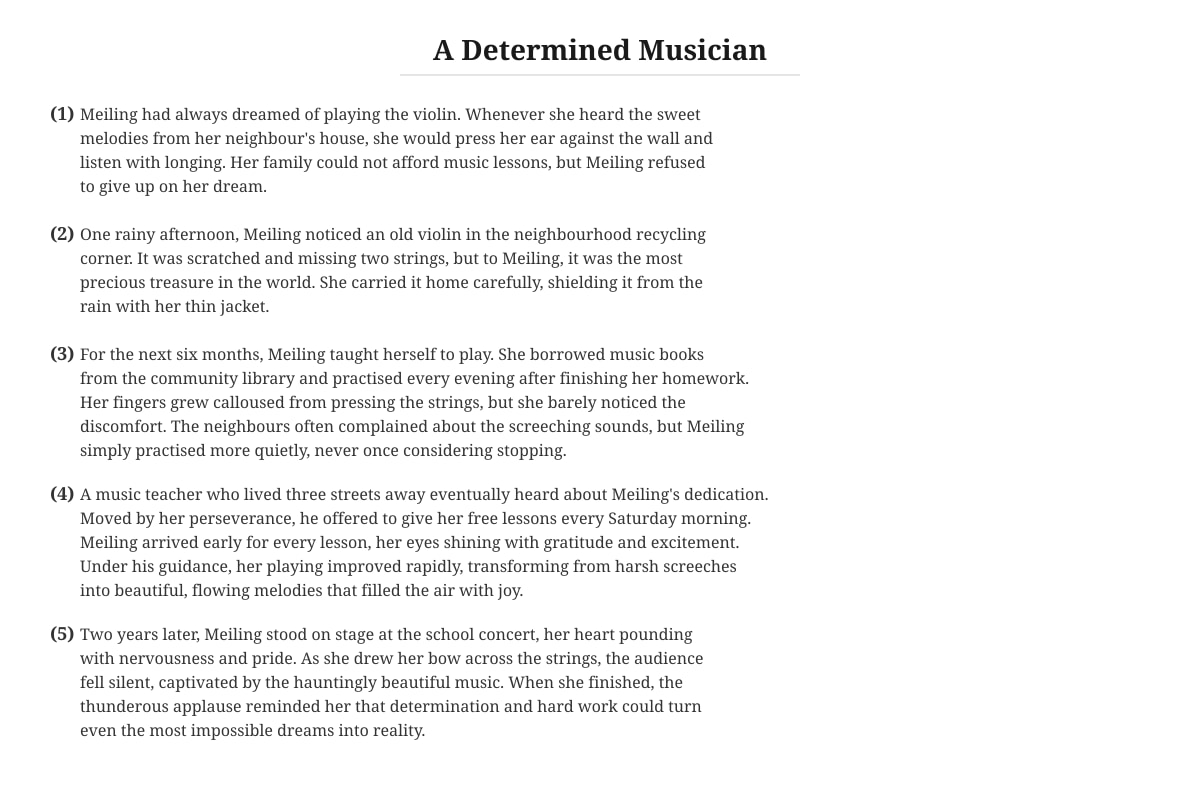
Working: "Each of the students" – although "students" is plural, "each" is the true subject and is singular. Therefore, we need a singular verb. The context describes a completed action in the past (the distribution has happened), so simple past "was" is correct.
Common mistake: Choosing "were" by making the verb agree with "students" instead of "each."
5. Answer: (2) has [1 mark]
Concept: Subject-verb agreement with uncountable nouns; present perfect tense.
Working: "The furniture" – furniture is an uncountable noun and takes a singular verb. "Been damaged" shows we need a form of "have/has" for the present perfect passive. "Has" is the singular form. The sentence describes damage that occurred at an unspecified time before now, continuing to affect the present.
Common mistake: Choosing "have" by treating "furniture" as plural.
6. Answer: (2) has [1 mark]
Concept: Subject-verb agreement with "many a + singular noun."
Working: "Many a student" means "many students" individually considered; this construction always takes a singular verb. "Has difficulty" is correct. The sentence describes a general, ongoing situation, so simple present is appropriate.
Common mistake: Choosing "have" because the meaning seems plural ("many").
7. Answer: (2) train [1 mark]
Concept: Subject-verb agreement with "not only...but also" (proximity rule).
Working: With "not only...but also," the verb typically agrees with the nearer subject. Here, "the team members" (plural) is nearer, so we need a plural verb. The sentence describes an ongoing, habitual action (regular training), so simple present "train" is correct, not the continuous forms.
Common mistake: Choosing "trains" by making the verb agree with "the captain" (first subject).
8. Answer: (2) seems [1 mark]
Concept: Subject-verb agreement with expressions of time, money, weight (singular unit).
Working: "Five dollars" represents a single amount of money, so it takes a singular verb. The sentence expresses a general opinion, so simple present "seems" is correct.
Common mistake: Choosing "seem" because "dollars" is plural in form.
9. Answer: (2) is [1 mark]
Concept: Subject-verb agreement with "either...or" (proximity rule).
Working: With "either...or," the verb agrees with the nearer subject. "The architect" (singular) is closer, so we need a singular verb. The sentence describes a current situation of responsibility, so simple present "is" is appropriate.
Common mistake: Choosing "are" by making the verb agree with "the engineers" (first subject).
10. Answer: (1) are [1 mark]
Concept: Collective nouns with plural verbs (when members act individually).
Working: "The committee" – while collective nouns often take singular verbs, this context specifies "divided in their opinions," showing the members hold different individual views. British English and Singapore usage allow plural verbs here when emphasising the members' separate actions. "Their" also signals plural agreement is acceptable.
Common mistake: Choosing "is" without considering that "their opinions" indicates individual members.
Section B: Vocabulary MCQ (5 marks)
11. Answer: (4) gurgling [1 mark]
Concept: Adjective-noun collocation; context clues in outdoor setting.
Working: Hikers need clean, running water to drink safely. "Gurgling" describes the pleasant sound of flowing water, suggesting a fresh, usable stream. "Turbulent" (violent, rough water), "crystal" (needs "clear" to make sense), and "stagnant" (still, possibly dirty water) do not fit the context of grateful hikers refilling bottles.
12. Answer: (2) accomplishment [1 mark]
Concept: Contextual understanding of emotions after completing work.
Working: After working hard and finishing a project, "accomplishment" (pride in achieving something) is the logical feeling. "Dread" (fear), "confusion" (puzzlement), and "boredom" (disinterest) are negative emotions that do not match "finally completed it."
13. Answer: (2) observant [1 mark]
Concept: Character trait vocabulary; context of noticing details.
Working: An "observant" person notices small details that others miss. The detective found "the tiny fingerprint that everyone else had missed," proving careful attention to detail. "Careless" (inattentive), "impatient" (unable to wait), and "ordinary" (not special) are contradicted by the evidence.
14. Answer: (1) summarize [1 mark]
Concept: Academic vocabulary for reading comprehension tasks.
Working: "Summarize" means to give a brief account of the main points, matching "in their own words." "Elaborate" (add detail), "criticize" (find faults), and "translate" (change language) do not match the teacher's instruction about main points.
15. Answer: (2) chimed [1 mark]
Concept: Sound vocabulary specific to clocks.
Working: "Chimed" is the precise verb for bells or clocks making musical sounds to mark the hour. "Whispered" (soft speech), "mumbled" (unclear speech), and "crackled" (sharp, irregular noise like fire) do not describe clock sounds.
Section C: Visual Text Comprehension (5 marks)
16. Answer: (2) Only students aged 9 to 12 [1 mark]
Evidence: Poster states "For primary school students aged 9-12."
Working: The age restriction is clearly stated as 9-12. Option 1 is too broad; option 3 specifies only one library's students; option 4 removes the age restriction. The poster explicitly limits participation by age, not by school affiliation.
17. Answer: (3) A place they like in Singapore [1 mark]
Evidence: Poster theme is "My Favourite Place in Singapore."
Working: "My Favourite Place in Singapore" directly matches option 3. Option 1 changes to "book," option 2 narrows to "school library," option 4 specifies the organiser. The theme allows any favourite place, not a specific one.
18. Answer: (3) is not allowed to participate [1 mark]
Evidence: Age requirement clearly states "aged 9-12"; an 8-year-old falls outside this range.
Working: The condition is strict: "aged 9-12." No exceptions are mentioned. The 8-year-old does not meet the age criterion, so participation is barred regardless of word count, parental help, or contacting the library.
19. Answer: (3) a $50 book voucher [1 mark]
Evidence: Poster states "Trophy + $50 book voucher."
Working: The exact prize components are specified. Option 1 incorrectly states "cash"; option 2 adds membership not mentioned; option 4 invents a published book. The voucher is specifically for books, not cash.
20. Answer: (2) the deadline has already passed [1 mark]
Evidence: Deadline is "15 November 2024"; Tommy submits on 20 November 2024.
Working: 20 November is five days after 15 November. The deadline has passed, so submission is too late. No late entry policy is mentioned, no cancellation is stated, and no prior email requirement exists.
BOOKLET B (30 marks)
Section D: Grammar Cloze (6 marks)
21. Answer: were [1 mark]
Concept: Subject-verb agreement with compound subject joined by "and."
Working: "My classmates and I" = plural subject (multiple people). Simple past tense matches the time marker "Last Saturday." The verb must be plural "were," not singular "was."
22. Answer: has [1 mark]
Concept: Subject-verb agreement with "neither...nor" (proximity rule); present perfect for experience.
Working: "Neither my mother nor my father" – "father" (singular) is nearer, so singular verb needed. "Ever been" requires present perfect ("have/has been"). "Has" is the singular form. The sentence describes life experience (never visited), which uses present perfect.
23. Answer: were [1 mark]
Concept: Subject-verb agreement with plural subject; simple past tense.
Working: "The exhibits" is clearly plural. The passage continues in past tense ("Last Saturday"), so "were" is correct, not "was" or present tense.
24. Answer: was [1 mark]
Concept: Subject-verb agreement with collective noun as unit; past tense.
Working: "A team of scientists" – "a team" is the subject head noun, singular. When the group acts together, use singular verb. Past tense "was" matches the narrative timeframe.
25. Answer: lasted [1 mark]
Concept: Simple past tense for completed time periods in narrative.
Working: The whole passage is in past tense. "Each demonstration" (singular subject) needs a past tense verb. "Last" is present, "lasts" is present singular, "lasted" is past tense – correct for the completed past event.
26. Answer: were [1 mark]
Concept: Subject-verb agreement with "not only...but also" (plural subjects both sides); past tense.
Working: "Not only the children (plural) but also the adults (plural)" – both subjects are plural. Past tense "were" matches the narrative and agrees with the plural compound subject. "Was" would be incorrect even by proximity since both parts are plural.
Section E: Sentence Synthesis and Transformation (4 marks)
27. Model Answer: Mrs. Tan, who coaches the Robotics Club, teaches Science. / Mrs. Tan, who teaches Science, coaches the Robotics Club. [2 marks]
Mark breakdown:
- Correct use of relative pronoun "who": 1 mark
- Sentence structure grammatically correct with meaning preserved: 1 mark
Working: We need to join two facts about Mrs. Tan using "who." "Who" replaces "Mrs. Tan" in one clause to create a relative clause. The main clause carries the primary information; the relative clause adds extra detail. Both versions work because neither activity is more important than the other.
Common mistake: Writing "Mrs. Tan who teaches Science coaches the Robotics Club" without commas, creating ambiguity about how many Mrs. Tans exist.
28. Model Answer: After the boys had finished their project, they presented it to the class. / After finishing their project, the boys presented it to the class. [2 marks]
Mark breakdown:
- Correct use of "After" at the beginning: 1 mark
- Grammatical completion with logical sequence (finishing before presenting): 1 mark
Working: "After" introduces a time sequence. The project must finish before presentation, so we need past perfect "had finished" or a gerund "finishing" to show this sequence clearly. "They presented it to the class after they finished their project" also accepts full marks if sequence is clear.
Common mistake: "After the boys finished their project, they presented it" – acceptable in informal use but past perfect is preferred for clear sequencing.
Section F: Reading Comprehension (12 marks)
29. Answer: When Meiling heard her neighbour playing the violin, she would press her ear against the wall and listen with longing. [2 marks]
Mark breakdown:
- Action of pressing ear against wall: 1 mark
- Listening with longing/showing desire: 1 mark
Working: The answer must come from paragraph 1. Two specific actions are described: (1) pressing her ear against the wall (physical action), and (2) listening with longing (emotional state). Both elements are needed for full marks.
Evidence: "she would press her ear against the wall and listen with longing"
30. Answer: Meiling considered the old violin precious because she had always dreamed of playing the violin but her family could not afford music lessons./It represented her dream coming true despite her family's poverty. [2 marks]
Mark breakdown:
- Reference to her dream/love of violin: 1 mark
- Reference to lack of money/family situation: 1 mark
Working: The answer requires inferential understanding. The violin was scratched and missing strings – objectively worthless. Its value to Meiling came from what it represented: a chance to achieve her dream despite financial obstacles. We must connect paragraph 1 (dream, no money) with paragraph 2 (finding the violin).
Evidence: "Her family could not afford music lessons" + "she refused to give up on her dream"
31. Answer: Any two of: (1) She taught herself to play for six months; (2) She practised every evening after homework; (3) Her fingers grew calloused but she barely noticed; (4) She practised more quietly when neighbours complained instead of stopping; (5) She arrived early for every Saturday lesson. [2 marks]
Mark breakdown:
- One valid example with evidence: 1 mark each (max 2)
Working: "Determined" means persisting despite difficulties. Each example shows sacrifice (time, comfort, convenience) or response to obstacles. The answer must include the example and brief explanation of what it shows about determination.
32. Answer: The teacher offered free lessons because he was moved by her perseverance/dedication. The passage states he "heard about Meiling's dedication" and was "moved by her perseverance." [2 marks]
Mark breakdown:
- Identifying perseverance/dedication: 1 mark
- Correct evidence from paragraph 4: 1 mark
Working: This is an inferential question requiring causal reasoning. The teacher's action (offering free lessons) resulted from learning about her character (dedicated, persevering). We must use explicit evidence: "heard about Meiling's dedication" and "moved by her perseverance."
Common mistake: Answering only "because he was kind" without textual evidence about what specifically moved him.
33. Answer: Meiling was likely feeling proud, happy, and satisfied. She had achieved her dream through years of hard work, from finding a broken violin to performing for a standing ovation. The smile shows she remembered her difficult journey and felt fulfilled. [2 marks]
Mark breakdown:
- Identifying positive emotion (pride/happiness/satisfaction): 1 mark
- Connecting to her journey/dream being realised: 1 mark
Working: This evaluative question requires reading beyond literal meaning. Her smile comes at the moment of success, triggering reflection on the entire journey. The contrast between "scratched violin in the rain" (paragraph 2) and "standing ovation" (paragraph 5) creates emotional depth.
34. Answer: We can learn that determination and hard work can help us overcome difficulties and achieve our dreams./We should not give up even when facing obstacles like poverty or lack of resources. [2 marks]
Mark breakdown:
- General lesson about perseverance/determination: 1 mark
- Connection to overcoming specific obstacles: 1 mark
Working: Theme extraction requires identifying the story's moral message. Meiling's story exemplifies the classic narrative of achieving through effort despite disadvantages. The lesson must move beyond "practice makes perfect" to include the overcoming-obstacles element.
Section G: Situational Writing (8 marks)
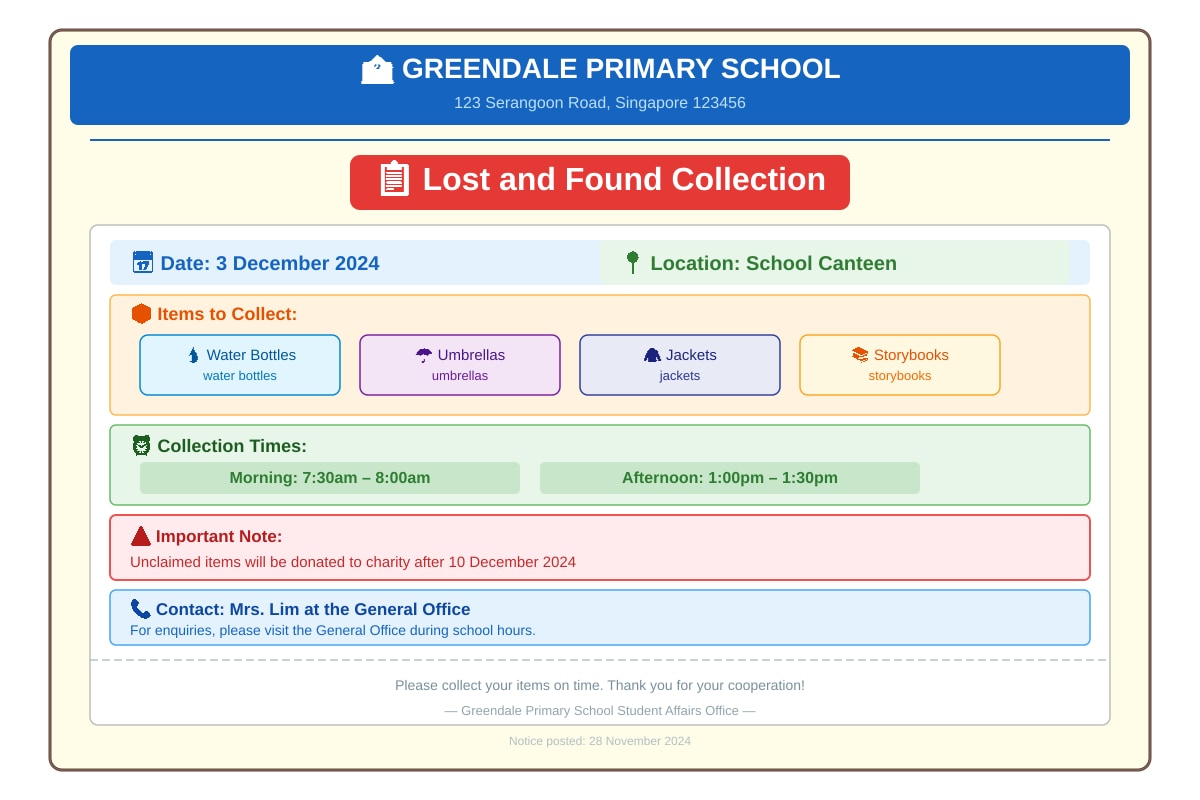
Task Requirements Checklist:
- Purpose stated (why writing): 1 mark
- Collection details (where and when): 2 marks
- What to bring/do: 2 marks
- Consequence of non-collection: 2 marks
- Tone and format appropriate for email to classmate: 1 mark
Model Answer (80-120 words):
Dear Zhi Hao,
I am writing to you because I think I found your water bottle at the canteen on Monday. I saw a blue water bottle left on one of the tables.
There is a Lost and Found collection at the school canteen on 3 December 2024. You can collect your water bottle from 7:30am to 8:00am or from 1:00pm to 1:30pm. Please bring your student pass for identification.
If you do not collect your water bottle by 10 December 2024, it will be donated to charity. Do go soon!
Your classmate, Jiawen
Marking Descriptor Bands:
| Marks | Descriptor |
|---|---|
| 7-8 | All four content points fully developed; clear, accurate language; appropriate email format with greeting and closing; word count within range |
| 5-6 | Three to four content points addressed; mostly accurate language with minor errors; recognisable email format; word count acceptable |
| 3-4 | Two to three content points present; language errors that sometimes impede meaning; some format elements missing; word count slightly off |
| 1-2 | One or two content points mentioned; significant language errors; poor format or tone; word count far outside range |
| 0 | No relevant content or entirely off-task |
Common errors to note:
- Missing signature or inappropriate tone (too formal or too casual)
- Wrong dates or times from the notice
- Omission of the 10 December deadline consequence
- Failure to mention bringing identification
End of Answer Key
Total Marks Verification:
- Booklet A: 10 + 5 + 5 = 20 marks ✓
- Booklet B: 6 + 4 + 12 + 8 = 30 marks ✓
- Grand Total: 50 marks ✓