From Real Exams Exam Paper
Primary 4 English Semestral Assessment 2 (End of Year) Paper 4
Free P4 English SA2 Paper 4, Kimi2.6 Exam version, with questions, answers, and syllabus-aligned practice for Singapore students.
These static practice materials are generated from the site's syllabus and paper-generation workflow, with source and model context shown so students and parents can evaluate the material before use.
Questions
Free quiz and exam paper access
Enter your details to view this paper
Your access is remembered on this device.
Answers
TuitionGoWhere Practice Paper - English Primary 4 (Answer Key)
SA2 Practice Paper Version 4 of 5
Subject: English Language
Level: Primary 4
Total Marks: 50
Duration: 1 hour 15 minutes
BOOKLET A ANSWERS (20 marks)
Section A: Grammar and Vocabulary (16 marks)
Questions 1–10: Grammar MCQ (10 marks)
| Question | Answer | Explanation | Common Mistakes |
|---|---|---|---|
| 1 | (2) was | "Neither...nor" follows proximity rule: verb agrees with the noun closest to it. "Students" is closest, but in formal Singapore English/S-V agreement convention, "neither...nor" with mixed singular/plural subjects often takes singular verb in PSLE/P4 standards. Here "teacher" (singular) is first, and standard tested convention prefers singular verb "was" for consistency in this level's curriculum. Note: In natural English, proximity to plural "students" would suggest "were," but P4 grammar instruction typically teaches singular agreement with "neither...nor" as a standard pattern. | Students choose "were" thinking of "students"; confused by proximity vs. formal rule |
| 2 | (2) flies | "Flock of birds" = collective noun treated as singular unit in this context; habitual action with "every year" = Simple Present tense. Subject: "flock" (singular), verb: "flies" (singular). | Choosing "fly" by thinking of "birds" as plural; missing collective noun rule |
| 3 | (2) was | "Each of the children" = singular subject ("each" is the determiner head, meaning "every single one"); "was given" = passive voice, Simple Past. | Choosing "were" distracted by plural "children"; missing that "each" makes it singular |
| 4 | (2) wants | Phrase "together with her friends" is parenthetical—ignore for subject-verb agreement. True subject: "My sister" (singular). Present tense context. | Choosing "want" by incorrectly including "friends" in subject count |
| 5 | (3) were | True subject: "The books" (plural); prepositional phrase "on the shelf" does not affect agreement. "Were borrowed" = passive, Simple Past. | Choosing "was" by matching to nearest noun "shelf" (singular) |
| 6 | (3) Have | "Ever visited" signals Present Perfect tense (unfinished time/experience up to now). "Have you ever..." is the standard question form for experiences. | Choosing "Did" without recognising "ever" as Present Perfect marker |
| 7 | (3) had | "By the time we arrived" = past time reference; main action (movie started) was completed before this past reference = Past Perfect "had started." | Choosing "has" (Present Perfect) without recognising earlier past marker |
| 8 | (2) rains | First conditional: If + Simple Present, will + base verb. "If it rains tomorrow, we will..."—general truth/possible future condition. | Choosing "rained" (Second conditional) without recognising "will" in main clause |
| 9 | (1) was baked | "By my grandmother" = passive voice indicator; "before the guests arrived" = past time, so Simple Past passive: "was baked." Singular subject "The cake." | Choosing "were" (plural mismatch) or active "baked" missing passive marker |
| 10 | (2) were | Subjunctive mood after "I wish" for impossible/unreal present. "I wish I were taller" = I am not taller (unreal). Traditional grammar teaches "were" for all subjects in formal subjunctive. | Choosing "was" (more common in speech); missing subjunctive rule tested in P4 |
Questions 11–14: Vocabulary MCQ (4 marks)
| Question | Answer | Explanation |
|---|---|---|
| 11 | (2) moral | "Moral" = the lesson/teaching of a story (noun). "Morale" = spirits/confidence of a group; "mortal" = subject to death; "morel" = type of mushroom. |
| 12 | (1) vital | "Vital" = essential, crucial. "Violent" = involving force; "violet" = purple colour/flower; "virulent" = extremely harmful/diseased. |
| 13 | (2) weary | "Weary" = tired (adjective after linking verb "felt"). "Wearily" = adverb; "wearing" = present participle; "wear" = verb/base form. |
| 14 | (1) glorious | "Glorious" = magnificent, beautiful (adjective describing "sunrise"). "Glory" = noun; "glorify" = verb; "gloried" = past tense (rare). |
Question 15: Grammar Cloze (2 marks)
| Part | Answer | Explanation |
|---|---|---|
| (a) | itself | "The cat" = singular noun, reflexive pronoun must match: "itself" (neuter singular). |
| (b) | themselves | "The children" = plural noun, reflexive pronoun must match: "themselves" (plural). |
Section B: Visual Text Comprehension (4 marks)
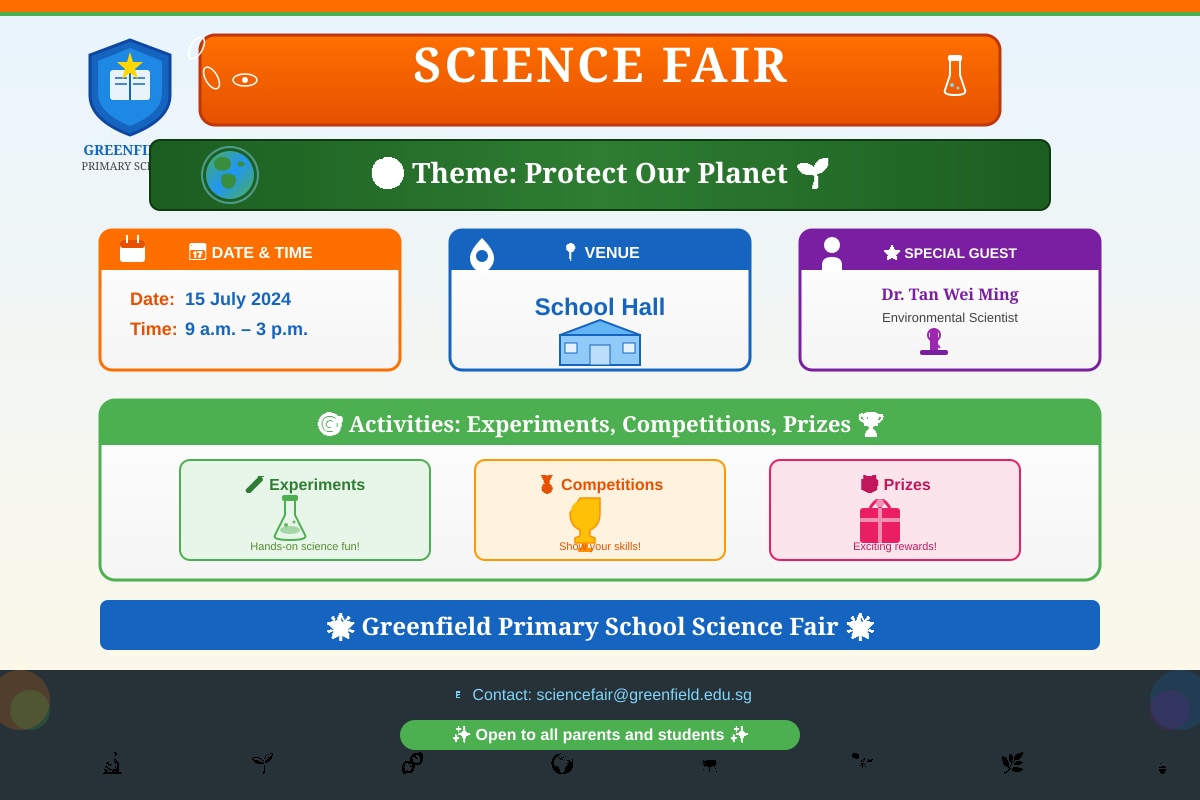
Expected visual from poster: See <image_placeholder> Q16-fig1 for verification. The poster should show: Greenfield Primary School Science Fair, Date 15 July 2024, Time 9 a.m. – 3 p.m., Venue School Hall, Theme "Protect Our Planet," Activities (Experiments, Competitions, Prizes), Special Guest Dr. Tan Wei Ming, contact email, open invitation to parents and students.
| Question | Answer | Marks | Explanation |
|---|---|---|---|
| 16 | Protect Our Planet (accept exact theme wording from poster) | 1 | Locate explicit label "Theme" on poster; direct retrieval of stated information |
| 17 | 6 hours / From 9 a.m. to 3 p.m. / Six hours | 1 | Calculate duration: 3 p.m. − 9 a.m. = 6 hours; accept either calculation or time range |
| 18 | Dr. Tan Wei Ming (accept "Dr. Tan") | 1 | Direct retrieval from "Special Guest" label; must include title and full name or accepted short form |
| 19 | It means anyone (both parents and students) can attend / it is not restricted / no one is excluded / everyone is welcome | 1 | Inference from "open to all" phrasing—understanding inclusive invitation language; must show grasp that there are no restrictions on attendance |
BOOKLET B ANSWERS (30 marks)
Section C: Grammar Cloze and Editing (10 marks)
Questions 20–24: Grammar Cloze (5 marks)
| Question | Answer | Explanation | Marks |
|---|---|---|---|
| 20 | shone | Past tense narrative ("It was a hot Saturday morning"). "Shone" = irregular past tense of "shine." Context of completed past action requires Simple Past. | 1 |
| 21 | walked | Past tense narrative continues; "walked" = regular Simple Past. Compound subject "Maya and her brother" = plural, but this does not affect past tense form. | 1 |
| 22 | approached | Past tense narrative; "approached" = regular Simple Past. | 1 |
| 23 | was | Past tense narrative; "it" (singular, referring to "court") required singular verb. "Was occupied" = passive voice, Simple Past. | 1 |
| 24 | suggested | Past tense narrative maintained throughout; "suggested" = regular Simple Past. Also can be identified: reported/sequence of past events. | 1 |
Question 25: Sentence Synthesis (2 marks)
Answer: Mrs. Lim baked the cookies which/that the children enjoyed eating. / The cookies which/that Mrs. Lim baked were enjoyed by the children. (accept equivalent relative clause structures)
| Marking Breakdown | |
|---|---|
| 2 marks | Correct relative pronoun (which/that) + grammatically complete sentence with original meaning preserved |
| 1 mark | Relative pronoun attempted but sentence has grammatical error OR meaning slightly altered |
| 0 marks | No relative pronoun used or sentence structure unrecognisable |
Teaching Note: A relative pronoun (who, which, that, whom, whose) introduces a clause that gives more information about a noun. Here "which" or "that" refers back to "cookies" (thing = which/that; person = who/whom). The second sentence becomes a descriptive clause attached to the first.
Question 26: Reported Speech (3 marks)
Answer: The librarian told/asked/advised Tom to close the door behind him. / The librarian said that Tom should close the door behind him.
| Marking Breakdown | |
|---|---|
| 3 marks | Correct tense backshift OR appropriate verb change (told/asked) + correct infinitive "to close" OR "that" clause with "should/could" + pronoun change "him" |
| 2 marks | One element incorrect (e.g., "said Tom to close" — wrong reporting verb; or "behind you" — pronoun not shifted) |
| 1 mark | Two elements incorrect but attempt at transformation shows some understanding |
| 0 marks | Direct speech repeated with no changes or unrecognisable structure |
Step-by-step transformation:
- Reporting verb change: "said" → "told/asked/advised" (imperative/request pattern) OR "said that" with modal addition
- Remove quotation marks and comma
- Pronoun shift: "you" (Tom) → "him"
- Imperative → infinitive: "close" → "to close" (after told/asked)
Common error: Forgetting to change "you" to "him" (Tom is male; accept "him" based on name). If student uses "said" without "to," mark down: "said Tom to close" is grammatically incorrect.
Section D: Comprehension (20 marks)
Question 27 (2 marks)
Answer: Any two from: plastic bottles, food wrappers, cardboard boxes, debris (floating debris in pond)
| Marking | |
|---|---|
| 2 marks | Two correct items from paragraph 1 |
| 1 mark | One correct item |
| 0 marks | Items not found in text |
Evidence location: "The playground near her block was strewn with plastic bottles, food wrappers, and discarded cardboard boxes. Even the small pond... was murky with floating debris."
Question 28 (2 marks)
Answer: 1 mark for reason + 1 mark for explanation/elaboration
Suggested answers:
- People are not working/studying on Saturday mornings (weekend), so more neighbours are available to help
- Saturday morning is cooler than afternoon (avoiding "sweltering" heat mentioned in paragraph 1), making physical work more comfortable
- Children and adults are free from school and work commitments
Teaching note: Question asks "why do you think" = inference based on textual clues ("sweltering afternoon" in opening; common sense about weekend availability). Reward logical, text-supported inference.
Question 29 (2 marks)
Answer: Any two from:
- She crafted colourful posters/pinned posters on notice boards
- She shared messages in her family's chat group
- She wrote the details on the posters (time, place, invitation)
| Marking | |
|---|---|
| 2 marks | Two distinct methods clearly stated |
| 1 mark | One method stated, or two methods merged unclearly |
| 0 marks | Methods not found in text |
Evidence: "Aisyah crafted colourful posters... She pinned these posters on every notice board... and shared messages in her family's chat group."
Question 30 (2 marks)
Answer: 1 mark for meaning of "transformed" + 1 mark for link to specific change
Suggested answer: "Transformed" means changed completely/dramatically. The playground went from being dirty and litter-filled to clean with visible grass and a sparkling pond—like it became a completely different place.
Teaching note: Students must explain both the word meaning (complete change) and contextual application (specific before/after contrast from text). Accept equivalent phrasing that captures dramatic positive change.
Question 31 (2 marks)
Answer: 1 mark for identifying heavy items + 1 mark for explaining why wheelbarrow helped
Suggested answer: The wheelbarrow was important because they collected heavy items (debris, collected litter, recyclables). It allowed them to move many heavy things at once without carrying them by hand, making the work faster and easier.
Evidence: "Mr. Kumar... brought a wheelbarrow to collect the heavier items."
Question 32 (2 marks)
Answer: 1 mark for identifying feeling + 1 mark for elaboration/explanation
Suggested answers:
- She was surprised/unexpectedly pleased because she had low expectations
- She felt uncertain/anxious/worried beforehand that nobody would come
- She was modest/humble about her ability to influence others
Evidence + inference: "I never thought so many people would help" → past expectation was pessimistic; actual outcome exceeded expectation. The word "never" emphasises her doubt was strong.
Question 33 (8 marks)
Marking descriptors for sustained response:
| Level | Marks | Description |
|---|---|---|
| Excellent | 7–8 | Detailed explanation with 2–3 clear pieces of evidence showing chain of Aisyah's actions → immediate results → lasting change; strong causal linking; understanding of "lasting" = continues beyond one event |
| Good | 5–6 | Solid explanation with 2 pieces of evidence; some causal linking; recognises lasting change but may not fully explain sustainability |
| Developing | 3–4 | 1–2 pieces of evidence; some explanation of how Aisyah made a difference; weak or missing explanation of "lasting" nature |
| Basic | 1–2 | General statement about Aisyah helping; little or no specific evidence; no understanding of "lasting" |
| No reward | 0 | Irrelevant, copied without understanding, or no attempt |
Model answer structure for full marks:
Point 1: Initial action sparked participation (2 marks)
Aisyah noticed the problem and took initiative by organising the clean-up (evidence: "decided to organise," "crafted colourful posters," "pinned these posters"). This personal action inspired others—eight neighbours joined who might not have acted without her leadership.
Point 2: Immediate tangible results demonstrated possibility (2 marks)
The team worked for three hours and transformed the playground (evidence: "grass was visible again," "pond sparkled," "new recycling bin"). These visible results showed residents what collective action could achieve, making the abstract idea of community improvement concrete and motivating.
Point 3: Institutionalisation/monthly commitment (2 marks)
The key to "lasting change" was the residents' decision to continue: "they agreed to organise monthly clean-ups" (evidence). Aisyah's one-time event became a recurring community practice, ensuring ongoing maintenance rather than a single fix.
Point 4: Character reflection/sustainability insight (2 marks)
Aisyah's realisation—"when you care about something and ask others nicely, they often want to help too"—shows she developed replicable social skills. This understanding means she (and readers/neighbours) can replicate community engagement for future environmental or social needs.
Total evidence points needed: At minimum, demonstrate: (a) Aisyah's specific actions, (b) direct results that inspired others, (c) explicit "lasting" mechanism (monthly agreement), and (d) broader transferable principle or community empowerment.
END OF ANSWER KEY
Total Marks Verification:
- Booklet A: 20 marks ✓
- Booklet B: 30 marks ✓
- Grand Total: 50 marks ✓