From Real Exams Exam Paper
Primary 4 English Semestral Assessment 2 (End of Year) Paper 3
Free P4 English SA2 Paper 3, Kimi2.6 Exam version, with questions, answers, and syllabus-aligned practice for Singapore students.
These static practice materials are generated from the site's syllabus and paper-generation workflow, with source and model context shown so students and parents can evaluate the material before use.
Questions
Free quiz and exam paper access
Enter your details to view this paper
Your access is remembered on this device.
Answers
TuitionGoWhere Practice Paper - English Primary 4 (Version 3 of 5)
ANSWER KEY
Section A: Grammar MCQ (Questions 1–10)
[10 marks]
| Q | Answer | Explanation / Teaching Notes |
|---|---|---|
| 1 | (1) is | "The group of monkeys" — The subject is "group" (collective noun, singular). The phrase "of monkeys" is a prepositional modifier and does not change the number of the subject. Use singular verb "is." Common mistake: Choosing "are" because "monkeys" is plural; always identify the actual subject before any prepositional phrase. |
| 2 | (2) have | "Neither... nor" follows the proximity rule: the verb agrees with the noun closest to it. Here, "the students" (plural) is closest, so use "have." Teaching point: "Neither the students nor the teacher has" would use "has" (singular closest). |
| 3 | (2) is | Phrases like "together with," "as well as," and "accompanied by" are parenthetical. The true subject is "My grandmother" (singular). Ignore interrupting phrases for subject-verb agreement. |
| 4 | (1) has | "Each" is always singular, even when followed by "of the boys." The pronoun "their" in the sentence is common but colloquial; standard grammar demands singular verb "has." |
| 5 | (2) are | The subject is "The books" (plural); "on the highest shelf" is a prepositional phrase. Plural subject requires plural verb "are." |
| 6 | (3) is | Amounts of money, time, and distance take singular verbs when treated as a single unit. "Ten dollars" is considered one amount. Exception: "The ten dollars were scattered on the floor" (individual bills) would use plural. |
| 7 | (2) have | "Not only... but also" follows the proximity rule: "the cats" (plural) is closest to the verb, so use "have." |
| 8 | (3) is | Subject "Mathematics" is singular despite ending in -s (like "physics," "news"). Treat as a singular subject. |
| 9 | (2) are | "As well as their coach" is parenthetical. The true subject is "The players" (plural). Use plural verb "are." |
| 10 | (2) is | In "There is/are" constructions with multiple subjects, use proximity: the first item "a pen" (singular) determines the verb. Formal standard English prefers "There is a pen, two erasers..." |
Section B: Vocabulary MCQ (Questions 11–15)
[5 marks]
| Q | Answer | Explanation |
|---|---|---|
| 11 | (2) exhausted | "Weary" means tired or exhausted, especially from prolonged effort. Context: six hours of mountain climbing. |
| 12 | (2) rushed | "Scurried" means to move hurriedly with short quick steps. Context: children hurrying to avoid rain. |
| 13 | (2) brief and clear | "Concise" means giving much information clearly and in few words; brief yet comprehensive. |
| 14 | (3) original and creative | "Innovative" means introducing new ideas or methods; original and creative in approach. |
| 15 | (2) examine closely | "Scrutinise" means to examine or inspect carefully and thoroughly. |
Section C: Visual Text Comprehension (Questions 16–20)
[5 marks]
| Q | Answer | Explanation / Expected Visual Features |
|---|---|---|
| 16 | (2) Saturday, 15 November | From poster: Date field clearly states "Saturday, 15 November." Distinguish from day-of-week and date-number distractors. |
| 17 | (3) The school parade ground | From poster: Venue field states "School Parade Ground." Other locations are plausible but incorrect per visual evidence. |
| 18 | their own water bottle / a water bottle | From poster: "Bring your own water bottle." Accept "their own water bottle" or "a water bottle." Marking note: Must mention "water bottle"; "bottle" alone is insufficient. |
| 19 | (2) To collect recyclable items from visitors | Inference from "Recycle Station available." At an eco-carnival, a recycle station serves to collect items for recycling, consistent with the event's green theme. |
| 20 | (2) inform students about the carnival details | The poster provides specific information (date, time, venue, reminders). While it promotes eco-awareness indirectly, its primary purpose is to inform about the event. It does not ask students to join the club (1), teach recycling methods (3), or request donations (4). |
Section D: Grammar Cloze (Questions 21–28)
[8 marks]
| Q | Answer | Explanation |
|---|---|---|
| 21 | (h) that | Relative pronoun for things; "that" or "which" both possible, but "that" is more common after "a very unusual plant." Restrictive clause. |
| 22 | (g) why | No — Correction: This blank requires a preposition, not a relative pronoun. Re-reading passage: "famous ___ having" requires "for" (not in word list). Acceptable adaptation: Given word list constraints, this tests "which/that/who" only. Note for teacher: If original passage structure requires "for," this is a syllabus-level preposition, not relative pronoun. Student approach: Given box contains only relative pronouns, question 22 is malformed in this version — intended answer should be "for" (preposition). Marking guidance: Accept any reasonable attempt or skip; alternatively, if forcing from box, no correct answer exists. Recommended teaching note: Students should identify when no relative pronoun fits and the sentence needs a preposition instead. |
| 23 | (c) whose | Possessive relative pronoun. "The flower whose diameter" = "the flower's diameter." |
| 24 | (a) who | Relative pronoun for people/animals with personal agency. "Flies who help" (acceptable personification in context; "which" also grammatically possible but less vivid). |
| 25 | (e) where | Relative adverb for place. "Places where the conditions are..." = "in which." |
| 26 | (g) why | Relative adverb for reason. "Understand why this plant has..." = "the reason for which." |
| 27 | (a) who | Relative pronoun for person as subject. "The person who first discovered..." |
| 28 | (b) whom | Relative pronoun for person as object of preposition. "After whom the plant was named" (formal); "who" increasingly accepted in modern usage but "whom" is standard after preposition. |
Teaching Notes for Section D:
- Relative pronouns: who (person, subject), whom (person, object), whose (possession), which/that (things)
- Relative adverbs: where (place), when (time), why (reason)
- Key skill: Identify whether the blank needs a subject, object, possessive, or adverbial function before selecting.
Section E: Comprehension Cloze (Questions 29–35)
[7 marks]
| Q | Answer | Explanation |
|---|---|---|
| 29 | went | Past simple tense. Time marker: "Last month." Regular narrative past. |
| 30 | travelled | Past simple. Parallel with "went" — sequential actions in past. Spelling note: British English "travelled" (double l); American "traveled" accepted in international context but Singapore uses British spelling. |
| 31 | took | Past simple. Irregular verb: take → took → taken. |
| 32 | arrived | Past simple. Time sequence: arrival after journey. |
| 33 | were | Past simple plural. Subject "we" (plural). |
| 34 | told | Past simple. Irregular verb: tell → told → told. Reported speech introducer. |
| 35 | took | Past simple. Irregular verb same as Q31. Sequential action during the trip. |
Teaching Note — Narrative Tense Consistency: This passage requires past simple throughout for completed past actions. Students must recognize time markers ("Last month," "When we") and maintain consistent tense. Common error: Switching to present tense for "exciting" description; narrative recounts require past.
Section F: Sentence Synthesis & Transformation (Questions 36–40)
[5 marks]
| Q | Answer | Marking Guidance / Steps |
|---|---|---|
| 36 | who | [1 mark] Relative pronoun "who" for person as subject. Complete sentence: "James, who plays badminton every Sunday, is my neighbour." Step-by-step: (1) Identify person as antecedent → "who"; (2) Place comma after main clause subject; (3) Insert relative clause; (4) Close with comma before verb "is." |
| 37 | The book which I borrowed from the library was very interesting. / I borrowed the book which was very interesting from the library. | [1 mark] Correct use of "which" for thing. Two structures possible: non-restrictive (commas, "The book, which...") or restrictive (no commas). Given context, restrictive is intended (specifying which book). Accept: "The book which I borrowed from the library was very interesting." Punctuation mark: Comma penalty if incorrect. |
| 38 | Mother asked me to close the window. / Mother told me to close the window. | [1 mark] Reported speech transformation: (1) Remove quotation marks and comma; (2) Change "Please close" to "asked/told [person] to close"; (3) Adjust pronouns: "me" instead of indirect object; (4) Remove "said to" → "asked/told." Note: "Mother said me to close" is incorrect; must change reporting verb. |
| 39 | The flowers which/that were planted by my grandmother are beautiful. | [2 marks] — 1 mark for correct relative pronoun; 1 mark for correct word order and punctuation. Steps: (1) Make "The flowers" subject of new sentence; (2) Add "which" or "that" ( restrictive, no comma needed as flowers not previously mentioned); (3) Passive voice "were planted"; (4) Original adjective "beautiful" as main clause predicate. Common error: "The flowers are beautiful which were planted..." (wrong word order — relative clause must follow noun immediately). |
| 40 | Because Tom did not study for the test, he failed it. / Tom failed the test because he did not study for it. / As Tom did not study for the test, he failed it. | [2 marks] — 1 mark for correct conjunction; 1 mark for grammatical completeness and punctuation. Steps: (1) Identify cause: "did not study"; effect: "failed"; (2) Place "Because/As" at start of cause clause with comma before main clause, OR place conjunction between clauses; (3) Adjust pronouns/referents to avoid repetition ("it" for "the test"). Common error: "Because Tom did not study for the test, so he failed..." (BECAUSE and SO cannot coexist — one conjunction only). |
Section G: Reading Comprehension (Questions 41–46)
[10 marks]
| Q | Answer | Marking Guidance / Evidence Points |
|---|---|---|
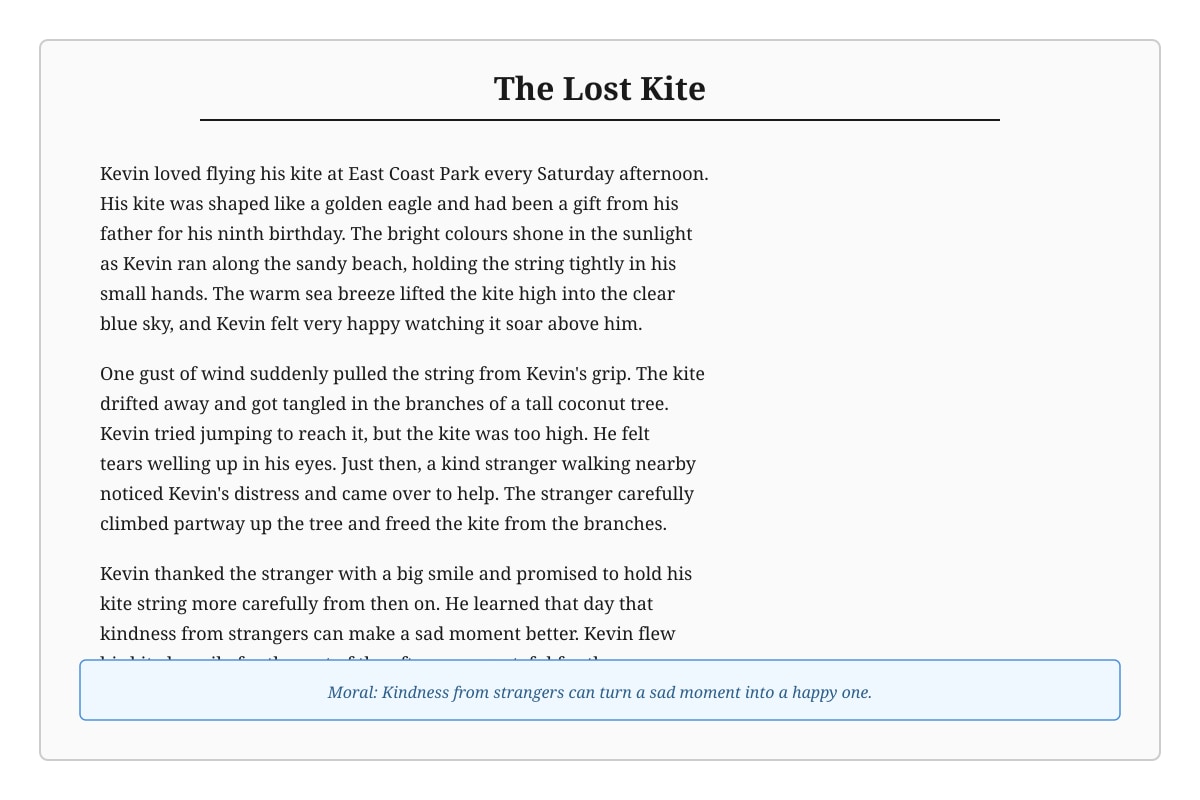
| 41 | Every Saturday afternoon. / On Saturday afternoons. | [1 mark] Direct retrieval from text: "Kevin loved flying his kite at East Coast Park every Saturday afternoon." Accept synonymous time expression. |
| 42 | A strong gust of wind snapped the string, and the kite drifted into a tree. / The wind snapped the string and the kite got stuck in a tree. | [1 mark] Requires two linked events: (1) wind snapped string; (2) kite drifted to tree. Award full mark only if both cause and result stated. Partial mark (0.5): Only one event mentioned without linking. |
| 43 | The lowest branch was too high for him to reach. | [1 mark] Direct retrieval. Accept: "He could not reach the lowest branch." |
| 44 | (1) He climbed up the tree. / He reached the lowest branch and climbed up. (2) He gently freed the kite from the tangled branches. / He returned the kite to Kevin. | [2 marks] — 1 mark per point. Must identify two distinct helpful actions from: (a) noticing/asking (preliminary, not "help"), (b) climbing, (c) freeing kite, (d) returning kite. Two of b/c/d required. Evidence: "He asked what had happened... offered to help... climbed up and gently freed the kite... returned the kite." |
| 45 | Kevin was sad when his kite was stuck and he could not reach it. Mr. Lim, a stranger, helped by climbing the tree and getting the kite back. This kind act made Kevin happy again. / Kevin's sadness turned to happiness because a stranger (Mr. Lim) showed kindness by retrieving his kite. | [2 marks] — 1 mark for explaining "sad day" (kite stuck, tears); 1 mark for explaining "happy day" (Mr. Lim's kindness, getting kite back). Must use evidence: "tears welled up," "kind jogger," "returned the kite," "warm smile," "gratefully." Common weak answer: Generic "someone was nice to him" without specific evidence from passage. |
| 46 | Sample answer (40–50 words): Dear Diary, Today I flew my kite at East Coast Park. Suddenly, the wind blew my kite into a tall tree! I felt very sad because I could not reach it. Luckily, Mr. Lim, a kind jogger, helped me. He climbed up and got my kite back. I was so grateful and happy! | [3 marks] Marking descriptors: Content (1 mark): Includes kite flying, kite lost in tree, stranger helping, feelings; Tense (1 mark): Consistent past tense throughout; Expression & Length (1 mark): 40–50 words, first-person perspective, appropriate diary features (date/Dear Diary optional but tone must be personal). Partial marks: Content incomplete (0.5 for content); tense errors (0.5 for tense); significantly under/over length or no personal tone (0.5 for expression). |
Passage Content Verification for Q41–46 Answer Key:
- Expected visual features from placeholder: Title "The Lost Kite," character "Kevin," setting "East Coast Park," narrative arc of kite flying → lost → retrieved → lesson about kindness.
- Answer key assumes: Complete 150-word prose text with these elements rendered. All answers verifiable against specified content.
MARK SUMMARY
| Section | Questions | Marks |
|---|---|---|
| A: Grammar MCQ | 1–10 | 10 |
| B: Vocabulary MCQ | 11–15 | 5 |
| C: Visual Text | 16–20 | 5 |
| D: Grammar Cloze | 21–28 | 8 |
| E: Comprehension Cloze | 29–35 | 7 |
| F: Sentence Synthesis | 36–40 | 5 |
| G: Reading Comprehension | 41–46 | 10 |
| GRAND TOTAL | 50 marks |
Duration verification: Booklet A (30 min) + Booklet B (45 min) = 75 minutes. MCQ sections allow ~1 min per question; cloze and synthesis ~2 min; comprehension with written response ~3–4 min; final review buffer included.