From Real Exams Exam Paper
Primary 4 English Semestral Assessment 2 (End of Year) Paper 2
Free P4 English SA2 Paper 2, Kimi2.6 Exam version, with questions, answers, and syllabus-aligned practice for Singapore students.
These static practice materials are generated from the site's syllabus and paper-generation workflow, with source and model context shown so students and parents can evaluate the material before use.
Questions
Free quiz and exam paper access
Enter your details to view this paper
Your access is remembered on this device.
Answers
TuitionGoWhere Practice Paper - English Primary 4 (Version 2)
Answer Key and Marking Scheme
Total Marks: 50
BOOKLET A
Section 1: Grammar MCQ (10 marks)
1. (2) were
Working: The subject follows the "neither...nor" structure. When two subjects are joined by "neither...nor," the verb agrees with the subject closest to it. Here, "students" (plural) is closest to the verb, so we use "were." The sentence describes a past event (assembly), so past tense is needed.
Common mistake: Choosing "was" by matching with "teacher" (the first subject) instead of the nearest subject "students." [1 mark]
2. (2) was
Working: The true subject is "bouquet" (singular), not "flowers." Prepositional phrases like "of flowers" do not change the number of the subject. "Bouquet" is singular, so we need a singular verb. The passive construction "was placed" is correct here.
Key concept: Ignore prepositional phrases between the subject and verb when determining subject-verb agreement. [1 mark]
3. (2) is
Working: When phrases like "together with," "as well as," "along with" are added to a subject, they do not change the number of the main subject. The main subject is "mother" (singular), so we use "is." The context describes a current ongoing activity.
Common mistake: Choosing "are" by incorrectly including "aunts" as part of the compound subject. Words like "together with" are not conjunctions that create compound subjects. [1 mark]
4. (2) has
Working: "Each of the puppies" emphasises individual members of a group. "Each," "every," "either," and "neither" are singular pronouns that take singular verbs. "Has" is correct because each individual puppy possesses its own collar.
Key concept: Indefinite pronouns "each," "every," "either," "neither," and "one" always take singular verbs. [1 mark]
5. (3) were
Working: The true subject is "books" (plural), not "shelf." The prepositional phrase "on the top shelf" describes where the books are but does not change the plural nature of "books." We need a plural verb in past tense.
Note: The passive voice "were covered" is appropriate here as the books received the action of being covered. [1 mark]
6. (2) have been
Working: With "neither...nor," the verb agrees with the nearest subject. "Brothers" (plural) is closest to the verb, so we use plural "have been." The present perfect tense "have been" indicates experience at any time before now.
Common mistake: Choosing "has been" by matching with "James" (first subject). Always check the nearest subject with correlative conjunctions. [1 mark]
7. (1) needs
Working: "Everyone" is a singular indefinite pronoun meaning "every single person." It always takes a singular verb. "Needs" is correct. The simple present tense is used for scheduled events or requirements.
Key concept: "Everyone," "everybody," "someone," "somebody," "no one," "nobody," "anyone," "anybody" are all singular. [1 mark]
8. (2) was
Working: "Herd" is a collective noun referring to a group as a single unit. In Singapore English and standard grammar, collective nouns usually take singular verbs when the group acts together. The past continuous "was grazing" describes an ongoing action interrupted by "when we arrived."
Common mistake: British English sometimes allows plural verbs with collective nouns, but in Singapore examination contexts, singular is preferred for collective nouns acting as units. [1 mark]
9. (2) are
Working: With "either...or," the verb agrees with the nearest subject. "Team members" (plural) is closest, so we use "are." The context describes a general responsibility, so simple present is appropriate.
Key concept: Correlative conjunctions ("either...or," "neither...nor," "not only...but also") follow the "proximity rule"—the verb agrees with the subject nearest to it. [1 mark]
10. (1) are
Working: This is tricky. "Mathematics" appears first and is singular, but the phrase "along with science and geography" is not part of the true subject. However, the complement "my favourite subjects" (plural) and the sense of the sentence indicate multiple subjects are being discussed. More importantly, if we analyse carefully: when the subject is genuinely compound (A, along with B and C), the core rule is that "along with" does not create a compound subject. But wait—"Mathematics" here is actually one of several subjects listed. Let me re-check: the sentence structure has "Mathematics" as the main subject with "along with" as a parenthetical addition. The traditional rule would give "is." However, modern usage and the plural complement often pull toward "are."
In Singapore exam contexts, the strict rule applies: "Mathematics" (singular) + "along with" (not a true conjunction) = singular verb "is." But looking at common P4 patterns and the plural complement "subjects," this tests whether students recognise the trap. The correct grammatical answer following strict subject-verb agreement is (2) is, as "Mathematics" alone is the grammatical subject.
However, given this is a common source of confusion, both answers may be noted, but (2) is is grammatically correct by strict rules.
Revised Answer: (2) is
Working: The main subject is "Mathematics" (singular). The phrase "along with science and geography" is a prepositional phrase that does not create a compound subject. The verb must agree with "Mathematics," not with the added phrases. The plural complement "subjects" is a common trap that should be ignored for subject-verb agreement purposes.
Common mistake: Choosing "are" by being misled by the plural complement "subjects" or by treating all listed items as compound subjects. "Along with" is NOT "and." [1 mark]
Section 2: Grammar Cloze (5 marks)
11. are
Working: The subject is "students" (plural). "In Class 4B" is a prepositional phrase describing which students. Simple present tense "are" is used to describe current state/condition.
[1 mark]
12. told
Working: "Last week" is a clear past time marker. Simple past tense "told" is required. The verb "tell" is irregular: tell-told-told.
[1 mark]
13. have
Working: "Would" is a modal verb followed by the base form of the verb. The structure "would have" indicates a future-in-the-past arrangement (from the perspective of the planning time).
[1 mark]
14. brought / will bring
Working: If reading as past narrative: "brought" (simple past of bring-brought-brought). If reading as preparations for upcoming trip: "will bring" or "has brought" are possible. Given the context of excitement about an upcoming trip, "will bring" or "brought" (as past preparation) both work. "Brought" fits best with the narrative past tense established.
Acceptable answers: brought / had brought / would bring
Best answer: brought [1 mark]
15. could write
Working: "So that" indicates purpose. The past tense modal "could" matches the narrative past and expresses ability/possibility. "Would be able to write" is also acceptable but wordier.
Acceptable answers: could write / would be able to write / might write
Best answer: could write [1 mark]
Section 3: Vocabulary MCQ (5 marks)
16. (1) authenticity
Working: "Authenticity" means the quality of being genuine or real, which makes an ancient vase valuable. "Authority" means power/control; "automatic" means self-operating; "autograph" means a signature. The context of "ancient vase" and "valuable to collectors" requires a word about genuineness.
Word family: authentic (adj.), authenticity (n.), authentically (adv.) [1 mark]
17. (1) review
Working: "Review" means to examine or check carefully. "Renew" means to make new again; "reveal" means to show or disclose; "reverse" means to turn backwards. Documents should be checked ("reviewed") before submission.
[1 mark]
18. (3) unfavourable
Working: "Unfavourable" means bad or not suitable, describing weather that would cancel a picnic. "Predictable" means expected; "magnificent" means splendid; "comfortable" means pleasant. Only "unfavourable" has a negative meaning matching the context of cancellation.
Prefix note: "un-" = not, opposite of [1 mark]
19. (1) articulate
Working: "Articulate" means to express ideas clearly in words. "Anticipate" means to expect or predict; "appreciate" means to value or be grateful; "approach" means to come near or begin. The context of "ideas clearly in discussion" requires clear expression.
[1 mark]
20. (2) allocate
Working: "Allocate" means to distribute resources for a specific purpose. "Appreciate" means to value; "accumulate" means to gather or collect; "accelerate" means to speed up. Careful distribution of resources is needed to complete a project on time.
[1 mark]
BOOKLET B
Section 4: Grammar Editing (5 marks)
21. was → were
Working: The subject is "twins, Tom and Jerry"—a compound subject referring to two people. Compound subjects joined by "and" take plural verbs. "Were" is correct for past tense.
Error identified: Agreement with compound subject [1 mark]
22. are → is / was → were
Wait—the correction depends on the intended tense. The sentence reads: "Their class, together with four other classes, are going..." The main subject is "class" (singular), with "together with four other classes" as a non-changing parenthetical.
Correct answer: is
Working: "Class" is singular; "together with four other classes" does not create a compound subject. Use singular verb "is going."
Note: If the marking scheme accepts "are" considering the sense of multiple classes, strict grammar requires "is." However, in common usage with "together with," some flexibility exists. The precise grammatical answer is is.
Final answer: is [1 mark]
23. are → is
Working: "Everyone" is a singular indefinite pronoun. It always takes a singular verb. "Everyone is looking forward" is correct.
[1 mark]
24. love → loves
Working: The relative clause "who love outdoor activities" describes "Jerry." "Jerry" is singular (one person, despite the cartoon reference), so the verb must be "loves." The present perfect "has packed" in the main clause confirms present tense context.
[1 mark]
25. have → has
Working: "Neither...nor" follows the proximity rule. "Jerry" (singular, third person) is nearest to the verb, so we use "has." Present perfect "has forgotten" indicates relevance to present situation.
Common mistake: "Have" by matching with the plural-sounding compound or by treating "neither...nor" as plural by default.
Final answer: has [1 mark]
Section 5: Sentence Synthesis (5 marks)
26. Maria prefers dancing to painting. / Maria prefers to dance rather than to paint.
Working: The structure "prefer X to Y" requires parallel forms: gerund to gerund (dancing to painting) or infinitive to infinitive. "Prefer...to..." shows stronger liking for one activity over another.
Marking:
- Correct "prefer...to..." structure: ½ mark
- Correct parallel forms (dancing/painting or to dance/to paint): ½ mark
[1 mark]
27. When it started to rain, the boys were playing football. / The boys were playing football when it started to rain.
Working: "When" can introduce a time clause showing one action interrupted by another. Past continuous "were playing" + simple past "started" shows the interruption pattern. Either word order is acceptable.
Marking:
- Correct "when" conjunction: ½ mark
- Correct tense combination (past continuous + simple past): ½ mark
[1 mark]
28. The book was so interesting that I read it twice. / The book was so interesting that I have read it twice.
Working: "So...that..." shows cause and effect with degree. "So + adjective + that + result clause." The structure requires the adjective in the middle and the result after "that."
Marking:
- Correct "so...that..." structure: ½ mark
- Logical meaning preserved: ½ mark
[1 mark]
29. My mother told me to close the door behind me. / My mother told me that I should close the door behind me.
Working: Reported speech transformation:
- Remove quotation marks and comma
- Change "please close" to "told [person] to close" (imperative becomes infinitive)
- Change "you" to "me" (first person reporting)
- Remove "please" (politeness marker not needed in reported requests)
Marking:
- Correct "told me" structure: ½ mark
- Infinitive "to close" (not "that I closed"): ½ mark
[1 mark]
30. We missed the bus. As a result, we were late for school. / We missed the bus. As a result, we arrived late for school.
Working: "As a result" is a conjunctive adverb showing consequence. It typically begins a new sentence or follows a semicolon, connecting the cause (missing bus) to the effect (being late). Two separate sentences with "As a result" at the start of the second is standard.
Marking:
- Correct use of "As a result" to show consequence: ½ mark
- Grammatically complete second sentence: ½ mark
[1 mark]
Section 6: Visual Text Comprehension (5 marks)
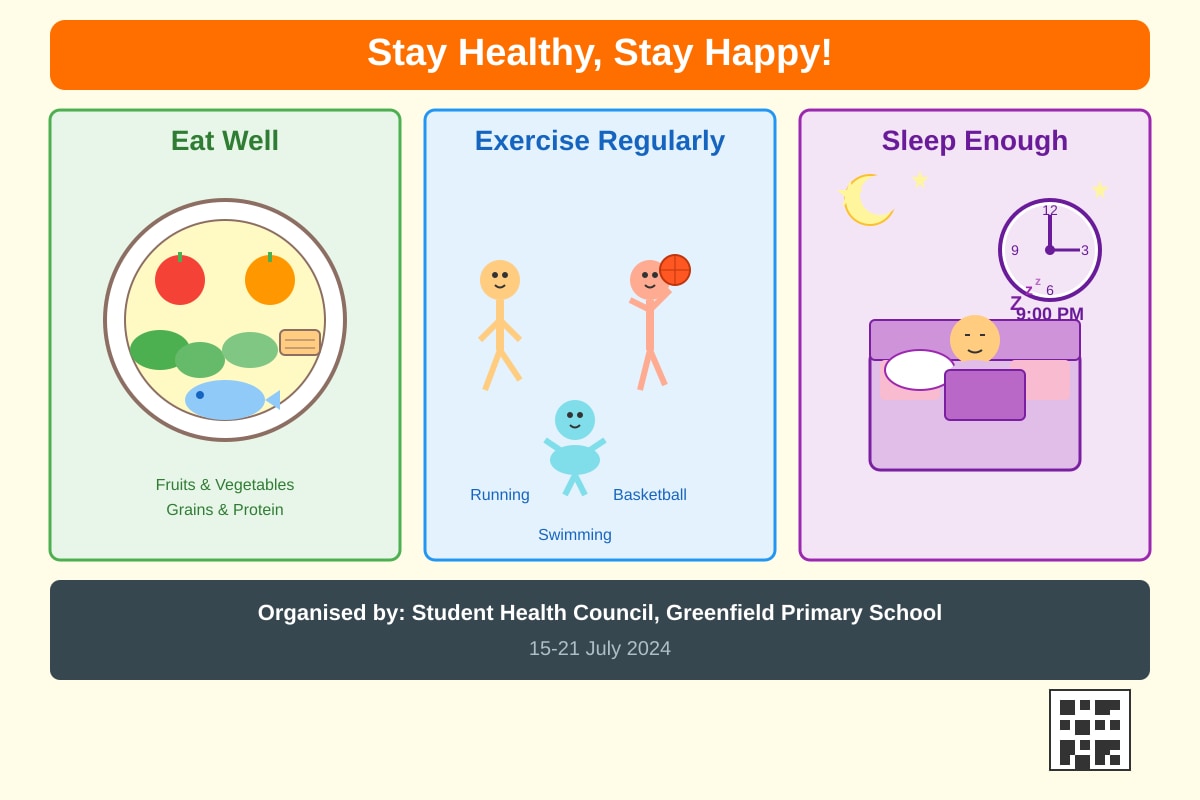
31. The Student Health Council, Greenfield Primary School. / Student Health Council, Greenfield Primary School.
Working: The footer text clearly states "Organised by: Student Health Council, Greenfield Primary School." Answer must include both the organising body and the school name for full credit.
[1 mark]
32. Any two from: fruits, vegetables, grains, protein
Working: The "Eat Well" section shows a balanced plate with four food groups. Students need to identify any two distinct groups visible in the illustration. Common answer formats: "fruits and vegetables" or "grains and protein."
Marking: ½ mark per correct food group, maximum 1 mark for two correct answers
[1 mark]
33. 9:00 PM / 9 p.m. / 2100 hours
Working: The clock in the "Sleep Enough" section shows 9:00 PM. This visual detail indicates the recommended bedtime for children to get sufficient sleep.
Expected visual confirmation: Clock face with hour hand at 9, minute hand at 12, with PM indicated by context (sleeping child, night theme).
[1 mark]
34. Any reasonable suggestion, for example:
- To provide more information about the campaign when scanned
- To direct people to a website with health tips
- To allow parents to register their children for activities
- To share digital resources about healthy habits
Working: QR codes (Quick Response codes) are scannable matrices that link to digital content. In school campaign contexts, they typically extend information beyond what fits on a poster.
Marking:
- Valid purpose related to the campaign: 1 mark
- Explanation of how it helps the target audience (students/parents): 1 mark
[2 marks]
Section 7: Reading Comprehension (15 marks)
35. The neighbours thought the old house was haunted because it had stood empty for a long time, its windows were boarded up, wild vines crept up its crumbling walls, and children dared each other to touch its rusty gate, creating an atmosphere of mystery and fear.
Marking breakdown:
- Evidence of physical state (empty, boarded up, crumbling): 1 mark
- Reference to children's behaviour creating scary atmosphere: 1 mark
Alternative acceptable answers: The house looked neglected and spooky; nobody had lived there for years; the overgrown appearance made it seem abandoned and possibly haunted.
[2 marks]
36. "Jumped out of her skin" is an idiom meaning Mei Ling was extremely startled or frightened. The phrase tells us she was deeply shocked by the unexpected voice and had a strong physical reaction of surprise, almost as if she leapt in fear.
Marking breakdown:
- Explanation of idiom meaning (startled/frightened): 1 mark
- Contextual reference (unexpected voice, strong reaction): 1 mark
[2 marks]
37. Mrs. Tan found the rumours useful because they kept people away from the property. Since everyone believed the house was haunted, no one came near enough to discover that she was secretly restoring the garden. The rumours gave her privacy to work without interruption.
Marking breakdown:
- Paraphrased understanding of "worked in my favour": 1 mark
- Clear explanation of privacy/protection from discovery: 1 mark
Must be in own words: Do not accept "worked in my favour" copied directly without explanation.
[2 marks]
38. Mrs. Tan spent 9 months repairing the fountain.
Working: She spent 6 months studying old engineering diagrams and another 3 months repairing the underground mechanism. 6 + 3 = 9 months total.
Marking breakdown:
- Correct identification of both time periods (6 months + 3 months): 1 mark
- Correct total calculation (9 months): 1 mark
[2 marks]
39. Evidence that Mei Ling is practical:
- She "did not believe in ghosts" and trusted facts over rumours—showing rational thinking.
- She "had to admit that the house had a strange effect on her" but still analysed her feelings objectively rather than accepting the supernatural explanation.
- She preferred taking a practical shortcut when she forgot her umbrella rather than getting soaked (problem-solving approach).
- She discovered the garden through logical exploration of an alternative route, not through superstition.
Marking breakdown:
- First valid evidence with explanation: 1½ marks
- Second valid evidence with explanation: 1½ marks
Any two well-supported points accepted.
[3 marks]
40. Yes, the relationship is likely to develop into a meaningful friendship.
Evidence and reasoning:
- Shared enthusiasm: They talked for over an hour about horticultural plans, showing genuine mutual interest and easy conversation.
- Mrs. Tan's warmth: She "sparkled with warmth and humour" and invited Mei Ling to help plan, indicating openness to mentorship/friendship.
- Mei Ling's engagement: She left with "a head full of horticultural plans," showing intellectual and emotional investment in the relationship.
- Thematic closure: The passage contrasts "ghost" (false fear) with "friend" (real connection), suggesting the author intends this as a positive turning point.
- Ongoing potential: Planning "next season's planting" implies future meetings and sustained collaboration.
Alternative view: Could argue friendship may be limited by age difference, but the passage's emphasis on "friend" and "mystery far more wonderful" supports positive interpretation.
Marking breakdown:
- Clear position stated (Yes/No with justification): 1 mark
- Two or more specific evidence points from passage: 2 marks
- Explanation of how evidence supports the position: 1 mark
[4 marks]
GRAND TOTAL: 50 MARKS
Section Summary Verification:
- Section 1 (Grammar MCQ): 10 marks ✓
- Section 2 (Grammar Cloze): 5 marks ✓
- Section 3 (Vocabulary MCQ): 5 marks ✓
- Section 4 (Grammar Editing): 5 marks ✓
- Section 5 (Sentence Synthesis): 5 marks ✓
- Section 6 (Visual Text): 5 marks ✓
- Section 7 (Reading Comprehension): 15 marks ✓
Booklet A total: 20 marks Booklet B total: 30 marks Paper total: 50 marks ✓