From Real Exams Exam Paper
Primary 4 English Semestral Assessment 2 (End of Year) Paper 1
Free P4 English SA2 Paper 1, Kimi2.6 Exam version, with questions, answers, and syllabus-aligned practice for Singapore students.
These static practice materials are generated from the site's syllabus and paper-generation workflow, with source and model context shown so students and parents can evaluate the material before use.
Questions
Free quiz and exam paper access
Enter your details to view this paper
Your access is remembered on this device.
Answers
Answer Key: SA2 Paper 1 - Version 1 of 5
English Primary 4 Grammar (Booklet A)
Section A: Grammar MCQ (10 marks)
| Question | Answer | Explanation |
|---|---|---|
| 1 | (2) are practising; work | Relative clause rule: "who" refers to "pupils" (plural), so "are practising." "Work" matches plural subject. Common mistake: Choosing (3) — "works" is singular. |
| 2 | (1) nor; knows | Correlative conjunction: "Neither...nor" is the correct pair. With "neither...nor," use subject-verb agreement with the closer noun ("teacher" = singular → "knows"). Key rule: "Or" never pairs with "neither." |
| 3 | (1) has | "Each of" rule: "Each" is singular despite "five team members" being plural. The subject is "each," requiring singular verb "has." Common mistake: Choosing "have" because of the plural phrase nearby. |
| 4 | (1) is | Intervening phrase rule: "together with my aunts" is parenthetical. The true subject is "My mother" (singular). Ignore phrases like "together with," "as well as," "accompanied by." |
| 5 | (3) is; have | Collective noun + present perfect: "Flock" as a unit → singular "is." "They" refers to individual birds → plural "have." Note: British English may use "are" for collective nouns, but Singapore exams prefer singular when acting as one unit. |
| 6 | (2) had; started | Past perfect tense: "By the time" + past action ("reached") requires earlier past action → "had started." The movie started BEFORE they arrived. Timeline: started → then reached. |
| 7 | (3) had; would | Second conditional: Unreal present/future situation. If + past simple... would + base verb. "If I had... I would build" = hypothetical (I don't have a million dollars). Common mistake: (1) "have...would" mixes 1st/2nd conditional incorrectly. |
| 8 | (1) to walk; taking | Parallel structure with "prefer": "prefer to [verb] rather than [verb+ing]" OR "prefer [verb+ing] to [verb+ing]." Given "rather than" follows, use "to walk...taking" (standard Singapore exam pattern). Note: Some grammars accept "walking; take" with "to" before "taking," but "rather than taking" is tested here. |
| 9 | (1) hand in; told | Phrasal verb + reported speech: "Hand in" = submit (correct). "Told" needs direct object ("told his class"). "Said to his class" is awkward; "said" alone lacks object. Key: "hand in project" not "hand to project." |
| 10 | (1) did; also | Inversion with "Not only": "Not only" + auxiliary verb + subject + main verb... "but... also." Correct: "Not only did Jamie finish, but she also helped." Inversion rule: When "Not only" begins sentence, use question word order (auxiliary before subject). |
Section B: Grammar Cloze (5 marks)
| Question | Answer | Full Sentence | Grammar Rule |
|---|---|---|---|
| 11 | (1) was | "The annual school fair was held last Saturday." | Past tense + passive voice ("held" = past participle). Singular subject "fair." |
| 12 | (2) was | "It was one of the most successful events..." | Past tense. "It" = singular. Superlative structure. |
| 13 | (2) were | "Many parents and former students were invited..." | Plural compound subject. Passive voice past tense. |
| 14 | (1) was | "The principal, together with several teachers, was present..." | Singular subject "principal." Ignore "together with several teachers." |
| 15 | (2) were | "There were numerous stalls..." | Plural subject "stalls." Past tense (consistent with narrative). |
Marking note: Award 1 mark each for correct answer number written in brackets.
Section C: Visual Text Comprehension (5 marks)
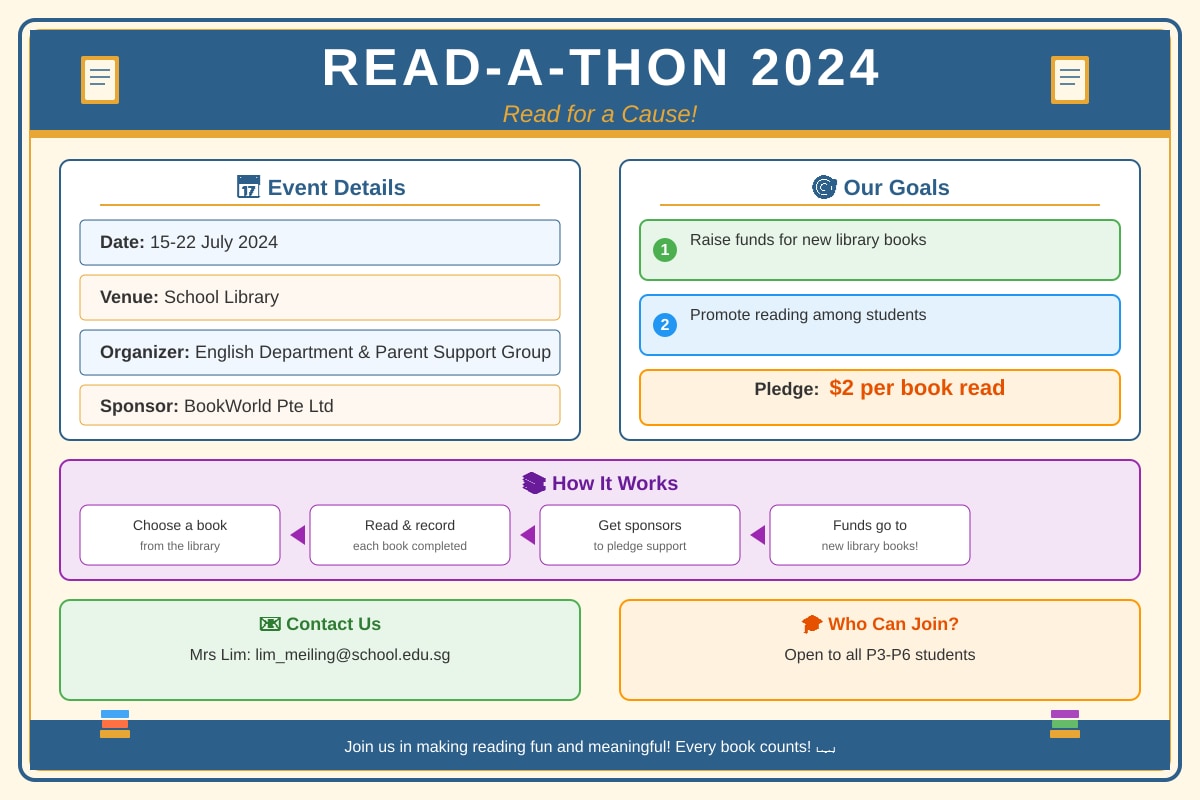
16. The organizers are the English Department and Parent Support Group / English Department & Parent Support Group (1 mark)
Acceptable: Either full names or with ampersand as shown on poster. Must identify BOTH organizations.
17. 2 per book / two dollars (1 mark)
Key skill: Extract specific numerical information from visual text. Students must distinguish pledge amount from other numbers.
18.
- The school library (receives new books / funds for books)
- Underprivileged students or future readers (implied by "new library books" for school use)
OR accept: BookWorld Pte Ltd (gets publicity) if student reasons that sponsors benefit from visibility. (1 mark)
Marking guidance: Award mark for any two plausible beneficiary groups with reasoning traceable to poster text. "The school" alone is insufficient—must specify library/books.
19. Any ONE reasonable inference:
- Email allows written record of communication
- More convenient for busy parents who cannot call during working hours
- Easier to send details/attachments (like pledge forms)
- Phone line might be engaged/unavailable
- Email can be accessed and replied to at any time (1 mark)
Note: Must be inference, not restated fact. Do not accept "because it's on the poster" or "Mrs Lim prefers email."
20. participated; raised (1 mark)
Grammar rules applied:
- Past tense "participated" = specific completed action "last year"
- Past tense "raised" = matching tense in coordinate clause describing simultaneous past event
Common error: "had participated; had raised" — past perfect unnecessary without sequence showing one action before another. Simple past is correct here.
Mark Allocation Summary
| Section | Marks |
|---|---|
| Section A (Q1–10) | 10 |
| Section B (Q11–15) | 5 |
| Section C (Q16–20) | 5 |
| Booklet A Total | 20 marks |
Booklet B (not generated in this version) would contain: Grammar Cloze (5), Vocabulary (5), Comprehension Open-Ended (15), Composition (10) = 30 marks
Grand Total: 50 marks
Teaching Notes for Common Grammar Patterns
| Pattern | When to Use | Example |
|---|---|---|
| Neither...nor | Two negative options; verb agrees with nearer subject | Neither the cat nor the dogs are here. |
| Each of + plural noun | Always singular verb | Each of the boys has a pen. |
| Together with / As well as | Ignore intervening phrase for S-V agreement | The teacher, with her students, is walking. |
| By the time + past | Earlier action needs past perfect | By the time I arrived, she had left. |
| If + past..., would | Unreal present/future (2nd conditional) | If I knew, I would tell you. |
| Not only...but also | Inversion required at sentence start | Not only did he sing, but he also danced. |