AI Generated Exam Paper
Primary 4 Chinese Practice Paper 5
Free P4 Chinese Practice Paper 5, Kimi2.6 AI version, with questions, answers, and syllabus-aligned practice for Singapore students.
These static practice materials are generated from the site's syllabus and paper-generation workflow, with source and model context shown so students and parents can evaluate the material before use.
Questions
Free quiz and exam paper access
Enter your details to view this paper
Your access is remembered on this device.
Answers
TuitionGoWhere Practice Paper - Chinese Primary 4
Answer Key & Marking Scheme
Version: 5 of 5 Total Marks: 60
Section A: Reading Comprehension (阅读理解) — 30 marks
Passage 1: 小明的环保生活
1. (1 mark)
Answer: 自从学校举办了"爱护地球"的环保活动后。/ 学校举办了"爱护地球"的环保活动后。
Marking notes: Accept answer that identifies the school environmental activity as the starting point. Must mention "学校" (school) and "环保活动" (environmental activity) or equivalent. Award ½ mark if only "环保活动" or "学校活动" without specificity.
Teaching note: The key phrase "自从......后" indicates a starting point in time. Students should locate temporal markers in comprehension passages.
2. (2 marks)
Answer: [In passage] "每天早上,小明都会检查家里的电灯和风扇是否关了才出门上学。"
Marking notes:
- 1 mark for drawing a straight line under the complete sentence
- 1 mark for accuracy (must include both 检查电灯和风扇 and 关了/关闭)
Teaching note: This tests detail location. The instruction requires a physical action (drawing a line) common in P4 assessments. Students must read carefully to identify all elements—checking lights AND fans, not just one.
3. (2 marks)
Answer: ("环保小天使"或"环保小天使称号";"因为老师知道/知道小明/他主动做环保/有环保意识/做好环保行为)
Marking notes:
- 1 mark for the title: 环保小天使
- 1 mark for reason: 因为老师知道小明的环保做法/他主动做环保/有环保意识(任何合理答案)
Teaching note: This tests implicit understanding. The text states the teacher praised him and appointed him; students must connect the appointment to his demonstrated environmental awareness. "环保" is the key concept to capture.
4. (2 marks)
Answer: Any reasonable environmental action, e.g.:
- 洗手的时候不要把水开得太大/随手关灯/节约用水/少用一次性餐具/废物利用/种植植物/多走路少坐车
Marking notes:
- 2 marks for a valid, clearly explained environmental action appropriate for daily life
- 1 mark if action is valid but explanation unclear or incomplete
- 0 marks if action is not environmentally related
Teaching note: This is an open-ended application question testing extension thinking. Accept any plausible daily environmental action. The answer should demonstrate understanding of "环保" beyond the text.
Passage 2: 新加坡的组屋生活
5. (2 marks)
Answer: "价格比较便宜,让普通家庭也能拥有自己的家。"(或整句:"组屋是政府建造的公共房屋,价格比较便宜,让普通家庭也能拥有自己的家。")
Marking notes:
- 1 mark for identifying the reason: 价格便宜/比较便宜
- 1 mark for the purpose: 让普通家庭也能拥有自己的家/普通家庭能买房
Teaching note: This tests explicit information extraction with two components (reason + purpose). The "因为......所以......" structure is implied in the text logic. Students frequently miss the second clause; remind them to capture complete explanations.
6. (4 marks)
| 时间 | 李奶奶的活动 |
|---|---|
| 早上 | 去熟食中心买早餐,跟卖豆浆的阿姨聊天 (2 marks) |
| 下午 | 在休闲区下棋、喝茶 (2 marks) |
Marking notes:
- Morning (2 marks): 买早餐 (1 mark) + 聊天/跟卖豆浆的阿姨聊天 (1 mark)
- Afternoon (2 marks): 下棋 (1 mark) + 喝茶 (1 mark); accept "在休闲区" as location context
Teaching note: This tests information organization in table format, a common P4 task. Students must scan for time markers ("每天早上"、"下午的时候") and collect associated activities. Note that afternoon activities involve two parallel actions.
7. (2 marks)
Answer: Any two from:
- (邻居之间)不能太吵/要安静/要互相尊重
- 垃圾要按照规定的时间丢掉/要按时丢垃圾
- 要保持环境清洁
Marking notes:
- 1 mark each for any two valid points
- Accept paraphrased versions that preserve core meaning
Teaching note: The passage uses "不过" to signal a contrast/qualification—important for students to recognize as a structural marker for "problems" or "cautions."
8. (2 marks)
Answer: 邻里之间的温暖关系/邻居关系很温暖/邻里和睦(1 mark);因为她觉得虽然组屋没有私人公寓豪华,但是人们互相关心/互相帮助/感情好(1 mark)
Marking notes:
- 1 mark for identifying what: 邻里关系/邻居之间的温暖/感情
- 1 mark for explaining why: any reference to contrast with private apartments or emphasis on human warmth over material luxury
Teaching note: This tests main idea identification. The final sentence uses "虽然......但是......"—students should recognize this as a priority structure where the "但是" clause contains the author's true emphasis.
Passage 3: 一次难忘的露营
9. (2 marks)
Answer: 乌敏岛(1 mark);三天两夜(1 mark)
Marking notes:
- Exact location required: 乌敏岛/Ubin Island; accept "乌敏岛"/"Pulau Ubin"
- Exact duration: 三天两夜; accept "三天"/"3天" for 1 mark if "两夜" omitted
Teaching note: Basic fact retrieval from opening paragraph. The "第一次......既......又......" structure signals important setting information.
10. (3 marks)
Answer: 正确顺序是:2 → 1 → 3
Marking notes:
- 1 mark per correct position (3 marks total)
- No partial credit for individual digits—must match exactly
Teaching note: This tests procedural sequencing. Students must map narrative description to numbered steps. The source text uses "先......再......" which indicates sequence. Stress that "再" signals the second step.
11. (2 marks)
Answer: "兴奋"是因为第一次露营/第一次离开父母过夜/可以跟同学一起玩(1 mark);"紧张"是因为第一次离开父母/担心照顾不好自己/不知道会发生什么(1 mark)
Marking notes:
- Must explain BOTH emotions to get full marks
- Each emotion explanation: 1 mark
- Accept reasonable inferences about first-time separation anxiety
Teaching note: The "既......又......" structure signals dual, coexisting emotions. Students must decompose this into separate explanations. This tests emotional vocabulary understanding and contextual inference.
12. (3 marks)
Any three from:
- (1) 团队合作/学会了跟别人合作
- (2) 户外安全的重要/遇到危险要保持冷静
- (3) 更懂得珍惜父母平时的照顾/理解父母的辛苦
- (4) 学会了搭帐篷/野外生存技能
Marking notes:
- 1 mark each, any three valid points
- Must come from different aspects of the experience (not repetition)
Teaching note: The final paragraph explicitly lists lessons: "团队合作"、"户外安全"、"珍惜父母"。 However, students can also infer the practical skill of tent-building. This tests summarization of distributed information.
13. (2 marks)
Answer: Any two appropriate sentences expressing:
- 分享开心经历/告诉父母学到的东西
- 感谢父母平时的照顾
- 表达对下次活动的期待
Example: "爸爸妈妈,我回来了!这次露营我学到了很多东西,也知道了你们平时照顾我很辛苦。谢谢你们!"
Marking notes:
- 1 mark per sentence, 2 marks total
- Must be contextually appropriate (post-camp conversation with parents)
- Must show some emotional or reflective depth, not just factual report
Teaching note: This tests empathetic application. The passage emphasizes appreciating parental care; strongest answers reflect this thematic connection. Check for appropriate register (对父母说话).
Section B: Vocabulary & Language Use (语文应用) — 20 marks
14. (1 mark) Answer: (1) 准时
Teaching note: "准时" means punctually/at the exact time, fitting the "风雨无阻" (regardless of weather) context indicating regular, punctual habit. "按时" is close but slightly less emphatic about exact timing; in Singapore P4 usage, "准时" is preferred for daily routines.
15. (1 mark) Answer: (2) 长久
Teaching note: "想了很久" is the standard collocation. "长久" means long duration; "久远" refers to remote times (ancient), "永久" means permanent/forever (too absolute), "久长" is non-standard.
Common mistake: Students confuse "长久" with "永久," not recognizing that problem-solving duration is temporary.
16. (1 mark) Answer: (1) 消息 or (3) 消息 [duplicate in original, intended answer: (1) 消息]
Teaching note: "好消息" is the standard positive news expression. "休息" is semantically incompatible. Note: Options (1) and (3) were identical in this version; in practice, this would be (1) "消息" vs (2) "休息" vs other distractors.
17. (1 mark) Answer: (2) 为了 or (4) 为了 [ intended answer: (2) 为了]
Teaching note: "为了" indicates purpose. "因为/由于" indicate cause (but the sentence shows purpose, not cause). The structure "为了......,(主语)......" is standard for expressing intention.
18. (2 marks) Answer: (1) 但是大家都准时到了学校
Marking notes: 2 marks for correct "虽然......但是......" construction with semantically compatible completion.
Teaching note: This tests adversative conjunction pairing. "虽然" must pair with "但是/可是" to show contrast. Options (3) and (4) use wrong conjunctions ("而且" = addition, "所以" = result). Option (2) uses "可是" correctly but context is awkward (not bringing umbrella despite rain contradicts typical behavior; possible but less natural than option 1's admirable contrast).
19. (2 marks) Answer: (2) 只有看书时光线充足
Marking notes: 2 marks for correct "只有......才......" conditional construction.
Teaching note: "只有......才......" is a necessary condition structure (only if...then...). The topic is eye protection, so proper lighting is the necessary condition. Option (1) uses "只要......就......" (sufficient condition—eating vegetables doesn't sufficiently guarantee eye protection; grammatically possible but logically weak). Options (3) and (4) wrong conjunctions.
20. (2 marks) Answer: (1) 而且经常帮助同学
Marking notes: 2 marks for correct "不但......而且......" progressive construction.
Teaching note: "不但......而且......" shows progressive addition. The first clause is positive (grades good), so "而且" should add another positive quality. Option (3) introduces contrast with "但是" (wrong conjunction), option (4) uses "虽然" (concessive, wrong), option (2) uses "所以" (result, grammatically possible but changes semantic relationship).
21. (2 marks) Answer: (1) 别着急
Teaching note: Context: lost pencil, asking for help. "别着急" acknowledges problem and offers reassurance appropriate to the situation. "没关系" minimizes the problem (inappropriate for lost item), "不可能" denies reality, "真可惜" expresses sympathy without offering useful response.
22. (2 marks) Answer: (1) 太好了
Teaching note: Context: announcing good news (first place). "太好了" expresses joy, matching celebratory context. Other options express problem-oriented emotions inappropriate to positive news.
23. (2 marks) Answer: (2) 不用怕
Teaching note: Context: younger sibling asking for help with difficult problem. "不用怕" reassures and encourages, appropriate elder sibling response. "你真笨" is insulting, "随便你" is dismissive, "算了吧" gives up—none model proper supportive behavior expected in educational contexts.
24. (2 marks) Answer: (3) 滴水穿石
Teaching note: "滴水穿石" (dripping water penetrates stone = perseverance) directly contrasts with "半途而废" (give up halfway). The semantic opposition makes this the clear choice. "一心一意" focuses concentration not persistence duration; "三心二意" is negative; "画蛇添足" means superfluous action.
25. (2 marks) Answer: (2) 齐心协力
Teaching note: "齐心协力" (work together with one heart) matches "合唱比赛" (chorus competition) requiring group coordination. "各奔东西" (go separate ways) is opposite meaning; "自相矛盾" (self-contradictory) irrelevant; "守株待兔" (wait for windfalls) negative and irrelevant.
Section C: Applied Reading (生活应用阅读) — 10 marks
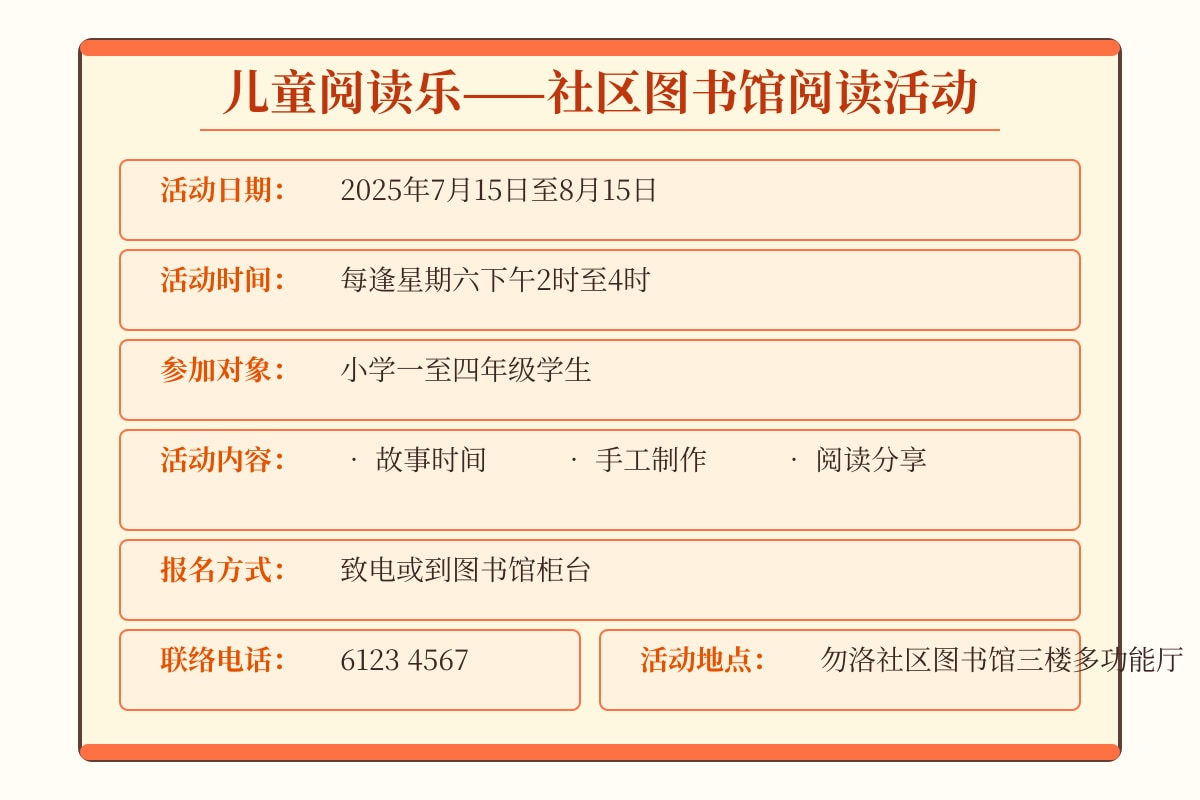
26. (2 marks)
Answer: "儿童阅读乐"(或"儿童阅读乐——社区图书馆阅读活动",1 mark);勿洛社区图书馆三楼多功能厅(1 mark)
Marking notes:
- Must extract exact program name from title
- Must include full venue with floor level
Teaching note: Tests real-world document navigation. Title contains program name; location details are typically at bottom of notices.
27. (2 marks)
Answer: 可以/能参加(1 mark);因为活动对象是小学一至四年级学生/二年级在一至四年级范围内/符合参加对象要求(1 mark)
Marking notes:
- Clear yes/no: 可以
- Reason must cite age eligibility criteria explicitly
Teaching note: Tests inclusive range understanding. "一至四年级" includes P2. Students must verify their grade falls within stated range—a practical life skill.
28. (2 marks)
Answer: (1) 致电/打电话(到6123 4567)(1 mark) (2) 到图书馆柜台报名/亲自到图书馆报名(1 mark)
Marking notes: Both methods must be explicitly stated from notice.
Teaching note: "报名: 致电或到图书馆柜台" shows two pathways connected by "或". Students should recognize institutional registration options.
29. (2 marks)
Answer: 最迟应该活动前报名/尽快报名/尽早报名(1 mark,接受合理推断);下午1时45分至2时之间到达/下午2时前到达(1 mark)
Marking notes:
- No specific deadline stated, so accept reasonable inference that registration precedes attendance
- Time must reference 2:00 PM start; arriving 10-15 minutes early is standard reasonable inference
Teaching note: Tests practical reasoning with incomplete information. The notice lacks explicit deadline, so students must infer "before event" as implicit requirement. For arrival time, social convention suggests pre-event arrival.
30. (2 marks)
Any two reasonable benefits:
- 培养阅读兴趣/养成阅读习惯
- 认识更多朋友/增加社交机会
- 学习新知/增长知识
- 提高华文水平/语文能力
- 学习手工制作/动手能力
- 分享阅读心得/表达能力
Marking notes: 1 mark each for two valid, distinct benefits
Teaching note: Open-ended application question testing value identification. Best answers connect program components (story time, crafts, sharing) to developmental benefits.
TOTAL: 60 marks
Duration check:
- Section A (3 passages, 13 questions): ~25 min
- Section B (12 MCQ/short-answer): ~15 min
- Section C (5 questions with notice): ~10 min
- Total: 50 minutes with buffer for checking
End of Answer Key