AI Generated Exam Paper
Primary 4 Chinese Practice Paper 3
Free P4 Chinese Practice Paper 3, Nemo3 AI version, with questions, answers, and syllabus-aligned practice for Singapore students.
These static practice materials are generated from the site's syllabus and paper-generation workflow, with source and model context shown so students and parents can evaluate the material before use.
Questions
Free quiz and exam paper access
Enter your details to view this paper
Your access is remembered on this device.
Answers
TuitionGoWhere Practice Paper - Chinese Primary 4 (Answer Key)
Subject: Chinese
Level: Primary 4
Paper: Practice Paper 3 (Reading Focus) — Version 3
Total Marks: 60
Section A: Language Application (语文应用) [15 marks]
Part 1: Character Recognition (辨字测验) [5 marks]
| Qn | Answer | Explanation |
|---|---|---|
| 1 | (1) 带 | **带 ** means "to take/bring someone". **戴 ** means "to wear (accessories)". **待 ** means "to treat/wait". **殆 ** means "almost/dangerous". Context: Mother took sister to doctor. |
| 2 | (1) 难 | **难 ** means "difficult". **南 ** = south, **男 ** = male, **囊 ** = bag. Context: Math question too difficult. |
| 3 | (2) 教 | **教 ** means "to teach/instruct". **叫 ** = call, **觉 ** = sleep/feel, **角 ** = corner/angle. Context: Teacher instructed us. |
| 4 | (2) 返 | **返 ** means "to return". **反 ** = opposite, **饭 ** = rice/meal, **犯 ** = commit crime. Context: Father returns home late. |
| 5 | (3) 尽 | **尽 ** means "to do one's best/utmost". **今 ** = today, **斤 ** = catty (weight), **进 ** = enter. Context: Do our utmost to protect environment. |
Common Mistakes: Confusing homophones (同音字) like 带/戴, 难/南. Always check context and meaning.
Part 2: Word Choice (词语选择) [5 marks]
| Qn | Answer | Explanation |
|---|---|---|
| 6 | (2) 坚持 | **坚持 ** = persist/continue steadily. **偶尔 ** = occasionally, **突然 ** = suddenly, **刚刚 ** = just now. Context: "从不间断" (never stops) → persists. |
| 7 | (1) 非常 | **非常 ** = very/extremely (adverb of degree). **好像 ** = seem, **也许 ** = perhaps, **大概 ** = probably. Context: Intensifies "有趣". |
| 8 | (3) 虽然 | **虽然 ** = although (concession). **因为/所以 ** = because/so (cause-effect). **如果 ** = if (condition). Context: "还是" (still) signals concession. |
| 9 | (1) 先 | **先 ** = first/then. Sequence: 先收拾,才看电视. **后 ** = after, **再 ** = then/again, **又 ** = also/again. |
| 10 | (3) 肯 | **肯 ** = willing to (volition). **能 ** = can (ability), **会 ** = will/know how, **要 ** = want to/must. Context: "只要……就……" structure requires willingness. |
Teaching Note: Distinguish word classes: adverbs (非常、坚持), conjunctions (虽然、如果), modal verbs (肯、能、会、要).
Part 3: Sentence Construction (句子搭配与改写) [5 marks]
| Qn | Correct Order | Correct Sentence | Explanation |
|---|---|---|---|
| 11 | 3 → 5 → 4 → 2 → 1 | 爷爷每天早上喜欢在公园里散步。 | Subject (爷爷) + Time (每天早上) + Verb (喜欢) + Location (在公园里) + Action (散步) |
| 12 | 4 → 1 → 2 → 3 → 5 | 明明因为生病所以没来上学。 | Subject + 因为 + Reason + 所以 + Result |
| 13 | 1 → 2 → 5 → 3 → 4 | 如果不努力考试就考不好。 | 如果 + Condition + Subject + 就 + Result |
| 14 | 5 → 1 → 2 → 3 → 4 | 这位同学不但聪明而且很用功。 | Subject + 不但 + Quality 1 + 而且 + Quality 2 |
| 15 | 1 → 2 → 3 → 4 → 5 | 尽管天气很热但是运动员们依然坚持训练。 | 尽管 + Concession + 但是 + Subject + Adverb + Verb |
Marking: 1 mark each for fully correct order. No partial marks.
Section B: Reading Comprehension I (阅读理解一) [20 marks]
Questions 16–20: Multiple Choice [5 marks]
| Qn | Answer | Explanation |
|---|---|---|
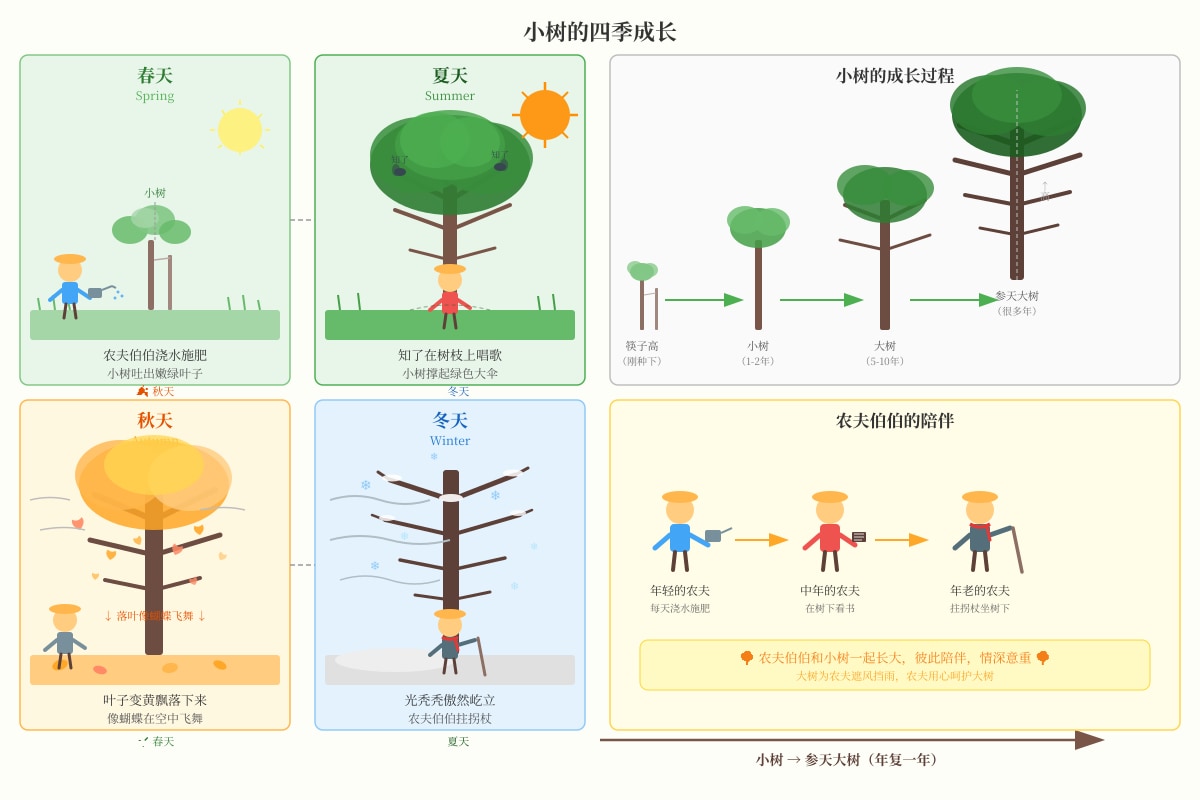
| 16 | (2) | Text: "生怕风吹倒了它" (afraid wind would blow it down). Stake and rope provide support. |
| 17 | (1) | "知了在树枝上唱歌,小树为它们撑起了一把绿伞" → "它们" refers to cicadas (知了). |
| 18 | (1) | "像蝴蝶在空中飞舞" uses 比喻 (simile): falling leaves compared to butterflies dancing. |
| 19 | (3) | Text shows farmer aged ("老了、拄拐杖") but still sits under tree ("依然喜欢坐在大树下"). They accompanied each other for years. |
| 20 | (2) | "大树没有倒下,依然坚强地站在那里" + "仿佛在说:别担心,我还能撑下去" → resilience, strong vitality. |
Questions 21–25: Open-Ended [15 marks]
21. [2 marks]
Answer: 筷子那么高、细细的、摇摇欲坠 (any two)
Marking: 1 mark per correct phrase. Must be from text.
22. [4 marks]
Answer:
- 春天:吐出嫩绿的叶子,在阳光下闪闪发光。
- 夏天:为知了撑起绿伞(树荫)。
- 秋天:叶子变黄、飘落,像蝴蝶飞舞。
- 冬天:光秃秃、挺直腰杆、在寒风中傲然屹立。
Marking: 1 mark per season with correct description. Order must be correct.
23. [3 marks]
Answer (any three):
- 每天早晚浇水
- 施肥
- 松土
- 立木桩、用绳子绑住小树防风
Marking: 1 mark per distinct care action.
24. [3 marks]
Answer:
- 修辞手法:拟人
- 表达效果:将大树拟人化,赋予它人的意志和语言,生动形象地表现了大树顽强不屈、坚韧不拔的生命力,增强了文章的感染力。
Marking: 1 mark for identifying 拟人, 2 marks for explaining effect (personification + vivid portrayal of resilience + emotional impact).
25. [3 marks]
Answer (sample):
这篇短文通过小树在农夫伯伯悉心照料下,经历四季风雨、从幼苗长成参天大树,再在暴风雨中虽折枝不倒的过程,告诉我们:成长需要呵护与坚持,生命贵在坚韧不拔。农夫伯伯的细心照料和大树的顽强生命力相互呼应,让我懂得了无论遇到多大困难,都要像大树一样挺直腰杆、坚强面对。
Marking:
- 1 mark: Identifies core message (growth needs care + resilience)
- 1 mark: References text evidence (farmer's care, tree's resilience)
- 1 mark: Personal reflection/connection
Section C: Reading Comprehension II (阅读理解二) [25 marks]
Questions 26–30: Multiple Choice [5 marks]
| Qn | Answer | Explanation |
|---|---|---|
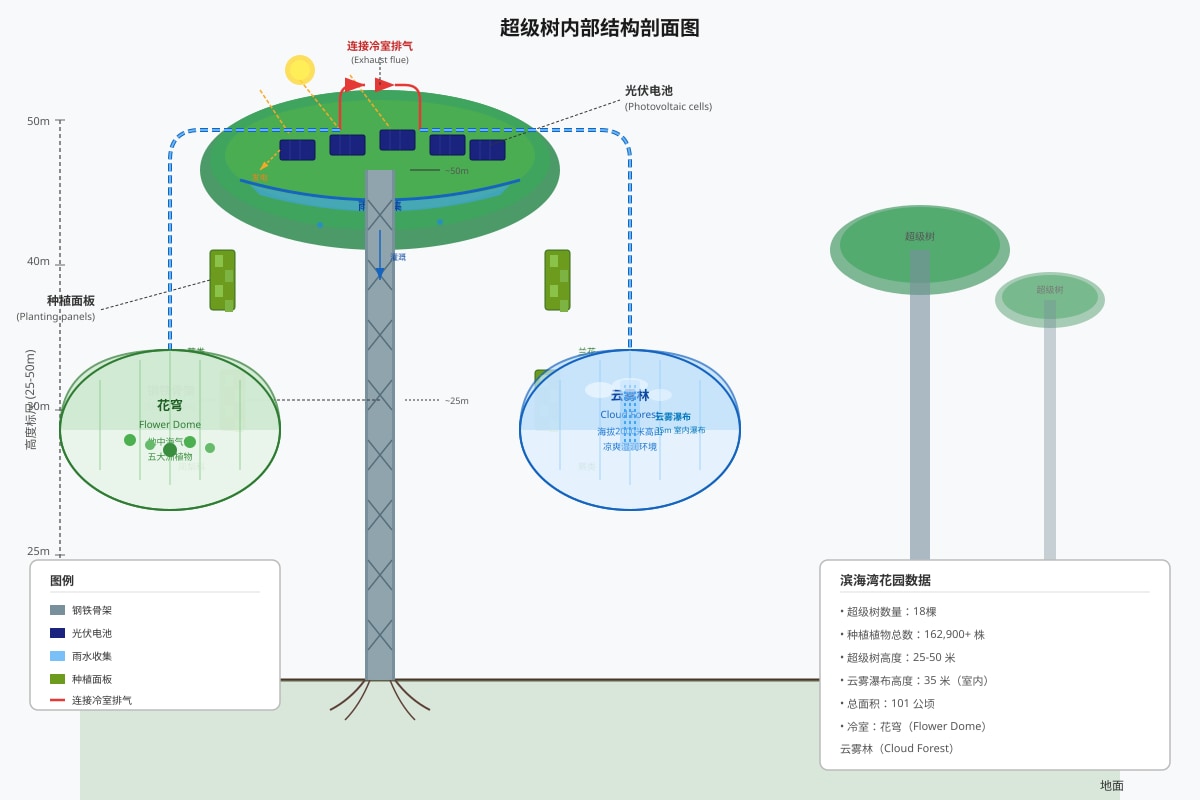
| 26 | (1) | Text: "由滨海南园、滨海东园和滨海中园三部分组成". |
| 27 | (3) | Text: "18棵高达25至50米的超级树". |
| 28 | (4) | Text lists: rainwater collection, solar power, exhaust flues. Growing food crops not mentioned. |
| 29 | (3) | Text: "模拟了海拔2000米高山的凉爽湿润环境". |
| 30 | (2) | Text: "实现城市发展与自然保护的和谐共生". |
Questions 31–36: Open-Ended [20 marks]
31. [3 marks]
Answer:
白天,超级树像一群巨人守护着花园;夜晚,它们换上绚丽的灯光,配合音乐表演《花园狂想曲》,宛如一场梦幻的光影秀。
Marking:
- 1 mark: Daytime description (giants guarding garden)
- 1 mark: Nighttime description (lights + music show)
- 1 mark: Contrast clearly expressed (day vs night)
32. [3 marks]
Answer (any three, 1 mark each):
- 树冠收集雨水,用于灌溉和喷泉。
- 部分超级树安装光伏电池,吸收太阳能发电,为园区照明提供能源。
- 连接花穹和云雾林,作为排气烟囱,帮助冷室维持适宜温湿度。
Marking: 1 mark per distinct eco-function with correct detail.
33. [4 marks]
Answer:
| 花穹 | 云雾林 | |
|---|---|---|
| 模拟气候 | 地中海和半干旱地区气候 | 海拔2000米高山的凉爽湿润环境 |
| 展示内容 | 来自五大洲的植物 | 珍稀高山植物、全球最高室内瀑布(35米云雾瀑布) |
| 体验方式 | 参观展示 | 乘电梯到"失落世界"和"水晶山",云端漫步 |
| Marking: 1 mark per correct comparison point (climate, exhibits, experience). 4 marks for at least 3 clear differences. |
34. [4 marks]
Answer:
"城市发展与自然保护和谐共生"是指:在有限土地上建设城市设施的同时,通过科技创新(如超级树的光伏发电、雨水循环、冷室排气系统)和生态设计(如模拟不同气候保育植物、建设传统园林),保护甚至丰富自然生态。例子:超级树既是景观又发电收水;冷室保育全球植物;传统园林传承文化。城市没牺牲绿化,反而创造了更多绿色空间。
Marking:
- 1 mark: Explains meaning of "harmonious coexistence"
- 1 mark: Cites tech innovation example (Super Tree eco-functions)
- 1 mark: Cites ecological design example (conservatories/traditional gardens)
- 1 mark: Synthesises — city development enhanced, not compromised, nature
35. [3 marks]
Answer:
反映了新加坡多元种族、多元文化的社会特色。意义:让不同族群在共同空间看到自己的文化根脉,增强归属感和文化自信;同时促进跨文化理解与欣赏,体现种族和谐与国家认同。
Marking:
- 1 mark: Identifies multiracial/multicultural character
- 1 mark: Explains significance (belonging, cross-cultural understanding, harmony)
- 1 mark: Links to national identity/social cohesion
36. [3 marks]
Answer (sample — Super Tree):
超级树如钢铁巨人矗立滨海,宛如守护花园的忠诚卫士。白天,它们张开枝臂拥抱阳光,贪婪吸吮甘露;夜晚,它们披上霓虹华服,随乐翩跹起舞。蕨类、兰花、凤梨,层层叠叠,织就绿色锦绣;光伏、雨水、排气,项项功能,诠释科技智慧。这不仅是树,更是新加坡“城市在花园中”的生动注脚。
Marking (holistic):
- 1 mark: Uses at least 3 rhetorical devices correctly (比喻: 钢铁巨人/卫士; 拟人: 张开枝臂/拥抱/贪婪吸吮/披上/起舞; 排比: 蕨类/兰花/凤梨... 光伏/雨水/排气)
- 1 mark: Vivid, accurate description of Super Tree features
- 1 mark: Language fluent, ~100 characters, emotionally expressive
Common Errors to Avoid:
- Using only 1-2 rhetorical devices
- Description not matching Super Tree/Cloud Forest features
- Exceeding word limit significantly or too brief
Mark Summary
| Section | Questions | Marks |
|---|---|---|
| A: Language Application | 1–15 | 15 |
| B: Reading Comprehension I | 16–25 | 20 |
| C: Reading Comprehension II | 26–36 | 25 |
| Total | 36 questions | 60 |
General Marking Guidelines for Teachers
- Language Application (Section A): Strict accuracy for MCQ and sentence order. No partial marks.
- Reading Comprehension (Sections B & C):
- MCQ: 1 mark each, no half marks.
- Open-ended: Award marks for key content points. Accept synonymous phrasing if meaning is correct.
- For Q36 (creative writing): Use holistic band marking — Content/Accuracy (1), Rhetorical Devices (1), Language Quality (1).
- Character Writing: Accept both simplified and traditional characters if correctly formed (though P4 uses simplified).
- Completeness: Answers must be in complete sentences for open-ended questions. Deduct 0.5–1 mark for fragment answers at teacher's discretion.
End of Answer Key