From Real Exams Exam Paper
Primary 4 Chinese Semestral Assessment 2 (End of Year) Paper 3
Free P4 Chinese SA2 Paper 3, Nemo3 Exam version, with questions, answers, and syllabus-aligned practice for Singapore students.
These static practice materials are generated from the site's syllabus and paper-generation workflow, with source and model context shown so students and parents can evaluate the material before use.
Questions
Free quiz and exam paper access
Enter your details to view this paper
Your access is remembered on this device.
Answers
TuitionGoWhere Practice Paper - Chinese Primary 4 (SA2 Version 3) - Answer Key
Subject: Chinese
Level: Primary 4
Paper: SA2 (Version 3)
Total Marks: 60
部分一:语文应用 (Language Application) [20 marks]
Section A: 辨字测验 (Character Recognition) [4 marks]
-
Answer: (2) 闭 [1 mark]
Explanation: The sentence means "Mother was too tired, so she closed her eyes to rest for a while." The correct character is **闭 **, meaning "to close".- (1) 闷 = stuffy/bored
- (3) 闪 = flash/shine
- (4) 卫 = guard/defend
Common Mistake: Confusing similar-looking characters (形似字) or homophones. "闷" and "闭" both have the "门" radical but different meanings.
-
Answer: (2) 带 [1 mark]
Explanation: The sentence means "Father brought us to the park for a picnic." The correct character is **带 **, meaning "to bring/take along".- (1) 代 = generation/replace
- (3) 待 = treat/wait
- (4) 戴 = wear (on head/neck)
Common Mistake: Confusing homophones "带" and "戴". Remember: "带" (hand radical 扌) involves using hands to carry; "戴" (hand radical 戈) involves putting something on the head.
-
Answer: (3) 想 [1 mark]
Explanation: The sentence means "This Math question is too difficult, I can't think of the answer." The correct character is **想 **, meaning "to think/want".- (1) 向 = direction/towards
- (2) 相 = mutual/appearance
- (4) 箱 = box/trunk
Common Mistake: Confusing "想" (heart radical 心 - thinking with heart) with "向" (mouth radical 口 - facing a direction).
-
Answer: (1) 叫 [1 mark]
Explanation: The sentence means "The teacher told/instructed us to hand in homework on time." The correct character is **叫 **, meaning "to call/order/tell".- (2) 教 = teach
- (3) 觉 = sleep/feel
- (4) 角 = corner/angle
Common Mistake: Confusing "叫" (mouth radical 口 - verbal instruction) with "教" (hand radical 扌 - teaching by hand/action).
Section B: 词语选择 (Word Choice) [8 marks]
-
Answer: (4) 欣慰 [1 mark]
Explanation: "欣慰 " means "gratified/pleased", typically used when elders feel comforted by younger generation's achievements. "高兴/开心/愉快" are general happiness. The context (son doing well, mother's reaction) fits "欣慰" best. -
Answer: (1) 记得 [1 mark]
Explanation: "记得 " means "remember to (do something in future)". "记着" = keep in mind (continuous state). "记住" = commit to memory (result). "记起" = recall (past memory). The sentence is a reminder for future action. -
Answer: (2) 真的 [1 mark]
Explanation: "真的 " (adverb) = really/truly, modifies adjective "有趣". "真" is often used in spoken language but "真的" is standard written form here. "真正" = genuine (adjective). "真心" = sincere (adjective). -
Answer: (1) 不小心 [1 mark]
Explanation: "不小心 " = carelessly/accidentally. Context: fell and hurt knee.- (2) 不客气 = you're welcome / impolite
- (3) 不知不觉 = unconsciously/without realizing
- (4) 不可思议 = incredible/unimaginable
-
Answer: (2) 举办 [1 mark]
Explanation: "举办 " = hold/organize (an event, exhibition, performance). "举行" = hold (meeting, ceremony). "举起" = lift up. "举动" = action/behaviour (noun). A performance is "held" -> 举办. -
Answer: (1) 细心 [1 mark]
Explanation: "细心 " = careful/attentive (character trait). "仔细" = careful/thorough (action manner). "认真" = serious/conscientious (attitude). "专心" = focused/concentrated. Caring for a sick child all night shows a caring, attentive nature -> 细心. -
Answer: (3) 格外 [1 mark]
Explanation: "格外 " = especially/particularly (implies exceeding the usual degree, often with positive connotation). "非常/十分" = very. "特别" = special. "格外美丽" implies exceptionally beautiful, more than usual. -
Answer: (2) 必须 [1 mark]
Explanation: "必须 " = must (strong obligation/necessity). "应该" = should (moral duty). "可以" = can/may (permission/possibility). "可能" = maybe (probability). "不浪费每一粒米" is a strong rule -> 必须.
Section C: 词语搭配 (Word Collocation) [4 marks]
-
Answer: B (本) [1 mark]
Explanation: "本 " is the classifier for books (书). -
Answer: D (条) [1 mark]
Explanation: "条 " is the classifier for long, thin objects like fish (鱼), rivers, roads. -
Answer: C (头) [1 mark]
Explanation: "头 " is the classifier for large animals like cows (牛), horses, elephants. -
Answer: A (条) [1 mark]
Explanation: "条 " is the classifier for rivers (河), long winding things.
Section D: 句子仿写 (Sentence Construction) [4 marks]
-
Answer: 虽然爸爸很忙,但是他还是抽时间陪我做功课。 [2 marks]
Marking: 1 mark for correct "虽然……但是……" structure; 1 mark for correct meaning retention.
Teaching Note: "虽然……但是……" connects contrasting clauses. The subject (爸爸) can be placed after "虽然" or at start of second clause. "还是" keeps the concession. -
Answer: 因为这道题很难,所以我不会做。 [2 marks]
Marking: 1 mark for correct "因为……所以……" structure; 1 mark for correct meaning retention.
Teaching Note: "因为……所以……" shows cause and effect. Cause (难) -> Effect (不会做). Do not use "虽然/但是" here as there is no concession.
部分二:阅读理解一 (Reading Comprehension 1) [16 marks]
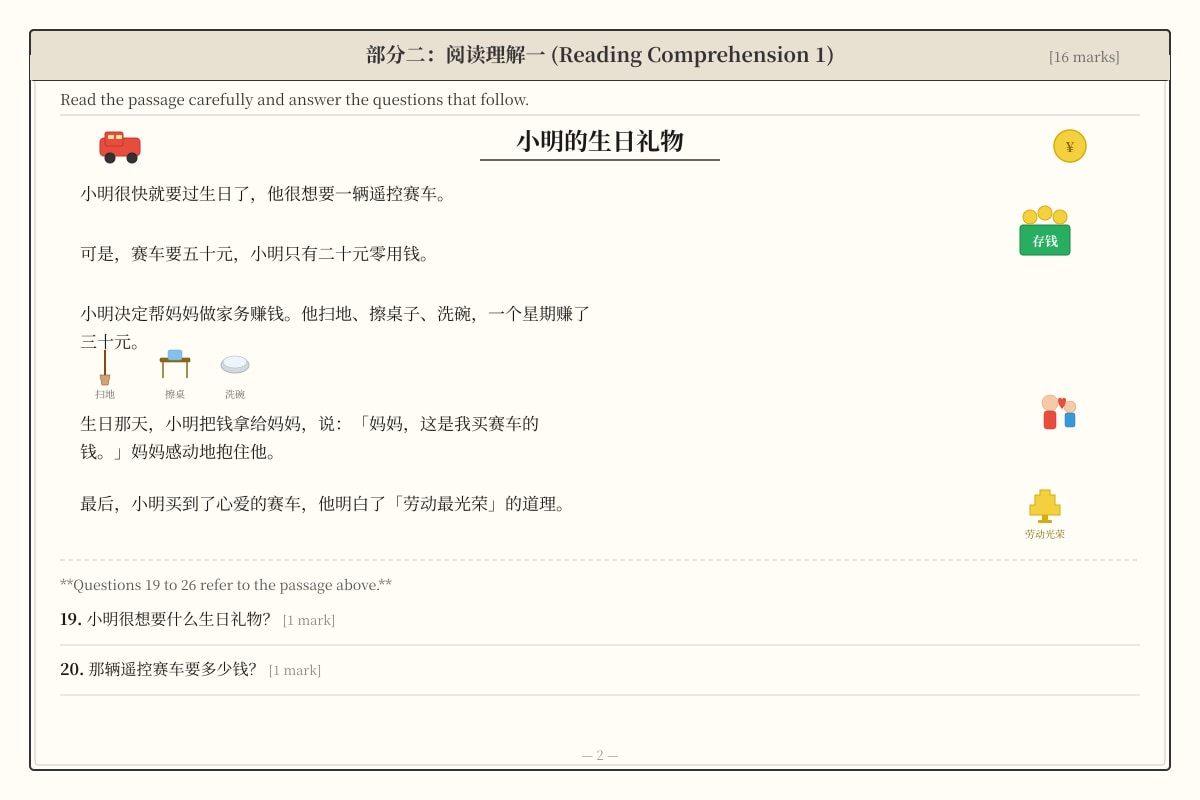
Passage: "小明的生日礼物" (Xiao Ming's Birthday Gift)
-
Answer: 一辆遥控赛车。 [1 mark]
Evidence: Paragraph 1: "他很想要一辆遥控赛车。" -
Answer: 五十元。 [1 mark]
Evidence: Paragraph 2: "赛车要五十元。" -
Answer: 二十元。 [1 mark]
Evidence: Paragraph 2: "小明只有二十元零用钱。" -
Answer: (Any two of the following) 扫地、擦桌子、洗碗。 [2 marks]
Marking: 1 mark per correct chore.
Evidence: Paragraph 3: "他扫地、擦桌子、洗碗。" -
Answer: 因为小明通过自己的劳动(做家务)赚钱买礼物,表现出懂事、独立、孝顺,妈妈为他的成长感到欣慰和感动。 [2 marks]
Marking: 1 mark for identifying the action (earning money through chores); 1 mark for explaining mother's emotional response (proud/touched by maturity).
Inference Skill: This is an inferential question. The text says "妈妈感动地抱住他" but doesn't explicitly say why. Students must infer from context: Xiao Ming didn't ask for money; he worked for it. -
Answer: 最后,小明买到了心爱的赛车。 [1 mark]
Evidence: Paragraph 5: "最后,小明买到了心爱的赛车。" (Must copy exact sentence). -
Answer: 劳动最光荣。 [1 mark]
Evidence: Paragraph 5: "他明白了『劳动最光荣』的道理。" -
Answer: 小明是一个懂事/勤劳/独立/孝顺的孩子。文中写道:「小明决定帮妈妈做家务赚钱。」或「他扫地、擦桌子、洗碗,一个星期赚了三十元。」 [2 marks]
Marking: 1 mark for appropriate adjective (懂事/勤劳/独立/孝顺); 1 mark for textual evidence (quote action).
Teaching Note: Answer must be supported by text. "聪明" is not supported. "勤劳" is supported by the list of chores.
部分三:阅读理解二 (Reading Comprehension 2) [24 marks]
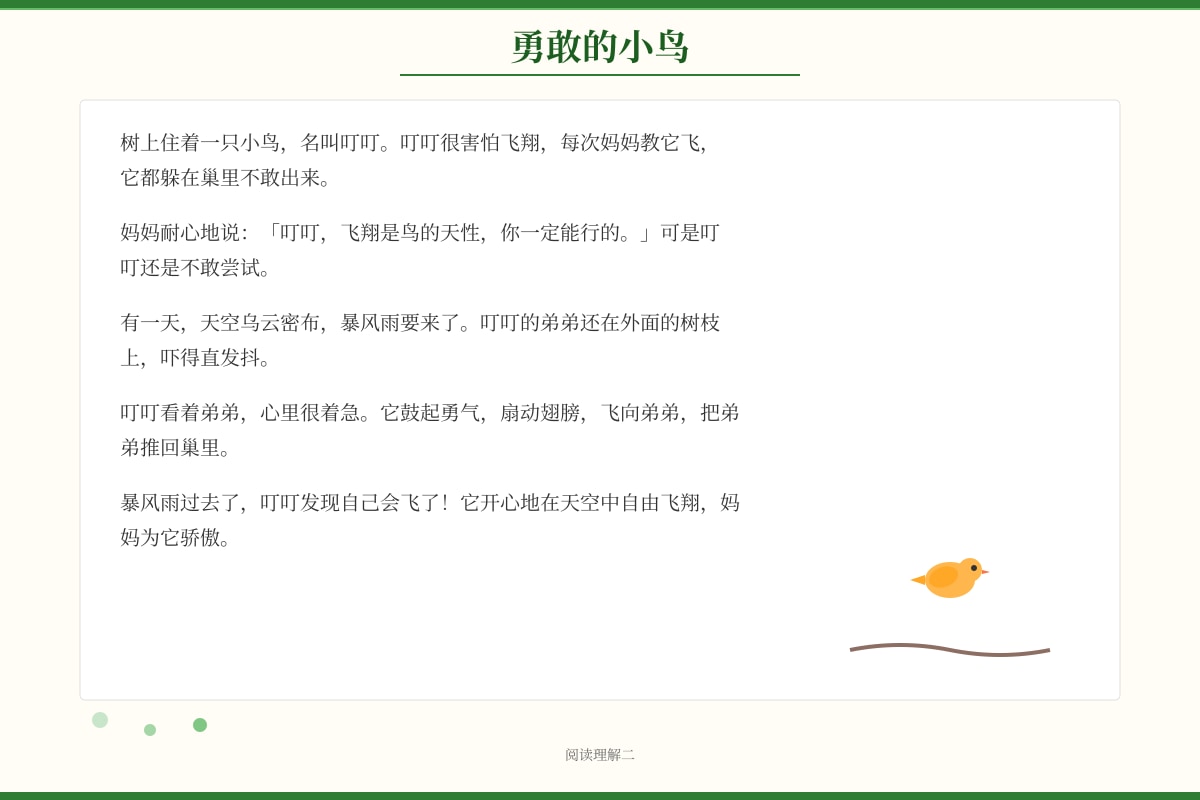
Passage: "勇敢的小鸟" (The Brave Little Bird)
-
Answer: 叮叮。 [1 mark]
Evidence: Paragraph 1: "名叫叮叮。" -
Answer: 飞翔。 [1 mark]
Evidence: Paragraph 1: "叮叮很害怕飞翔。" -
Answer: 「叮叮,飞翔是鸟的天性,你一定能行的。」 [1 mark]
Evidence: Paragraph 2: Direct quote required. -
Answer: 在外面的树枝上。 [1 mark]
Evidence: Paragraph 3: "叮叮的弟弟还在外面的树枝上。" -
Answer: 因为暴风雨要来了,弟弟在外面的树枝上吓得直发抖,很危险,叮叮想救他。 [2 marks]
Marking: 1 mark for identifying the danger (storm coming, brother on branch); 1 mark for stating the intention to save/rescue.
Inference Skill: Combines info from Para 3 (storm, brother scared on branch) and Para 4 (Ding Ding anxious, flew to him). -
Answer: 叮叮鼓起勇气,扇动翅膀,飞向弟弟,把弟弟推回巢里。 [2 marks]
Marking: 1 mark for "鼓起勇气/扇动翅膀/飞向弟弟" (action); 1 mark for "把弟弟推回巢里" (result).
Evidence: Paragraph 4: "它鼓起勇气,扇动翅膀,飞向弟弟,把弟弟推回巢里。" -
Answer: 叮叮发现自己会飞了。/ 自己学会飞翔了。 [1 mark]
Evidence: Paragraph 5: "叮叮发现自己会飞了!" -
Answer: 鼓起勇气。 [1 mark]
Evidence: Paragraph 4: "它鼓起勇气...". This phrase describes the internal state/mental effort to overcome fear. -
Answer: 因为叮叮为了救弟弟克服了对飞翔的恐惧,在危急关头鼓起勇气飞了起来,所以暴风雨后发现自己其实已经会飞了,感到开心和自由。 [2 marks]
Marking: 1 mark for linking the flight to saving brother (overcoming fear); 1 mark for explaining the realization of ability leading to happiness.
Synthesis Skill: Requires connecting the climax (saving brother) to the resolution (flying freely). The "cause" of flying was love/courage, not practice. -
Answer: (Accept reasonable, encouraging response showing pride/love)
Example: 「叮叮,妈妈为你骄傲,你真勇敢!」/ 「孩子,你救回了弟弟,你长大了!」
Marking: 1 mark for appropriate tone (motherly, proud); 1 mark for relevant content (acknowledging bravery/saving brother).
Creative Expression: Tests oral interaction/writing voice. Must fit character and context. -
Answer: 这个故事告诉我们:遇到困难要勇敢面对,关键时刻爱能给我们勇气,克服恐惧就能发现自己的能力。 [2 marks]
Marking: 1 mark for "bravery/overcoming fear"; 1 mark for "love/courage/self-discovery".
Moral/Theme: Standard P4 comprehension requirement to extract moral value. Keywords: 勇敢, 克服恐惧, 爱/亲情, 发现能力. -
Answer: (Accept suitable title ≤ 8 characters)
Examples: 勇敢的叮叮 / 学会飞翔 / 爱给我勇气 / 叮叮救弟弟
Marking: 1 mark for relevance to main plot/theme; 1 mark for conciseness (≤ 8 chars).
Teaching Note: Title should capture the essence (bravery, learning to fly, love). "小鸟" alone is too vague. "暴风雨" misses the point.
Total Marks: 60
End of Answer Key