From Real Exams Exam Paper
Primary 4 Chinese Semestral Assessment 2 (End of Year) Paper 1
Free P4 Chinese SA2 Paper 1, Kimi2.6 Exam version, with questions, answers, and syllabus-aligned practice for Singapore students.
These static practice materials are generated from the site's syllabus and paper-generation workflow, with source and model context shown so students and parents can evaluate the material before use.
Questions
Free quiz and exam paper access
Enter your details to view this paper
Your access is remembered on this device.
Answers
TuitionGoWhere Exam Practice (AI) - SA2 Answer Key
Version 1 of 5 | Reading and Language Application
Subject: Chinese Language
Level: Primary 4
Total Marks: 40 marks
Section A: 阅读理解(一)Reading Comprehension (Passage 1) [13 marks]
Passage Summary: 善意的谎言 — A story about Xiaoli finding a broken pair of reading glasses and choosing to tell a "white lie" to protect an elderly woman's feelings, then learning from her mother about balancing kindness with honesty and practical help.
Question 1 (2 marks)
Question: 老奶奶为什么看起来很悲伤?
Answer: 因为她的老花镜丢了,没有老花镜,她连报纸都读不了。而且这副眼镜是她孙子送给她的生日礼物,所以特别珍贵。
Marking Notes:
- 1 mark: 提到"老花镜丢了"或"读不了报纸"
- 1 mark: 提到"生日礼物"或对孙子的特殊意义
- Common mistake: 只写"丢了东西"不够具体,必须指出是老花镜及其重要性
Question 2 (2 marks)
Question: 根据短文内容,小丽的"善意的谎言"是指什么?
Answer: 小丽告诉老奶奶眼镜是在凉亭里找到的,而且"完好无损"。但实际上眼镜是在草丛里找到的,并且镜框已经摔裂了一道缝。
Marking Notes:
- 1 mark: 指出谎言内容(完好无损/在凉亭找到)
- 1 mark: 指出真相(草丛里找到/镜框摔裂)
- Teaching note: "善意的谎言" = white lie told with good intention, not meant to harm
Question 3 (2 marks)
Question: 小丽在哪里真正找到了眼镜?她发现了什么问题?
Answer: 在不远处的草丛里找到的。她发现镜框已经摔裂了一道缝。
Marking Notes:
- 1 mark: "草丛里"(精确位置)
- 1 mark: "镜框摔裂了一道缝"
- Deduct 0.5 if only say "坏了" without specifying the crack
Question 4 (2 marks)
Question: 老奶奶为什么"激动地说"?从文中找出原因。
Answer: 因为老奶奶以为眼镜完好无损地找回来了,她又可以读报纸了,而且这是孙子送的珍贵礼物。
Marking Notes:
- 1 mark: 眼镜失而复得,可以读报纸
- 1 mark: 礼物的情感价值(对孙子的思念/珍视)
- Must reference text evidence; own interpretation without textual support gets 1 mark max
Question 5 (2 marks)
Question: 妈妈建议小丽以后可以怎么做?
Answer: 妈妈建议可以想更好的办法,比如帮老奶奶修一修镜框,而不是用谎言来解决问题。
Marking Notes:
- 1 mark: "修一修镜框"或"修眼镜"
- 1 mark: 理解到要用实际行动帮助,而非撒谎
- Key teaching point: 诚实 + 帮助 = better solution than lying alone
Question 6 (1 mark)
Question: "小丽看着老奶奶的笑容,心里也暖暖的。"这句话表现了小丽什么样的心情?
Answer: 表现了小丽感到满足、快乐、欣慰的心情。她虽然撒了谎,但看到老奶奶开心,自己也感到幸福。
Marking Notes:
- 1 mark: 关键词"满足/快乐/欣慰/温暖/开心"
- Accept synonyms; reject "后悔/难过/害怕"等相反情绪
Question 7 (2 marks)
Question: 读完这篇短文后,你觉得小丽做得对吗?请说明理由。
Answer: (开放题,言之成理即可)
Sample approved responses:
立场一:做得对(2 marks)
- 1 mark: 保护老奶奶的心情,避免她伤心
- 1 mark: 出发点是善意的,为别人着想
立场二:做得不完全对(2 marks)
- 1 mark: 诚实更重要,应该告诉真相
- 1 mark: 但可以同时帮忙修理,像妈妈建议的那样
立场三:不完全对(1 mark)
- 只写"不对,不应该撒谎"但没有提出更好办法,得1分
Teaching note: This develops critical thinking — there is no single "correct" answer, but reasoning must be sound and text-based.
Section B: 阅读理解(二)Reading Comprehension (Passage 2) [15 marks]
Passage Summary: 蜜蜂的启示 — An expository narrative about bees' hard work and communication dances, through which Xiaoming learns to persevere in his studies.
Question 8 (1 mark)
Question: 根据短文,蜜蜂后腿沾满了什么?
Answer: 金黄色的花粉
Marking Notes:
- Must include "花粉" (pollen); color description optional
- Reject "花蜜" (nectar) as incorrect — text says pollen first, then discusses nectar in next paragraph
Question 9 (2 marks)
Question: 一只蜜蜂要访问多少朵花才能酿出一公斤蜂蜜?请写出文中的数字。
Answer: 大约三百万朵(3,000,000朵)
Marking Notes:
- 2 marks: "三百万" or "3,000,000" written accurately
- 1 mark: 只写"三百万"但漏"大约";或数字写法有误
- Teaching note: 大约 = approximately; emphasizes the vast quantity
Question 10 (2 marks)
Question: 蜜蜂每次飞行可以携带多少花蜜?请用文中的语句回答。
Answer: "跟自己体重相当的花蜜"
Marking Notes:
- 2 marks: 精确引用"跟自己体重相当的花蜜"
- 1 mark: 意思对但用自己的话,如"和它身体一样重的花蜜"
- Must quote or paraphrase accurately; "很多花蜜" = 0 marks
Question 11 (2 marks)
Question: 为什么说蜜蜂"跳舞"?请简要解释。
Answer: 当一只蜜蜂发现了花蜜丰富的地方,它回到蜂巢后会跳一种特殊的舞蹈,用舞蹈来告诉同伴们花蜜的方向和距离,这样其他蜜蜂就能找到花蜜的来源。
Marking Notes:
- 1 mark: 目的——通知同伴花蜜位置(方向和距离)
- 1 mark: 方法——特殊的舞蹈语言
- Teaching note: This is animal communication, not entertainment; emphasize the informative function
Question 12 (2 marks)
Question: 区分"圆圈舞"和"八字舞"的不同含义。
Answer:
- "圆圈舞"表示花蜜就在附近(距离近)
- "八字舞"表示花蜜较远(距离远),而且舞蹈的方向能指示方位
Marking Notes:
- 1 mark: 圆圈舞 = 附近/近处
- 1 mark: 八字舞 = 远处 + 指示方位(两个信息点,漏一个扣0.5)
- Teaching note: 圆圈舞 (round dance) vs. 八字舞/摇臀舞 (waggle dance) — classic ethology research by Karl von Frisch
Question 13 (2 marks)
Question: 小明从蜜蜂身上学到了什么道理?请用自己的话回答。
Answer: 小明学到了要像蜜蜂一样勤劳和坚持,遇到困难不放弃,只有长期努力才能收获成果。
Marking Notes:
- 1 mark: 勤劳/坚持/不放弃的精神
- 1 mark: 努力才能收获/成功需要积累
- Must be in student's own words; exact copying from last paragraph = 1 mark max
Question 14 (4 marks)
Question: 如果你是小明的朋友,你会如何向他学习蜜蜂的精神?请写出两点。
Answer: (开放题,言之成理即可,每点2 marks)
Sample approved response points:
Point 1 (2 marks): 学习方面
- 具体做法:每天按时完成功课,遇到难题主动思考,请教老师同学(1 mark)
- 联系蜜蜂精神:像蜜蜂采蜜一样,一点一滴积累知识(1 mark)
Point 2 (2 marks): 生活方面
- 具体做法:坚持体育锻炼,培养一项兴趣爱好并持之以恒(1 mark)
- 联系蜜蜂精神:不怕辛苦,长期坚持(1 mark)
Marking descriptors:
- Excellent (4 marks): Two distinct, concrete points with clear bee connection + elaboration
- Good (3 marks): Two points, one well-developed, one basic
- Adequate (2 marks): Two basic points or one well-developed point
- Weak (1 mark): Vague, no specific actions stated
- Teaching note: Must include both WHAT (具体做法) and WHY/WHOW (蜜蜂精神的联系)
Section C: 词语理解与运用 Vocabulary in Context [12 marks]
Question 15 (2 marks)
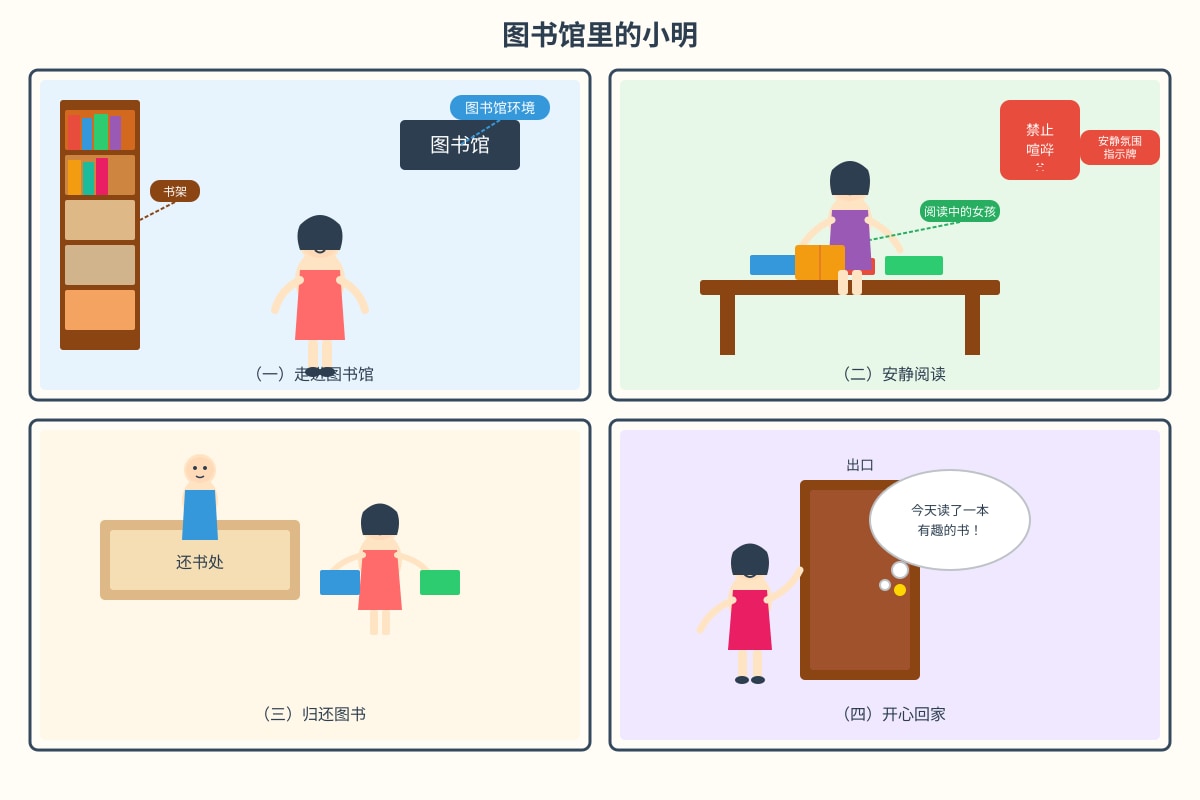
Question: 图书馆里应该保持( ),不能大声说话。
Answer: (2)安静
Teaching Notes:
- 热闹 (lively/noisy), 欢乐 (joyful), 兴奋 (excited) — all inappropriate for library setting
- Image clue: 禁止喧哗标志 and quiet reading posture
- Context clue: "不能大声说话" directly signals the opposite quality is needed
Question 16 (2 marks)
Question: 经过长期的( ),小华的打字速度越来越快了。
Answer: (3)练习
Teaching Notes:
- 游玩 (play), 休息 (rest), 谈话 (conversation) — none lead to improved typing speed
- "打字速度越来越快" indicates skill acquisition through repeated practice
- 练习 = practice/exercise; key vocabulary for P4 achievement contexts
Question 17 (2 marks)
Question: 看到妈妈辛苦工作的样子,小明的内心充满了( )。
Answer: (2)感激
Teaching Notes:
- 害怕 (fear), 烦恼 (annoyance), 着急 (anxiety) — negative emotions inappropriate
- 感激 = gratitude/appreciation; fits filial piety context common in P4 texts
- Common mistake: 选"烦恼"误以为"担心妈妈"——但"辛苦工作"应引发正面情感回应
Question 18 (2 marks)
Question: 这道数学题太难了,我想了很久还是( )。
Answer: (3)无可奈何
Teaching Notes:
- 一清二楚 (crystal clear) — opposite of difficult problem experience
- 半信半疑 (half-believing, half-doubting) — irrelevant to problem-solving
- 恍然大悟 (sudden realization) — would mean problem solved, contradicts "想了很久还是"
- 无可奈何 = helpless, no choice; accurately captures stuck/frustrated state
Question 19 (2 marks)
Question: 台风过后,街道上一片( ),大树被吹倒了,到处都是落叶。
Answer: (2)混乱
Teaching Notes:
- 整洁 (tidy), 美丽 (beautiful), 平静 (calm/peaceful) — all contradict typhoon damage description
- 混乱 = chaotic/disorderly; matches "大树被吹倒""到处都是落叶" scene
- Real-world context: 台风 (typhoon) common Singapore weather experience
Question 20 (2 marks)
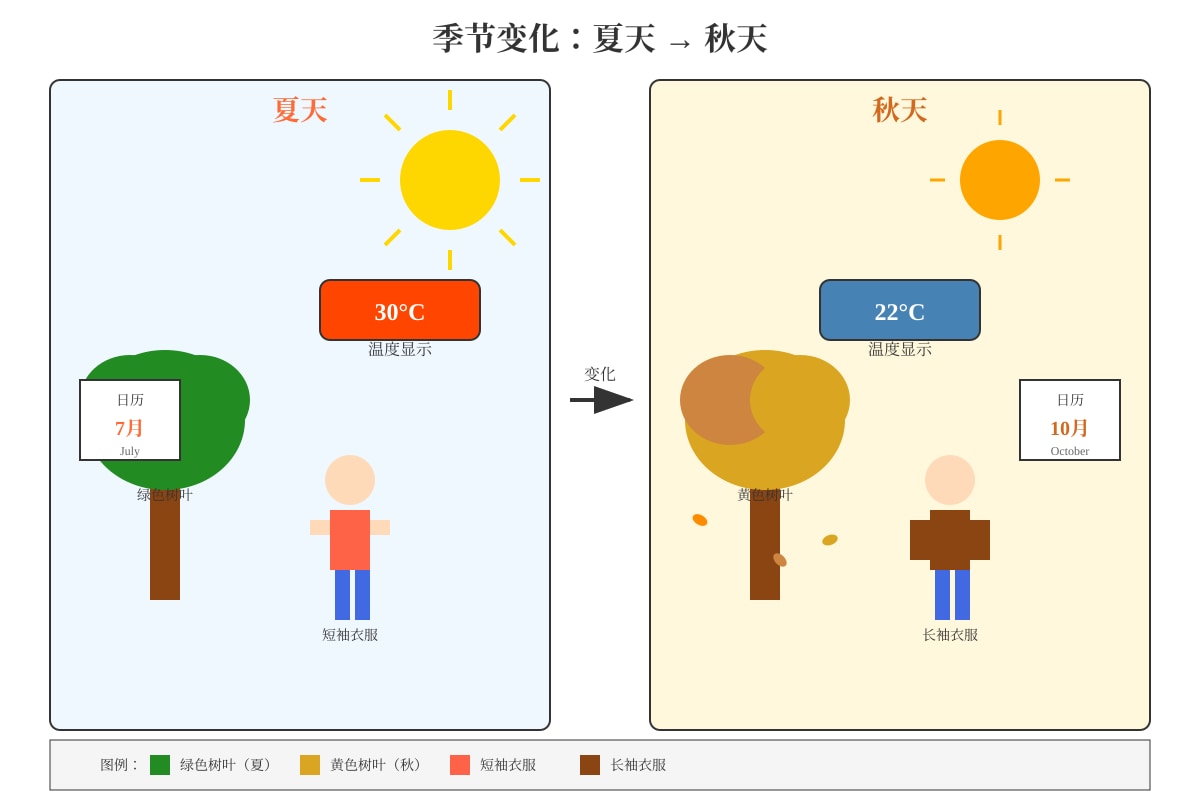
Question: 上图显示了季节的变化,请选出最恰当的句子描述这个变化。
Answer: (3)秋天到了,天气渐渐凉爽,树叶也慢慢变黄了。
Teaching Notes & Expected Image Features:
- Temperature: 30°C → 22°C (cooling trend)
- Leaves: Green → Yellow (characteristic autumn change)
- Clothing: Short sleeves → Long sleeves (adapting to cooler weather)
- Calendar: Summer month → September/November
Why other options wrong:
- (1) 夏天:temperature increasing, leaves stay green, but image shows cooling
- (2) 冬天:image shows no snow, 22°C too warm for winter, clothing not thick enough
- (4) 春天:flowers blooming, animals waking — opposite of cooling/leaf-falling trend
Visual verification points for later image generation: Must show clear cooling direction with color transition from green to yellow-green to yellow; avoid red autumn leaves (too late in season); clothing change should suggest light layering, not heavy coats.
Total Marks Verification
| Section | Marks |
|---|---|
| Section A (Q1–7) | 13 |
| Section B (Q8–14) | 15 |
| Section C (Q15–20) | 12 |
| Grand Total | 40 ✓ |
Reading Skills Framework (for teaching reference)
| Skill Tested | Questions | Level |
|---|---|---|
| 直接提取信息 (Literal retrieval) | 1, 3, 5, 8, 9, 10 | P4 Basic |
| 理解推断 (Inference) | 2, 4, 6 | P4 Developing |
| 分析评价 (Evaluation) | 7, 14 | P4 Advanced |
| 词义语境理解 (Vocabulary in context) | 15–20 | P4 Core |
| 图文转换 (Visual-text integration) | 20 | P4 Applied |
End of Answer Key