AI Generated Quiz
Primary 3 Tamil Speaking Quiz
Free P3 Tamil Speaking quiz, Kimi2.6 AI version, with questions, answers, and syllabus-aligned practice for Singapore students.
These static practice materials are generated from the site's syllabus and paper-generation workflow, with source and model context shown so students and parents can evaluate the material before use.
Questions
Free quiz and exam paper access
Enter your details to view this paper
Your access is remembered on this device.
Answers
Primary 3 Tamil Quiz - Speaking (பேசுதல்) — Answer Key
Total Marks: 40
Section A: Pronunciation and Phonetics [10 marks]
1. (a) [1 mark]
Answer: பழம்
Teaching Note: The word பழம் (paḻam / fruit) contains the special ழ் sound. This retroflex approximant is unique to Tamil and a few other Dravidian languages. To pronounce it, curl your tongue back slightly without touching the roof of your mouth. Listening to native speakers and mimicking the "lapped" quality of this sound helps mastery.
Common Error: Students sometimes substitute "l" (ல்) for ழ், saying "palam" instead of "paḻam" — this changes the word's authenticity.
1. (b) [1 mark]
Answer: Any valid Tamil word containing ழ், e.g., வழி (vaḻi / path), நீழல் (nīḻal / shadow), தமிழ் (tamiḻ / Tamil), மொழி (moḻi / language), பழகு (paḻagu / practice)
Teaching Note: The ழ் sound appears in common Tamil vocabulary. தமிழ் is particularly important as the name of the language itself. Building awareness of this sound strengthens cultural and linguistic identity.
2. (a) [1 mark]
Answer: ந ( dental/ alveolar n )
Teaching Note: The three n-sounds in Tamil form a place-of-articulation series:
- ந = alveolar (tongue tip near upper teeth ridge) — used in "நல்ல" (good)
- ன = dental (tongue tip touches upper teeth) — used in "மனிதன்" (human)
- ண = retroflex (tongue curled back) — used in "கண்" (eye)
ந specifically represents the tongue-tip sound made at the alveolar ridge, the bumpy area just behind your upper teeth. You can feel this spot by running your tongue behind your front teeth.
2. (b) [1 mark]
Answer: The under/back of the tongue (or specifically, the tongue tip curled backward/upward) should be used. The key is curling the tongue back so the underside approaches the hard palate.
Teaching Note: Retroflex sounds like ண், ட், ட, ண, ள் require retraction — pulling the tongue body back and curling the tip upward. English speakers learning Tamil often struggle because English "d" and "t" are alveolar, not retroflex. The physical sensation is like preparing to say "r" in some American dialects but with contact.
3. [2 marks]
Answer: (b) க + இ = கி (ka + i = ki)
Teaching Note: This question tests understanding of சார்பெழுத்து (dependent vowel signs / combining forms). While all options show valid combinations, option (b) specifically demonstrates how the காரம் (ka) base takes the இ dependent form (ி), which wraps to the right side of the consonant.
The other options show:
- (a) க + அ: The inherent "a" vowel — no visible combining mark needed (zero marker)
- (c) ச + அ: Same inherent vowel pattern
- (d) ப + அ: Same inherent vowel pattern
Option (b) is the only one where a visible dependent sign transforms the base consonant's appearance and sound value. The combining form ி physically changes how க appears on paper.
Marking: 2 marks for correct selection; 1 mark if student explains correctly but selects wrong option.
4. (a) [1 mark]
Answer: அ + ழகு or more precisely, the pattern is: உயிர் எழுத்து (vowel) + மெய் எழுத்து (consonant) + உயிர் மெய் எழுத்து
Broken down: அ (vowel) + ழ் (consonant) + கு (consonant+vowel combination / உயிர்மெய்)
Or simplified: V + C + CV pattern
Teaching Note: ஒலிக்கோவை means the systematic arrangement/phonetic pattern. அழகு follows அ-தொடர்முறை (a-series): beginning with vowel அ, then adding consonant cluster. Understanding these patterns helps students decode new words when speaking and reading aloud.
4. (b) [1 mark]
Answer: Tongue twisters like "காக்கா காக்கா காக்கா" (kākkā kākkā kākkā / crow, crow, crow) help because:
- They repeat similar sounds rapidly, training tongue muscle memory
- They improve ஒலித்தெளிவு (articulation clarity)
- They build speed control — speaking fast without slurring
- They strengthen the specific motor patterns needed for Tamil consonant clusters
Teaching Note: This particular tongue twister practices the க் stop consonant with following vowel variations. Primary 3 students developing fluency benefit from starting slow, then gradually increasing speed while maintaining each sound distinctly.
5. (a) [1 mark]
Answer: Any valid word, e.g.: மங்கல் (maṅgal / auspicious), அங்கு (aṅgu / there), பங்கு (paṅgu / share), சங்கு (caṅgu / conch), வெங்காயம் (veṅkāyam / onion)
Teaching Note: The ங் sound is a velar nasal — made by raising the back of your tongue to the soft palate (velum), same position as க். It commonly occurs before க in compound clusters (ங்க, ங்கி, etc.). Tamil phonological rules prevent words beginning with pure ங்; it must be followed by a க-family consonant.
5. (b) [1 mark]
Answer: The student is substituting ந் (alveolar nasal) for ங் (velar nasal), changing where the sound is made in the mouth.
Detailed Explanation:
- அங்கு requires the back of tongue raised to soft palate (velar position, like "ng" in English "sing")
- அந்கு incorrectly uses the tongue tip/near ridge (alveolar position, like "n" in "sun")
This is a place-of-articulation error — two different nasal sounds that must be distinguished in Tamil though they merge in some language varieties.
Section B: Speaking in Contexts [10 marks]
6. [2 marks — 0.5 each]
Answer:
- (i) B — முதியோர் மரியாதை மொழி / respectful elder language (with modifications for authority figures)
- (ii) D — மேடைப் பேச்சு / platform speech (formal presentation style)
- (iii) A — நண்பர் மொழி / peer language (casual, equal status)
- (iv) C — பொதுவான பேச்சு / general formal speech (or elevated respectful register adjusted for public occasion)
Teaching Note: Tamil சொல்லாட்சி (register selection) requires adjusting:
- வினைச்சொல்ல வடிவங்கள் (verb honorific levels): varu vs. vāṅgu vs. varavum
- சொல்லுகளின் தேர்வு (word choice): Sanskritic vs. pure Tamil alternatives
- ஒலியனுகரம் (tone): Softer, measured pace for elders; energetic for peers
Students should recognize that வயதுக்கேற்ற மொழி (age-appropriate language) and நிலைக்கேற்ற மொழி (status-appropriate language) both matter.
Partial credit: 0.5 marks per correct match; if (i) marked C and (iv) marked B (swapped), award 1.5 as these are closely related registers.
7. (a) [1 mark]
Answer: Any polite Tamil request, e.g.:
- "நண்பா, நாளை தமிழ் வகுப்புக்கு உன் அகராதியைக் கொடுப்பாயா?" (Friend, will you give your dictionary for tomorrow's Tamil class?)
- "தயவுசெய்து உன் தமிழ் அகராதியை எனக்குக் கடனாகத் தருவாயா?" (Please lend me your Tamil dictionary?)
- "நாளை என் அகரதி வீட்டில் இருக்கிறது. உன்னுடையதைப் பயன்படுத்திக்கொள்ளலாமா?" (My dictionary is at home tomorrow. May I use yours?)
Teaching Note: Polite requests in Tamil typically:
- Use நீங்கள்/நான் honorific distance, or intimate நீ/நீங்கள் with softening particles
- Include தயவுசெய்து (please) or தா (softening suffix)
- Use -ஆ? question marker for gentle inquiry rather than direct -ஆ?
- Soften with -கூடாதா?/…வாயா? (could you/would you)
7. (b) [1 mark]
Answer: Any polite affirmative, e.g.:
- "நிச்சயமாக, இதோ எடுத்துக்கொள்." (Certainly, here take it.)
- "கண்டிப்பாக, நாளை கொண்டுவந்து தருகிறேன்." (Definitely, I'll bring it tomorrow.)
- "சந்தோஷமாகத் தருகிறேன்." (Happily giving.)
Teaching Note: Agreeing to requests in Tamil culture often includes enthusiasm markers — simple "yes" may seem cold. Adding நிச்சயமாக/கண்டிப்பாக (certainly/definitely) or offering specifics (when/how) demonstrates உதவும் மனப்பான்மை (helpful disposition), valued in Tamil communication culture.
8. (a) [1 mark]
Answer: Any two valid situations, e.g.:
- When describing something sad or emotional (death, loss, failure)
- When introducing a surprise or important revelation
- When explaining complex or unfamiliar information
- At a climax point where tension builds
- When quoting someone important or wise
Teaching Note: வேக மாற்றம் (pace variation) operates on உணர்வுகளின் சுடர் (emotion's intensity). Slowing creates எதிர்பார்ப்பு (anticipation) and allows processing of weighty content. Tamil storytelling tradition (வில்லுப்பாட்டு, கதைசொல்லல்) masters use dramatic silence (இடைவெளி) as purposeful technique.
8. (b) [1 mark]
Answer: Raising the voice slightly at the end of questions signals ** interrogative intonation pattern**, helping listeners recognize:
- This utterance expects response/answer, not continuation
- The speaker has yielded the turn (conversation space)
- The grammatical structure may be identical to a statement, so ஒலி ஏற்றம் (pitch rise) provides the critical distinction
Teaching Note: Tamil is partially a pitch-accent language where intonation carries grammatical meaning. Unlike English question rise which can sound uncertain, Tamil question rise is sharper and shorter, signaling confidence in seeking information. Students should practice with எ-words (எங்கே, எப்போது) where rise starts earlier in the word.
9. (a) [1 mark]
Answer: Any two backchannel/attention signals, e.g.:
- "ஆம்" (yes/uh-huh)
- "சரி" (okay/right)
- "அப்படியா?" (Is that so? — showing interest)
- "ம்ஹும்" (mm-hmm — nasal acknowledgment)
- "தொடர்ந்து சொல்" (continue speaking)
- "கேட்கிறேன்" (I'm listening)
Teaching Note: செவிமடுத்தல் (attentive listening) in Tamil conversation requires active participation — silence can indicate disinterest or disagreement. Short interjections assure the speaker of கவனம் (attention) and மரியாதை (respect). அப்படியா? with proper rising intonation shows generative listening (processing and engaging), not mere acknowledgment.
9. (b) [1 mark]
Answer: Any polite interruption, e.g.:
- "மன்னிக்கவும், ஒரு அவசரச் செய்தி." (Excuse me, an urgent message.)
- "இடைமறிப்பதற்கு மன்னிக்கவும், ஆனால்..." (Sorry to interrupt, but...)
- "ஒரு நிமிடம், இது மிக முக்கியம்." (One minute, this is very important.)
- "தவறாக எண்ணாதீர்கள், அவசரம்." (Don't mistake me, it's urgent.)
Teaching Note: இடைமறிப்பு (interruption) breaches பேச்சு மரபு (speech convention), so requires heavy face-saving work. The phrase must:
- Acknowledge the breach (மன்னிக்கவும்)
- Justify the necessity (அவசரம்/முக்கியம்)
- Be minimal — get necessary attention, then yield back or move to sidebar
10. (a) [1 mark]
Answer: Any clarification-checking sentence, e.g.:
- "நான் சொன்னதை மீண்டும் சொல்வாயா? நீ இப்படித்தானே புரிந்துகொண்டாய்?" (Will you repeat what I said? You understood it this way, right?)
- "என் பேச்சைத் தவறாகப் புரிந்துகொண்டாயா?" (Did you misunderstand my speech?)
- "நீ கேட்டது சரிதானா?" (What you heard, is it correct?)
Teaching Note: சரிபார்ப்பு (verification) prevents தவறான தொடர்ச்சி (wrong continuation). Tamil communication values ஐக்கியப்பாடு (harmony/unity), so direct accusations ("You misunderstood!") threaten முகம் (face). Better to mutualize the problem: "Did we have unclear communication?"
10. (b) [1 mark]
Answer: Any polite correction, e.g.:
- "மன்னிக்கவும், நான் இப்படிச் சொல்லவில்லை; இதுதான் சொன்னேன்..." (Sorry, I didn't say it this way; this is what I said...)
- "சிறிது தவறாகப் புரிந்துகொண்டாய். என் கருத்து இதுதான்..." (You understood slightly wrong. My meaning is...)
- "இல்லை, இல்லை, அது அல்ல; இப்படித்தான்..." (No, no, not that; it's like this...)
Teaching Note: Effective திருத்தல் (correction) in spoken Tamil:
- Softens first with மன்னிக்கவும் or similar
- Attributes error to speech, not person ("it was unclear" not "you failed")
- Provides replacement, not mere negation
- Uses contrastive stress on corrected element
Section C: Presentation and Public Speaking [10 marks]
11. (a) [1 mark]
Answer: Any three valid preparation items, e.g.:
- Cue cards with key words (not full sentences)
- Mental outline: beginning, 3 main points, ending
- Practice speaking aloud multiple times
- Prepare the physical book as visual aid
- Write difficult names/words on paper
- Time yourself with a clock
Teaching Note: சுயநினைவு மூலங்கள் (memory aids) for Primary 3 should be visual and minimal — full scripts encourage reading, destroying நேர்கொணர்வு (eye contact). Key word technique: one word triggers one paragraph of memory. This builds உடன்பேச்சு (extemporaneous speaking) capacity.
11. (b) [1 mark]
Answer: Mirror practice helps because:
- You see your own face, mouth movements, and body posture as others see them
- You train eye contact habit — looking at faces, not down
- You notice nervous habits (fidgeting, swaying) and can correct them
- You build familiarity with your own appearance while speaking, reducing self-consciousness
Teaching Note: கண்ணாடிப் பயிற்சி (mirror practice) creates உருமாற்றம் (transformation of self-image). Many Primary 3 students feel surprised ("I look like that?!"); this desensitization is valuable. For Tamil specifically, mirror shows mouth shape for retroflex sounds — curled tongue position is visible.
12. (a) [1 mark]
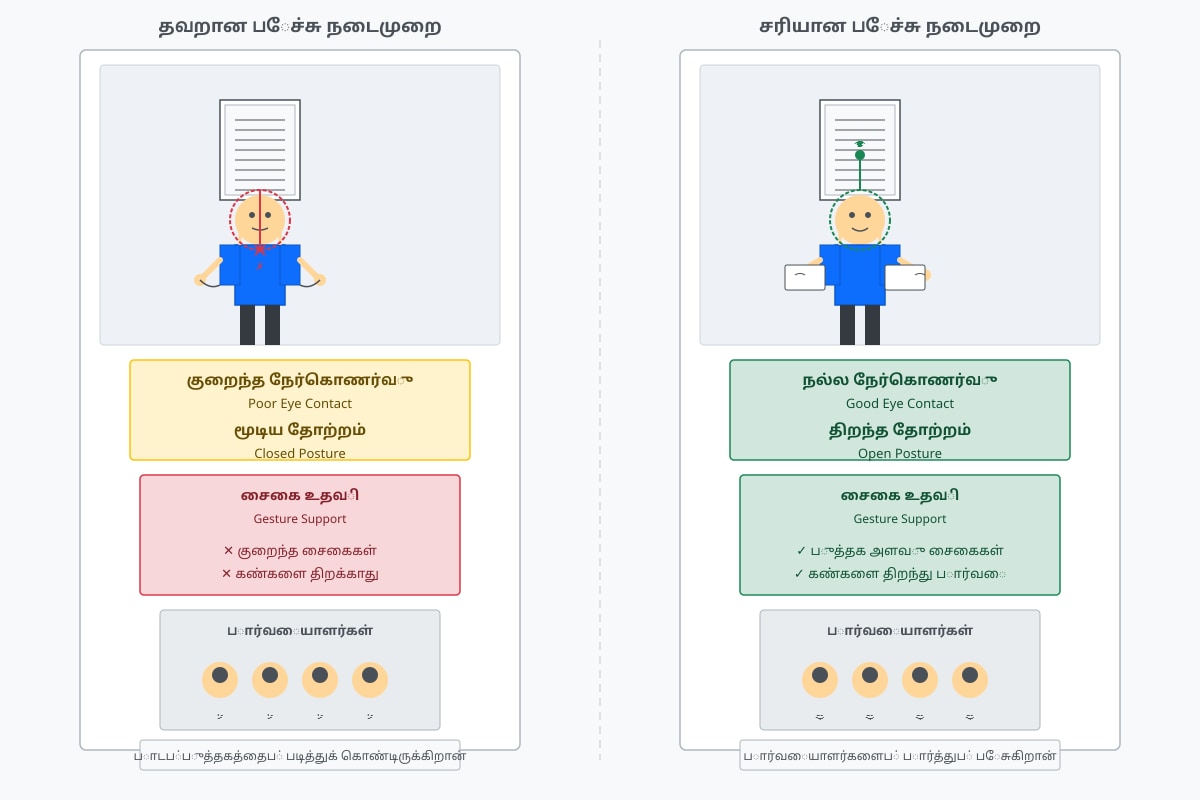
Answer: Any two problems from left image, e.g.:
- No eye contact / looking down at notes — loses audience connection
- Crossed arms — closed, defensive posture; blocks communication
- Slouched or small stance — lacks confidence projection
- No hand movement — misses opportunity for visual reinforcement
Teaching Note: The நேர்கொணர்வு இல்லாமை (absence of eye contact) is particularly problematic in Tamil communication culture, where கண்ணில் பார்த்துப் பேசுதல் (speaking while watching eyes) signals உண்மை (truthfulness) and மரியாதை (respect). Downcast eyes can imply பொய் (falsehood) or பயம் (fear) in traditional interpretation.
12. (b) [1 mark]
Answer: The right-image student likely uses hand gesture showing size/shape of the book — palms facing, appropriate distance apart. This iconic gesture (resembling the object):
- Makes abstract description concrete — audience visualizes dimensions
- **Adds இரட்டைச் சேனல் (dual channel) processing: ears + eyes
- Shows enthusiasm and engagement with topic
- Releases nervous energy into purposeful movement
Teaching Note: Tamil சைகை மொழி (gesture language) tradition includes இலக்கணக் குமரி (dance-like codified gestures), but in speeches, spontaneous iconic gestures are most effective. The gesture should emerge naturally from the content description, not be planned as isolated technique.
13. (a) [1 mark]
Answer: Any appropriate Tamil closing, e.g.:
- "இதோடு என் பேச்சை முடித்துக்கொள்கிறேன். கேட்ட அனைவருக்கும் நன்றி." (Thus I conclude my speech. Thanks to all who listened.)
- "நன்றி, வணக்கம்." (Thanks, greetings/respect.)
- "இவ்வளவுதான். உங்கள் செவிக்கு நன்றி." (This is all. Thanks for your ears/attention.)
Teaching Note: தமிழ் முடிவுரை (Tamil conclusion) should signal clearly to prevent தொடர்ச்சி எதிர்பார்ப்பு (expectation of continuation). நன்றி வணக்கம் is standard but minimal; better to enumerate thanks (to teacher, friends, time-givers) demonstrating கடன் நன்றி (debt of gratitude) cultural value.
13. (b) [1 mark]
Answer: Announcing your topic early helps because:
- Sets expectations: audience knows what to listen FOR
- **Activates அறிவுக்களஞ்சியம் (prior knowledge) — listeners connect to what they already know
- **Creates கூர்மை (sharpness/attentiveness) — focused listening rather than passive hearing
- **Allows கணிப்பு (prediction) — audience guesses what might come, engaging actively
Teaching Note: This is நுழைவாயில் (threshold/gateway) technique in Tamil rhetoric. Classical முதல் இசை (prosody opening) always stated பாடுபொருள் (song's subject). Modern equivalents: rhetorical question, surprising fact, or direct statement all serve this expectation-setting function.
14. (a) [1 mark]
Answer: Any two techniques, e.g.:
- Project voice from diaphragm (belly breathing) not throat — louder, less strain
- Face the back of room directly — sound travels forward most efficiently
- Speak slightly slower — allows sound waves to carry and register
- Use strategic pauses — silence regains attention, compensates for volume
- Ask "Can those at back hear?" — direct check and adjustment
Teaching Note: வயிற்று மூச்சு (belly/diaphragmatic breathing) is foundational for தொண்டைப் பேச்சு (throat speaking) vs நெஞ்சுப் பேச்சு (chest speaking). Primary students often shout from throat, damaging vocal cords. Teaching proper சுவாச ஒலிப்படுத்தல் (breath phonation) early prevents long-term habits.
14. (b) [1 mark]
Answer: Speaking too softly is especially problematic in Tamil because:
- Tamil has many near-minimal pairs distinguished only by quantity/stress: கல் (stone) vs கால் (leg/foot) — vowel length differs
- Retroflex vs dental distinctions (ட/த, ட்/த்) are already subtle; reduced volume loses place-of-articulation cues
- Voicing contrasts (க/க, ப/ப) rely on clear breath stream
- நாசிகப் பேச்சு (nasalization) distinctions become lost without adequate projection
Soft speech collapses these fine phonemic distinctions into indistinguishable blur.
Teaching Note: This connects acoustic phonetics to pedagogical practice. Teachers noting "mumbling" in Tamil may actually be observing phonemic neutralization — loss of distinctive features. Volume training directly supports phonemic awareness development.
15. (a) [1 mark]
Answer: Any two anxiety-reduction techniques, e.g.:
- Prepare thoroughly — knowing content reduces unknown-fear
- Practice with friendly audience first — family, mirror, pet
- Visualize success — imagine confident completion
- Arrive early to familiarize with room — reduces environmental unknowns
- Prepare first sentence perfectly — overcoming initial barrier builds momentum
Teaching Note: பேச்சு அச்சம் (speech fear/speech anxiety) in Primary 3 often stems from -evaluation apprehension — fear of peer judgment. தயாரிப்பு (preparation) specifically over-learned opening creates automaticity, freeing cognitive resources for situation management rather than content retrieval.
15. (b) [1 mark]
Answer: Deep breathing technique:
- Inhale slowly through nose for count of 4 — fills lungs fully, activates parasympathetic nervous system
- Hold briefly (count of 2) — then exhale slowly through mouth (count of 6)
- Repeat 3–5 times
This helps because:
- Counteracts அதிர்ச்சி (stress response) — shallow breathing signals danger to brain
- Oxygenates blood — improves cognitive clarity, reduces சுவாசக் கடினம் (breathlessness)
- **Creates வேண்டுமென்றே செய்யும் செயல் (deliberate action) — shifts locus of control internally
Teaching Note: Tamil tradition includes பிராணாயாமம் (prāṇāyāma / breath control) from yoga, though secular classroom technique differs. Drawing connection to cultural heritage may increase student buy-in for Primary 3 Tamil learners.
Section D: Grammar in Speaking [10 marks]
16. (a) [1 mark]
Answer: செய்தேன் (ceytēṉ / I did) or செய்தார் (ceytār / he did) — context suggests செய்தேன் if father speaks of himself, or செய்தேன் for past tense first person.
If student interprets "father" as third-person description: செய்தார்
Teaching Note: கடந்த காலம் (past tense) in Tamil:
- First person: -ேன் ending (ceytēṉ, vantēṉ)
- Third person masculine respectful: -ார் (ceytār)
The ஆண்பால் ஏவல்வினை (masculine imperative/action) and பால்/காலம் agreement must match speaker identity. Context says "your father describes" = father speaking = first person in his speech.
16. (b) [1 mark]
Answer: செய்வேன் (ceyvēṉ / I will do) — first person future
Teaching Note: எதிர்காலம் (future tense) marker -வ் + person ending:
- செய் + வ் + ஏன் = செய்வேன்
Spoken Tamil often contracts: செய்வேன் may become செய்யுவேன் in some dialects, but செய்வேன் is standard literary-spoken hybrid appropriate for school contexts.
17. [2 marks — 0.5 each]
Answer:
- (i) B — Where (எங்கே)
- (ii) A — How (எப்படி)
- (iii) D — When (எப்பொழுது)
- (iv) C — Why (ஏன்)
Teaching Note: These எ-சொற்கள் (e-words / wh-words) are universal question formation tools. Tamil additionally uses -ஆ? suffix for yes/no, and ஏன் can be sentence-initial or final (flexible). எப்பொழுது shortens to எப்போ in rapid speech — students should recognize both.
18. (a) [1 mark]
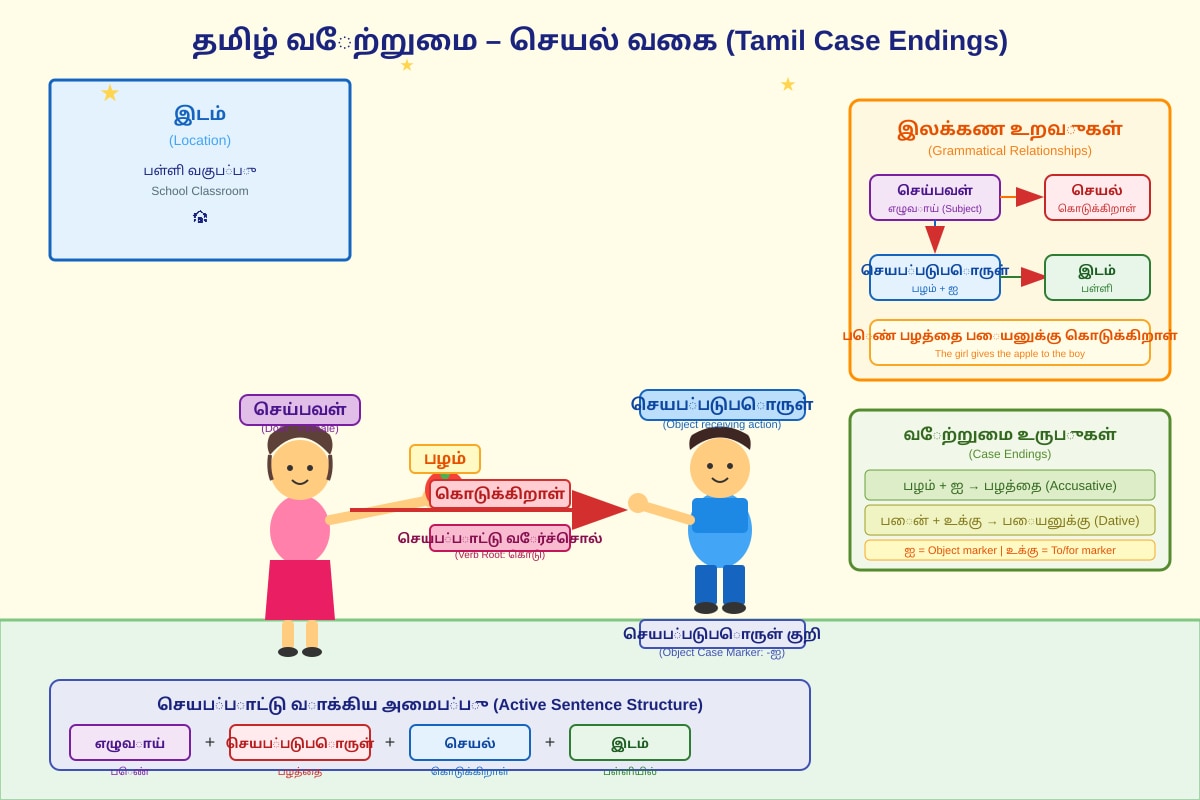
Answer: இரண்டாம் வேற்றுமை / செய்யப்படுபொருள் வேற்றுமை / accusative case / objective case
In Tamil: இரண்டாம் வேற்றுமை (second case) or செயப்படுபொருள் வேற்றுமை
Teaching Note: Tamil 8-case system (though merged in modern usage):
- முதல் — nominative (subject)
- இரண்டாம் — accusative (direct object)
- மூன்றாம் — instrumental/sociative
- நான்காம் — dative (to/for)
- ஐந்தாம் — ablative (from)
- ஆறாம் — genitive (of/'s)
- ஏழாம் — locative (in/on/at)
- எட்டாம் — vocative (O!)
பழம் as direct object takes zero overt marker in modern Tamil (definite: பழத்தை with -ஐ), but case relation still understood structurally.
18. (b) [1 mark]
Answer: நான்காம் வேற்றுமை / கொடை வேற்றுமை / dative case
In Tamil: நான்காம் வேற்றுமை or கொடை வேற்றுமை (giving-case)
Teaching Note: "to him" = அவனுக்கு / அவருக்கு — the -உக்கு / -க்கு suffix marks recipient/beneficiary. This case marks indirect objects with கொடு (give), சொல் (tell), காட்டு (show) — verbs of transfer/communication. Diagram should show arrow pointing toward recipient.
19. (a) [1 mark]
Answer: மேலும் (mēlum / furthermore/moreover/also)
Teaching Note: இணைப்புச் சொற்கட் தொகுதி (connective word inventory):
| Word | Function | Example Context |
|---|---|---|
| மேலும் | Addition (similar) | "Also..." "Furthermore..." |
| ஆனால் | Contrast | "But..." "However..." |
| ஏனெனில் | Reason/Cause | "Because..." "For..." |
| அதனால் | Result/Effect | "Therefore..." "So..." |
மேலும் specifically continues ஒத்த எண்ணம் (parallel thought), not contrast or causation.
19. (b) [1 mark]
Answer: "எனக்குத் தமிழ்க் கதைகள் பிடிக்கும்; ஏனெனில் அவை நல்ல பண்புகளைக் கற்றுத்தருகின்றன."
Or with மேலும்: Less appropriate since "teach good values" is reason, not additional similar point.
Better with ஏனெனில் (because): "நான் தமிழ்க் கதைகளை விரும்புகிறேன், ஏனெனில் அவை நல்ல பண்புகளைச் சொல்லித்தருகின்றன."
Teaching Note: Students choosing மேலும் demonstrate connector-concept mismatch — the semantic relationship is causal, not additive. This is common error at Primary 3. Accept மேலும் + adjusted meaning ("I also like... they also teach...") only if student makes explicit parallel structure.
Marking: Full credit for ஏனெனில் with grammatically complete sentence; partial credit (0.5) for மேலும் with forced but grammatically valid construction.
20. (a) [1 mark]
Answer: Any self-correction phrase, e.g.:
- "மன்னிக்கவும், அல்ல..." (Sorry, no/not that...)
- "அல்ல, அல்ல, அது சரியில்லை..." (No, no, that's not right...)
- "திருத்துகிறேன்..." (I am correcting...)
- "அப்படியல்ல, இப்படித்தான்..." (Not like that, like this...)
- "ஒரு நிமிடம், நான் தவறாகச் சொன்னேன்..." (One minute, I spoke wrongly...)
Teaching Note: சுயத் திருத்தல் (self-correction) demonstrates மேலான பேச்சுத்திறன் (superior speaking skill) — metacognitive awareness of own output. In Tamil, மன்னிக்கவும் softens the temporary conversation disruption. Skilled speakers mark the correction explicitly ("I correct myself") rather than just replacing content.
20. (b) [1 mark]
Answer: Correcting immediately is better because:
- Prevents தவறான தகவல் பரவல் (spread of wrong information) — listener may act on/remember error
- Maintains பேச்சு நம்பகத்தன்மை (speech credibility) — shows care for accuracy
- Demonstrates சுய ஒழுங்குமுறை (self-regulation) — valued communication competence
- Reduces தொடர்ச்சியான குழப்பம் (ongoing confusion) — cumulative errors compound
- Builds சவால் எதிர்கொள்ளும் திறன் (challenge-facing skill) — confidence grows through handling mistakes openly
Teaching Note: Tamil பண்பாட்டு மதிப்பீடு (cultural valuation) historically preferred flawless performance (memorized poetry recitation), but modern உண்மைப் பேச்சு (authentic speech) accepts well-managed error recovery as competence sign. Teaching students error ≠ failure but error + correction = learning is crucial at Primary 3 identity-formation stage.
END OF ANSWER KEY
Caveat: This quiz is generated from LLM-inferred patterns aligned with the interpreted Primary 3 Tamil syllabus. No past-year paper evidence was available for this level and topic. Content is designed for syllabus-appropriate practice and teaching purposes.