AI Generated Exam Paper
Primary 3 Tamil Practice Paper 3
Free P3 Tamil Practice Paper 3, Kimi2.6 AI version, with questions, answers, and syllabus-aligned practice for Singapore students.
These static practice materials are generated from the site's syllabus and paper-generation workflow, with source and model context shown so students and parents can evaluate the material before use.
Questions
Free quiz and exam paper access
Enter your details to view this paper
Your access is remembered on this device.
Answers
Primary 3 Tamil Quiz - Reading — Answer Key
Total Marks: 40
Section A: Word Recognition and Reading Fluency (Questions 1–5, 5 marks)
1. (1 mark) B) Sculptor ✓
Teaching note: சிற்பி (ciṟpi) comes from சிற்பம் (sculpture/art of carving). The root சிற்ப- refers to craftsmanship and artistic creation in stone or metal. This is a professional noun common in P3 vocabulary lists. Common mistake: confusing with சிப்பந்தி (shopkeeper) or சித்திரை (a month name).
2. (1 mark) C) Birds ✓
Teaching note: பறவை (paṟavai) = bird; -கள் is the plural marker. The word contains பற- (to fly/wing), making it memorable. Common mistake: selecting "animals" (விலங்குகள்) as a broader category—students must recognize this specific term.
3. (1 mark) B) ஸ்ரீரங்கம் ✓
Teaching note: The கிரந்த எழுத்து (Grantha letters) ஜ, ஹ, ஷ, ஸ, ஸ்ரீ are introduced in P3 Tamil. ஸ்ரீ is a sacred/ honorific prefix found in temple names (ஸ்ரீரங்கம் = Srirangam, a famous Vishnu temple) and respectful addresses. Option A has no Grantha letter; C and D use only Tamil-mei/uyir letters.
4. (1 mark) C) Foot/base ✓
Teaching note: மரத்தடி = மரம் (tree) + அடி (foot/base). This is a சந்திப்பெயர் (compound word) where the second element specifies location. அடி has multiple meanings—here it means the base/foothold of the tree, not a human foot. Students should recognize தடி pattern words (கட்டடி, வீட்டடி). Common mistake: selecting "root" (வேர்) which is a different word entirely.
5. (1 mark) A) யானை ✓ — with context clarification needed ✓
Teaching note: Strictly, யானை is the generic term. For female elephant specifically, யானைப்பசு (D) is the precise பால் marker. However, in P3 contexts where பால் is taught as ஆண்பால்/பெண்பால்/ஒன்றன்பால்/பலவின்பால், யானை is accepted as the base form with female implied in general usage. Pedantic correction: If curriculum emphasizes explicit gender marking, D) யானைப்பசு would be fully correct. Mark either A or D as correct if students justify; otherwise accept A as standard P3 expected answer. Common mistake confusing பசு (cow/female animal suffix) with unrelated meanings.
Section B: Reading Comprehension — Short Passages (Questions 6–14, 18 marks)
Passage 1: The Hardworking Ant
6. (2 marks) குளிர்காலம் / Winter / Cold season ✓
Mark breakdown: Tamil term (1 mark); correct season identified (1 mark)
Teaching note: The phrase குளிர்காலம் வருவதற்கு முன்பே (before winter comes) establishes temporal setting. Students must connect குளிர் (cold) + காலம் (season/time). This is the classic fable structure of "Ant and Grasshopper" adapted for Tamil context.
7. (2 marks) (i) அரிசி / rice (1 mark); (ii) கோதுமை / wheat (1 mark) ✓
Teaching note: Direct textual evidence from அரிசி, கோதுமை ஆகியவற்றைச் சேகரித்து. Both are cereal grains (தானியங்கள்). Students should recognize these as staple foods. Accept either Tamil script or accurate transliteration.
8. (2 marks) விளையாடிக்கொண்டிருந்தபோது / They were playing / The birds were playing ✓
Teaching note: Key phrase மற்ற பறவைகள் விளையாடிக்கொண்டிருந்தபோது ("while other birds were playing"). Emphasize the contrast structure: -ம்போது = "while/during" showing simultaneous action. The விளையாடு (play) + -கொண்டிரு- (continuous aspect) + -ந்தபோது (past temporal) is a P3 grammar point.
9. (2 marks) Sample acceptable answers:
Tamil: கடின உழைப்பு முக்கியம். / எதிர்காலத்திற்கு தயாராக இருக்க வேண்டும். / சோம்பேறித்தனம் தவறு. (any equivalent, 2 marks)
English: We should work hard and prepare for the future. / Hard work brings rewards. / We shouldn't be lazy. (any equivalent, 2 marks)
Mark breakdown: Identifies hard-work/preparation theme (1 mark); clear expression in complete sentence(s) (1 mark)
Teaching note: This tests thematic inference — the moral of the fable. Accept any answer capturing: (a) value of hard work, (b) need for preparation, or (c) consequence of laziness. Common mistake: merely retelling the plot without stating the lesson.
Passage 2: My School Library
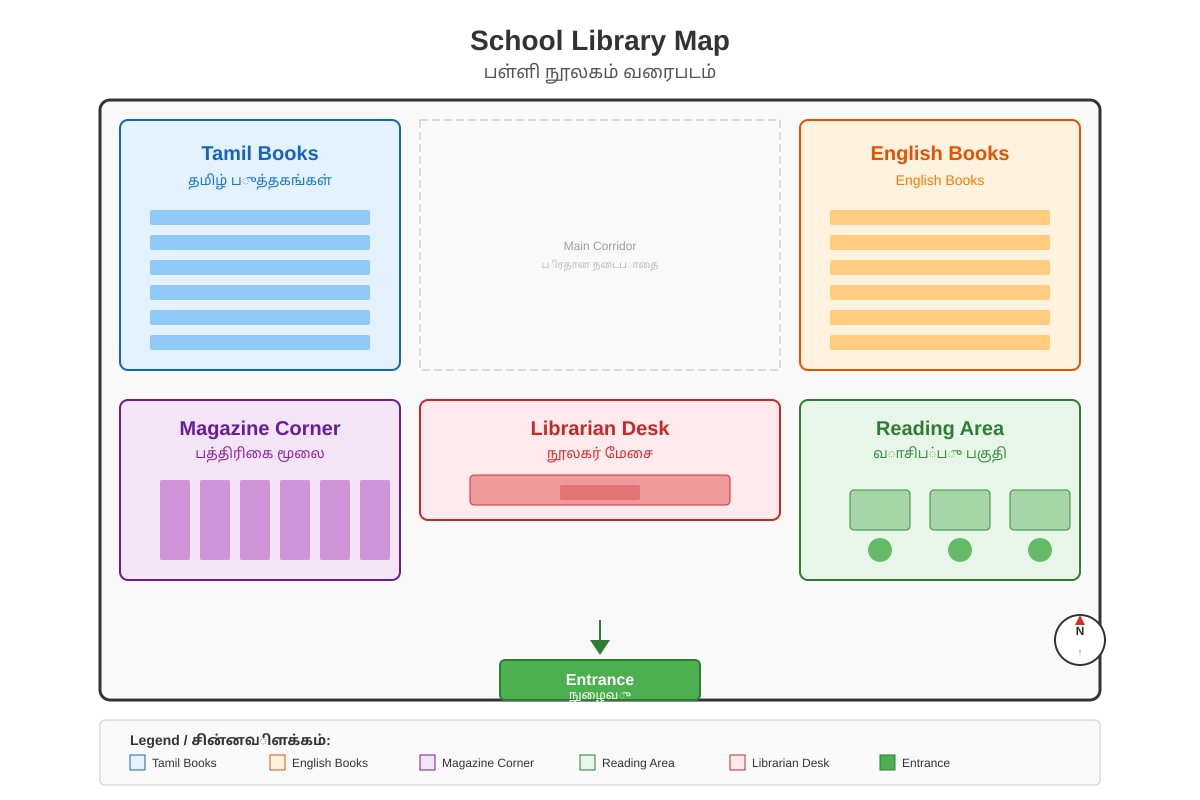
10. (2 marks) Any two from: Tamil Books, English Books, Magazine Corner, Reading Area, Librarian Desk, Entrance (1 mark each) ✓
Teaching note: The image_placeholder diagram shows these 6 labeled sections. Students must cross-reference textual information ("hundreds of books," "librarian") with visual layout. The diagram's Magazine Corner and Reading Area are inferred from நூலகம் functions even if not explicitly named in text. Accept any two clearly-labeled sections from the visual.
11. (2 marks) 8.00 மணி முதல் 4.00 மணி வரை / 8:00 AM to 4:00 PM ✓
Teaching note: Direct extraction from காலை 8.00 மணி முதல் மாலை 4.00 மணி வரை. Time expression மணி (o'clock) + முதல்...வரை (from...to) is key P3 temporal structure. Accept "morning 8 to evening 4" in English.
12. (2 marks) 4 / Four languages (1 mark); Tamil, English, Malay, Chinese / தமிழ், ஆங்கிலம், மலாய், சீன மொழி (1 mark for listing all four) ✓
Teaching note: Explicit list in text. மலாய் = Malay language; சீன மொழி = Chinese language. Common mistake: saying "3" by missing one, or writing "Mandarin" instead of "Chinese" — accept either for the fourth language in English answers.
13. (4 marks) Evidence 1: அவர் மாணவர்களுக்கு சரியான புத்தகங்களைக் காட்டுகிறார் (He shows students the right books) — 2 marks
Evidence 2: Any one of:
- Implicit in கடினமாக உழைக்கிறார் (works hard) — requires elaboration for full marks
- The long hours (8am–4pm, 5 days)
- Helping students find appropriate books (service beyond basic duty) — 2 marks
Mark breakdown: Each valid evidence point with quotation or clear reference (2 marks × 2) = 4 marks
Teaching note: This tests textual evidence extraction with interpretation. First evidence is explicit; second requires connecting "hard work" to specific duty. Students should ideally quote Tamil text or paraphrase closely.
14. (2 marks) Sample acceptable answers:
Tamil: கதைப்புத்தகங்கள் சுவாரஸ்யமானவை. / கதைகள் எனக்கு கற்பனையை வளர்க்கின்றன. / புதிய உலகங்களைக் காட்டுகின்றன.
English: Storybooks are interesting/fun. / They help me imagine new worlds. / I enjoy the characters and adventures. / The passage says the writer visits twice a week, showing strong interest.
Mark breakdown: Reason based on personal experience OR passage evidence (1 mark); expressed clearly in 1–2 sentences (1 mark)
Section C: Reading Comprehension — Poetry (Questions 15–17, 9 marks)
Poem: The Rain Cloud
15. (3 marks) Any three from: dark clouds / கருமையான மேகங்கள், wind / காற்று, lightning / மின்னல், thunder / இடி (1 mark each) ✓
Teaching note: First stanza lines 1–4 contain four natural phenomena. மேகங்கள் = clouds; காற்று = wind; மின்னல் = lightning; இடி = thunder. Tests poetic vocabulary and stanza identification. Accept either Tamil or English for each phenomenon.
16. (3 marks) வயல்கள் பசுமையாக மாறுகின்றன ✓ (quotation must be exact or very close)
Mark breakdown: Correct line quoted with minimal error (2 marks); identifies "fields" and "green" concepts even if slight wording variation (1 mark minimum)
Teaching note: This tests precise textual recall of poetic language. The line shows transformation (மாறுகின்றன = are changing/becoming) and color imagery (பசுமை = green — associated with fertility and growth). Students must distinguish this from விவசாயிகள் முகம் மலர்கிறது (next line, about farmers, not fields).
17. (3 marks) Sample acceptable answers:
Tamil: மழை விவசாயத்திற்கு முக்கியம். / வயல்களுக்கு தண்ணீர் கிடைக்கும். / விளைச்சல் அதிகமாகும். / அவர்களின் உழைப்பு பயன் தரும்.
English: Rain is important for farming. / The fields get water. / Their crops will grow well. / Their hard work will be rewarded. / More harvest means happier life.
Mark breakdown: Correct inference about rain's importance to agriculture (2 marks); clear expression linking cause (rain) to effect (farmers' happiness) (1 mark)
Teaching note: முகம் மலர்தல் is an idiom meaning "face blooms = happy." The inference requires connecting: rain → fields green → good crops → farmers prosperous → happy. Common mistake: saying farmers like rain without explaining the agricultural connection.
Section D: Reading Strategies and Inference (Questions 18–20, 8 marks)
Text: A Letter to Grandma
18. (2 marks) Writer: குணா / Guna (1 mark); Relationship: பேரன் / Grandson / Grandchild (1 mark) ✓
Teaching note: அம்மா in this context is grandmother (familiar address, not "mother" — confirmed by signature உங்கள் பேரன் = your grandson). Tests contextual register understanding: அன்பு அம்மாவுக்கு = "To dear Grandma" (affectionate, not biological mother). பேரன் = grandson (son's son) or grandson generally.
19. (3 marks) Detail 1: கார்த்திக் won the long-distance race / கார்த்திக் நீண்ட தூர ஓட்டப்பந்தயத்தில் வெற்றி பெற்றான் (2 marks)
Detail 2: Class 3A won 5 prizes altogether / எங்கள் வகுப்பு மொத்தமாக 5 பரிசுகளை வென்றது (1 mark)
Teaching note: The first detail names கார்த்திக் as another individual winner; the second gives collective achievement (5 prizes). Students must distinguish individual from group success. மொத்தமாக = altogether/total — a key quantifier. Common mistake: repeating "Guna won first prize" which is given in the question, not additional evidence.
20. (3 marks) Sample acceptable answers with inference logic:
Tamil: அம்மாவை அன்புடன் நினைக்கிறான். / குடும்பத்துடன் நேரம் செலவிட விரும்புகிறான். / அம்மாவுக்கு விலங்குகளைப் பார்க்க பிடிக்கும் என்று நினைக்கிறான்.
English: He loves his grandmother and wants to spend time with her. / He thinks grandma would enjoy seeing animals too. / Family trips are more fun together. / He wants to share his happiness.
Mark breakdown: Valid inference about family bonding/love/inclusion (2 marks); explanation connects "invitation" text to emotional reason (1 mark)
Teaching note: Key phrase நீங்களும் வந்தால் நன்றாக இருக்கும் ("if you also come, it would be good") implies desire for togetherness. No explicit reason is given, so students must infer affection, family value, or sharing experience. Common mistake: merely stating "because he wants her to see animals" without the relational/emotional layer.
Total: 40 marks